
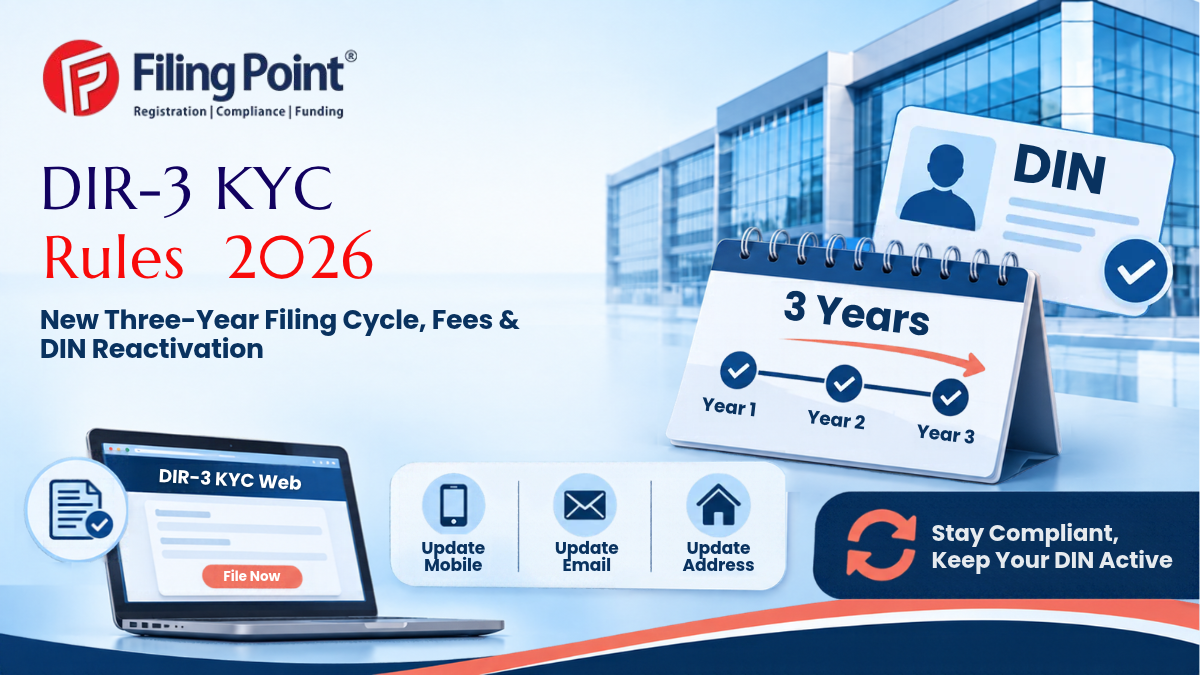
For years, individuals holding a Director Identification Number (DIN) had to complete Director KYC every year to keep their identification details updated with the Ministry of Corporate Affairs (MCA).
That requirement has changed.
With effect from 31 March 2026, the Ministry of Corporate Affairs replaced the annual Director KYC filing requirement with a simplified KYC intimation once every three consecutive financial years.
The change was introduced through the Companies (Appointment and Qualification of Directors) Amendment Rules, 2025, notified through G.S.R. 943(E), dated 31 December 2025.
However, there is an important detail that directors should not overlook.
The new three-year cycle does not mean that you can ignore changes to your registered mobile number, email address or residential address for three years. These changes must still be reported to the MCA within 30 days.
The MCA has also introduced a revised fee structure for DIR-3 KYC Web filings through G.S.R. 300(E), dated 21 April 2026.
This guide explains the revised framework, who needs to comply, how to understand the filing cycle, what happens when a DIN becomes deactivated, and how to approach the updated filing process.
What Is DIR-3 KYC?
DIR-3 KYC is the process through which the Ministry of Corporate Affairs maintains and verifies the personal information of individuals holding a Director Identification Number.
A DIN is a unique identification number allotted to an individual who intends to become a director of a company. The same DIN is also used as the Designated Partner Identification Number for an individual appointed as a designated partner of an LLP.
The purpose of Director KYC is to help the MCA maintain accurate records of individuals holding these identification numbers.
The information associated with a DIN may include:
- Name and personal identification details.
- Permanent Account Number (PAN), where applicable.
- Nationality and residential status.
- Personal mobile number.
- Personal email address.
- Residential address.
- Other information required under the prescribed form.
Director KYC is an individual-level compliance requirement. It is not a filing that a company can ignore simply because it has no sales, no employees or no active business operations.
A director may hold a DIN even if the company in which the individual was appointed is inactive. The individual’s applicable KYC obligation must therefore be assessed separately.
What Changed Under the New DIR-3 KYC Rules in 2026?
The amendment to Rule 12A of the Companies (Appointment and Qualification of Directors) Rules, 2014 introduced a significant change in the frequency and method of Director KYC.
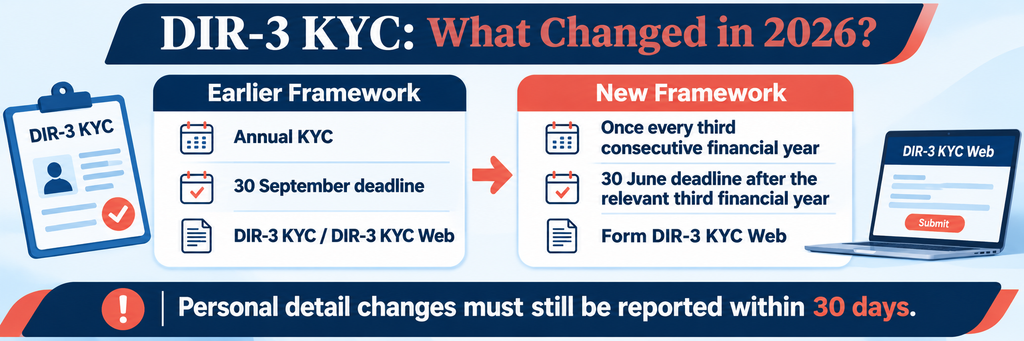
The earlier annual filing cycle has been replaced with a three-year cycle.
The new framework also consolidates the earlier DIR-3 KYC and DIR-3 KYC Web options into the revised Form DIR-3 KYC Web.
Old Rules vs New Rules
| Particulars | Earlier framework | Framework effective from 31 March 2026 |
| Periodic KYC frequency | Annual | Once every third consecutive financial year |
| Periodic filing deadline | 30 September under the previous framework | 30 June after the relevant third consecutive financial year |
| Form | DIR-3 KYC and DIR-3 KYC Web | Form DIR-3 KYC Web |
| Personal detail changes | Separate filing requirements under the earlier framework | Within 30 days of the change |
| Fee for timely periodic filing | Nil | Nil |
| Fee for delayed filing or DIN reactivation | ₹5,000 under the previous fee framework | ₹5,000 |
| Fee for subsequent personal detail update | Subject to earlier fee provisions | ₹500 per filing |
The practical benefit is a reduction in repetitive annual compliance.
However, the change does not remove the obligation to maintain accurate personal information with the MCA.
When Did the New Rules Become Effective?
The Ministry of Corporate Affairs notified the Companies (Appointment and Qualification of Directors) Amendment Rules, 2025 on 31 December 2025.
The amendment became effective on 31 March 2026.
The amendment substituted Rule 12A with a revised provision titled Directors KYC and updation thereof.
The revised provision has two important parts:
Rule 12A(1): Periodic KYC
An individual holding a DIN as on 31 March of a financial year must file KYC intimation through Form DIR-3 KYC Web on or before 30 June of the immediately following every third consecutive financial year.
Rule 12A(2): Changes in personal information
If the individual changes their personal mobile number, email address or residential address, the prescribed form must be submitted within 30 days of the change, along with the applicable fee.
These are separate obligations. Completing periodic KYC does not remove the need to report a subsequent change in personal information.
Who Needs to File DIR-3 KYC?
The requirement applies to individuals holding a Director Identification Number under the applicable provisions.
This includes individuals who:
- Serve as directors of private limited companies.
- Serve as directors of public limited companies.
- Hold DINs but are not currently appointed as directors.
- Have resigned from a directorship but continue to hold their DIN.
- Are designated partners of LLPs using a DIN.
- Hold a DIN associated with an inactive company.
- Have a DIN that requires reactivation because of earlier KYC non-compliance.
The key point is that the KYC requirement is linked to the individual holding the DIN, not merely to whether the company is currently carrying on business.
A person holding multiple directorships does not ordinarily need a separate KYC filing for every company. The DIN identifies the individual, and the KYC obligation is associated with that identification number.
Where an individual has more than one identification record or a disputed DIN status, the MCA records should be checked before filing.
How Does the New Three-Year DIR-3 KYC Cycle Work?
This is one of the most important parts of the amendment.
The filing cycle should not be calculated by simply adding three years to the date on which the director last logged into the MCA portal.
The rule refers to the financial year and the DIN-holding position as at 31 March.
The MCA’s published illustrations also distinguish between existing DIN holders and individuals whose DIN was allotted during FY 2025–26.
Example 1: Director Who Completed KYC for FY 2025–26
A director who had already completed the applicable KYC for FY 2025–26 falls under the new cycle.
The MCA’s published illustration states that, where the director had completed the earlier KYC for FY 2025–26, the next periodic filing is due between April 2028 and 30 June 2028, provided the relevant personal details do not change.
Example 2: DIN Allotted During FY 2025–26
Consider an individual whose DIN was allotted during FY 2025–26.
The MCA’s published illustration indicates that the first periodic KYC filing under the new cycle would be due between April 2029 and June 2029.
This is an important distinction. A director who received a DIN during FY 2025–26 should not automatically assume that the next periodic filing is due in June 2028.
Example 3: Director Changes Their Residential Address in FY 2027–28
Suppose a director’s periodic KYC cycle is due in June 2029.
The director changes their residential address during FY 2027–28.
The address change must be reported within 30 days through DIR-3 KYC Web, with the applicable fee.
The address-update filing does not automatically reset the three-year periodic KYC cycle.
Important
The examples above follow the MCA’s published illustrations. For an individual case, check the DIN allotment date, earlier KYC filing history, current DIN status and applicable MCA records before deciding the due date.
What Is the 30-Day Update Requirement?
The new Rule 12A(2) creates a separate requirement for updating personal information.
Every individual holding a DIN must submit Form DIR-3 KYC Web within 30 days if any of the following changes:
- Personal mobile number.
- Personal email address.
- Residential address.
This requirement applies independently of the three-year periodic KYC cycle.
For example, a director who has completed KYC and whose next periodic filing is due in 2028 must still report a residential address change that occurs in 2027 within the prescribed 30-day period.
A common mistake would be to assume that the next periodic KYC deadline is the only date that matters.
It is not.
Directors should maintain a record of the date on which a change occurs and arrange the prescribed filing within the applicable period.
Which Form Should Be Used Under the New Rules?
The revised framework uses Form DIR-3 KYC Web.
The amendment replaced the earlier references to DIR-3 KYC and DIR-3 KYC Web with the revised form.
The form is intended for:
- Periodic KYC intimation.
- Updating personal mobile number.
- Updating personal email address.
- Updating residential address.
- Reactivation of DIN.
Directors should avoid relying on old tutorials that explain the previous distinction between first-time DIR-3 KYC e-form filing and annual DIR-3 KYC Web verification without checking the current MCA instructions.
The form and its live portal workflow should always be verified before submission.
DIR-3 KYC Fees in 2026
The Companies (Registration Offices and Fees) Amendment Rules, 2026, notified through G.S.R. 300(E) dated 21 April 2026, revised the fee structure for DIR-3 KYC Web.
The fee depends on the purpose and timing of the filing.
| Filing purpose | Government fee |
| Periodic KYC filed within the prescribed timeline | Nil |
| Filing after the prescribed timeline | ₹5,000 |
| Reactivation of DIN | ₹5,000 |
| Subsequent filing for a change under Rule 12A(2) | ₹500 per filing |
Is DIR-3 KYC Free?
Yes. The periodic KYC filing is free when submitted within the prescribed timeline.
However, a filing made after the deadline attracts the prescribed ₹5,000 fee.
Is the 30-Day Update Free?
No. The fee schedule prescribes ₹500 for each subsequent DIR-3 KYC Web filing made for a change under Rule 12A(2).
The government fee is separate from any professional service fee charged by a consultant or company secretary.
Always check the current MCA fee schedule before making payment.
What Happens If You Do Not File DIR-3 KYC?
Failure to comply with the applicable KYC requirement can result in the DIN being marked as deactivated due to non-filing of KYC.
A deactivated DIN can create practical difficulties in completing director-related MCA filings.
The individual may also face problems when attempting to participate in corporate compliance processes that require an active DIN.
The consequences should not be confused with automatic disqualification from holding a directorship.
DIN deactivation for KYC non-compliance and director disqualification are separate legal concepts.
A director should check the actual reason displayed against the DIN rather than assume that every inactive DIN has the same cause.
How to Reactivate a Deactivated DIN
If a DIN is deactivated because of non-filing of KYC, the individual may need to complete the prescribed reactivation process through Form DIR-3 KYC Web.
A practical approach is:
Step 1: Check DIN status
Use the MCA portal to verify the DIN and the reason for its current status.
Step 2: Review previous filing history
Check whether the individual has previously filed DIR-3 KYC or DIR-3 KYC Web and whether any application remains pending.
Step 3: Confirm personal information
Check the name, PAN, mobile number, email address and residential address against the relevant records.
Step 4: Prepare the filing
Use the applicable Form DIR-3 KYC Web option for reactivation.
Step 5: Complete verification
Follow the current form instructions for identity verification, digital signatures and professional certification where applicable.
Step 6: Pay the prescribed fee
The revised fee schedule prescribes ₹5,000 for DIN reactivation.
Step 7: Check the DIN status again
Do not assume that payment alone means the DIN has become active. Verify the updated status on the MCA portal and retain the acknowledgement.
Where the DIN is deactivated for a reason other than KYC non-compliance, the correct remedy may be different.
Is a Digital Signature Certificate Required?
The MCA’s 1 January 2026 announcement explains that verification through the DIN holder’s digital signature and certification by a professional through digital signature are required only when the KYC form is submitted to update the mobile number, email address or residential address.
This is an important change from older filing instructions.
However, directors should not rely on outdated tutorials to decide which digital signature or professional certification is required for a particular transaction.
The applicable MCA form instructions and portal workflow should be checked at the time of filing.
If an update is being made, the director should be prepared to complete the prescribed verification and professional certification requirements.
Documents and Information to Keep Ready
The exact information required depends on the filing purpose and the fields displayed in the current form.
Before starting, keep the following information available:
- DIN.
- PAN details, where applicable.
- Current personal mobile number.
- Current personal email address.
- Current residential address.
- Relevant address proof where requested.
- Details of the change, if updating personal information.
- Valid digital signature, where required.
- Supporting information for resolving a mismatch in MCA records.
For foreign nationals, the applicable identity and residential documents may differ.
The information entered should be consistent with the relevant official records. A mismatch in the name, PAN or identity information should be resolved rather than concealed through an incorrect form entry.
Does the New Rule Apply to LLP Designated Partners?
Yes, the DIN used for an LLP designated partner is the same identification number used for director-related purposes.
The MCA integrated DIN and DPIN into a single identification number in 2011.
Accordingly, an individual holding a DIN for an LLP designated-partner role should review the applicable KYC obligation under the revised framework.
An LLP should not assume that its designated partners are outside the Director KYC framework simply because the entity is not a company.
The individual should verify the DIN status and filing history before deciding the applicable date.
Do Resigned Directors Need to File DIR-3 KYC?
Resigning from a directorship does not automatically cancel the individual’s DIN.
The KYC requirement is linked to holding the DIN.
Therefore, an individual who has resigned from a company but continues to hold an approved DIN should not assume that the KYC requirement has ended.
If the individual no longer intends to use the DIN, the appropriate legal options should be reviewed separately. Resignation from a company and surrender or cancellation of a DIN are not the same procedure.
Does an Inactive Company Need Director KYC?
A company with no sales, no employees or no current business activity may still have applicable statutory obligations.
Director KYC is an individual-level requirement.
Therefore, a director holding a DIN should assess the applicable KYC filing requirement even if the company is inactive.
This is particularly relevant for founders who incorporated a company for a future project and have not yet started operations.
Company inactivity does not automatically deactivate or cancel the director’s DIN obligations.
Common Mistakes Directors Should Avoid
Mistake 1: Assuming KYC Is No Longer Required
The annual requirement has changed, but periodic KYC remains mandatory.
Mistake 2: Treating June 2028 as a Universal Deadline
The MCA’s published example confirms June 2028 for directors who completed the applicable FY 2025–26 KYC. Individuals with newly allotted DINs may have a different first filing cycle.
Mistake 3: Ignoring the 30-Day Update Requirement
Changes in personal mobile number, email address and residential address must be reported within 30 days.
Mistake 4: Using Old DIR-3 KYC Tutorials
Older guides may explain separate forms and filing procedures that have since changed.
Mistake 5: Confusing DIN Deactivation With Director Disqualification
These are different legal situations. Check the actual reason for the DIN status.
Mistake 6: Assuming a Resigned Director Has No KYC Obligation
The DIN continues to exist unless it is formally surrendered or cancelled through the applicable procedure.
Mistake 7: Paying Before Checking the Correct Filing Category
The government fee depends on whether the filing is periodic KYC, a change update or DIN reactivation.

A Practical DIR-3 KYC Compliance Checklist
Before closing the KYC matter, check:
- DIN is correctly identified.
- Current DIN status has been checked.
- Earlier KYC filing history has been reviewed.
- Applicable three-year filing cycle has been determined.
- No recent personal information change has been overlooked.
- Any change has been reported within 30 days.
- Correct Form DIR-3 KYC Web filing category has been selected.
- Required identity and address information is accurate.
- Digital signature and professional certification requirements have been checked.
- Correct government fee has been paid.
- Filing acknowledgement has been saved.
- Updated DIN status has been verified, where applicable.
How FilingPoint Can Help With Director KYC
The 2026 amendment reduces the frequency of periodic KYC, but directors may still face difficulties when checking their filing cycle, correcting personal details or reactivating a deactivated DIN.
FilingPoint can assist with:
- Reviewing DIN status and previous KYC filing history.
- Identifying the appropriate filing category.
- Assisting with Form DIR-3 KYC Web.
- Reviewing personal information and supporting documents.
- Coordinating applicable digital signature and professional certification requirements.
- Assisting with DIN reactivation.
- Reviewing the prescribed government fee.
- Maintaining filing acknowledgements and compliance records.
The service required depends on the director’s actual DIN status and the purpose of the filing.
Need help with DIR-3 KYC or DIN reactivation?
Contact FilingPoint’s experienced professionals:
Phone: +91 72999 72500
Email: enquiry@filingpoint.com
Frequently Asked Questions
1. Is DIR-3 KYC required every year in 2026?
No. From 31 March 2026, the annual periodic KYC requirement has been replaced by a filing once every third consecutive financial year.
2. What is the due date for DIR-3 KYC?
The due date is 30 June following the relevant third consecutive financial year. The exact year depends on the individual’s DIN and filing history.
3. Is DIR-3 KYC free?
Periodic KYC filed within the prescribed timeline has a nil government fee. Late filing or reactivation attracts ₹5,000.
4. What is the fee for changing a mobile number or email address?
The prescribed government fee is ₹500 for each subsequent filing made for a change under Rule 12A(2).
5. Is address change also required to be reported?
Yes. A change in residential address must be reported within 30 days through Form DIR-3 KYC Web.
6. Can a deactivated DIN be reactivated?
A DIN deactivated due to KYC non-compliance may be reactivated through the prescribed process. The fee schedule prescribes ₹5,000 for reactivation.
7. Do LLP designated partners need DIR-3 KYC?
Individuals holding a DIN for an LLP designated-partner role should also review the applicable KYC requirements. DIN and DPIN were integrated into one identification number.
8. Do resigned directors need to complete KYC?
Resignation does not automatically cancel a DIN. Individuals who continue to hold a DIN should check their applicable KYC obligations.
9. Does a director of an inactive company need KYC?
Company inactivity does not automatically remove the individual’s DIN-related KYC obligation.
10. Does changing my mobile number reset the three-year KYC cycle?
No. A personal-detail update is a separate filing under Rule 12A(2). It does not automatically reset the periodic KYC cycle.
Conclusion
The 2026 DIR-3 KYC amendment is an important change for company directors and individuals holding DINs.
The shift from annual KYC to a three-year cycle reduces repetitive filing. However, it does not remove the need to keep MCA records accurate.
The most important points to remember are:
- Periodic KYC is now required once every third consecutive financial year.
- The prescribed form is DIR-3 KYC Web.
- The deadline is 30 June following the relevant third consecutive financial year.
- Changes to personal mobile number, email address or residential address must be reported within 30 days.
- Timely periodic KYC attracts no government filing fee.
- Delayed filing or DIN reactivation attracts ₹5,000.
- A subsequent personal-detail update filing attracts ₹500.
Do not assume that every DIN holder has the same next due date. Check the DIN allotment date, earlier KYC filing history and MCA records before deciding when to file.
A simpler filing cycle is useful only when directors understand which obligation still applies to them.
Disclaimer: This article is for general information and educational purposes. It is not legal advice. Filing requirements, fees and MCA portal procedures should be verified against the latest official notifications, forms and records before submission.