



 Company Registration
  Filing Point

Service Included



Starting a company online is easy through FilingPoint. A Private Limited Company is the best business structure to start a business in India. It helps you to maintain limited liability, have a separate legal entity, buy assets in its own name, Udyam Registration in India, open bank accounts, open branches anywhere, do business and enjoy government startup subsidies and certain tax benefits. All that is required are the PAN card. (or Passport, if the promoter is a foreigner), address proof and bank statement copies of the promoters, along with address proof for the registered office address.

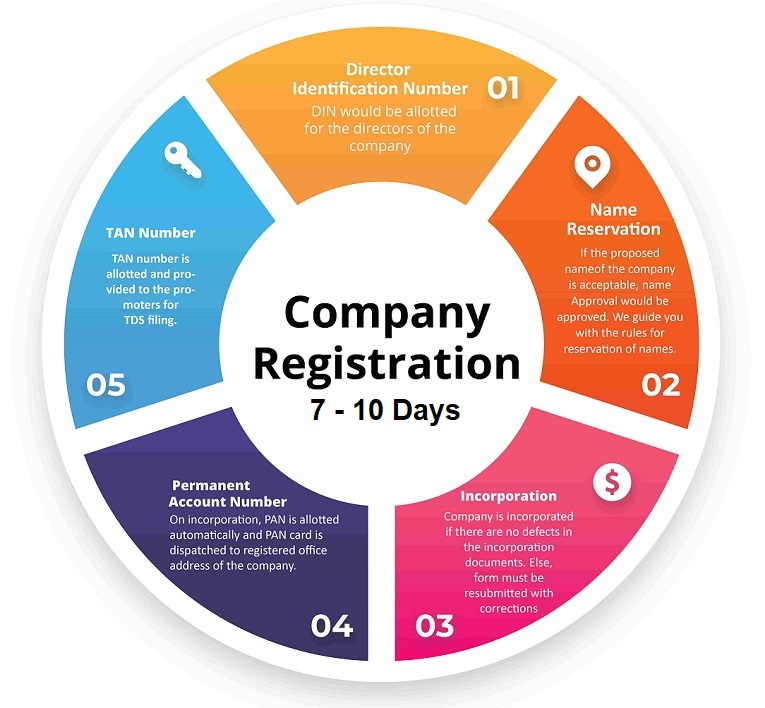
How many days does it take to form a company? A new Company Registration in Chennai can be completed within 10 - 15 days. If you have the necessary documents for Company Registration Services in Chennai, you can call us and discuss with our advisor to incorporate your company.
Limited liability is the status of being legally responsible only to a limited amount for the debts of a company. Unlike proprietorships and partnerships, in a private limited company the liability of the shareholders in respect of the company's liabilities is limited. In other words, the liability of the shareholders of a company is limited only to the value of shares taken up by them.
NRIs, foreign nationals and foreign entities can register a company and invest in India, subject to the Foreign Direct Investment norms set by the RBI. However, incorporation rules in India require one Indian national to be a part of the company's Board of Directors. You need to have your registered office in India
Do you know how many days it will take to complete a new company registration in Chennai? Generally, it takes a maximum of 15 working days to incorporate a Startup Company.
Pricing
Private Limited Company Registration Suitable for First-Time Entrepreneurs.
Private Limited Company Registration along with GST Quarterly Filing + Commencement
Startup Plan + GST Registration + Commencement Certificate + Board Meetings for four quarters
 Our Process
Our FAQs
Our Process
Our FAQs
Yes, we need your presence one time for signing. Also, we would like to maintain a long-term business relationship with you.
The Registered Office is the main location to receive all communications about Company Registration. As per the Companies Act, we have to register a place without fail to maintain all statutory registers. At FilingPoint, we recommend NOT starting from a Shared Office. As per the Department's latest stand, a company cannot be started in a shared office or Co-Working Space.
Yes, you can register at your residence and open your branch office anywhere in India.
Yes, but it depends on your employment contract. You should avoid a Conflict of Interest (the same line of business as your employer).
NO hidden charges or fees will be charged, and there are NO long-term commitments in addition to the Pvt Ltd Company Registration Cost. Our actual charges are as follows:
| Nature of Payment | Amount (Rs.) |
|---|---|
| Digital Signature Certificates | Rs.1998 |
| Name Approval and Incorporation Fee | Rs.1663 |
| Courier Charge | Rs.100 |
| Attestation | Rs.325 |
| GST @ 18% | Rs.616 |
| Total (Rounded Off) | Rs.4702 |
The government fee may vary from state to state and based on capital, etc. You can use the ROC Fee Calculator for Incorporation. Please note that this offer price is ONLY for Resident Directors and NON-Finance/Special Category Companies where the Proposed Capital is less than or equal to Rs.10 Lakhs.
Your company registration cost in Chennai is payable 100% in advance - Prepaid Model. You can pay ROC Fees and Taxes later from your account. We use Razorpay/Instamojo/others as payment gateways, which provide 60+ Payment Options like Credit Cards, Net Banking, Debit Cards, Wallets, etc.

 Filing Point
Registering a Private Limited Company offers numerous advantages for entrepreneurs and growing businesses. It provides limited liability protection, ensuring that personal assets of shareholders remain safe from business debts or losses. This structure enhances credibility and trust among customers, suppliers, and investors, making it easier to attract funding and partnerships.
Our Process
 Our Details
The most popular one is called the Private Limited Company in India. A Private Limited Company can be a good idea for you to start your own business in India. This is a very useful type of company in India because it provides you with a Separate Legal Identity as well as a Limited Liability Legal Personality.
There are many benefits of having a Private Limited Company, and one of them is that you do not have to worry about having a lot of debts when you start your business. Another type of Company is known as an LLP / Limited Liability Partnership in India, and it is a good option for you to get started with your new business in India.
Advantages & Disadvantages
| Features | Private Limited Company | One Person Company | LLP | Partnership Firm | Proprietorship Firm |
|---|---|---|---|---|---|
| ▶ Separate legal entity | ✓ | ✓ | ✓ | ✕ | ✕ |
| A Company is a legal entity separate from its promoters | An OPC is a legal entity separate from its promoters | An LLP is a legal entity separate from its promoters | A Partnership is a legal entity but not separate from its partners | The proprietor and the proprietorship business are the same thing | |
| ▶ Limited Liability | ✓ | ✓ | ✓ | ✕ | ✕ |
| Shareholders of a Company are bound to pay only up to the capital they have subscribed to the company. | In an OPC, unlike a proprietorship, the shareholder cannot be asked to pay beyond his subscribed capital | The partners of an LLP can be called upon to pay only up to the amount of capital they subscribed to. | There is no protection of limited liability; even the personal properties of partners are at risk for business losses | The proprietor is the sole owner of the business, and his liability for the debts or losses of the proprietorship is unlimited. | |
| ▶ Number of members | 2 - 200 | 1 | 2 - unlimited | 2 - 20 | 1 |
| A Company can be opened with at least two people. However, the maximum number cannot be more than 200 | In the case of an OPC, only one person can be a shareholder. He would be required to appoint a nominee. | An LLP can be incorporated with two partners, and there is no limit on the maximum number of partners | A Partnership firm can start with a minimum of two partners; however, the maximum number is capped at 20 | Only one person, known as the proprietor, is required for a proprietorship. | |
| ▶ Number of Directors / DP | 2 - 15 | 1 - 15 | 2 to unlimited | Not Applicable | Not Applicable |
| A company can be opened with at least two and a maximum of 15 directors. The same person can be a shareholder as well as a director | At least one person must be appointed as the director of the company. The shareholder and director may be the same person | A minimum of two designated partners is required in an LLP, and there is no limit to the maximum number. | There is no separation of ownership and management in the case of a partnership. All partners are equally responsible for the conduct of business. | In the case of a proprietorship, the proprietor is solely responsible for the conduct of business. | |
| ▶ Foreign Investment (FDI) | ✓ | ✕ | ✓ | ✕ | ✕ |
| Foreign Direct Investment in the case of a Private Limited Company is available under the automatic route. | FDI is not allowed in a One Person Company | FDI in an LLP is permitted subject to prior approval from the central government | FDI is not allowed in a Partnership Firm | FDI is not allowed in a proprietorship business. | |
| ▶ Ownership Transferability | ✓ | ✓ | ✓ | ✕ | ✕ |
| The shareholding of a Pvt Ltd Company is easily transferable | OPC Shares can be transferred to a new shareholder along with the nominee | In an LLP, a partner's share can be transferred with the consent of all other partners. | Not Possible; every admission or removal of a partner amounts to a new firm. | Not Applicable | |
| ▶ Perpetual Existence | ✓ | ✓ | ✓ | ✕ | ✕ |
| A Company exists beyond the life of its owners/shareholders. After death, the shares are transmitted to the legal heirs | An OPC continues to exist even after the death of its only shareholder, as it passes to the nominee. | An LLP also has perpetual existence and exists beyond the life of its designated partners | No perpetual existence; with the death of a partner, the partnership ends. | No perpetual existence; with the death of the proprietor, it ends. | |
| ▶ Tax Benefits | Effective | Effective | Low | Low | Good |
| The company tax rate is flat at 25% on its profits | The company tax rate is 25% on its profits | LLP Income Tax Rate is 30% on its profits | Partnership firms are taxed at 30% on their profits | For a small business with low turnover, there is the benefit of individual tax slabs | |
| ▶ Statutory Compliance | High | High | Low | Minimum | Minimum |
| The company is required to file an annual return and balance sheet with the ROC, and an ITR, around the month of September | An OPC is required to file an annual return and balance sheet with the ROC, and an ITR, around the month of September | An LLP has to file an annual return in Form 11, a financial statement in Form 8 and an ITR | Only ITR is to be filed | ITR is required to be filed if the taxable income is more than 2.5 Lakh | |
| Formation Cost | 999/- | 999/- | 999/- | 999/- | 999/- |
| Pay Now | Pay Now | Pay Now | Pay Now | Pay Now |
Why choose us
Best Company Formation Cost or Fee Finding the Best Company Registration Consultants or Auditors for Company Registration Services is the first important step in Company Formation. Most aspiring entrepreneurs are more concerned about renting office space and production units for their upcoming business. They are busier sourcing funds, hiring the right staff and keeping things moving forward. Business owners do not realize the importance of business registration. Setting up a Business in India / Online Company Registration in India is an easier process if you give importance to selecting the type of company in India. Now the Best Company Registration Services in Chennai are available @ Rs.999/- at FilingPoint.com.
In the current competitive Online business world, you need the safety net of a legally registered business like a Private Limited Company in India to have a firm foothold in the world. Business registration is helpful in protecting the personal assets of owners. Every entrepreneur needs to build their target audience’s trust and reliability. It is a sure way of laying a strong foundation by way of Online Company Registration in India.
 Our FAQs
Top Consultants support you in registering a startup company in Chennai / Udyam Registration Online for your success. FilingPoint.com helps you complete Startup company registration online after the ROC Chennai company search and Company Name Approval. You will get the Certificate of Incorporation, Documents and Registration Number from the Registration Office after the setup process.
If you are ready, we can complete a company registration within 5 working days. It helps you to complete Startup Registration immediately with our Company Formation Agents.
We are the best company registration consultants. You have come to the right place, where you can buy the best services at a reasonable price.
Company Name Check is an important option to verify before applying for name approval. Company Online Registration is the next process after Startup Company Name Registration in Chennai India. We have provided a bookmark to Search in the MCA Master Database and Trademark Registry Database Online. It helps during Startup Company Registration in India Chennai. Get Pvt Ltd Company Name Suggestions easily for a New Company Name Search. We are here to support you at all times.
Trademark Registration is a very easy task with your Business Name or Trade Name / Brand. It provides the benefits of distinctiveness, exclusive rights, and property rights. and help you avoid unfair competition.
As mentioned above, we need address proof, identification proof and proposed office address proof as the required documents to register your company immediately.