
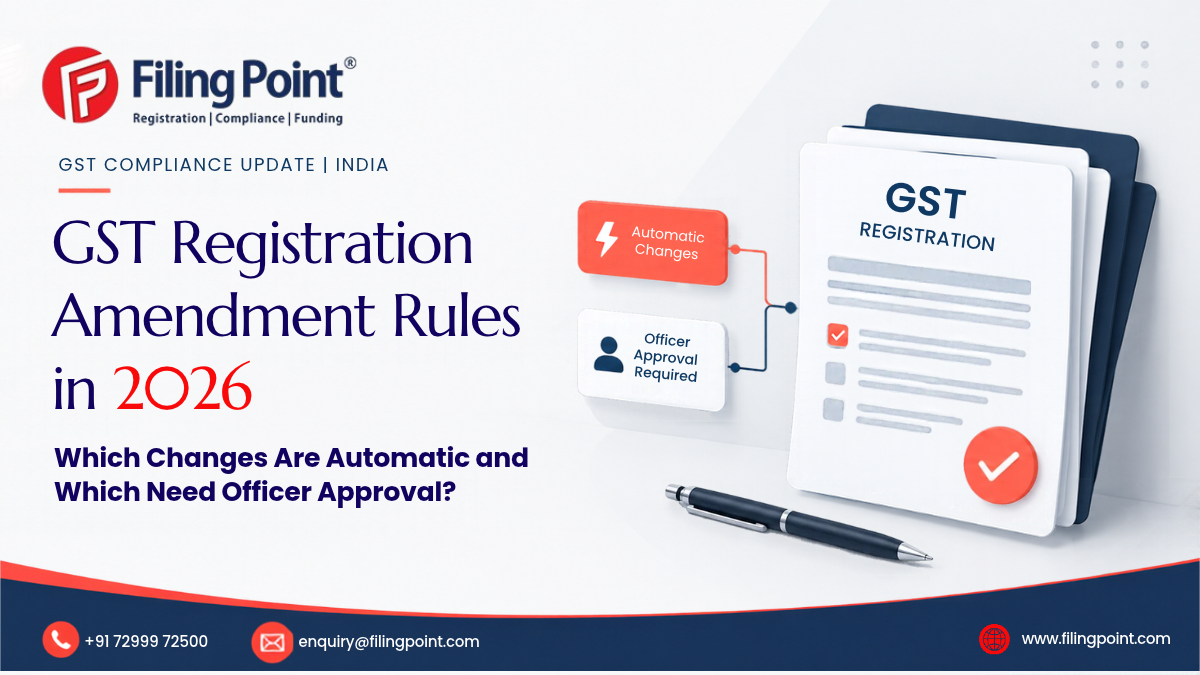
If your business details have changed, you may need to update your GST registration. This could include a change in your business’s legal name, constitution, principal place of business or additional place of business.
The process for making these changes has become more straightforward for certain categories of amendments. Guidance published by the Press Information Bureau (PIB) on 9 October 2026 explains that specified changes previously treated as core amendments can now be processed automatically by the GST system.
However, not every GST registration amendment is automatically approved. The processing route depends on the type of change and, for changes to the principal place of business, whether the registration was obtained under Rule 14A of the Central Goods and Services Tax (CGST) Rules, 2017.
This guide explains the changes, how to apply through Form GST REG-14, which documents you may need and what to check before submitting your application.
What changed in GST registration amendments in October 2026?
The PIB guidance published on 9 October 2026 explains the processing route for several GST registration amendments. The key distinction is whether the change is eligible for automatic system processing or requires approval from a tax officer.
The changes described in the publication include:
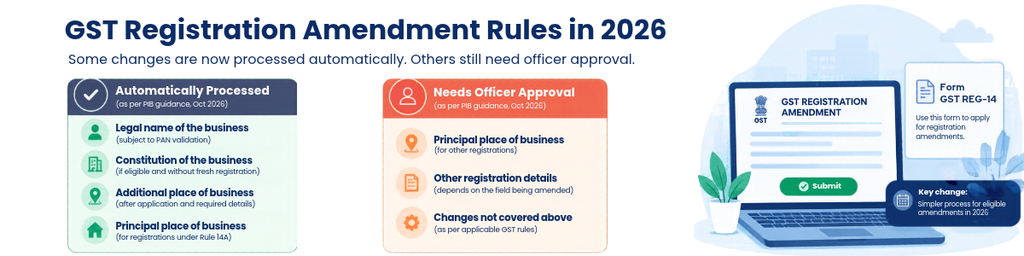
- Legal name of the business: eligible amendments can be processed automatically following submission and successful PAN validation.
- Constitution of the business: eligible amendments can be processed automatically, provided the change does not require cancellation of the existing registration and a fresh registration under a different PAN.
- Additional place of business: eligible amendments can be processed automatically after the application and required details are submitted.
- Principal place of business: automatic processing applies to registrations covered by Rule 14A. For other registrations, officer approval continues to be required.
These changes can reduce manual intervention for eligible applications. They do not remove the need to submit accurate information or the supporting documents required for the amendment.
GST registration amendment: automatic processing vs officer approval
The following table summarises the processing routes described in the PIB’s October 2026 guidance.
| Type of amendment | Processing route described in the guidance |
| Legal name of the business | Automatic processing, subject to successful PAN validation |
| Constitution of the business | Automatic processing where the change is eligible and does not require fresh registration |
| Additional place of business | Automatic processing |
| Principal place of business under Rule 14A | Automatic processing |
| Principal place of business for other registrations | Tax officer approval continues to be required |
| Other registration details | Depends on the field being amended and the applicable GST procedure |
Important: The table summarises the published guidance. For a particular application, verify the current GST portal process and applicable legal provisions before filing.
How to change the legal name in GST registration
A business may need to update its GST registration when its legal name changes. The name recorded in the GST registration should reflect the business’s valid legal particulars.
According to the PIB’s October 2026 guidance, the legal-name amendment can be processed automatically after an application is submitted through the GST portal and the PAN details are successfully validated.
How to apply
- Visit the official GST portal and log in.
- Navigate to the registration amendment service.
- Select the relevant business details and enter the revised legal name.
- Complete the required information and submit Form GST REG-14, where applicable.
- Complete the verification and submission steps shown on the portal.
- Retain the acknowledgement and check the updated registration details.
What should you check before filing?
Make sure the revised name is supported by the relevant legal records. A name change should not be treated as merely a spelling correction if it reflects a change in the legal identity of the business.
The portal’s validation process and the documents required may depend on the nature of the change. Review the current instructions before submitting the application.
How to add an additional place of business
A business may need to add another location to its GST registration when it opens a warehouse, branch, office, shop or another eligible business premises in the relevant state.
The PIB guidance states that an amendment to add an additional place of business can be processed automatically through the system after the application and required premises documents are submitted.
Steps to follow
- Log in to the GST portal.
- Open the registration amendment service.
- Select the section for additional places of business.
- Enter the new premises details accurately.
- Upload the required supporting documents.
- Submit the amendment application and save the acknowledgement.
- Check the registration details to confirm that the additional premises have been recorded.
Which documents may be required?
Depending on the premises and the portal’s current requirements, you may need documents such as:
- Proof of ownership, where the premises are owned.
- A rent or lease agreement, where applicable.
- A consent letter or other acceptable evidence when the premises are used with another person’s permission.
- Supporting address documents specified by the GST portal.
Do not assume that the same document will be accepted for every property arrangement. Check the applicable document requirements before filing.
Can you add multiple business locations?
The PIB guidance states that there is no need to wait for an earlier additional-place amendment to be approved before submitting another such application where the amendment is eligible for automatic processing. Ensure that every location is entered correctly and supported by the required evidence.
How to change the principal place of business
The principal place of business is the primary business location recorded in the GST registration. A business may need to update it when it relocates its main office, shop, factory or other principal premises.
The processing route depends on the type of GST registration.
For registrations under Rule 14A
The PIB guidance explains that an amendment to the principal place of business for a registration obtained under Rule 14A of the CGST Rules, 2017, can be processed automatically through the system.
The applicant must submit the amendment application and the required proof of the new premises through the GST portal.
For other GST registrations
For registrations other than those obtained under Rule 14A, the principal-place-of-business amendment continues to require approval from the proper officer, according to the published guidance.
The guidance describes the following process for a normal taxpayer registered under Rule 9:
- If no discrepancy is found, the officer is to approve the application within 15 days of the application.
- If a discrepancy is identified, the officer may issue a show-cause notice within the specified period.
- The taxpayer must respond within the prescribed period, and the officer then takes further action according to the applicable procedure.
These are procedural timelines described in the published guidance. Follow the dates and instructions shown in any notice or communication issued for your own application.
What should you prepare?
Before submitting the amendment, check the new address, premises evidence, effective date and consistency of the information entered in the application. Incomplete or inconsistent information may lead to a request for clarification or further action.
Change in business constitution: will you need a new GST registration?
A change in business constitution may arise when the ownership or legal structure of a business changes. The GST implications depend on the nature of the change and whether the business continues under the same PAN.
The October 2026 PIB guidance identifies eligible constitution-related amendments as changes that can be processed automatically. This should not be interpreted to mean that every change in constitution can be handled by amending the existing GST registration.
If the change results in a different PAN, a fresh GST registration may be required rather than an amendment to the existing registration. The existing registration may also need to be cancelled, depending on the circumstances.
Before filing, establish whether the change is a modification within the existing legal identity or the creation of a different taxable person. This distinction is particularly important when moving between business structures.
For example, a change that preserves the same PAN may be treated differently from a restructuring that creates a new legal entity with a different PAN. Obtain appropriate professional advice if the legal effect of the restructuring is unclear.
Which form is used for GST registration amendments?
The form identified in the PIB guidance for applying to amend registration particulars is Form GST REG-14.
The form is used to submit the proposed changes and the supporting information through the GST common portal. The documents and details required depend on the amendment being requested.
A typical application may involve:
- Identifying the GSTIN and the details to be changed.
- Selecting the appropriate amendment fields.
- Entering the revised information.
- Uploading the required supporting documents.
- Completing verification and submitting the application.
- Saving the acknowledgement or application reference number.
- Checking the status and updated registration particulars.
Use the instructions available on the live GST portal because the available fields and supporting-document requirements can vary according to the amendment type.

Documents required for GST registration amendment
There is no single document list that applies to every GST amendment. The evidence required depends on the information being changed.
| Amendment type | Documents or information to check |
| Legal name | Legal records supporting the revised name and matching PAN information |
| Additional place of business | Acceptable proof of the premises, such as ownership, lease, rent or consent documentation where applicable |
| Principal place of business | Proof of the new principal premises and other information required by the portal |
| Constitution of business | Relevant legal records showing the change and confirmation of whether the PAN remains the same |
| Other registration details | Supporting evidence specified for the particular field |
This table is a practical preparation guide, not a substitute for the official document checklist. Check the requirements shown in the GST portal and the applicable instructions before uploading documents.
Common reasons an amendment may need further attention
Problems can arise when:
- The address entered does not match the supporting evidence.
- The document is incomplete or unclear.
- The revised legal name does not match the information available for PAN validation.
- The amendment selected does not accurately describe the change.
- A change in constitution has been treated as an ordinary amendment even though a different PAN is involved.
- The taxpayer has not responded to a notice within the prescribed period.
Review the application carefully before submission. Automatic processing does not mean that incorrect or unsupported information can be accepted without validation.
How to check the status of a GST amendment
After submitting Form GST REG-14, retain the acknowledgement or application reference number and monitor the application through the GST portal.
A practical follow-up process is:
- Log in to the GST portal.
- Open the relevant registration or application-status service.
- Enter the details requested by the portal.
- Review the current status and any communication issued.
- If the amendment has been processed, verify the updated registration particulars.
- If a notice or clarification request is issued, read it carefully and respond within the applicable deadline.
The exact status labels and steps displayed may depend on the application and portal interface. Use the live portal as the source of your application’s current status.
What should you do if a GST amendment notice is issued?
An amendment application may require further attention if the officer identifies a discrepancy or the supporting documents are insufficient. This is particularly relevant to amendments for which officer approval continues to apply.
If you receive a notice:
- Read the reason stated in the notice.
- Identify the specific information or evidence requested.
- Check whether the original application contains an error.
- Prepare a clear response supported by relevant documents.
- Submit the response through the prescribed portal process within the deadline.
- Save the acknowledgement and monitor the subsequent status.
Do not ignore a notice simply because some categories of amendments are now processed automatically. The applicable process depends on the type of amendment and the circumstances of the application.
What should you do after the amendment is processed?
Once the amendment has been processed, review the GST registration details to make sure the change has been recorded correctly.
Depending on the amendment, you should check:
- The legal name and other business particulars.
- The principal and additional places of business.
- The GST registration certificate and related records.
- Whether invoices, accounting systems and internal business records need to be updated.
- Whether any other registrations, licences or business records also need to be amended.
For an address change, make sure your business records and operational documents reflect the correct premises. For a legal-name change, review the relevant records used for invoicing, banking and commercial transactions.
Updating GST registration does not automatically update every other government registration or private business record. Review each relevant requirement separately.
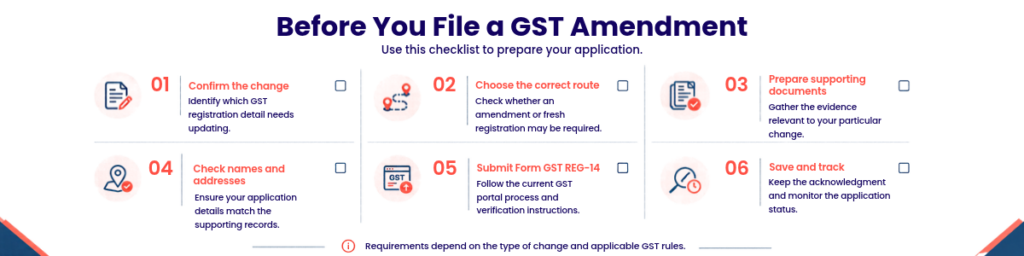
Practical checklist before filing Form GST REG-14
Use this checklist before submitting an amendment application.
- Identify exactly which GST registration detail has changed.
- Confirm whether the change can be made through an amendment or requires fresh registration.
- Check whether the principal-place-of-business change falls under Rule 14A.
- Gather the documents required for the selected amendment.
- Check that names, addresses and other details are consistent across the application and supporting evidence.
- Enter the correct effective date and reasons, where requested.
- Complete the portal’s verification and submission process.
- Save the acknowledgement or application reference number.
- Monitor the application and respond promptly if further information is requested.
- Verify the updated registration details after processing.
Common Questions About GST Registration Amendments
1. Which GST registration amendments can be processed automatically in 2026?
The PIB guidance published on 9 October 2026 identifies eligible amendments involving the legal name, constitution of the business and additional place of business as changes that can be processed automatically. Principal-place-of-business amendments are also covered by the automatic route for registrations under Rule 14A.
2. Does every principal-place-of-business amendment receive automatic approval?
No. The published guidance distinguishes registrations under Rule 14A from other registrations. For registrations outside Rule 14A, approval by the proper officer continues to be required.
3. Which form is used to amend GST registration details?
The form identified in the PIB guidance is Form GST REG-14. Check the GST portal for the current application process and the documents required for your particular amendment.
4. Can I add another business location without waiting for an earlier amendment?
The PIB guidance states that where an additional-place amendment is eligible for automatic processing, the taxpayer does not need to wait for an earlier such application to be approved before filing another one.
5. Is a new GST registration needed after a change in business constitution?
It depends on the legal effect of the change. If it results in a different PAN, a fresh GST registration may be required. Confirm the applicable treatment before attempting to amend the existing registration.
6. What should I do if my amendment application requires clarification?
Read the notice, identify the discrepancy, prepare the requested supporting evidence and submit your response through the prescribed process within the applicable deadline.
7. Should I check my GST registration after an amendment is processed?
Yes. Verify that the revised details are correct and update relevant business records separately wherever necessary.
Final Takeaway
The October 2026 guidance makes the processing route clearer for several GST registration amendments. Eligible changes involving the legal name, constitution of the business and additional place of business can be processed automatically. Principal-place-of-business amendments follow the automatic route for registrations under Rule 14A, while other registrations continue to require officer approval.
Before filing, confirm the type of amendment, check whether a fresh registration is necessary, prepare the required evidence and verify the outcome on the GST portal.
Need help with GST registration or compliance? FilingPoint can help you understand the amendment process, prepare the relevant information and identify the next steps based on your business circumstances.
Disclaimer: This article provides general information and is not legal or tax advice. GST procedures and requirements may change. Verify the current rules, notifications and portal instructions before filing.