
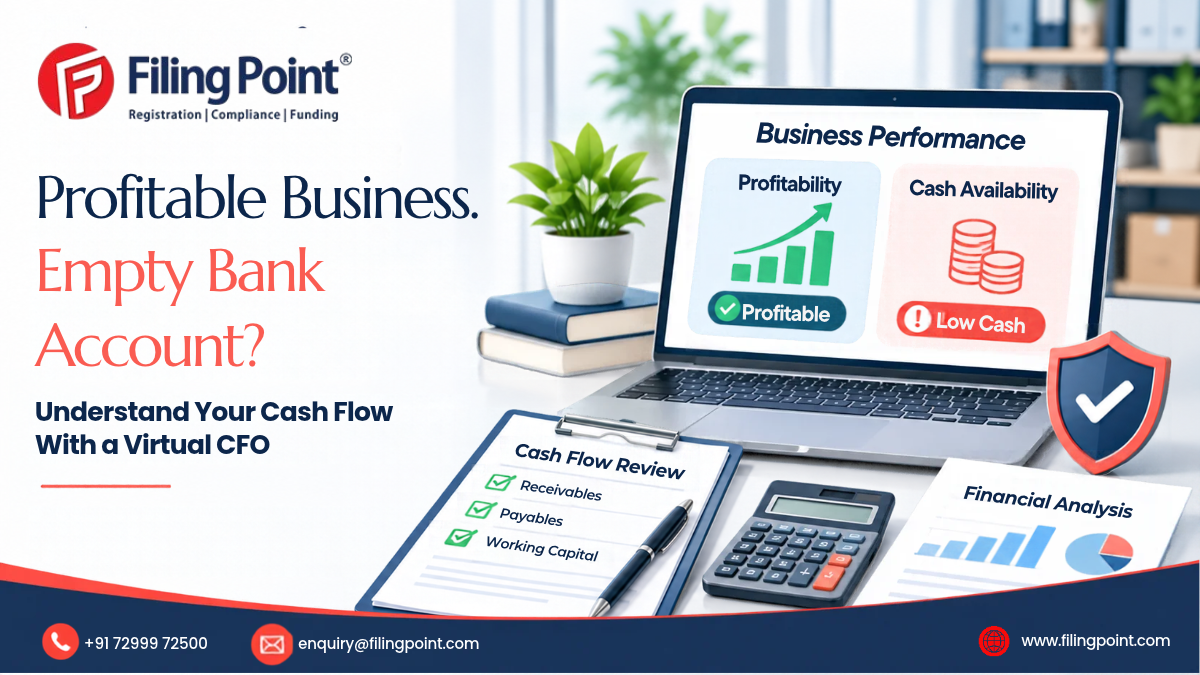
Imagine running a successful manufacturing business in Chennai. Your sales are increasing, customers are placing repeat orders, and your accountant confirms that the company is profitable.
Yet, when salaries become due, you find yourself checking the bank balance repeatedly. Suppliers are demanding payments. GST liabilities are approaching. Your business needs fresh inventory, but available funds are insufficient.
Despite reporting profits, you are considering another business loan simply to manage routine expenses.
Does this situation sound familiar?
Many business owners assume that profitability automatically translates into financial security. Unfortunately, accounting profit and available cash are two different financial measures.
A business can generate substantial revenue, report healthy profits and still experience serious liquidity problems.
The underlying issue may not be insufficient sales. It could be the way money moves through the organisation, how financial commitments are managed or how business decisions are made.
This is where professional Virtual CFO services can provide strategic financial support.
Rather than focusing exclusively on bookkeeping and statutory compliance, a Virtual CFO helps management understand the financial consequences of business activities and make informed decisions about growth, expenditure and liquidity.
Profitability and Liquidity Are Not the Same
Profit measures financial performance over a particular accounting period. Liquidity measures the ability of a business to meet its financial obligations when they become due.
A profitable business generates revenue exceeding its recognised expenses. A liquid business has sufficient accessible financial resources to meet immediate commitments.
These conditions do not necessarily occur together.
Consider a wholesale distributor that supplies products worth ₹10 lakh to customers on credit. The business recognises revenue according to its applicable accounting policies. However, the customers may pay only after sixty days.
During that period, employees must receive salaries, suppliers must be paid and operating expenses must be funded.
The profit may already appear in the financial statements, while the corresponding cash remains unavailable.
This difference becomes particularly important in businesses where credit transactions are common.
Entrepreneurs should therefore avoid treating the profit and loss account as a complete representation of financial health.
Profitability answers whether the business is generating economic returns. Liquidity answers whether it can continue meeting its commitments.
A financially sustainable business needs both.
Why Revenue Growth Can Create Financial Pressure
Business expansion is frequently associated with financial success.
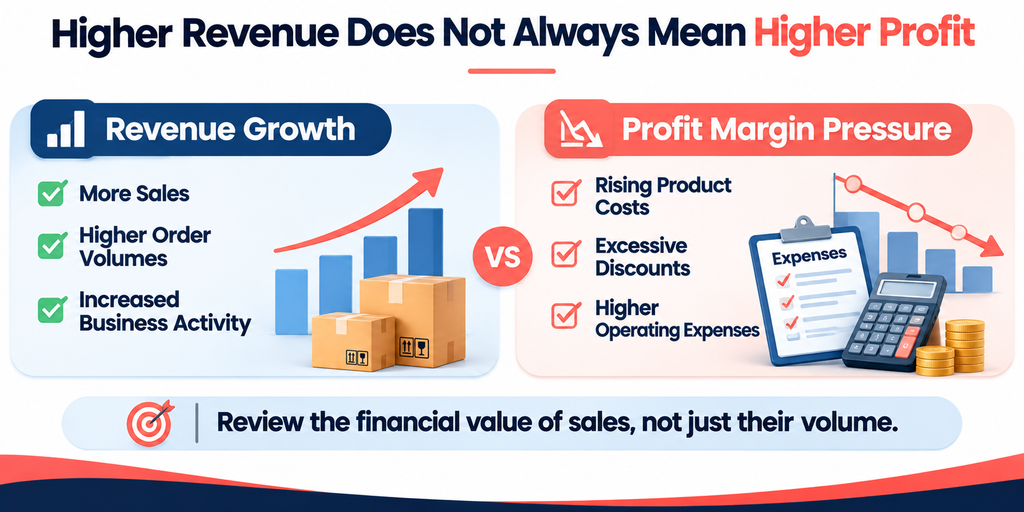
Higher sales can improve market presence, increase profitability and create opportunities for further investment.
However, growth also creates additional financial requirements.
A manufacturer receiving larger orders may need to purchase additional raw materials, increase production capacity and employ more workers.
A distributor entering new markets may require larger inventory holdings.
A service company onboarding additional customers may need to recruit employees before receiving payments from those customers.
In each case, the business spends money before receiving the full financial benefit of its expansion.
When growth happens faster than the organisation’s ability to fund these commitments, liquidity pressure can emerge.
This problem is sometimes described as overtrading: business activity expands beyond the financial resources available to support it.
It does not necessarily mean that the business is unprofitable. It means that the financing of its operating activities has not kept pace with its commercial growth.
Management must therefore assess growth not only through sales targets but also through the financial resources required to achieve those targets.
Why Your Bank Balance Cannot Explain Your Entire Financial Position
Many entrepreneurs monitor their business performance by checking the available bank balance.
While cash availability is important, a bank balance provides only a snapshot of financial resources at a particular moment.
It does not automatically reveal the commitments that will become due in the coming weeks.
A business may have ₹15 lakh in its bank account today but face significant supplier payments, salary commitments and tax obligations tomorrow.
Another business may have a relatively low balance but expect reliable customer collections within a few days.
The implications of these situations are different.
A bank balance also does not show whether the business has borrowed heavily to maintain its available funds.
Loan proceeds may temporarily increase cash availability without improving underlying profitability.
Similarly, receiving customer advances may increase the available balance while creating future delivery obligations.
The relevant question is therefore not simply how much money the business currently holds.
Management must understand how much of that money is genuinely available after considering upcoming commitments and operational requirements.
The Three Financial Statements Every Business Owner Should Understand
Business owners do not need to become professional accountants. However, understanding the purpose of the principal financial statements can significantly improve decision-making.
The profit and loss account explains financial performance during a specified period.
The balance sheet provides information about assets, liabilities and equity at a particular reporting date.
The cash flow statement explains movements in cash and cash equivalents during a reporting period.
These statements complement one another.
For example, an increase in revenue may appear favourable in the profit and loss account. However, the balance sheet may reveal that customer receivables have increased substantially.
The cash flow statement may then show that operating activities have generated less cash than expected.
Accounting standards such as AS 3 and Ind AS 7 distinguish cash flows arising from operating, investing and financing activities.
The applicable reporting framework varies depending on the entity.
Even where a formal cash flow statement is not mandatory, management can benefit from preparing suitable internal cash reports.
A Virtual CFO can help translate these financial statements into information that supports practical business decisions.
Operating Activities: Is Your Core Business Generating Cash?
A business should ideally understand whether its normal commercial activities produce sufficient cash to support ongoing operations.
Operating activities include the financial movements associated with selling products, delivering services and meeting routine business expenses.
A business may generate accounting profits while experiencing weak operating cash flows because customers have not paid, inventory levels have increased or payments to suppliers are concentrated within a short period.
Persistent operating cash shortages deserve particular attention.
If the business repeatedly depends on fresh borrowing or additional capital to fund routine expenses, management should investigate the underlying operating model.
Sometimes the problem is temporary. A seasonal business may experience predictable periods of lower collections.
In other cases, the shortage may indicate structural weaknesses in pricing, customer payment arrangements or operational efficiency.
Distinguishing temporary timing differences from persistent financial weaknesses is essential.
The appropriate solution depends on the actual cause rather than the apparent size of the cash shortage.
Investing Activities: Where Has the Business Committed Its Money?
Growing businesses frequently invest in machinery, vehicles, technology, commercial premises or production infrastructure.
These investments may support future profitability.
However, purchasing long-term assets can significantly reduce immediate cash availability.
The entire amount spent on an asset is not necessarily recognised as an expense in the profit and loss account during the purchase period. Instead, applicable accounting treatment may spread the recognised cost through depreciation over the asset’s useful life.
Consequently, the business may report a healthy accounting profit while experiencing a substantial cash outflow.
This is not automatically a sign of poor financial management.
A carefully planned investment may be commercially justified.
The problem arises when long-term investments consume funds required for ordinary operating activities.
Business owners should therefore evaluate whether investment commitments are compatible with their available financial resources and expected future cash generation.
Financial planning should connect investment decisions with operational liquidity rather than considering the two independently.
Financing Activities: Borrowing Can Hide Financial Weaknesses
Business loans and capital contributions can provide valuable support during expansion.
However, external financing should not be confused with cash generated by business operations.
A company that receives a new loan may report an improved bank balance even though its core business remains financially weak.
Loan proceeds create repayment commitments.
Repayment of loan principal generally reduces cash without being recognised as an ordinary expense in the profit and loss account.
Interest has its own applicable accounting and tax treatment.
A business owner who focuses only on profitability may therefore underestimate the effect of repayment obligations on available cash.
If borrowings repeatedly fund operating shortfalls without addressing the original problem, the organisation may become increasingly dependent on external finance.
This does not mean that borrowing is inherently undesirable.
The important distinction is whether funding supports a commercially sustainable purpose or merely postpones an unresolved financial difficulty.
Practical Case Study: A Profitable Manufacturing Company Facing a Cash Shortage
Consider an illustrative engineering component manufacturer operating in Coimbatore.
The company has a successful customer base and receives regular purchase orders from industrial buyers.
During a particular month, it reports revenue of ₹25 lakh and expenses of ₹20 lakh, resulting in accounting profit of ₹5 lakh.
Assume that the figures exclude GST and that the profit includes depreciation of ₹1 lakh.
The company begins the month with available cash of ₹4 lakh.
During the month, operating receivables increase by ₹8 lakh because customers have not yet paid for completed supplies.
Inventory increases by ₹2 lakh as management prepares for additional production.
Trade payables increase by ₹3 lakh because some supplier payments remain outstanding.
Assuming no other operating adjustments or tax payments for this simplified example, operating cash flow is negative ₹1 lakh.
The business also purchases equipment for ₹2 lakh and repays loan principal of ₹75,000.
Its closing cash position is therefore only ₹25,000.
The business generated ₹5 lakh in accounting profit but experienced a net reduction in cash of ₹3.75 lakh.
This apparent contradiction is explained by the financial movements behind the reported profit.
The company has not necessarily lost its profitability. However, its money is committed to receivables, inventory, equipment and financing obligations.
Management now needs to determine whether the underlying financial arrangements remain suitable for the company’s growth.
This is an illustrative scenario, not an actual FilingPoint client case.
Why Traditional Financial Reporting May Not Be Enough
Accurate bookkeeping is fundamental to responsible financial management.
Tax returns, statutory records and financial statements provide important information about the organisation.
However, historical reporting alone may not adequately support forward-looking decisions.
A financial statement prepared after the end of a reporting period can explain what happened during that period.
Management also needs to understand what may happen next.
For example, a company may have reported satisfactory profits during the previous quarter. Nevertheless, a major customer’s financial difficulties could affect future collections.
A manufacturer may receive a profitable new contract but need additional funding to fulfil it.
A service company may experience stable revenue while preparing for substantial employee-related expenditure.
These situations require interpretation, forecasting and commercial judgement.
A Virtual CFO can help connect accounting information with management decisions by examining the financial implications of planned activities.
This role complements accurate bookkeeping and compliance rather than replacing them.
The Hidden Cost of Financial Decisions Made in Isolation
Business decisions are often assessed separately by different departments.
The sales team may focus on increasing revenue.
The purchasing team may negotiate larger orders to obtain discounts.
The production team may seek additional equipment.
The human resources team may recommend recruitment.
Each proposal may appear reasonable when considered independently.
However, implementing several decisions simultaneously can create substantial pressure on available cash.
A supplier discount may be attractive, but purchasing unnecessary inventory can restrict liquidity.
Recruiting additional employees may support growth, but the associated commitments begin before additional revenue necessarily materialises.
Offering favourable customer credit terms may increase sales while delaying collections.
The financial consequences of commercial decisions must therefore be evaluated collectively.
A Virtual CFO can help management establish a coordinated decision-making framework in which operational plans are assessed alongside their financial implications.
This improves the organisation’s ability to identify competing priorities before they create difficulties.
Financial Visibility: The Foundation of Better Business Decisions
Financial visibility means having timely, reliable information about the organisation’s financial condition.
It goes beyond receiving annual financial statements or knowing the current bank balance.
Management should understand the sources of available funds, outstanding commitments and major financial risks affecting the business.
Information should be sufficiently current to support decisions.
A business that discovers collection problems several months after they emerge has fewer opportunities to respond.
Similarly, identifying an increase in operating expenses only after annual accounts are finalised limits management’s ability to intervene.
Improved visibility enables earlier discussions about expenditure, customer relationships, funding requirements and commercial priorities.
It also helps management distinguish between temporary pressures and longer-term financial concerns.
Technology can support this process, but purchasing an accounting application or financial dashboard does not automatically create effective financial management.
The information must be accurate, properly interpreted and connected to actions.
How a Virtual CFO Diagnoses Business Financial Problems
A Virtual CFO provides senior financial management support through an outsourced or flexible engagement.
The work typically begins by understanding the business model, its financial history and management’s objectives.
The financial assessment may examine whether reported profitability is supported by operating cash generation.
It may identify whether the business regularly encounters shortfalls despite strong sales.
The review can also consider how customer arrangements, supplier commitments, investments and financing decisions interact.
The purpose is not simply to identify accounting differences.
It is to understand which financial factors are preventing the business from operating comfortably.
Once the underlying issues are identified, management can evaluate suitable actions.
These may involve revisiting commercial arrangements, improving internal controls, modifying expenditure plans or reconsidering funding requirements.
The exact scope depends on the agreed engagement and the organisation’s circumstances.
A Virtual CFO cannot guarantee improved profitability or eliminate every financial risk. However, structured financial analysis can support more informed management decisions.
Creating Financial Accountability Within the Organisation
Financial management is not solely the responsibility of the accounts department.
Sales arrangements affect collections. Purchasing decisions influence cash commitments. Inventory management affects the amount of money tied up in stock.
Senior management must therefore establish clear accountability across departments.
When financial problems emerge, the organisation should know who is responsible for investigating them and implementing improvements.
A useful approach is to connect financial objectives with operational responsibilities.
For example, sales performance should not be evaluated exclusively through revenue generation. Management may also consider the commercial quality of those sales.
Purchasing decisions should reflect operational requirements and available funding.
Investment proposals should be assessed within the organisation’s overall financial priorities.
A Virtual CFO can support management by establishing consistent financial review processes and helping departments understand the financial implications of their decisions.
The business remains responsible for implementing the agreed actions.
Financial Discipline Without Restricting Business Growth
Some entrepreneurs associate financial discipline with reducing expenditure or postponing every investment.
However, effective financial management is not necessarily about spending less.
It is about allocating resources to activities that support the organisation’s objectives while maintaining an appropriate degree of financial flexibility.
A business may need to invest in machinery, technology, employees or market expansion to remain competitive.
Avoiding all expenditure can create its own commercial risks.
The challenge is to identify which commitments are necessary, which can be delayed and which are unlikely to generate adequate value.
Financial planning can help management evaluate these alternatives before committing resources.
A profitable business should not have to abandon every expansion opportunity because its available cash is poorly managed.
Similarly, growth ambitions should not justify commitments that the organisation cannot reasonably support.
Balanced financial discipline helps businesses pursue sustainable growth rather than relying on continual emergency funding.
Financial Management in the Indian Business Environment
Indian businesses operate within a financial environment that includes tax obligations, commercial credit arrangements, regulatory requirements and industry-specific challenges.
Manufacturers may experience lengthy production and collection cycles.
Trading businesses may need significant inventory investment before seasonal demand.
Service companies may face recurring employee costs while customers follow extended payment schedules.
Tax obligations can create additional pressure because the timing of statutory payments does not always correspond with customer collections.
Accounting practices and financial management arrangements must therefore reflect the organisation’s actual operating environment.
A business should understand the difference between commercial commitments and statutory obligations.
Management cannot assume that delayed receipts automatically extend legal payment deadlines.
Professional financial planning should integrate tax compliance with operational decisions.
This is especially important for businesses experiencing rapid growth, seasonal fluctuations or significant concentrations of revenue among a small number of customers.
Building a More Financially Resilient Business
Financial resilience refers to the organisation’s ability to respond to unexpected financial developments without immediately compromising essential operations.
A resilient business understands its major risks and maintains appropriate resources and management processes to respond to them.
These risks may include delayed customer collections, unexpected expenditure, reduced demand or disruptions in supply.
The objective is not to predict every possible event accurately.
Instead, management should establish decision-making processes that enable timely responses when circumstances change.
This includes maintaining reliable financial information, reviewing major commitments and regularly evaluating the organisation’s ability to meet its obligations.
Financial resilience also involves recognising when a business requires external expertise.
An organisation that continually manages financial emergencies may benefit from reassessing its existing approach rather than treating each shortage as an isolated event.
When Should Your Business Consider Virtual CFO Services?
Not every business requires the same level of financial management support.
However, several situations may indicate that additional expertise would be valuable.
These include recurring cash shortages despite reported profits, expanding operations without reliable financial planning, difficulty understanding business performance and uncertainty regarding major investment decisions.
Businesses preparing for funding discussions or significant expansion may also require more structured financial information.
A company may already have competent accounting and compliance support but still lack senior financial analysis.
In such circumstances, a Virtual CFO can provide an additional layer of financial management without necessarily requiring a full-time executive appointment.
The appropriate arrangement depends on the complexity of the business, its objectives and its existing finance team.
Management should evaluate the required services and expected responsibilities before selecting an outsourced financial advisory arrangement.
How FilingPoint Virtual CFO Services Can Support Your Business
FilingPoint provides Virtual CFO services designed to support financial planning, reporting, compliance and strategic business decision-making.
The engagement can begin with understanding the organisation’s financial requirements and current management practices.
Relevant areas may include analysing cash flow, reviewing budgets, developing financial forecasts and improving the quality of management reporting.
The objective is to help business owners understand their financial position more clearly and evaluate commercial decisions using reliable information.
Businesses operating in Chennai, across Tamil Nadu and elsewhere in India can explore professional financial management assistance according to their requirements.
A properly structured engagement should establish the agreed scope, deliverables, reporting frequency and management responsibilities.
Financial outcomes depend on business conditions and implementation of the relevant recommendations.
Visit FilingPoint’s Virtual CFO Services page to discuss the financial challenges affecting your organisation.
Conclusion: A Profitable Business Should Understand Its Cash
Profitability is an essential measure of business performance, but it does not automatically establish financial stability.
A company can generate profits while experiencing cash shortages because its financial resources are committed to operating activities, investments or repayment obligations.
Understanding these relationships allows management to investigate the actual causes of financial pressure.
Instead of responding repeatedly to immediate shortages, business owners can develop a more coordinated approach to financial management.
Professional Virtual CFO support can help connect accounting information, commercial decisions and financial objectives.
The ultimate goal is not simply to increase reported profits.
It is to build a business capable of meeting its commitments, managing financial risks and pursuing sustainable growth.
Frequently Asked Questions
Can a profitable business run out of cash?
Yes. Accounting profits can be recognised before customer payments are received, while operating expenses and other financial obligations continue.
Does negative cash flow mean a business is making losses?
Not necessarily. Cash outflows may arise from inventory investment, equipment purchases, debt repayments or timing differences.
Is a high bank balance proof of profitability?
No. Borrowings, capital contributions and customer advances can increase cash without establishing profitability.
Does a Virtual CFO replace an accountant?
Generally, the functions complement each other. The agreed Virtual CFO scope may focus on financial strategy, analysis and management decisions.
Can a small business engage a Virtual CFO?
Yes. An outsourced arrangement may be suitable depending on the business’s complexity, requirements and budget.
Can a Virtual CFO guarantee better cash flow?
No. Outcomes depend on financial conditions, management decisions and implementation.
Is cash flow management relevant to service businesses?
Yes. Service businesses also need to manage collections, recurring employee costs and statutory obligations.