GSTR-1 - 11-Oct-2026
GSTR-3B - 20-Oct-2026

GST Registration

Freelancing has become a serious business model in India. Software developers, designers, consultants, digital marketers, video editors, writers and other professionals increasingly work with clients across India and overseas.

But as freelance income grows, questions about GST become harder to ignore.

A designer may receive payments from clients in India and the United States. A developer may earn through a foreign freelancing platform. A consultant may receive payments in US dollars but maintain a bank account in India. Another freelancer may earn less than the usual registration threshold and wonder whether GST registration is necessary at all.

These situations are not identical.

The answer depends on several factors: the freelancer’s aggregate turnover, the type of service supplied, the location of the customer, the place of supply, the payment arrangement and whether any special registration provision applies.

This guide explains how to approach GST as a freelancer in India, including registration, foreign clients, export of services, Letter of Undertaking (LUT), invoices, records and ongoing compliance.

Important: This article provides general information, not a personalised tax opinion. GST provisions and administrative procedures can change. Check the current official GST and CBIC guidance before acting, especially where foreign-client contracts, intermediary services or cross-border payment arrangements are involved.

What does GST mean for a freelancer?

Goods and Services Tax is an indirect tax framework that applies to specified supplies of goods and services. A freelancer who supplies services independently may be treated as a supplier for GST purposes, depending on the facts and applicable law.

The word “freelancer” does not create a separate blanket exemption from GST.

For example, consider three professionals:

  • A graphic designer serving Indian businesses.
  • A software developer supplying services directly to a company in the United States.
  • A consultant who works through an agency and receives payment from an Indian business.

Their GST treatment may differ because their customers, contracts, service arrangements and places of supply may differ.

GST is also separate from income tax. A freelancer may need to consider income-tax reporting even when no GST is charged on a particular supply. Likewise, an income-tax presumptive scheme does not, by itself, decide whether GST registration is required.

The correct starting point is to identify what service is being supplied, who receives it, how much aggregate turnover the freelancer has and whether a registration provision applies.

What is the GST registration threshold for freelancers?

Section 22 of the Central Goods and Services Tax Act, 2017 establishes a general registration threshold, subject to the Act, notifications and other applicable conditions. The commonly applicable threshold for service suppliers in many states is ₹20 lakh of aggregate turnover in a financial year, with a lower threshold applying in certain specified states.

However, freelancers should not use one number without checking their circumstances.

The relevant questions include:

  1. In which state or union territory is the freelancer located?
  2. What supplies form part of aggregate turnover?
  3. Does the freelancer provide only services, or also goods?
  4. Are any compulsory-registration provisions applicable?
  5. Is the person relying on a specific exemption or notification?

Aggregate turnover is a legal concept. It is not always identical to the cash deposited into a bank account, the profit shown in an income-tax return or the amount left after deducting business expenses.

Under the CGST Act, aggregate turnover is calculated on an all-India basis for supplies of persons having the same PAN, subject to the statutory definition and exclusions. It generally includes taxable supplies, exempt supplies and exports, while specified taxes and certain inward supplies are excluded.

Does income from foreign clients count towards the threshold?

Do not automatically exclude foreign-client income merely because the payment arrives in a foreign currency or the customer is outside India.

Export supplies are part of the GST framework, and the statutory definition of aggregate turnover includes exports. Whether a particular transaction qualifies as an export of services is a separate legal test.

For example, if a freelancer supplies services to Indian clients and overseas clients, the relevant turnover assessment may need to consider both. A professional should not calculate the threshold using only domestic receipts without checking the legal definition.

Does working with clients in another Indian state automatically require registration?

The answer depends on the applicable provisions and the nature of the supply. The general registration threshold and the rules for inter-State supplies must be read together with relevant exemptions and notifications.

Freelancers should not rely solely on a social-media comment saying that every inter-State service requires registration, or that every freelancer below a particular amount is exempt. The applicable notification and facts matter.

For a registration decision, check the current CGST Act and relevant notifications or obtain advice from a qualified GST practitioner.

Is GST registration compulsory for every freelancer?

No. Being a freelancer does not, by itself, mean that registration is immediately compulsory in every case.

A freelancer must assess the general threshold as well as the categories of persons who may be required to register under Section 24 and any relevant notifications or exemptions.

Registration can also be a business decision in some circumstances, but voluntary registration has consequences. Once registered, a person generally has ongoing compliance responsibilities, including applicable returns and record-keeping, even if the business has a low level of activity.

Before choosing voluntary registration, consider:

  • Whether registration is legally required.
  • Whether clients need a GST registration number or tax invoice.
  • Whether input tax credit is relevant to the business.
  • The cost and time of maintaining compliance.
  • Whether the freelancer’s supplies are domestic, exported or a mixture.
  • Whether registration could create obligations that outweigh the immediate benefit.

Do not register simply because another freelancer has done so. Equally, do not delay registration when the law requires it.
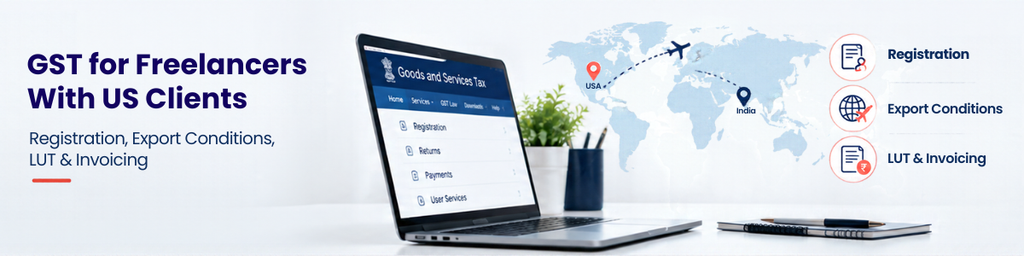
GST for freelances with US clients

Do freelancers have to charge GST to foreign clients?

This is one of the most misunderstood areas of freelance taxation.

A payment from a foreign client is not automatically an export of services for GST purposes. To qualify, the supply must satisfy the conditions in Section 2(6) of the Integrated Goods and Services Tax Act, 2017.

Broadly, the conditions require that:

  1. The supplier is located in India.
  2. The recipient is located outside India.
  3. The place of supply is outside India.
  4. Payment is received in convertible foreign exchange or Indian rupees wherever permitted by the Reserve Bank of India.
  5. The supplier and recipient are not merely establishments of a distinct person in the circumstances covered by the provision.

The exact statutory wording and applicable exceptions should be checked before relying on export treatment.  

If all the relevant conditions are satisfied, the service may qualify as an export of services. Exports are treated as zero-rated supplies under the IGST framework, subject to the applicable rules.

Zero-rated does not mean “ignore GST.” Registration, documentation, invoicing and return requirements may still apply.

Example: an Indian software developer serving a US company

Suppose an Indian software developer supplies development services directly to a US company. The developer should review the contract, identify the actual recipient, establish the place of supply, check the payment terms and determine whether the statutory export conditions are satisfied.

If the conditions are met, the transaction may qualify as an export of services. The developer can then consider the applicable zero-rated supply route, including an LUT where eligible and appropriate.

If the developer is actually acting as an intermediary, or the arrangement involves another party receiving the service, the analysis may be different. The customer’s overseas address alone does not settle the question.

What is an LUT, and why might a freelancer need one?

A Letter of Undertaking, commonly called an LUT, is a declaration filed through the GST system that allows an eligible registered person to make qualifying exports without payment of integrated GST, subject to the applicable requirements.

The relevant form is GST RFD-11.

The official GST Portal guidance explains the online process through Services → User Services → Furnish Letter of Undertaking (LUT). The portal generates an acknowledgement reference after successful filing. 

An LUT is not a substitute for registration where registration is required. Nor does it turn an ordinary domestic supply into an export.

A freelancer should first determine whether the supply qualifies as an export and whether the person is eligible to use the LUT route. The LUT should be filed for the relevant financial year in accordance with the applicable requirements.

What if the freelancer does not file an LUT?

The consequences depend on the transaction, timing and applicable provisions. Do not assume that filing an LUT later automatically cures every earlier invoice or tax issue.

If export invoices have already been issued, review the dates, return treatment, payment status and applicable rules with a GST professional before attempting corrections.

How should a freelancer invoice a foreign client?

An invoice should accurately describe the services supplied and reflect the transaction’s actual tax treatment.

For an export of services made under an LUT without payment of integrated GST, the applicable invoice endorsement and prescribed details must be followed. The GST invoice rules contain specific export-invoice requirements; the exact wording and fields should be checked against the current rules.

A freelancer’s invoice process should normally include:

  • Correct legal name and address of the supplier.
  • GSTIN, where applicable.
  • Invoice number and date.
  • Customer’s legal name and address.
  • Clear description of the service.
  • Currency and agreed consideration.
  • Applicable tax treatment and required export endorsement.
  • Contract or project reference where useful.
  • Payment terms and due date.
  • Relevant banking or payment instructions.

Do not add GST merely because a software template automatically inserts a tax rate. Equally, do not label every foreign-client invoice “zero-rated export” without checking the legal conditions.

A freelancer should retain the invoice alongside the contract, statements of work, evidence of delivery, payment records and supporting remittance documentation.

What if a foreign client pays in Indian rupees?

Payment currency is an important part of the export-of-services analysis, but it is not the only condition.

The statutory definition recognises receipt in convertible foreign exchange or in Indian rupees wherever permitted by the Reserve Bank of India. That means a payment in INR is not automatically disqualifying in every circumstance, but the relevant permitted payment route and supporting evidence need to be established.

For example, payment through an authorised arrangement may have a different evidentiary position from a domestic transfer where the relationship between the payer and overseas customer is unclear.

Freelancers should keep the contract, invoice, payment advice and bank or payment-platform records. If a platform deducts fees before settlement, preserve the gross transaction information and the fee breakdown as well.

Do not rely on a general online answer that says all INR receipts qualify—or that none can qualify. Check the applicable RBI-permitted route and the GST export conditions for the actual transaction.

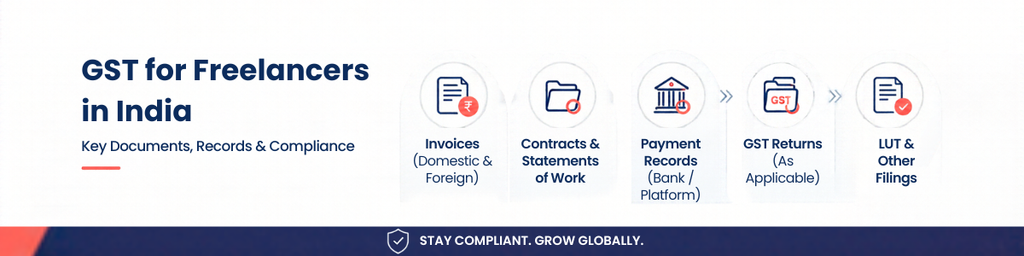
What records should freelancers keep?

Good records make GST compliance easier and help explain transactions if a question arises.

Depending on the business, maintain:

  • Client contracts and statements of work.
  • Invoices and credit notes.
  • Bank statements and payment-platform reports.
  • Foreign remittance or payment advice available from the bank or authorised provider.
  • LUT filing acknowledgement, where applicable.
  • GST registration and return acknowledgements.
  • Purchase invoices for business expenses.
  • Input-tax-credit records, where applicable.
  • Correspondence explaining changes to the scope or recipient of the service.
  • A reconciliation between invoices, amounts received and GST returns.

Do not assume that one specific document, such as a FIRC or FIRA, is universally required in exactly the same form for every payment route. What is available and what is legally relevant may depend on the banking or payment arrangement. Ask the authorised bank or payment provider what documentation it can issue and confirm the GST evidence requirements for your transaction.

GST Registration Chennai

Do freelancers need to file GST returns if they charge no GST?

Potentially, yes.

A registered freelancer may still have return-filing obligations even when eligible exports are made without payment of IGST under an LUT. Zero-rated supplies are not automatically omitted from GST reporting.

The precise returns and frequency depend on the taxpayer’s registration, filing scheme and applicable requirements. A freelancer should confirm the current return obligations on the GST Portal and ensure that invoices, export values, tax liability and input tax credit reconcile.

A “zero GST invoice” and a “no compliance obligation” are not the same thing.

Missing a required return can create late fees, notices and other consequences, depending on the circumstances. A freelancer should set reminders and retain acknowledgements after filing.

Can a freelancer claim input tax credit or a refund?

The answer depends on eligibility, the nature of the expense, the credit conditions and the refund provisions.

An eligible registered exporter may be able to claim a refund of accumulated eligible input tax credit on qualifying zero-rated supplies made without payment of tax under a bond or LUT, subject to the law and prescribed procedure.

However, not every purchase automatically qualifies for credit. The expense must satisfy the relevant conditions, and blocked credits and other restrictions may apply. Personal purchases should not be treated as business input tax credit merely because the freelancer has a GSTIN.

A freelancer who exports all services and has little or no domestic output tax may have a different credit position from someone who supplies both domestic and overseas customers. Refund eligibility and the amount recoverable should be assessed from the records, not assumed.

What about freelancers working through platforms or agencies?

A platform payment does not, by itself, tell you who the recipient of the service is for GST purposes.

A freelancer may be supplying a service directly to an overseas customer, providing a service to an Indian agency, or working under a platform arrangement with separate contractual roles. The platform may collect money, deduct fees or facilitate delivery without necessarily being the recipient of the underlying service.

Review the contract and terms of service. Identify:

  • Who hired the freelancer?
  • Who is legally receiving the service?
  • Who is responsible for paying the freelancer?
  • Is the platform an agent, intermediary or contracting party?
  • Where is the recipient located?
  • What service is actually supplied?

The answers may affect the place-of-supply and export analysis. Where an intermediary arrangement is possible, seek professional review before applying export treatment.

Common GST mistakes freelancers should avoid

Mistake 1: Assuming overseas income never counts towards turnover.
Aggregate turnover must be calculated under the statutory definition, which includes exports.

Mistake 2: Treating every foreign client as an export.
The statutory export conditions must be satisfied.

Mistake 3: Confusing zero-rated with exempt.
Zero-rated exports remain within the GST framework and may involve reporting and input-tax-credit provisions.

Mistake 4: Using an LUT as a replacement for registration.
An LUT is a route for eligible registered persons; it does not remove a registration requirement.

Mistake 5: Forgetting returns because no GST was charged.
Registered taxpayers may still have filing obligations.

Mistake 6: Treating income-tax rules as GST rules.
A presumptive income-tax provision and GST registration are separate legal questions.

Mistake 7: Relying on payment currency alone.
The recipient, place of supply, contract and permitted payment route all matter.

Mistake 8: Ignoring platform fees and reconciliation.
Keep gross transaction values, deductions and net receipts clear in your records.

A practical GST checklist for freelancers

Before deciding how to invoice, work through this checklist:

  1. List your services and customer types.
  2. Calculate aggregate turnover under the GST definition.
  3. Check the registration threshold applicable to your circumstances.
  4. Review compulsory-registration provisions and relevant notifications.
  5. For each foreign-client service, check all export-of-services conditions.
  6. Review the contract to determine who receives the service.
  7. Confirm the permitted payment route and retain evidence.
  8. If registered and eligible, assess whether an LUT is appropriate.
  9. Use invoices that match the actual transaction and prescribed rules.
  10. File the applicable returns and reconcile them with invoices and payments.
  11. Review input tax credit and refund eligibility before claiming.
  12. Get professional advice for intermediary services, mixed supplies or unclear cross-border arrangements.
Frequently asked questions

1. Is GST registration mandatory for every freelancer in India?

No. Registration depends on aggregate turnover, the nature of supplies, the applicable threshold and any compulsory-registration provision or exemption. Freelancers should assess their actual circumstances rather than assume all freelancers must register immediately.

2. Does foreign-client income count towards the GST threshold?

Exports form part of the statutory aggregate-turnover definition. A freelancer should not automatically exclude overseas receipts when calculating turnover.

3. Do freelancers need to charge 18% GST to US clients?

Not automatically. If the supply qualifies as an export of services, it may be zero-rated subject to the applicable conditions and procedures. The service arrangement and place of supply must be checked first.

4. What is an LUT for a freelancer?

An LUT is a Letter of Undertaking filed through Form GST RFD-11. An eligible registered exporter can use it to make qualifying exports without payment of integrated GST, subject to applicable rules.

5. Can I file an LUT without GST registration?

An LUT does not replace GST registration. The freelancer must first establish the applicable registration position and eligibility to use the LUT route.

6. Do I need GST returns if all my income comes from foreign clients?

If you are registered, you may still need to file the applicable returns and report qualifying exports. The exact filing obligations depend on your registration and the applicable rules.

7. Can a freelancer claim a refund of GST paid on a laptop or software?

Possibly, if the freelancer is registered and the expense and credit satisfy the relevant conditions. Blocked-credit rules and refund eligibility must be considered; not every purchase automatically qualifies.

8. Does receiving money through a payment platform make a transaction an export?

Not by itself. The recipient, contractual arrangement, place of supply, payment route and other export conditions must be assessed.

9. Is GST the same as income tax for freelancers?

No. GST and income tax are separate tax systems. An income-tax treatment does not, by itself, settle GST registration or export eligibility.

10. What should I do if I have already issued foreign invoices without an LUT?

Review the invoice dates, registration status, payment records and applicable rules with a qualified GST professional. Do not assume a later filing automatically resolves every earlier transaction.

How FilingPoint can help

Freelancers often begin with simple client invoices, then gradually take on larger projects, foreign contracts and recurring payments. As the business grows, GST decisions can become more complex.

FilingPoint supports businesses with GST registration and related compliance services. If you are unsure whether registration is required, whether your overseas services qualify as exports, or what filing steps apply after registration, review your facts before choosing a compliance route.

Need help understanding your GST registration and compliance requirements?

Phone: +91 72999 72500
Email: enquiry@filingpoint.com

A rejection does not mean you should simply submit the same application again without understanding the reason. First identify the issue, review the rejection order, correct the underlying problem and then determine whether a fresh application or an appeal is appropriate.

What Does GST Registration Rejection Mean?

When you apply for GST registration, the application is examined by the proper officer along with the information and documents submitted.

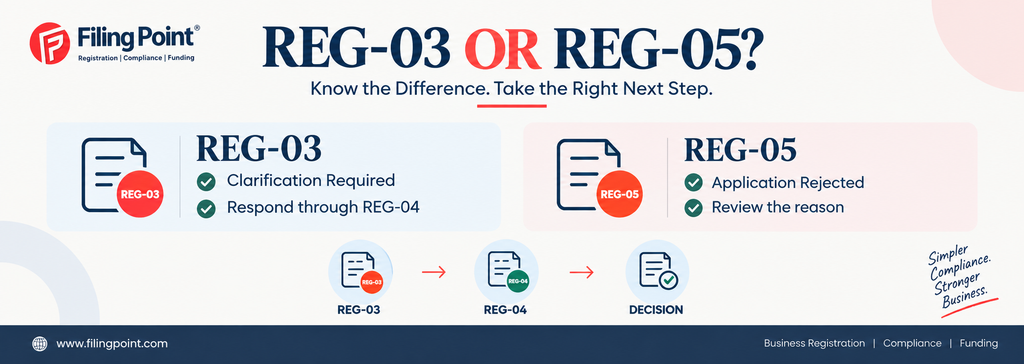
The officer may approve the application if the details are satisfactory. If the application has deficiencies or clarification is required, the officer may issue FORM GST REG-03 asking for additional information, clarification or documents.

The applicant can respond electronically through FORM GST REG-04.

If the applicant does not respond within the prescribed period, or the officer is not satisfied with the clarification, information or documents provided, the application can be rejected through FORM GST REG-05, with reasons recorded by the officer.

So, there is an important difference between:

GST application pending → clarification requested → response submitted → approval/rejection

and

GST application rejected → rejection order issued → next action needs to be considered.

Does GST Registration Rejection Mean Your Business Cannot Operate?

Not necessarily.

A rejected GST registration application is different from cancellation of an existing GST registration.

If your new registration application is rejected, you do not receive a GSTIN through that application. The next step depends on why the application was rejected and whether the issue can be corrected through a fresh application or whether an appeal or other remedy should be considered.

The GST Portal itself notes, in relation to a new-registration rejection where the reason needs clarification, that the applicant can review notices/orders and may file another new registration application after making the desired changes.

However, reapplying without fixing the underlying issue may simply lead to another rejection.

Why Is a GST Registration Application Rejected?

There is no single list that covers every rejection. The reason should be read from the relevant notice or rejection order.

However, several practical issues commonly arise during GST registration verification.

1. Incorrect business information

Details entered in the GST application should correspond with the supporting records.

Examples include:

  • Incorrect legal name
  • Incorrect PAN details
  • Incorrect constitution of business
  • Incorrect principal place of business
  • Inconsistent promoter or authorised signatory details
  • Incorrect business commencement or liability information

The GST registration rules require the applicant to provide specified information and documents through FORM GST REG-01.

2. Problems with address documents

The principal place of business is an important part of the GST registration application.

Problems can arise when:

  • The address in the application does not match the supporting documents.
  • The ownership or occupancy document is unclear.
  • A required consent/NOC is not properly provided where applicable.
  • The uploaded document is incomplete or difficult to verify.
  • The business premises information does not adequately support the application.

The exact documents required can vary according to the nature and possession of the premises.

3. Incomplete or incorrect documents

Submitting a document is not enough.

The document should also support the information declared in the application.

For example, if the applicant provides an address document that does not correspond with the business address entered in the application, the officer may seek clarification.

The same principle applies to identity, constitution and other supporting information.

4. Failure to respond to REG-03

This is one of the most important points for applicants to understand.

A REG-03 notice is not the final rejection order. It is a request for additional information, clarification or documents.

Under Rule 9, the applicant is required to furnish the response electronically in FORM GST REG-04 within seven working days from receipt of the notice.

Ignoring the notice can therefore turn a correctable issue into a rejected application.

5. Unsatisfactory clarification

Submitting a REG-04 response does not automatically guarantee approval.

The officer may consider the clarification, information or documents provided and determine whether they adequately address the issue raised.

If the response is not satisfactory, the application may be rejected through REG-05.

This is why a response should address the specific point raised in the notice rather than simply uploading unrelated documents.

6. Mismatch with earlier GST information

The GST registration process also considers information associated with the applicant’s PAN and earlier registrations.

CBIC has specifically instructed officers to exercise caution where an applicant seeks another registration in the same State despite having an existing registration or where an earlier registration has been cancelled.

If your business has an earlier GST registration, cancellation history or another registration associated with the same PAN, the circumstances should be reviewed before submitting a new application.

What Is GST REG-03?

FORM GST REG-03 is a notice issued by the tax officer when additional information, clarification or documents are required in relation to the GST registration application.

The form identifies the application reference number and sets out the information or clarification required. It also states the date by which the applicant needs to respond.

Think of it as:

REG-03 = “Please clarify/provide additional information.”

It is not the same as:

REG-05 = “Your application has been rejected.”

This distinction is important because the REG-03 stage gives the applicant an opportunity to address the issue before the registration application is rejected.

What Is GST REG-04?

FORM GST REG-04 is the applicant’s response to the REG-03 notice.

The response is used to provide:

  • Clarification
  • Additional information
  • Supporting documents
  • Corrections to permitted application particulars

The current registration rules provide a seven-working-day period from receipt of the REG-03 notice for furnishing the response.

A good response should directly answer every point raised in the notice.

For example:

Notice: Clarification required regarding business premises.

Weak response: Uploading the same document again without explanation.

Better response: Providing the requested premises document together with a concise explanation showing how the document supports the address declared in the application.

What Is GST REG-05?

FORM GST REG-05 is the order used to communicate rejection of certain GST applications, including a new registration application where the requirements under the registration procedure have not been satisfactorily met.

For a new registration application, Rule 9 provides that where the applicant does not furnish the required response within the prescribed period or the officer is not satisfied with the clarification, information or documents submitted, the application may be rejected through REG-05.

The rejection order should be read carefully because it tells you the reason for the decision.

Do not treat REG-05 as simply a technical error message.

What Should You Do After GST Registration Is Rejected?

Follow this sequence.

Step 1: Download and read the rejection order

Check the GST Portal for the relevant notice and order.

The GST Portal’s known-issues guidance directs applicants to:

TRN → Services → User Services → View Notices and Orders

when the reason for a new-registration rejection needs to be checked.

Step 2: Identify the exact reason

Do not rely on assumptions.

Look for the specific reason mentioned in the order.

Ask:

  • Was there a document issue?
  • Was the address unclear?
  • Was information inconsistent?
  • Was a clarification not submitted?
  • Was the response considered insufficient?
  • Is there an earlier GST registration associated with the PAN?

Step 3: Correct the underlying problem

If you decide to make a fresh application, correct the problem first.

For example, if the problem relates to:

Address → review the premises documents.

Business constitution → verify the legal entity details.

PAN/name mismatch → check the source records.

Missing clarification → understand what information the officer requested.

Previous GST registration → review the earlier registration status and history.

Step 4: Decide whether to reapply or consider an appeal

A fresh application and an appeal are not the same thing.

A fresh application starts a new registration process.

An appeal challenges an order.

Section 107 of the CGST Act provides a general appeal mechanism against decisions or orders passed under the Act, with the general period for an aggrieved person being three months from the date on which the decision or order is communicated.

Whether an appeal is appropriate in a particular registration-rejection case depends on the order and circumstances. The applicable appellate procedure should therefore be checked before taking action.

Can You Apply for GST Registration Again After Rejection?

A new registration application can be considered after a rejected application, particularly where the underlying issue has been corrected.

The GST Portal’s known-issues guidance specifically states that, where a new registration application has been rejected and the rejection reason needs clarification, the applicant may file another application after making the desired changes.

But do not simply copy the previous application.

Before reapplying:

  1. Read the rejection order.
  2. Identify the issue.
  3. Correct the information.
  4. Review supporting documents.
  5. Check the business address.
  6. Verify PAN and legal-name details.
  7. Check previous GST registrations.
  8. Review the complete application before submission.

What If Your GST Application Is Rejected Because of Address Proof?

Address-related issues should be handled carefully because the principal place of business is a key part of the registration application.

First check whether:

  • The address is entered correctly.
  • The supporting document relates to the same premises.
  • The nature of possession is correctly declared.
  • Required supporting documents have been provided.
  • Names and addresses are consistent across documents.
  • The document is clear and readable.

Do not upload random documents simply to increase the number of attachments.

The objective is to establish a clear connection between the business and the declared place of business.

What If GST Registration Is Rejected Due to PAN or Name Mismatch?

PAN is a fundamental part of GST registration.

The registration process validates the PAN and requires the legal name of the business/entity to correspond with PAN records.

Before reapplying, check:

PAN → Legal name → Constitution → Applicant details

If these details do not align, determine which record is correct and address the mismatch before submitting another application.

Can You Check Your GST Registration Application Status?

Yes.

The GST Portal provides an application-status facility using the application reference information.

During registration, the application receives an Application Reference Number (ARN), and the applicant can track the application status through the GST Portal.

The portal may show different statuses during processing, so the applicant should not assume that a pending application has been rejected.

If a notice or order has been issued, check the notices/orders section rather than relying only on the headline status.

What Happens If You Do Not Respond to REG-03?

The consequences can be significant.

Under Rule 9, if the applicant does not furnish the required response within the prescribed period, the proper officer may reject the registration application through REG-05.

That means a business may lose the opportunity to resolve a correctable issue during the clarification stage.

The practical lesson is simple:

GST notice received → read it immediately → note the deadline → prepare the correct response → submit it through the prescribed process.

Is GST Registration Rejection the Same as GST Cancellation?

No.

This distinction is important.

GST registration rejection

You applied for a new GST registration, but the application was rejected before the GSTIN was granted.

GST cancellation

You already have a GST registration, and that registration is subsequently cancelled under the applicable procedure.

Revocation of cancellation

A taxpayer whose registration was cancelled by the proper officer in circumstances covered by the law may have a route to seek revocation of the cancellation. This is a different process from a rejected new-registration application.

Do not use a cancellation/revocation article to answer a new-registration rejection problem.

What Happens If the Officer Does Not Take Action?

Rule 9 contains provisions concerning deemed approval if the proper officer does not take the prescribed action within the relevant period.

For a standard registration application, the rule provides that if the proper officer does not act within three working days from submission, or within seven working days from receipt of the applicant’s clarification/information/documents, the application shall be deemed to have been approved, subject to the applicable provisions of the rules.

However, GST registration procedures can involve specific authentication and verification requirements.

Therefore, businesses should not assume that every delayed application automatically means a GSTIN has been granted.

Check the actual application status and applicable procedure.

How to Avoid GST Registration Rejection

Before submitting a new GST registration application, use this checklist.

GST Registration Pre-Filing Checklist

Business details

  • Legal name checked against PAN
  • PAN details correct
  • Constitution of business correct
  • Business activity accurately described

Promoters/authorised signatory

  • Names checked
  • PAN details checked
  • Contact details active
  • Required authentication completed

Business premises

  • Correct principal address
  • Appropriate address document
  • Supporting documents readable
  • Ownership/occupancy details consistent

Application

  • Registration reason checked
  • State and jurisdiction details reviewed
  • Goods/services information checked
  • Required documents attached
  • Declaration and verification completed

After submission

  • ARN saved
  • GST Portal notifications monitored
  • REG-03 checked promptly if issued
  • REG-04 response prepared within the prescribed period

Example: How a GST Rejection Can Happen

Consider a small consulting company applying for GST registration.

The company submits its application but the officer requires clarification regarding the principal place of business.

A REG-03 notice is issued.

The applicant sees the notification but does not respond.

The prescribed response period passes.

Under Rule 9, failure to furnish the required reply can result in rejection through REG-05.

The business owner then submits the same application again without reviewing the original issue.

This may create another avoidable problem.

A better approach is:

REG-03 → understand the issue → prepare REG-04 → submit supporting clarification → wait for the decision.

If the application is ultimately rejected:

REG-05 → identify the reason → correct the issue → consider fresh application or appropriate remedy.

GST Registration Rejection vs Clarification Notice

SituationWhat it meansWhat you should do
Application submittedGST application is under processingTrack ARN
REG-03 receivedOfficer needs clarification/information/documentsRespond through REG-04
REG-04 submittedApplicant has provided the requested responseMonitor application
REG-05 issuedApplication has been rejectedRead the reasons and decide next step
REG-06 issuedGST registration grantedDownload certificate and follow applicable compliance

The forms themselves have different purposes: REG-03 is for seeking additional information/clarification/documents, REG-04 is the applicant’s response, REG-05 is the rejection order, and REG-06 is the registration certificate.

Common Mistakes After GST Registration Rejection

Mistake 1: Applying again without reading the order

A fresh application does not fix an unresolved problem.

Mistake 2: Ignoring REG-03

A clarification notice is an opportunity to address the issue before rejection.

Mistake 3: Uploading unrelated documents

More documents do not necessarily mean a stronger response.

Mistake 4: Repeating the same information

If the officer has identified a mismatch, the response should address the mismatch.

Mistake 5: Confusing rejection with cancellation

The legal and procedural situations are different.

Mistake 6: Assuming every rejection should be appealed

An appeal is a separate legal remedy. The appropriate next step depends on the order and facts.

Mistake 7: Not checking previous GST registrations

Earlier registration or cancellation history can be relevant to a new application. CBIC has specifically highlighted the need for caution in such cases.

Frequently Asked Questions

Why was my GST registration application rejected?

A GST application may be rejected where required information or documents are deficient, the applicant does not respond to a REG-03 notice within the prescribed period, or the officer is not satisfied with the clarification, information or documents submitted.

What is REG-03 in GST?

REG-03 is a notice issued by the proper officer seeking additional information, clarification or documents regarding the GST registration application.

How many days do I get to reply to REG-03?

Under Rule 9, the applicant is required to furnish the response in REG-04 within seven working days from receipt of the REG-03 notice.

What happens if I do not reply to REG-03?

If no reply is furnished within the prescribed period, the registration application may be rejected through REG-05.

What is REG-05?

REG-05 is the electronic order used to communicate rejection of specified GST applications, including registration applications where the requirements have not been satisfactorily met.

Can I apply for GST registration again after rejection?

A fresh application may be possible after correcting the issue. The GST Portal’s guidance also states that another new-registration application can be filed after making the desired changes in circumstances covered by its rejection guidance.

Can I appeal against GST registration rejection?

The CGST Act provides an appeal mechanism under Section 107 for persons aggrieved by applicable decisions or orders. The general period is three months from communication of the decision or order. Whether an appeal is appropriate in a particular registration-rejection matter should be checked against the actual order and applicable procedure.

Is GST registration rejection the same as GST cancellation?

No. Rejection concerns an application for registration. Cancellation concerns an existing GST registration.

How can I avoid GST registration rejection?

Check PAN and business details, verify the principal place of business documents, submit complete information, monitor the GST Portal after filing and respond promptly to any REG-03 notice.

Final Takeaway

A GST registration rejection is not something to ignore, but it is also not a reason to panic.

The most important thing is to understand exactly what happened.

If you receive REG-03, respond properly through REG-04 within the prescribed period.

If you receive REG-05, read the rejection reasons carefully before deciding whether to correct the issue and make a fresh application or consider an applicable appeal or other remedy.

The goal should not be to submit another application as quickly as possible.

The goal is to fix the reason that caused the rejection.

Need help with GST registration or business compliance?

Filing Point can help you understand the applicable registration requirements, review the documentation and assist with the GST registration process.

📞 +91 72999 72500
📧 enquiry@filingpoint.com

Introduction to Kovai

Coimbatore, affectionately called “Kovai,” is renowned as the Manchester of South India due to its thriving textile industry and dynamic industrial base. But it’s more than just a textile hub—Coimbatore is a powerful blend of industrial progress, startup energy, and educational excellence. Strategically located near Kerala and connected to major cities by rail, road, and air, it acts as a vital catalyst for industrial and trade movements across southern India.

With excellent infrastructure, entrepreneurial culture, and government support, Coimbatore is the ideal destination to launch your dream company. Starting a business in Coimbatore has never been easier, thanks to online company registration services. Whether you’re an aspiring entrepreneur, a growing startup, or an established business looking to formalize operations, Coimbatore offers a thriving ecosystem and simplified online registration options. With the help of professional service providers like FilingPoint.com, the entire process is digital, hassle-free, and affordable.


Why Start a Company in Coimbatore?

Coimbatore, known as the “Manchester of South India,” is a booming hub for textiles, engineering, IT, manufacturing, and startup ventures. The city is supported by various Special Economic Zones (SEZs), industrial parks, and a strong logistics infrastructure, making it easy to conduct domestic and international trade.

Moreover, the city’s skilled workforce, access to world-class educational institutions, low cost of living, and business-friendly government policies make it a perfect launchpad for new businesses. Whether you are into textiles, automation, software services, education, or agriculture-based ventures, Coimbatore provides a supportive and scalable environment.

Coimbatore also has a strong network of financial institutions, angel investors, and incubators to support early-stage entrepreneurs. So, starting a business here isn’t just affordable—it’s smart.


Types of Companies You Can Register Online

Before you register your business, it’s essential to choose the right structure. Each business type has its legal implications, tax benefits, and compliance requirements:

  • Private Limited Company (Pvt Ltd) – Offers limited liability and is suitable for startups seeking funding or scalability.
  • One Person Company (OPC) – Allows a single individual to own and operate with limited liability, ideal for freelancers and consultants.
  • Limited Liability Partnership (LLP) – Provides flexibility of a partnership with the legal benefits of a company, best for service-based businesses.
  • Sole Proprietorship – Easy to start and manage, but the owner has unlimited liability.
  • Public Limited Company – For larger businesses that plan to list on the stock exchange and raise capital from the public.
  • Section 8 Company – For NGOs and non-profit institutions involved in charitable, educational, or religious activities.

Each structure serves a different business purpose. FilingPoint.com provides free consultation to help you pick the right one based on your business vision.


Step-by-Step Process of Online Company Registration

Here is a detailed breakdown of how the online company registration process works:

  1. Choose a Suitable Business Structure – Based on your goals, funding plans, and scalability.
  2. Apply for Digital Signature Certificate (DSC) – A digital identity for signing documents electronically.
  3. Obtain Director Identification Number (DIN) – Every director must have a unique ID issued by the MCA.
  4. Reserve Company Name – Use the RUN (Reserve Unique Name) service on the MCA portal.
  5. Prepare Incorporation Documents – Includes MOA, AOA, and declaration forms.
  6. File SPICe+ Form – The integrated form for incorporation, PAN, TAN, and GST.
  7. Verification and Approval – The Registrar of Companies (ROC) reviews and approves.
  8. Receive Incorporation Certificate – Congratulations! Your company is now legally registered.

With expert assistance, this process can be completed quickly and correctly, avoiding common errors.


Documents Required for Company Registration in Coimbatore

To ensure a smooth registration process, you must have the following documents ready:

For Directors/Shareholders:

  • PAN Card
  • Aadhaar Card/Voter ID/Passport
  • Passport-size Photograph
  • Email ID and Mobile Number

For Registered Office:

  • Rental Agreement or Property Deed
  • Electricity Bill or Gas Bill (not older than 2 months)
  • NOC from Property Owner

Other Supporting Documents:

  • Bank statements
  • Consent to act as Director

All documents must be self-attested and in the correct format. FilingPoint.com helps in preparing and uploading all documents professionally.


Government Fees and Professional Charges Explained

The total cost to register a company in Coimbatore depends on:

  • Authorized Capital: Government fees increase as your capital increases.
  • Stamp Duty: Varies by the state; Tamil Nadu has its own rates.
  • Professional Fee: Service providers like FilingPoint.com charge a nominal fee based on the complexity of the registration.

Sample Pricing (Approx.):

  • Private Limited Company: ₹4,999 to ₹14,999
  • OPC Registration: ₹4,999 to ₹10,000
  • LLP Formation: ₹5,999 to ₹12,999

Additional services such as GST, MSME, and IEC registration can be bundled as a package.


How Long Does It Take to Register a Company Online?

On average, online company registration takes 7 to 10 working days, depending on document readiness and name approval. Here’s a rough breakdown:

  • Digital Signature: 1 Day
  • DIN Application: 1 Day
  • Name Approval: 1 to 2 Days
  • Filing Incorporation: 2 Days
  • MCA Approval: 2 to 3 Days

With FilingPoint.com’s express service, your company can be incorporated in as little as 5 days.


Benefits of Online Registration vs. Offline

  • Time-Saving: No need to travel or stand in queues
  • Paperless Process: All documentation is done digitally
  • Cost-Effective: Lower overheads and no hidden charges
  • Accuracy: Guided by professionals to avoid rejection
  • Convenience: Track your registration status online
  • Integration: Additional registrations like PAN, TAN, GST can be done simultaneously

Best Company Registration Service Provider in Coimbatore

FilingPoint.com. is one of Tamil Nadu’s leading business service providers, offering:

  • Experienced CA/CS/Legal experts
  • Transparent and fixed pricing
  • Step-by-step support
  • Additional services like GST, Trademark, Accounting, and Compliance
  • 24/7 chat and phone support

Clients include textile exporters, software firms, traders, and service providers in and around Coimbatore. With over 5000+ successful registrations, they are the go-to platform for entrepreneurs.


Common Mistakes to Avoid While Registering Your Business

  • Name Conflict: Choosing a name already registered or trademarked
  • Wrong Structure: Picking a structure not suitable for your business model
  • Incomplete Documents: Missing address proof or ID documents
  • Ignoring Compliance: Not applying for GST or missing ROC filings

By choosing an experienced service provider, you can avoid these pitfalls and ensure a seamless process.


FAQs on Online Company Formation in Coimbatore

Q1. Can I register a company in Coimbatore without visiting any office?
Yes, the process is fully online.

Q2. How many directors are needed for a Private Limited Company?
Minimum of 2 directors and a maximum of 15.

Q3. Is a commercial office address necessary?
No, even a residential address can be used for registration.

Q4. What if my company name is rejected?
You’ll be given the option to resubmit with alternate names.

Q5. Can an NRI register a company in Coimbatore?
Yes, with specific documents like passport, foreign address proof, and Indian mobile number.

Q6. Is it mandatory to have GST registration while starting a company?
Not mandatory initially unless your turnover exceeds ₹20 lakhs or you deal in inter-state supply.


Conclusion

Coimbatore is a land of opportunity, and setting up a business here can open the door to great success. From textile giants to tech startups, Coimbatore supports all kinds of ventures. With digital platforms and expert guidance from FilingPoint.com, online company registration in Coimbatore is not only fast and secure but also affordable.

If you’ve been waiting to turn your business dream into reality, now is the perfect time. Let FilingPoint.com handle the legalities while you focus on building your vision.


Start Your Company Today

👉 Visit FilingPoint.com for expert guidance, free consultation, and the best company registration packages in Coimbatore!