

A rejection does not mean you should simply submit the same application again without understanding the reason. First identify the issue, review the rejection order, correct the underlying problem and then determine whether a fresh application or an appeal is appropriate.
What Does GST Registration Rejection Mean?
When you apply for GST registration, the application is examined by the proper officer along with the information and documents submitted.
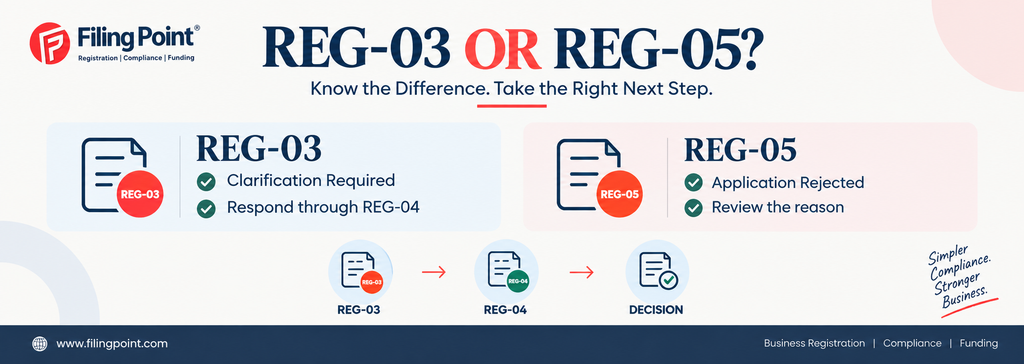
The officer may approve the application if the details are satisfactory. If the application has deficiencies or clarification is required, the officer may issue FORM GST REG-03 asking for additional information, clarification or documents.
The applicant can respond electronically through FORM GST REG-04.
If the applicant does not respond within the prescribed period, or the officer is not satisfied with the clarification, information or documents provided, the application can be rejected through FORM GST REG-05, with reasons recorded by the officer.
So, there is an important difference between:
GST application pending → clarification requested → response submitted → approval/rejection
and
GST application rejected → rejection order issued → next action needs to be considered.
Does GST Registration Rejection Mean Your Business Cannot Operate?
Not necessarily.
A rejected GST registration application is different from cancellation of an existing GST registration.
If your new registration application is rejected, you do not receive a GSTIN through that application. The next step depends on why the application was rejected and whether the issue can be corrected through a fresh application or whether an appeal or other remedy should be considered.
The GST Portal itself notes, in relation to a new-registration rejection where the reason needs clarification, that the applicant can review notices/orders and may file another new registration application after making the desired changes.
However, reapplying without fixing the underlying issue may simply lead to another rejection.

Why Is a GST Registration Application Rejected?
There is no single list that covers every rejection. The reason should be read from the relevant notice or rejection order.
However, several practical issues commonly arise during GST registration verification.
1. Incorrect business information
Details entered in the GST application should correspond with the supporting records.
Examples include:
- Incorrect legal name
- Incorrect PAN details
- Incorrect constitution of business
- Incorrect principal place of business
- Inconsistent promoter or authorised signatory details
- Incorrect business commencement or liability information
The GST registration rules require the applicant to provide specified information and documents through FORM GST REG-01.
2. Problems with address documents
The principal place of business is an important part of the GST registration application.
Problems can arise when:
- The address in the application does not match the supporting documents.
- The ownership or occupancy document is unclear.
- A required consent/NOC is not properly provided where applicable.
- The uploaded document is incomplete or difficult to verify.
- The business premises information does not adequately support the application.
The exact documents required can vary according to the nature and possession of the premises.
3. Incomplete or incorrect documents
Submitting a document is not enough.
The document should also support the information declared in the application.
For example, if the applicant provides an address document that does not correspond with the business address entered in the application, the officer may seek clarification.
The same principle applies to identity, constitution and other supporting information.
4. Failure to respond to REG-03
This is one of the most important points for applicants to understand.
A REG-03 notice is not the final rejection order. It is a request for additional information, clarification or documents.
Under Rule 9, the applicant is required to furnish the response electronically in FORM GST REG-04 within seven working days from receipt of the notice.
Ignoring the notice can therefore turn a correctable issue into a rejected application.
5. Unsatisfactory clarification
Submitting a REG-04 response does not automatically guarantee approval.
The officer may consider the clarification, information or documents provided and determine whether they adequately address the issue raised.
If the response is not satisfactory, the application may be rejected through REG-05.
This is why a response should address the specific point raised in the notice rather than simply uploading unrelated documents.
6. Mismatch with earlier GST information
The GST registration process also considers information associated with the applicant’s PAN and earlier registrations.
CBIC has specifically instructed officers to exercise caution where an applicant seeks another registration in the same State despite having an existing registration or where an earlier registration has been cancelled.
If your business has an earlier GST registration, cancellation history or another registration associated with the same PAN, the circumstances should be reviewed before submitting a new application.
What Is GST REG-03?
FORM GST REG-03 is a notice issued by the tax officer when additional information, clarification or documents are required in relation to the GST registration application.
The form identifies the application reference number and sets out the information or clarification required. It also states the date by which the applicant needs to respond.
Think of it as:
REG-03 = “Please clarify/provide additional information.”
It is not the same as:
REG-05 = “Your application has been rejected.”
This distinction is important because the REG-03 stage gives the applicant an opportunity to address the issue before the registration application is rejected.
What Is GST REG-04?
FORM GST REG-04 is the applicant’s response to the REG-03 notice.
The response is used to provide:
- Clarification
- Additional information
- Supporting documents
- Corrections to permitted application particulars
The current registration rules provide a seven-working-day period from receipt of the REG-03 notice for furnishing the response.
A good response should directly answer every point raised in the notice.
For example:
Notice: Clarification required regarding business premises.
Weak response: Uploading the same document again without explanation.
Better response: Providing the requested premises document together with a concise explanation showing how the document supports the address declared in the application.
What Is GST REG-05?
FORM GST REG-05 is the order used to communicate rejection of certain GST applications, including a new registration application where the requirements under the registration procedure have not been satisfactorily met.
For a new registration application, Rule 9 provides that where the applicant does not furnish the required response within the prescribed period or the officer is not satisfied with the clarification, information or documents submitted, the application may be rejected through REG-05.
The rejection order should be read carefully because it tells you the reason for the decision.
Do not treat REG-05 as simply a technical error message.
What Should You Do After GST Registration Is Rejected?
Follow this sequence.
Step 1: Download and read the rejection order
Check the GST Portal for the relevant notice and order.
The GST Portal’s known-issues guidance directs applicants to:
TRN → Services → User Services → View Notices and Orders
when the reason for a new-registration rejection needs to be checked.
Step 2: Identify the exact reason
Do not rely on assumptions.
Look for the specific reason mentioned in the order.
Ask:
- Was there a document issue?
- Was the address unclear?
- Was information inconsistent?
- Was a clarification not submitted?
- Was the response considered insufficient?
- Is there an earlier GST registration associated with the PAN?
Step 3: Correct the underlying problem
If you decide to make a fresh application, correct the problem first.
For example, if the problem relates to:
Address → review the premises documents.
Business constitution → verify the legal entity details.
PAN/name mismatch → check the source records.
Missing clarification → understand what information the officer requested.
Previous GST registration → review the earlier registration status and history.
Step 4: Decide whether to reapply or consider an appeal
A fresh application and an appeal are not the same thing.
A fresh application starts a new registration process.
An appeal challenges an order.
Section 107 of the CGST Act provides a general appeal mechanism against decisions or orders passed under the Act, with the general period for an aggrieved person being three months from the date on which the decision or order is communicated.
Whether an appeal is appropriate in a particular registration-rejection case depends on the order and circumstances. The applicable appellate procedure should therefore be checked before taking action.
Can You Apply for GST Registration Again After Rejection?
A new registration application can be considered after a rejected application, particularly where the underlying issue has been corrected.
The GST Portal’s known-issues guidance specifically states that, where a new registration application has been rejected and the rejection reason needs clarification, the applicant may file another application after making the desired changes.
But do not simply copy the previous application.
Before reapplying:
- Read the rejection order.
- Identify the issue.
- Correct the information.
- Review supporting documents.
- Check the business address.
- Verify PAN and legal-name details.
- Check previous GST registrations.
- Review the complete application before submission.
What If Your GST Application Is Rejected Because of Address Proof?
Address-related issues should be handled carefully because the principal place of business is a key part of the registration application.
First check whether:
- The address is entered correctly.
- The supporting document relates to the same premises.
- The nature of possession is correctly declared.
- Required supporting documents have been provided.
- Names and addresses are consistent across documents.
- The document is clear and readable.
Do not upload random documents simply to increase the number of attachments.
The objective is to establish a clear connection between the business and the declared place of business.
What If GST Registration Is Rejected Due to PAN or Name Mismatch?
PAN is a fundamental part of GST registration.
The registration process validates the PAN and requires the legal name of the business/entity to correspond with PAN records.
Before reapplying, check:
PAN → Legal name → Constitution → Applicant details
If these details do not align, determine which record is correct and address the mismatch before submitting another application.
Can You Check Your GST Registration Application Status?
Yes.
The GST Portal provides an application-status facility using the application reference information.
During registration, the application receives an Application Reference Number (ARN), and the applicant can track the application status through the GST Portal.
The portal may show different statuses during processing, so the applicant should not assume that a pending application has been rejected.
If a notice or order has been issued, check the notices/orders section rather than relying only on the headline status.
What Happens If You Do Not Respond to REG-03?
The consequences can be significant.
Under Rule 9, if the applicant does not furnish the required response within the prescribed period, the proper officer may reject the registration application through REG-05.
That means a business may lose the opportunity to resolve a correctable issue during the clarification stage.
The practical lesson is simple:
GST notice received → read it immediately → note the deadline → prepare the correct response → submit it through the prescribed process.
Is GST Registration Rejection the Same as GST Cancellation?
No.
This distinction is important.
GST registration rejection
You applied for a new GST registration, but the application was rejected before the GSTIN was granted.
GST cancellation
You already have a GST registration, and that registration is subsequently cancelled under the applicable procedure.
Revocation of cancellation
A taxpayer whose registration was cancelled by the proper officer in circumstances covered by the law may have a route to seek revocation of the cancellation. This is a different process from a rejected new-registration application.
Do not use a cancellation/revocation article to answer a new-registration rejection problem.
What Happens If the Officer Does Not Take Action?
Rule 9 contains provisions concerning deemed approval if the proper officer does not take the prescribed action within the relevant period.
For a standard registration application, the rule provides that if the proper officer does not act within three working days from submission, or within seven working days from receipt of the applicant’s clarification/information/documents, the application shall be deemed to have been approved, subject to the applicable provisions of the rules.
However, GST registration procedures can involve specific authentication and verification requirements.
Therefore, businesses should not assume that every delayed application automatically means a GSTIN has been granted.
Check the actual application status and applicable procedure.

How to Avoid GST Registration Rejection
Before submitting a new GST registration application, use this checklist.
GST Registration Pre-Filing Checklist
Business details
- Legal name checked against PAN
- PAN details correct
- Constitution of business correct
- Business activity accurately described
Promoters/authorised signatory
- Names checked
- PAN details checked
- Contact details active
- Required authentication completed
Business premises
- Correct principal address
- Appropriate address document
- Supporting documents readable
- Ownership/occupancy details consistent
Application
- Registration reason checked
- State and jurisdiction details reviewed
- Goods/services information checked
- Required documents attached
- Declaration and verification completed
After submission
- ARN saved
- GST Portal notifications monitored
- REG-03 checked promptly if issued
- REG-04 response prepared within the prescribed period
Example: How a GST Rejection Can Happen
Consider a small consulting company applying for GST registration.
The company submits its application but the officer requires clarification regarding the principal place of business.
A REG-03 notice is issued.
The applicant sees the notification but does not respond.
The prescribed response period passes.
Under Rule 9, failure to furnish the required reply can result in rejection through REG-05.
The business owner then submits the same application again without reviewing the original issue.
This may create another avoidable problem.
A better approach is:
REG-03 → understand the issue → prepare REG-04 → submit supporting clarification → wait for the decision.
If the application is ultimately rejected:
REG-05 → identify the reason → correct the issue → consider fresh application or appropriate remedy.
GST Registration Rejection vs Clarification Notice
| Situation | What it means | What you should do |
| Application submitted | GST application is under processing | Track ARN |
| REG-03 received | Officer needs clarification/information/documents | Respond through REG-04 |
| REG-04 submitted | Applicant has provided the requested response | Monitor application |
| REG-05 issued | Application has been rejected | Read the reasons and decide next step |
| REG-06 issued | GST registration granted | Download certificate and follow applicable compliance |
The forms themselves have different purposes: REG-03 is for seeking additional information/clarification/documents, REG-04 is the applicant’s response, REG-05 is the rejection order, and REG-06 is the registration certificate.

Common Mistakes After GST Registration Rejection
Mistake 1: Applying again without reading the order
A fresh application does not fix an unresolved problem.
Mistake 2: Ignoring REG-03
A clarification notice is an opportunity to address the issue before rejection.
Mistake 3: Uploading unrelated documents
More documents do not necessarily mean a stronger response.
Mistake 4: Repeating the same information
If the officer has identified a mismatch, the response should address the mismatch.
Mistake 5: Confusing rejection with cancellation
The legal and procedural situations are different.
Mistake 6: Assuming every rejection should be appealed
An appeal is a separate legal remedy. The appropriate next step depends on the order and facts.
Mistake 7: Not checking previous GST registrations
Earlier registration or cancellation history can be relevant to a new application. CBIC has specifically highlighted the need for caution in such cases.
Frequently Asked Questions
Why was my GST registration application rejected?
A GST application may be rejected where required information or documents are deficient, the applicant does not respond to a REG-03 notice within the prescribed period, or the officer is not satisfied with the clarification, information or documents submitted.
What is REG-03 in GST?
REG-03 is a notice issued by the proper officer seeking additional information, clarification or documents regarding the GST registration application.
How many days do I get to reply to REG-03?
Under Rule 9, the applicant is required to furnish the response in REG-04 within seven working days from receipt of the REG-03 notice.
What happens if I do not reply to REG-03?
If no reply is furnished within the prescribed period, the registration application may be rejected through REG-05.
What is REG-05?
REG-05 is the electronic order used to communicate rejection of specified GST applications, including registration applications where the requirements have not been satisfactorily met.
Can I apply for GST registration again after rejection?
A fresh application may be possible after correcting the issue. The GST Portal’s guidance also states that another new-registration application can be filed after making the desired changes in circumstances covered by its rejection guidance.
Can I appeal against GST registration rejection?
The CGST Act provides an appeal mechanism under Section 107 for persons aggrieved by applicable decisions or orders. The general period is three months from communication of the decision or order. Whether an appeal is appropriate in a particular registration-rejection matter should be checked against the actual order and applicable procedure.
Is GST registration rejection the same as GST cancellation?
No. Rejection concerns an application for registration. Cancellation concerns an existing GST registration.
How can I avoid GST registration rejection?
Check PAN and business details, verify the principal place of business documents, submit complete information, monitor the GST Portal after filing and respond promptly to any REG-03 notice.
Final Takeaway
A GST registration rejection is not something to ignore, but it is also not a reason to panic.
The most important thing is to understand exactly what happened.
If you receive REG-03, respond properly through REG-04 within the prescribed period.
If you receive REG-05, read the rejection reasons carefully before deciding whether to correct the issue and make a fresh application or consider an applicable appeal or other remedy.
The goal should not be to submit another application as quickly as possible.
The goal is to fix the reason that caused the rejection.
Need help with GST registration or business compliance?
Filing Point can help you understand the applicable registration requirements, review the documentation and assist with the GST registration process.
📞 +91 72999 72500
📧 enquiry@filingpoint.com
