GSTR-1 - 11-Oct-2026
GSTR-3B - 20-Oct-2026

Articles

Freelancing has become a serious business model in India. Software developers, designers, consultants, digital marketers, video editors, writers and other professionals increasingly work with clients across India and overseas.

But as freelance income grows, questions about GST become harder to ignore.

A designer may receive payments from clients in India and the United States. A developer may earn through a foreign freelancing platform. A consultant may receive payments in US dollars but maintain a bank account in India. Another freelancer may earn less than the usual registration threshold and wonder whether GST registration is necessary at all.

These situations are not identical.

The answer depends on several factors: the freelancer’s aggregate turnover, the type of service supplied, the location of the customer, the place of supply, the payment arrangement and whether any special registration provision applies.

This guide explains how to approach GST as a freelancer in India, including registration, foreign clients, export of services, Letter of Undertaking (LUT), invoices, records and ongoing compliance.

Important: This article provides general information, not a personalised tax opinion. GST provisions and administrative procedures can change. Check the current official GST and CBIC guidance before acting, especially where foreign-client contracts, intermediary services or cross-border payment arrangements are involved.

What does GST mean for a freelancer?

Goods and Services Tax is an indirect tax framework that applies to specified supplies of goods and services. A freelancer who supplies services independently may be treated as a supplier for GST purposes, depending on the facts and applicable law.

The word “freelancer” does not create a separate blanket exemption from GST.

For example, consider three professionals:

  • A graphic designer serving Indian businesses.
  • A software developer supplying services directly to a company in the United States.
  • A consultant who works through an agency and receives payment from an Indian business.

Their GST treatment may differ because their customers, contracts, service arrangements and places of supply may differ.

GST is also separate from income tax. A freelancer may need to consider income-tax reporting even when no GST is charged on a particular supply. Likewise, an income-tax presumptive scheme does not, by itself, decide whether GST registration is required.

The correct starting point is to identify what service is being supplied, who receives it, how much aggregate turnover the freelancer has and whether a registration provision applies.

What is the GST registration threshold for freelancers?

Section 22 of the Central Goods and Services Tax Act, 2017 establishes a general registration threshold, subject to the Act, notifications and other applicable conditions. The commonly applicable threshold for service suppliers in many states is ₹20 lakh of aggregate turnover in a financial year, with a lower threshold applying in certain specified states.

However, freelancers should not use one number without checking their circumstances.

The relevant questions include:

  1. In which state or union territory is the freelancer located?
  2. What supplies form part of aggregate turnover?
  3. Does the freelancer provide only services, or also goods?
  4. Are any compulsory-registration provisions applicable?
  5. Is the person relying on a specific exemption or notification?

Aggregate turnover is a legal concept. It is not always identical to the cash deposited into a bank account, the profit shown in an income-tax return or the amount left after deducting business expenses.

Under the CGST Act, aggregate turnover is calculated on an all-India basis for supplies of persons having the same PAN, subject to the statutory definition and exclusions. It generally includes taxable supplies, exempt supplies and exports, while specified taxes and certain inward supplies are excluded.

Does income from foreign clients count towards the threshold?

Do not automatically exclude foreign-client income merely because the payment arrives in a foreign currency or the customer is outside India.

Export supplies are part of the GST framework, and the statutory definition of aggregate turnover includes exports. Whether a particular transaction qualifies as an export of services is a separate legal test.

For example, if a freelancer supplies services to Indian clients and overseas clients, the relevant turnover assessment may need to consider both. A professional should not calculate the threshold using only domestic receipts without checking the legal definition.

Does working with clients in another Indian state automatically require registration?

The answer depends on the applicable provisions and the nature of the supply. The general registration threshold and the rules for inter-State supplies must be read together with relevant exemptions and notifications.

Freelancers should not rely solely on a social-media comment saying that every inter-State service requires registration, or that every freelancer below a particular amount is exempt. The applicable notification and facts matter.

For a registration decision, check the current CGST Act and relevant notifications or obtain advice from a qualified GST practitioner.

Is GST registration compulsory for every freelancer?

No. Being a freelancer does not, by itself, mean that registration is immediately compulsory in every case.

A freelancer must assess the general threshold as well as the categories of persons who may be required to register under Section 24 and any relevant notifications or exemptions.

Registration can also be a business decision in some circumstances, but voluntary registration has consequences. Once registered, a person generally has ongoing compliance responsibilities, including applicable returns and record-keeping, even if the business has a low level of activity.

Before choosing voluntary registration, consider:

  • Whether registration is legally required.
  • Whether clients need a GST registration number or tax invoice.
  • Whether input tax credit is relevant to the business.
  • The cost and time of maintaining compliance.
  • Whether the freelancer’s supplies are domestic, exported or a mixture.
  • Whether registration could create obligations that outweigh the immediate benefit.

Do not register simply because another freelancer has done so. Equally, do not delay registration when the law requires it.
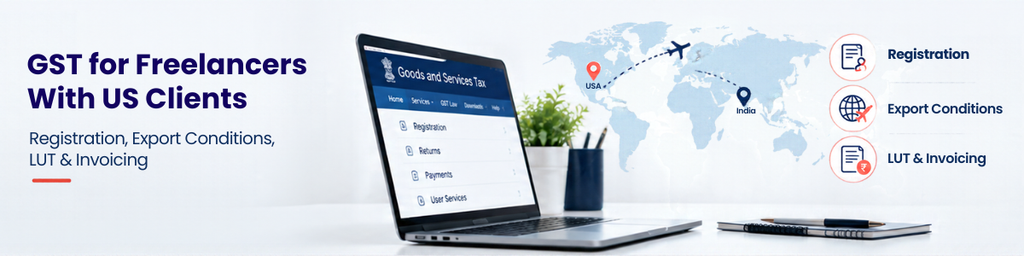
GST for freelances with US clients

Do freelancers have to charge GST to foreign clients?

This is one of the most misunderstood areas of freelance taxation.

A payment from a foreign client is not automatically an export of services for GST purposes. To qualify, the supply must satisfy the conditions in Section 2(6) of the Integrated Goods and Services Tax Act, 2017.

Broadly, the conditions require that:

  1. The supplier is located in India.
  2. The recipient is located outside India.
  3. The place of supply is outside India.
  4. Payment is received in convertible foreign exchange or Indian rupees wherever permitted by the Reserve Bank of India.
  5. The supplier and recipient are not merely establishments of a distinct person in the circumstances covered by the provision.

The exact statutory wording and applicable exceptions should be checked before relying on export treatment.  

If all the relevant conditions are satisfied, the service may qualify as an export of services. Exports are treated as zero-rated supplies under the IGST framework, subject to the applicable rules.

Zero-rated does not mean “ignore GST.” Registration, documentation, invoicing and return requirements may still apply.

Example: an Indian software developer serving a US company

Suppose an Indian software developer supplies development services directly to a US company. The developer should review the contract, identify the actual recipient, establish the place of supply, check the payment terms and determine whether the statutory export conditions are satisfied.

If the conditions are met, the transaction may qualify as an export of services. The developer can then consider the applicable zero-rated supply route, including an LUT where eligible and appropriate.

If the developer is actually acting as an intermediary, or the arrangement involves another party receiving the service, the analysis may be different. The customer’s overseas address alone does not settle the question.

What is an LUT, and why might a freelancer need one?

A Letter of Undertaking, commonly called an LUT, is a declaration filed through the GST system that allows an eligible registered person to make qualifying exports without payment of integrated GST, subject to the applicable requirements.

The relevant form is GST RFD-11.

The official GST Portal guidance explains the online process through Services → User Services → Furnish Letter of Undertaking (LUT). The portal generates an acknowledgement reference after successful filing. 

An LUT is not a substitute for registration where registration is required. Nor does it turn an ordinary domestic supply into an export.

A freelancer should first determine whether the supply qualifies as an export and whether the person is eligible to use the LUT route. The LUT should be filed for the relevant financial year in accordance with the applicable requirements.

What if the freelancer does not file an LUT?

The consequences depend on the transaction, timing and applicable provisions. Do not assume that filing an LUT later automatically cures every earlier invoice or tax issue.

If export invoices have already been issued, review the dates, return treatment, payment status and applicable rules with a GST professional before attempting corrections.

How should a freelancer invoice a foreign client?

An invoice should accurately describe the services supplied and reflect the transaction’s actual tax treatment.

For an export of services made under an LUT without payment of integrated GST, the applicable invoice endorsement and prescribed details must be followed. The GST invoice rules contain specific export-invoice requirements; the exact wording and fields should be checked against the current rules.

A freelancer’s invoice process should normally include:

  • Correct legal name and address of the supplier.
  • GSTIN, where applicable.
  • Invoice number and date.
  • Customer’s legal name and address.
  • Clear description of the service.
  • Currency and agreed consideration.
  • Applicable tax treatment and required export endorsement.
  • Contract or project reference where useful.
  • Payment terms and due date.
  • Relevant banking or payment instructions.

Do not add GST merely because a software template automatically inserts a tax rate. Equally, do not label every foreign-client invoice “zero-rated export” without checking the legal conditions.

A freelancer should retain the invoice alongside the contract, statements of work, evidence of delivery, payment records and supporting remittance documentation.

What if a foreign client pays in Indian rupees?

Payment currency is an important part of the export-of-services analysis, but it is not the only condition.

The statutory definition recognises receipt in convertible foreign exchange or in Indian rupees wherever permitted by the Reserve Bank of India. That means a payment in INR is not automatically disqualifying in every circumstance, but the relevant permitted payment route and supporting evidence need to be established.

For example, payment through an authorised arrangement may have a different evidentiary position from a domestic transfer where the relationship between the payer and overseas customer is unclear.

Freelancers should keep the contract, invoice, payment advice and bank or payment-platform records. If a platform deducts fees before settlement, preserve the gross transaction information and the fee breakdown as well.

Do not rely on a general online answer that says all INR receipts qualify—or that none can qualify. Check the applicable RBI-permitted route and the GST export conditions for the actual transaction.

What records should freelancers keep?

Good records make GST compliance easier and help explain transactions if a question arises.

Depending on the business, maintain:

  • Client contracts and statements of work.
  • Invoices and credit notes.
  • Bank statements and payment-platform reports.
  • Foreign remittance or payment advice available from the bank or authorised provider.
  • LUT filing acknowledgement, where applicable.
  • GST registration and return acknowledgements.
  • Purchase invoices for business expenses.
  • Input-tax-credit records, where applicable.
  • Correspondence explaining changes to the scope or recipient of the service.
  • A reconciliation between invoices, amounts received and GST returns.

Do not assume that one specific document, such as a FIRC or FIRA, is universally required in exactly the same form for every payment route. What is available and what is legally relevant may depend on the banking or payment arrangement. Ask the authorised bank or payment provider what documentation it can issue and confirm the GST evidence requirements for your transaction.

GST Registration Chennai

Do freelancers need to file GST returns if they charge no GST?

Potentially, yes.

A registered freelancer may still have return-filing obligations even when eligible exports are made without payment of IGST under an LUT. Zero-rated supplies are not automatically omitted from GST reporting.

The precise returns and frequency depend on the taxpayer’s registration, filing scheme and applicable requirements. A freelancer should confirm the current return obligations on the GST Portal and ensure that invoices, export values, tax liability and input tax credit reconcile.

A “zero GST invoice” and a “no compliance obligation” are not the same thing.

Missing a required return can create late fees, notices and other consequences, depending on the circumstances. A freelancer should set reminders and retain acknowledgements after filing.

Can a freelancer claim input tax credit or a refund?

The answer depends on eligibility, the nature of the expense, the credit conditions and the refund provisions.

An eligible registered exporter may be able to claim a refund of accumulated eligible input tax credit on qualifying zero-rated supplies made without payment of tax under a bond or LUT, subject to the law and prescribed procedure.

However, not every purchase automatically qualifies for credit. The expense must satisfy the relevant conditions, and blocked credits and other restrictions may apply. Personal purchases should not be treated as business input tax credit merely because the freelancer has a GSTIN.

A freelancer who exports all services and has little or no domestic output tax may have a different credit position from someone who supplies both domestic and overseas customers. Refund eligibility and the amount recoverable should be assessed from the records, not assumed.

What about freelancers working through platforms or agencies?

A platform payment does not, by itself, tell you who the recipient of the service is for GST purposes.

A freelancer may be supplying a service directly to an overseas customer, providing a service to an Indian agency, or working under a platform arrangement with separate contractual roles. The platform may collect money, deduct fees or facilitate delivery without necessarily being the recipient of the underlying service.

Review the contract and terms of service. Identify:

  • Who hired the freelancer?
  • Who is legally receiving the service?
  • Who is responsible for paying the freelancer?
  • Is the platform an agent, intermediary or contracting party?
  • Where is the recipient located?
  • What service is actually supplied?

The answers may affect the place-of-supply and export analysis. Where an intermediary arrangement is possible, seek professional review before applying export treatment.

Common GST mistakes freelancers should avoid

Mistake 1: Assuming overseas income never counts towards turnover.
Aggregate turnover must be calculated under the statutory definition, which includes exports.

Mistake 2: Treating every foreign client as an export.
The statutory export conditions must be satisfied.

Mistake 3: Confusing zero-rated with exempt.
Zero-rated exports remain within the GST framework and may involve reporting and input-tax-credit provisions.

Mistake 4: Using an LUT as a replacement for registration.
An LUT is a route for eligible registered persons; it does not remove a registration requirement.

Mistake 5: Forgetting returns because no GST was charged.
Registered taxpayers may still have filing obligations.

Mistake 6: Treating income-tax rules as GST rules.
A presumptive income-tax provision and GST registration are separate legal questions.

Mistake 7: Relying on payment currency alone.
The recipient, place of supply, contract and permitted payment route all matter.

Mistake 8: Ignoring platform fees and reconciliation.
Keep gross transaction values, deductions and net receipts clear in your records.

A practical GST checklist for freelancers

Before deciding how to invoice, work through this checklist:

  1. List your services and customer types.
  2. Calculate aggregate turnover under the GST definition.
  3. Check the registration threshold applicable to your circumstances.
  4. Review compulsory-registration provisions and relevant notifications.
  5. For each foreign-client service, check all export-of-services conditions.
  6. Review the contract to determine who receives the service.
  7. Confirm the permitted payment route and retain evidence.
  8. If registered and eligible, assess whether an LUT is appropriate.
  9. Use invoices that match the actual transaction and prescribed rules.
  10. File the applicable returns and reconcile them with invoices and payments.
  11. Review input tax credit and refund eligibility before claiming.
  12. Get professional advice for intermediary services, mixed supplies or unclear cross-border arrangements.

Frequently asked questions

1. Is GST registration mandatory for every freelancer in India?

No. Registration depends on aggregate turnover, the nature of supplies, the applicable threshold and any compulsory-registration provision or exemption. Freelancers should assess their actual circumstances rather than assume all freelancers must register immediately.

2. Does foreign-client income count towards the GST threshold?

Exports form part of the statutory aggregate-turnover definition. A freelancer should not automatically exclude overseas receipts when calculating turnover.

3. Do freelancers need to charge 18% GST to US clients?

Not automatically. If the supply qualifies as an export of services, it may be zero-rated subject to the applicable conditions and procedures. The service arrangement and place of supply must be checked first.

4. What is an LUT for a freelancer?

An LUT is a Letter of Undertaking filed through Form GST RFD-11. An eligible registered exporter can use it to make qualifying exports without payment of integrated GST, subject to applicable rules.

5. Can I file an LUT without GST registration?

An LUT does not replace GST registration. The freelancer must first establish the applicable registration position and eligibility to use the LUT route.

6. Do I need GST returns if all my income comes from foreign clients?

If you are registered, you may still need to file the applicable returns and report qualifying exports. The exact filing obligations depend on your registration and the applicable rules.

7. Can a freelancer claim a refund of GST paid on a laptop or software?

Possibly, if the freelancer is registered and the expense and credit satisfy the relevant conditions. Blocked-credit rules and refund eligibility must be considered; not every purchase automatically qualifies.

8. Does receiving money through a payment platform make a transaction an export?

Not by itself. The recipient, contractual arrangement, place of supply, payment route and other export conditions must be assessed.

9. Is GST the same as income tax for freelancers?

No. GST and income tax are separate tax systems. An income-tax treatment does not, by itself, settle GST registration or export eligibility.

10. What should I do if I have already issued foreign invoices without an LUT?

Review the invoice dates, registration status, payment records and applicable rules with a qualified GST professional. Do not assume a later filing automatically resolves every earlier transaction.

How FilingPoint can help

Freelancers often begin with simple client invoices, then gradually take on larger projects, foreign contracts and recurring payments. As the business grows, GST decisions can become more complex.

FilingPoint supports businesses with GST registration and related compliance services. If you are unsure whether registration is required, whether your overseas services qualify as exports, or what filing steps apply after registration, review your facts before choosing a compliance route.

Need help understanding your GST registration and compliance requirements?

Phone: +91 72999 72500
Email: enquiry@filingpoint.com

Choosing a legal structure is an important decision when starting a business. A sole proprietor may begin with a small consultancy, a partnership may start with two founders, or a startup may register as a Limited Liability Partnership (LLP) because it suits the initial business model.

But a business does not remain the same forever.

A small enterprise may start hiring employees, take on larger clients, seek outside investment or expand into new locations. The founders may then discover that their existing structure no longer suits their plans. A private limited company may also decide that an LLP better fits its ownership and operating model, subject to the applicable legal and tax conditions.

This leads to a common question: Can you change your business structure after registration, or must you start again?

The answer depends on the legal form you currently have, the form you want to adopt and the route permitted by law. It is not safe to assume that every business can simply “convert” by filing one form with the Ministry of Corporate Affairs (MCA).

This guide explains the main routes available in India, the checks to complete before conversion, and the registrations and records that may need attention afterwards.

What does changing a business structure mean?

Changing a business structure means moving from one legal form of business to another. Examples include:

  • A sole proprietorship moving its business into a private limited company.
  • A partnership firm converting into an LLP.
  • An LLP registering as a company under the applicable legal route.
  • A One Person Company (OPC) becoming a private limited company.
  • A private limited company converting into an LLP, where eligible.
  • A private limited company converting into a public company.

These changes are different from changing a company’s name, registered office, directors, shareholders or business activities. Those actions may require their own approvals and filings, but they do not necessarily change the legal form of the entity.

For example, a private limited company can update its permitted business activities where legally appropriate without becoming an LLP. Likewise, changing a proprietorship’s trade name does not create a separate incorporated entity.

The first step is therefore to identify the change you actually need.

Why might a business want to change its structure?

There is no single reason for restructuring. Common triggers include the following.

Bringing in investors

A startup may want to issue shares, create an employee stock option plan or prepare for an equity investment. A private limited company is often considered for these goals, although the correct structure depends on the investor, business model and applicable rules.

Managing liability

A proprietor and the business are not separate legal persons in the same way as a company. An LLP or company may offer a separate legal identity and limited liability, subject to statutory exceptions and the facts of the case.

Reducing or changing compliance responsibilities

A founder may find that a company’s governance and filing obligations no longer match the scale or operating needs of the business. An LLP may be worth evaluating, but it is not automatically cheaper or simpler in every situation. Conversion itself may involve professional fees, filings, tax analysis and changes to registrations.

Adding co-founders or changing ownership

A sole proprietor may wish to formalise ownership with another founder. A partnership may want to introduce more structured governance, while an established company may consider a different ownership or capital arrangement.

Preparing for expansion

Larger customers, lenders, tenders, licences or business partners may have preferences or eligibility requirements relating to the supplier’s legal form. Confirm the actual requirement rather than restructuring based on assumptions.

Practical point: Changing a structure should solve a defined business problem. Do not convert only because another structure is popular or because someone claims it guarantees lower tax or fewer compliance obligations.

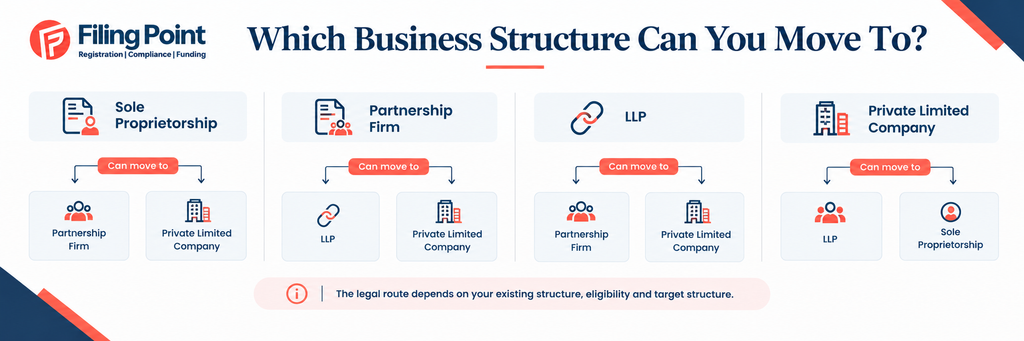
Which business structures can be changed?

The table below is a starting guide, not a determination that every business is eligible.

Existing structurePossible target structureGeneral route
Sole proprietorshipPrivate limited companyUsually incorporate a new company and transfer the business
Sole proprietorshipLLPUsually form an LLP and transfer the business
Partnership firmLLPStatutory conversion route may be available if conditions are met
Partnership firmCompanyRegistration under the applicable Companies Act route may be available
LLPPrivate limited companyRegistration under the Companies Act route may be available, subject to requirements
OPCPrivate limited companyCompany conversion process under applicable company law
Private limited companyPublic limited companyCompany-class conversion under the Companies Act
Private limited companyLLPStatutory conversion route may be available if the conditions are met
Private limited companyOPCPossible only if current legal requirements and eligibility conditions are satisfied

The legal route, approvals, forms and consequences differ. Confirm the latest MCA requirements before starting the transaction.

Business Structure Conversion

Conversion is not always the same as creating a new business

This is one of the most important distinctions in business restructuring.

When a statutory conversion route exists

Certain types of firms and entities can register or convert into another form under a specific legal provision. For example, the Companies Act, 2013 provides for conversion of companies already registered under the Act into another class of company, subject to the applicable requirements. Section 366 and the Companies (Authorised to Register) Rules, 2014 provide a route for specified entities, including LLPs and partnership firms, to register as companies. The LLP Act also provides conversion routes for specified entities.

The correct route depends on the existing entity and target structure. Relevant provisions include Section 18 and Section 366 of the Companies Act, 2013, and the applicable schedules of the Limited Liability Partnership Act, 2008.  

When a new entity must be formed

A sole proprietorship is not a company registered under the Companies Act. It generally cannot be transformed into a private limited company by simply changing its registration type. Instead, the proprietor incorporates a company and transfers the business or relevant assets, contracts and operations to it under an appropriately structured transaction.

That transfer needs careful planning. It may involve agreements, consent from counterparties, asset-transfer documentation, employee arrangements, tax analysis and fresh or amended registrations.

Why the distinction matters

The two approaches can have different effects on:

  • The identity of the legal entity.
  • Existing debts and obligations.
  • Ownership of assets and intellectual property.
  • Customer and supplier contracts.
  • Bank accounts and borrowing arrangements.
  • Tax treatment and potential tax costs.
  • Licences, permits and registrations.
  • Business continuity and documentary evidence.

Do not assume that every licence, tax registration, contract or bank account automatically continues unchanged. Check each one separately.

How to choose the right conversion route

Before selecting forms or preparing documents, answer these questions.

Check the actual registration documents. A business using a trade name may still be a proprietorship. An LLP has an LLP identification number (LLPIN), while a company has a Corporate Identity Number (CIN). A partnership firm may have a partnership deed and, where applicable, registration with the relevant state authority.

Do not base the decision solely on the business name, GST certificate or Udyam registration.

Step 2: Define the target structure

Decide whether the goal is to become a private limited company, LLP, public company or another permitted form. The reason matters. A funding requirement, liability concern and desire to reduce administrative work may lead to different conclusions.

Step 3: Check statutory eligibility

Review the conditions applying to the specific conversion. Depending on the route, these may concern ownership, consent of partners or shareholders, creditors, security interests, company filings, capital, constitutional documents or other statutory conditions.

For example, an LLP-to-company registration route under Section 366 is not the same as a private-company-to-LLP conversion under the LLP Act. Do not use a generic “conversion checklist” for both.

Step 4: Review pending compliance

Before proceeding, check whether returns, financial statements, annual filings, tax returns, statutory registers or other obligations are outstanding. A conversion plan should include a method for addressing defaults and determining which obligations remain due.

The exact requirements depend on the entity and transaction. Review the MCA record and relevant tax records instead of assuming that conversion automatically resolves past non-compliance.

Step 5: Review tax implications before transferring assets

Identify the business assets, stock, receivables, liabilities, goodwill, intellectual property and capital balances. Ask a tax professional to assess the proposed transfer and the applicable conditions.

Some transactions may qualify for specific tax treatment if statutory conditions are met. That treatment should never be assumed merely because the parties call the transaction a “conversion”. The Income Tax Department’s guidance on Section 47 describes conditions for certain forms of business succession and company-to-LLP conversion. https://www.incometaxindia.gov.in/w/capital-gain

Step 6: Map contracts and registrations

Prepare a list of every registration, licence, contract, bank facility and online account linked to the existing entity. Identify whether it must be transferred, amended, surrendered or obtained afresh.

Step 7: Prepare a written implementation plan

Set out the approvals, filings, transaction documents, responsible people and dependencies. A conversion should not be treated as complete merely because a new certificate has been issued.

GST Registration Chennai

What happens to GST, PAN, bank accounts and other registrations?

This is a major area of risk because business owners sometimes focus on the MCA filing and overlook operational continuity.

PAN and income-tax records

A new legal entity may require its own PAN and tax registrations. Whether a PAN changes or a new one is required depends on the legal route and whether the same legal person continues. A proprietorship-to-company transfer, for example, should not be treated as though the proprietor and company were the same taxpayer.

Review income-tax filings, tax credits, advance tax, TDS/TCS obligations, books of account and any tax attributes before the transition.

GST registration

GST treatment depends on the legal structure, the transaction and applicable GST rules. A transfer of a business as a going concern, a transfer of assets, or a change in the person carrying on the business can have different implications. The old registration should not simply be reused for a different legal person without checking the applicable requirements.

Plan for outstanding returns, input tax credit, stock, invoices, customer advances, tax liabilities and the effective date of the transition. Confirm whether a new registration, amendment, transfer of eligible credit or cancellation process applies in the specific case.

 Bank accounts and loans

Banks may require updated incorporation documents, KYC, board or partner resolutions, fresh mandates and changes to account ownership. Existing loans, guarantees, security interests and working-capital facilities may require lender consent or revised documentation.

Never assume that a bank account or loan automatically moves to the new structure.

UDYAM Registration

Udyam/MSME registration

Review the Udyam registration details after restructuring. The correct action depends on the nature of the change and the portal’s current requirements. Do not assume that the old registration automatically reflects a new legal entity or ownership structure.

Licences, contracts and intellectual property

Review trade licences, professional or sector-specific approvals, lease agreements, vendor contracts, customer contracts, trademarks, domain names, software licences and insurance policies. Some may need amendments, assignments, new applications or counterparty consent.

The list should be prepared before the effective date, not after the business has already moved.

Can you change a company’s business activities without changing its structure?

Yes, changing business activities is different from changing the legal structure.

A private limited company may be able to expand into a new line of business without becoming an LLP or another type of entity. However, the proposed activity must be permitted by the company’s constitutional documents and comply with applicable law. The company may need to alter its memorandum, pass the required resolutions or obtain sector-specific approvals, depending on the circumstances.

For instance, a company incorporated for software services may want to add product sales. The founders should review the objects and applicable regulatory requirements rather than assume that a full legal-structure conversion is needed.

FilingPoint lists a separate Business Nature Change service in its service menu. Use the correct process for the change you actually need. 

Tax implications: what should founders review?

Tax consequences depend on the route, assets transferred, consideration, ownership and statutory conditions. There is no universal “tax-free conversion” rule covering every structure change.

Before proceeding, review:

  • Whether assets are transferred to a new entity or vest under a statutory conversion.
  • Whether the transaction involves a sale, slump sale, contribution or another transfer mechanism.
  • Whether the relevant conditions for any claimed tax relief are satisfied.
  • The treatment of inventory, receivables, fixed assets, goodwill and intellectual property.
  • GST consequences of the business or asset transfer.
  • Existing tax liabilities, tax credits and pending assessments.
  • Whether accumulated losses or other tax attributes can continue to be used.
  • Stamp duty and state-specific costs, where applicable.

The Income Tax Department’s published material on Section 47 identifies conditions relevant to certain successions of proprietary concerns and firms, as well as certain conversions of unlisted companies into LLPs. The conditions are specific and may include requirements relating to assets, liabilities, ownership, consideration, turnover or continuing ownership. 

Do not make a tax decision from a blog checklist alone. Ask a qualified tax professional to assess the exact transaction and applicable law as of the proposed effective date.

Documents to prepare before restructuring

The final document list will depend on the legal route, but the initial review often includes:

  • Certificate of incorporation, partnership deed or existing registration records.
  • Memorandum and Articles of Association, LLP agreement or other constitutional documents.
  • PAN, GST registration and Udyam details.
  • Latest financial statements and relevant tax returns.
  • List of assets, liabilities, receivables and stock.
  • Details of loans, charges, guarantees and security interests.
  • Partner or shareholder details and ownership percentages.
  • Board, shareholder or partner approvals, as applicable.
  • Major customer, supplier, employment and lease agreements.
  • Intellectual-property records and licences.
  • Details of pending litigation, notices, assessments or statutory defaults.
  • Proposed transfer or conversion documents and a transition plan.

These are review categories, not a universal mandatory list. Use the applicable MCA form instructions and professional advice to confirm what must be filed.

Common mistakes to avoid

Assuming all structures can be converted directly

They cannot. A sole proprietorship, partnership firm, LLP and company have different legal characteristics. First confirm whether a statutory route exists.

Treating incorporation as the end of the process

A new certificate does not resolve every contract, tax registration, bank mandate or licence. The transition must be managed across the business.

Ignoring tax until after the transfer

A transaction that appears simple from a registration perspective may have significant tax or stamp-duty consequences. Assess these before signing documents or transferring assets.

Overlooking creditor and lender rights

Loans, charges, guarantees and contractual restrictions can affect the available route. Obtain appropriate advice and consent where required.

Forgetting pending compliance

Outstanding filings and defaults may affect eligibility, timing or risk. Identify them early.

Assuming GST or Udyam details automatically update

Confirm the applicable steps for each registration. Keep the effective date, invoices, records and entity details consistent.

Choosing a structure only to reduce compliance

An LLP may be suitable for one business and unsuitable for another. Consider funding, ownership, liability, tax, contracts and long-term plans together.

Example: a growing consultancy considers incorporation

Suppose two founders operate a consultancy as a partnership. They begin working with larger corporate clients and plan to introduce an investor. They are considering a private limited company.

The right first step is not to submit a conversion form immediately. They should confirm how the partnership is registered, whether the proposed company route is available, what happens to the existing partnership’s assets and contracts, and whether all partners agree to the proposed arrangement.

They should also review the tax treatment of transferring the business, decide how ownership will be reflected in the new company, and identify which customer contracts, bank facilities, registrations and licences require action.

If the partnership cannot or should not use the intended statutory route, a new company and a documented business transfer may be considered. The precise approach must be selected after legal and tax review.

This example illustrates the central principle: the business goal determines the target structure, but the existing entity and applicable law determine the route.

A practical checklist before changing your business structure

Before proceeding, make sure you can answer the following:

  • What is the existing legal structure?
  • What target structure do we need, and why?
  • Is a statutory conversion route available?
  • What eligibility conditions and approvals apply?
  • Are statutory and tax filings up to date?
  • Have we reviewed assets, liabilities, contracts and creditor rights?
  • Have we obtained a tax assessment of the proposed transaction?
  • What will happen to PAN, GST, TDS, Udyam and other registrations?
  • Have we checked bank accounts, loans, licences and intellectual property?
  • Who will manage the transition and verify completion?

Frequently asked questions

1. Can I change my business structure after registration in India?

Often, yes. The available route depends on the existing structure and the target structure. Some changes have a statutory conversion route; others require forming a new entity and transferring the business.

2. Can a sole proprietorship be converted into a private limited company?

A proprietorship generally does not become a company through a direct change of registration type. The usual approach is to incorporate a new company and transfer the business through an appropriately documented arrangement.

3. Can an LLP become a private limited company?

A route may be available under Section 366 of the Companies Act, 2013 and the applicable rules. Eligibility, documents and the current MCA process should be verified before filing.

4. Can a private limited company become an LLP?

A statutory route exists under the LLP Act, subject to applicable eligibility and procedural requirements. Tax treatment must be assessed separately; not every transaction automatically qualifies for tax relief.

5. Can a partnership firm become an LLP?

A partnership firm may be eligible for conversion under the LLP Act if the prescribed conditions are met. The partners should verify the statutory requirements and the current filing process.

6. Will the business keep the same PAN after conversion?

Do not assume that it will. The answer depends on whether the legal person continues or a new entity is formed. Review the tax and registration consequences for the specific route.

7. What happens to GST registration when the structure changes?

The GST action depends on the transaction and the legal identity of the business after the change. Review registration, returns, tax liabilities, eligible credit and invoices before implementation.

8. Does conversion automatically transfer contracts and licences?

Not necessarily. Check each contract, licence and approval. Assignment, amendment, consent or a fresh application may be required.

9. Is changing business structure always tax-free?

No. Any relief depends on the specific legal provision and whether all applicable conditions are met. Obtain a transaction-specific tax assessment.

10. Should I change my business structure just to reduce compliance?

Not without comparing the full implications. Consider liability, ownership, fundraising, tax, contracts, administrative costs and the future direction of the business.

Conclusion

Changing your business structure after registration can be a sensible step when your business goals evolve. But it is not a one-size-fits-all process. A direct statutory conversion, registration as a company, or a new entity with a business transfer may be appropriate in different circumstances.

The safest approach is to identify your current legal structure, confirm the available legal route, assess tax and contractual implications, and prepare a coordinated plan for statutory filings and operational registrations.

Need help with company registration or compliance? FilingPoint can help you understand the applicable process for your business.

  • Phone: +91 72999 72500
  • Email: info@filingpoint.com

A business may obtain GST registration, start issuing invoices and build its customer base, only to discover that its registration has been suspended or cancelled by the tax department.

This can be worrying, especially when customers expect GST invoices, payments are pending, or the business needs to continue trading.

The first thing to understand is that GST registration cancellation is not the same as rejection of a new GST registration application. Rejection occurs when an application for registration is not approved. Cancellation affects a registration that already exists.

The solution is not always to submit another registration application. Depending on the reason, you may need to respond to a notice, correct a compliance issue, apply for revocation, or consider another legally appropriate route.

This guide explains how to assess a cancelled GST registration in India, what to check before taking action, and how to avoid repeating the same problem.

What does GST registration cancellation mean?

GST registration cancellation means that the existing registration has been cancelled under the applicable GST provisions. Cancellation may occur following an application by the taxpayer or action initiated by the proper officer.

The reasons and procedures differ according to the circumstances. For example, a business may apply for cancellation because it has discontinued operations or is no longer liable to be registered. The department may initiate cancellation proceedings where it believes a legal or compliance condition has been breached.

Section 29 of the Central Goods and Services Tax Act, 2017, addresses cancellation of registration. It also makes clear that cancellation does not automatically remove tax liabilities or other obligations relating to the period before cancellation. The applicable provisions and state GST law should be checked for the particular case.

Important: Do not assume that a cancelled GSTIN has erased past tax liabilities, pending returns or earlier non-compliance.

Why might the GST department cancel a registration?

The exact reason should be stated or explained in the relevant notice or order. Common issues that can lead to cancellation proceedings include:

  • Failure to file required GST returns for the applicable period.
  • The business not operating from its declared place of business.
  • Registration obtained through fraud, wilful misstatement or suppression of facts.
  • Certain invoicing or input tax credit violations.
  • Other breaches covered by the applicable GST Act and Rules.

These are examples, not a complete list of every possible ground. The legal basis and facts in the department’s order matter.

Why the reason matters

Two businesses may both see “cancelled” in their GST portal status but require different next steps.

A taxpayer whose registration was cancelled because returns were not filed may need to address outstanding returns and liabilities. A taxpayer whose case concerns the declared business premises may need to examine the premises records, actual business operations and the department’s findings.

The correct response should address the actual reason rather than simply submitting a generic explanation.

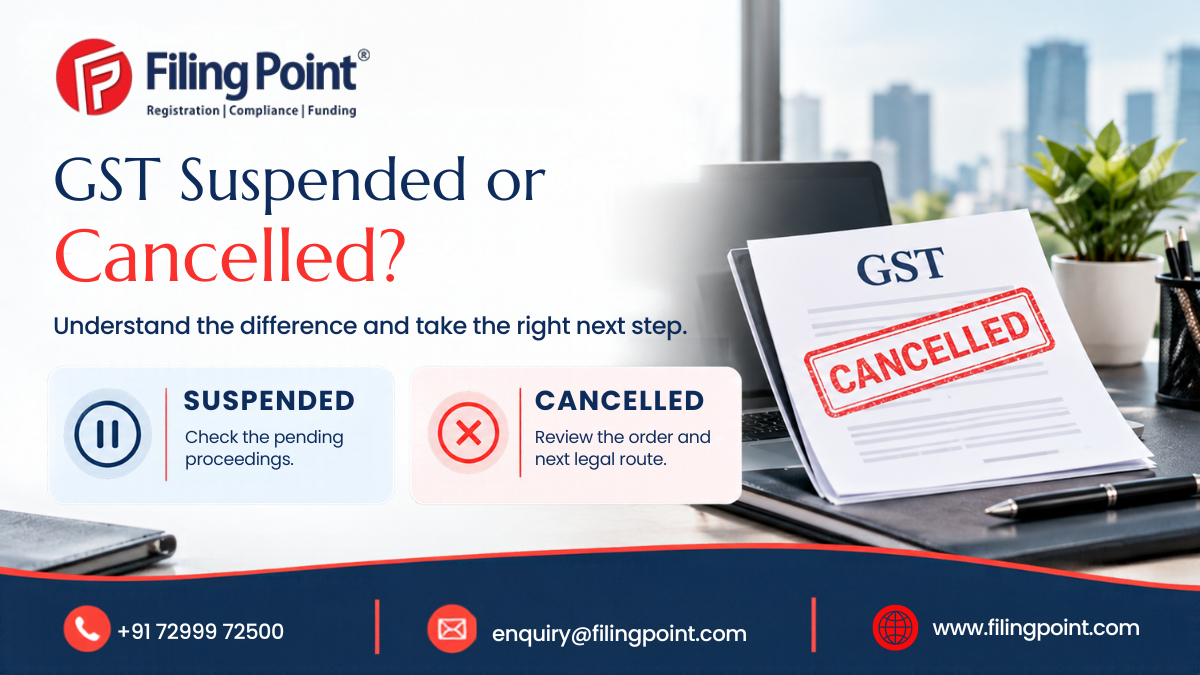
Suspension vs cancellation: check the exact status

Suspension and cancellation are not interchangeable terms.

A GST registration may be suspended while cancellation proceedings are pending or in circumstances provided by the rules. Cancellation is a formal outcome that changes the registration status.

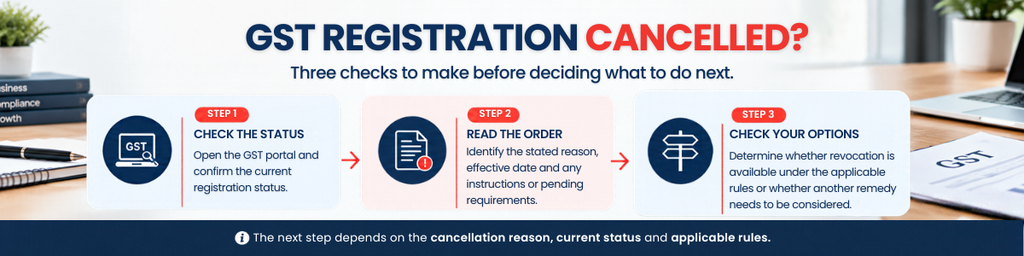
Before taking action, check:

  • The status shown on the GST portal.
  • Whether a notice has been issued.
  • Whether a cancellation order has been passed.
  • The date the order was served.
  • The effective date of cancellation, if applicable.
  • Whether any reply or application is pending.

Do not rely only on an email notification, an old screenshot or what a third party has told you. Review the actual portal record and order.

What should you do immediately after receiving a cancellation order?

Use this sequence to organise the case before filing anything.

Step 1: Download the notice and order

Keep copies of the show-cause notice, your reply, the cancellation order and related correspondence. Record the dates on which the documents were issued and served.

Read the reasons carefully. Note the rule or provision cited, the facts alleged and whether the order discusses unanswered notices, missing returns, address verification or another issue.

Step 3: Check your return-filing position

Review the returns due before cancellation, including any periods for which the portal shows outstanding filings. Compare portal information with your accounting records.

Step 4: Review tax and other dues

Check whether tax, interest, late fees or penalties are outstanding. Do not assume that filing a missing return alone resolves every liability.

Step 5: Check whether revocation is available

Revocation is generally relevant when the proper officer has cancelled registration on their own motion. It is not the same as requesting cancellation voluntarily.

If your case does not qualify for revocation, the next step may be different. Verify the legal route before submitting a form.

Step 6: Prepare an evidence-based response

Collect documents that directly address the reason for cancellation. For example, a premises-related case may need relevant address and business-operation evidence. A return-default case needs a return and payment review.

Step 7: Track the next deadline

Record the relevant date and any deadline in the notice, order or applicable rule. If the time limit is close or has passed, obtain advice promptly rather than waiting for another reminder.

What is revocation of GST registration cancellation?

Revocation means reversing a cancellation made by the proper officer, subject to the applicable law and procedure.

Section 30 of the CGST Act and Rule 23 of the CGST Rules deal with revocation of cancellation. The process is not available in every situation: the cancellation must be of the kind for which revocation is permitted.

A taxpayer who voluntarily applied to cancel their GST registration should not assume that the same revocation procedure automatically applies. First establish how the cancellation occurred and what order was passed.

Is revocation automatic?

No. An application must meet the applicable conditions and be considered by the proper officer. Filing an application does not itself prove that the registration has been restored.

The taxpayer should monitor the application and any notice or clarification request issued during the process.

What is Form GST REG-21 used for?

Form GST REG-21 is used for an application to revoke cancellation of GST registration where the applicable rules permit it.

Before filing, verify that:

  • The cancellation was initiated by the proper officer.
  • The case qualifies for revocation.
  • Any required returns have been filed.
  • Tax and related amounts required under the rules have been paid.
  • The explanation and supporting evidence address the cancellation grounds.
  • The application is within the applicable time limit, or a permitted extension route is available.

The current rule text and the portal’s live workflow should be checked before submission because procedures and time limits may change.

GST Registration Chennai

What if GST registration was cancelled because returns were not filed?

Non-filing requires careful attention because an application for revocation may not be considered until the relevant return defaults and associated dues have been addressed as required by the rules.

Start by preparing a period-wise list of returns that remain pending. Check the return type, tax period, filing status and any tax, interest, penalty or late fee applicable to the case.

Then reconcile the return information with sales, purchase, bank and accounting records. Filing returns without checking the underlying data can create additional inconsistencies.

A practical checklist

  • Identify all pending returns and periods.
  • Reconcile outward supplies and tax reported.
  • Check eligible input tax credit against supporting records and applicable conditions.
  • Calculate outstanding liabilities using current information.
  • File the returns required for the case.
  • Pay the amounts legally due.
  • Keep acknowledgements and payment records.
  • Review the cancellation order and the current revocation requirements before applying.

Do not assume that clearing one return will automatically restore registration. Follow the required procedure and wait for the relevant order or status update.

What if the deadline for revocation has passed?

Do not assume that the only option is to apply for a new GST registration.

The applicable time limit and any permitted extension must be checked against the current version of Rule 23, relevant notifications and the dates in your case. The current rule text provides for an initial period and a possible extension in qualifying circumstances, subject to the conditions and authority specified in the rule.

This is an area where old online articles can be misleading: earlier versions of the rules used different time limits.

If the deadline appears to have passed:

  1. Confirm the date on which the cancellation order was served.
  2. Check the rule and amendments applicable to your case.
  3. Determine whether a permitted extension or other remedy remains available.
  4. Prepare evidence explaining the delay, where relevant.
  5. Obtain professional advice if the registration is essential to ongoing operations.

Never rely on a generic statement such as “you always have 30 days” or “you can apply at any time.” The applicable law and case facts control.

What if the revocation application is rejected?

A rejected revocation application should be reviewed carefully before taking another step.

Read the rejection order and identify whether the issue relates to eligibility, outstanding returns, payment, missing evidence, an unanswered notice or the time limit.

Do not repeatedly submit the same application without addressing the reason for rejection.

Depending on the facts and applicable law, the next step may involve responding to a notice, reviewing whether an appeal or other remedy is available, or correcting a procedural issue where permitted. The right route depends on the order and the statutory framework.

Keep copies of the application, acknowledgement, notices, replies and rejection order. These documents are important for understanding the decision and assessing available options.

Can Your GST Registration be Restored

Can you continue business after GST registration is cancelled?

A business should not assume it can continue treating itself as a registered taxpayer after cancellation.

The consequences depend on the effective date, the nature of supplies, the applicable provisions and whether a later order restores the registration. A cancelled registration can affect invoicing, tax collection, input tax credit and dealings with customers.

At the same time, cancellation does not necessarily mean that every business activity must cease permanently. The business should obtain advice on what activities may lawfully continue, what tax obligations remain and whether registration is required for future supplies.

Do not issue invoices that represent the business as currently GST-registered if that status is no longer valid. Check the law and the actual registration status before making tax representations to customers.

What happens to earlier tax liabilities and records?

Cancellation does not automatically wipe out obligations relating to earlier periods. Section 29(3) addresses the continuation of liability for tax and other dues and obligations for the period before cancellation.

A business should retain its invoices, books, return records, payment receipts, bank records, purchase documents and correspondence with the department.

If registration is restored, reconcile the period covered by the cancellation and the restoration order. Check which returns or other actions remain necessary and confirm how the portal reflects the status.

A business should not assume that restoration alone fixes every historical issue.

Common mistakes to avoid

Mistake 1: Confusing cancellation with application rejection

They are different procedures. A business that already had a GSTIN should begin with its cancellation order and status.

Mistake 2: Filing without checking the order

The response should address the actual cancellation grounds.

Mistake 3: Ignoring pending returns

Where return defaults are involved, required returns and dues can be central to the revocation process.

Mistake 4: Relying on outdated time limits

Check the current rule and applicable amendments, not an old blog post.

Mistake 5: Assuming revocation is available after every cancellation

The route depends on how cancellation occurred and the applicable provisions.

Mistake 6: Ignoring earlier tax obligations

Cancellation does not erase every liability relating to the pre-cancellation period.

Mistake 7: Treating a submitted application as approval

Track the application and obtain confirmation of the actual outcome.

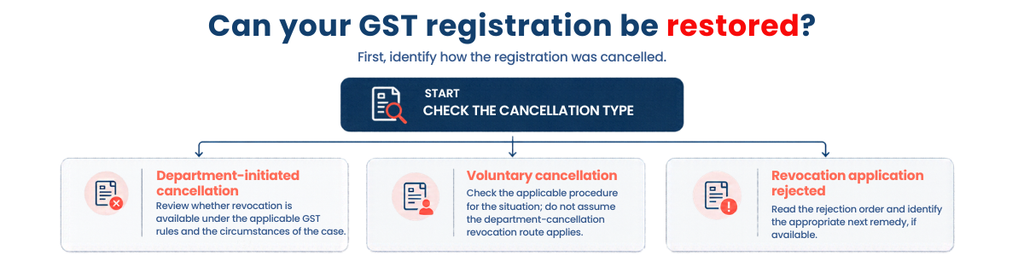
A practical decision guide

Your situationWhat to review first
You received a cancellation notice but no final orderNotice, reply deadline and evidence
Your GST registration is suspendedPortal status and pending proceedings
The officer has cancelled registrationOrder, effective date and revocation eligibility
Cancellation relates to missing returnsPending returns, tax and related dues
You applied for cancellation voluntarilyCorrect route for your circumstances; do not assume REG-21 applies
Your revocation application was rejectedRejection order and any available remedy
The revocation deadline may have passedCurrent Rule 23 and possible extension provisions
Registration has been restoredOrder, portal status, returns and remaining obligations

This is a starting guide, not a substitute for reviewing the actual order.

How to reduce the risk of future cancellation

A business can reduce avoidable compliance problems by establishing a reliable routine.

  • Maintain a calendar for applicable GST return due dates.
  • Reconcile books and GST returns regularly.
  • Keep the declared principal place of business and supporting records accurate.
  • Respond promptly to notices and verification requests.
  • Monitor GST portal messages and application status.
  • Retain acknowledgements, invoices and payment records.
  • Review changes in the business, ownership, premises or registration details.
  • Seek help when a notice is unclear or a deadline is approaching.

The objective is not just to restore a GSTIN after cancellation. It is to address the underlying issue so the business can manage its tax obligations more consistently.

Frequently asked questions

1. Can I restore a GST registration cancelled by the department?

Possibly. Revocation may be available when the proper officer cancelled the registration on their own motion and the taxpayer satisfies the applicable conditions. Check the cancellation order and current rules.

2. Which form is used to apply for revocation?

Form GST REG-21 is used for an application for revocation of cancellation where the applicable rules permit it.

3. Can I apply for revocation if I have not filed GST returns?

If cancellation occurred because of return non-filing, the relevant returns and amounts due generally need to be addressed as required by the rules before an application can be filed.

4. Is a cancelled GST registration the same as a rejected GST application?

No. Rejection concerns an application for new registration. Cancellation affects an existing registration.

5. Can I apply for revocation after the deadline?

Possibly, depending on the current rules, any permitted extension and the circumstances. Check the current law and the order’s service date promptly.

6. What if the officer rejects my revocation application?

Review the rejection order and identify the reason. Depending on the facts, an appropriate response or other remedy may be available under the applicable law.

7. Does GST cancellation remove earlier tax liabilities?

No. Cancellation does not automatically remove liabilities or obligations relating to the pre-cancellation period.

8. Should I apply for a new GST registration instead?

Do not assume that a fresh application is the right solution. First determine whether revocation or another route is available and whether a new application would be legally appropriate.

Conclusion

A cancelled GST registration needs a prompt, evidence-based response. Start with the cancellation order, confirm the portal status, identify the reason, review pending returns and liabilities, and determine whether revocation is available.

The correct route depends on the way the registration was cancelled, the applicable deadlines and the taxpayer’s compliance position. Avoid relying on outdated online guidance or submitting forms without understanding the order.

Need help understanding your GST registration status or compliance requirements? Filing Point can help you review the issue and identify the appropriate next steps.

📞 +91 72999 72500
📧 enquiry@filingpoint.com

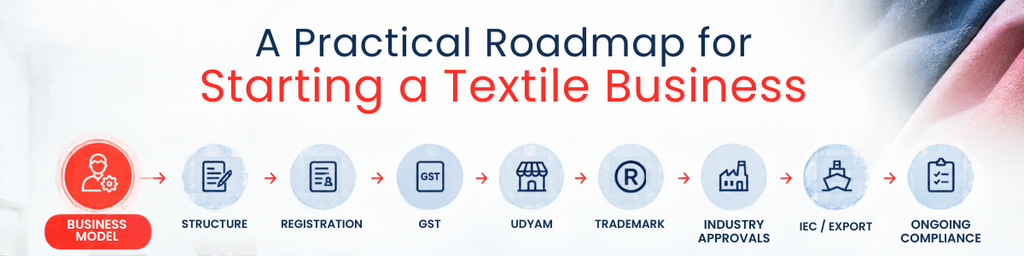
Tiruppur is one of Tamil Nadu’s most important textile and knitwear business clusters. For an entrepreneur, however, starting a textile business involves much more than setting up a production unit or finding buyers.

Depending on the nature and scale of the business, you may need to choose an appropriate business structure, complete tax registrations, obtain Udyam registration, protect your brand through trademark registration, and consider additional approvals for manufacturing, processing, employment, environmental compliance or exports.

The right registration strategy depends on what you manufacture or sell, how you operate, your business structure, turnover, location, workforce, whether you export, and the processes carried out at your premises.

This guide explains the major registrations and compliance considerations for entrepreneurs planning to start a textile, garment, apparel, clothing, knitting, processing or textile-related business in Tiruppur.

Quick Answer: A textile business in Tiruppur may require a combination of business/entity registration, GST registration where applicable, Udyam/MSME registration, trademark protection and, for exporters, an Importer Exporter Code (IEC). Manufacturing and textile-processing units may also need additional approvals depending on their activities, premises, machinery, workforce and environmental impact. There is no single registration that covers every textile business.

Why Tiruppur Is an Important Location for Textile Businesses

Tiruppur has a deep textile ecosystem covering knitting, garment manufacturing, processing and apparel-related activities.

The Tamil Nadu government’s textile information identifies Tiruppur as a major knitting and garmenting cluster and highlights its importance to India’s knitwear sector. The state also has a significant network of textile-processing infrastructure, including Common Effluent Treatment Plants in Tiruppur.

The business ecosystem can support different types of entrepreneurs, including:

  • Garment manufacturers
  • Knitwear manufacturers
  • Textile traders
  • Apparel wholesalers
  • Clothing brands
  • Fashion startups
  • Private-label manufacturers
  • Exporters
  • Textile job-work units
  • Knitting units
  • Dyeing and processing units
  • Printing and embroidery businesses
  • Textile accessory suppliers
  • D2C clothing brands
  • Online apparel businesses

The important point is that these businesses do not necessarily have the same registration requirements.

For example, a clothing brand selling finished garments may have a very different compliance profile from a dyeing or processing unit.

What Registrations Does a Textile Business in Tiruppur Need?

There is no universal registration checklist for every textile business.

Your requirements should be mapped according to your business model.

A typical textile entrepreneur may need to consider:

Registration / RequirementWhy It Matters
Business structure/entity registrationEstablishes the legal form of the business
PANRequired for tax and financial identification
GST registrationApplicable based on GST law and business circumstances
Udyam/MSME registrationEstablishes MSME classification where eligible
Trademark registrationProtects the business/brand identity
IECImportant for businesses undertaking import/export activities
Local/business-related approvalsMay apply depending on premises and activity
Factory/manufacturing approvalsMay apply depending on the nature and scale of manufacturing
Pollution/environmental approvalsParticularly relevant to textile processing activities
Labour-related registrations/complianceDepends on workforce and applicable laws
Industry-specific certificationsMay be relevant to particular products, buyers or markets

The exact combination should be determined before the business starts operations, rather than treating every registration as interchangeable.

1. Choose the Right Business Structure

One of the first decisions is determining how the textile business will be legally structured.

Common options include:

Sole Proprietorship

A proprietorship can be suitable for a small business operated by one individual, particularly where the entrepreneur wants a relatively simple structure.

It can work for certain:

  • Small textile traders
  • Boutique businesses
  • Small clothing sellers
  • Independent apparel businesses
  • Home-based businesses

However, the owner and business are not separate legal persons in the same way as a company.

Partnership Firm

A partnership may be considered when two or more individuals want to operate a business together under a partnership arrangement.

It can be relevant for:

  • Family-owned textile businesses
  • Small garment trading businesses
  • Manufacturing businesses with multiple partners
  • Traditional textile enterprises

A properly drafted partnership agreement should clearly establish responsibilities, capital contributions, profit-sharing arrangements and other important terms.

Limited Liability Partnership

An LLP can be considered when entrepreneurs want a separate legal structure combined with limited liability characteristics and a partnership-style management model.

It may be relevant for:

  • Textile trading businesses
  • Apparel sourcing businesses
  • Textile consulting businesses
  • Businesses with multiple founders
  • Certain growing manufacturing or export ventures

Private Limited Company

A Private Limited Company may be appropriate where the founders expect a more structured corporate setup and future growth.

It can be particularly relevant to:

  • Growing garment manufacturers
  • Apparel brands
  • Textile exporters
  • D2C clothing companies
  • Businesses seeking external investment
  • Businesses planning to build a larger corporate operation

FilingPoint already has a dedicated article on Pvt Ltd Company Registration in Tiruppur. Therefore, this article should not duplicate the incorporation process; instead, it places Pvt Ltd registration within the broader textile-business compliance framework.

How Should You Choose?

Consider:

  • Number of owners
  • Capital requirements
  • Expected growth
  • Liability considerations
  • Funding plans
  • Export plans
  • Management structure
  • Compliance capacity
  • Long-term ownership plans

There is no universally “best” structure for every textile entrepreneur.

2. GST Registration for a Textile Business

GST is an important consideration for textile manufacturers, traders, wholesalers and clothing businesses.

GST registration requirements depend on factors such as turnover, nature of supply and circumstances that can trigger registration.

For example, GST law contains threshold exemptions and compulsory-registration provisions, so entrepreneurs should not rely on a simple turnover number without checking the current rules applicable to their particular business.

CBIC’s GST material explains the registration framework and also notes that certain circumstances can affect the availability of threshold exemption.

Why GST Matters to Textile Businesses

A registered textile business may need GST compliance for:

  • Tax invoices
  • Input tax credit
  • B2B transactions
  • Interstate supplies
  • Certain e-commerce transactions
  • Export-related transactions
  • GST returns
  • Business-to-business procurement

A textile manufacturer should also correctly identify the applicable HSN classification for the goods being supplied. The GST portal’s registration guidance requires businesses dealing in goods to provide relevant HSN information.

Example

Suppose a Tiruppur business manufactures cotton T-shirts and sells them to retailers in Tamil Nadu and customers in other states.

The entrepreneur should assess:

  1. Whether GST registration is required.
  2. Correct classification of the products.
  3. Applicable GST rate.
  4. Invoice requirements.
  5. Input tax credit eligibility.
  6. Interstate supply requirements.
  7. Return filing obligations.

The answer should be based on the actual business model, not simply the fact that the business is located in Tiruppur.

3. Udyam Registration for Textile and Garment Businesses

Many textile businesses in Tiruppur may fall within the MSME ecosystem.

Udyam Registration is the government’s official MSME registration system.

The official Udyam portal states that registration is free, online, paperless and based on self-declaration, and that an enterprise receives a permanent Udyam Registration Number and an online certificate.

Current MSME Classification

Under the current classification shown on the official Udyam portal:

MSME CategoryInvestment LimitTurnover Limit
MicroUp to ₹2.5 croreUp to ₹10 crore
SmallUp to ₹25 croreUp to ₹100 crore
MediumUp to ₹125 croreUp to ₹500 crore

These criteria are based on the current Udyam framework and should be checked against the latest government notifications when publishing or updating this article.

Why Textile Businesses Consider Udyam Registration

Udyam registration can be useful for eligible businesses because MSME status can be relevant to:

  • Government schemes
  • Institutional support
  • Certain procurement opportunities
  • Business financing
  • MSME-related programmes
  • Formal recognition as an MSME

However, Udyam registration does not replace company registration or GST registration.

These are different regulatory systems serving different purposes.

Company Registration in Chennai

4. Trademark Registration for a Textile or Clothing Brand

If you are building a clothing or textile brand, protecting the brand name should be considered early.

For example, imagine a Tiruppur manufacturer launches its own clothing brand.

The entrepreneur may invest heavily in:

  • Brand name
  • Logo
  • Packaging
  • Labels
  • Website
  • Social media
  • Retail distribution
  • Advertising

Without a proper trademark strategy, the entrepreneur may face brand-protection issues later.

Trademark registration is therefore different from company registration.

Company registration establishes an entity. Trademark registration protects a brand identifier.

Which Trademark Classes Are Relevant to Textile Businesses?

Trademark classification depends on what you sell or provide.

For textile and apparel businesses, the appropriate Nice Classification class or classes should be determined based on the actual goods/services being protected.

The Indian Trade Marks system uses the Nice Classification framework.

A clothing brand may need to examine classes relevant to its:

  • Garments
  • Footwear
  • Headwear
  • Textile goods
  • Retail services
  • Online retail services
  • Manufacturing-related services
  • Other branded products

The correct class should be selected based on the actual business and the goods/services for which protection is sought.

Current Trademark Filing Fees

As of the current IP India fee schedule, the official e-filing fee for a TM-A application is:

  • ₹4,500 per class/per mark for an individual, startup or small enterprise.
  • ₹9,000 per class/per mark for other applicants.

These are official government filing fees; professional service charges, if any, are separate.

Because trademark fees and rules can change, the latest IP India fee schedule should be checked before publication or filing.

5. IEC for Textile Export Businesses

Tiruppur has a strong export-oriented apparel ecosystem, so many entrepreneurs may eventually consider international markets.

If your textile business plans to undertake import or export activities, Importer Exporter Code (IEC) becomes an important consideration.

DGFT’s Foreign Trade Policy states that an IEC is a 10-character alphanumeric number allotted to an entity and is mandatory for undertaking import/export activities unless specifically exempted.

This can be particularly relevant for:

  • Garment exporters
  • Knitwear exporters
  • Textile manufacturers exporting directly
  • Apparel brands selling internationally
  • Textile sourcing businesses
  • Businesses importing textile machinery or materials

Export Business Planning Should Start Early

An entrepreneur planning exports should consider more than IEC.

The business may also need to understand:

  • GST treatment of exports
  • Export documentation
  • Invoicing
  • Shipping documentation
  • Buyer requirements
  • Product specifications
  • Country-specific requirements
  • Customs procedures
  • Payment mechanisms
  • Foreign exchange considerations
  • Product certifications where required

GST materials describe exports as zero-rated supplies under the GST framework, subject to the applicable conditions and procedures.

6. Textile Manufacturing Can Require Additional Approvals

This is one of the most important distinctions for textile entrepreneurs.

A clothing brand and a dyeing or processing factory should not be treated as having identical compliance requirements.

For example:

Apparel Trading Business

A business that purchases finished garments and resells them may have a relatively different compliance profile.

Garment Manufacturing Unit

A manufacturing facility may need to consider additional requirements relating to:

  • Premises
  • Machinery
  • Workers
  • Factory-related compliance
  • Fire and safety
  • Local approvals
  • Labour compliance

Dyeing or Processing Unit

Textile processing can involve environmental considerations, wastewater and effluent management.

Tamil Nadu’s Handlooms and Textiles Department specifically identifies Tiruppur as a hub for textile processing and knitting and notes the presence of Common Effluent Treatment Plants in the cluster.

Therefore, entrepreneurs planning:

  • Dyeing
  • Bleaching
  • Printing
  • Washing
  • Processing
  • Effluent-generating activities

should identify the applicable environmental and operational approvals before setting up the facility.

This is an area where a generic “company registration checklist” is not sufficient.

7. What Documents Are Commonly Needed?

The exact documents depend on the structure and registration.

A textile entrepreneur may commonly need information relating to:

Promoters / Owners

  • PAN
  • Aadhaar or other identity information
  • Address details
  • Photographs/contact information where applicable

Business

  • Proposed business name
  • Business activity
  • Ownership details
  • Capital/contribution details
  • Partnership or incorporation documents where applicable

Business Premises

  • Address proof
  • Ownership document or rental/lease documentation
  • Utility bill or other acceptable premises evidence, depending on the registration

Tax and Banking

  • PAN
  • Bank account information where applicable
  • GST-related information where applicable

Trademark

Trademark applications require information about the applicant, mark and relevant goods/services, along with the applicable filing details.

Export

An exporter will need the relevant entity and tax information required for IEC and related export procedures.

The important principle is:

Do not collect documents randomly. First determine which registrations apply to your particular textile business.

8. Textile Business Registration: Manufacturer vs Trader vs Brand

A major mistake is assuming every textile business needs the same registration package.

Consider these three examples.

Example 1: Tiruppur Garment Manufacturer

The business manufactures T-shirts and exports them.

Potential areas to evaluate:

  • Business structure
  • GST
  • Udyam
  • Trademark if operating a brand
  • IEC
  • Manufacturing/factory requirements
  • Environmental requirements where applicable
  • Labour compliance

Example 2: Textile Trader

The business purchases garments from manufacturers and sells them to retailers.

The focus may instead be:

  • Business structure
  • GST applicability
  • Udyam eligibility
  • Trademark if operating a brand
  • Trading-related compliance

Example 3: D2C Clothing Brand

The entrepreneur designs products, outsources manufacturing to Tiruppur factories and sells through a website.

The entrepreneur may not operate a textile factory at all.

The focus may include:

  • Business structure
  • GST applicability
  • Udyam eligibility
  • Trademark
  • E-commerce/business compliance
  • Vendor agreements
  • Product and consumer-related requirements
  • Export/IEC if selling internationally

These three businesses operate in the same textile ecosystem but have different compliance requirements.

9. Should a Small Textile Business Register as an MSME?

If the enterprise qualifies under the current MSME criteria, Udyam registration can be considered.

The official portal allows eligible enterprises to register online through a free, paperless process and provides a permanent registration number.

Importantly, Udyam registration is not limited to one type of textile activity.

An enterprise can specify multiple activities, including manufacturing or services, within the Udyam framework.

This can be useful for textile businesses that combine activities.

For example:

Manufacturing + wholesale + branded apparel

may involve multiple business activities that need to be correctly reflected in the business’s registrations and records.

10. When Should You Register Your Trademark?

Ideally, trademark planning should happen before substantial investment in the brand.

Before launching a clothing brand, consider:

Step 1: Choose the brand name

Do not assume that a domain name or social-media username means the brand is legally protected.

Step 2: Search existing trademarks

Check whether similar marks already exist.

Step 3: Identify relevant classes

Determine which goods and/or services your brand needs protection for.

Step 4: File the application

The appropriate trademark application can then be submitted through IP India’s system.

Step 5: Monitor the application

The trademark process can involve examination, responses and potentially opposition proceedings.

The official IP India process and forms should be checked for the current requirements.

11. A Practical Registration Roadmap for a Tiruppur Textile Startup

Instead of treating registrations as unrelated tasks, entrepreneurs can approach the process in stages.

Stage 1: Define the Business

Decide:

  • What products will you sell?
  • Will you manufacture or outsource?
  • Will you sell B2B or B2C?
  • Will you export?
  • Will you operate a brand?
  • How many owners are involved?

Stage 2: Select the Business Structure

Compare:

  • Proprietorship
  • Partnership
  • LLP
  • Private Limited Company

The choice should reflect ownership, growth and operational requirements.

Stage 3: Establish the Business

Complete the relevant incorporation or registration process.

Obtain the necessary PAN and other foundational business information.

Stage 4: Evaluate GST

Determine whether GST registration applies based on:

  • Turnover
  • Nature of supply
  • Interstate transactions
  • Applicable compulsory-registration provisions
  • Business model

Do not rely on outdated threshold information.

Stage 5: Obtain Udyam Registration Where Eligible

If the business qualifies as an MSME, evaluate Udyam registration.

The official portal currently states that Udyam registration is free and does not require payment to private intermediaries for the government registration itself.

Stage 6: Protect the Brand

If you are building a clothing or textile brand:

  • Search the brand
  • Select appropriate classes
  • File the trademark application
  • Monitor the application

Stage 7: Evaluate Industry-Specific Requirements

For manufacturing, processing and other physical operations, check:

  • Factory-related requirements
  • Local approvals
  • Fire/safety requirements
  • Labour compliance
  • Environmental requirements
  • Electricity/power-related requirements
  • Waste/effluent requirements

The exact requirements depend on the activity and premises.

Stage 8: Prepare for Exports

If exporting:

  • Evaluate IEC
  • Review GST export procedures
  • Understand customs documentation
  • Identify destination-market requirements
  • Review buyer-specific certifications
  • Establish appropriate export documentation processes

12. Common Mistakes Textile Entrepreneurs Make

Mistake 1: Thinking Company Registration Is Enough

Registering a company does not automatically complete GST, MSME, trademark, export or industry-specific compliance.

Each serves a different purpose.

Mistake 2: Choosing a Business Structure Without Considering Growth

A structure suitable for a small family trading operation may not necessarily be the best fit for a business planning external investment or rapid expansion.

Mistake 3: Treating Udyam and GST as the Same Registration

They are not.

GST = indirect tax registration/compliance framework.

Udyam = MSME registration/classification framework.

Mistake 4: Delaying Trademark Registration

Building a clothing brand first and thinking about trademark protection later can create unnecessary risk.

Mistake 5: Assuming Every Textile Business Has the Same Approvals

A garment trader, clothing brand, garment factory and dyeing unit can have substantially different compliance requirements.

Mistake 6: Ignoring Export Requirements

If international sales are part of the business plan, export-related requirements should be considered before accepting overseas orders.

Mistake 7: Using Outdated GST or MSME Information

GST thresholds, procedures and government schemes can change.

The same applies to MSME classifications and regulatory requirements.

Always verify current rules before filing.

Textile Business Registration Checklist for Tiruppur

Use this as a starting checklist:

Business Setup

  • Decide business structure
  • Select business name
  • Establish business address
  • Prepare promoter/partner/director information
  • Complete relevant business registration

Tax

  • Obtain PAN
  • Evaluate GST applicability
  • Identify relevant HSN classifications
  • Establish invoicing system
  • Understand GST return requirements

MSME

  • Check MSME eligibility
  • Complete Udyam registration if applicable
  • Keep Udyam information updated

Brand

  • Search proposed brand name
  • Identify relevant trademark classes
  • File trademark application where appropriate
  • Monitor trademark status

Manufacturing

  • Check premises requirements
  • Check factory-related requirements
  • Evaluate labour requirements
  • Evaluate fire/safety requirements
  • Check environmental approvals where applicable

Export

  • Evaluate IEC requirement
  • Understand export GST treatment
  • Prepare export documentation
  • Review destination-market requirements

Frequently Asked Questions

1. What registrations are required to start a textile business in Tiruppur?

There is no single checklist for every business. Depending on the model, you may need business/entity registration, GST registration where applicable, Udyam registration, trademark registration and IEC for import/export activities. Manufacturing and processing businesses may have additional requirements.

2. Is GST registration mandatory for every textile business in Tiruppur?

Not necessarily. GST registration depends on the applicable GST rules, turnover, nature of supply and circumstances that may trigger compulsory registration. The current GST framework should be checked before deciding.

3. Is Udyam registration useful for a textile business?

Eligible textile and garment businesses can consider Udyam registration. The official portal states that Udyam registration is free, paperless and based on self-declaration.

4. Can a textile business have both GST and Udyam registration?

Yes. They serve different purposes. GST relates to the GST tax framework, while Udyam establishes MSME registration/classification.

5. Do I need a trademark for my clothing brand?

Trademark registration is not the same as company registration, but it can be an important part of protecting a clothing or textile brand.

6. What trademark class should a clothing business choose?

The appropriate class depends on the actual goods and services offered by the business. Textile and apparel entrepreneurs should identify the relevant Nice Classification categories before filing.

7. How much does trademark registration cost?

IP India’s current e-filing fee for a TM-A application is ₹4,500 per class/per mark for an individual, startup or small enterprise and ₹9,000 for other applicants. Professional fees, if applicable, are separate.

8. Do textile exporters in Tiruppur need IEC?

Businesses undertaking import/export activities generally need an Importer Exporter Code unless a specific exemption applies. DGFT describes IEC as mandatory for import/export activities, subject to applicable exemptions.

9. Is company registration compulsory for every textile business?

No. The appropriate business structure depends on how the entrepreneur intends to operate. A textile business may operate through different legal structures depending on its circumstances.

10. Does a garment manufacturing business need additional approvals?

Potentially, yes. Manufacturing premises, workforce, machinery, fire/safety, environmental impact and other factors can create additional compliance requirements.

11. Is a clothing brand the same as a garment manufacturing company?

No. A clothing brand may outsource manufacturing to a third-party factory. Its compliance requirements can therefore differ from those of a business operating its own manufacturing facility.

12. Can a Tiruppur textile business sell internationally?

Yes, textile and apparel businesses can target international markets, but export-related requirements, documentation, taxation and destination-market rules need to be evaluated.

13. Can an MSME have multiple business activities under Udyam?

The official Udyam portal states that multiple activities, including manufacturing or services, can be specified or added under one Udyam Registration, subject to the applicable framework.

14. Should I register my business or trademark first?

Business formation and trademark protection are separate processes. Entrepreneurs planning a brand should consider trademark searches and protection early rather than waiting until the brand has significant market exposure.

15. What is the first step for starting a textile business in Tiruppur?

Start by defining your business model: manufacturer, trader, exporter, clothing brand, D2C business, job-work unit or processor. Once that is clear, you can identify the appropriate business structure and registrations.

Final Takeaway

Starting a textile business in Tiruppur is not simply a matter of registering a company and beginning production.

Your compliance requirements should be built around the actual nature of your business.

A typical roadmap may look like:

Business Model → Business Structure → Business Registration → GST Assessment → Udyam/MSME → Trademark → Industry-Specific Approvals → IEC/Export Compliance → Ongoing Compliance

The requirements can vary significantly between a garment manufacturer, textile trader, clothing brand, exporter and textile-processing unit.

Tiruppur’s textile ecosystem creates significant opportunities, but entrepreneurs should establish the correct legal and compliance foundation before investing heavily in manufacturing, branding or international sales. Tamil Nadu’s official textile ecosystem specifically recognizes Tiruppur’s importance in knitting, garmenting and textile processing.

If you are planning to start a textile, garment, apparel, clothing brand, manufacturing or export business in Tiruppur, getting the registration roadmap right at the beginning can make future expansion and compliance much easier.

Planning to start a textile business in Tiruppur? FilingPoint can help you evaluate the appropriate business structure, registration requirements, GST, MSME/Udyam, trademark and related business compliance based on your specific business model.

Important Note

Registration and compliance requirements can vary according to the business structure, turnover, products, premises, manufacturing activity, workforce, interstate transactions and export activity. Government rules and fees can change. Entrepreneurs should verify the latest requirements with the relevant government authority before filing.

Trademark registration in India is generally valid for 10 years and can be renewed every 10 years. The renewal application is filed using Form TM-R with the prescribed fee. Under the Trade Marks Rules, an application for renewal may be made up to one year before the expiry of the existing registration.

If renewal is not completed by the expiry date, the owner may still have a statutory window to apply for renewal with surcharge. If the trademark has already been removed from the Register for non-payment, restoration may be possible within the prescribed period, subject to the applicable requirements.

What Is Trademark Renewal?

Trademark renewal is the process of extending the validity of an existing registered trademark.

When a trademark is registered in India, the registration is granted for a period of 10 years. The registration can then be renewed from time to time for additional periods of 10 years.

For example, if a trademark registration is due to expire in June 2027, the proprietor should not wait until the final days to start the renewal process. The renewal can be planned in advance, allowing time to verify the registration details and complete the required filing.

Trademark renewal is different from applying for a new trademark registration.

If you already have a registered mark that you want to continue protecting, the relevant process is renewal. A fresh application may have different implications and does not simply substitute for maintaining an existing registration.

How Long Is a Trademark Registration Valid in India?

A trademark registration is generally valid for 10 years.

Section 25 of the Trade Marks Act, 1999 provides that registration is for a period of 10 years and may be renewed from time to time. Each renewal extends the registration for another 10-year period.

There is therefore no fixed lifetime limit on the number of times a trademark can be renewed.

A business may continue renewing its registered trademark as long as it remains eligible and the applicable requirements are satisfied.

Example

Suppose a business has a registered trademark with an expiry date in August 2027.

The owner can plan the renewal before August 2027 rather than waiting until the last moment.

If the renewal is completed correctly, the trademark can continue for another 10-year period.

This is why businesses should maintain a simple trademark renewal calendar for all their registered marks.

When Should You Renew a Trademark in India?

Under Rule 57 of the Trade Marks Rules, 2017, an application for renewal of trademark registration can be made not more than one year before the expiration of the last registration.

This gives trademark owners an opportunity to plan renewal well in advance.

A practical approach is to review the trademark several months before its expiry date and check:

  • Trademark registration number
  • Registered proprietor’s name
  • Trademark class or classes
  • Expiry date
  • Current address and contact details
  • Whether the trademark is still being used
  • Whether ownership details have changed
  • Whether any related applications or proceedings are pending

Early review can help identify issues before the renewal filing is made.

Which Form Is Used for Trademark Renewal?

The prescribed form for renewal of trademark registration is Form TM-R.

IP India lists TM-R for renewal of trademark registration under Section 25. The current official fee schedule also specifies the renewal fee for each class.

The application should be prepared using the details of the registered trademark and filed through the applicable Trade Marks Registry process.

It is important to distinguish renewal from other trademark forms.

For example, if the proprietor’s details have changed because of an assignment or transfer, that may involve a separate procedure. Renewal should not be treated as a way to automatically correct every change in ownership or registration details.

What Is the Trademark Renewal Fee in India?

Trademark renewal fees are prescribed under the Trade Marks Rules and the official IP India fee schedule.

As currently listed by IP India, ordinary renewal of a trademark under Section 25 is charged per class. The current e-filing fee shown for ordinary renewal is ₹9,000 per class, while physical filing is listed at ₹10,000 per class.

Additional amounts apply where renewal is filed with surcharge or where restoration is involved.

Because government fees and filing procedures can change, businesses should check the latest IP India fee schedule before making payment rather than relying on an old fee quotation.

Check IP India Forms & Official Fees

Important: Fee depends on the situation

The amount payable may differ depending on whether the application is:

  • Normal renewal
  • Renewal after expiry with surcharge
  • Restoration and renewal after removal

The applicable fee is also relevant per class, so businesses with multiple registered classes should review each registration carefully.

What Happens If You Miss the Trademark Renewal Date?

Missing the renewal date does not necessarily mean that all options immediately disappear.

Section 25 of the Trade Marks Act provides a statutory mechanism for renewal after expiry with payment of the prescribed fee and surcharge within the specified period. The Registrar may remove the trademark from the Register if the applicable renewal conditions are not fulfilled, subject to the statutory protection available during the prescribed post-expiry period.

This is why a missed renewal should be addressed promptly.

The longer the matter remains unattended, the more complicated the position can become.

A trademark owner who discovers that a registration has expired should first verify:

  1. The exact expiry date.
  2. Whether the registration is still on the Register.
  3. Whether renewal can be filed with surcharge.
  4. Whether the mark has already been removed.
  5. Whether restoration provisions may apply.

Do not assume that an expired trademark and a removed trademark are exactly the same situation.

What Is Trademark Renewal With Surcharge?

If the ordinary renewal deadline has passed, the law provides a period in which renewal may be sought with the prescribed surcharge.

Section 25(3) provides that where the prescribed fee and surcharge are paid within six months from the expiration of the last registration, the Registrar shall renew the registration in accordance with the statutory provision.

IP India’s current fee schedule separately lists an application for renewal with surcharge and specifies the additional amount payable per class.

Therefore:

Normal renewal → prescribed renewal fee

Late renewal within the applicable period → renewal fee + prescribed surcharge

The exact amount should be checked against the current official fee schedule at the time of filing.

What Happens If the Trademark Has Already Been Removed?

A trademark that has been removed from the Register for failure to pay the renewal fee may still have a route to restoration.

Section 25(4) provides for restoration where the application is made after six months and within one year from the expiration of the last registration, subject to the Registrar being satisfied that restoration is appropriate and the prescribed fee is paid.

This is different from ordinary renewal.

The owner should therefore establish the current status of the trademark before deciding what filing to make.

In simple terms

SituationPossible route
Renewal period not yet expiredNormal renewal
Registration expired but within statutory late-renewal periodRenewal with surcharge
Trademark removed from RegisterRestoration and renewal may be possible, subject to the law
Statutory restoration period has also passedFurther legal assessment may be required

This table is a simplified guide. The actual position should be checked against the current Register and applicable provisions.

What Is Trademark Restoration?

Trademark restoration is the process of seeking restoration of a trademark that has been removed from the Register because the renewal requirements were not completed.

It is not simply another name for late renewal.

The Trade Marks Act creates a separate mechanism for restoration after removal, while IP India’s fee schedule separately identifies an application for restoration and renewal.

This distinction matters because the appropriate filing depends on the current status of the trademark.

If a business discovers an old registered trademark that was allowed to lapse, it should first check the official trademark record instead of immediately filing a new application.

Does a Trademark Need to Be Used to Renew It?

Trademark renewal and trademark use are related to the broader protection of a mark, but renewal itself should not be understood as a substitute for actual trademark use.

The renewal provisions primarily deal with maintaining the registration by complying with the applicable renewal requirements and paying the prescribed fees.

At the same time, registered trademarks can be subject to other legal issues, including proceedings concerning non-use in appropriate circumstances.

Therefore, businesses should not think of renewal as simply paying a fee and ignoring the trademark thereafter.

If the business has stopped using the mark, changed its brand, sold the business or substantially changed its products or services, it is sensible to review the trademark portfolio before renewal.

Trademark Registration Chennai

Should You Renew a Trademark If Your Business Has Changed?

Not necessarily without first reviewing the trademark portfolio.

Businesses often change over a 10-year period.

For example:

  • A company may change its legal name.
  • Ownership may change.
  • A brand may be assigned to another entity.
  • Products or services may expand.
  • Some brands may be discontinued.
  • The business may start using a new logo.
  • The proprietor’s address may change.

A renewal exercise is therefore a useful opportunity to check whether the trademark records still reflect the business.

However, renewal does not automatically update ownership or other registration details. Where a separate change is required, the appropriate Trade Marks Registry procedure should be considered.

Trademark Renewal vs New Trademark Registration

These two processes should not be confused.

Trademark RenewalNew Trademark Registration
Applies to an existing registered trademarkApplies to a new trademark application
Extends the existing registrationStarts a new registration process
Generally every 10 yearsDepends on successful registration
Uses TM-R for renewalUses the applicable registration application process
Maintains the existing registered markSeeks registration of a mark

If your trademark is already registered and approaching expiry, renewal is generally the starting point for maintaining that registration.

If the brand has materially changed, however, the business may need to assess whether additional trademark applications or other filings are appropriate.

What Documents and Details Should You Keep Ready?

Trademark renewal is primarily an official filing process, but businesses should keep their trademark records organised.

Before filing, review:

  • Trademark registration certificate/details
  • Trademark registration number
  • Class or classes
  • Registered proprietor name
  • Current address
  • Expiry date
  • Details of any assignment or ownership change
  • Details of any pending trademark proceedings
  • Authorisation details, where a representative is filing

The exact documentation required can depend on the nature of the application and the circumstances of the trademark.

Do not assume that every renewal application requires the same supporting documents.

How to Check Your Trademark Renewal Status

Before filing a renewal application, check the trademark record through the official Trade Marks Registry system.

The purpose is to establish:

  • Whether the mark is registered
  • Registration number
  • Class
  • Proprietor
  • Registration date
  • Expiry date
  • Current status
  • Relevant proceedings or correspondence

This is particularly important where a trademark was registered many years ago and the business does not have complete historical records.

A business should work from the current official trademark record, not only from an old certificate or internal spreadsheet.

Common Mistakes in Trademark Renewal

1. Waiting until the last day

Even where the law provides a renewal window, waiting creates unnecessary risk.

2. Looking only at the registration certificate

Old records may not reflect later changes or current status.

3. Confusing renewal with ownership change

Renewal does not automatically transfer a trademark to a new proprietor.

4. Ignoring multiple classes

Renewal fees are prescribed per class, so a business with multiple classes should review each applicable registration.

5. Assuming an expired mark is automatically permanently lost

The law provides specific post-expiry mechanisms, including renewal with surcharge and restoration in prescribed circumstances.

6. Treating renewal as the only trademark compliance issue

A business should also consider changes in ownership, address, use, branding and other relevant trademark matters.

7. Relying on outdated fee information

Government fees and procedures can change. Always check the current IP India fee schedule before filing.

A Practical Trademark Renewal Checklist

Before the renewal date, use this checklist:

Trademark details

  • Registration number checked
  • Class or classes checked
  • Registered proprietor verified
  • Expiry date confirmed

Business details

  • Proprietor details reviewed
  • Address reviewed
  • Ownership changes checked
  • Brand/logo changes reviewed

Renewal

  • Renewal eligibility checked
  • Current IP India fee verified
  • TM-R prepared
  • Correct class details confirmed
  • Filing/payment completed
  • Filing acknowledgement retained

After filing

  • Application status monitored
  • Renewal record checked
  • Updated expiry information recorded
  • Next renewal reminder created

Example: A Small Business With an Expiring Trademark

Suppose an Indian clothing business registered its brand in 2017.

The registration is approaching its 2027 expiry date.

Instead of waiting until the final month, the business checks the trademark record, confirms the proprietor and class details, reviews whether the brand is still being used and prepares the renewal application.

Because the renewal can be made within the permitted advance period, the business has an opportunity to deal with the matter before the registration expires.

Now consider another business that discovers after expiry that it never completed renewal.

The correct response is not automatically to file a new trademark application. The business should first check whether the existing registration is eligible for renewal with surcharge or, if already removed, whether restoration is available under the applicable provisions. 

What Should You Do If Your Trademark Renewal Is Already Overdue?

If you have missed your trademark renewal date, take these steps:

Step 1: Check the trademark record

Confirm the current status with the Trade Marks Registry.

Step 2: Confirm the expiry date

Do not rely only on an old reminder or internal record.

Step 3: Identify the applicable route

Determine whether the matter falls under:

  • Normal renewal
  • Renewal with surcharge
  • Restoration and renewal

Step 4: Check the current official fee

Use the latest IP India fee schedule.

Step 5: Review the trademark details

Check the proprietor, class, address and other relevant information.

Step 6: File the appropriate application

Use the applicable form and procedure based on the current status.

Step 7: Monitor the application

Keep the acknowledgement and track the application until the renewal or restoration is reflected appropriately.

Why Trademark Renewal Matters for Businesses

A trademark can become an important business asset over time.

A registered brand may be used on:

  • Products
  • Packaging
  • Websites
  • Marketing materials
  • Online marketplaces
  • Storefronts
  • Franchise operations
  • Business communications

Allowing an important trademark registration to lapse can create avoidable uncertainty around the brand’s registered protection.

For a business that has invested years in building brand recognition, trademark renewal should therefore be treated as part of its intellectual property management, not just as an administrative deadline.

Is Trademark Renewal Mandatory?

The better way to understand this is that renewal is required if the proprietor wants to continue the registered status of the trademark beyond the current registration period.

A registered trademark has a defined registration period. If the proprietor does not comply with the applicable renewal requirements, the Registrar can remove the mark from the Register subject to the statutory safeguards and post-expiry mechanisms. 

Therefore, businesses that want to maintain their registered trademark should actively track and complete renewal.

Frequently Asked Questions

How often does a trademark need to be renewed in India?

A registered trademark is generally valid for 10 years and can be renewed for further 10-year periods.

Which form is used for trademark renewal?

Trademark renewal is filed using Form TM-R with the prescribed fee. 

Can I renew my trademark before expiry?

Yes. Under Rule 57, an application for renewal may be made at any time not more than one year before the expiration of the last registration. 

What happens if I miss the trademark renewal deadline?

A statutory mechanism exists for renewal with surcharge within the prescribed period after expiry. If the trademark has been removed, restoration may be possible within the prescribed period, subject to the applicable requirements. 

What is the current trademark renewal fee?

IP India’s current fee schedule lists ₹9,000 for e-filing of ordinary renewal per class. Additional fees apply for surcharge and restoration. Check the current official schedule before filing.

Can a trademark be renewed after it is removed from the Register?

In certain circumstances, yes. Section 25(4) provides for restoration and renewal after removal for non-payment, subject to the statutory period and applicable requirements.

Does trademark renewal change the owner of the trademark?

No. Renewal itself does not automatically transfer ownership. A change in proprietor may require a separate procedure.

Should I file a new trademark application if my old trademark expired?

Not necessarily. First check the current status of the existing trademark and whether renewal with surcharge or restoration is available.

Final Takeaway

Trademark renewal in India is a recurring requirement for businesses that want to maintain their registered trademark. Registration generally lasts for 10 years, after which it can be renewed for another 10 years and subsequently renewed again.  

The safest approach is to track the expiry date, review the trademark details in advance and file TM-R within the permitted period.

If the deadline has already been missed, do not immediately assume that the trademark is permanently lost. Check its current status and determine whether renewal with surcharge or restoration is available under the applicable provisions.

For businesses, trademark renewal is also a good opportunity to review whether the registered proprietor, brand, classes and other details still match the way the business operates.

Need help with trademark registration or renewal?

Filing Point can help businesses understand the applicable trademark filing and compliance requirements.

📞 +91 72999 72500
📧 enquiry@filingpoint.com

Registered a company but haven’t started the business yet? You may still have compliance obligations even if your company has earned ₹0 revenue.

Many founders incorporate a Private Limited Company before they are ready to start actual business operations. They may still be developing their product, looking for funding, finalising their premises, hiring employees or waiting for the right time to launch.

During this period, it is easy to assume that there is nothing to comply with because the company has no customers and no sales.

That assumption can create problems.

A company can have zero revenue and still have ROC, accounting, income-tax, GST or director-related obligations, depending on its registrations, transactions and circumstances.

For example, a company with no sales but an active GST registration may have a different compliance position from a company that has not obtained GST registration. Similarly, a company with no revenue but with professional fees, bank charges or other expenses still has financial transactions that need to be considered.

So, the better question is not:

“Did my company make any money?”

Instead, founders should ask:

  • Is the company still active?
  • Has the business actually started?
  • Does the company have GST registration?
  • Has it incurred any expenses?
  • Has it received or issued any invoices?
  • Has shareholder capital been introduced?
  • Do the directors have applicable KYC obligations?
  • Is the registered office still valid?
  • Have applicable ROC filings been completed?
  • Does the company still need to exist?

This guide explains what founders should review when a newly incorporated company has zero revenue or has not yet started business.

Does Zero Revenue Mean Zero Compliance?

No.

This is one of the most important distinctions for a newly incorporated company.

Consider two companies.

Company A

  • Incorporated in April
  • No sales
  • No employees
  • No GST registration
  • No bank transactions except incorporation-related expenses

Company B

  • Incorporated in April
  • No sales
  • GST registration obtained
  • Company bank account active
  • Director expenses paid through the company account
  • Professional fees incurred

Both companies have zero revenue, but their compliance position may not be identical.

Company B has an active GST registration and financial transactions that need to be considered. Company A may have a different set of obligations.

Therefore, founders should not use revenue alone to determine whether compliance is required.

The company’s registrations, transactions, legal status and activities all matter.

Does ROC Compliance Continue If the Company Has No Business?

Zero revenue does not automatically eliminate applicable corporate compliance.

A registered company may still have obligations relating to its books of account, financial statements, annual filings, director-related requirements and other applicable MCA filings.

The exact requirements depend on the company’s structure, status and circumstances.

This means:

₹0 sales does not necessarily mean ₹0 ROC compliance.

Depending on the company, continuing compliance may involve:

  • Books of account
  • Financial statements
  • Auditor-related requirements, where applicable
  • Annual return
  • Applicable MCA forms
  • Director-related filings
  • Registered-office records
  • Other event-based filings

The absence of customers or sales does not automatically remove these obligations.

Why this matters for a newly incorporated company

A founder may incorporate a company in April and plan to launch in October.

During those six months, the company may have no customers or revenue.

However, the company still exists as a legal entity during that period.

It is therefore important to review its applicable corporate obligations rather than waiting until the business launch.

What If the Company Has No Transactions at All?

The phrase “no transactions” can mean different things.

Situation 1: No operational activity

There are no customers, sales, purchases or business expenses.

Situation 2: No revenue but expenses exist

The company may have paid:

  • Accounting fees
  • Bank charges
  • Professional fees
  • Software subscriptions
  • Office rent
  • Other business expenses

Situation 3: Shareholder money was introduced

A founder may have deposited money into the company’s bank account or paid expenses on behalf of the company.

Situation 4: GST registration is active

The company may have no sales but still have applicable GST return obligations.

Situation 5: The company has been abandoned

The founders may have decided that they no longer want to pursue the business.

These situations should not automatically be treated as the same.

Before deciding that a company has “no activity”, review what actually happened after incorporation.

Why Accounting Records Still Matter

“No revenue” does not necessarily mean “nothing to record”.

Even a company that has not started operations may have financial entries such as:

  • Bank charges
  • Incorporation-related expenses
  • Professional fees
  • Shareholder funds
  • Assets purchased
  • Liabilities
  • Statutory payments
  • Software subscriptions
  • Other business expenses

These transactions may need to be appropriately reflected in the company’s books and financial statements.

This is why it is better to maintain accounting records from the date of incorporation instead of waiting until the company starts generating revenue.

Example

Suppose a company has no sales for six months but spends:

  • ₹15,000 on professional services
  • ₹3,000 on software
  • ₹2,000 on bank charges

The company’s revenue is still ₹0.

However, it has had financial activity.

That distinction becomes important when preparing the company’s accounts and reviewing its tax and corporate compliance.

Does a Company With No Income Need to File an Income-Tax Return?

Do not assume that no income means no income-tax compliance.

A company’s income-tax obligations need to be assessed based on the applicable tax framework and its actual circumstances.

A company may have:

  • No sales
  • No profit
  • Expenses only
  • Share capital
  • Bank interest
  • Preliminary expenses
  • Other financial entries

Therefore:

No profit does not automatically mean no income-tax compliance.

The applicable return and reporting position should be determined based on the company’s records and the tax framework applicable to the relevant period.

For a newly incorporated company, it is therefore important to distinguish between:

No revenue
No taxable income
No tax compliance

These are not necessarily the same thing.

Important Income-Tax Update for 2026

There is an important tax-framework transition in 2026.

The Income Tax Act, 2025 came into effect from 1 April 2026.

This means companies need to identify the correct tax framework and relevant tax year when reviewing their obligations.

For example, income relating to FY 2025–26 is dealt with under the earlier framework for AY 2026–27, while Tax Year 2026–27 falls under the new Income Tax Act, 2025.

For a company that has not started business, this distinction is still relevant.

The company should review:

  • The relevant financial/tax year
  • Whether any income was received
  • Whether expenses were incurred
  • Whether other financial transactions occurred
  • The applicable return requirements

The fact that the company has not started commercial operations does not, by itself, answer all of these questions.

What If the Company Has GST Registration but No Sales?

This is another common issue for newly incorporated businesses.

Suppose you registered your company and obtained GST registration because you expected to begin business.

The launch is then delayed.

There are:

  • No sales
  • No taxable supplies
  • No tax collected
  • No business activity

Does GST compliance automatically stop?

No.

If the GST registration remains active and the taxpayer is required to file the applicable returns, the absence of transactions may mean that nil returns need to be filed rather than filing nothing.

So:

No sales does not automatically mean no GST return.

The specific GST filing obligations depend on the taxpayer’s registration and applicable filing category.

This is why an inactive business with an active GST registration should periodically review its GST compliance rather than simply stop filing because there are no invoices.

GST Registration Chennai

Should You Keep the GST Registration?

There is no single answer for every inactive company.

It depends largely on what you intend to do with the business.

If the business will start soon

You may decide to retain the GST registration and continue the applicable GST compliance.

If the launch has been postponed

Review whether retaining the registration is appropriate based on your expected business plans.

If the business has been permanently discontinued

You can assess whether GST cancellation is appropriate.

The important distinction is:

GST cancellation is not the same as company closure.

Cancelling the GST registration does not automatically dissolve the company.

Company Registration and GST Registration Are Separate

This distinction is particularly important for first-time founders.

A founder may think:

“I cancelled my GST registration, so my company is closed.”

That is not correct.

Company incorporation and GST registration are separate legal and regulatory matters.

AreaWhat it relates to
Company incorporationCreation of the corporate entity
ROC complianceCorporate-law filings and obligations
Income taxDirect-tax compliance
GSTIndirect-tax registration and returns
UdyamMSME registration
TrademarkBrand protection
Company closureFormal exit from the corporate register

Cancelling one registration does not automatically cancel the others.

If the company itself is no longer required, its corporate status needs to be addressed separately.

What Is a Dormant Company?

A company that is not currently carrying on business may potentially consider dormant company status, provided it satisfies the applicable legal conditions.

The Companies Act provides a framework for dormant companies, including companies formed for a future project or to hold an asset or intellectual property and meeting the applicable conditions.

However:

An inactive company does not automatically become a dormant company.

Dormant status is a formal statutory status.

An eligible company needs to follow the prescribed process and meet the applicable conditions.

This can be useful to consider where founders want to preserve a company for a future project rather than immediately close it.

Dormant Is Not the Same as Abandoned

These terms are sometimes used interchangeably, but they describe different situations.

Dormant

The company has formally obtained dormant status under the applicable legal framework.

Inactive

The company has little or no business activity, but that does not necessarily mean it has formal dormant status.

Non-compliant

The company has failed to complete applicable statutory obligations.

Closed

The company has gone through an appropriate legal closure or strike-off process.

These are different situations.

Simply stopping business activity does not automatically convert a company into a dormant company or close it.

What About Udyam Registration?

Udyam registration is separate from company incorporation.

A company should not assume:

“I registered my company, so I am automatically an MSME.”

Udyam eligibility depends on the applicable MSME classification criteria and the enterprise’s relevant information.

For a newly incorporated company that has not started business, the practical question is whether it meets the applicable conditions for Udyam registration and whether registration is relevant to its business.

Udyam registration also does not replace:

  • Company incorporation
  • ROC compliance
  • GST compliance
  • Income-tax compliance
  • Company closure procedures

Each registration serves a different purpose.

UDYAM Registration

What Happens to the Registered Office?

Even if the company has no customers, it still has a registered office.

The registered office remains important because statutory communications and company records are connected with the company’s registered details.

If the company moves to another address, the applicable MCA process should be followed.

If the company operates from a rented premises, founders should also ensure that the relevant address documentation remains valid.

An inactive company should not assume that its registered office is irrelevant simply because the business has not started.

Does Director KYC Still Apply?

Another common misconception is:

“There is no business, so the directors don’t need to do anything.”

Director-related MCA compliance can continue even when the company has little or no business activity.

Where applicable, directors holding DIN need to comply with prescribed KYC requirements.

Therefore, an inactive or pre-launch company should review:

  • DIN status
  • Director KYC
  • DSC validity
  • Changes in director details
  • Other applicable director-related requirements

Company inactivity does not automatically remove director-level compliance.

What About INC-20A?

For applicable companies, the declaration of commencement of business is a separate post-incorporation requirement.

This is important because:

Incorporation and commencement of business are not necessarily the same compliance event.

A founder may receive a Certificate of Incorporation and still have post-incorporation requirements to consider.

If the company is subject to the applicable commencement-of-business provisions, the founders should check the relevant requirement rather than assuming that incorporation itself completes every post-incorporation compliance step.

When Should You Consider Closing the Company?

Sometimes a business idea never gets launched.

A company may be incorporated, but after several months the founders may decide that they no longer want to pursue the business.

In that situation, simply abandoning the company is not a good substitute for assessing its formal status.

The founders can review whether the company should:

  • Continue as an active company
  • Consider dormant status, if eligible
  • Explore formal closure or strike-off, if eligible

Before considering closure, review:

  • Pending ROC filings
  • Income-tax compliance
  • GST status
  • Outstanding liabilities
  • Bank account
  • Assets
  • Contracts
  • Employee obligations
  • Shareholder matters
  • Regulatory or legal matters

The appropriate route depends on the company’s actual circumstances.

Keep the Company, Make It Dormant or Close It?

A simple framework can help founders organise the decision.

Current situationWhat to assess
Business launching soonContinue the company and maintain applicable compliance
Business delayed but still plannedReview whether continuing as active is appropriate
Future project with no current operationsAssess eligibility for dormant status
Business permanently abandonedAssess formal closure/strike-off
GST no longer requiredSeparately assess GST cancellation
Company still needed for future business or IPAssess whether retaining the entity is appropriate
Compliance has already been missedReview and regularise applicable obligations first

There is no universal answer.

The company’s structure, compliance history, registrations, liabilities and future plans all need to be considered.

Example: Startup Incorporated Before Launch

Consider Arun and Priya.

They incorporate ABC Technologies Private Limited in April and plan to launch their SaaS product in October.

Between April and September:

  • No customers
  • No sales
  • No taxable turnover
  • ₹20,000 in software expenses
  • ₹5,000 in bank charges
  • Founders introduce money into the company
  • Company bank account remains active

They should not simply conclude:

“We had no business, so there is nothing to file.”

Instead, they should review:

  1. Accounting records
  2. Financial statements
  3. Applicable ROC filings
  4. Income-tax requirements
  5. GST obligations, if registered
  6. Director KYC
  7. Registered-office compliance
  8. Commencement-of-business requirements, where applicable
  9. Whether the company should remain active for the planned launch

The company has zero revenue, but it has still had financial activity.

Example: A Business That Was Permanently Abandoned

Now consider another founder who incorporated XYZ Retail Private Limited but never launched the business.

After one year:

  • No sales
  • No employees
  • No active contracts
  • No planned launch
  • No future requirement for the company

This is a different situation.

The founder should review whether the company should:

Remain active,
seek dormant status if eligible, or
explore formal closure/strike-off if eligible.

The appropriate route depends on the company’s compliance position and future plans.

The key point is that zero revenue alone does not determine the company’s next legal status.

10 Common Mistakes Founders Make

1. “No sales means no ROC filing.”

Not necessarily.

Applicable corporate compliance can continue even when revenue is zero.

2. “No GST sales means no GST return.”

If GST registration remains active and the applicable return is due, nil filing may still be required.

3. “GST cancellation closes the company.”

It does not.

GST cancellation and company closure are separate processes.

4. “An inactive company automatically becomes dormant.”

Dormant status follows a formal statutory framework.

5. “We can ignore MCA until the business launches.”

This can allow applicable compliance obligations to accumulate.

6. “No bank activity means no accounting is required.”

The company’s records should still be reviewed for all financial entries and obligations.

7. “No income means no income-tax compliance.”

The applicable tax-return position should be assessed for the relevant tax year.

8. “Udyam registration replaces company registration.”

It does not.

9. “Closing the office means closing the company.”

It does not.

10. “We will fix everything when we restart.”

Delaying compliance can make the eventual regularisation process more complicated.

Inactive Company Compliance Checklist

If your company is registered but has not started business, review these areas.

Corporate Compliance

  • Certificate of Incorporation
  • CIN
  • MOA and AOA
  • Registered-office details
  • Applicable post-incorporation requirements
  • INC-20A, where applicable
  • Annual ROC compliance

Accounting

  • Bank account
  • Bank statements
  • Expenses
  • Shareholder funds
  • Assets
  • Liabilities
  • Financial statements

Tax

  • Income-tax return requirements
  • GST registration status
  • Applicable GST returns
  • GST cancellation assessment, if appropriate
  • TDS obligations, if applicable

Directors

  • DIN status
  • Director KYC
  • DSC validity
  • Director information

MSME

  • Udyam eligibility
  • Existing Udyam registration
  • Required updates, where applicable

Future Status

Finally, decide whether the company should:

Continue → Consider dormant status, if eligible → Consider closure, if appropriate

 What Should You Do First?

If your company is registered but has not started business, do not immediately cancel registrations or assume that nothing needs to be filed.

Start with a compliance-status review.

Step 1: Check the company’s MCA status

Confirm that the company is active and identify any pending filings.

Step 2: Review the financial records

Check whether the company has had:

  • Income
  • Expenses
  • Bank transactions
  • Capital introduced
  • Assets
  • Liabilities

Step 3: Check GST

Determine whether the company has an active GSTIN and identify the applicable filing requirements.

Step 4: Review income-tax obligations

Identify the relevant tax year and applicable return framework.

Step 5: Review director compliance

Check DIN, KYC and other applicable director-related requirements.

Step 6: Decide the company’s future

Ask:
“Are we actually going to use this company?”

If yes, maintain the applicable compliance.

If the business is postponed, assess whether continuing as an active company or considering dormant status is appropriate.

If the business has been permanently abandoned, assess whether formal closure is available.

Frequently Asked Questions

Does a company with zero revenue still need ROC filing?

Zero revenue does not automatically remove applicable ROC and corporate compliance obligations. The company’s structure, status and circumstances need to be considered.

Does a company with no sales need to file GST returns?

If the company has an active GST registration and the applicable return is due, nil filing may still be required.

Can I cancel the GST without closing my company?

Yes. GST cancellation and company closure are separate processes.

Does an inactive company automatically become dormant?

No. Dormant status is a formal statutory status subject to applicable eligibility and procedural requirements.

Does Director KYC apply if the company has no business?

Director-related KYC obligations can continue even when the company has little or no business activity.

Should I close a company that has never started business?

Not automatically. First review the company’s compliance position and determine whether it should remain active, qualify for dormant status or be considered for formal closure.

Is Udyam registration the same as company registration?

No. Udyam registration and company incorporation serve different purposes and have separate eligibility and compliance frameworks.

What should I check first if my company has been inactive for a year?

Start with the company’s MCA status, pending ROC filings, accounting records, GST status, income-tax position, director KYC and registered-office details. Then assess the appropriate future status of the company.

Final Takeaway

A company does not stop being a company simply because the founders have not started selling.

That is why:

Zero revenue and zero compliance are not the same thing.

For a newly incorporated or inactive company, the important areas to review are:

ROC → Accounting → Income Tax → GST → Director KYC → Registered Office → Udyam → Future Status

The key question is not simply whether the company has made money.

It is whether the company is:

  • Preparing to launch
  • Temporarily inactive
  • Being preserved for a future project
  • Or permanently abandoned

Once that is clear, the founders can determine which compliance obligations need attention and whether the company should continue, seek an appropriate dormant status or explore formal closure.

Need Help With Company Compliance?

Need help understanding your company’s compliance position after incorporation?

Filing Point can help you understand the applicable requirements for your business.

📞 +91 72999 72500
📧 enquiry@filingpoint.com

This article is for general information. Company, GST, income-tax and MCA requirements can vary depending on the company’s structure, transactions, registrations and circumstances. Verify the applicable requirements before filing, cancelling a registration or closing a company.

A healthcare business can start small.

It could be a doctor opening a consultation clinic, two professionals establishing a speciality centre, an entrepreneur setting up a diagnostic laboratory, or a healthcare group planning multiple branches.

But the regulatory position can become more complicated as the services expand.

A clinic that provides consultation may have a very different operational profile from a diagnostic centre performing laboratory investigations. A centre using specialised equipment may have additional requirements. A business generating biomedical waste has environmental compliance considerations. A company employing staff and operating from commercial premises may also need to examine employment, premises and local requirements.

This is why “register the company first and sort out the rest later” is not always the best way to approach a healthcare venture.

The better approach is to create a compliance roadmap before the facility opens.

What Does It Mean to Start a Healthcare Business?

There are two different questions involved:

1. What is the legal business entity?

This could be a proprietorship, partnership, LLP, company or another suitable structure depending on the proposed business.

2. What healthcare activity will that entity conduct?

For example:

  • Medical consultation
  • Specialist consultation
  • Polyclinic services
  • Diagnostic laboratory services
  • Imaging or investigative services
  • Day-care treatment
  • Nursing or inpatient services
  • Allied healthcare services
  • Other specialised healthcare activities

These two layers should not be confused.

Company registration does not automatically mean that the healthcare facility has received every approval required to operate.

The Ministry of Health and Family Welfare’s Clinical Establishments framework itself distinguishes clinical establishments such as clinics, hospitals and diagnostic centres.

Clinic vs Diagnostic Centre: Why the Difference Matters

A clinic generally focuses on consultation, examination, treatment or related patient-care services.

A diagnostic centre may conduct investigations such as laboratory, pathology or other diagnostic services.

Tamil Nadu’s clinical-establishment rules specifically define a clinic and a clinical laboratory, among other categories. The rules also recognise hospitals, polyclinics, dental establishments and other healthcare establishments.

That distinction matters because the applicable requirements can depend on what the establishment actually does.

For example, a business providing only consultations may have a different compliance profile from a diagnostic centre handling biological samples and biomedical waste.

Therefore, before selecting a business structure, prepare a simple description of:

  • Services offered
  • Type of patients
  • Whether treatment is provided
  • Whether diagnostic tests are performed
  • Whether samples are collected
  • Whether medicines are sold
  • Whether equipment is used
  • Whether patients stay overnight
  • Number of professionals
  • Number of employees
  • Whether the business will have one location or multiple branches

This basic exercise can prevent compliance decisions from being made blindly.

Do You Need to Register a Company?

Not every healthcare professional necessarily needs to create a Private Limited Company.

The appropriate business structure depends on factors such as:

  • Number of owners
  • Ownership arrangement
  • Investment
  • Liability considerations
  • Whether partners are involved
  • Future expansion
  • Funding requirements
  • Management structure
  • Compliance capacity

For example, a solo professional may consider an individual business structure, while two or more professionals may examine an LLP or another partnership structure.

A healthcare venture seeking outside investment or planning multiple branches may consider a company structure.

The important point is:

Do not choose the business structure merely because it sounds more prestigious. Choose it based on how the healthcare business is actually going to operate.

For company incorporation, MCA’s SPICe+ framework is used for incorporation-related processes and linked registrations. MCA documentation also describes PAN, TAN, bank-account and optional GST-related functionality within the incorporation process.

Company Registration in Chennai

Private Limited Company for a Healthcare Business

A Private Limited Company may be considered where the founders want a separate corporate entity and are planning a more structured or scalable business.

It can be relevant for:

  • Multi-doctor healthcare businesses
  • Diagnostic companies
  • Healthcare startups
  • Multi-branch clinics
  • Investor-backed ventures
  • Businesses intending to bring in shareholders

However, incorporation does not replace healthcare-specific compliance.

A Private Limited Company operating a diagnostic centre still has to consider the requirements applicable to its healthcare activity, premises, waste management and other regulated areas.

This distinction is particularly important because some existing healthcare businesses make the mistake of treating the Certificate of Incorporation as the final operating approval.

It is not.

LLP for Clinics and Healthcare Partnerships

An LLP can be considered when two or more professionals or entrepreneurs want to operate through a structured partnership with limited liability features.

It can be relevant where:

  • Two doctors are starting a practice
  • Multiple professionals are collaborating
  • Founders want defined partnership arrangements
  • The business does not require a conventional shareholder structure

The decision should be based on the actual ownership and operating model rather than simply comparing incorporation costs.

Before registration, the founders should clarify:

  • Who owns the business?
  • Who manages it?
  • Who contributes capital?
  • How will profits be shared?
  • Who will sign contracts?
  • What happens if one partner exits?
  • Who controls future expansion?

These questions are particularly important in healthcare because professional responsibilities and business responsibilities may overlap.

What Is Clinical Establishment Registration in Tamil Nadu?

This is one of the most important distinctions for anyone starting a clinic or diagnostic business in Tamil Nadu.

Tamil Nadu has its own Clinical Establishments (Regulation) Act and Rules.

The Tamil Nadu framework defines clinical establishments and provides for registration and regulation. The 2018 Rules include definitions covering clinics and clinical laboratories and prescribe requirements concerning registration, records, staff and equipment.

The State’s official Gazette records the 2018 Rules and the notification identifying district-level competent authorities. The rules were subsequently amended in 2024, so applicants should verify the currently applicable forms, requirements and procedures before filing.

This is particularly relevant to:

  • Clinics
  • Clinical laboratories
  • Hospitals
  • Polyclinics
  • Other covered clinical establishments

The important lesson is that business registration and clinical-establishment registration are separate compliance questions.

What Does Clinical-Establishment Compliance Involve?

The applicable requirements depend on the category and services of the establishment.

The Tamil Nadu rules address matters including:

  • Registration
  • Qualifications of personnel
  • Equipment
  • Conditions applicable to different services
  • Clinical records
  • Staff and equipment records
  • Display of registration certificate
  • Renewal
  • Changes in ownership or system of medicine

The rules also require clinical establishments to maintain records relating to clinical observations, tests, investigations, diagnostic opinions, advice and treatment.

Therefore, healthcare entrepreneurs should think about compliance before opening the facility, not after receiving patient appointments.

Biomedical Waste Compliance

A healthcare establishment may generate waste that falls within biomedical-waste regulations.

The Tamil Nadu Pollution Control Board states that biomedical waste includes waste generated during diagnosis, treatment or immunisation and that State Pollution Control Boards issue authorisation to healthcare facilities under the applicable biomedical-waste framework.

This can be relevant to clinics, laboratories and other healthcare facilities depending on their activities and waste generation.

A healthcare business should therefore examine:

  • What type of waste will be generated?
  • How will it be segregated?
  • How will it be stored?
  • Who will collect it?
  • Which authorised facility will handle it?
  • What documentation is required?
  • Is TNPCB authorisation applicable?

The exact compliance requirement should be determined from the facility’s activities rather than assumed.

GST for Healthcare Businesses

GST treatment in healthcare requires careful attention because healthcare services are not automatically treated the same way as every other service or business activity.

CBIC’s GST framework defines “clinical establishment” and “health care services” and provides exemptions for specified healthcare services, while particular supplies can have different GST treatment.

This means a clinic or diagnostic centre should not simply ask:

“Is healthcare exempt from GST?”

The better question is:

“What exactly are we supplying, to whom, and how are we billing it?”

A business may have multiple revenue streams, such as:

  • Consultation
  • Diagnostic services
  • Room or facility services
  • Pharmacy-related sales
  • Wellness services
  • Medical products
  • Equipment-related services
  • Other commercial services

Each revenue stream should be examined separately.

Do not assume that because one healthcare service is exempt, every transaction of the business automatically receives the same treatment.

Udyam Registration for Healthcare Businesses

A clinic or diagnostic centre that meets the applicable MSME classification requirements may consider Udyam Registration.

The official Udyam portal currently classifies enterprises based on investment and turnover criteria and states that registration is free, online and based on self-declaration. The portal also provides that an enterprise receives a permanent Udyam Registration Number and an online certificate.

The current MSME classification from 1 April 2025 uses:

CategoryInvestment limitTurnover limit
MicroUp to ₹2.5 croreUp to ₹10 crore
SmallUp to ₹25 croreUp to ₹100 crore
MediumUp to ₹125 croreUp to ₹500 crore

Whether a particular healthcare business qualifies depends on its facts and the applicable classification rules.

Udyam is not a replacement for healthcare-specific registration.

It is a separate MSME formalisation mechanism.

What About the Premises?

The premises should be considered before signing a long-term lease or investing heavily in interiors and equipment.

Ask:

  • Is the property permitted for the intended use?
  • Is the address acceptable for the proposed registration?
  • Are there building-related requirements?
  • Does the local authority require a licence or permission?
  • Are fire-safety requirements applicable?
  • Can the required equipment legally be installed?
  • Can biomedical waste be handled appropriately?
  • Are there restrictions under the building or local planning framework?

The answer can vary depending on the location, type of premises and nature of healthcare activity.

This is why a rented property should not be selected only on the basis of rent and patient footfall.

Regulatory suitability should be part of the site-selection decision.

Fire and Safety Requirements

Fire-safety requirements can depend on the nature, size, layout, occupancy and use of the premises.

A small consultation clinic may not have the same requirements as a hospital with inpatient facilities.

Similarly, a diagnostic facility with specialised equipment may have different safety considerations from a simple consultation centre.

Therefore, rather than assuming that every clinic needs exactly the same certificate, the business owner should identify the applicable requirements for the specific premises and activity.

This is another reason to assess the site before commencing operations.

Other Approvals May Depend on the Services

A healthcare business may require additional registrations, permissions or compliance depending on what it does.

For example, the requirements can change if the business:

  • Sells medicines
  • Operates a pharmacy
  • Uses radiation-generating equipment
  • Runs specialised diagnostic equipment
  • Provides inpatient care
  • Performs procedures
  • Operates an ambulance
  • Offers blood-related services
  • Uses certain medical devices
  • Employs a large workforce
  • Operates multiple branches

The correct approach is therefore activity-based compliance mapping.

Instead of starting with a generic list of 20 licences, start with:

What exactly will this facility do?

Then map each activity to the authority and approval that applies.

A Practical Registration Roadmap

For a new clinic or diagnostic centre, the process can broadly be organised into the following stages.

Stage 1: Define the healthcare model

Decide:

  • Clinic or diagnostic centre
  • Services
  • Location
  • Ownership
  • Staffing
  • Equipment
  • Patient model
  • Whether medicines are sold
  • Whether the business will expand

Stage 2: Choose the business structure

Evaluate:

  • Proprietorship
  • Partnership
  • LLP
  • Private Limited Company
  • Other applicable structure

Stage 3: Register the business

Where a company is selected, incorporation is carried out through the MCA framework.

For other structures, the applicable registration and tax process should be followed.

Stage 4: Organise tax registrations

Evaluate:

  • PAN
  • TAN where applicable
  • GST applicability
  • TDS-related obligations
  • Other tax registrations depending on the business

Stage 5: Address healthcare-specific registration

Check whether the establishment falls within Tamil Nadu’s clinical-establishment framework and complete the applicable registration process.

Stage 6: Address environmental compliance

Assess biomedical-waste generation and TNPCB requirements.

Stage 7: Check premises and safety requirements

Review:

  • Local permissions
  • Building/use requirements
  • Fire safety
  • Electrical and equipment requirements
  • Waste arrangements

Stage 8: Set up operational records

Prepare systems for:

  • Patient records
  • Staff records
  • Equipment records
  • Financial records
  • Tax invoices
  • Compliance documents
  • Renewal dates

Stage 9: Protect the brand

If the clinic or diagnostic centre will operate under a distinctive name or logo, consider trademark protection early.

Stage 10: Plan ongoing compliance

Registration is the beginning of the business’s compliance journey, not the end.

Common Mistakes to Avoid

Mistake 1: Assuming company registration is enough

A Certificate of Incorporation does not automatically satisfy every healthcare-specific requirement.

Mistake 2: Choosing the business structure first and services later

The structure should be selected after understanding the actual business model.

Mistake 3: Signing a lease without checking the premises

A low-rent property can become expensive if it cannot support the intended healthcare activity.

Mistake 4: Assuming all healthcare services have the same GST treatment

Different supplies should be reviewed individually.

Mistake 5: Ignoring biomedical waste

Even a relatively small healthcare facility should assess whether biomedical-waste rules apply.

Mistake 6: Treating Udyam as a healthcare licence

Udyam is an MSME registration mechanism, not a substitute for clinical-establishment or other sector-specific compliance.

Mistake 7: Waiting until launch to organise records

Patient, staff, equipment, financial and statutory records should be designed into the operating system from the beginning.

Mistake 8: Using a brand without checking trademark availability

A business name being available for company incorporation does not by itself settle trademark availability.

Example: A Doctor Starting a Specialist Clinic

Suppose a doctor plans to start a specialist outpatient clinic in Chennai.

The doctor could begin by defining:

  • Services offered
  • Whether procedures will be performed
  • Whether medicines will be sold
  • Premises
  • Staff
  • Equipment
  • Ownership structure

The doctor could then evaluate the appropriate business structure, complete the applicable business registration, assess GST treatment, check Tamil Nadu clinical-establishment requirements, examine biomedical-waste obligations and verify premises-related requirements.

If the clinic will operate under a distinctive brand, trademark availability can also be checked before significant investment is made in signage, website development and marketing.

The important point is that the doctor should not treat these as unrelated tasks.

They form one healthcare-business setup plan.

Example: Starting a Diagnostic Centre

Now consider an entrepreneur establishing a diagnostic centre.

The planning exercise should include:

  • Type of diagnostic services
  • Laboratory activities
  • Sample collection
  • Equipment
  • Staffing
  • Premises
  • Waste generation
  • Business structure
  • GST treatment
  • Clinical-establishment requirements
  • Environmental compliance
  • Brand protection

The compliance profile may therefore be broader than that of a simple consultation clinic.

The business should identify the requirements before purchasing expensive equipment or commencing operations.

Clinic or Diagnostic Centre: A Practical Checklist

Before opening, review these categories:

AreaWhat to check
Business structureProprietorship, LLP, company or other suitable structure
Business registrationApplicable registration completed
PAN/TANApplicable tax identifiers
GSTRegistration and treatment of each revenue stream
Clinical establishmentTamil Nadu registration requirements
PremisesPermitted use and documentation
Biomedical wasteApplicable authorisation and disposal arrangement
Fire/safetyRequirements applicable to the premises
StaffQualifications and employment records
EquipmentApplicable installation/use requirements
Patient recordsRecord-keeping system
MSMEUdyam eligibility
BrandTrademark search/protection
Ongoing complianceTax, ROC and sector-specific renewals

This is a planning checklist, not a universal licence list. The exact requirements depend on the facility.

What Changes If You Expand?

The compliance picture can change when a clinic becomes a larger healthcare business.

For example:

One doctor → multiple doctors

Single location → multiple branches

Consultation → procedures

Consultation → diagnostics

Diagnostics → specialised equipment

Small practice → company with employees

Each expansion can introduce additional requirements.

Therefore, healthcare entrepreneurs should review compliance whenever they change:

  • Services
  • Premises
  • Ownership
  • Equipment
  • Branches
  • Staffing
  • Revenue model

Final Takeaway

Starting a healthcare clinic or diagnostic centre in Tamil Nadu is not simply a company-registration exercise.

The business needs to be viewed through several layers:

Business structure
↓
Business registration
↓
Tax and GST assessment
↓
Clinical-establishment requirements
↓
Premises and safety requirements
↓
Biomedical-waste compliance
↓
Service-specific approvals
↓
Brand and operational compliance
↓
Ongoing statutory compliance

The exact requirements depend on what the healthcare business actually does.

That is why the safest starting point is not to collect a generic list of licences. First define the healthcare model, then map the registrations and approvals that apply to it.

Need help setting up your healthcare business?

Filing Point can help you understand the applicable business-registration and compliance requirements for your proposed healthcare venture.

📞 +91 72999 72500
📧 enquiry@filingpoint.com
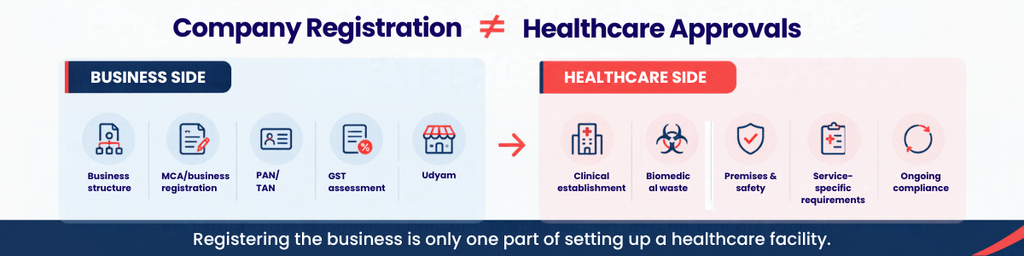
This article is for general informational purposes. Healthcare regulations and local requirements can change, and applicability depends on the services, premises and operating model of the establishment. Verify the current requirements with the relevant authority before commencing operations.

A rejection does not mean you should simply submit the same application again without understanding the reason. First identify the issue, review the rejection order, correct the underlying problem and then determine whether a fresh application or an appeal is appropriate.

What Does GST Registration Rejection Mean?

When you apply for GST registration, the application is examined by the proper officer along with the information and documents submitted.

The officer may approve the application if the details are satisfactory. If the application has deficiencies or clarification is required, the officer may issue FORM GST REG-03 asking for additional information, clarification or documents.

The applicant can respond electronically through FORM GST REG-04.

If the applicant does not respond within the prescribed period, or the officer is not satisfied with the clarification, information or documents provided, the application can be rejected through FORM GST REG-05, with reasons recorded by the officer.

So, there is an important difference between:

GST application pending → clarification requested → response submitted → approval/rejection

and

GST application rejected → rejection order issued → next action needs to be considered.

Does GST Registration Rejection Mean Your Business Cannot Operate?

Not necessarily.

A rejected GST registration application is different from cancellation of an existing GST registration.

If your new registration application is rejected, you do not receive a GSTIN through that application. The next step depends on why the application was rejected and whether the issue can be corrected through a fresh application or whether an appeal or other remedy should be considered.

The GST Portal itself notes, in relation to a new-registration rejection where the reason needs clarification, that the applicant can review notices/orders and may file another new registration application after making the desired changes.

However, reapplying without fixing the underlying issue may simply lead to another rejection.

Why Is a GST Registration Application Rejected?

There is no single list that covers every rejection. The reason should be read from the relevant notice or rejection order.

However, several practical issues commonly arise during GST registration verification.

1. Incorrect business information

Details entered in the GST application should correspond with the supporting records.

Examples include:

  • Incorrect legal name
  • Incorrect PAN details
  • Incorrect constitution of business
  • Incorrect principal place of business
  • Inconsistent promoter or authorised signatory details
  • Incorrect business commencement or liability information

The GST registration rules require the applicant to provide specified information and documents through FORM GST REG-01.

2. Problems with address documents

The principal place of business is an important part of the GST registration application.

Problems can arise when:

  • The address in the application does not match the supporting documents.
  • The ownership or occupancy document is unclear.
  • A required consent/NOC is not properly provided where applicable.
  • The uploaded document is incomplete or difficult to verify.
  • The business premises information does not adequately support the application.

The exact documents required can vary according to the nature and possession of the premises.

3. Incomplete or incorrect documents

Submitting a document is not enough.

The document should also support the information declared in the application.

For example, if the applicant provides an address document that does not correspond with the business address entered in the application, the officer may seek clarification.

The same principle applies to identity, constitution and other supporting information.

4. Failure to respond to REG-03

This is one of the most important points for applicants to understand.

A REG-03 notice is not the final rejection order. It is a request for additional information, clarification or documents.

Under Rule 9, the applicant is required to furnish the response electronically in FORM GST REG-04 within seven working days from receipt of the notice.

Ignoring the notice can therefore turn a correctable issue into a rejected application.

5. Unsatisfactory clarification

Submitting a REG-04 response does not automatically guarantee approval.

The officer may consider the clarification, information or documents provided and determine whether they adequately address the issue raised.

If the response is not satisfactory, the application may be rejected through REG-05.

This is why a response should address the specific point raised in the notice rather than simply uploading unrelated documents.

6. Mismatch with earlier GST information

The GST registration process also considers information associated with the applicant’s PAN and earlier registrations.

CBIC has specifically instructed officers to exercise caution where an applicant seeks another registration in the same State despite having an existing registration or where an earlier registration has been cancelled.

If your business has an earlier GST registration, cancellation history or another registration associated with the same PAN, the circumstances should be reviewed before submitting a new application.

What Is GST REG-03?

FORM GST REG-03 is a notice issued by the tax officer when additional information, clarification or documents are required in relation to the GST registration application.

The form identifies the application reference number and sets out the information or clarification required. It also states the date by which the applicant needs to respond.

Think of it as:

REG-03 = “Please clarify/provide additional information.”

It is not the same as:

REG-05 = “Your application has been rejected.”

This distinction is important because the REG-03 stage gives the applicant an opportunity to address the issue before the registration application is rejected.

What Is GST REG-04?

FORM GST REG-04 is the applicant’s response to the REG-03 notice.

The response is used to provide:

  • Clarification
  • Additional information
  • Supporting documents
  • Corrections to permitted application particulars

The current registration rules provide a seven-working-day period from receipt of the REG-03 notice for furnishing the response.

A good response should directly answer every point raised in the notice.

For example:

Notice: Clarification required regarding business premises.

Weak response: Uploading the same document again without explanation.

Better response: Providing the requested premises document together with a concise explanation showing how the document supports the address declared in the application.

What Is GST REG-05?

FORM GST REG-05 is the order used to communicate rejection of certain GST applications, including a new registration application where the requirements under the registration procedure have not been satisfactorily met.

For a new registration application, Rule 9 provides that where the applicant does not furnish the required response within the prescribed period or the officer is not satisfied with the clarification, information or documents submitted, the application may be rejected through REG-05.

The rejection order should be read carefully because it tells you the reason for the decision.

Do not treat REG-05 as simply a technical error message.

What Should You Do After GST Registration Is Rejected?

Follow this sequence.

Step 1: Download and read the rejection order

Check the GST Portal for the relevant notice and order.

The GST Portal’s known-issues guidance directs applicants to:

TRN → Services → User Services → View Notices and Orders

when the reason for a new-registration rejection needs to be checked.

Step 2: Identify the exact reason

Do not rely on assumptions.

Look for the specific reason mentioned in the order.

Ask:

  • Was there a document issue?
  • Was the address unclear?
  • Was information inconsistent?
  • Was a clarification not submitted?
  • Was the response considered insufficient?
  • Is there an earlier GST registration associated with the PAN?

Step 3: Correct the underlying problem

If you decide to make a fresh application, correct the problem first.

For example, if the problem relates to:

Address → review the premises documents.

Business constitution → verify the legal entity details.

PAN/name mismatch → check the source records.

Missing clarification → understand what information the officer requested.

Previous GST registration → review the earlier registration status and history.

Step 4: Decide whether to reapply or consider an appeal

A fresh application and an appeal are not the same thing.

A fresh application starts a new registration process.

An appeal challenges an order.

Section 107 of the CGST Act provides a general appeal mechanism against decisions or orders passed under the Act, with the general period for an aggrieved person being three months from the date on which the decision or order is communicated.

Whether an appeal is appropriate in a particular registration-rejection case depends on the order and circumstances. The applicable appellate procedure should therefore be checked before taking action.

Can You Apply for GST Registration Again After Rejection?

A new registration application can be considered after a rejected application, particularly where the underlying issue has been corrected.

The GST Portal’s known-issues guidance specifically states that, where a new registration application has been rejected and the rejection reason needs clarification, the applicant may file another application after making the desired changes.

But do not simply copy the previous application.

Before reapplying:

  1. Read the rejection order.
  2. Identify the issue.
  3. Correct the information.
  4. Review supporting documents.
  5. Check the business address.
  6. Verify PAN and legal-name details.
  7. Check previous GST registrations.
  8. Review the complete application before submission.

What If Your GST Application Is Rejected Because of Address Proof?

Address-related issues should be handled carefully because the principal place of business is a key part of the registration application.

First check whether:

  • The address is entered correctly.
  • The supporting document relates to the same premises.
  • The nature of possession is correctly declared.
  • Required supporting documents have been provided.
  • Names and addresses are consistent across documents.
  • The document is clear and readable.

Do not upload random documents simply to increase the number of attachments.

The objective is to establish a clear connection between the business and the declared place of business.

What If GST Registration Is Rejected Due to PAN or Name Mismatch?

PAN is a fundamental part of GST registration.

The registration process validates the PAN and requires the legal name of the business/entity to correspond with PAN records.

Before reapplying, check:

PAN → Legal name → Constitution → Applicant details

If these details do not align, determine which record is correct and address the mismatch before submitting another application.

Can You Check Your GST Registration Application Status?

Yes.

The GST Portal provides an application-status facility using the application reference information.

During registration, the application receives an Application Reference Number (ARN), and the applicant can track the application status through the GST Portal.

The portal may show different statuses during processing, so the applicant should not assume that a pending application has been rejected.

If a notice or order has been issued, check the notices/orders section rather than relying only on the headline status.

What Happens If You Do Not Respond to REG-03?

The consequences can be significant.

Under Rule 9, if the applicant does not furnish the required response within the prescribed period, the proper officer may reject the registration application through REG-05.

That means a business may lose the opportunity to resolve a correctable issue during the clarification stage.

The practical lesson is simple:

GST notice received → read it immediately → note the deadline → prepare the correct response → submit it through the prescribed process.

Is GST Registration Rejection the Same as GST Cancellation?

No.

This distinction is important.

GST registration rejection

You applied for a new GST registration, but the application was rejected before the GSTIN was granted.

GST cancellation

You already have a GST registration, and that registration is subsequently cancelled under the applicable procedure.

Revocation of cancellation

A taxpayer whose registration was cancelled by the proper officer in circumstances covered by the law may have a route to seek revocation of the cancellation. This is a different process from a rejected new-registration application.

Do not use a cancellation/revocation article to answer a new-registration rejection problem.

What Happens If the Officer Does Not Take Action?

Rule 9 contains provisions concerning deemed approval if the proper officer does not take the prescribed action within the relevant period.

For a standard registration application, the rule provides that if the proper officer does not act within three working days from submission, or within seven working days from receipt of the applicant’s clarification/information/documents, the application shall be deemed to have been approved, subject to the applicable provisions of the rules.

However, GST registration procedures can involve specific authentication and verification requirements.

Therefore, businesses should not assume that every delayed application automatically means a GSTIN has been granted.

Check the actual application status and applicable procedure.

How to Avoid GST Registration Rejection

Before submitting a new GST registration application, use this checklist.

GST Registration Pre-Filing Checklist

Business details

  • Legal name checked against PAN
  • PAN details correct
  • Constitution of business correct
  • Business activity accurately described

Promoters/authorised signatory

  • Names checked
  • PAN details checked
  • Contact details active
  • Required authentication completed

Business premises

  • Correct principal address
  • Appropriate address document
  • Supporting documents readable
  • Ownership/occupancy details consistent

Application

  • Registration reason checked
  • State and jurisdiction details reviewed
  • Goods/services information checked
  • Required documents attached
  • Declaration and verification completed

After submission

  • ARN saved
  • GST Portal notifications monitored
  • REG-03 checked promptly if issued
  • REG-04 response prepared within the prescribed period

Example: How a GST Rejection Can Happen

Consider a small consulting company applying for GST registration.

The company submits its application but the officer requires clarification regarding the principal place of business.

A REG-03 notice is issued.

The applicant sees the notification but does not respond.

The prescribed response period passes.

Under Rule 9, failure to furnish the required reply can result in rejection through REG-05.

The business owner then submits the same application again without reviewing the original issue.

This may create another avoidable problem.

A better approach is:

REG-03 → understand the issue → prepare REG-04 → submit supporting clarification → wait for the decision.

If the application is ultimately rejected:

REG-05 → identify the reason → correct the issue → consider fresh application or appropriate remedy.

GST Registration Rejection vs Clarification Notice

SituationWhat it meansWhat you should do
Application submittedGST application is under processingTrack ARN
REG-03 receivedOfficer needs clarification/information/documentsRespond through REG-04
REG-04 submittedApplicant has provided the requested responseMonitor application
REG-05 issuedApplication has been rejectedRead the reasons and decide next step
REG-06 issuedGST registration grantedDownload certificate and follow applicable compliance

The forms themselves have different purposes: REG-03 is for seeking additional information/clarification/documents, REG-04 is the applicant’s response, REG-05 is the rejection order, and REG-06 is the registration certificate.

Common Mistakes After GST Registration Rejection

Mistake 1: Applying again without reading the order

A fresh application does not fix an unresolved problem.

Mistake 2: Ignoring REG-03

A clarification notice is an opportunity to address the issue before rejection.

Mistake 3: Uploading unrelated documents

More documents do not necessarily mean a stronger response.

Mistake 4: Repeating the same information

If the officer has identified a mismatch, the response should address the mismatch.

Mistake 5: Confusing rejection with cancellation

The legal and procedural situations are different.

Mistake 6: Assuming every rejection should be appealed

An appeal is a separate legal remedy. The appropriate next step depends on the order and facts.

Mistake 7: Not checking previous GST registrations

Earlier registration or cancellation history can be relevant to a new application. CBIC has specifically highlighted the need for caution in such cases.

Frequently Asked Questions

Why was my GST registration application rejected?

A GST application may be rejected where required information or documents are deficient, the applicant does not respond to a REG-03 notice within the prescribed period, or the officer is not satisfied with the clarification, information or documents submitted.

What is REG-03 in GST?

REG-03 is a notice issued by the proper officer seeking additional information, clarification or documents regarding the GST registration application.

How many days do I get to reply to REG-03?

Under Rule 9, the applicant is required to furnish the response in REG-04 within seven working days from receipt of the REG-03 notice.

What happens if I do not reply to REG-03?

If no reply is furnished within the prescribed period, the registration application may be rejected through REG-05.

What is REG-05?

REG-05 is the electronic order used to communicate rejection of specified GST applications, including registration applications where the requirements have not been satisfactorily met.

Can I apply for GST registration again after rejection?

A fresh application may be possible after correcting the issue. The GST Portal’s guidance also states that another new-registration application can be filed after making the desired changes in circumstances covered by its rejection guidance.

Can I appeal against GST registration rejection?

The CGST Act provides an appeal mechanism under Section 107 for persons aggrieved by applicable decisions or orders. The general period is three months from communication of the decision or order. Whether an appeal is appropriate in a particular registration-rejection matter should be checked against the actual order and applicable procedure.

Is GST registration rejection the same as GST cancellation?

No. Rejection concerns an application for registration. Cancellation concerns an existing GST registration.

How can I avoid GST registration rejection?

Check PAN and business details, verify the principal place of business documents, submit complete information, monitor the GST Portal after filing and respond promptly to any REG-03 notice.

Final Takeaway

A GST registration rejection is not something to ignore, but it is also not a reason to panic.

The most important thing is to understand exactly what happened.

If you receive REG-03, respond properly through REG-04 within the prescribed period.

If you receive REG-05, read the rejection reasons carefully before deciding whether to correct the issue and make a fresh application or consider an applicable appeal or other remedy.

The goal should not be to submit another application as quickly as possible.

The goal is to fix the reason that caused the rejection.

Need help with GST registration or business compliance?

Filing Point can help you understand the applicable registration requirements, review the documentation and assist with the GST registration process.

📞 +91 72999 72500
📧 enquiry@filingpoint.com

A trademark opposition can delay your registration but it does not automatically mean your application will be rejected.

Here’s what happens after an opposition is filed, including the TM-O process, response deadlines, evidence, hearing and possible outcomes. 

What Is a Trademark Opposition?

A trademark opposition is a legal proceeding through which another party challenges the registration of a trademark.

It normally becomes relevant after a trademark application has been examined and advertised or re-advertised in the Trade Marks Journal.

The party filing the opposition is generally referred to as the opponent, while the business or person who filed the trademark application is the applicant.

The opposition process gives the opponent an opportunity to state why the trademark should not be registered and gives the applicant an opportunity to respond.

Under Rule 42, the notice of opposition must be filed in Form TM-O within four months from publication or republication of the relevant trademark application in the Trade Marks Journal. The Registrar ordinarily serves a copy of the notice on the applicant within three months of receiving it.

Simple example

Suppose ABC Foods Pvt. Ltd. applies to register the brand name FreshBite for food products.

The application is examined and later advertised in the Trade Marks Journal.

Another business, XYZ Foods, believes that registration of FreshBite could affect rights it claims in an earlier trademark.

XYZ Foods may file a trademark opposition within the prescribed period.

ABC Foods would then have an opportunity to respond through the opposition procedure.

The actual outcome would depend on the grounds raised, evidence submitted and applicable trademark law.

Trademark Registration Journey in India

What Is the Difference Between Trademark Objection and Trademark Opposition?

This is one of the most important distinctions for anyone applying for trademark registration in India.

Although the terms trademark objection and trademark opposition are sometimes used interchangeably in casual discussions, they refer to different stages and procedures.

Trademark Examination ObjectionTrademark Opposition
Arises during examination of the applicationArises after advertisement/re-advertisement
Raised by the Trade Marks RegistryFiled by another party
Communicated through an examination reportFiled through a notice of opposition
Applicant responds to Registry’s objectionApplicant responds to opponent’s case
Covered by the examination procedureCovered by the opposition procedure
Rule 33 is relevantRules 42–50 are relevant

Under Rule 33, the Registrar examines a trademark application and may communicate objections to acceptance through an examination report. The applicant is given an opportunity to respond under the prescribed procedure.

A trademark opposition, on the other hand, is filed by a third party after the application has been advertised in the Journal.

Why does this distinction matter?

Because the deadlines, documents and response process are different.

If you receive an examination report, you are dealing with the Registry’s examination process.

If you receive a notice of opposition, you are dealing with another party’s challenge to your trademark application.

Understanding which document you have received is therefore the first step.

When Can Someone Oppose a Trademark Application?

A trademark application can generally be opposed after it has been advertised or re-advertised in the Trade Marks Journal.

Rule 42 provides that a notice of opposition must be filed in Form TM-O within four months from the date of publication of the relevant Trade Marks Journal.

This means filing a trademark application does not immediately result in registration.

There are different stages between filing an application and obtaining registration.

A simplified journey is:

Trademark application → Examination → Advertisement in Journal → Opposition period → Registration, if applicable

If an opposition is filed during the prescribed period, the application enters an opposition proceeding.

Can someone oppose a trademark before it is advertised?

The statutory opposition process under Section 21 and Rule 42 is linked to advertisement or re-advertisement of the application.

Therefore, businesses should distinguish between:

  • Examination by the Registry
  • Advertisement in the Journal
  • Opposition by a third party

These are different stages of the trademark registration process.

Why Would Someone Oppose a Trademark?

There can be different reasons for a trademark opposition.

The exact grounds depend on the facts of the case and the legal provisions relied upon by the opponent.

For example, an opposition may involve arguments relating to:

  • An earlier trademark
  • Similarity between trademarks
  • Similar goods or services
  • Likelihood of confusion
  • Prior rights
  • Lack of distinctiveness
  • Other grounds available under trademark law

An opposition notice is therefore not necessarily based on one single issue.

For example, an opponent may argue that:

“The applicant’s proposed trademark is sufficiently similar to an earlier mark and is being applied for related goods or services.”

Another opposition may involve different legal grounds.

The applicant should therefore read the actual notice of opposition instead of assuming that the dispute is simply about the name being similar.

What Information Does a Trademark Opposition Notice Contain?

Rule 43 specifies information that must be included in a notice of opposition.

This includes information relating to:

  • The trademark application being opposed
  • Application number
  • Goods or services being opposed
  • Name of the trademark applicant
  • Earlier trademark or earlier right relied upon
  • Opponent
  • Grounds on which the opposition is based

The notice must also be properly verified.

This information is important because it tells the applicant what exactly is being challenged.

For example, an opposition may not necessarily concern every class or every product covered by an application.

If an application covers multiple classes, the opposition may relate only to particular classes.

Rule 42 also contains provisions concerning opposition against particular classes and division of applications in certain circumstances.

What Happens After a Trademark Opposition Is Filed?

Once a valid opposition is filed, the matter moves into a formal proceeding.

The broad sequence is:

1. Notice of opposition

The opponent files the opposition in Form TM-O.

2. Service of opposition

The Registrar ordinarily serves a copy of the opposition notice on the applicant.

3. Counterstatement

The applicant files a counterstatement in Form TM-O.

4. Evidence by opponent

The opponent may submit evidence by affidavit or state that it does not wish to submit evidence.

5. Evidence by applicant

The applicant gets an opportunity to submit evidence.

6. Reply evidence

The opponent may submit evidence in reply.

7. Hearing

The Registrar may conduct the hearing stage in accordance with the Rules.

8. Decision

The Registrar communicates the decision to the parties in writing.

Rules 42–50 of the Trade Marks Rules, 2017 provide the principal procedural framework for these stages.

How Long Do You Have to Respond to a Trademark Opposition?

This is one of the most important questions for an applicant.

Under Rule 44, the applicant’s counterstatement must be filed in Form TM-O within two months from receipt of the copy of the notice of opposition from the Registrar.

This should not be confused with the four-month period available for filing the initial opposition.

The two deadlines are different

Opponent:

Four months from publication or republication of the trademark application in the Journal.

Applicant:

Two months from receipt of the copy of the opposition notice.

Keeping these dates separate is important.

What should you do after receiving the notice?

Immediately:

  1. Note the date of receipt.
  2. Check the trademark application number.
  3. Identify the opponent.
  4. Read all grounds raised.
  5. Check the goods or services involved.
  6. Record the counterstatement deadline.
  7. Gather relevant documents.
  8. Prepare the response.

Do not rely only on the date shown on the original trademark application.

The counterstatement deadline under Rule 44 is linked to receipt of the opposition notice.

What Is a Counterstatement in Trademark Opposition?

A counterstatement is the applicant’s formal response to a trademark opposition.

Under Rule 44, it is filed in Form TM-O.

The counterstatement sets out the applicant’s position regarding the facts alleged in the notice of opposition, including which facts, if any, are admitted. It must also be verified in the prescribed manner.

A counterstatement should therefore be more than a simple statement such as:

“We want to register our trademark.”

It needs to address the opposition raised against the application.

The appropriate response depends on:

  • The opponent’s identity
  • The grounds of opposition
  • The trademark involved
  • Goods and services
  • Earlier marks or rights relied upon
  • Applicant’s use of the mark
  • Relevant supporting evidence

Because every opposition can involve different facts, the contents of a counterstatement should be prepared based on the actual notice received.

What Happens After the Counterstatement?

The trademark opposition does not end after the applicant files the counterstatement.

The matter may move into the evidence stage.

Evidence by the opponent

Under Rule 45, the opponent has two months from service of the counterstatement to:

  • Submit evidence by affidavit, or
  • Inform the Registrar and applicant that it does not wish to submit evidence and intends to rely on the facts stated in the notice of opposition.

If the opponent takes no action within the prescribed period, the Rules provide that the opposition is deemed abandoned.

Evidence by the applicant

Under Rule 46, the applicant gets two months after receiving the opponent’s evidence or relevant intimation to submit evidence by affidavit or indicate that it does not wish to submit further evidence.

If the applicant takes no action within the prescribed period, the application is deemed abandoned under the Rule.

Evidence in reply

Rule 47 provides the opponent with one month from receiving the applicant’s affidavit copies to submit evidence by affidavit in reply.

The Rules also contain provisions concerning further evidence in appropriate circumstances.

What Documents Can Be Used as Evidence in a Trademark Opposition?

The evidence required depends on the facts and grounds of the case.

Depending on the circumstances, relevant records may include:

Business-use evidence

  • Invoices
  • Purchase orders
  • Sales records
  • Product packaging
  • Labels
  • Product photographs

Marketing evidence

  • Advertisements
  • Brochures
  • Social media records
  • Website pages
  • Promotional material
  • Marketing campaigns
  • Earlier trademark registrations
  • Trademark applications
  • Assignment documents
  • Licensing records
  • Correspondence
  • Other relevant intellectual property records

Business records

  • Company documents
  • Commercial agreements
  • Distributor records
  • Customer records, where relevant

The correct evidence depends on what the opponent is alleging and what the applicant needs to establish.

There is no universal document list that applies identically to every trademark opposition.

What If You Ignore a Trademark Opposition?

Ignoring a trademark opposition can have serious procedural consequences.

The Trade Marks Rules prescribe specific actions at different stages.

For example:

  • The applicant has a prescribed period to file the counterstatement.
  • The opponent has a prescribed period to submit evidence or notify reliance on the opposition notice.
  • The applicant has a prescribed period for evidence.
  • The opponent may have a further period for reply evidence.

Rule 46 specifically provides that if the applicant takes no action within the prescribed evidence period, the application is deemed abandoned.

This is why businesses should not simply assume that their trademark application will continue automatically after an opposition is filed.

If you have missed a deadline

The correct next step depends on:

  • Which deadline was missed
  • When the deadline expired
  • What stage the proceeding has reached
  • What communication has been issued
  • Whether any procedural option is available

Check the current official record and obtain appropriate professional guidance where necessary.

Company Registration in Chennai

Can a Trademark Be Registered After Opposition?

Yes, an opposition does not automatically mean that registration is impossible.

The opposition is a proceeding through which the opponent challenges the application.

The applicant gets an opportunity to present its case under the prescribed process.

The final result depends on the facts, pleadings, evidence, applicable law and Registrar’s decision.

Rule 53 provides that where no opposition is filed within the prescribed period, or where an opposition is filed and dismissed, the Registrar shall, subject to the applicable provisions of the Act and Rules, enter the trademark on the register.

Therefore, an applicant should not treat the receipt of an opposition notice as equivalent to a final rejection.

Instead, the applicant should focus on responding correctly to the opposition.

What Happens at the Trademark Opposition Hearing?

After the evidence stage closes, Rule 50 provides for a hearing.

The Registrar gives notice of the first hearing date, which is to be at least one month after the first hearing notice. The Rules also contain provisions concerning adjournments.

The parties may present their respective submissions in accordance with the applicable procedure.

The Registrar considers the material before deciding the opposition.

The Rules also state that written arguments, where submitted by a party, are to be considered by the Registrar.

The final decision is communicated to the parties in writing at the address provided for service.

Why should businesses prepare carefully?

By the hearing stage, the matter may already contain:

  • Opposition notice
  • Counterstatement
  • Affidavits
  • Exhibits
  • Reply evidence
  • Written arguments

The hearing should therefore be viewed as part of the overall proceeding rather than as an isolated event.

Can a Trademark Opposition Be Settled or Withdrawn?

A trademark opposition does not necessarily have to continue until a contested decision in every situation.

Depending on the circumstances, parties may resolve their dispute through settlement or other appropriate procedural steps, including withdrawal where applicable.

However, whether settlement is suitable depends on:

  • The rights claimed by the opponent
  • Similarity between the marks
  • Goods or services
  • Evidence of use
  • Commercial relationship
  • Negotiation position
  • Stage of the opposition

Businesses should not assume that every opposition should be settled or every opposition should be contested.

The appropriate course depends on the actual circumstances.

What Is the Current Trademark Opposition Position in India in 2026?

Businesses dealing with trademark opposition matters should also be aware of current developments from IP India.

On 31 August 2026, IP India published a notice titled “Special Disposal Drive for Disposal of Pending Trade Mark Opposition Matters (Settlement/Withdrawal)”.

The title of the notice indicates that the initiative concerns pending opposition matters and settlement/withdrawal.

This should not be confused with a change to the basic opposition deadlines under Rule 42 or Rule 44.

The existing Trade Marks Rules continue to provide the procedural framework for opposition, counterstatement, evidence and hearing.

IP India also published a notice on 21 August 2026 inviting stakeholders to submit comments and suggestions on the Revised Draft Manual of the Trade Marks Office (Practice & Procedure).

For businesses with pending trademark matters, the practical lesson is simple:

Check current IP India communications rather than relying only on old trademark articles or outdated procedural information.

What Should You Do After Receiving a Trademark Opposition?

If your trademark application has been opposed, use this checklist.

1. Confirm the application number

Make sure the opposition relates to your actual trademark application.

2. Identify the opponent

Check the person or business filing the opposition and the rights or trademark they rely upon.

3. Read the grounds carefully

Do not assume that the opposition is simply because the names are similar.

Read every ground stated in the notice.

4. Check the goods and services

Determine whether the opposition concerns:

  • All goods/services
  • Particular goods/services
  • Particular classes

5. Record the deadline

The counterstatement deadline under Rule 44 is linked to receipt of the opposition notice.

6. Review your trademark history

Collect:

  • Application documents
  • User claims
  • Earlier correspondence
  • Trademark search information
  • Business-use records

7. Gather evidence

Depending on the case, collect invoices, advertisements, packaging, website records and other relevant documents.

8. Monitor the proceeding

Do not stop checking the status after filing the counterstatement.

The proceeding can move through evidence and hearing stages.

9. Keep copies of every filing

Maintain an organised record of:

  • Opposition notice
  • Counterstatement
  • Evidence
  • Affidavits
  • Exhibits
  • Hearing notices
  • Written arguments
  • Orders and decisions

What Are Common Mistakes Businesses Make During Trademark Opposition?

Mistake 1: Treating opposition as a rejection

An opposition is a proceeding, not automatically the final rejection of the trademark.

Mistake 2: Missing the counterstatement deadline

Rule 44 provides a specific period for filing the counterstatement.

Mistake 3: Giving a generic response

The counterstatement should address the allegations actually raised.

Mistake 4: Ignoring evidence

Trademark disputes can involve evidence relating to use, prior rights and commercial activity.

Mistake 5: Assuming the trademark is protected because an application was filed

Filing an application and obtaining registration are different stages.

Mistake 6: Using outdated information

Trademark procedures and administrative practices can change.

Always check current IP India information for important procedural matters.

Mistake 7: Waiting until the hearing to understand the case

The opposition should be reviewed from the beginning so that the evidence and response can be prepared appropriately.

Trademark Opposition Timeline in India

Here is a simplified view of the main stages under the Trade Marks Rules:

StageWhat happens?Relevant rule
AdvertisementApplication is published/re-published—
OppositionNotice filed in Form TM-ORule 42
CounterstatementApplicant responds in Form TM-ORule 44
Opponent evidenceEvidence by affidavit or reliance on noticeRule 45
Applicant evidenceEvidence by affidavit or reliance on recordRule 46
Reply evidenceOpponent may submit reply evidenceRule 47
Further evidenceMay be allowed by Registrar in appropriate casesRule 48
HearingHearing after closure of evidenceRule 50
DecisionRegistrar communicates decisionRule 50

The individual procedural periods should be calculated from the relevant event specified in the Rules rather than from the original trademark filing date.

Trademark Opposition vs Trademark Objection: Which One Did You Receive?

If you are confused about the document you received, use this simple test:

If the document is an examination report:

You are likely dealing with a trademark examination objection.

If another party has filed a notice challenging your advertised application:

You are dealing with a trademark opposition.

If you have received Form TM-O relating to opposition:

Check the application number, opponent, grounds and applicable deadline immediately.

This distinction can help prevent businesses from following the wrong response process.

Is Form TM-O Used for Trademark Opposition?

Yes.

Form TM-O is used for a notice of opposition under Rule 42 and for the applicant’s counterstatement under Rule 44. It is also prescribed for various other trademark proceedings under the Rules.

IP India’s current Forms & Official Fees page provides the official forms and applicable fee information.

The current official fee schedule also provides separate fees for trademark opposition and related proceedings. Businesses should check the current official schedule before filing because the applicable fee depends on the type of proceeding and filing circumstances.

Can One Trademark Application Be Opposed for Only One Class?

Yes, the opposition procedure can operate at the class level in relevant circumstances.

Rule 42 specifically addresses opposition where a single trademark application covers different classes.

Where an opposition is filed only for particular classes, the Rules contain provisions concerning the remaining classes and division of the application.

This is particularly relevant for businesses that have filed multi-class trademark applications.

Therefore, when receiving an opposition, check not only the trademark name, but also:

  • Application number
  • Classes
  • Goods/services
  • Scope of the opposition

Does Trademark Opposition Mean Someone Owns the Trademark?

Not necessarily.

An opponent may rely on an earlier trademark or other rights, but the existence of an opposition itself does not establish that the opponent automatically has superior rights.

The opponent has to present its case through the prescribed proceeding.

Similarly, the applicant has an opportunity to present its response and evidence.

The Registrar decides the matter based on the applicable law and material before the Registry.

How Filing Point Can Help

A trademark opposition can involve several procedural stages, and the appropriate response depends on the actual application, opposition notice, grounds and evidence.

Filing Point provides Trademark Registration support for businesses looking to protect their brands in India, including assistance around trademark search, class selection and the registration process.

If your trademark application has received an objection or opposition, the first step is to understand exactly what communication you have received and what deadline applies.

Need help with trademark registration or related filing support?

📞 +91 72999 72500

📧 enquiry@filingpoint.com

Frequently Asked Questions About Trademark Opposition in India

1. Can someone oppose my trademark after I file the application?

Yes. Once the application is advertised or re-advertised in the Trade Marks Journal, a third party can file an opposition within the prescribed period. Rule 42 provides a four-month period from publication or republication.

2. What is the trademark opposition deadline in India?

Under Rule 42, the notice of opposition is generally filed within four months from publication or republication of the application in the Trade Marks Journal.

3. How long do I have to reply to a trademark opposition?

Under Rule 44, the applicant has two months from receipt of the copy of the opposition notice to file the counterstatement in Form TM-O.

4. What is Form TM-O?

TM-O is the prescribed form used for several trademark proceedings, including a notice of opposition and the applicant’s counterstatement in an opposition matter.

5. Is trademark objection the same as trademark opposition?

No. An examination objection is raised by the Trade Marks Registry during examination. A trademark opposition is filed by another party after the application has been advertised.

6. What happens after filing a trademark opposition?

The process can include a counterstatement, evidence by the opponent, evidence by the applicant, reply evidence, hearing and a decision by the Registrar.

7. What happens if the applicant does not file evidence?

Under Rule 46, if the applicant takes no action within the prescribed evidence period, the application is deemed abandoned.

8. What happens if the opponent does not file evidence?

Under Rule 45, if the opponent takes no action within the prescribed period, the opposition is deemed abandoned.

9. Can a trademark be registered after opposition?

An opposition does not automatically prevent registration. Rule 53 provides for registration where an opposition is filed and dismissed, subject to the applicable provisions of the Act and Rules.

10. Can a trademark opposition be settled?

Depending on the circumstances, parties may resolve an opposition through settlement or withdrawal where the applicable procedure permits. The appropriate approach depends on the particular dispute.

11. How long does trademark opposition take?

The Rules prescribe individual periods for different stages, but the total duration of an opposition can vary depending on the proceeding, evidence, hearing schedule and Registry process. It is better not to promise a fixed overall timeline.

12. What should I do after receiving a trademark opposition notice?

Check the application number, opponent, grounds, goods/services and date of receipt. Then identify the applicable counterstatement deadline and prepare the response and supporting material.

Conclusion

A trademark application in India is not automatically registered simply because it has been filed.

After examination and advertisement in the Trade Marks Journal, another party may oppose the application within the prescribed period. Under Rule 42, the notice of opposition is filed in Form TM-O within four months from publication or republication. If an opposition is filed, the applicant generally has two months from receipt of the opposition notice to file a counterstatement under Rule 44.

The proceeding may then move through evidence, reply evidence, hearing and a decision by the Registrar.

For a business owner, the most important practical steps are to:

Read the opposition → understand the grounds → track the deadline → prepare the counterstatement → organise evidence → monitor the proceeding.

A trademark opposition is a formal legal proceeding, so businesses should avoid relying on generic templates or outdated information. Always check the current Trade Marks Registry requirements and the actual notice received in your case.

Starting a manufacturing business in Coimbatore involves more than registering a company. Depending on the business model, founders may need to consider company or LLP registration, GST, Udyam/MSME registration, trademark protection, factory-related approvals, pollution-control requirements, labour registrations and product-specific licences.

The exact requirements depend on the legal structure, manufacturing activity, premises, turnover, employees, machinery, products and applicable Tamil Nadu and central regulations.

This guide explains how these registrations fit together and what entrepreneurs should consider before starting a manufacturing business in Coimbatore.

Quick Answer: What Registration Does a Manufacturing Business in Coimbatore Need?

A manufacturing business in Coimbatore may need several registrations and approvals depending on its circumstances.

Company or LLP registration establishes the legal structure of the business. GST registration deals with indirect tax requirements. Udyam registration provides MSME recognition for eligible enterprises. Trademark registration protects the business brand, while factory, pollution-control, labour and product-specific approvals may apply depending on the manufacturing activity and premises.

There is therefore no single registration that covers every requirement for a manufacturing business.

Why Coimbatore Is a Strong Location for Manufacturing Businesses

Coimbatore has a long-established industrial and manufacturing ecosystem.

The Coimbatore District administration identifies textiles, textile machinery, auto components, pumps, motors, wet grinders, engineering products and other manufacturing activities as important parts of the local economy. The district also has a substantial base of small, medium and large industries.

This makes the city relevant for entrepreneurs starting businesses such as:

  • Engineering components
  • Industrial machinery
  • Pumps and motors
  • Textile machinery
  • Garments and textile products
  • Auto components
  • Electrical and electronic products
  • Consumer products
  • Food and packaged products
  • Industrial tools and equipment
  • Manufacturing-related technology businesses

For a new entrepreneur, however, choosing Coimbatore as the manufacturing location is only one part of the decision.

The founder also needs to decide how the business will be legally structured and which registrations and approvals will be required for the actual activity

Company Incorporation

Choosing the Right Legal Structure for a Manufacturing Business

The first major decision is the legal structure.

Common options include:

StructureUsually suitable forKey consideration
Private Limited CompanyGrowing manufacturers and startupsShare-based ownership and structured corporate framework
LLPPartner-led businesses and some engineering/service businessesFlexible partnership structure with limited liability
Partnership FirmSmall businesses with closely involved partnersPartnership-based ownership
OPCEligible single-founder businessesSingle-member corporate structure
ProprietorshipVery small individual businessesSimpler structure but no separate legal entity

There is no universal answer.

A founder manufacturing industrial components for a few customers may have very different requirements from a startup developing a new technology product and planning to raise external investment.

Private Limited Company for Manufacturing

A Pvt Ltd manufacturing company can be appropriate when founders want a formal corporate structure with shareholders and directors.

It may be particularly relevant when the business plans to:

  • Bring in investors
  • Add shareholders
  • Expand ownership
  • Build a larger corporate organisation
  • Pursue institutional funding
  • Create a scalable manufacturing business
  • Establish a long-term brand

Company incorporation is handled through the Ministry of Corporate Affairs (MCA) framework.

For a new company, the incorporation process involves matters such as name selection, incorporation documents, directors, registered office details, Digital Signature Certificates and other linked registrations.

The exact government fees depend on factors such as the incorporation details and applicable state stamp duty, so founders should avoid relying on a single advertised “company registration fee” as a universal cost.

LLP for Manufacturing and Engineering Businesses

An LLP manufacturing business can be considered where two or more partners want limited liability with a partnership-based structure.

LLPs can be particularly relevant for certain engineering, consulting, design, technical-service or closely held businesses.

MCA’s LLP incorporation process uses FiLLiP for name reservation and LLP incorporation.

An LLP can also be eligible for DPIIT Startup India recognition if it satisfies the applicable requirements.

However, founders should consider future funding and ownership plans before choosing an LLP. Startup India’s guidance notes that investors in an LLP would generally become partners, whereas a company can accommodate investors through its shareholding structure.

Partnership Firm for Small Manufacturing Businesses

A registered partnership firm may be considered by two or more individuals operating a closely held small manufacturing business.

It can be relevant where the founders already have a clear partnership arrangement and do not require a corporate shareholding structure.

However, the partners should understand the legal, financial and tax implications before selecting this structure.

For a manufacturing business that expects significant expansion, external investment or a more formal corporate ownership structure, it is worth comparing a partnership with an LLP or Private Limited Company before registration.

Private Limited Company Registration

MSME/Udyam Registration for Manufacturing Businesses

One of the most common areas of confusion is the difference between company registration and MSME registration.

They are not the same.

Company registration creates the business structure.

Udyam registration provides MSME recognition to an eligible enterprise.

An eligible manufacturing business can obtain Udyam Registration through the official Ministry of MSME portal.

The official Udyam portal states that registration is free, paperless and based on self-declaration, and an enterprise receives a permanent Udyam Registration Number and online certificate.

The current MSME classification uses investment and turnover criteria.

MSME categoryInvestment limitTurnover limit
MicroUp to ₹2.5 croreUp to ₹10 crore
SmallUp to ₹25 croreUp to ₹100 crore
MediumUp to ₹125 croreUp to ₹500 crore

These are the current classification limits displayed on the official Udyam portal following the revision effective from 1 April 2025.

For a company or LLP, the Udyam process also uses the organisation’s PAN and GSTIN where applicable, together with Aadhaar details of the authorised person.

Why Udyam Registration Matters

An eligible manufacturing MSME may consider Udyam registration because MSME recognition can be relevant when accessing government schemes, formal credit channels and other benefits available to eligible enterprises.

However, entrepreneurs should not assume that Udyam registration automatically provides every MSME benefit. Individual schemes can have additional eligibility conditions.

GST Registration for Manufacturing Companies

GST is another important consideration for manufacturing businesses.

GST registration is separate from company registration and Udyam registration.

Whether a manufacturing business needs GST registration depends on its taxable supplies, turnover and the applicable compulsory-registration provisions.

The CGST framework contains turnover-based registration provisions, while specific circumstances can trigger registration under separate provisions.

Therefore, a founder should not simply assume:

“I registered my company, so GST is automatically completed.”

That is not how these registrations work.

A manufacturing company should evaluate:

  • What products it sells
  • Whether the products are taxable or exempt
  • Annual aggregate turnover
  • Whether it makes inter-State supplies
  • Whether any compulsory-registration provision applies
  • Where the business operates
  • Whether it needs GST registration for commercial reasons

For a manufacturing business selling products across Tamil Nadu or other Indian states, GST planning should be considered early because the business may need to issue compliant tax invoices and maintain appropriate GST records once registered.

Trademark Registration for Manufacturing Brands

Manufacturing companies often invest heavily in a product name, logo, packaging and market reputation.

That makes trademark registration worth considering as part of the business setup process.

A manufacturing brand may include:

  • Machinery brands
  • Industrial equipment brands
  • Consumer products
  • Electrical products
  • Textile brands
  • Private-label products
  • Engineering product brands
  • Food or packaged-product brands

Company registration does not automatically give comprehensive trademark protection for the brand.

For example, registering ABC Manufacturing Private Limited as a company does not mean every use of “ABC” as a product or brand name is automatically protected as a trademark.

Before investing heavily in packaging, machinery branding, website development or marketing, founders should consider conducting a trademark search and assessing whether trademark registration is appropriate.

Other Registrations and Approvals for Manufacturing Businesses

This is where manufacturing businesses differ significantly from ordinary service businesses.

There is no universal list of licences that applies to every factory in Coimbatore.

The applicable approvals can depend on:

  • Type of product
  • Manufacturing process
  • Factory premises
  • Machinery
  • Power usage
  • Number of employees
  • Pollution category
  • Chemicals or hazardous materials used
  • Storage requirements
  • Packaging
  • Local-body requirements
  • Environmental impact
  • Industry-specific laws

Factory and Labour Requirements

Manufacturing units may have obligations under applicable factory and labour laws depending on their operations.

Tamil Nadu’s labour systems provide registration-related services for factories and other establishments.

The exact requirement should therefore be assessed based on the proposed premises, workforce and manufacturing activity rather than applying a generic checklist.

Pollution-Control Approvals

Manufacturing activity can also involve the Tamil Nadu Pollution Control Board (TNPCB).

Depending on the nature and pollution category of the unit, the business may need approvals such as Consent to Establish (CTE) and/or Consent to Operate (CTO).

TNPCB maintains processes for consent-related approvals and its technical committee handles specified categories of industrial units.

A manufacturing founder should therefore identify the applicable pollution category and approval requirements before setting up the unit.

Businesses manufacturing, packing or importing certain products for sale may also have requirements under Legal Metrology laws.

For example, Tamil Nadu’s labour/legal-metrology department provides registration procedures for manufacturers, packers and importers of packaged commodities.

This illustrates why a product-specific assessment is important.

A machinery manufacturer, food manufacturer and packaged consumer-product manufacturer may not have the same compliance requirements.

Manufacturing Business Registration Checklist

The following checklist can help a founder identify the major areas to evaluate.

RequirementWhy it mattersWhen applicable
Business structureEstablishes the legal form of the businessAlways choose an appropriate structure
PAN/TANTax and financial complianceDepending on entity and tax requirements
GSTIndirect tax complianceBased on applicable GST rules
UdyamMSME recognitionEligible enterprises
TrademarkProtects brand identityWhen protecting a brand
Factory-related approvalsRegulatory compliance for manufacturing premisesDepending on factory/activity
TNPCB approvalEnvironmental complianceDepending on industry and pollution category
Labour registrationsEmployee and workplace complianceDepending on workforce and applicable laws
Legal MetrologyProduct/packaging complianceWhere applicable
Sector-specific licencesCompliance with industry-specific lawsDepending on product
Local approvalsPremises and local operational requirementsDepending on location and activity

This should be treated as a starting checklist, not a universal licence list.

Company Registration vs MSME Registration

This is one of the most important distinctions for a manufacturing entrepreneur.

Company RegistrationMSME/Udyam Registration
Creates/registers the chosen business entityRecognises an eligible enterprise as an MSME
Governed through the applicable legal framework for the entityGoverned through the Ministry of MSME framework
Relevant to companies such as Private Limited CompaniesAvailable to eligible enterprises meeting MSME criteria
Does not automatically provide MSME statusDoes not create a Private Limited Company or LLP
Company incorporation is separate from UdyamUdyam is a separate registration

For example, suppose two founders start a machinery manufacturing business in Coimbatore.

They could first establish a Private Limited Company or another suitable business structure.

If the enterprise meets the applicable MSME classification criteria, it could then obtain Udyam Registration.

The two registrations serve different purposes.

This distinction is particularly important for founders searching for MSME registration in Coimbatore or Udyam registration in Coimbatore because Udyam registration is not a replacement for company incorporation.

How to Register a Manufacturing Company in Coimbatore

The practical process can be approached in stages.

Step 1: Define the Manufacturing Business

Clearly identify:

  • Product
  • Manufacturing process
  • Target customers
  • Proposed premises
  • Machinery
  • Number of employees
  • Expected turnover
  • Whether sales will be local, across India or international

This information affects later compliance decisions.

Step 2: Choose the Business Structure

Compare the suitability of:

  • Private Limited Company
  • LLP
  • Partnership
  • OPC, where appropriate

Do not choose a structure only because its initial registration cost appears lower.

Consider ownership, funding, liability, compliance and long-term plans.

Step 3: Complete the Business Registration

For a Private Limited Company, incorporation is carried out through the MCA framework.

For an LLP, MCA provides the FiLLiP incorporation route.

The incorporation process involves submitting the required details and documents and obtaining the applicable identification and registration details.

Step 4: Set Up Tax and Banking Requirements

After incorporation, assess:

  • PAN
  • TAN
  • GST
  • Business bank account
  • Accounting system
  • Applicable tax registrations

Do not assume that every optional or conditional registration is automatically required.

Step 5: Obtain Udyam Registration if Eligible

If the business qualifies as a micro, small or medium enterprise, consider Udyam Registration.

The official Udyam portal states that the registration process is free and paperless.

Step 6: Check Factory and Product-Specific Approvals

Before starting production, assess applicable:

  • Factory requirements
  • TNPCB approvals
  • Labour requirements
  • Local-body approvals
  • Fire/safety requirements where applicable
  • Legal Metrology requirements
  • Product-specific licences
  • Industry-specific regulations

This stage should be based on the actual manufacturing activity.

How Much Does Manufacturing Company Registration Cost in Coimbatore?

There is no single fixed cost for registering a manufacturing business in Coimbatore.

The cost depends on the legal structure and the requirements of the business.

For example, the overall setup cost can involve:

  • Government incorporation fees
  • Applicable stamp duty
  • Professional service fees
  • DSC-related costs where applicable
  • GST-related professional assistance, if required
  • Udyam registration assistance, if any
  • Trademark fees, if applicable
  • Factory or local approvals
  • Environmental approvals
  • Product-specific licences

Udyam Registration itself is officially free on the government portal.

Manufacturing businesses should therefore avoid comparing structures solely by their incorporation fee.

A better question is:

What will this business need to legally start production and sell its products?

That gives a more realistic picture of the setup requirement.

How Long Does Manufacturing Company Registration Take?

There is no single guaranteed timeline for every manufacturing business.

The time required depends on:

  • Whether the proposed company name is accepted
  • Accuracy of incorporation documents
  • MCA processing
  • Government approvals
  • Nature of the manufacturing activity
  • Premises-related requirements
  • Pollution-control requirements
  • Factory approvals
  • Product-specific licences

Company incorporation itself and obtaining permission to operate a manufacturing facility are also separate processes.

A business may complete its legal entity registration while still needing additional approvals before commencing a particular manufacturing activity.

Therefore, founders should plan the registration and approval process as a compliance sequence, rather than assuming that incorporation alone means the factory is ready to operate.

Practical Example: Engineering Startup in Coimbatore

Consider two founders starting an engineering company that manufactures industrial pump components.

They may decide to establish a Private Limited Company because they expect to grow the business and potentially bring in investors later.

Their setup could involve:

Stage 1: Private Limited Company incorporation

Stage 2: PAN/TAN and business banking

Stage 3: GST assessment and registration, where applicable

Stage 4: Udyam registration if the enterprise qualifies as an MSME

Stage 5: Trademark assessment for the product/brand

Stage 6: Factory and premises-related compliance

Stage 7: TNPCB assessment and applicable consent

Stage 8: Labour and employee-related compliance

Stage 9: Product-specific regulatory assessment

Notice that there is no single “manufacturing registration” completing all these steps.

Each requirement addresses a different part of the business.

Common Mistakes Manufacturing Entrepreneurs Make

1. Assuming incorporation covers everything

Registering a Private Limited Company or LLP does not automatically mean every manufacturing approval is completed.

Better approach: Prepare a separate post-incorporation and factory-compliance checklist.

2. Treating Udyam as company registration

Udyam registration and business entity registration serve different purposes.

Better approach: Complete the appropriate entity registration first and then evaluate Udyam eligibility.

3. Choosing a structure only because it is cheaper

A low initial registration cost does not necessarily mean lower long-term business costs.

Better approach: Consider ownership, funding, compliance and future expansion.

4. Ignoring product-specific rules

A food manufacturer, machinery manufacturer and packaged-product manufacturer can have very different regulatory requirements.

Better approach: Identify the exact product and manufacturing process before finalising the compliance checklist.

5. Checking licences after taking the premises

Some manufacturing approvals can depend on the location, premises and nature of operations.

Better approach: Check applicable premises and regulatory requirements before making significant investments.

6. Forgetting brand protection

Manufacturers often invest heavily in a product name before checking trademark availability.

Better approach: Conduct a trademark search early and consider registration where appropriate.

Frequently Asked Questions

1. Is company registration mandatory for a manufacturing business in Coimbatore?

Not every manufacturing business must be incorporated as a company. Depending on the business model, an entrepreneur may consider a Private Limited Company, LLP, partnership or other suitable structure. The correct choice depends on ownership, liability, funding and business plans.

2. Is Udyam registration the same as company registration?

No. Udyam registration is not company incorporation. Udyam provides MSME recognition to eligible enterprises, while company registration establishes a company as a legal entity.

3. Is Udyam registration compulsory for a manufacturing company?

Udyam registration should not be confused with incorporation. It is the official MSME registration mechanism for eligible enterprises. Whether an entrepreneur should obtain it depends on the business’s eligibility and intended use of MSME-related benefits.

4. Does a manufacturing company need GST registration?

It depends on the business’s taxable supplies, turnover and applicable GST provisions. GST registration is separate from company incorporation and Udyam registration.

5. Is LLP suitable for a manufacturing business?

An LLP can be suitable for some partner-led businesses, particularly where flexibility and closely held ownership are important. However, founders expecting substantial external equity investment should compare LLP and Private Limited structures carefully.

6. Is a Private Limited Company suitable for manufacturing?

A Private Limited Company can be suitable for manufacturers planning a formal corporate structure, shareholders, expansion or external investment. Its suitability depends on the founders’ business and funding plans.

7. Does every manufacturing unit need TNPCB approval?

Not necessarily in the same form. Requirements depend on the nature and category of the industrial activity and applicable environmental regulations. A manufacturing business should assess the specific requirements before starting operations.

8. What is the MSME limit for a manufacturing business?

Under the current Udyam classification, a micro enterprise can have investment up to ₹2.5 crore and turnover up to ₹10 crore; a small enterprise up to ₹25 crore investment and ₹100 crore turnover; and a medium enterprise up to ₹125 crore investment and ₹500 crore turnover.

9. Can a manufacturing startup get DPIIT recognition?

An eligible Private Limited Company, LLP or registered partnership can apply for DPIIT startup recognition if it meets the current Startup India criteria.

10. What documents are needed for manufacturing company registration?

The documents depend on the chosen structure. Incorporation generally involves identity and address information of the founders/directors or partners, registered-office information and other documents required by the applicable MCA process. Additional documents may be required for GST, Udyam, factory and sector-specific approvals.

Final Checklist for Entrepreneurs in Coimbatore

Before starting a manufacturing business, review these areas:

Business structure

  • Private Limited Company
  • LLP
  • Partnership
  • OPC, where appropriate

Tax and statutory

  • PAN
  • TAN
  • GST, where applicable
  • Accounting and tax compliance

MSME

  • Udyam eligibility
  • Udyam Registration

Brand

  • Trademark search
  • Trademark registration, where appropriate

Factory and premises

  • Factory-related requirements
  • Local approvals
  • Labour requirements
  • Fire/safety requirements where applicable

Environmental

  • TNPCB category
  • Consent requirements where applicable

Product

  • Legal Metrology, where applicable
  • Industry-specific licences
  • Product-specific regulatory requirements

The final checklist should be based on the actual product, premises, manufacturing process and workforce, not simply on the fact that the business is located in Coimbatore.

Conclusion

Starting a manufacturing business in Coimbatore requires more than choosing a company name and completing incorporation.

The first step is selecting the appropriate business structure. The next steps may include GST registration, Udyam/MSME registration, trademark protection, factory-related compliance, pollution-control approvals, labour registrations and product-specific licences, depending on the business.

The key distinction is simple:

Company registration establishes your business structure. Udyam registration provides MSME recognition. GST registration addresses indirect tax requirements. Other approvals may be required to legally operate the manufacturing activity.

If you are planning company registration for a manufacturing business in Coimbatore, FilingPoint can help you evaluate the appropriate business structure and complete the relevant incorporation process.

You can explore FilingPoint’s company registration, LLP registration and OPC registration services before deciding which structure fits your business.

Choosing a legal structure is one of the first important decisions when starting a technology business in India.

For a two-founder SaaS business, software development company, AI startup, IT services company or technology product business, the two structures most commonly considered are a Limited Liability Partnership (LLP) and a Private Limited Company.

Both provide limited liability and can operate as independent legal entities. But they are not interchangeable.

A Private Limited Company is generally better suited to a technology startup that plans to raise equity investment, issue shares to founders or employees, build a formal ownership structure and scale aggressively. An LLP can be attractive when the founders want limited liability with comparatively flexible management and a simpler ownership arrangement.

The right choice depends on your business model and growth plans not simply on which registration is cheaper.

LLP vs Private Limited Company: Quick Answer

A Private Limited Company is usually the stronger choice for a tech startup planning to raise angel or venture capital, issue equity, create an employee stock option structure or build a business for rapid scale. An LLP can be more suitable for a founder-led technology services or consulting business where external equity funding is not a major objective.

Both Private Limited Companies and LLPs can be eligible for Startup India recognition, subject to the applicable eligibility conditions. Startup India currently recognises Private Limited Companies, registered partnership firms and LLPs, among other eligible entities.

What Is an LLP in India?

A Limited Liability Partnership (LLP) is a separate legal business structure governed by the Limited Liability Partnership Act, 2008.

It combines features of a traditional partnership with limited liability protection. The business is operated through partners, including designated partners who are responsible for statutory and regulatory matters.

For example, suppose two software developers in Chennai start a technology consulting business. They do not intend to raise venture capital and expect most of their income to come from client projects.

An LLP may provide the limited-liability structure they need without creating a share-based company structure.

An LLP is particularly worth considering for:

  • Technology consulting firms
  • Software development agencies
  • IT service businesses
  • Freelance teams becoming formal businesses
  • Professional service businesses
  • Bootstrapped businesses
  • Businesses owned and operated primarily by their founders

However, an LLP may become less convenient if the business later wants to bring in multiple equity investors.

What Is a Private Limited Company?

A Private Limited Company is a separate legal entity incorporated under the Companies Act, 2013 and registered with the Ministry of Corporate Affairs (MCA).

Ownership is represented through shares held by shareholders, while management is handled by directors.

This structure is commonly used by technology startups because it creates a formal framework for:

  • Founder shareholding
  • Equity investment
  • Share transfers
  • Investor participation
  • Employee equity arrangements
  • Corporate governance
  • Future fundraising

For example, consider three founders building an AI SaaS platform.

They expect to spend the first two years developing the product and then approach angel investors or venture capital funds.

For this type of business, Private Limited Company Registration is generally more suitable than LLP registration because the company already has a share-based ownership structure.

LLP vs Private Limited Company: Key Differences

FactorLLPPrivate Limited Company
Governing frameworkLLP Act, 2008Companies Act, 2013
Separate legal entityYesYes
Liability protectionLimited, subject to lawLimited, subject to law
OwnershipPartnership interest/contributionShares
ManagementPartners/designated partnersDirectors
Equity fundraisingLess suitable for conventional startup equity fundingGenerally better suited
Angel/VC investmentCan be possible depending on structure and applicable rules, but less conventionalCommonly preferred
Employee equityLess straightforwardShare-based ESOP structures can be used, subject to law
ComplianceGenerally lighter than a company, but still requires statutory filingsGenerally more extensive
GovernanceMore flexibleMore formal
Founder controlFlexible through LLP agreementDetermined through shareholding, Articles and shareholder arrangements
Best suited forBootstrapped/service-led businessesFundable/scalable startups
Startup India eligibilityCan qualify, subject to conditionsCan qualify, subject to conditions
Conversion considerationsMay be possible depending on circumstancesMay be converted/restructured subject to applicable law

The important point is that “less compliance” does not mean “no compliance.” An LLP still has annual statutory filing requirements with MCA, while a company has a broader corporate compliance framework. MCA provides separate filing processes for companies and LLPs.

Which Is Better for a Tech Startup?

There is no universal answer.

But you can use this simple rule:

Choose a Private Limited Company if you plan to:

  • Raise angel investment
  • Raise venture capital
  • Give equity to investors
  • Create an employee stock option plan
  • Have several shareholders
  • Bring in strategic investors
  • Build a technology product for rapid scale
  • Potentially sell or transfer part of the business
  • Create a formal corporate ownership structure

Consider an LLP if you plan to:

  • Bootstrap the business
  • Operate mainly as a technology services company
  • Earn revenue from consulting or development projects
  • Keep ownership among a small group of founders
  • Avoid conventional equity fundraising
  • Prefer comparatively flexible internal management
  • Keep ongoing corporate formalities more manageable

The distinction becomes particularly important when you think beyond the first year.

A Realistic Example: Two Tech Startups, Two Different Choices

Example 1: Chennai SaaS startup

Suppose Arun and Priya develop a cloud-based HR software product in Chennai.

Their plan is:

  1. Build the MVP.
  2. Acquire 100 paying customers.
  3. Raise ₹1 crore from angel investors.
  4. Hire a product team.
  5. Raise a larger VC round later.

For this business, a Private Limited Company would normally be the more practical starting structure.

Why?

Because the founders can establish shareholding between themselves and subsequently issue or transfer shares subject to applicable law and documentation.

The company structure is designed around shareholders and shares, which fits the way equity-funded startups are normally structured.

Example 2: Software development business

Now consider three developers who start a software development and consulting firm.

Their plan is:

  • Get clients in India and overseas
  • Earn revenue from projects
  • Hire 10–15 employees
  • Distribute profits between the founders
  • Remain privately funded
  • Have no immediate plan to raise venture capital

Here, an LLP may be worth considering.

The founders may value flexibility and a comparatively lighter corporate compliance framework more than an investor-oriented equity structure.

The important lesson is:

Do not choose a Private Limited Company merely because someone says it is the “best” structure. Choose it when its ownership and fundraising model match your business plan.

Private Limited Company vs LLP for Startup Funding

This is one of the biggest differences.

Private Limited Company

A company has share capital and shareholders.

That makes it easier to design a conventional investment structure involving:

  • Founder shares
  • Investor shares
  • Different shareholding percentages
  • Future equity rounds
  • Share transfers
  • Employee equity arrangements, subject to applicable law

For a startup that expects multiple rounds of investment, this structure is usually easier for investors and professional advisers to work with.

LLP

An LLP does not operate through shares in the same way.

The relationship between partners is primarily governed through the LLP agreement and applicable law.

That can work very well for a closely held business.

But if your five-year plan includes multiple institutional investors and repeated equity funding rounds, you should think about the implications before registering the business.

Changing structures later can involve additional legal, tax, accounting and compliance work.

What About Startup India Recognition?

This is an important point for founders.

You do not need to form a Private Limited Company merely to become a recognised startup.

Startup India states that eligible startups can include Private Limited Companies and LLPs, subject to the applicable recognition conditions.

The current Startup India recognition framework also considers factors such as the age of the entity, turnover and whether the business is working towards innovation, development or improvement of products, processes or services, or has a scalable business model with potential for employment or wealth creation.

The current Startup India portal states that a startup can generally remain within the recognition period for up to 10 years, or 20 years for a DeepTech startup, and the turnover ceiling is currently ₹200 crore for a non-DeepTech startup and ₹300 crore for a DeepTech startup, subject to the applicable conditions.

So the decision should not be:

“LLP or Private Limited—which one gets Startup India?”

Both can potentially qualify.

The better question is:

“Which structure fits the way we intend to own, fund and operate the startup?”

What About Tax?

Tax should be considered, but it should not be the only reason for choosing the structure.

For AY 2026–27, the Income Tax Department states that a partnership firm, including an LLP, is taxable at 30%, with applicable surcharge and 4% health and education cess; AMT provisions can also apply in specified circumstances.

Private Limited Company taxation depends on the applicable tax regime and conditions. Companies may have different corporate tax options and should be assessed based on their circumstances rather than assuming a single tax rate applies to every company.

For a startup, the bigger financial question is often:

What will happen to the money generated by the business?

If profits are regularly distributed to founders, the tax and cash-flow implications may differ from a startup that retains profits and reinvests them into:

  • Product development
  • Employees
  • Marketing
  • Technology
  • Research
  • Expansion

Therefore, founders should compare the structure with their expected profit, salary/remuneration, reinvestment and fundraising plans rather than selecting one purely because of a headline tax rate.

What About GST?

LLP registration or Private Limited Company Registration does not automatically mean that every business must immediately obtain GST registration simply because the entity exists.

GST registration depends on the nature of supplies, turnover, applicable thresholds and specific compulsory-registration provisions.

For example, a technology company providing taxable services may need GST registration when the applicable conditions are met.

A startup should therefore treat these as separate questions:

  1. What legal entity should we form?
  2. Do we need GST registration?
  3. What GST compliance will apply to our business?

Do not assume that incorporation and GST registration are the same process.

The GST system is administered through the GST framework and portal, with registration and compliance requirements depending on the business’s circumstances.

GST Registration

PAN and TAN After Company or LLP Registration

PAN is important for the entity’s tax and financial operations.

TAN is relevant where the entity is required to deduct or collect tax at source under the applicable provisions.

For companies incorporated through the MCA’s SPICe+ process, MCA’s incorporation FAQs explain that PAN and TAN-related services are integrated into the incorporation process. The exact charges and process should always be checked against the current MCA filing system before quoting a registration package.

This is one reason founders should not treat company incorporation as simply “getting a certificate”.

There are several connected registrations and post-incorporation steps.

How Does Private Limited Company Registration Work in India?

The incorporation process is handled through the MCA’s online system.

For a typical Private Limited Company, the broad process involves:

Step 1: Decide the business structure

Determine whether Private Limited Company, LLP, OPC, partnership or proprietorship is appropriate.

Step 2: Decide founders and ownership

For a Private Limited Company, decide:

  • Shareholders
  • Directors
  • Proposed shareholding
  • Capital structure
  • Business activities

Step 3: Obtain Digital Signature Certificates

Digital signatures are used for electronically signing applicable incorporation documents.

Step 4: Select and reserve the company name

The proposed name must comply with MCA naming requirements and should not conflict with existing names or trademarks.

Step 5: Prepare incorporation documents

Typical incorporation documentation can include identity and address proofs, registered-office-related documents, declarations and constitutional documents as applicable.

Step 6: File through SPICe+

MCA’s SPICe+ framework covers company name reservation and incorporation-related services.

MCA’s official FAQ explains that SPICe+ Part A is used for name reservation, while Part B covers incorporation and linked services such as DIN, PAN and TAN, with GSTIN available as an optional linked service where applicable.

Step 7: MCA review

MCA examines the submitted application. If clarification or resubmission is required, the applicant needs to respond accordingly.

Step 8: Certificate of Incorporation

Once approved, the company receives its Certificate of Incorporation and related identification details.

The actual time can vary depending on document accuracy, name availability, MCA processing and whether resubmission or clarification is required. Therefore, a fixed “X-day guarantee” should not be treated as a government rule.

How Does LLP Registration Work?

LLP registration also takes place through the MCA system.

Broadly, founders need to:

  1. Decide the proposed LLP name.
  2. Identify partners and designated partners.
  3. Arrange required digital signatures and identification requirements.
  4. Prepare registered-office and partner documents.
  5. Apply for name reservation where applicable.
  6. File the LLP incorporation application.
  7. Receive the LLP incorporation/registration approval.
  8. Execute and file the LLP agreement within the applicable framework.
  9. Complete tax and other registrations relevant to the business.

After registration, an LLP also has continuing MCA compliance.

For example, MCA provides Form 8 for the Statement of Account and Solvency and Form 11 for the LLP’s annual return.

How Much Does Company Registration Cost in India?

There is no single government fee that applies to every startup.

The cost can depend on:

  • Business structure
  • State
  • Authorised share capital for a company
  • Contribution for an LLP
  • Stamp duty
  • Number of partners/directors
  • Documentation
  • Professional assistance
  • Additional registrations
  • Optional services

For companies incorporated through SPICe+, MCA’s published FAQ states that filing fees depend on authorised share capital and that stamp duty varies by state. It also describes a “zero filing fee” concession for companies incorporated through SPICe+ with authorised capital up to ₹15 lakh, while applicable state stamp duty remains payable.

That means an online advertisement saying:

“Company registration ₹999”

does not necessarily tell you what the founder will actually pay.

Before comparing service providers, ask for a clear breakup of:

Cost componentWhat to check
MCA filing feeBased on applicable structure/capital
Stamp dutyState-specific
DSCWhether included
PAN/TANWhether included in quoted package
Professional feeSeparate or included
GST registrationIncluded or additional
Annual complianceSeparate recurring cost
Other registrationsCheck based on business requirement

The initial registration cost is only one part of the decision. Annual compliance cost can matter much more over five years.

LLP vs Private Limited: Compliance Difference

This is often overlooked by new founders.

Private Limited Company

A company generally has more formal corporate compliance requirements.

These can include:

  • Maintenance of statutory records
  • Board-related requirements
  • Financial statements
  • Annual return
  • Income-tax compliance
  • TDS compliance where applicable
  • GST compliance where applicable
  • Audit requirements where applicable
  • Event-based MCA filings when changes occur

MCA’s filing system includes forms such as AOC-4 for financial statements and MGT-7/MGT-7A for applicable annual returns.

LLP

An LLP generally has a comparatively simpler internal governance structure, but it is still required to maintain statutory compliance.

Typical recurring filings include:

  • Annual Return
  • Statement of Account and Solvency
  • Income-tax return
  • TDS compliance where applicable
  • GST compliance where applicable
  • Event-based filings for applicable changes

MCA’s Form 8 instructions specifically relate to the Statement of Account and Solvency, demonstrating that LLPs also have formal annual reporting obligations.

So the real comparison is:

LLP = generally lighter corporate compliance

versus

Private Limited = more formal corporate governance and reporting

—not:

LLP = no compliance.

Other Business Structures You Could Consider

Before choosing LLP registration or Private Limited Company Registration, founders should also understand the alternatives.

StructureSuitable forFundingCompliance level
Private Limited CompanyScalable startupsStrong fit for equity fundingHigher
LLPBootstrapped/service businessesLess conventional for VC equityModerate
OPCSingle-founder businessLimited compared with investor-focused company structureModerate
Partnership FirmSmall founder groupsLimited suitability for startup equity fundingRelatively lower
Sole ProprietorshipIndividual/small businessNot designed for institutional equity fundingLower

A sole proprietorship is particularly different because the business does not have the same separate-entity structure as a company or LLP.

For a technology startup with ambitions to raise institutional capital, it is usually worth discussing the long-term ownership model before registering.

What About MSME/Udyam Registration?

Your legal entity and your MSME/Udyam status are separate matters.

A Private Limited Company or LLP may potentially qualify for Udyam registration if it satisfies the applicable MSME classification and registration requirements.

Do not confuse:

Company Registration

with:

Udyam Registration

or:

Startup India Recognition

They serve different purposes.

A startup may have:

  • MCA incorporation
  • PAN
  • GST registration, where applicable
  • Udyam registration, where eligible
  • DPIIT Startup recognition, where eligible
  • Trademark registration

These are not automatically the same registration.

Tamil Nadu Tech Startups: Does Location Change the Choice?

The fundamental choice between LLP and Private Limited Company is governed primarily by India’s central legal framework.

However, Tamil Nadu startups may also need to consider the state’s startup ecosystem and schemes.

Startup India’s Tamil Nadu policy information recognises Private Limited Companies, registered partnership firms and LLPs as possible eligible forms for the relevant state startup policy, subject to the policy’s conditions.

Therefore, a Chennai founder should not choose LLP simply because the business is in Tamil Nadu, or choose Private Limited merely because it is a “startup”.

The better approach is:

Choose the legal structure first based on ownership, funding and business model, then examine the central and Tamil Nadu schemes for which the business may qualify.

Common Mistakes Founders Make

1. Choosing based only on registration price

Saving a few thousand rupees during incorporation may not matter if the structure becomes inconvenient when you raise funding.

2. Assuming every startup needs a Private Limited Company

Not every technology business is a VC-funded startup.

A profitable software consulting company may be perfectly comfortable as an LLP.

3. Assuming LLP cannot be a startup

This is incorrect.

Eligible LLPs can apply for Startup India recognition subject to the applicable criteria.

4. Ignoring future investors

If you expect to approach investors within 12–24 months, discuss the ownership structure before incorporation.

5. Looking only at incorporation cost

The recurring compliance and professional costs can become more important than the initial registration expense.

6. Treating GST as part of incorporation

GST registration is a separate tax registration. Whether it is required depends on the business and applicable GST provisions.

7. Ignoring founder agreements

Registration alone does not solve founder disputes.

Founders should consider documenting:

  • Ownership
  • Roles
  • Decision-making
  • Intellectual property
  • Exit arrangements
  • Founder departure
  • Confidentiality
  • Investment rights

A technology startup should also pay attention to ownership of source code, product IP, domain names, designs and other intellectual property.

A Practical Decision Checklist

Before choosing LLP registration or Private Limited Company Registration, answer these 10 questions:

Choose Private Limited if most answers are “Yes”

  • Do we want angel or VC funding?
  • Will outside investors receive equity?
  • Do we expect multiple funding rounds?
  • Will we create an employee equity programme?
  • Do we want a formal shareholding structure?
  • Are there several founders?
  • Do we expect strategic investors?
  • Are we building a scalable technology product?
  • Could we eventually sell part or all of the business?
  • Are we comfortable with greater corporate compliance?

Consider LLP if most answers are “Yes”

  • Are we bootstrapping?
  • Is the business primarily service-based?
  • Will the founders remain closely involved?
  • Do we have no immediate VC funding plans?
  • Do we want a flexible partner-based structure?
  • Is profit distribution between founders more important than equity fundraising?
  • Do we want comparatively lighter corporate formalities?

This is not a substitute for professional legal or tax advice, but it is a useful first filter.

Frequently Asked Questions

1. Which is better for a tech startup: LLP or Private Limited?

A Private Limited Company is generally more suitable when a tech startup expects external equity funding, multiple shareholders, employee equity or rapid scaling. An LLP can be a good fit for bootstrapped technology services and consulting businesses.

2. Is LLP registration cheaper than Private Limited Company Registration?

Not necessarily in every case. Government fees, stamp duty, contribution/share capital and professional fees vary. More importantly, founders should compare ongoing compliance costs rather than only incorporation costs.

3. Can an LLP get Startup India recognition?

Yes. Eligible LLPs can apply for Startup India recognition, subject to the applicable eligibility requirements.

4. Can a Private Limited Company get Startup India recognition?

Yes. A Private Limited Company can apply for DPIIT Startup recognition if it satisfies the applicable conditions.

5. Can an LLP raise investment?

An LLP can bring in additional partners or restructure partner interests subject to the LLP agreement and applicable laws. However, conventional angel and venture-capital equity investment is generally structured more naturally through a company with shares.

6. How long does company registration take in India?

There is no single guaranteed government timeline applicable to every incorporation. Processing depends on name approval, documentation, filing accuracy, MCA processing and whether clarification or resubmission is required.

7. Do I need GST immediately after registering a company?

Not necessarily. GST registration depends on the nature of the business, turnover and other compulsory-registration provisions. Incorporation and GST registration are separate matters.

8. Is an LLP suitable for a SaaS startup?

It can be, particularly for a bootstrapped or founder-funded SaaS business. If the SaaS startup expects substantial equity funding, investor participation or employee equity, a Private Limited structure may be more appropriate.

9. Can I convert an LLP into a Private Limited Company later?

There are legal routes for restructuring/conversion in certain circumstances, but the process, tax implications and eligibility should be evaluated before assuming that conversion will be simple or cost-free.

10. Do LLPs have annual compliance?

Yes. LLPs have continuing statutory filing obligations. MCA provides annual filing mechanisms including Form 11 and Form 8.

11. Do Private Limited Companies have more compliance than LLPs?

Generally, yes. A Private Limited Company has a more formal corporate governance framework and additional filing and record-keeping requirements.

12. Should a two-founder technology startup choose an LLP?

It depends on the business plan. If the founders are building a bootstrapped service business, LLP may work well. If they intend to raise equity investment and build a scalable product company, Private Limited is usually the more practical starting point.

Final Verdict: LLP or Private Limited?

For most funding-oriented technology startups in India, a Private Limited Company is usually the better long-term structure.

For a bootstrapped technology services, consulting or closely held business, an LLP can be a sensible alternative.

The decision should come down to four things:

Funding + ownership + compliance + growth plans.

Do not choose a structure only because the registration price is lower.

If your business is still at the idea stage, spend some time deciding how the founders will own the business and where you expect the company to be in three to five years. Changing the structure later can involve additional professional, legal, tax and compliance work.

If you want to register your company in India, FilingPoint can help you complete the incorporation process and understand the registrations and compliance requirements relevant to your business.

Introduction

Running a company involves more than serving customers and growing sales. Every registered company also has yearly compliance duties. Company Annual Return Filing is one of the key ROC requirements in India. A company may need to file forms such as AOC-4 and MGT-7 with the Ministry of Corporate Affairs (MCA). These filings keep important company information and financial records updated with the ROC. Missing or delaying these filings can lead to additional fees and compliance issues. This is why completing your annual ROC filing correctly and on time is important for your company.

What Is Company Annual Return Filing?

Company Annual Return Filing is the yearly process of submitting important company information to the Registrar of Companies (ROC) through the MCA portal. It gives the government an updated view of your company’s financial and business records. This filing is not only for companies with high turnover. Depending on the type of company and applicable rules, even a company with little or no business activity may have annual filing responsibilities.

Think of annual ROC filing as your company’s yearly compliance update. It tells the ROC, “This is the current position of our company.”For business owners, this is important because keeping company records updated can make future compliance work much easier. It can also help when the company needs changes such as adding directors, transferring shares, raising capital, or carrying out other corporate actions.FilingPoint makes ROC annual filing simple, clear, and stress-free for businesses.Get expert support for AOC-4, MGT-7, and other annual compliance filings.

Who Needs to File AOC-4 and MGT-7?

Most registered companies in India have annual ROC filing responsibilities. The exact forms and requirements depend on the company’s type, size, and applicable rules. Private Limited Companies, Public Companies, OPCs, and other eligible companies may have to submit annual documents to the ROC. It is important to check the correct form before filing. Using the wrong form or missing a required filing can create compliance problems. A professional review can help business owners understand what their company needs to file each year.

Companies That May Have Annual Filing Requirements

  • Private Limited Companies
  • Public Limited Companies
  • One Person Companies (OPCs)
  • Small Companies
  • Other companies covered under the Companies Act
  • Companies with active business operations
  • Companies with limited or no business activity, where filing is applicable

The applicable annual return form can also depend on the company category. For example, eligible OPCs and small companies may use MGT-7A instead of MGT-7. AOC-4 is generally used for filing financial statements and related documents. The filing requirements should be checked based on the company’s current status and applicable MCA rules. This is important because every company does not have exactly the same compliance requirements. Getting the form and filing requirement right from the beginning can help avoid unnecessary corrections, delays, and additional costs.

Documents Required for AOC-4 Filing

AOC-4 filing is connected with the company’s financial statements. Before preparing the form, the company should keep its financial records and supporting documents ready. The accounts should be properly prepared and approved as required. Depending on the company and its circumstances, additional documents may also be required. Having all documents ready before starting the filing makes the process smoother. It also gives the filing team enough information to check whether the financial figures and company details are consistent before submitting the form to the MCA.

Common Documents and Information Required

  • Balance Sheet
  • Statement of Profit and Loss
  • Cash Flow Statement, where applicable
  • Notes to Accounts
  • Board’s Report
  • Auditor’s Report
  • Financial statements
  • AOC-1, where applicable
  • CIN and company details
  • Registered office details
  • Details required for applicable attachments
  • Digital Signature Certificate (DSC) of the authorised person, where applicable

The exact documents can vary based on the company’s structure and applicable requirements. Financial statements should be checked carefully before filing because errors in figures, dates, or company information can create problems later. Missing attachments can also result in the form being rejected or requiring further action. This is why document verification is an important part of AOC-4 filing. A good compliance process does not simply upload documents. It checks the information first and then proceeds with the MCA filing.

AOC-4 vs MGT-7 – Comparison Table

FeatureAOC-4MGT-7
Main purposeFiling financial statementsFiling annual return
Main focusFinancial informationCompany and ownership information
IncludesBalance sheet, profit & loss and applicable financial documentsDirectors, members, shareholding and other company details
Filed withRegistrar of Companies (ROC)Registrar of Companies (ROC)
Filing platformMCA portalMCA portal
Applies toCompanies required to file financial statementsCompanies required to file annual returns
Main benefitKeeps financial records updated with ROCKeeps annual company information updated with ROC
Filing timelineGenerally within 30 days of AGMGenerally within 60 days of AGM
Professional helpUseful for accurate preparation and filingUseful for checking company and shareholder information

Documents and Information Required for MGT-7

MGT-7 focuses on the company’s annual return rather than only its financial statements. The form requires important information about the company and its activities during the relevant financial year. Before filing, the company should collect its basic corporate records and check whether the information matches its MCA records. Details relating to directors, members, shareholding and meetings should be reviewed carefully. Proper preparation helps reduce mistakes and makes the annual return filing process easier for both the company and the professional handling the ROC compliance.

Common Information Required for MGT-7

  • Corporate Identity Number (CIN)
  • Company name
  • Registered office address
  • Company email address
  • Details of directors
  • Details of members
  • Shareholding details
  • Changes in shareholding, where applicable
  • Details of company meetings
  • Details of directors’ meetings
  • Details of members’ meetings
  • Details of changes during the year
  • Other applicable annual return information

MGT-7 should be prepared using accurate and updated company records. Even a small mismatch in shareholding, director details, registered office information, or other corporate records can create unnecessary filing issues. Before submission, the information should be reviewed against the company’s documents and MCA records. This simple verification step can save time later. If the company has made changes during the year, those changes should also be considered while preparing the annual return and related compliance documents.

Step-by-Step Company Annual Return Filing Process

Step 1 – Collect Company Records

Collect the company’s financial statements, annual return information, director details, shareholder information, registered office details, previous filings, and other documents required for the applicable ROC forms.

Step 2 – Finalise Financial Statements

Prepare and finalise the company’s financial statements according to applicable accounting and legal requirements. Ensure the figures, dates, company details, and supporting records are properly checked.

Step 3 – Complete Audit Requirements

Where an audit is applicable, complete the audit process and obtain the required auditor’s report and related documents before proceeding with the annual ROC filing.

Step 4 – Conduct the AGM

The company should conduct its Annual General Meeting according to the applicable requirements. The financial statements and other required matters are considered during the AGM.

Step 5 – Prepare AOC-4

Prepare AOC-4 using the company’s approved financial statements and required information. Check every important figure and attachment carefully before moving to the submission stage.

Step 6 – Prepare MGT-7 or MGT-7A

Prepare the applicable annual return form using updated company, director, member, shareholding, meeting, and other required information for the relevant financial year.

Step 7 – Verify Company Details

Compare the information in the forms with the company’s records and previous MCA filings. Correct mismatches before submission to reduce the chance of filing problems.

Step 8 – Apply Digital Signature

The required authorised person and professional should complete the applicable digital signature and certification requirements before the forms are submitted through the MCA system.

Step 9 – Submit Forms on MCA

Upload the completed forms and required attachments through the MCA portal. Review the information once more before submitting to avoid simple errors or missing documents.

Step 10 – Pay Applicable Fees

Pay the applicable government filing fees and any additional fees, if applicable. The amount can depend on the filing circumstances and whether the filing is delayed.

Step 11 – Check Filing Status

After submission, keep the generated acknowledgement and SRN safely. Check the MCA filing status to confirm whether the forms have been successfully processed.

Step 12 – Keep Records Safely

Keep copies of the filed forms, acknowledgements, financial statements, annual return and supporting documents. Proper records make future ROC compliance and company-related work easier.

What Happens If You Delay ROC Annual Filing?

ROC annual filing should not be treated as a task that can be postponed without checking the consequences. A delay in AOC-4 or MGT-7 filing may result in additional filing fees and can create a compliance backlog. It may also make future company-related work more difficult. Business owners may need updated ROC records for banking, investments, due diligence, or corporate changes. Therefore, completing annual filing within the applicable time is a smart way to keep your company’s compliance records in order.

Problems That May Arise From Delayed Filing

  • Additional government filing fees may apply.
  • Pending ROC compliance can build up.
  • Future company changes may become more difficult.
  • Due diligence may identify pending filings.
  • Investors or lenders may ask for updated compliance records.
  • Directors may face additional compliance concerns.
  • Old pending filings can increase the overall compliance burden.
  • Correcting mistakes later may take additional time.
  • The company may need professional help to clear accumulated filings.

A delayed filing does not simply mean completing the same work a few days later. Depending on the situation, additional fees, documents, explanations, or corrective actions may be required. The longer compliance remains pending, the more difficult it can become to manage company records. Business owners should therefore keep a yearly compliance calendar and start the process early. If you are unsure about your filing status, checking the company’s MCA records and previous annual filings can be a useful first step.

Common Mistakes Companies Make During AOC-4 & MGT-7 Filing

Many companies do not intentionally ignore ROC compliance. Mistakes often happen because the filing involves several documents, figures, company details, and deadlines. A small mismatch can create unnecessary problems. Common examples include entering incorrect financial figures, providing outdated director or shareholder information, missing an attachment, or preparing the wrong annual return form. Some companies also wait until the deadline and then rush the filing. This can increase the chance of mistakes. A proper review before submission can make the process smoother and help prevent avoidable compliance issues.

Common mistakes include:

  • Entering incorrect financial figures.
  • Using outdated company information.
  • Incorrect director details.
  • Incorrect shareholder or shareholding information.
  • Missing required attachments.
  • Selecting an incorrect form.
  • Not checking previous ROC filings.
  • Ignoring changes made during the financial year.
  • DSC-related problems during filing.
  • Filing close to the deadline.
  • Not checking the final form before submission.
  • Failing to keep filing acknowledgements safely.

These mistakes may look small, but they can take additional time to correct. A careful filing process should therefore include document collection, data verification, form preparation, attachment checking, digital signature verification, and final review. The goal is not only to submit the form but to submit accurate information. Companies should also keep copies of their filed documents and acknowledgements for future reference. If you are not comfortable handling MCA forms yourself, professional ROC filing support can make the yearly process easier and more organised.

Your ROC Filing Journey With FilingPoint

START

  │

  ▼

Contact FilingPoint

  │

  ▼

Share Company Details

  │

  ▼

Submit Required Documents

  │

  ▼

Document & Data Review

  │

  ▼

AOC-4 Preparation

  │

  ▼

MGT-7 / MGT-7A Preparation

  │

  ▼

Final Verification

  │

  ▼

MCA Filing

  │

  ▼

Filing Acknowledgement

  │

  ▼

ROC Compliance Completed

Frequently Asked Questions

1. What is Company Annual Return Filing?

Company Annual Return Filing is the yearly compliance process where a company submits required financial, ownership, management, and other company information to the ROC through the MCA portal.

2. What is AOC-4 filing?

AOC-4 is generally used to file a company’s financial statements and related documents with the Registrar of Companies through the MCA system, subject to applicable requirements.

3. What is MGT-7 filing?

MGT-7 is an annual return form used to report important company information, including details about the company, directors, members, shareholding, and other applicable information.

4. Is AOC-4 mandatory for a Private Limited Company?

A Private Limited Company generally has financial statement filing obligations. The applicable form and requirements should be checked based on the company’s specific circumstances and current rules.

5. Is MGT-7 mandatory for a Private Limited Company?

Applicable companies generally need to file their annual return with the ROC. The correct annual return form depends on the company’s category and applicable MCA requirements.

6. What is the difference between AOC-4 and MGT-7?

AOC-4 mainly deals with financial statements, while MGT-7 mainly deals with annual company information, including directors, members, shareholding, and other applicable corporate details.

7. What documents are required for AOC-4 filing?

Common documents include financial statements, Board’s Report, Auditor’s Report, notes to accounts, and other applicable documents. Exact requirements can vary according to the company.

8. What documents are required for MGT-7 filing?

MGT-7 generally requires company details, director information, member details, shareholding information, meeting details, and other applicable annual return information for the relevant year.

9. When should AOC-4 be filed?

The applicable AOC-4 filing deadline is generally linked to the company’s AGM. The exact deadline should be checked according to the applicable Companies Act requirements.

10. When should MGT-7 be filed?

The applicable MGT-7 filing deadline is generally linked to the company’s AGM. The exact deadline should be checked based on the company’s circumstances and current rules.

11. What happens if ROC annual filing is delayed?

Delayed ROC filing can result in additional fees and compliance issues. Pending filings may also create difficulties when the company later needs other corporate or regulatory services.

12. Can FilingPoint handle my complete ROC annual filing?

Yes. FilingPoint can guide you through document collection, information checking, applicable form preparation, ROC filing, and acknowledgement, helping make your annual compliance process simpler.

Why Choose FilingPoint for ROC Annual Filing?

Choosing the right professional for your ROC filing can save time and reduce compliance stress. FilingPoint makes the annual filing process simple by guiding you from document collection to final submission. Our team helps you understand the required documents, checks important company information, and supports the preparation of applicable ROC forms. We focus on making the process clear instead of making you deal with complicated compliance terms. Whether you need AOC-4, MGT-7, or related ROC support, FilingPoint provides a convenient and organised filing experience for your company.

Conclusion

Company Annual Return Filing is an important yearly responsibility for maintaining proper ROC compliance. AOC-4 and MGT-7 serve different purposes, so submitting the correct information and documents is essential. Delaying the filing can also lead to additional fees and compliance difficulties. Instead of waiting until the deadline, start your annual filing early and keep your company records updated. With the right professional support, the process can be simple and stress-free. FilingPoint helps businesses manage their ROC annual filing with clear guidance, document support, and an organised process from beginning to
completion.


Introduction

Annual ROC filing is an important duty for companies in India. Every year, companies must submit certain documents and details to the Ministry of Corporate Affairs (MCA). These filings help keep company records updated and show that the business is following company law. Many business owners delay ROC filing because they think it is needed only when the company makes a profit. This is not always true. Understanding the forms, due dates, documents, and process can help you avoid late fees and compliance problems. This guide explains annual ROC filing in simple words.

What Is Annual ROC Filing?

Annual ROC filing means submitting a company’s yearly financial and business information to the Registrar of Companies (ROC) through the Ministry of Corporate Affairs (MCA). It is a regular compliance requirement for companies registered in India. The company needs to provide details such as its financial statements, directors, shareholders, share capital, and other required information. The exact forms and documents can depend on the type and size of the company. Even a company with little or no business may still have annual filing requirements. Filing these documents on time helps keep the company’s MCA records updated and reduces the risk of additional fees and other compliance issues.

For business owners who are not sure which forms to file or what documents are needed, FilingPoint can help check the applicable requirements and assist with the ROC filing process. FilingPoint provides simple and professional ROC filing support for companies.

Is ROC Filing Mandatory for Every Company?

Yes, annual ROC filing is generally mandatory for registered companies in India. The requirement does not depend only on whether the company made a profit. A company may still need to complete its annual compliance even if it has not started business or has had no income during the year. However, the exact forms and requirements can differ based on the company’s type, size, and applicable rules. Before filing, it is important to check the company’s current compliance position and identify the forms that apply to it.

Common company types that may have annual ROC filing requirements include:

  • Private Limited Company
  • Public Limited Company
  • One Person Company (OPC)
  • Small Company
  • Section 8 Company
  • Other companies registered under the Companies Act

The filing process can be confusing if you are doing it for the first time. You need to check financial statements, annual return details, directors, shareholders, AGM details, and other information before submitting the forms. Missing a requirement can lead to additional fees or compliance issues. FilingPoint can help you understand the applicable ROC requirements and complete your annual filing with proper document support.

Main ROC Forms for Annual Filing

Different companies may need different ROC forms. The two important annual filing forms are generally AOC-4 and MGT-7 or MGT-7A. AOC-4 is used for filing financial statements with the ROC. MGT-7 is used for filing the annual return for companies to which it applies. Eligible One Person Companies and small companies generally use MGT-7A for their annual return. Some companies may also come under XBRL filing requirements. The correct form depends on the company’s structure and applicable rules, so it is important to check before filing.

Common ROC Annual Filing Forms

  • AOC-4 – Filing of financial statements
  • MGT-7 – Annual return for applicable companies
  • MGT-7A – Annual return for eligible OPCs and small companies
  • AOC-4 XBRL – Financial statement filing for companies covered by XBRL requirements
  • Other applicable forms – Certain companies may have additional filing requirements

Using the correct form is important because each form asks for different company information. Before submitting, the financial statements and annual return details should be checked carefully. Errors in company names, directors, shareholders, financial figures, or other details can create problems. FilingPoint can review the applicable forms and help prepare your annual ROC filing correctly and smoothly.

ROC Filing Due Dates

ROC filing has specific due dates, and companies should plan their compliance before the deadline. Generally, the due date for AOC-4 is within 30 days from the date of the Annual General Meeting (AGM). The annual return in MGT-7 or MGT-7A is generally filed within 60 days from the date of the AGM. The AGM itself also has a separate legal deadline. These timelines can vary in certain situations, so the company should check the rules that apply to its specific case.

Common Annual ROC Filing Timelines

  • AOC-4: Generally within 30 days from the AGM
  • MGT-7: Generally within 60 days from the AGM
  • MGT-7A: Generally within 60 days from the AGM
  • AGM: Must also be conducted within the applicable legal timeline
  • Late filing: May result in additional fees and, where applicable, penalties

Do not wait until the final day to start the filing. Financial statements, audit work, Board’s Report, AGM records, DSC, and other documents may need to be ready first. Starting early gives you time to correct mistakes and collect missing documents. FilingPoint can help you plan and complete your annual ROC filing before the applicable due dates, making the process easier for your business.

Documents Required for Annual ROC Filing

Annual ROC filing needs different documents and company details. The documents help the ROC understand the company’s financial position and yearly activities. The exact documents can change based on the company type and applicable rules. Before starting the filing, the company should collect and check all required records. This can help avoid delays and mistakes during MCA submission. Properly prepared documents also make it easier to complete the annual forms correctly and keep the company’s compliance records in order.

Common Documents Required

  • Audited Balance Sheet
  • Profit and Loss Statement
  • Cash Flow Statement, where applicable
  • Notes to Accounts
  • Auditor’s Report
  • Board’s Report
  • Details of directors
  • Details of shareholders
  • Share capital details
  • Registered office details
  • AGM details
  • Financial year details
  • Digital Signature Certificate (DSC)
  • Other documents, where applicable

Before filing, all information should be checked carefully. The names of directors, shareholders, share capital, financial figures, and other company details should match the company’s records. Missing or incorrect information can cause filing errors or require corrections later. The documents also depend on the company’s size, structure, and legal requirements. FilingPoint can help you identify the required documents and support you in preparing them for annual ROC filing.

Step-by-Step Annual ROC Filing Process

Step 1: Prepare Books of Accounts

The company should keep its books of accounts updated for the financial year. All business transactions, income, expenses, assets, and liabilities should be properly recorded.

Step 2: Prepare Financial Statements

Prepare the company’s Balance Sheet, Profit and Loss Statement, and other applicable financial statements using the completed books of accounts.

Step 3: Complete Statutory Audit

Where audit is required, the company’s financial statements must be reviewed by the appointed statutory auditor before the annual ROC filing process continues.

Step 4: Prepare Board’s Report

The company prepares its Board’s Report with the required information about company performance, directors, financial matters, and other applicable compliance details.

Step 5: Hold the AGM

The company conducts its Annual General Meeting within the applicable legal timeline and approves the financial statements and other required matters.

Step 6: Prepare AOC-4

AOC-4 is prepared with the company’s financial statement information and required attachments before it is submitted to the MCA.

Step 7: File AOC-4

The completed AOC-4 is submitted electronically through the MCA portal with the required digital signatures and applicable filing fees.

Step 8: Prepare Annual Return

The company prepares MGT-7 or MGT-7A, depending on its type and eligibility, using the required company and annual return information.

Step 9: File Annual Return

The completed annual return is submitted on the MCA portal after checking all information, attachments, signatures, and applicable filing requirements.

Step 10: Save Filing Proof

After successful submission, save the SRN, acknowledgement, challan, and submitted documents for future reference and company compliance records.

ROC Filing for Private Limited Companies

Private Limited Companies registered in India generally have annual ROC compliance requirements. They need to submit their financial statements and annual return to the ROC within the applicable time limits. AOC-4 is generally used for filing financial statements, while MGT-7 is generally used for the annual return. The company must also maintain proper books of accounts, complete the required audit, prepare the Board’s Report, and conduct its AGM as required. Company information such as directors, shareholders, share capital, registered office, and financial details should be checked before filing. Even if a Private Limited Company has not made a profit, it may still have annual ROC filing obligations.

 The exact requirements can depend on the company’s size, status, and applicable rules. Delaying these filings may result in additional fees and other compliance issues. It is better to prepare the documents early and review the information before submitting the forms.FilingPoint can help Private Limited Companies with document preparation, form checking, and annual ROC filing support.Contact FilingPoint to make your annual ROC compliance simple and easier to manage.

ROC Filing for OPC and Small Companies

One Person Companies (OPCs) and eligible small companies also have annual ROC compliance requirements. Their annual return requirements can be simpler in certain cases. Eligible OPCs and small companies generally use MGT-7A for their annual return, while AOC-4 is generally used for filing financial statements. The company must still maintain proper accounts and complete other applicable requirements. The financial statements should be prepared correctly, and an audit should be completed where required. The company should also check its directors, share capital, registered office, and other details before filing. Small companies should not assume that being a small business means they do not need ROC filing. Even when there is little business activity, applicable annual compliance should be completed.

The exact requirements depend on whether the company meets the legal conditions for a small company or other applicable category. Checking the company’s status before filing helps avoid using the wrong form.FilingPoint can help OPCs and eligible small companies understand their ROC requirements and complete the applicable filings.
Choose FilingPoint for simple, professional, and timely annual ROC filing support.

ROC Filing Checklist

Before submitting annual ROC forms, it is useful to follow a simple checklist. This helps the company make sure that important documents and information are ready. A small mistake or missing document can delay the filing process. The directors should review the company’s records before the forms are submitted. Financial statements, annual return details, AGM information, and other required documents should be checked carefully. A proper checklist also makes the annual compliance process easier to manage every year.

Annual ROC Filing Checklist

  • ☐ Books of accounts completed
  • ☐ Financial statements prepared
  • ☐ Statutory audit completed, where applicable
  • ☐ Auditor’s Report ready
  • ☐ Board’s Report prepared
  • ☐ AGM completed
  • ☐ Director details checked
  • ☐ Shareholder details checked
  • ☐ Share capital details checked
  • ☐ Registered office details checked
  • ☐ DSC is active
  • ☐ AOC-4 prepared
  • ☐ MGT-7/MGT-7A prepared
  • ☐ Required attachments checked
  • ☐ MCA filing completed
  • ☐ SRN and acknowledgement saved

Once the checklist is complete, the company can move ahead with the MCA filing. It is important to compare the information in the forms with the company’s official records before submission. This reduces the chance of errors and unnecessary corrections. FilingPoint can assist you with the ROC filing checklist, document review, form preparation, and MCA submission process.

What Happens If You Do Not File ROC Returns?

Not filing your annual ROC returns on time can create compliance problems for your company. The company may have to pay additional filing fees for delayed forms. Continued non-compliance can also lead to penalties under the Companies Act, depending on the form and situation. It may become harder to keep your company records in good order. Long delays can also create problems when you need to complete other company-related work. For example, investors, banks, or other parties may ask for updated company records.

Directors should therefore take annual ROC filing seriously, even when the company has very little business activity. The exact consequences depend on the type of company, form, and period of delay.FilingPoint can help you check pending ROC filings and complete the applicable annual compliance requirements.
Get professional ROC filing support from FilingPoint and avoid unnecessary compliance stress.

ROC Filing Penalties and Additional Fees

Late ROC filing can increase the cost of company compliance. When a company files certain forms after the prescribed due date, additional fees may apply. The amount can depend on the form and the number of days the filing is delayed. In some situations, separate penalties may also apply under the Companies Act. This is why companies should not wait until a filing becomes overdue. If several years of filings are pending, the total cost and compliance work can become more difficult. Before making a filing, the company should check the latest MCA rules and the fees applicable to its specific situation.

 Companies should also keep their financial statements, annual returns, and other documents ready before the due date. Filing on time is usually easier and less costly than correcting years of pending compliance.FilingPoint can help review your company’s ROC status and guide you through applicable filing requirements and fees.Choose FilingPoint for professional support in completing your annual ROC compliance on time.

ROC Filing vs Income Tax Filing Compression Table

ROC filing and Income Tax filing are two different compliance requirements. Many business owners think that completing one filing means the other is also completed. This is not correct.

PointROC FilingIncome Tax Filing
Filed withMinistry of Corporate Affairs / ROCIncome Tax Department
Main purposeCompany and corporate complianceReporting income and tax
Common formsAOC-4, MGT-7/MGT-7AApplicable ITR
Main informationFinancial statements and company detailsIncome, deductions, tax and related details
Applies toCompanies based on applicable rulesTaxpayers based on applicable rules
Filing deadlineDepends on the applicable ROC form and AGMDepends on the applicable ITR and taxpayer
Late filingAdditional fees/penalties may applyInterest, late fee or penalties may apply

Important: Completing your Income Tax return does not replace your ROC filing requirement. Both should be checked separately.

Why Should You Not Delay ROC Filing?

Delaying ROC filing can make a simple annual compliance task more difficult. When you wait until the last moment, you may find missing documents, expired DSCs, incorrect company details, or other filing issues. You may also have less time to correct mistakes before the deadline. Timely filing helps keep your company records updated and makes future compliance easier. It also gives directors peace of mind because the annual filing is completed within the applicable timeline.

Reasons to File on Time

  • Avoid unnecessary additional filing fees
  • Reduce the risk of compliance problems
  • Keep MCA company records updated
  • Get enough time to correct errors
  • Keep financial documents organised
  • Make future filings easier
  • Maintain better compliance records
  • Reduce last-minute pressure
  • Avoid accumulation of pending filings
  • Make company information easier to verify

Early preparation also helps you identify problems before they become urgent. Your accounts, audit, Board’s Report, AGM records, DSC, and annual forms can be checked in advance. This gives you a smoother filing process and reduces avoidable delays. If you are unsure about your company’s ROC due date or pending filings, professional assistance can help you understand what needs to be completed.

Frequently Asked Questions

1. What is annual ROC filing?

Annual ROC filing is the process of submitting required company information and financial documents to the Registrar of Companies through the MCA within the applicable legal timeline.

2. Is ROC filing mandatory for Private Limited Companies?

Yes. Private Limited Companies generally have annual ROC filing requirements, even when the company has little business activity or does not make a profit.

3. Is ROC filing required if my company has no business?

Generally, yes. A company may still have annual compliance requirements even when there is no business activity or income during the financial year.

4. What is AOC-4?

AOC-4 is generally used by companies to file their financial statements and applicable attachments with the Registrar of Companies through the MCA.

5. What is MGT-7?

MGT-7 is the annual return form generally used by companies that are required to file their annual return using this form.

6. What is MGT-7A?

MGT-7A is a simplified annual return form generally applicable to One Person Companies and eligible small companies under the applicable rules.

7. What happens if ROC filing is late?

Late filing can result in additional fees and, depending on the circumstances, penalties or other compliance consequences under applicable company law.

8. Is ROC filing the same as Income Tax filing?

No. ROC filing is related to corporate compliance with the MCA, while Income Tax filing deals with income and tax-related requirements.

9. Can I file ROC returns myself?

Yes, a company can manage its own filing if it understands the applicable requirements and has the necessary information, documents, digital signatures, and MCA access.

10. Does an OPC need annual ROC filing?

Yes. An OPC generally has annual ROC compliance requirements. Eligible OPCs generally use MGT-7A for their annual return.

Why Choose FilingPoint for Annual ROC Filing?

Annual ROC filing can feel difficult when you are not familiar with MCA forms and compliance rules. FilingPoint helps make the process simple. We can assist with understanding applicable forms, preparing required information, checking documents, and supporting the MCA filing process. Our goal is to reduce confusion and help business owners complete their annual compliance properly. Whether you operate a Private Limited Company, OPC, or eligible small company, FilingPoint can help you understand the applicable requirements. With clear communication and professional support, you can spend less time worrying about ROC compliance and more time focusing on your business.

Conclusion

Annual ROC filing is an important responsibility for companies registered in India. It helps keep company information and financial records updated with the MCA. Companies should understand which forms apply to them, prepare the required documents, and complete filing within the applicable deadlines. Delaying compliance can lead to additional fees and other problems. If you are unsure about your company’s ROC requirements, getting professional support can make the process easier. FilingPoint can help you manage your annual ROC filing with simple guidance and professional support. Contact FilingPoint today and take the next step toward keeping your company compliance on track.

Introduction

A media company spends a lot of time building its name, logo, and brand. People may know the company through news, videos, films, podcasts, social media, or websites. As the brand grows, protecting it becomes important. Trademark registration helps a media company protect its unique brand identity and build trust with its audience. It also gives the company stronger rights over its registered brand. Registering early can help avoid problems later and support smooth business growth.FilingPoint can help media companies understand the trademark process.Get professional support from FilingPoint to protect your media brand.

What Is a Trademark for a Media Company?

A trademark is a name, logo, word, symbol, or other brand identity that helps people identify a business. For a media company, the trademark can be an important part of its public identity. For example, a media company may use one name for its news channel, website, YouTube channel, podcast, or entertainment content.When we build a media brand, we want people to remember our name and identify our content easily. A trademark can help protect that identity. It can also help us create a strong and professional image in the market.

A media company may consider protecting its company brand, channel name, logo, or other important brand elements, depending on its business activities and trademark strategy. Before filing, it is important to check the availability of the proposed mark and choose the suitable trademark class.FilingPoint can guide media companies through trademark search, class selection, documentation, and filing.Choose FilingPoint for simple and professional support with your media trademark registration.

Why Is Trademark Registration Important for a Media Company?

A media company builds its brand through content, marketing, audience trust, and years of work. Once people start recognizing our name, that name becomes valuable to our business. Trademark registration helps us take steps to protect this important brand identity.

Some key benefits include:

  • Protecting our media brand name
  • Helping prevent confusingly similar brand use
  • Building a strong brand identity
  • Supporting audience trust and recognition
  • Giving stronger legal protection to the registered mark
  • Supporting future business expansion
  • Adding value to the company’s intellectual property
  • Helping protect important logos or brand elements

For a growing media company, trademark registration is not only about legal protection. It is also about planning for the future. We may start with a website or YouTube channel today and expand into podcasts, television, publishing, events, or other media services later.By protecting our brand early, we can build our media business with greater confidence and focus on creating good content.

Protect Your Media Brand From Copying

As a media company, our brand name can become one of our biggest assets. We spend time creating content, promoting our name, building an audience, and earning trust. If another business starts using a very similar name or logo, our audience may become confused. This can affect our brand image and business growth.Trademark registration gives us stronger rights over the registered mark and helps us take action if someone uses the mark in a way that creates a legal problem. It can also make our brand ownership clearer.For a new media company, it is better to think about trademark protection at an early stage. Before spending heavily on advertising, social media promotion, websites, videos, or other marketing, we can check whether our proposed brand name is available for registration.

A strong trademark strategy allows us to grow our media brand with confidence. It helps us focus on our audience, content, and future plans while taking steps to protect the identity we are building.FilingPoint can help with trademark search, application filing, and registration support.Protect your growing media brand with simple trademark support from FilingPoint.

Step-by-Step Process for Media Trademark Registration

Step 1 — Choose Your Media Brand

First, we choose the media company name, channel name, logo, podcast name, or other brand we want to protect. The mark should be distinctive and suitable for registration.

Step 2 — Search the Trademark

We search existing trademarks to check whether a similar name or logo is already registered. This helps us identify possible conflicts before submitting our trademark application.

Step 3 — Select the Correct Class

We identify the trademark class that matches our media business activities. The correct class is important because trademark protection applies to the goods or services covered by registration.

Step 4 — Prepare the Documents

We prepare the required applicant details, brand information, identity documents, business details, logo, and other supporting documents needed for the trademark registration application.

Step 5 — File the Application

We submit the trademark application with the required details and applicable government fee. After successful filing, we receive an application number to track its progress.

Step 6 — Trademark Examination

The Trademark Registry examines the application to check whether it meets the applicable requirements. If an examination report raises an objection, we may need to respond.

Step 7 — Handle Opposition

If the trademark is published for opposition, another party may oppose the application within the prescribed period. We may need to respond and defend our trademark application.

Step 8 — Get Trademark Registration

If there are no successful objections or oppositions, the application can proceed toward registration. The registered trademark gives the media company stronger rights over its protected brand.

Step 9 — Maintain Your Trademark

After registration, we should continue using the trademark properly and remember its renewal requirements. This helps us maintain protection and keep our media brand secure.


Protects Your Name Across Media Platforms

A media company may use its brand on many platforms. We may have a website, YouTube channel, podcast, social media pages, news portal, or television program. As our business grows, the same brand name can become well known. Protecting that name becomes important. Trademark registration helps us build stronger rights over our registered brand. It also helps us create one clear identity across different media platforms. This can make it easier for our audience to recognize our genuine company and content.

When we use the same protected brand across our media activities, we can build a stronger and more consistent business identity. This is useful when we add new services or enter new platforms. It also helps us think about our brand as a long-term business asset instead of only a company name.

Trademark Can Become a Valuable Business Asset

When we build a media company, our brand can become more than just a name. Our audience may connect our brand with the quality of our news, videos, entertainment, podcasts, or other content. As this recognition grows, the brand can become an important part of our business value. Trademark registration helps us protect this valuable identity. It can also support our long-term plans when we expand the company, enter partnerships, or develop new media services.

Some ways a strong trademark can support our business include:

  • Strengthening our brand identity
  • Supporting long-term brand ownership
  • Helping build brand recognition
  • Supporting business expansion
  • Adding value to intellectual property
  • Helping during business partnerships
  • Supporting licensing opportunities
  • Creating a stronger professional image

As a media company, we want the value we create to stay connected with our business. A recognizable and protected brand can become an important part of that value. It can support our plans as we grow from a small media project into a larger and trusted media business.

What Can a Media Company Trademark?

A media company can have many different elements that make its brand unique. The company name may be the first thing people remember, but the brand can also include a logo, channel name, tagline, or other distinctive identity used in its business. Protecting the right elements can help us build a stronger brand strategy.

For example, a media company may consider trademark protection for:

  • Media company name
  • News channel name
  • Entertainment brand name
  • YouTube channel brand
  • Podcast name
  • Digital publication name
  • Logo
  • Tagline or slogan
  • Brand names used for media services

Before applying, we should check whether the proposed trademark is available and identify the suitable class based on our actual business activities. This is important because trademark protection is connected to the goods or services covered by the application.Our goal should be to protect the brand elements that are important to our current business and future plans. A well-planned trademark application can give us a better foundation for building a trusted media brand.FilingPoint can guide media companies in selecting and preparing their trademark applications.
With FilingPoint, we can get professional support from search to filing and build our brand with confidence.

Frequently Asked Questions About Media Trademark Registration

1. What is media trademark registration?

Media trademark registration is the process of registering a media company’s brand name, logo, or other eligible mark to get stronger legal protection for the brand.

2. Which trademark class is suitable for a media company?

The suitable class depends on the actual services offered by the media company. News, publishing, entertainment, advertising, and other services may require different classification considerations.

3. Can a new media company register a trademark?

Yes. A new media company can apply for trademark registration if the proposed mark meets the applicable requirements and is available for registration.

4. Can I register my media company name before starting business?

A trademark application can be considered before the business becomes fully operational, depending on the application basis and applicable requirements. Early planning can help protect the proposed brand.

5. How do I check if my media brand name is available?

We can conduct a trademark search before filing. The search helps identify existing identical or similar trademarks that may create problems for the proposed media brand.

6. What documents are needed for media trademark registration?

The required documents depend on the applicant and application. Generally, applicant details, identity information, business details, and the proposed trademark information may be required.

7. How much does media trademark registration cost?

The cost can depend on factors such as the applicant type, number of classes, government fees, and professional service charges. The exact cost should be checked before filing.

8. How long does media trademark registration take?

There is no single fixed timeline. The process can take different amounts of time depending on examination, objections, opposition, and other steps in the trademark process.

9. Can a media company register its brand in more than one class?

Yes. If a media company provides services covered by different classes, it may consider filing in multiple appropriate classes to seek protection for those relevant services.

10. How can FilingPoint help with media trademark registration?

FilingPoint can help media companies with trademark search, suitable class guidance, document preparation, application filing, and support throughout the trademark registration process.

When Should a Media Company Register Its Trademark?

For a media company, timing can be an important part of brand protection. We may spend months creating our company name, logo, website, social media pages, and content. If we plan to build a brand for the long term, it makes sense to think about trademark protection early. Ideally, we should check the proposed name before making a large investment in marketing and promotion.

A media company should consider trademark registration:

  • Before launching a new media brand
  • Before starting a new channel
  • Before spending heavily on marketing
  • Before building a large audience around the name
  • When creating a new media service
  • When expanding into new business areas
  • When developing an important logo or brand identity

Early planning can help us reduce the risk of choosing a name that creates problems later. A trademark search can help us understand whether similar marks already exist. We can then make a more informed decision about our proposed brand.For a growing media company, protecting the brand early can be a smart business step. It allows us to focus on content, audience growth, and expansion while taking steps to protect the identity we are building.

Trademark Registration Process for a Media Company

When we decide to register our media company trademark, we should follow a clear process. The first step is to choose the brand we want to protect. This may be our company name, channel name, logo, or another important brand element. We then check whether a similar trademark already exists.After the search, we identify the suitable trademark class based on our media services. We prepare the required details and documents and submit the trademark application. Once filed, the application goes through the examination process. There may also be an opportunity for others to oppose the application during the relevant stage.

If there are objections, the applicant may need to respond. Once the process is successfully completed, the trademark can be registered. The registered trademark can then become an important part of our brand protection strategy.The process may take time, so proper preparation is useful from the beginning. FilingPoint can support media companies with trademark search, documentation, application filing, and process guidance.
Choose FilingPoint for simple, professional, and reliable trademark registration support.

Comparison table

PointWith Trademark RegistrationWithout Trademark Registration
Brand protectionStronger statutory protection for the registered markProtection may be more limited and harder to enforce
Media brand nameHelps protect the registered name for the covered servicesAnother business may use a similar name
Logo protectionA distinctive logo can be registeredProtection may be less clear
Audience recognitionHelps build a clear and consistent brand identityBrand identity may be easier to copy or confuse
Legal rightsProvides stronger legal rights in relation to the registered goods/servicesRights may depend more on other legal protections
Business valueCan become a valuable business assetBrand value may be harder to protect formally
ExpansionSupports plans to grow the brand across relevant servicesExpansion may carry greater brand-conflict risk
Brand confidenceAllows the company to build its brand with greater confidenceThe company may face more uncertainty
LicensingA registered trademark can be licensed or assignedBrand arrangements may be less straightforward
Long-term planningSupports a structured brand protection strategyBrand protection may be less organised

Common Mistakes Media Companies Should Avoid

A media company works hard to build its brand. We create content, promote our name, connect with audiences, and invest in marketing. Because of this, choosing and protecting the right brand should be taken seriously. Avoiding common mistakes can make our trademark journey smoother and help us build our brand with greater confidence.

Some common mistakes include:

  • Not checking the trademark before choosing a name
  • Selecting a name that is too similar to another brand
  • Waiting too long to consider registration
  • Choosing an unsuitable trademark class
  • Not preparing accurate information
  • Ignoring important trademark notices
  • Not protecting important brand elements
  • Forgetting about trademark renewal requirements

A little planning at the beginning can help us avoid unnecessary problems later. We should check our proposed name carefully and understand what we want to protect. We should also keep our business activities in mind when selecting the appropriate trademark class.For a growing media company, trademark protection should be part of our brand planning. Good preparation can help us build a strong and lasting media identity.

Why Choose FilingPoint for Media Company Trademark Registration?

As a media company, we want the trademark process to be simple and clear. We may already have many things to manage, such as content creation, marketing, audience growth, advertising, and business operations. Professional support can make it easier to understand the trademark process and complete the required steps.

With FilingPoint, media companies can get support for areas such as:

  • Trademark search
  • Trademark class guidance
  • Document preparation
  • Application filing
  • Application status guidance
  • Support during the registration process
  • Clear communication about the process
  • Support for growing media brands

Our goal is not only to register a trademark. We want to build a strong brand that can support our company for years. FilingPoint can help us understand the process in simple language and take the right steps for our brand.Whether we are starting a new media company, launching a digital platform, or growing an existing media brand, proper trademark planning can give us greater confidence. FilingPoint can be a useful partner in protecting the brand we are working hard to build.

Conclusion

A media company puts time, creativity, and money into building its brand. The company name, logo, channel name, and other brand elements can become valuable as the audience grows. Trademark registration helps us take steps to protect this identity and support our future plans. It can also help us build a professional and trusted brand across different media platforms. For a growing media company, protecting the brand early can be a smart business decision.FilingPoint can help make trademark registration simple and clear.
Choose FilingPoint to protect your media brand with professional support.

If you run a small business in India, the MSMED (Amendment) Act, 2026, brings important changes to the MSME framework. It focuses on digital registration, payment mechanisms, faster delayed-payment dispute resolution, recovery procedures, and a simplified penalty framework. However, not every recent MSME change comes from the 2026 amendment. The revised MSME classification thresholds, effective from 1 April 2025, were already introduced earlier. The 2026 amendment builds on this framework. Understanding these changes helps businesses maintain Udyam details, manage delayed payments, and stay compliant. FilingPoint supports MSME registration and ongoing compliance.

Here are seven changes worth understanding.

ChangeWhat it means
Digital MSME RegistrationMore digital and voluntary framework
ClassificationInvestment + turnover
TReDSFaster receivable financing
Payment DisputesTime-bound mediation and arbitration
AwardsFinancial consequences for challenges
MSEFCStronger dispute-resolution framework
PenaltiesWarnings and graded penalties

What Is the MSME Amendment Act 2026?

The Micro, Small and Medium Enterprises Development (Amendment) Act, 2026 amends the MSMED Act, 2006, which provides the legal framework for micro, small and medium enterprises in India.

The changes focus on areas that directly affect how MSMEs register, receive payments, resolve disputes and deal with compliance.

For a business owner, the practical questions are more important than the legal wording:

  • Does my business qualify as an MSME?
  • Do I need to do anything differently?
  • Does my Udyam Registration need to be updated?
  • Can the new framework help me recover delayed payments?
  • Does it affect the businesses that buy from me?
  • Are there any new compliance obligations?

Let’s break those down.

1. MSME Registration Is Moving Further Towards a Digital, Voluntary Framework

One of the important changes is the move towards free and voluntary filing of the MSME memorandum through a national digital platform.

The amended framework also allows state governments to notify their own digital platforms.

This is intended to make MSME registration more accessible and support eligible businesses in accessing government schemes and benefits.

What does this mean for a business owner?

It does not mean that every existing MSME needs to register again.

If you already have a valid Udyam Registration, don’t rush to submit a second application simply because the law has changed.

Instead, check whether the information associated with your existing registration is accurate.

Pay particular attention to:

  • Business name
  • PAN
  • GST details, where applicable
  • Investment information
  • Turnover
  • Business activity
  • Address and contact details

The official Udyam system already uses information from government databases such as the Income Tax Department and GSTN for classification in applicable cases.

The practical takeaway

Existing MSMEs should focus on keeping their information accurate rather than assuming they need a fresh Udyam Registration.

2. MSME Classification Now Looks at Both Investment and Turnover

This is an area where business owners need to be careful because the classification thresholds were revised before the 2026 amendment.

From 1 April 2025, the Ministry of MSME’s current classification framework uses a composite criterion based on:

  • Investment in plant and machinery or equipment
  • Annual turnover

The current limits are

CategoryInvestment limitAnnual turnover limit
MicroUp to ₹2.5 croreUp to ₹10 crore
SmallUp to ₹25 croreUp to ₹100 crore
MediumUp to ₹125 croreUp to ₹500 crore

These thresholds apply to both manufacturing enterprises and enterprises providing services.

Why does this matter?

A business can grow considerably before moving out of the MSME framework.

For example, imagine a service business with:

  • ₹8 crore annual turnover
  • ₹2 crore investment in equipment

Under the current classification limits, it can still fall within the Micro Enterprise category, assuming the other applicable conditions are satisfied.

That matters because MSME status can affect eligibility for various government schemes, procurement preferences, credit programs, and other support measures.

Don’t make this mistake.

Don’t look at turnover alone and decide your MSME category.

The classification is based on the composite investment-and-turnover framework.

3. TReDS Is Becoming More Important for MSME Payments

Delayed payments are one of the biggest cash-flow problems faced by small businesses.

This is where TReDS—Trade Receivables Discounting System—becomes important.

TReDS is an electronic platform regulated by the Reserve Bank of India that enables MSMEs to obtain financing against eligible trade receivables.

The 2026 amendment provides for Central Public Sector Enterprises (CPSEs) to settle invoices for procurement from MSMEs through TReDS, with the Central Government able to extend the framework to other entities through notification.

But there is an important timeline point:

The Government had already issued a 30 June 2026 notification requiring operating CPSEs to route settlement of invoices for goods and services procured from MSMEs through RBI-authorised TReDS platforms.

So this should not be presented as though the entire TReDS requirement suddenly appeared for the first time with the amendment.

Why should MSMEs care about TReDS?

Suppose your business supplies ₹20 lakh worth of goods to an eligible buyer.

Instead of waiting for the invoice to be paid according to the normal cycle, an eligible receivable may be discounted through TReDS, subject to the platform’s process and financing terms.

That can improve:

  • Working capital
  • Cash-flow planning
  • Access to invoice financing
  • Receivables management

For MSME suppliers

If you regularly sell to CPSEs or other covered buyers, understanding TReDS is becoming increasingly important.

The Government’s MyMSME portal currently directs MSMEs towards TReDS onboarding and identifies RBI-authorised platforms.

4. Delayed-Payment Disputes Are Getting More Structured

This is potentially one of the most important changes for MSMEs.

Getting an invoice raised is easy.

Getting the customer to actually pay it can be the difficult part.

The amended framework introduces specific timelines for mediation and arbitration in payment disputes.

Mediation

Where a dispute goes through mediation, the amended framework provides for mediation to be completed within 90 days from the date fixed for the first appearance.

Arbitration

If mediation does not resolve the dispute, the matter is to be referred for arbitration within 30 days from the termination of mediation.

The amended framework also provides for the arbitral award to be made within 90 days from completion of pleadings.

Why does this matter?

For a large corporation, an unpaid invoice may be frustrating.

For a small business, it can be existential.

A delayed ₹5 lakh payment can affect:

  • Employee salaries
  • Supplier payments
  • Inventory purchases
  • Loan repayments
  • GST payments
  • Business expansion
  • Day-to-day working capital

A more time-bound dispute-resolution process is therefore directly relevant to MSME cash flow.

5. Challenging an MSME Award Can Have Significant Financial Consequences

The amended framework also deals with challenges to awards and mediated settlements.

The existing MSMED framework requires a party challenging a covered award to deposit 75% of the award amount before the application is entertained.

The 2026 amendment extends the framework to challenges involving mediated settlement agreements and adds provisions concerning payment to the MSME supplier while a challenge remains pending. If proceedings remain pending for more than six months, at least 50% of the awarded amount is to be paid to the supplier from the deposited amount, subject to the statutory conditions.

Why is this important for buyers?

If your company regularly purchases goods or services from MSMEs, delayed payment disputes are not simply an administrative issue.

Your business should have a proper system for:

  • Vendor classification
  • Purchase orders
  • Invoice approval
  • Payment deadlines
  • Dispute documentation
  • MSME declarations
  • Outstanding payment tracking

This is particularly important because tax consequences can also arise when payments to eligible micro and small enterprises are delayed beyond the applicable MSMED Act timelines.

6. MSME Facilitation Councils Get a Stronger Role in Dispute Resolution

The Micro and Small Enterprises Facilitation Council (MSEFC) is an important part of the MSME delayed-payment framework.

The amendment provides for State Governments to establish an adequate number of Facilitation Councils and provides for their composition and supporting infrastructure.

The objective is straightforward:

Give MSMEs a more structured mechanism for dealing with payment disputes.

The Council framework includes representatives connected with micro and small enterprise associations as well as a government officer and a legal member.

What should an MSME do before approaching an MSEFC?

Don’t treat the Council as a substitute for maintaining proper business records.

Keep:

  • Purchase orders
  • Contracts
  • Invoices
  • Delivery records
  • Emails
  • Payment reminders
  • Written objections from the buyer
  • Proof of acceptance
  • Bank records
  • Udyam Registration details

If a payment dispute eventually becomes a formal proceeding, good documentation can make a significant difference.

7. Certain MSME Violations Move Towards Warnings and Graded Penalties

The amendment also changes the approach to certain offences.

For specified violations, the framework moves towards warnings and graded monetary penalties rather than relying entirely on criminal prosecution.

For example, wilfully providing false information for MSME registration is subject to:

  • A warning for the first instance
  • A monetary penalty ranging from ₹1,000 to ₹50,000 for subsequent contraventions

The amended framework also introduces graded penalties for specified buyer-related contraventions.

Does this mean MSMEs can ignore compliance?

Absolutely not.

The lesson is the opposite.

Don’t provide incorrect information simply because the first consequence may be a warning.

Your registration, financial records and supporting information should remain accurate.

A clean compliance record is much better than trying to correct problems after they become disputes.

What Has Actually Changed for MSMEs in 2026?

Here’s the simplest way to look at it.

AreaWhat business owners should understand
MSME classificationCurrent framework uses investment + turnover
Udyam RegistrationDigital registration remains central; don’t assume existing businesses must re-register
TReDSIncreasingly important for covered MSME receivables and CPSE transactions
Delayed paymentsMore structured mediation and arbitration timelines
MSME disputesStronger framework around awards and mediated settlements
MSEFCGreater focus on adequate councils and infrastructure
PenaltiesCertain violations move towards warnings and graded monetary penalties

The important point is that not all of these developments began on the same date.

Some were introduced through earlier notifications, while the 2026 amendment adds further statutory changes.

Do You Need to Update Your Udyam Registration?

This is probably the question many existing MSMEs will have.

The short answer is

Not simply because the MSME Amendment Act 2026 has been enacted.

If your Udyam Registration is already valid, don’t automatically create another registration.

Instead, check whether:

  • Your business information is correct
  • Your PAN details are accurate
  • Your GST information, where applicable, is correct
  • Your investment data is consistent
  • Your turnover information is accurate
  • Your business activities are correctly represented

The Udyam framework already relies on data from government systems such as the Income Tax Department and GSTN in applicable circumstances.

If your business has undergone a significant change, check the applicable Udyam process rather than assuming your old information remains correct.

One more warning

Use the official Udyam Registration website.

The Ministry’s own MSME portal specifically warns users about fake registration websites and identifies the official Udyam portal as udyamregistration.gov.in.

Does the MSME Amendment Act 2026 Change Your Compliance Obligations?

For most business owners, the answer is:

It depends on what your business does and whom you sell to or buy from.

The amendment does not create one giant new compliance checklist that applies identically to every MSME.

Your obligations can depend on:

  • Your enterprise classification
  • Your business structure
  • Whether you are a manufacturer or service provider
  • Whether you supply government entities
  • Whether your customers are CPSEs
  • Whether you have outstanding MSME receivables
  • Whether you are involved in a payment dispute
  • Your GST and income-tax position
  • Other sector-specific regulations

This is why simply reading a headline such as “new MSME rules 2026” is not enough.

You need to understand which provisions actually apply to your business.

What Happens If Your Business Is Not Registered as an MSME?

There is an important distinction between being eligible to qualify as an MSME and having Udyam Registration.

A business may fall within the statutory classification based on investment and turnover, but registration is the practical route through which enterprises establish their MSME status for many government schemes and benefits.

The Government’s current MSME framework uses Udyam Registration as the central digital registration mechanism.

If you are eligible but have never registered, it is worth checking:

  • Whether Udyam Registration is appropriate for your business
  • Which government benefits or schemes require registration
  • Whether your current classification is correct
  • Whether your business information is up to date

However, don’t assume that Udyam Registration automatically gives you every MSME benefit.

Eligibility requirements vary by scheme.

2026 MSME Compliance Checklist for Business Owners

If you run an MSME, use this as a practical starting point.

Registration

  • Check whether your business qualifies under the current MSME classification framework.
  • Verify your Udyam Registration details.
  • Make sure your PAN and other business information are accurate.
  • Keep investment and turnover records properly documented.

Receivables

  • Identify all outstanding invoices.
  • Separate MSME and non-MSME customers where relevant.
  • Check payment terms in your contracts.
  • Keep evidence of delivery and acceptance.
  • Maintain written follow-ups for overdue payments.

TReDS

  • Check whether you supply CPSEs or other entities covered by TReDS requirements.
  • Understand the TReDS process relevant to your transactions.
  • Review whether invoice financing could improve working capital.

Disputes

  • Keep purchase orders and contracts.
  • Preserve emails and payment correspondence.
  • Maintain proof of delivery.
  • Keep your Udyam details available.
  • Understand the MSEFC process if an eligible payment dispute arises.

General Compliance

  • Review your GST compliance.
  • Review income-tax compliance.
  • Check whether delayed MSME payments have tax implications for your business.
  • Review vendor payment processes if you purchase from MSMEs.
  • Monitor government notifications for implementation changes.

What Should Existing MSMEs Do Now?

Don’t overreact.

The sensible approach is to review your current position against the new framework.

If you’re already Udyam registered

Check that your information is accurate. There is no reason to assume you need a fresh registration merely because the law has changed.

If you’re eligible but not registered

Check whether Udyam Registration would be useful for your business and for the schemes or benefits you intend to access.

If customers owe you money

Start improving your documentation now.

Don’t wait until a payment becomes a legal dispute.

If you buy from MSMEs

Review your procurement and payment process.

Delayed MSME payments can have consequences beyond a supplier relationship, including tax implications under the Income-tax Act.

If you supply CPSEs

Understand the TReDS requirements and whether your transactions fall within the applicable framework. The Government has already introduced mandatory TReDS settlement requirements for operating CPSEs for MSME procurement.

The Bigger Picture: What Is the MSME Amendment Act Trying to Achieve?

The easiest way to understand the 2026 reforms is to look beyond individual sections.

The direction is towards:

Digital registration → better formalization → easier access to support → faster payment mechanisms → quicker dispute resolution → more structured enforcement.

For a small business, that can matter more than the legal terminology itself.

An MSME does not usually struggle because it doesn’t know the wording of Section 18.

It struggles because:

  • A customer doesn’t pay.
  • Working capital gets stuck.
  • A dispute takes too long.
  • Business records are incomplete.
  • The owner doesn’t know which registration or compliance requirement applies.

The reforms attempt to address several of these problems.

But legislation alone cannot solve poor financial controls.

Business owners still need proper contracts, invoicing systems, documentation and cash-flow management.

Frequently Asked Questions

What is the MSME Amendment Act 2026?

The MSME Amendment Act 2026 amends the MSMED Act, 2006 and introduces changes relating to MSME registration, payment settlement, dispute resolution, Facilitation Councils and penalties for specified violations.

What are the 7 major MSME changes in 2026?

The key areas are digital and voluntary MSME registration, the investment-and-turnover classification framework, TReDS-related payment settlement, time-bound mediation and arbitration, stronger treatment of awards and settlements, an expanded Facilitation Council framework and graded penalties for specified violations.

Do existing MSMEs need to register again under the MSME Amendment Act 2026?

Not simply because of the amendment. Existing businesses should first verify their Udyam Registration information and check whether any specific government notification or procedure requires action.

Do I need to update my Udyam Registration?

Not automatically. However, businesses should ensure their registration and underlying business information remain accurate and should update information when required under the applicable Udyam process.

What is TReDS for MSMEs?

TReDS, or Trade Receivables Discounting System, is an RBI-regulated electronic platform that allows MSMEs to obtain financing against eligible trade receivables.

Does TReDS apply to every business?

No. The relevant statutory and government notifications determine which buyers and transactions are covered. Operating CPSEs are already subject to the Government’s TReDS settlement requirement for MSME procurement.

How long can MSME mediation take under the amended framework?

The amended framework provides for mediation to be completed within 90 days from the date fixed for the first appearance.

What happens if MSME mediation fails?

The dispute is to move towards arbitration under the amended framework, with the reference to arbitration required within 30 days from termination of mediation. An award is to be made within 90 days from completion of pleadings.

What happens if a buyer challenges an MSME award?

The MSMED framework requires a 75% deposit for a covered challenge. The 2026 amendment also addresses challenges to mediated settlements and provides for payment to the MSME supplier from the deposited amount in specified circumstances, including a minimum 50% where the case remains pending for more than six months, subject to the statutory conditions.

What are the current MSME classification limits?

From 1 April 2025, the Ministry’s current framework lists Micro enterprises at up to ₹2.5 crore investment and ₹10 crore turnover, Small at up to ₹25 crore investment and ₹100 crore turnover, and Medium at up to ₹125 crore investment and ₹500 crore turnover.

What should a small business do after the MSME changes?

Review your Udyam information, classification, outstanding receivables, customer payment terms, documentation and TReDS applicability. Also monitor official notifications because implementation details can change.

Final Takeaway

The MSME Amendment Act 2026 is important, but business owners shouldn’t treat it as a reason to panic or immediately redo every registration.

The smarter approach is to look at what actually affects your business.

If you’re an MSME, start with three things:

Check your Udyam information.

Review your outstanding payments.

Understand whether TReDS and the amended dispute-resolution framework apply to your customers or transactions.

And if you regularly purchase from MSMEs, review your payment and vendor-management process as well.

The biggest practical shift is towards a more structured MSME ecosystem — one where registration is increasingly digital, payment mechanisms are being strengthened and disputes are intended to move through defined timelines.

For business owners, the legal amendment matters. But knowing what to do with it matters more.
At FilingPoint, we help businesses with MSME registration, Udyam updates, and ongoing compliance support. Get expert assistance to keep your business compliant and up to date with the latest MSME requirements.

Introduction

An Auditor Appointment is an important legal requirement for every Private Limited Company registered in India. An auditor examines the company’s financial records, verifies whether the accounts are accurate, and ensures compliance with the Companies Act, 2013. Appointing the right auditor helps businesses maintain transparency, build trust with investors, and avoid legal penalties. Whether you are starting a new Private Limited Company or replacing an existing auditor, understanding the appointment process is essential. This guide explains everything about Auditor Appointment in simple language to help business owners make informed and legally compliant decisions.

Example – Mr. Ramesh Wants to Appoint an Auditor

Mr. Ramesh recently incorporated a Private Limited Company to expand his manufacturing business. After completing the company registration process, he learned that appointing an auditor was one of the first legal compliances required under the Companies Act, 2013. Although he understood the importance of maintaining financial records, he was unsure about who could become an auditor, what documents were required, when the appointment should be made, and whether any forms had to be filed with the Ministry of Corporate Affairs (MCA). He also worried that making a mistake could result in penalties, unnecessary notices, or future compliance issues.

 Like many new entrepreneurs, Mr. Ramesh wanted a simple, hassle-free solution that would allow him to focus on growing his business instead of spending time understanding complicated legal procedures. After consulting a compliance expert, he received proper guidance on eligibility, documentation, timelines, and statutory requirements. With professional support, the auditor was appointed correctly, ensuring complete legal compliance. FilingPoint makes the entire Auditor Appointment process simple, accurate, and stress-free for every business owner.

Main Explanation

An Auditor Appointment is the legal process of selecting a qualified Chartered Accountant to examine a company’s financial records and ensure they present a true and fair view of its financial position. Every company registered under the Companies Act, 2013 must appoint an auditor within the prescribed time. The auditor independently reviews books of accounts, financial statements, statutory records, and compliance requirements before issuing an audit report. This process helps identify accounting errors, improve financial transparency, and strengthen internal controls. A properly appointed auditor also increases the confidence of shareholders, banks, investors, suppliers, and government authorities.

Whether the company is newly incorporated or already operating, timely auditor appointment is essential for maintaining legal compliance and avoiding unnecessary penalties. Delays or incorrect appointments may lead to regulatory issues and additional compliance costs. Understanding the complete Auditor Appointment process allows business owners to meet statutory obligations with confidence and focus on business growth. With FilingPoint’s experienced compliance professionals, appointing an auditor becomes quick, accurate, and completely hassle-free.

Advice to Managing director of a private limited

The compliance expert advised the Managing Director of a Private Limited Company not to delay the appointment of the company’s first auditor because it is one of the earliest statutory compliances after company incorporation. Waiting until the last moment could create unnecessary pressure, increase the risk of missing legal deadlines, and attract penalties under the Companies Act, 2013. The expert also recommended selecting an auditor who has experience in handling companies of similar size and industry. An experienced auditor not only verifies financial records but also provides valuable guidance on maintaining proper books of accounts, improving financial controls, and ensuring ongoing compliance throughout the financial year.

The Managing Director was also advised to maintain all invoices, bank statements, accounting records, and statutory documents in an organized manner so that the audit process would be smooth and efficient. By taking the right steps from the beginning, the company could avoid future compliance issues and build greater trust with investors, banks, customers, and government authorities. FilingPoint provides end-to-end support for Auditor Appointment, helping businesses complete every legal requirement accurately and on time with complete peace of mind.

Suggestions for Managing director of a private limited

Starting a business is an exciting journey, but fulfilling legal compliances is equally important for long-term success. Appointing the right auditor at the right time helps maintain accurate financial records, improves business credibility, and ensures compliance with the Companies Act, 2013. Instead of waiting until deadlines approach, every Managing Director of a Private Limited Company should prepare the required documents early and follow the prescribed legal process. These practical suggestions can help the Managing Director of a Private Limited Company complete the Auditor Appointment smoothly and avoid unnecessary complications.

Suggestions

  • Choose a Qualified Chartered Accountant
    Appoint an auditor who is eligible under the Companies Act, 2013 and has relevant professional experience.
  • Verify Eligibility Before Appointment
    Ensure the proposed auditor is not disqualified under any legal provisions and is eligible to accept the appointment.
  • Complete the Appointment Within the Prescribed Time
    Avoid delays by completing the appointment within the statutory timeline.
  • Maintain Proper Financial Records
    Keep invoices, bank statements, vouchers, and accounting records organized for an efficient audit.
  • Pass the Required Board Resolution
    Record the appointment through a properly approved Board Resolution wherever applicable.
  • Obtain Written Consent from the Auditor
    Collect the auditor’s consent and eligibility certificate before finalizing the appointment.
  • Maintain Statutory Registers
    Update all company records and statutory registers after the appointment.
  • Seek Professional Guidance
    Consult compliance experts whenever there is uncertainty regarding documentation or legal procedures.

A properly planned Auditor Appointment not only ensures legal compliance but also strengthens the financial foundation of the company. Businesses that complete this process correctly face fewer compliance issues and gain greater confidence from banks, investors, and government authorities. Professional guidance also reduces the chances of errors that may lead to penalties or unnecessary delays. FilingPoint assists businesses at every stage of Auditor Appointment, providing expert support, accurate documentation, and timely compliance so you can focus on growing your business with confidence.

Types of Auditor Appointments

Companies may appoint auditors at different stages of their business lifecycle depending on legal requirements and corporate decisions. Every type of auditor appointment has a specific purpose, approval process, and compliance requirement under the Companies Act, 2013. Understanding these different types helps business owners choose the correct procedure and remain compliant with statutory regulations. Whether it is the first appointment after incorporation or the appointment of a new auditor due to resignation or expiry of tenure, knowing the differences helps avoid compliance mistakes.

Types of Auditor Appointments

  • First Auditor Appointment
    Appointed immediately after company incorporation as required under the Companies Act, 2013.
  • Regular Auditor Appointment
    Appointed by the shareholders during the Annual General Meeting (AGM) after the first auditor’s tenure.
  • Reappointment of Auditor
    An existing auditor may be reappointed after completing the prescribed legal formalities.
  • Appointment to Fill Casual Vacancy
    A new auditor is appointed when the existing auditor resigns, dies, or becomes disqualified before completing the term.
  • Appointment Due to Auditor Resignation
    A replacement auditor is appointed when the previous auditor voluntarily resigns from the position.
  • Appointment Due to Auditor Removal
    A new auditor is appointed after obtaining the necessary approvals when the existing auditor is removed before the expiry of the term.
  • Joint Auditor Appointment
    Two or more auditors are appointed together to conduct the audit of the company.
  • Branch Auditor Appointment
    An auditor is appointed specifically to audit the accounts of a branch office where applicable.

Understanding the different types of Auditor Appointments enables companies to comply with legal requirements at every stage of their growth. Choosing the correct appointment process prevents delays, avoids regulatory penalties, and ensures uninterrupted financial compliance. Every business should carefully evaluate its circumstances before initiating an appointment and maintain proper documentation throughout the process. FilingPoint provides complete Auditor Appointment services, helping companies select the correct appointment process, prepare all required documents, and complete statutory compliances quickly, accurately, and without hassle.

Eligibility / Rules

Before appointing an auditor, every company must ensure that the proposed auditor satisfies the eligibility conditions prescribed under the Companies Act, 2013. Selecting an eligible auditor protects the company from future legal issues and ensures that the audit report is accepted by regulatory authorities. The auditor must possess the required professional qualifications, remain independent from the company’s management, and should not fall under any disqualification specified by law. Understanding these eligibility rules helps business owners make the right appointment and maintain complete statutory compliance from the very beginning.

Eligibility / Rules

  • Qualified Chartered Accountant
    • The auditor must be a practicing Chartered Accountant or a Chartered Accountant firm eligible under the Companies Act, 2013.
  • Valid Certificate of Practice
    • The auditor should hold a valid Certificate of Practice (COP) issued by the Institute of Chartered Accountants of India (ICAI).
  • Independent from the Company
    • The auditor must remain independent and should not have any financial or personal interest that affects professional judgment.
  • Not Disqualified
    • The proposed auditor must not be disqualified under Section 141 of the Companies Act, 2013.
  • Written Consent
    • The auditor should provide written consent confirming the willingness to accept the appointment.
  • Eligibility Certificate
    • A certificate confirming eligibility under the Companies Act should be obtained before appointment.
  • Board Recommendation
    • The Board of Directors should recommend the appointment wherever required.
  • Shareholder Approval
    • Shareholders must approve the appointment where applicable under the Companies Act, 2013.

Following these eligibility requirements helps companies appoint the right auditor without legal complications. An eligible auditor improves the credibility of financial statements, strengthens stakeholder confidence, and ensures smooth statutory compliance. Companies should verify every requirement before passing the appointment resolution to avoid future disputes or penalties. FilingPoint assists businesses in verifying auditor eligibility, preparing documentation, and completing the Auditor Appointment process accurately, ensuring complete compliance with the Companies Act, 2013.

What is an Auditor?

An auditor is an independent financial professional appointed by a company to examine its books of accounts, financial statements, accounting records, and statutory compliances. The auditor’s primary responsibility is to verify whether the company’s financial statements present a true and fair view of its financial position in accordance with applicable accounting standards and the Companies Act, 2013. An auditor reviews transactions, evaluates internal controls, identifies accounting errors, and reports significant observations to shareholders. Unlike management, the auditor works independently and provides an unbiased opinion on the company’s financial reporting.

 This independent verification increases the confidence of investors, banks, government authorities, suppliers, and customers. Every company should appoint a competent and experienced auditor because accurate financial reporting supports better business decisions and strengthens long-term growth. A professional auditor not only fulfills legal obligations but also helps businesses identify financial risks, improve accounting practices, and maintain transparency. With FilingPoint, businesses receive complete support in appointing qualified auditors who ensure accurate compliance, reliable financial reporting, and long-term business confidence.

Why Auditors are Important in a Company

Auditors play a vital role in maintaining the financial health and legal compliance of every company. They independently examine financial records, verify accounting accuracy, and ensure that statutory requirements are followed. Their professional opinion increases trust among shareholders, banks, investors, customers, and government authorities. Beyond legal compliance, auditors help businesses identify weaknesses in financial systems, improve internal controls, and reduce the risk of fraud or accounting errors. A well-qualified auditor contributes to stronger governance and supports sustainable business growth.

Key Points

  • Ensures Financial Accuracy
    • Verifies that financial statements are prepared correctly.
  • Maintains Legal Compliance
    • Ensures compliance with the Companies Act, 2013 and applicable regulations.
  • Builds Investor Confidence
    • Independent audits improve trust among investors and shareholders.
  • Detects Errors
    • Identifies accounting mistakes before they become major issues.
  • Reduces Fraud Risk
    • Helps detect suspicious transactions and strengthens internal controls.
  • Supports Better Decisions
    • Reliable financial information helps management make informed decisions.
  • Improves Business Credibility
    • Audited financial statements increase confidence among banks and business partners.
  • Strengthens Corporate Governance
    • Promotes transparency, accountability, and ethical business practices.

Every successful company benefits from the expertise of a professional auditor. Regular audits improve financial discipline, reduce compliance risks, and strengthen the company’s reputation in the marketplace. Businesses that appoint experienced auditors are better prepared for expansion, funding opportunities, and regulatory inspections. FilingPoint helps companies appoint experienced auditors who provide dependable financial oversight and ensure complete compliance, allowing business owners to focus confidently on growing their business.

The appointment of auditors in India is governed by the Companies Act, 2013, which lays down clear rules regarding eligibility, appointment procedures, tenure, responsibilities, independence, and removal of auditors. Every company must comply with these legal provisions to ensure that its financial statements are audited by a qualified professional. The Act also prescribes timelines for appointing the first auditor, reappointing auditors, filling casual vacancies, and maintaining statutory compliance. Understanding these legal requirements helps companies avoid penalties, strengthen corporate governance, and maintain transparency in financial reporting.

Key Points

  • Governed by the Companies Act, 2013
    • Auditor appointments must follow statutory provisions.
  • First Auditor Appointment
    • Every newly incorporated company must appoint its first auditor within the prescribed time.
  • Eligibility Requirements
    • Only eligible Chartered Accountants or firms can be appointed.
  • Auditor Independence
    • The auditor must remain independent throughout the engagement.
  • Written Consent
    • Consent and eligibility certificate are required before appointment.
  • Board and Shareholder Approvals
    • Approvals should be obtained wherever applicable.
  • Statutory Compliance
    • Companies must maintain proper records relating to auditor appointments.
  • Penalties for Non-Compliance
    • Failure to comply may result in legal consequences and financial penalties.

A clear understanding of the Companies Act, 2013 enables businesses to complete Auditor Appointments correctly and avoid unnecessary legal complications. Compliance with statutory provisions not only protects the company from penalties but also improves transparency and financial credibility. FilingPoint’s compliance experts guide businesses through every legal requirement of Auditor Appointment, ensuring complete compliance with the Companies Act, 2013 from start to finish.

Common Scenarios Where Companies Appoint Auditors

Every company requires an auditor at different stages of its business journey. While appointing the first auditor is a legal requirement after incorporation, businesses may also appoint or change auditors due to the completion of an auditor’s term, resignation, expansion, or other statutory requirements. Understanding these situations helps business owners stay compliant and avoid unnecessary penalties. Timely auditor appointments ensure that financial records remain accurate, audits are completed on schedule, and the company continues to meet the legal requirements under the Companies Act, 2013.

Common Scenarios

  • New Company Incorporation
    • Every newly incorporated company must appoint its first auditor within the prescribed timeline.
  • Completion of Auditor’s Term
    • A company appoints or reappoints an auditor after the existing term expires.
  • Auditor Resignation
    • A new auditor is appointed when the existing auditor resigns before completing the tenure.
  • Casual Vacancy
    • The vacancy created due to death, disqualification, or resignation must be filled as per the Companies Act.
  • Business Expansion
    • Growing companies often appoint experienced auditors to handle increased financial reporting requirements.
  • Regulatory Compliance
    • Companies appoint auditors to ensure timely audits and statutory compliance.
  • Corporate Restructuring
    • During mergers, acquisitions, or internal restructuring, companies may appoint a different auditor.
  • Improving Financial Governance
    • Businesses appoint skilled auditors to strengthen transparency and internal financial controls.

Understanding when an auditor should be appointed helps businesses remain compliant throughout every stage of their growth. Missing the right time for appointment may lead to legal complications, additional costs, and delays in statutory filings. Planning the appointment in advance allows businesses to maintain smooth operations and strong financial governance. FilingPoint helps companies identify the right time for Auditor Appointment and completes the entire compliance process professionally and within statutory timelines.

What This Guide Covers

This guide provides a complete understanding of the Auditor Appointment process under the Companies Act, 2013 in simple and practical language. Whether you are a startup founder, entrepreneur, director, or business owner, this guide explains every important aspect of appointing an auditor without using complicated legal terminology. You will learn who can become an auditor, the eligibility requirements, documents required, appointment procedures, legal timelines, Board and shareholder approvals, statutory compliances, and common mistakes to avoid. The guide also explains the different types of auditor appointments, situations where a new auditor must be appointed, and practical tips that help businesses complete the process correctly the first time.

Real-life examples and easy-to-understand explanations make every topic simple for beginners while remaining useful for experienced business owners. By the end of this guide, you will clearly understand your legal responsibilities and the importance of appointing a qualified auditor for your company. FilingPoint supports businesses throughout the Auditor Appointment process with expert guidance, complete documentation, and timely compliance services to ensure complete peace of mind.

First Auditor Appointment

The First Auditor Appointment is one of the earliest legal compliances that every newly incorporated company must complete. Appointing the first auditor within the prescribed timeline ensures that the company’s financial records are independently verified from the beginning of its operations. A timely appointment helps maintain transparency, builds confidence among stakeholders, and prevents unnecessary legal issues. Business owners should understand the legal requirements, required approvals, and documentation to ensure that the first auditor is appointed correctly and in accordance with the Companies Act, 2013.

Key Points

  • Mandatory Compliance
    • Every newly incorporated company must appoint its first auditor.
  • Prescribed Timeline
    • The appointment should be completed within the time specified under the Companies Act, 2013.
  • Eligible Auditor
    • Only a qualified Chartered Accountant or eligible audit firm can be appointed.
  • Written Consent
    • The proposed auditor must provide written consent before appointment.
  • Eligibility Certificate
    • The auditor should confirm eligibility under the applicable legal provisions.
  • Board Approval
    • The Board of Directors approves the appointment wherever applicable.
  • Proper Documentation
    • Maintain all appointment records and supporting documents safely.
  • Early Compliance
    • Completing the appointment early avoids last-minute complications.

A properly completed First Auditor Appointment creates a strong foundation for future statutory compliance and financial reporting. Businesses that complete this compliance on time reduce legal risks and establish greater confidence among banks, investors, and regulatory authorities. Early planning also makes future audits more organized and efficient. FilingPoint simplifies the First Auditor Appointment process by handling documentation, compliance, and professional coordination from start to finish.

Reappointment of Auditor

An auditor’s appointment does not continue indefinitely. After completing the prescribed term, the company must decide whether to reappoint the existing auditor or appoint a new one in accordance with the Companies Act, 2013. Reappointing a competent auditor helps maintain continuity, improves the understanding of the company’s financial systems, and supports consistent compliance. Before reappointment, the company should verify the auditor’s eligibility, independence, and willingness to continue. Following the correct legal procedure ensures that the reappointment remains valid and free from future disputes.

Key Points

  • Review Auditor Performance
    • Evaluate the quality of audit services before considering reappointment.
  • Verify Eligibility
    • Ensure the auditor continues to satisfy all legal requirements.
  • Obtain Written Consent
    • Receive confirmation from the auditor to continue the engagement.
  • Pass Required Resolution
    • Obtain necessary approvals through the appropriate company resolution.
  • Maintain Independence
    • Confirm that the auditor remains independent and unbiased.
  • Complete Documentation
    • Preserve all resolutions, consent letters, and statutory records.
  • Follow Legal Procedure
    • Complete the reappointment according to the Companies Act, 2013.
  • Ensure Continuous Compliance
    • Timely reappointment prevents compliance gaps and unnecessary legal issues.

Reappointing an experienced auditor allows businesses to maintain consistency in financial reporting while ensuring uninterrupted statutory compliance. Companies should always complete the reappointment process before the existing tenure ends to avoid operational and legal complications. FilingPoint assists businesses with every stage of Auditor Reappointment, ensuring complete legal compliance, accurate documentation, and a smooth, hassle-free process.

Casual Vacancy in Auditor Appointment

A casual vacancy in the office of an auditor may arise due to resignation, death, disqualification, or any other reason that prevents the existing auditor from continuing the assignment. When such a vacancy occurs, the company must appoint a new auditor within the prescribed time and follow the legal procedure under the Companies Act, 2013. Filling the vacancy without delay ensures uninterrupted statutory audits, smooth financial reporting, and continued compliance with legal requirements while protecting the company’s credibility.

Key Points

  • Resignation of Auditor
    • A new auditor must be appointed if the existing auditor resigns before completing the term.
  • Death of Auditor
    • The company should fill the vacancy promptly to continue audit activities.
  • Disqualification
    • If an auditor becomes legally disqualified, the company must appoint another eligible auditor.
  • Incapacity
    • When an auditor is unable to perform professional duties, the vacancy should be filled.
  • Board Recommendation
    • The Board should initiate the appointment process wherever applicable.
  • Shareholder Approval
    • Approval should be obtained if required under the Companies Act, 2013.
  • Timely Compliance
    • The appointment should be completed within the prescribed legal timeline.
  • Maintain Proper Records
    • Keep resolutions, consent letters, and statutory records safely.

Filling a casual vacancy promptly helps companies continue their statutory audit without interruption. Delaying the appointment may affect compliance deadlines and create unnecessary legal complications. Business owners should understand the legal procedure and complete every requirement carefully to maintain smooth business operations. FilingPoint provides complete assistance for filling casual vacancies in Auditor Appointment by managing documentation, approvals, and compliance from start to finish.

Eligibility of an Auditor

Selecting an eligible auditor is essential for maintaining transparency and ensuring that the audit report is legally valid. Before making an appointment, every company should verify that the proposed auditor satisfies the eligibility conditions prescribed under the Companies Act, 2013. Choosing an experienced and qualified auditor not only fulfills statutory requirements but also improves the quality of financial reporting and corporate governance. Proper verification before appointment prevents future legal issues and ensures complete compliance.

Key Points

  • Practicing Chartered Accountant
    • The auditor must be a qualified Chartered Accountant in practice.
  • Certificate of Practice
    • A valid Certificate of Practice should be held by the auditor.
  • Independent Professional
    • The auditor should remain independent from the company.
  • No Legal Disqualification
    • The proposed auditor should not be disqualified under Section 141.
  • Written Consent
    • Consent should be obtained before the appointment.
  • Eligibility Certificate
    • The auditor should certify legal eligibility.
  • Professional Ethics
    • The auditor must follow ICAI professional standards.
  • Compliance with Law
    • The appointment should satisfy all statutory provisions.

Verifying the auditor’s eligibility before appointment protects the company from unnecessary disputes and compliance failures. A qualified auditor strengthens financial transparency and supports long-term business growth through reliable financial reporting. Businesses should always complete proper verification before approving any appointment. FilingPoint helps companies verify auditor eligibility and complete the Auditor Appointment process accurately and professionally.

Documents Required

Preparing the required documents before initiating the Auditor Appointment process saves valuable time and reduces the chances of delays or rejection. Every company should maintain accurate records and collect the necessary documents well in advance. Proper documentation helps the Board, shareholders, auditors, and regulatory authorities verify the appointment without difficulty. Organized records also make future statutory audits easier and demonstrate good corporate governance practices.

Documents Required

  • Auditor’s Written Consent
  • Eligibility Certificate under the Companies Act, 2013
  • Certificate of Practice (COP)
  • ICAI Membership Number
  • Board Resolution (where applicable)
  • Shareholder Resolution (where applicable)
  • PAN Card of the Auditor
  • Appointment Letter
  • Company Incorporation Documents
  • Previous Auditor’s Resignation Letter (if applicable)

Preparing complete documentation before starting the Auditor Appointment process helps businesses avoid unnecessary delays and legal complications. Maintaining organized records also makes future compliance activities simpler and improves communication with auditors and regulatory authorities. Companies should verify every document before proceeding with the appointment. FilingPoint prepares, reviews, and verifies all Auditor Appointment documents to ensure a smooth and error-free compliance process.

Step-by-Step Process

  • Step 1: Identify a qualified and eligible Chartered Accountant or audit firm.
  • Step 2: Verify the auditor’s eligibility under the Companies Act, 2013.
  • Step 3: Obtain the auditor’s written consent and eligibility certificate.
  • Step 4: Convene the Board Meeting, wherever applicable.
  • Step 5: Pass the required Board Resolution approving the appointment.
  • Step 6: Obtain shareholder approval if required under the Companies Act, 2013.
  • Step 7: Issue the official appointment letter to the auditor.
  • Step 8: Update the statutory registers and company records.
  • Step 9: Preserve all resolutions, consent letters, and supporting documents safely.
  • Step 10: Continue regular statutory compliance and coordinate with the appointed auditor throughout the financial year.

Common Mistakes

Many companies unknowingly make mistakes while appointing an auditor, especially during the initial years of business. These errors often lead to delays in statutory compliance, additional penalties, and unnecessary legal complications. Most mistakes occur because business owners are unaware of the legal timelines, required documents, or eligibility conditions prescribed under the Companies Act, 2013. Understanding these common mistakes helps companies avoid compliance risks and ensures that the Auditor Appointment process is completed correctly the first time.

Common Mistakes

  • Delaying the Appointment
    • Missing the statutory timeline for appointing the auditor.
  • Choosing an Ineligible Auditor
    • Appointing a person who does not satisfy the legal eligibility requirements.
  • Ignoring Written Consent
    • Failing to obtain the auditor’s consent before appointment.
  • Incomplete Documentation
    • Missing eligibility certificates or supporting documents.
  • Improper Board Resolution
    • Passing incorrect or incomplete resolutions.
  • Poor Record Maintenance
    • Not preserving appointment records properly.
  • Ignoring Legal Requirements
    • Overlooking provisions under the Companies Act, 2013.
  • Seeking Help Too Late
    • Consulting professionals only after receiving compliance notices.

Avoiding these mistakes saves both time and money while ensuring smooth statutory compliance. Companies that complete every legal formality correctly are less likely to face regulatory penalties or future disputes. Proper planning and professional guidance make the Auditor Appointment process simple and stress-free. FilingPoint helps businesses avoid costly compliance mistakes by providing expert guidance, complete documentation, and end-to-end Auditor Appointment services.

Professional Tips

Appointing an auditor is not merely a statutory requirement; it is an important business decision that contributes to financial transparency and long-term success. Choosing an experienced auditor, maintaining proper records, and completing legal formalities on time help companies avoid future compliance issues. Businesses that stay proactive with financial compliance build greater confidence among investors, banks, and regulatory authorities. Following professional best practices ensures that audits are completed efficiently and without unnecessary delays.

Professional Tips

  • Appoint the Auditor Early
    • Do not wait until the compliance deadline.
  • Maintain Accurate Books of Accounts
    • Well-organized records simplify the audit process.
  • Verify Eligibility Carefully
    • Confirm legal eligibility before making the appointment.
  • Keep Supporting Documents Ready
    • Prepare resolutions, consent letters, and statutory records.
  • Review Compliance Regularly
    • Monitor compliance throughout the financial year.
  • Communicate with the Auditor
    • Share financial information promptly.
  • Preserve Company Records
    • Maintain statutory registers and audit-related documents safely.
  • Consult Compliance Experts
    • Seek professional advice whenever required.

Following these professional tips improves financial discipline and makes future statutory audits much easier. Businesses that maintain proper compliance from the beginning enjoy smoother operations and stronger financial credibility. A proactive approach always costs less than correcting compliance mistakes later. FilingPoint supports businesses with expert Auditor Appointment services and ongoing compliance guidance to keep every statutory requirement on track.

 Auditor Appointment for Private Limited Companies

Every Private Limited Company registered under the Companies Act, 2013 is legally required to appoint an auditor within the prescribed timeline after incorporation. The appointed auditor examines the company’s financial statements, accounting records, and statutory compliance to ensure they present a true and fair view of the company’s financial position. Timely appointment of an auditor is essential because it enables the company to complete statutory audits, prepare accurate financial reports, and comply with annual filing requirements. Directors should ensure that the proposed auditor is eligible, independent, and willing to accept the appointment before passing the required resolutions. Proper documentation, written consent, and eligibility certificates should always be obtained before finalizing the appointment. Delays or errors in the appointment process may lead to unnecessary penalties and legal complications. An experienced auditor also provides valuable guidance on financial controls, accounting practices, and regulatory compliance, helping businesses operate more efficiently. FilingPoint assists Private Limited Companies with complete Auditor Appointment services, ensuring every legal requirement is fulfilled accurately, professionally, and within the prescribed timeline.

Auditor Appointment for LLPs

Although Limited Liability Partnerships (LLPs) follow different compliance provisions compared to companies, appointing an auditor becomes necessary when the LLP crosses the prescribed turnover or contribution limits under applicable laws. An experienced auditor helps LLPs verify financial records, maintain transparency, and ensure that statutory obligations are fulfilled correctly. Even where audit is not mandatory, many LLPs voluntarily appoint auditors to strengthen financial management, improve business credibility, and provide confidence to banks, investors, and business partners. Proper accounting records, timely financial reporting, and professional audits help LLPs identify errors early and improve operational efficiency. Business owners should understand whether their LLP falls within the mandatory audit requirements and complete the appointment process accordingly. Maintaining accurate books of accounts throughout the financial year also simplifies the audit process and reduces compliance risks. Professional guidance ensures that LLPs remain compliant while focusing on business growth instead of regulatory complexities. FilingPoint provides reliable Auditor Appointment and LLP compliance services, helping businesses meet every statutory requirement accurately while supporting long-term financial success.

Auditor Resignation

An auditor may resign from the office before completing the term due to professional commitments, personal reasons, conflicts of interest, health issues, or other valid circumstances. When an auditor resigns, the company should act immediately to appoint a new eligible auditor and ensure that all statutory requirements are completed within the prescribed timeline. Delaying the replacement may affect the company’s audit process, annual compliance, and financial reporting. Understanding the resignation procedure helps companies maintain uninterrupted compliance and avoid unnecessary legal complications.

Key Points

  • Written Resignation
    • The auditor should submit a formal resignation letter to the company.
  • Board Review
    • The Board should review and record the resignation.
  • Fill the Vacancy
    • The company should appoint a new eligible auditor within the prescribed timeline.
  • Maintain Records
    • Preserve the resignation letter and supporting documents safely.
  • Update Company Records
    • Update statutory records after accepting the resignation.
  • Ensure Compliance
    • Complete all legal formalities without delay.
  • Communicate with Stakeholders
    • Inform relevant parties where necessary.
  • Plan Future Audits
    • Coordinate with the newly appointed auditor for a smooth transition.

A timely response to an auditor’s resignation protects the company from compliance issues and ensures that statutory audits continue without interruption. Proper documentation and prompt action help maintain financial transparency and business credibility. FilingPoint provides complete assistance in managing Auditor Resignation, preparing documentation, and appointing a replacement auditor with complete legal compliance.

Auditor Removal

Sometimes a company may decide to remove an auditor before the completion of the term due to professional misconduct, loss of confidence, non-performance, or other valid reasons permitted under the Companies Act, 2013. Since auditor removal is governed by specific legal provisions, companies must carefully follow the prescribed procedure before making such a decision. Failure to comply with statutory requirements may lead to legal disputes or regulatory action. Understanding the correct process helps companies complete the removal lawfully and maintain corporate governance standards.

Key Points

  • Valid Reason
    • Removal should be based on genuine and legally acceptable grounds.
  • Follow Legal Procedure
    • Complete the removal according to the Companies Act, 2013.
  • Board Resolution
    • Pass the required Board Resolution wherever applicable.
  • Shareholder Approval
    • Obtain approval if required under the law.
  • Maintain Documentation
    • Preserve notices, resolutions, and supporting records.
  • Appoint a Replacement
    • Select a new eligible auditor without unnecessary delay.
  • Maintain Compliance
    • Complete every statutory requirement within the prescribed timeline.
  • Professional Guidance
    • Seek expert advice before initiating the removal process.

Removing an auditor should always be handled carefully because it directly affects statutory compliance and financial reporting. Following the proper legal procedure protects the company from future disputes and ensures smooth continuation of audit activities. FilingPoint offers expert assistance for Auditor Removal by managing documentation, legal procedures, and complete compliance from beginning to end.

ADT-1 Filing

Form ADT-1 is an important compliance form associated with the appointment of an auditor. It records the details of the auditor appointed by the company and forms part of the company’s statutory compliance process. Business owners should ensure that the required information is accurate and all supporting documents are properly maintained before completing the filing. Incorrect details or incomplete documentation may create avoidable compliance issues and delay future regulatory procedures. Companies should also preserve copies of resolutions, consent letters, eligibility certificates, and all records related to the appointment for future reference. Maintaining proper documentation demonstrates good corporate governance and simplifies future compliance activities.

Since statutory filing requirements must be handled carefully, many businesses prefer professional assistance to avoid errors and ensure that every requirement is completed correctly. Timely compliance also strengthens the company’s reputation with shareholders, financial institutions, and regulatory authorities. FilingPoint assists businesses in preparing Auditor Appointment documentation and completing every compliance requirement accurately, professionally, and within the prescribed timelines.

ROC Compliance

Registrar of Companies (ROC) compliance plays an important role in maintaining the legal status and credibility of every registered company. Auditor Appointment is one among several statutory compliances that companies should complete carefully while maintaining accurate records and supporting documentation. Proper compliance demonstrates that the company follows legal requirements, maintains transparent financial reporting, and fulfills its corporate responsibilities. Companies should establish a system for maintaining statutory registers, Board resolutions, financial records, and audit-related documents throughout the financial year.

Regular compliance reviews help identify issues before they become major legal problems and ensure that annual filings are completed smoothly. Business owners who stay proactive with ROC compliance are better prepared for inspections, funding opportunities, and long-term business growth. Professional guidance further reduces compliance risks and allows directors to focus on managing their business instead of regulatory procedures. FilingPoint provides comprehensive ROC compliance and Auditor Appointment services, helping businesses remain legally compliant while building a strong foundation for sustainable growth.

Comparison Table

ParticularsFirst AuditorSubsequent AuditorAuditor for Casual Vacancy
Appointment StageAfter company incorporationAfter expiry of the existing auditor’s termWhen the existing auditor resigns, dies, or becomes disqualified
Appointing AuthorityBoard of DirectorsShareholders at the Annual General Meeting (AGM)Board or Shareholders, depending on the reason for the vacancy
PurposeTo begin statutory audit complianceTo continue statutory audit servicesTo ensure uninterrupted audit compliance
EligibilityQualified Chartered Accountant or Audit FirmQualified Chartered Accountant or Audit FirmQualified Chartered Accountant or Audit Firm
Written ConsentMandatoryMandatoryMandatory
Eligibility CertificateRequiredRequiredRequired
Compliance RequirementMandatory under the Companies Act, 2013Mandatory under the Companies Act, 2013Mandatory under the Companies Act, 2013
Primary ObjectiveEstablish statutory complianceContinue financial reporting and auditFill the vacancy without affecting compliance

Frequently Asked Questions (FAQs)

1. Who can be appointed as a company auditor?
A qualified Chartered Accountant in practice or an eligible Chartered Accountant firm can be appointed as an auditor under the Companies Act, 2013.

2. Is Auditor Appointment mandatory for every company?
Yes. Every company must comply with the auditor appointment provisions applicable under the Companies Act, 2013.

3. When should the first auditor be appointed?
The first auditor should be appointed within the timeline prescribed under the Companies Act, 2013.

4. Can an existing auditor be reappointed?
Yes. An eligible auditor may be reappointed after following the applicable legal procedure.

5. What documents are required for Auditor Appointment?
Written consent, eligibility certificate, Board Resolution, and other supporting documents are generally required.

6. Can a company remove its auditor before the term ends?
Yes. However, the company must follow the legal procedure prescribed under the Companies Act, 2013.

7. What happens if the auditor resigns?
The company should appoint another eligible auditor within the prescribed timeline to maintain statutory compliance.

8. Why is an independent auditor important?
An independent auditor improves financial transparency, strengthens corporate governance, and builds confidence among investors, banks, and regulatory authorities.

9. What are the consequences of not appointing an auditor?
Failure to appoint an auditor may result in statutory non-compliance, penalties, and other legal consequences.

10. Why should I choose FilingPoint for Auditor Appointment?
FilingPoint provides complete assistance with documentation, compliance, professional guidance, and end-to-end Auditor Appointment services at transparent pricing.

Summary

Auditor Appointment is a vital statutory compliance that ensures accurate financial reporting, strengthens corporate governance, and protects companies from legal risks. Choosing a qualified auditor, maintaining proper documentation, and completing the appointment within the prescribed timeline are essential responsibilities for every business. Understanding the legal procedure helps companies avoid penalties while building confidence among shareholders, banks, and regulatory authorities. With professional guidance, the process becomes simple and efficient. FilingPoint provides end-to-end Auditor Appointment services, helping businesses complete every compliance requirement accurately, quickly, and with complete peace of mind.

Why Choose FilingPoint?

FilingPoint is a trusted compliance partner for businesses across India, providing reliable Auditor Appointment services with complete legal accuracy. Our experienced professionals handle documentation, eligibility verification, resolutions, and statutory compliance from start to finish. We focus on timely service, transparent pricing, expert guidance, and personalized support for every client. Whether you are appointing your first auditor or replacing an existing one, we simplify the entire process and help you remain fully compliant with the Companies Act, 2013. Choose FilingPoint for professional, hassle-free, and dependable compliance services.

Introduction

Share capital is one of the most important parts of a Private Limited Company. It represents the money invested by shareholders to start and grow the business. During company registration, every business owner must decide the share capital carefully. Many entrepreneurs hear terms like authorized capital, paid-up capital, and issued capital but do not understand their meaning. Learning about the different types of share capital helps business owners make better decisions, stay compliant with the Companies Act, 2013, and plan for future business growth with confidence.

Example – Mr. Ramesh

Mr. Ramesh planned to start a Private Limited Company with his friend. While preparing the incorporation documents, he came across several terms related to share capital, such as authorized share capital, issued share capital, and paid-up share capital. Since he was starting his first company, he believed all these terms referred to the same amount of money. This misunderstanding made him unsure about how much capital he should mention in the registration application.

After consulting a company registration expert, Mr. Ramesh learned that each type of share capital has a different purpose. He understood how to choose the right capital structure based on his business needs and future expansion plans. With proper guidance, he completed the company registration without any delays or mistakes. Like Mr. Ramesh, many entrepreneurs can simplify the registration process by taking expert assistance from FilingPoint, ensuring accurate documentation and smooth MCA compliance.

Why Share Capital Is Important for a Private Limited Company

Share capital plays a major role in building a strong foundation for a Private Limited Company. It provides the financial support needed to begin business operations and helps define the ownership of each shareholder. A properly planned share capital structure also improves business credibility and prepares the company for future investment opportunities. Understanding its importance helps entrepreneurs make informed decisions during company incorporation.

Benefits of Share Capital

  • Helps start business operations.
  • Shows the ownership of shareholders.
  • Builds trust with banks and investors.
  • Makes fundraising easier.
  • Supports future business expansion.
  • Helps issue new shares when needed.
  • Improves the company’s financial structure.
  • Ensures compliance with MCA regulations.

A well-planned share capital structure can reduce future legal and financial complications. Business owners should estimate their funding needs before deciding the authorized and paid-up capital. Choosing the right capital from the beginning makes future expansion and investment much easier. With expert guidance from FilingPoint, entrepreneurs can select the most suitable share capital structure and complete their company registration with confidence and full legal compliance.

Authorized Share Capital

Authorized Share Capital is the maximum amount of share capital that a company is legally allowed to issue according to its Memorandum of Association (MOA). This limit is decided during company incorporation and can be increased later by following the procedures under the Companies Act, 2013. Choosing an appropriate authorized capital is important because it determines how much investment the company can raise in the future without making immediate changes to its legal documents.

For example, if a company has an authorized share capital of ₹10,00,000, it cannot issue shares worth more than this amount unless it first increases the authorized capital through MCA approval. Many startups choose a higher authorized capital to support future expansion and fundraising. FilingPoint helps entrepreneurs decide the right authorized capital based on their business goals and manages the complete MCA filing process whenever changes are required.

Issued Share Capital

Issued Share Capital is the portion of the authorized share capital that a company decides to offer to its shareholders. A company is not required to issue all of its authorized capital during incorporation. Instead, it can issue only the amount needed for its current business requirements and keep the remaining capital available for future fundraising. This approach gives the company flexibility to bring in new investors, raise additional funds, and support business expansion without immediately changing its authorized capital.

Key Points

  • It is part of the authorized share capital.
  • It represents the shares offered to investors.
  • Companies can issue more shares later if required.
  • It helps raise funds for business growth.
  • It cannot exceed the authorized share capital.
  • Proper board approvals are required before issuing shares.

For example, a company may have an authorized capital of ₹20,00,000 but initially issue only ₹5,00,000 worth of shares. The remaining capital can be issued later when additional funds are needed. This gives the company enough room to attract new investors and expand its operations as the business grows. Proper planning of issued share capital also helps maintain a balanced ownership structure and ensures smooth compliance with company law. FilingPoint assists businesses in issuing shares correctly while ensuring compliance with all MCA regulations and documentation requirements.

Subscribed Share Capital

Subscribed Share Capital is the portion of the issued share capital that investors or shareholders agree to purchase. A company may offer many shares to the public or selected investors, but not all of them may be accepted. The value of the shares that investors actually subscribe to becomes the subscribed share capital. This amount shows the confidence of investors in the company and forms an important part of the company’s financial structure.

For example, if a company issues shares worth ₹8,00,000 but investors subscribe to only ₹6,00,000, then the subscribed share capital is ₹6,00,000. The remaining shares can be offered later when more investors are available. Understanding subscribed share capital helps business owners estimate funding more accurately. FilingPoint guides entrepreneurs through the share subscription process and ensures every legal requirement is completed correctly during company registration and future share allotments.

Paid-up Share Capital

Paid-up Share Capital is the amount of money that shareholders have actually paid to the company for the shares they subscribed to. Although shareholders may agree to buy shares, the paid-up capital represents the amount that has been received by the company. This money is used to run business operations, purchase assets, and support daily activities.

Key Points

  • It is the money actually received from shareholders.
  • It forms part of the subscribed capital.
  • It is used for business operations.
  • It helps improve the company’s financial position.
  • It is recorded in the company’s financial statements.
  • It can increase when additional shares are fully paid.

For example, if shareholders subscribe to shares worth ₹5,00,000 and pay the full amount, the paid-up share capital becomes ₹5,00,000. If only ₹4,50,000 is paid, then the paid-up capital will be ₹4,50,000 until the balance is received. FilingPoint helps companies maintain proper records of paid-up capital and complete all MCA compliance related to share allotments and capital changes.

Reserve Share Capital

Reserve Share Capital is a special portion of the company’s uncalled share capital that can be collected only if the company goes into winding up. It is not used for normal business activities or day-to-day expenses. Companies usually create reserve share capital to provide additional financial protection during exceptional situations. Although this type of share capital is not commonly used by small businesses or startups, it remains an important concept under the Companies Act, 2013.

For most Private Limited Companies, reserve share capital does not play an active role in regular operations. However, understanding its purpose helps directors gain better knowledge of company law and financial management. It acts as a safeguard for creditors during liquidation and cannot be called unless specific legal conditions are met. FilingPoint helps business owners understand every type of share capital and ensures complete compliance with MCA regulations throughout the company’s lifecycle.

Equity Share Capital

Equity Share Capital represents the ownership shares of a company. People who purchase equity shares become equity shareholders and are considered the actual owners of the business. They have voting rights, participate in important company decisions, and may receive dividends when the company earns profits. Most Private Limited Companies begin their business by issuing equity shares because they are simple to manage and provide ownership to the founders and investors.

Key Benefits of Equity Shares

  • Gives ownership in the company.
  • Provides voting rights.
  • Allows shareholders to receive dividends.
  • Helps raise long-term business capital.
  • Supports business expansion.
  • Gives shareholders a share in company growth.

Equity shareholders also benefit if the company’s value increases over time. Although dividends are not guaranteed, shareholders can enjoy higher returns when the business performs well. Equity shares remain the most common form of investment in Private Limited Companies. FilingPoint assists businesses in issuing equity shares correctly while ensuring complete compliance with the Companies Act and MCA procedures.

Preference Share Capital

Preference Share Capital refers to shares that give shareholders certain benefits over equity shareholders. These shareholders receive priority when dividends are distributed and also have preference during the repayment of capital if the company is wound up. Unlike equity shareholders, preference shareholders usually have limited voting rights. Many growing companies issue preference shares to attract investors who prefer stable returns instead of taking higher business risks.

For example, if both equity and preference shareholders are part of a company, the preference shareholders receive their fixed dividend first whenever profits are declared. If the company closes, they also receive repayment before equity shareholders. However, they usually do not participate in the company’s day-to-day management or voting decisions. FilingPoint helps businesses understand when preference shares are suitable and assists with the legal documentation and MCA compliance required for issuing different classes of shares.

Comparison Table of Different Types of Share Capital

Type of Share CapitalMeaningMain Purpose
Authorized Share CapitalMaximum amount of capital a company is legally allowed to issueSets the legal limit for issuing shares
Issued Share CapitalPortion of authorized capital offered to shareholdersRaises funds from investors
Subscribed Share CapitalShares accepted by investorsShows investor commitment
Paid-up Share CapitalAmount actually received from shareholdersProvides funds for business operations
Reserve Share CapitalCapital used only during company winding upProtects creditors in special situations
Equity Share CapitalOwnership shares with voting rightsGives ownership and business control
Preference Share CapitalShares with priority in dividends and repaymentOffers fixed benefits to investors

Step-by-Step Procedure to Decide Share Capital

Choosing the right share capital is an important part of Private Limited Company registration. The amount should match the present needs and future plans of the business. A very low amount may create problems when the company wants to issue more shares. A very high amount may increase registration fees. Business owners should therefore plan the capital carefully before preparing the incorporation documents.

Step 1: Estimate the Business Requirement

Calculate how much money the company needs for office rent, equipment, salaries, marketing, software, stock, and other expenses.

Step 2: Decide the Authorized Capital

Fix the maximum capital that the company may issue. Keep future growth and investment plans in mind.

Step 3: Decide the Face Value

Choose the value of each share. Many companies select a face value of ₹10 per share.

Step 4: Calculate the Number of Shares

Divide the total share capital by the face value.

For example:

₹1,00,000 ÷ ₹10 = 10,000 shares.

Step 5: Decide the Shareholding Ratio

Decide how many shares each shareholder will receive. This ratio determines company ownership and voting power.

Step 6: Fix the Issued Capital

Decide how much of the authorized capital will be offered to the shareholders during incorporation.

Step 7: Collect Share Money

The shareholders must pay the agreed amount to the company through proper banking channels.

Step 8: Complete the Share Allotment

The company should approve the allotment and record the details in its statutory registers.

Step 9: Issue Share Certificates

Share certificates must be prepared and issued within the required legal period.

Step 10: Maintain MCA and ROC Compliance

The company must file the required forms whenever it increases capital or issues additional shares.

FilingPoint helps companies decide the correct capital, prepare documents, issue shares, and complete MCA filings without unnecessary delays.

Decision Tree – How to Select Share Capital

Use this simple decision tree before fixing your company’s capital.

Are you registering a Private Limited Company?

                    |

                   Yes

                    |

                    v

How much money is needed to start the business?

                    |

                    v

Do you plan to raise funds soon?

              /             \

            Yes              No

             |                |

             v                v

Keep higher             Keep capital based

authorized capital      on present needs

             \                /

              \              /

               v            v

Choose the face value of each share

                    |

                    v

Decide the number of shares

                    |

                    v

Decide the shareholding ratio

                    |

                    v

Fix the issued and paid-up capital

                    |

                    v

Complete incorporation and share allotment

A startup planning to bring investors may keep enough authorized capital for future allotments. A small family-owned company may begin with a simpler capital structure. FilingPoint studies the business plan and recommends a suitable structure.

Practical Examples of Share Capital

Example 1: Small Startup

ABC Technologies Private Limited has an authorized capital of ₹10,00,000. At the time of registration, the company issues shares worth ₹1,00,000 to its two founders.

Authorized capital: ₹10,00,000
Issued capital: ₹1,00,000
Subscribed capital: ₹1,00,000
Paid-up capital: ₹1,00,000

The company still has space to issue more shares in the future without immediately increasing its authorized capital.

Example 2: Two Equal Shareholders

Mr. Arun and Ms. Priya start a company with paid-up capital of ₹2,00,000. Each receives shares worth ₹1,00,000.

Mr. Arun’s ownership: 50%
Ms. Priya’s ownership: 50%

Both shareholders normally have equal voting rights.

Example 3: Unequal Shareholding

A company has 10,000 equity shares. Mr. Ramesh receives 6,000 shares, while his partner receives 4,000 shares.

Mr. Ramesh’s ownership: 60%
Partner’s ownership: 40%

Mr. Ramesh will normally have greater voting control because he owns more shares.

Example 4: Bringing a New Investor

A company has authorized capital of ₹20,00,000 but has issued only ₹5,00,000. It later issues additional shares worth ₹3,00,000 to a new investor.

After the allotment, the issued capital becomes ₹8,00,000. The company does not need to increase its authorized capital because the new issue remains within the existing limit.

FilingPoint can calculate the share ratio and prepare the required resolutions, registers, certificates, and MCA filings.

Eligibility and Rules for Share Capital

A Private Limited Company must follow the Companies Act, 2013 and its Articles of Association while issuing shares. The company should have a valid authorized capital limit and cannot allot shares beyond that amount. It must also record the name, number of shares, face value, and amount paid by each shareholder.

RequirementRule
Minimum shareholdersTwo
Maximum shareholdersTwo hundred, subject to legal exclusions
Minimum paid-up capitalNo fixed statutory minimum
Authorized capitalMust be stated in the MOA
Share issue limitCannot exceed authorized capital
Equity sharesCommonly issued to founders
Preference sharesCan be issued by following applicable rules
Share certificatesMust be issued within the prescribed period
Register of membersMust be maintained
Capital increaseRequires approvals and ROC filing

Share allotment should be supported by proper approvals and documents. Money received for shares should be recorded correctly in the company’s books. FilingPoint helps companies meet these requirements and avoid filing errors.

Common Mistakes in Share Capital Planning

Choosing the right share capital is one of the most important decisions during company registration. Many first-time entrepreneurs focus only on completing the incorporation process and do not understand how share capital affects ownership, future investment, and legal compliance. Even a small mistake at the beginning can create complications when the company grows or plans to raise additional funds. Understanding these common mistakes helps business owners make informed decisions and maintain a strong financial and legal foundation from the start.

Common mistakes include:

  • Treating authorized and paid-up capital as the same.
  • Selecting capital without estimating business needs.
  • Issuing shares beyond the authorized limit.
  • Dividing shares without discussing ownership rights.
  • Giving the wrong share ratio to founders.
  • Accepting share money without proper bank records.
  • Delaying the issue of share certificates.
  • Failing to maintain the register of members.
  • Increasing capital without required approvals.
  • Forgetting ROC filings after capital changes.
  • Issuing preference shares without checking the AOA.
  • Using personal money and share capital without clear records.

Avoiding these mistakes helps a company maintain proper ownership records, comply with the Companies Act, 2013, and prepare for future business growth. Business owners should review their share capital structure carefully before making any decisions and seek professional guidance whenever changes are required. Proper planning reduces legal risks, prevents disputes among shareholders, and builds confidence among investors. FilingPoint reviews your share capital structure, identifies possible issues, and provides complete support to ensure smooth company registration and ongoing MCA compliance.

Myth vs Fact About Share Capital

MythFact
Authorized capital is the money available in the company’s bank account.Authorized capital is only the maximum legal limit for issuing shares.
Paid-up capital must always equal authorized capital.Paid-up capital can be lower than authorized capital.
A company must begin with a very high capital amount.Capital can be selected according to the business requirement.
Every shareholder must receive equal shares.Shareholding can be divided in any agreed and legally valid ratio.
Authorized capital cannot be changed later.It can be increased by following the required procedure.
Preference shareholders always control the company.They normally have limited voting rights.
Issued capital and subscribed capital are always different.They may be equal when all offered shares are subscribed.
Share capital can be changed without documentation.Proper approvals, records, and filings are required.

Understanding these facts helps directors make better decisions. FilingPoint explains each capital term in simple language before completing the registration.

Professional Tips for Choosing Share Capital

Business owners should not select share capital only to complete company registration. It should support the long-term financial and ownership plan of the business.

Follow these professional tips:

  • Estimate expenses for at least the first six months.
  • Keep enough authorized capital for near-term growth.
  • Discuss ownership ratios before incorporation.
  • Consider future investors before dividing shares.
  • Choose a simple face value for easy calculation.
  • Keep all share money transactions through bank accounts.
  • Record every allotment and transfer correctly.
  • Review the AOA before issuing a new class of shares.
  • Do not issue shares beyond the authorized capital.
  • Take professional support before changing ownership.

A clear capital plan reduces disputes between founders. It also makes future fundraising easier. FilingPoint provides end-to-end guidance for company registration, share allotment, capital increases, and ROC compliance.

Frequently Asked Questions

1. What are the main types of share capital?

The main types are authorized, issued, subscribed, paid-up, reserve, equity, and preference share capital. Each type has a different legal and financial purpose.

2. Is authorized capital the same as paid-up capital?

No. Authorized capital is the maximum amount the company can issue. Paid-up capital is the amount actually received from shareholders.

3. Is there a minimum paid-up capital for a Private Limited Company?

There is no fixed statutory minimum paid-up capital. However, the company should select an amount suitable for its business activities and expenses.

4. Can a company increase its authorized share capital?

Yes. The company can increase it by checking its AOA, obtaining the required approvals, altering the MOA, and filing the applicable ROC form.

5. Can paid-up capital be lower than authorized capital?

Yes. A company may keep a higher authorized limit while issuing and receiving only a smaller amount as paid-up capital.

6. What is the normal face value of a share?

Many companies use ₹10 as the face value of each share. However, the company may choose another legally valid value based on its capital plan.

7. Can two shareholders hold unequal shares?

Yes. Two shareholders may hold shares in any agreed ratio, such as 60:40 or 70:30. The ratio affects ownership and voting power.

8. What happens when a company issues shares beyond its authorized capital?

The company should first increase its authorized capital. Issuing shares beyond the existing limit may create compliance problems and make the allotment invalid.

9. Do preference shareholders have voting rights?

Preference shareholders normally have limited voting rights. Their rights depend on the Companies Act, the terms of issue, and the company’s documents.

10. Can share capital be used for business expenses?

Paid-up capital received by the company may be used for genuine business needs such as rent, salaries, equipment, marketing, software, and stock.

Summary

The different types of share capital help a Private Limited Company manage ownership, investment, and business funding. Authorized capital sets the maximum issue limit. Issued capital is offered to shareholders. Subscribed capital is accepted by them, while paid-up capital is the amount actually received. Equity shares usually provide ownership and voting rights. Preference shares provide priority in dividends and capital repayment. A proper capital structure supports future growth, avoids founder disputes, and improves compliance. Business owners should plan each amount carefully before company registration or a new share issue.

Why Choose FilingPoint?

FilingPoint makes share capital planning and company registration simple for new entrepreneurs. Our professionals help you select authorized and paid-up capital, calculate the number of shares, decide the ownership ratio, and prepare incorporation documents. We also support board resolutions, share allotments, share certificates, capital increases, and ROC filings. With clear guidance, transparent support, and complete documentation, FilingPoint helps your Private Limited Company maintain an accurate and legally compliant share capital structure from registration to future growth.

Introduction 

A Private Limited Company may not always need the same amount of share capital throughout its business journey. After company registration, as the business grows, restructures, or faces financial losses, it may decide to reduce its share capital. This process helps improve the company’s financial position and ensures that its capital structure matches its actual business needs. However, reducing share capital is a legal process under the Companies Act, 2013, and requires proper approvals, documentation, and compliance with the prescribed rules.

Example – Mr. Ramesh 

Mr. Ramesh started a Private Limited Company with an authorized and paid-up share capital that was much higher than what his business actually required. During the first few years, the company expanded slowly, and a large portion of its capital remained unused. The company also faced some business losses, making its financial statements look weaker than expected. His accountant advised him to consider reducing the share capital to better reflect the company’s actual financial position.After understanding the legal process, Mr. Ramesh passed the required board and shareholder resolutions, obtained approval from the National Company Law Tribunal (NCLT), and completed the required ROC filings. 

Once the process was completed, the company’s balance sheet became healthier and easier for investors, lenders, and stakeholders to understand. The company also remained fully compliant with the Companies Act, 2013, throughout the process.If you are planning to reduce the share capital of your Private Limited Company, FilingPoint can help you complete the entire process accurately with expert guidance, proper documentation, and timely ROC compliance.

What Does Reduction of Share Capital Mean?

Reduction of share capital means decreasing the company’s existing share capital through a legally approved process. A company may reduce its capital to remove excess capital, write off accumulated losses, or return surplus funds to shareholders. Since this affects shareholders and creditors, the Companies Act, 2013, requires companies to follow a specific legal procedure before making any changes.

Common Ways to Reduce Share Capital

  • Cancel shares that have not been paid for.
  • Reduce the face value of existing shares.
  • Write off accumulated business losses.
  • Return excess paid-up capital to shareholders.
  • Cancel capital that is no longer required for business.

A properly planned reduction of share capital improves the company’s financial statements and capital structure. However, companies must obtain approvals from shareholders, creditors, and the National Company Law Tribunal (NCLT) before implementing the reduction. Proper documentation and timely ROC filings are essential to avoid legal issues and future compliance problems.

Why Do Companies Reduce Share Capital?

Every company begins with a certain amount of share capital based on its business plans. Over time, the company’s financial position may change. Some businesses may have more capital than they actually need, while others may accumulate losses that affect their balance sheet. In such situations, reducing share capital becomes a practical solution. It helps the company align its capital structure with its current financial needs while remaining compliant with the Companies Act, 2013.Companies may also reduce share capital during business restructuring, mergers, or financial reorganization. A reduction can improve financial ratios, increase investor confidence, and present a more accurate picture of the company’s financial health. 

However, because this process impacts shareholders and creditors, it must be carried out carefully by following all legal requirements and obtaining the necessary approvals from the authorities.If your company is planning to reduce its share capital, FilingPoint offers end-to-end professional support, including document preparation, legal guidance, NCLT assistance, and ROC filing services to ensure a smooth and compliant process.

Eligibility and Rules for Share Capital Reduction

A Private Limited Company cannot reduce its share capital whenever it wants. The Companies Act, 2013, lays down specific eligibility conditions and legal requirements to protect shareholders and creditors. Before starting the process, the company should ensure that its Articles of Association allow capital reduction and that all statutory conditions are satisfied.

Eligibility and Rules

  • The Articles of Association (AOA) should permit share capital reduction.
  • The company must pass a Special Resolution.
  • Approval from the National Company Law Tribunal (NCLT) is mandatory.
  • Creditors’ interests should be protected.
  • All applicable ROC filings must be completed.
  • The company should comply with the Companies Act, 2013.
  • Financial records and supporting documents should be accurate.

Meeting these eligibility conditions helps the company complete the reduction process without unnecessary delays or legal complications. Professional guidance is highly recommended because even a small documentation or compliance error can delay NCLT approval. FilingPoint assists businesses throughout the entire share capital reduction process, ensuring accurate documentation, timely filings, and complete legal compliance.

Step-by-Step Procedure to Reduce Share Capital

Step 1: Check the Articles of Association

Verify whether the company’s Articles of Association permit the reduction of share capital. If this provision is missing, amend the Articles before starting the legal process for capital reduction.

Step 2: Conduct a Board Meeting

Hold a Board Meeting to discuss the proposal, approve the reduction plan, and authorize directors or professionals to complete the necessary legal and regulatory procedures.

Step 3: Pass a Special Resolution

Obtain shareholder approval by passing a Special Resolution in the General Meeting. This resolution authorizes the company to proceed with reducing its share capital legally.

Step 4: Apply to the NCLT

Submit an application before the National Company Law Tribunal along with supporting documents, financial statements, resolutions, and other required records seeking approval for capital reduction.

Step 5: Notify Creditors

Inform creditors about the proposed reduction of share capital and address any objections. The company must ensure that creditors’ interests remain protected throughout the process.

Step 6: Obtain NCLT Approval

The National Company Law Tribunal reviews the application, documents, and creditor representations before issuing an order approving the company’s share capital reduction request.

Step 7: File Forms with ROC

After receiving NCLT approval, file the prescribed forms and supporting documents with the Registrar of Companies within the applicable time limits to complete compliance.

Step 8: Update Company Records

Update the company’s statutory registers, share certificates, financial records, Memorandum of Association, and other relevant documents to reflect the revised share capital structure.

Documents Required for Share Capital Reduction

The process of reducing share capital requires several legal and financial documents. Preparing complete and accurate documents helps avoid delays during NCLT proceedings and ROC filings. Every document should be verified before submission to ensure compliance with the Companies Act, 2013.

Documents Required

  • Board Resolution
  • Special Resolution
  • NCLT Application/Petition
  • List of Creditors
  • Auditor’s Certificate
  • Latest Financial Statements
  • Memorandum of Association (MOA)
  • Articles of Association (AOA)
  • Affidavits and Declarations
  • NCLT Order
  • ROC Filing Forms
  • Updated Share Capital Details

Submitting complete and properly prepared documents significantly improves the chances of obtaining faster approval. Missing or incorrect documents may result in objections, additional hearings, or delays in completing the share capital reduction process. FilingPoint helps businesses prepare, verify, and file every required document accurately from start to finish.

Comparison Table

ParticularsReduction of Share CapitalBuyback of SharesShare Forfeiture
PurposeReduce existing share capitalRepurchase company sharesCancel unpaid shares
Governing LawCompanies Act, 2013Companies Act, 2013Articles of Association & Companies Act
NCLT ApprovalRequiredGenerally Not RequiredNot Required
Shareholder ApprovalSpecial ResolutionSpecial Resolution/Board ResolutionAs per Articles
Creditor ProtectionMandatoryLimitedNot Applicable
Cash PaymentMay be requiredYesUsually No
ROC FilingMandatoryMandatoryMandatory where applicable
Main ObjectiveFinancial restructuringReturn surplus cashRecover unpaid share amount

Practical Examples

Example 1 – Writing Off Business Losses

ABC Private Limited accumulated losses over several years. Instead of showing inflated paid-up capital, the company reduced its share capital after obtaining NCLT approval. This improved its balance sheet and presented a more realistic financial position to investors and banks.

Example 2 – Returning Excess Capital

XYZ Technologies Private Limited raised substantial capital for expansion. After completing the project, a significant portion of the funds remained unused. The company legally reduced its share capital and returned the excess amount to shareholders after following the required legal procedures.

Example 3 – Business Restructuring

PQR Manufacturing Private Limited merged two business divisions and no longer required its earlier capital structure. It reduced its share capital to match the new business model, making financial reporting simpler and improving operational efficiency.

Example 4 – Startup Capital Adjustment

A startup initially issued higher paid-up capital to attract investors. Later, after revising its business strategy, it reduced its share capital through the prescribed legal process to align with its actual operational requirements and maintain better financial management.

Common Mistakes to Avoid While Reducing Share Capital

Reducing share capital is a legal process, and even a small mistake can delay approval or create compliance issues. Companies should carefully review every document and follow the Companies Act, 2013, before submitting their application.

Common Mistakes

  • Not checking whether the Articles of Association permit capital reduction.
  • Passing an incorrect or incomplete Special Resolution.
  • Filing incomplete or inaccurate documents with the NCLT.
  • Ignoring the rights and objections of creditors.
  • Providing incorrect financial statements or auditor certificates.
  • Missing statutory filing deadlines with the Registrar of Companies.
  • Failing to update the Memorandum of Association after approval.
  • Maintaining incorrect statutory registers after capital reduction.
  • Not seeking professional legal or compliance advice.
  • Assuming share capital reduction is the same as a share buyback.

Myth vs Fact

MythFact
Every Private Limited Company can reduce share capital at any time.Capital reduction is allowed only after following the Companies Act, 2013, and obtaining the required approvals.
NCLT approval is optional.NCLT approval is mandatory in most cases of share capital reduction.
Creditors do not have any role in the process.Creditors’ interests must be protected before approval is granted.
Share capital reduction and share buyback are the same.Both are different legal procedures with different objectives and compliance requirements.
Only loss-making companies reduce share capital.Even profitable companies may reduce excess or unnecessary capital.
ROC filing alone completes the process.The process also requires shareholder approval, NCLT approval, and compliance with statutory requirements.

Checklist Before Applying for Share Capital Reduction

Compliance Checklist

☐ Verify that the Articles of Association allow capital reduction.

☐ Conduct a Board Meeting and approve the proposal.

☐ Pass a Special Resolution.

☐ Prepare the NCLT application.

☐ Arrange the latest financial statements.

☐ Obtain the Auditor’s Certificate.

☐ Prepare the list of creditors.

☐ Address creditor objections, if any.

☐ Receive the NCLT order.

☐ File all required ROC forms.

☐ Update the MOA and statutory registers.

☐ Preserve all compliance records for future reference.

Eligibility Matrix

Eligibility RequirementEligibleNot Eligible
Private Limited Company✔—
AOA permits capital reduction✔✘
Special Resolution passed✔✘
NCLT approval obtained✔✘
Creditors’ interests protected✔✘
Required ROC filings completed✔✘
Proper financial documents available✔✘
Companies violating statutory provisions✘✔

Frequently Asked Questions (FAQs)

1. Can every Private Limited Company reduce its share capital?

Yes. A Private Limited Company can reduce its share capital if it satisfies the legal conditions under the Companies Act, 2013, obtains shareholder approval, and receives approval from the National Company Law Tribunal (NCLT).

2. Is NCLT approval mandatory for reducing share capital?

Yes. In most cases, approval from the National Company Law Tribunal is mandatory before a company can legally reduce its share capital.

3. Why do companies reduce share capital?

Companies reduce share capital to write off losses, eliminate excess capital, improve financial statements, restructure the business, or return surplus funds to shareholders.

4. Are creditors affected during share capital reduction?

Yes. The company must protect the interests of its creditors and resolve their objections before the reduction process is approved.

5. What documents are required for share capital reduction?

The company generally requires Board Resolution, Special Resolution, financial statements, Auditor’s Certificate, creditor list, NCLT application, and ROC filing documents.

6. How long does the share capital reduction process take?

The timeline depends on document preparation, NCLT proceedings, creditor approvals, and ROC processing. Professional assistance can help reduce unnecessary delays.

7. Is share capital reduction the same as a share buyback?

No. Share capital reduction and share buyback are separate legal procedures with different objectives, compliance requirements, and approval processes.

8. Can FilingPoint help with share capital reduction?

Yes. FilingPoint provides complete assistance with documentation, NCLT applications, ROC filings, compliance management, and end-to-end professional support.

Summary

Reducing share capital helps a Private Limited Company improve its financial structure, eliminate excess capital, write off accumulated losses, and maintain accurate financial records. Since the process affects shareholders and creditors, companies must follow the Companies Act, 2013, obtain NCLT approval, and complete all ROC compliances. Proper planning, accurate documentation, and professional guidance make the entire procedure smoother while reducing the risk of delays, objections, or legal issues. Every company should carefully evaluate its requirements before initiating the process.

Why Choose FilingPoint? 

FilingPoint offers complete assistance for share capital reduction with experienced professionals who understand every legal and compliance requirement. Our team prepares documents, assists with Board and shareholder resolutions, supports NCLT applications, completes ROC filings, and ensures timely compliance under the Companies Act, 2013. We focus on accuracy, transparency, and faster processing so businesses can complete the reduction process confidently. Whether your company wants to write off losses or reduce excess capital, FilingPoint provides reliable end-to-end professional support.

Introduction 

Understanding the difference between Authorized Capital and Paid-up Capital is important for every business owner planning to register a company in India. These two terms are commonly used during company incorporation, but many entrepreneurs believe they mean the same thing. In reality, they serve different purposes under the Companies Act, 2013. Choosing the right capital structure helps businesses remain legally compliant, attract future investors, and support long-term growth. This guide explains both concepts in simple English with practical examples.

Example – Mr. Ramesh 

Mr. Ramesh wanted to start a Private Limited Company with his friend to provide software development services. During the company registration process, he came across two terms in the incorporation documents—Authorized Capital and Paid-up Capital. Since both terms included the word “capital,” he assumed they meant the same thing. His consultant explained that Authorized Capital is the maximum amount of share capital the company is legally allowed to issue, while Paid-up Capital is the amount actually invested by the shareholders. For registration, they chose an Authorized Capital of ₹10 lakh and a Paid-up Capital of ₹1 lakh.

A year later, Mr. Ramesh’s company grew quickly and attracted a new investor. Since the Authorized Capital was already fixed at ₹10 lakh, the company could issue more shares without immediately changing its capital structure. This helped them complete the investment process smoothly and save time. Mr. Ramesh understood that selecting the right capital at the beginning helped his business grow without unnecessary legal delays. FilingPoint helps entrepreneurs choose the right Authorized Capital and Paid-up Capital during company registration with complete professional support.

What Is Authorized Capital?

Authorized Capital is the maximum amount of share capital that a company is legally permitted to issue to its shareholders. This limit is decided during company incorporation and is mentioned in the company’s Memorandum of Association (MOA). If a company wants to issue shares beyond this limit in the future, it must first increase its Authorized Capital by following the legal process prescribed by the Ministry of Corporate Affairs (MCA). Proper planning of Authorized Capital helps businesses prepare for future expansion and investment opportunities.

Key Points About Authorized Capital

  • It is the maximum share capital a company can issue.
  • It is mentioned in the Memorandum of Association (MOA).
  • It is decided during company registration.
  • It can be increased later by following MCA procedures.
  • Paid-up Capital can never be more than Authorized Capital.
  • Higher Authorized Capital gives flexibility for future fundraising.
  • Government fees may vary depending on the Authorized Capital.

Choosing the right Authorized Capital is an important business decision. A very low limit may require additional compliance later, while a well-planned amount supports future business growth without frequent changes. Business owners should estimate their future funding needs before deciding the Authorized Capital. FilingPoint guides entrepreneurs in selecting the most suitable Authorized Capital based on their business plans and future expansion goals.

What Is Paid-up Capital?

Paid-up Capital is the amount of money that shareholders have actually invested in the company by purchasing its shares. Unlike Authorized Capital, which only sets the maximum limit, Paid-up Capital represents the real funds received by the company. This amount is used to run daily business operations, purchase assets, pay business expenses, and support company growth. Paid-up Capital always remains equal to or less than the Authorized Capital. If shareholders invest more money later, the company can increase its Paid-up Capital by issuing additional shares within the Authorized Capital limit.

For example, if a company has an Authorized Capital of ₹20 lakh and the shareholders invest only ₹3 lakh, then the Paid-up Capital is ₹3 lakh. The remaining ₹17 lakh can be issued as shares in the future whenever the business requires additional funding. This flexibility helps companies raise investment without changing their business structure immediately. Understanding Paid-up Capital helps business owners make better financial decisions and maintain proper corporate compliance. FilingPoint assists businesses in planning the right Paid-up Capital and completing all required MCA filings accurately and on time.

Authorized Capital vs Paid-up Capital

Authorized Capital and Paid-up Capital are related, but they are not the same. Authorized Capital shows the maximum amount of share capital that a company can issue, while Paid-up Capital shows the actual amount invested by shareholders. Every company should understand these differences before starting a business because they affect future investment, share allotment, and legal compliance. Knowing the difference helps entrepreneurs plan their capital structure wisely and avoid unnecessary legal procedures in the future.

Comparison Table

ParticularAuthorized CapitalPaid-up Capital
MeaningMaximum capital a company can issueActual capital received from shareholders
PurposeSets the legal limit for issuing sharesRepresents actual shareholder investment
Mentioned InMemorandum of Association (MOA)Company financial records
Can Be IncreasedYesYes
MCA ApprovalRequired for increaseRequired when applicable
Business UseFuture fundraisingBusiness operations
RelationAlways equal to or higherCannot exceed Authorized Capital

Understanding this comparison helps business owners make informed decisions while registering a company or planning future investments. FilingPoint provides expert guidance to help entrepreneurs choose the right capital structure and stay fully compliant with MCA regulations.

Why Do Companies Need Both? 

Authorized Capital and Paid-up Capital work together to create a strong financial foundation for a company. Authorized Capital gives the company permission to issue shares up to a certain limit, while Paid-up Capital reflects the actual money invested by shareholders. Having both allows a business to plan for future expansion without making frequent legal changes. Investors, banks, and financial institutions also review a company’s capital structure before making investment or lending decisions. Therefore, selecting appropriate capital during incorporation is an important step for every entrepreneur.

A company with sufficient Authorized Capital can raise additional funds quickly whenever new investors join or business expansion is planned. At the same time, Paid-up Capital shows the company’s current financial commitment from its shareholders. Together, these two concepts improve credibility, support long-term planning, and ensure compliance with the Companies Act, 2013. Choosing the right balance between Authorized Capital and Paid-up Capital helps businesses grow smoothly and avoid unnecessary compliance issues in the future. FilingPoint offers complete assistance in company registration, capital planning, MCA compliance, and future capital changes with expert professional support.

Eligibility and MCA Rules

Every company registered under the Companies Act, 2013 must comply with the rules relating to Authorized Capital and Paid-up Capital. While companies are free to choose their capital during incorporation, they must follow MCA regulations whenever they increase their share capital or issue additional shares. Understanding these rules helps businesses remain legally compliant and avoid unnecessary penalties or delays during future fundraising.

Eligibility and MCA Rules

  • Every company must decide its Authorized Capital during incorporation.
  • Paid-up Capital cannot be more than Authorized Capital.
  • Authorized Capital can be increased after shareholder approval.
  • The company must amend its MOA if Authorized Capital is increased.
  • Form SH-7 must be filed with the Registrar of Companies (ROC).
  • Additional shares can be issued only within the Authorized Capital limit.
  • Proper Board Resolution and Shareholder Resolution are required.
  • The company must maintain updated statutory records.
  • Government filing fees depend on the amount of Authorized Capital.
  • All MCA filings should be completed within the prescribed time.

Following MCA rules protects the company from legal issues and ensures smooth business operations. Proper documentation and timely filings are essential whenever there is a change in the company’s capital structure. FilingPoint helps companies complete every MCA procedure accurately and on time with professional guidance.

Step-by-Step Procedure to Increase Authorized Capital

Step 1 – Review the Articles of Association (AOA)

Check whether the company’s Articles of Association permit an increase in Authorized Capital. If the AOA does not allow it, amend the AOA before proceeding with the capital increase process.

Step 2 – Conduct a Board Meeting

Hold a Board Meeting to discuss the proposed increase in Authorized Capital. The Board should approve the proposal and decide to convene an Extraordinary General Meeting (EGM).

Step 3 – Send Notice to Shareholders

Issue a proper notice to all shareholders regarding the Extraordinary General Meeting. The notice should clearly mention the agenda, date, time, and proposed capital increase resolution.

Step 4 – Pass Shareholders’ Resolution

Conduct the Extraordinary General Meeting and obtain shareholder approval by passing the required Ordinary Resolution or Special Resolution, depending on the company’s Articles of Association.

Step 5 – File Form SH-7

Prepare and file Form SH-7 with the Ministry of Corporate Affairs along with the required documents, resolutions, and applicable government filing fees within the prescribed timeline.

Step 6 – Receive ROC Approval

After verification, the Registrar of Companies approves the increase in Authorized Capital. The company’s records are updated, allowing it to issue additional shares within the revised limit.

Step-by-Step Procedure to Increase Paid-up Capital

Step 1 – Conduct a Board Meeting

The Board of Directors should approve the proposal to issue additional shares and record the decision through a properly passed Board Resolution before beginning the share allotment process.

Step 2 – Offer Shares to Investors

Offer new shares to existing shareholders or eligible investors according to the provisions of the Companies Act, 2013, and the company’s internal share issuance policies.

Step 3 – Receive Share Application Money

Collect the investment amount from shareholders through proper banking channels and maintain complete records of payments received for the proposed share allotment.

Step 4 – Allot the Shares

The Board of Directors should formally allot the shares to eligible applicants and prepare the necessary allotment records and supporting company documents.

Step 5 – File Form PAS-3

File Form PAS-3 with the Ministry of Corporate Affairs within the prescribed timeline after share allotment, along with all required supporting documents and resolutions.

Step 6 – Update Company Registers

Update the Register of Members, Share Certificates, statutory registers, and internal company records to reflect the revised Paid-up Capital after successful share allotment.

Practical Examples

Example 1 – New Startup

ABC Technologies Private Limited starts its business with an Authorized Capital of ₹10 lakh. The promoters invest only ₹2 lakh initially. Therefore, the Paid-up Capital is ₹2 lakh, while ₹8 lakh remains available for future share issuance.

Example 2 – Adding a New Investor

After two years, the company receives investment from a new shareholder worth ₹4 lakh. Since the Authorized Capital is sufficient, the company issues additional shares and increases its Paid-up Capital without increasing its Authorized Capital.

Example 3 – Authorized Capital Becomes Full

XYZ Private Limited has an Authorized Capital of ₹5 lakh, and its entire ₹5 lakh has already been issued as Paid-up Capital. When another investor wants to invest ₹3 lakh, the company must first increase its Authorized Capital before issuing new shares.

Example 4 – Business Expansion

A manufacturing company plans to open a second factory next year. During incorporation, it keeps an Authorized Capital of ₹50 lakh but starts operations with a Paid-up Capital of only ₹5 lakh to support future fundraising.

Example 5 – Wrong Capital Planning

A company chooses an Authorized Capital of only ₹1 lakh during registration. Within six months, it needs additional investment. Because the Authorized Capital is too low, the company must complete additional MCA procedures before issuing more shares.

Common Mistakes

Many entrepreneurs misunderstand the difference between Authorized Capital and Paid-up Capital. These mistakes often lead to delays during company registration, additional MCA compliance, or difficulties while raising investment. Understanding these common errors helps business owners avoid unnecessary expenses and ensures smooth company operations. Proper planning at the beginning can save both time and money in the future.

Common Mistakes to Avoid

  • Assuming Authorized Capital and Paid-up Capital are the same.
  • Choosing very low Authorized Capital during incorporation.
  • Issuing shares beyond the Authorized Capital limit.
  • Not filing Form SH-7 before increasing Authorized Capital.
  • Forgetting to update the Memorandum of Association (MOA).
  • Filing MCA forms after the due date.
  • Maintaining incorrect share allotment records.
  • Ignoring Board and Shareholder resolutions.
  • Not updating statutory registers after share allotment.
  • Handling capital changes without professional guidance.

Avoiding these mistakes keeps your company legally compliant and makes future fundraising much easier. A well-planned capital structure reduces compliance risks and supports business growth. FilingPoint helps businesses avoid these errors by providing expert guidance for company registration, share allotment, and MCA compliance.

Professional Tips

Choosing the right Authorized Capital and Paid-up Capital is not only a legal requirement but also a smart business decision. A well-planned capital structure gives flexibility for future investment and avoids unnecessary ROC filings. Business owners should think beyond their current business needs and consider future expansion while deciding their company capital.

Professional Tips

  • Estimate future funding before deciding Authorized Capital.
  • Keep sufficient Authorized Capital for future investors.
  • Maintain proper share allotment records.
  • File MCA forms within the prescribed timelines.
  • Conduct Board Meetings before every capital change.
  • Update statutory registers immediately after share allotment.
  • Review your company’s capital structure every year.
  • Maintain proper resolutions and supporting documents.
  • Seek professional advice before issuing additional shares.
  • Follow Companies Act, 2013 compliance requirements carefully.

Following these best practices helps companies remain compliant and investment-ready. Proper capital planning reduces legal complications and builds confidence among banks and investors. FilingPoint provides complete professional assistance for capital planning, ROC filings, and company compliance.

Myth vs Fact

MythFact
Authorized Capital is the company’s bank balance.It is only the maximum limit for issuing shares.
Paid-up Capital can be higher than Authorized Capital.No. Paid-up Capital can never exceed Authorized Capital.
Every company must choose very high Authorized Capital.It depends on the company’s future business plans.
Authorized Capital cannot be changed.It can be increased through the MCA process.
Paid-up Capital means company profit.It represents money invested by shareholders.
Capital changes do not require MCA filings.Certain capital changes require mandatory ROC filings.

Checklist Before Changing Company Capital

Before increasing Authorized Capital or Paid-up Capital, make sure the company has completed all required legal and procedural formalities.

Checklist

☐ Review the Memorandum of Association (MOA)

☐ Review the Articles of Association (AOA)

☐ Conduct a Board Meeting

☐ Prepare Board Resolution

☐ Obtain Shareholder Approval

☐ File Form SH-7 (if increasing Authorized Capital)

☐ File Form PAS-3 (after share allotment)

☐ Pay applicable MCA filing fees

☐ Update statutory registers

☐ Issue Share Certificates

☐ Preserve all MCA acknowledgements

☐ Maintain proper company records

Eligibility Matrix

Business SituationAuthorized Capital ChangePaid-up Capital ChangeMCA Filing Required
New Company RegistrationYes (Decide initially)YesYes
Issue Additional SharesOnly if limit is insufficientYesYes
Add New InvestorIf requiredYesYes
Existing Authorized Capital is sufficientNoYesPAS-3
Increase Maximum Share LimitYesNoSH-7
No Capital ChangeNoNoNo
Private Limited CompanyEligibleEligibleApplicable
OPCEligibleEligibleApplicable

Frequently Asked Questions (FAQs)

1. What is Authorized Capital?

Authorized Capital is the maximum amount of share capital that a company is legally allowed to issue.

2. What is Paid-up Capital?

Paid-up Capital is the amount actually received from shareholders for the shares issued by the company.

3. Can Paid-up Capital be more than Authorized Capital?

No. Paid-up Capital can never exceed the Authorized Capital.

4. Can Authorized Capital be increased?

Yes. A company can increase its Authorized Capital by following the MCA procedure and filing Form SH-7.

5. Is Paid-up Capital compulsory for company registration?

Yes. Shareholders must subscribe to the shares allotted during incorporation.

6. Which MCA form is used for increasing Authorized Capital?

Form SH-7 is used to increase Authorized Capital.

7. Which MCA form is filed after allotting new shares?

Form PAS-3 is filed after the allotment of additional shares.

8. Why should a company keep higher Authorized Capital?

It allows the company to issue more shares in the future without immediately changing its capital structure.

9. Does Authorized Capital affect company ownership?

No. Ownership depends on the shares issued and held by shareholders, not on the Authorized Capital limit.

10. Can FilingPoint help with company capital changes?

Yes. FilingPoint provides complete assistance for company registration, Authorized Capital increase, Paid-up Capital changes, ROC filings, and MCA compliance.

Summary 

Authorized Capital and Paid-up Capital are two important concepts in company registration, but they serve different purposes. Authorized Capital is the maximum amount of share capital a company can issue, while Paid-up Capital is the actual amount invested by shareholders. Understanding the difference helps entrepreneurs make informed financial decisions, comply with MCA regulations, and prepare for future business growth. Proper capital planning also makes fundraising easier and reduces legal complications throughout the company’s journey.

Why Choose FilingPoint? 

FilingPoint provides complete support for company registration, Authorized Capital planning, Paid-up Capital changes, ROC filings, share allotment, and MCA compliance. Our experienced professionals help businesses choose the right capital structure based on their current needs and future expansion plans. We ensure accurate documentation, timely filing of MCA forms, transparent pricing, and end-to-end assistance throughout the registration process. Whether you are starting a new company or planning to raise investment, FilingPoint makes the entire process simple, quick, and hassle-free.

Introduction 

Share capital is the money that shareholders agree to invest in a company when they receive shares. This money helps the business start its operations, buy assets, pay employees, and support future growth during the company registration process. When a shareholder does not pay the agreed share capital, the company may face financial and legal challenges. The Companies Act, 2013, also provides rules for dealing with unpaid share capital. Understanding these rules helps business owners avoid disputes and maintain proper corporate compliance from the beginning.

Example – Mr. Ramesh 

Mr. Ramesh and his friend started a Private Limited Company to launch an online trading business. They decided to invest ₹5 lakh as the company’s share capital, with each shareholder contributing ₹2.5 lakh. After the company was incorporated, Mr. Ramesh paid his contribution immediately. However, his friend delayed paying his share capital because of personal financial issues. As a result, the company did not receive the full amount required for business operations. This created difficulties in purchasing equipment, paying initial expenses, and maintaining sufficient working capital.

The board of directors issued reminder notices asking the shareholder to pay the remaining amount within the specified time. Since the payment was still not made, the company considered further action according to its Articles of Association and the Companies Act, 2013. This situation clearly shows why shareholders should honour their financial commitment after accepting shares. Timely payment protects both the company and the shareholders from unnecessary legal and financial problems.FilingPoint helps companies manage share allotment, shareholder compliance, and ROC procedures with professional guidance.

Why Must Shareholders Pay Share Capital?

Shareholders are legally responsible for paying the amount they agreed to invest in the company. This money becomes an important source of funds for running daily business activities. Without receiving the promised share capital, a company may struggle to meet expenses, complete projects, or expand its operations. Timely payment also builds trust among directors, investors, lenders, and other stakeholders while ensuring the company follows the legal requirements under the Companies Act, 2013.

Benefits of Paying Share Capital on Time

  • Provides funds for business operations.
  • Improves company cash flow.
  • Builds investor and lender confidence.
  • Helps meet legal compliance requirements.
  • Supports business growth and expansion.
  • Reduces the risk of shareholder disputes.
  • Strengthens the company’s financial position.

Paying share capital on time is not only a legal responsibility but also a commitment to the company’s success. Every shareholder should fulfil this obligation to help the business grow without unnecessary financial pressure. Companies should also maintain proper records and communicate payment schedules clearly to avoid misunderstandings.

What Happens If Share Capital Is Not Paid?

When a shareholder fails to pay the agreed share capital, the company may experience financial difficulties because it does not receive the expected funds. Depending on the company’s Articles of Association and the Companies Act, 2013, the board may issue reminder notices, charge interest where applicable, or take further action if the default continues. Delayed payment can also affect the shareholder’s rights and create compliance issues for the company.

Possible Consequences

  • Reminder notices may be issued.
  • Interest may be charged if permitted.
  • Voting rights may be affected in certain cases.
  • Dividend benefits may be restricted.
  • Shares may be liable for forfeiture.
  • The company may begin legal recovery procedures.

Ignoring unpaid share capital can create long-term financial and legal problems for both the shareholder and the company. Directors should follow proper legal procedures while shareholders should make payments within the specified time to avoid unnecessary disputes and maintain smooth business operations.

Legal Rules Under the Companies Act, 2013 

The Companies Act, 2013 provides the legal framework for issuing shares and collecting share capital from shareholders. When shares are allotted, shareholders become responsible for paying the amount according to the terms of issue and the company’s call notices. The board of directors must follow proper procedures before making calls on unpaid share capital. Every action, including notices, resolutions, and statutory records, should be properly documented to ensure legal compliance. The Articles of Association also play an important role in deciding how unpaid share capital should be handled.

If shareholders continue to default even after receiving valid notices, the company may exercise its rights according to the Articles of Association, including charging interest or initiating share forfeiture where legally permitted. Following the correct legal process helps protect both the company and the shareholders from unnecessary disputes. Proper compliance also improves transparency and strengthens corporate governance.FilingPoint assists companies in complying with the Companies Act, preparing board resolutions, maintaining statutory records, and completing ROC compliance accurately.

Eligibility and Rules

Every shareholder who accepts shares in a company must follow the payment terms decided during the allotment process. The board of directors is responsible for issuing proper call notices and ensuring that shareholders receive sufficient time to make payment. Companies should also maintain accurate records of every call and payment to remain compliant with the Companies Act, 2013 and their Articles of Association.

Important Rules

  • Shares must be legally allotted.
  • Shareholders must pay the agreed amount.
  • The board should approve call notices.
  • Payment timelines must be clearly mentioned.
  • Proper statutory records should be maintained.
  • Interest may apply if company rules permit.
  • Further action should follow the Articles of Association.

Following these eligibility rules helps companies avoid legal disputes and financial difficulties. Proper documentation, timely communication, and compliance with the Companies Act ensure smooth management of share capital. Professional guidance can further reduce compliance risks and help companies handle shareholder obligations efficiently.

What Happens If Share Capital Is Not Paid by Shareholders?

Step-by-Step Procedure When Share Capital Is Unpaid

Step 1: Shares Are Allotted

The company allots shares to eligible shareholders after incorporation or during a fresh issue. Every shareholder agrees to pay the value of the shares according to the terms decided by the company.

Step 2: Board Passes a Resolution

The board of directors approves a resolution to make a call on unpaid share capital. The resolution specifies the amount payable, due date, and other payment conditions.

Step 3: Call Notice Is Issued

The company sends a call notice to shareholders mentioning the amount due, payment deadline, mode of payment, and consequences of failing to pay within the specified period.

Step 4: Shareholder Makes the Payment

The shareholder pays the required share capital within the due date. The company records the payment in its books and updates the statutory registers accordingly.

Step 5: Reminder Notice Is Sent

If payment is not received before the due date, the company issues reminder notices requesting the shareholder to clear the outstanding amount within an additional period.

Step 6: Company Takes Further Action

If payment is still not received, the company may charge interest, initiate forfeiture proceedings, or recover the unpaid amount according to its Articles of Association.

Step 7: Records and Compliance Are Updated

After resolving the matter, the company updates its statutory registers, accounting records, and other compliance documents to maintain proper corporate governance and legal compliance.

Consequences for Shareholders

Failure to pay share capital can create several financial and legal issues for shareholders. Since accepting shares is a legal commitment, delaying payment may affect shareholder rights and the relationship with the company. Depending on the company’s Articles of Association, additional actions such as charging interest or forfeiting shares may also be taken. Paying the agreed amount on time helps shareholders protect their ownership rights and maintain a good business reputation.

Consequences for Shareholders

  • May lose voting rights in certain situations.
  • Dividend benefits may be restricted.
  • Interest may be charged on delayed payments.
  • Shares may be forfeited if company rules permit.
  • Legal recovery action may be initiated.
  • Business reputation may be affected.
  • Future investment opportunities may become difficult.

Shareholders should always honour their financial commitment after accepting shares. Timely payment avoids disputes, protects ownership rights, and supports the company’s financial stability. Seeking professional advice can also help shareholders understand their legal responsibilities and avoid unnecessary compliance issues.

Consequences for the Company

When shareholders fail to pay the promised share capital, the company may face serious financial challenges. Businesses often depend on this capital to purchase assets, pay employees, meet operational expenses, and expand their activities. Delayed payments can affect cash flow, business planning, and overall financial stability. Companies should act quickly by following proper legal procedures and maintaining complete records to minimise the impact of unpaid share capital.

Consequences for the Company

  • Shortage of working capital.
  • Delay in business expansion.
  • Difficulty paying operational expenses.
  • Reduced investor confidence.
  • Challenges in obtaining business loans.
  • Additional legal and administrative work.
  • Cash flow management problems.

Companies should maintain proper communication with shareholders and follow the Companies Act, 2013 while recovering unpaid amounts. Professional compliance support helps businesses handle such situations efficiently without affecting their long-term growth.

Can Unpaid Share Capital Be Recovered?

Yes. In many cases, a company can recover unpaid share capital by following the procedures mentioned in the Companies Act, 2013 and its Articles of Association. The board of directors should first issue proper call notices and reminder notices before taking further action. If the shareholder continues to default, the company may exercise its legal rights, including charging interest or initiating share forfeiture where permitted.

Companies should never take action without following the correct legal process. Proper documentation, board resolutions, and statutory records are essential for successful recovery. Seeking professional guidance also helps avoid legal disputes and ensures every step complies with applicable corporate laws.

Practical Examples

Example 1 – Payment Made After Reminder

ABC Private Limited issued a call notice requesting shareholders to pay the remaining share capital within 30 days. One shareholder missed the deadline but cleared the payment after receiving a reminder notice. The company accepted the payment, updated its records, and no further action was required.

Example 2 – Shares Were Forfeited

XYZ Private Limited repeatedly reminded a shareholder to pay the unpaid share capital. Even after the final notice, no payment was received. Following its Articles of Association, the board passed a resolution to forfeit the shares according to the prescribed legal procedure.

Example 3 – Business Expansion Delayed

A startup planned to purchase new machinery using the expected share capital from its shareholders. Since one investor failed to pay the committed amount, the company postponed the purchase and delayed its expansion plans until sufficient funds became available.

Example 4 – Legal Recovery

A manufacturing company completed all required procedures, issued notices, and maintained proper records. After continuous default by a shareholder, the company initiated legal recovery proceedings as permitted under its governing documents and applicable laws.

Comparison Table – Paid vs Unpaid Share Capital

ParticularsPaid Share CapitalUnpaid Share Capital
Company FundsFully availablePartially available
Business OperationsRun smoothlyMay face delays
Cash FlowStableCan become unstable
Shareholder RightsFully availableMay be restricted
Dividend EligibilityNormally availableMay be affected
Legal RiskVery lowHigher risk
Investor ConfidenceStrongMay reduce
Company GrowthEasier expansionExpansion may slow
Compliance IssuesMinimalAdditional procedures required

What Happens If Share Capital Is Not Paid by Shareholders?

Common Mistakes

Many companies and shareholders make avoidable mistakes while dealing with share capital. These errors may lead to legal disputes, compliance issues, and unnecessary delays in business operations. Following proper procedures under the Companies Act, 2013 helps companies avoid these problems.

  • Ignoring payment deadlines.
  • Not issuing proper call notices.
  • Failing to maintain statutory records.
  • Delaying board resolutions.
  • Not following the Articles of Association.
  • Assuming shareholders can pay anytime.
  • Forgetting to update company registers.
  • Poor communication with shareholders.
  • Not documenting reminder notices.
  • Taking legal action without following due process.

Professional Tips

  • Clearly mention payment terms during share allotment.
  • Pass proper board resolutions before making calls on shares.
  • Send call notices with clear payment deadlines.
  • Keep proof of every notice sent to shareholders.
  • Record every payment immediately in company books.
  • Update statutory registers without delay.
  • Review the Articles of Association before taking action.
  • Consult a professional before initiating share forfeiture.
  • Maintain complete ROC compliance records.
  • Resolve payment issues early to avoid disputes.

Myth vs Fact

MythFact
Shareholders can pay whenever they want.Payment should follow the company’s call notice and agreed terms.
Unpaid share capital has no legal effect.It can create financial and legal consequences for both parties.
Companies cannot recover unpaid share capital.Companies have legal remedies under applicable laws and their Articles.
Share allotment means payment is complete.Shares may be allotted even if the amount remains unpaid.
Only large companies face these issues.Companies of every size should properly manage unpaid share capital.

Checklist for Companies

✔ Issue shares according to the Companies Act, 2013.

✔ Pass a board resolution before making calls.

✔ Send proper call notices to shareholders.

✔ Clearly mention payment due dates.

✔ Maintain records of every payment.

✔ Update statutory registers regularly.

✔ Issue reminder notices when necessary.

✔ Follow the Articles of Association before taking action.

✔ Maintain ROC compliance records.

✔ Seek professional guidance whenever required.

Eligibility Matrix

ParticularsEligible
Private Limited CompanyYes
One Person Company (OPC)Yes
Public Limited CompanyYes
Individual ShareholderYes
NRI Shareholder (subject to FEMA rules)Yes
Body CorporateYes
Existing ShareholdersYes
New ShareholdersYes

Frequently Asked Questions (FAQs)

1. Is it compulsory for shareholders to pay share capital?

Yes. Shareholders should pay the agreed amount according to the company’s terms and payment schedule.

2. Can a company issue reminders for unpaid share capital?

Yes. Companies generally send reminder notices before taking further legal action.

3. Can unpaid shares be forfeited?

Yes. Shares may be forfeited if the Articles of Association permit and proper legal procedures are followed.

4. Does unpaid share capital affect company growth?

Yes. It may reduce available funds and delay business expansion.

5. Can interest be charged on unpaid share capital?

Yes. Interest may be charged if allowed by the company’s Articles or the terms of issue.

6. Can a shareholder lose voting rights?

Depending on the company’s governing documents and applicable rules, certain shareholder rights may be affected.

7. Is board approval required before making a call on shares?

Yes. The board should approve the call through a proper resolution.

8. Can unpaid share capital affect investors?

Yes. Financial instability caused by unpaid capital may reduce investor confidence.

9. Should companies maintain records of share capital payments?

Yes. Proper statutory records help maintain legal compliance and corporate transparency.

10. Can FilingPoint help with share capital compliance?

Yes. FilingPoint provides professional support for share allotment, ROC compliance, statutory records, and corporate legal documentation.

Summary 

Unpaid share capital can affect both shareholders and the company by creating financial challenges, compliance issues, and legal complications. Companies should follow the Companies Act, 2013, issue proper notices, maintain statutory records, and take action according to their Articles of Association. Shareholders should fulfil their payment obligations on time to protect their ownership rights and support the company’s growth. With proper planning and professional guidance from FilingPoint, businesses can manage share capital efficiently and maintain smooth corporate compliance.

Why Choose FilingPoint? 

Managing share capital requires proper legal knowledge and timely compliance. FilingPoint helps businesses handle share allotment, board resolutions, statutory registers, ROC filings, and shareholder compliance with complete professional support. Our experienced team ensures that every process follows the Companies Act, 2013, reducing the risk of penalties and legal disputes. Whether you are starting a new company or managing an existing business, FilingPoint offers reliable, transparent, and affordable compliance solutions to help your company grow with confidence.

Introduction

Starting a company registration process for a Private Limited Company involves several financial and legal steps, and one of the first is paying the share capital. Many new business owners ask whether share capital can be paid in cash or whether it must be transferred through a bank. Understanding the correct method is important because it affects accounting records, company compliance, and future audits. Knowing the applicable rules helps directors maintain proper documentation and avoid mistakes while ensuring the company follows the requirements of the Companies Act, 2013.

Example – Mr. Ramesh

Mr. Ramesh decided to start a Private Limited Company with his friend. They agreed to invest ₹2,00,000 as the company’s initial share capital. Since Mr. Ramesh already had the money available, he planned to pay his contribution in cash. He believed that once the company received the amount, there would be no further formalities. Before making the payment, he wanted to confirm whether paying share capital in cash was legally allowed.After discussing the matter with a company registration professional, Mr. Ramesh learned that while cash payment may be accepted in certain situations, maintaining complete records is essential. He also understood that payments made through banking channels provide better evidence and make accounting much easier.

 To avoid future compliance issues, he deposited the amount through his bank account and maintained proper supporting documents from the beginning.For expert guidance on company registration and share capital compliance, FilingPoint helps businesses complete every legal step correctly.Our professionals ensure your company starts with proper documentation and full MCA compliance.

Can Share Capital Be Paid in Cash?

Yes, share capital can be paid in cash in certain situations because the Companies Act, 2013 does not specifically prohibit cash payments for share subscriptions. However, the company must properly record the transaction, identify the shareholder, issue receipts where necessary, and maintain complete accounting records. The focus is not only on how the payment is made but also on whether the company can prove the source and maintain transparent financial records.Although cash payments may be legally possible, most professionals recommend using bank transfers, cheques, demand drafts, or other digital payment methods. These methods create a clear audit trail and help avoid questions during tax assessments, statutory audits, or future company inspections. 

Digital payment records also make bookkeeping simpler and improve the credibility of the company’s financial statements.FilingPoint guides new business owners on the safest and most compliant way to receive share capital.Our experts help you complete every company compliance requirement with confidence.

What Does the Companies Act Say?

The Companies Act, 2013 provides the legal framework for issuing shares and maintaining company records. While the Act does not expressly state that share capital must always be paid through a bank, it requires companies to maintain accurate books of accounts, statutory registers, and proper evidence of every financial transaction. The objective is to ensure transparency, accountability, and proper corporate governance throughout the company’s operations from incorporation onwards.

Important requirements under the Companies Act

  • Proper issue of shares
  • Accurate accounting records
  • Board approval for share allotment
  • Register of Members should be updated
  • Share Certificates should be issued
  • Company records must be maintained
  • Statutory registers should remain updated
  • Financial records should be available for inspection

Maintaining these records is more important than the payment method itself. Whether the shareholder pays through cash or banking channels, the company should be able to prove the transaction with supporting documents. Good documentation reduces compliance risks and makes ROC filings, statutory audits, and tax assessments much smoother for the company throughout its business journey.

Eligibility and Rules

Not every payment automatically becomes valid share capital. Before accepting the amount, the company should ensure that the shareholder is eligible to subscribe for shares and that all legal procedures are followed. Proper documentation, accounting entries, and board approvals should be completed without delay. Following these rules protects both the company and its shareholders while maintaining compliance with the Companies Act and other applicable regulations.

Basic eligibility and compliance rules

  • Shareholder identity should be verified
  • Share application should be available
  • Board approval should be obtained
  • Money received should be recorded
  • Receipt should be issued where applicable
  • Share allotment should be completed
  • Register of Members should be updated
  • Share Certificates should be issued
  • Company books should reflect the transaction

When these requirements are followed correctly, the company creates a transparent record of ownership and investment. Proper compliance also helps during statutory audits, bank loan applications, investment discussions, and ROC filings. Companies that maintain complete documentation from the beginning usually face fewer compliance issues in the future.

Different Ways to Pay Share Capital

A company can receive share capital through different payment methods. Although some methods may be legally acceptable, not every option offers the same level of documentation and transparency. Banking channels are generally preferred because they create clear financial records and simplify future compliance. The table below compares the commonly used payment methods.

Payment MethodLegally AcceptableDocumentationRecommended
Bank Transfer (NEFT/RTGS/IMPS)YesExcellent⭐ Highly Recommended
ChequeYesVery Good✅ Recommended
Demand DraftYesVery Good✅ Recommended
UPIYesGood✅ Recommended
CashPossible with proper recordsLimited⚠ Not Preferred

Although cash payment may be accepted in certain situations, companies should carefully maintain receipts, accounting entries, and supporting documents. Choosing a bank transfer or another digital payment method provides stronger evidence of the transaction, improves financial transparency, and makes future compliance much easier. For most Private Limited Companies, digital payments remain the safest and most practical choice

Step-by-Step Procedure to Receive Share Capital

Step 1 – Decide the Share Capital

The promoters decide the authorised and subscribed share capital of the company. Each shareholder agrees on the number of shares they will subscribe to and the amount they will invest.

Step 2 – Collect the Share Capital

The company receives the share capital from the shareholders through the agreed payment method. Bank transfer is generally preferred because it creates proper financial records and simplifies future compliance.

Step 3 – Record the Payment

The company records the amount received in its books of accounts. Proper accounting entries should clearly mention the shareholder’s name, payment details, date, and amount received.

Step 4 – Pass the Board Resolution

The Board of Directors passes a resolution approving the allotment of shares. This officially authorises the company to issue shares to the respective shareholders after receiving payment.

Step 5 – Allot the Shares

The company allots shares to the shareholders according to their investment. Each shareholder receives ownership in proportion to the number of shares subscribed during incorporation or allotment.

Step 6 – Update Statutory Registers

The Register of Members and other statutory records are updated with the shareholder details. Accurate records help the company remain compliant with MCA requirements and future audits.

Step 7 – Issue Share Certificates

The company prepares and issues Share Certificates to every shareholder within the prescribed timeline. These certificates serve as legal proof of ownership in the company.

Step 8 – Preserve All Documents

The company safely stores payment proofs, resolutions, accounting records, share certificates, and statutory registers. Proper documentation helps during audits, ROC filings, and future business transactions

Comparison Table – Cash vs Bank Transfer for Share Capital

ParticularsCash PaymentBank Transfer
Legal AcceptanceAllowed with proper recordsFully accepted
Payment ProofLimitedExcellent
Accounting TransparencyModerateHigh
Audit FriendlyLess suitableHighly suitable
Income Tax VerificationDifficultEasy
MCA ComplianceRequires extra careEasier
Risk of DisputesHigherLower
Preferred by ProfessionalsNoYes
Best for Long-Term RecordsNoYes

Practical Examples

Example 1 – Payment Through Bank Transfer

Mr. Arun subscribed to shares worth ₹1,00,000 in a newly incorporated Private Limited Company. He transferred the amount through NEFT from his personal bank account. The company recorded the transaction, passed the Board Resolution, updated the Register of Members, and issued the Share Certificate. The bank statement served as clear proof of payment, making future audits and compliance simple.

Example 2 – Cash Payment with Proper Records

Ms. Priya invested ₹50,000 as share capital and paid the amount in cash. The company immediately issued a receipt, recorded the payment in its books of accounts, completed the Board Resolution, and maintained all supporting documents. Although the payment was made in cash, proper documentation helped maintain compliance and financial transparency.

Example 3 – Multiple Shareholders

Three friends started a company and invested different amounts through separate bank transfers. Each payment was recorded individually, shares were allotted according to the investment, and separate Share Certificates were issued. The company maintained complete statutory records, making ownership clear and reducing the possibility of future disputes.

Common Mistakes to Avoid

Many new companies unknowingly make mistakes while receiving share capital. These errors may create accounting issues, compliance problems, or difficulties during audits. Avoiding these mistakes helps maintain proper corporate records from the beginning.

Common Mistakes

  • Accepting money without proper documentation.
  • Not recording the payment in the books of accounts.
  • Delaying the Board Resolution for share allotment.
  • Forgetting to update the Register of Members.
  • Issuing Share Certificates after the prescribed timeline.
  • Mixing personal funds with company funds.
  • Not preserving payment receipts or bank statements.
  • Maintaining incomplete shareholder information.
  • Ignoring statutory compliance requirements.
  • Assuming cash payments require no documentation.

Myth vs Fact

MythFact
Share capital can only be paid through a bank.Cash payment may be possible with proper records, but bank transfer is preferred.
Cash payments do not need receipts.Every payment should be properly documented.
Share Certificates are optional.Share Certificates are mandatory after share allotment.
Small companies can skip statutory records.Every company must maintain statutory records.
Once money is received, compliance is complete.Several legal steps must be completed after receiving share capital.
Bank transfers are only for large companies.Every company benefits from transparent banking records, regardless of its size.

Checklist Before Accepting Share Capital in Cash

Before accepting share capital in cash, every company should verify that all legal and accounting requirements are satisfied. A proper checklist helps directors avoid compliance mistakes, maintain accurate records, and simplify future audits. Even if cash payment is legally accepted in certain situations, the company should keep complete supporting documents and follow the Companies Act, 2013. Maintaining proper records from the beginning creates transparency and protects the company during MCA filings, tax assessments, and statutory audits.

Compliance Checklist

☐ Verify the shareholder’s identity

☐ Receive the share application

☐ Collect the share capital amount

☐ Issue a receipt for the payment

☐ Record the transaction in the books of accounts

☐ Pass the Board Resolution

☐ Complete the share allotment

☐ Update the Register of Members

☐ Issue Share Certificates

☐ Preserve payment proof and supporting documents

☐ Maintain statutory registers

☐ Ensure compliance with the Companies Act, 2013

Eligibility Matrix

CategoryEligible to Subscribe for SharesImportant Note
Indian Resident IndividualYesMust provide valid KYC documents
Director of the CompanyYesCan subscribe as a shareholder
NRIYesSubject to FEMA and RBI regulations
Foreign InvestorYesSubject to FDI policy and FEMA compliance
Body CorporateYesBoard approval and authorised signatory required
LLPYesSubject to applicable legal provisions
Partnership FirmCase-specificDepends on applicable laws and company requirements

Frequently Asked Questions (FAQs)

1. Can share capital be paid in cash?

Yes. Share capital may be paid in cash if proper documentation, accounting records, and statutory compliance are maintained. However, bank transfers are generally recommended for better transparency.

2. Is bank transfer mandatory for paying share capital?

No. The Companies Act does not specifically require bank transfers, but banking channels provide stronger proof of payment and simplify future audits.

3. Can directors invest share capital in cash?

Yes. Directors can contribute share capital, provided the company maintains complete documentation and follows all legal procedures.

4. Why do professionals recommend bank payments?

Bank payments create a clear audit trail, reduce compliance risks, simplify accounting, and provide reliable proof during MCA filings and tax assessments.

5. What documents should be maintained after receiving share capital?

Companies should maintain payment proof, Board Resolution, accounting entries, Register of Members, Share Certificates, and other statutory records.

6. Can an NRI pay share capital?

Yes. NRIs can subscribe to shares, but the investment must comply with FEMA regulations, RBI guidelines, and applicable foreign investment rules.

7. What happens if the company fails to maintain proper records?

Poor documentation may create compliance issues, accounting errors, audit observations, and difficulties during future inspections or statutory filings.

8. Can UPI be used for paying share capital?

Yes. UPI payments are generally acceptable because they provide digital transaction records that help maintain financial transparency.

9. Is a receipt necessary for cash payments?

Yes. Companies should always issue a receipt and properly record the transaction whenever share capital is received in cash.

10. Who can help with share capital compliance?

Professional consultants like FilingPoint can guide businesses through company registration, share allotment, statutory documentation, and MCA compliance.

Summary

Paying share capital in cash is legally possible in certain situations, but maintaining proper documentation is the most important requirement. Companies should issue receipts, record transactions accurately, update statutory registers, and complete the share allotment process on time. Although cash payments may be accepted, bank transfers are generally the preferred option because they create a transparent audit trail and simplify compliance. Following the correct procedure from the beginning helps businesses avoid future legal, accounting, and regulatory issues.

Why Choose FilingPoint?

Starting a company is easier when experienced professionals guide you through every legal requirement. FilingPoint provides complete support for company registration, share capital compliance, ROC filings, statutory documentation, and post-incorporation services. Our experts ensure that every step is completed accurately, helping businesses avoid delays, penalties, and compliance issues. Whether you are starting a new Private Limited Company or need assistance with corporate compliance, FilingPoint offers reliable, transparent, and end-to-end professional services across India.

Introduction 

A Private Limited Company may need additional funds as it grows after company registration. The business may expand, buy new equipment, hire more employees, or welcome new investors. In these situations, increasing share capital helps the company raise more money legally by issuing additional shares. The process must follow the Companies Act, 2013 and the Ministry of Corporate Affairs (MCA) rules. Understanding the correct procedure helps avoid legal issues and filing delays. This guide explains everything you need to know in simple language.

Example – Mr. Ramesh 

Mr. Ramesh started ABC Technologies Private Limited with an authorised share capital of ₹10 lakh. During the first year, the company operated smoothly using its initial investment. As the business grew, he received larger customer orders and wanted to purchase new machinery and hire additional employees. At the same time, one of his friends showed interest in investing in the company. However, Mr. Ramesh discovered that his company’s authorised share capital was not sufficient to issue more shares to the new investor.

After consulting professionals, Mr. Ramesh conducted a Board Meeting and obtained shareholder approval to increase the authorised share capital. The company amended the Capital Clause in the Memorandum of Association (MOA), filed Form SH-7 with the Registrar of Companies (ROC), and paid the required government fees. Once the ROC approved the application, the company legally issued additional shares to the investor and successfully raised more funds for expansion. With expert guidance from FilingPoint, businesses can complete the entire share capital increase process accurately and without unnecessary delays.

What Does Increasing Share Capital Mean?

Increasing share capital means raising the amount of capital that a company is legally allowed to issue through shares. Most companies first increase their authorised share capital before issuing additional shares to existing or new shareholders. This process provides the company with greater flexibility to raise funds for business growth. The increase must follow the Companies Act, 2013, and all required approvals and MCA filings must be completed before additional shares are issued.

Key Points

  • Helps raise additional business funds.
  • Allows the company to issue more shares.
  • Supports business expansion.
  • Attracts new investors.
  • Requires shareholder approval.
  • Requires ROC filing.
  • Must comply with MCA rules.

After increasing the authorised share capital, the company gains the legal ability to issue additional shares whenever required. This helps businesses meet future financial needs without changing their business structure. Companies planning rapid growth often increase their authorised capital in advance to avoid repeating the legal process every time they require fresh investment. Proper documentation and timely filing make the entire procedure smooth and legally compliant.

Why Do Companies Increase Share Capital? 

Every growing business eventually requires additional funds to achieve its future goals. A Private Limited Company may need more money to expand into new markets, purchase machinery, develop new products, increase production capacity, or improve its services. Sometimes, existing shareholders want to invest more money, or new investors are interested in joining the company. If the authorised share capital is insufficient, the company cannot legally issue additional shares until the authorised capital is increased.

Increasing share capital also improves the company’s financial strength and creates opportunities for future growth. Instead of depending completely on loans, businesses can raise money through equity investment by issuing shares. This reduces financial pressure and helps maintain better cash flow. Companies planning long-term expansion often increase their authorised share capital well before they actually need additional funding. FilingPoint helps businesses complete every legal step professionally, ensuring quick approvals and full compliance with MCA regulations.

Eligibility and Legal Rules

Before increasing share capital, a Private Limited Company must satisfy certain legal requirements. These conditions ensure that the company follows the Companies Act, 2013 and the rules prescribed by the Ministry of Corporate Affairs. Ignoring these requirements may result in rejection of the application, delays in approval, or penalties. Every company should carefully verify its constitutional documents and obtain the required approvals before filing the necessary forms with the Registrar of Companies.

Eligibility and Rules

  • Company must be legally registered.
  • Company should be active.
  • Articles of Association should permit the increase.
  • Shareholders must approve the proposal.
  • Board Resolution is required.
  • ROC filing is mandatory.
  • Government fees must be paid.
  • Companies Act, 2013 must be followed.

Meeting all these legal requirements makes the share capital increase process smooth and legally valid. Companies should also maintain proper records of resolutions, notices, and filings for future reference. Following the correct procedure protects the company from compliance issues and ensures that future investments are accepted without legal complications. Professional guidance can help businesses complete every requirement correctly and avoid unnecessary delays during the approval process.

Types of Share Capital

A company may deal with different types of share capital throughout its business journey. Understanding these types helps business owners make informed financial decisions and comply with legal requirements. Each type represents a different stage in the company’s capital structure. While increasing share capital, businesses usually focus on authorised share capital first because it determines the maximum amount of shares that the company can legally issue to shareholders in the future.

Types of Share Capital

  • Authorised Share Capital
  • Issued Share Capital
  • Subscribed Share Capital
  • Paid-up Share Capital
  • Called-up Share Capital

Each type of share capital serves a different purpose in company management and financial planning. Business owners should clearly understand these differences before issuing additional shares or accepting investments. Increasing authorised share capital provides flexibility for future fundraising, while paid-up capital reflects the money actually received by the company. Maintaining accurate capital records also improves compliance, builds investor confidence, and supports the company’s long-term business growth.

Step-by-Step Procedure 

Step 1: Check the Articles of Association

Review the Articles of Association to confirm that the company has permission to increase its authorised share capital. If required, amend the Articles before starting the capital increase process.

Step 2: Conduct a Board Meeting

Hold a Board Meeting to discuss the proposal, approve the increase in authorised share capital, and authorise the calling of a shareholders’ meeting for obtaining approval.

Step 3: Issue Notice for Extraordinary General Meeting

Send a proper notice to all shareholders explaining the proposed increase in share capital, meeting date, agenda, and the resolution that will be presented for approval.

Step 4: Pass the Shareholders’ Resolution

Shareholders must approve the proposal by passing the required resolution during the Extraordinary General Meeting before the company proceeds with filing documents before the Registrar of Companies.

Step 5: Amend the Memorandum of Association

Update the Capital Clause of the Memorandum of Association to reflect the revised authorised share capital before submitting Form SH-7 and completing the ROC filing process.

Step 6: File Form SH-7

Prepare and file Form SH-7 with the Registrar of Companies through the MCA portal. Attach all required documents and ensure the information entered is accurate and complete.

Step 7: Pay the Government Fees

Pay the prescribed government fees based on the amount of authorised share capital increased. The fee varies according to the capital slab prescribed under MCA regulations.

Step 8: Receive ROC Approval

The Registrar of Companies verifies the application and supporting documents. If everything is correct, the ROC approves the increase in authorised share capital and updates company records.

Step 9: Issue Additional Shares

After receiving ROC approval, the company can legally issue additional shares to existing or new shareholders and complete the allotment process by filing the required MCA forms.

Documents Required

Increasing share capital requires several legal documents to support the application filed with the Registrar of Companies. Preparing these documents correctly helps avoid delays and ensures smooth approval. Every document should contain accurate information and be properly signed wherever required. Companies should also keep copies of all documents for future reference and compliance purposes. Proper documentation makes the entire process faster and reduces the possibility of objections from the Registrar of Companies.

Documents Required

  • Board Resolution
  • Shareholders’ Resolution
  • Notice of Extraordinary General Meeting (EGM)
  • Altered Memorandum of Association (MOA)
  • Altered Articles of Association (AOA), if applicable
  • Digital Signature Certificate (DSC)
  • Director Identification Number (DIN)
  • Certificate of Incorporation
  • PAN of the Company
  • Any supporting documents required by ROC

Before filing the application, review every document carefully to ensure there are no errors or missing details. Incorrect or incomplete documentation can delay the approval process and may require fresh filings. Companies should maintain organised records because these documents may be needed during audits, inspections, or future compliance activities. Seeking professional assistance can help prepare accurate documents and complete the filing process without unnecessary complications.

MCA Forms Required

The Ministry of Corporate Affairs requires specific forms for increasing share capital and issuing additional shares. Filing the correct forms within the prescribed time is essential for legal compliance. Each form serves a different purpose and should be completed accurately with supporting documents. Incorrect filing may result in rejection or additional clarification requests from the Registrar of Companies. Understanding the purpose of each MCA form helps companies complete the process confidently and correctly.

Important MCA Forms

  • Form SH-7 – Increase in Authorised Share Capital
  • Form PAS-3 – Return of Allotment after issuing shares
  • Form MGT-14 – Filing certain shareholder resolutions, where applicable

Each MCA form should be filed only after completing the necessary approvals and preparing the required documents. Companies must verify all information before submission to avoid mistakes. Timely filing helps maintain legal compliance and keeps company records updated with the Ministry of Corporate Affairs. Professional guidance ensures that the correct forms are filed in the proper sequence, reducing the risk of delays or rejection by the Registrar of Companies.

ROC Filing Process

The Registrar of Companies plays an important role in approving the increase in authorised share capital. Every Private Limited Company must follow the prescribed ROC filing procedure after obtaining board and shareholder approval. Filing should be completed through the MCA portal using the applicable forms and supporting documents. Following each step carefully helps companies receive faster approval and remain compliant with the Companies Act, 2013.

ROC Filing Process

  • Conduct Board Meeting.
  • Obtain shareholder approval.
  • Amend the Memorandum of Association.
  • Prepare supporting documents.
  • File Form SH-7.
  • Pay applicable government fees.
  • Wait for ROC verification.
  • Receive approval from ROC.
  • Issue additional shares.
  • File PAS-3 after allotment, if applicable.

Completing the ROC filing process correctly helps maintain accurate company records and avoids future legal issues. Businesses should verify every document before submission and respond promptly if the ROC requests additional clarification. Keeping proper filing records is also important for future compliance and statutory audits. Working with experienced professionals can simplify the process and ensure every legal requirement is completed within the prescribed timeline.

Comparison Table – Before vs After Increasing Share Capital

ParticularsBefore Increasing Share CapitalAfter Increasing Share Capital
Authorised CapitalLimitedIncreased
Ability to Issue SharesRestrictedMore shares can be issued
Fund Raising CapacityLimitedHigher fundraising potential
New InvestorsLimited opportunitiesEasier to onboard investors
Business ExpansionMay be restrictedBetter growth opportunities
Financial FlexibilityLowerHigher
Company ValuationLimited growthBetter investment potential
Compliance StatusExisting capital limitUpdated with ROC records
Future InvestmentsRestrictedEasier to accept investments
Business GrowthSlowerSupports long-term expansion

Practical Examples

Example 1 – Startup Expansion

A technology startup plans to open offices in three new cities. To raise funds from angel investors, it first increases its authorised share capital and then issues additional equity shares.

Example 2 – Manufacturing Company

A manufacturing company wants to purchase new machinery worth ₹1 crore. Instead of taking a bank loan, it raises funds by issuing additional shares after increasing its authorised capital.

Example 3 – Family Business Growth

A family-owned Private Limited Company wants to admit two new family members as shareholders. The company increases its authorised share capital to allot new shares legally.

Example 4 – Venture Capital Investment

A growing software company receives funding from a venture capital firm. Before accepting the investment, the company increases its authorised share capital to accommodate the new share allotment.

Eligibility Matrix

Eligibility RequirementMandatoryRemarks
Registered Private Limited Company✔ YesMust be legally incorporated
Active Company Status✔ YesCompany should be active
Articles of Association Permit Increase✔ YesAmend AOA if required
Board Resolution✔ YesMandatory before shareholders’ meeting
Shareholder Approval✔ YesRequired through resolution
Amendment of MOA✔ YesCapital clause must be updated
Form SH-7 Filing✔ YesMandatory ROC filing
Government Fees✔ YesBased on authorised capital increase
Digital Signature Certificate (DSC)✔ YesRequired for MCA filing
Compliance with Companies Act, 2013✔ YesMust follow all legal provisions

Common Mistakes

Many companies make small mistakes while increasing their share capital. These mistakes can delay approval, lead to additional filing costs, or even result in legal compliance issues. Most errors occur because companies overlook important documents, fail to obtain approvals, or submit incorrect information to the Registrar of Companies. Understanding these common mistakes helps business owners complete the process correctly and avoid unnecessary delays. Careful planning and proper documentation are essential for a smooth and successful capital increase.

Common Mistakes

  • Not checking the Articles of Association (AOA)
  • Passing incorrect Board Resolution
  • Missing shareholder approval
  • Filing incorrect Form SH-7
  • Entering wrong share capital details
  • Paying incorrect government fees
  • Forgetting to amend the MOA
  • Delaying ROC filing
  • Not maintaining proper company records
  • Filing PAS-3 incorrectly after share allotment

Avoiding these mistakes saves both time and money while ensuring the company remains legally compliant. Every document should be reviewed before submission, and all approvals should be obtained in the correct order. Maintaining proper records also helps during future audits and statutory inspections. Businesses should always verify the latest MCA requirements before filing. Professional guidance can further reduce the chances of rejection and make the entire process faster and more efficient.

Professional Tips

  • Plan your future funding requirements before deciding the amount of authorised share capital.
  • Review the Articles of Association before starting the process.
  • Conduct Board and Shareholder meetings as per legal requirements.
  • Prepare all resolutions carefully.
  • Verify every document before filing with MCA.
  • Pay the correct government fees based on the revised capital.
  • File Form SH-7 within the applicable timeline.
  • Keep digital copies of all resolutions and ROC acknowledgements.
  • Update statutory registers after increasing share capital.
  • File PAS-3 immediately after allotting new shares.
  • Consult a professional before accepting investments from new shareholders.
  • Maintain complete compliance with the Companies Act, 2013.

Myth vs Fact

MythFact
Every company can issue unlimited shares.A company can issue shares only up to its authorised share capital.
Board approval alone is enough.Shareholder approval is also required in most cases.
Increasing share capital changes company ownership automatically.Ownership changes only when additional shares are allotted.
ROC filing is optional.Filing Form SH-7 with ROC is mandatory.
Only large companies increase share capital.Small businesses and startups also increase share capital for growth.
The process takes several months.If documents are correct, approval is usually completed much faster.
Government fees are the same for every company.Fees depend on the amount of authorised capital increased.
MOA never needs changes.The Capital Clause of the MOA must be amended when authorised capital increases.

Frequently Asked Questions

1. What is share capital in a Private Limited Company?

Share capital is the money a company raises by issuing shares to its shareholders. It forms an important part of the company’s financial structure and supports business operations and future growth.

2. Why should a company increase its share capital?

A company increases its share capital to raise additional funds, attract investors, expand business operations, purchase assets, or support future business growth without depending entirely on loans.

3. Is shareholder approval required to increase share capital?

Yes. Shareholders must approve the proposal by passing the required resolution before the company can file the necessary forms with the Registrar of Companies.

4. Which MCA form is used to increase authorised share capital?

Form SH-7 is the primary MCA form used for increasing authorised share capital. Additional forms such as PAS-3 may also be required after the allotment of shares.

5. Can a company issue new shares without increasing authorised capital?

Yes, but only if the existing authorised share capital is sufficient. Otherwise, the company must first increase its authorised share capital through the prescribed legal process.

6. How long does the process take?

The timeline depends on document preparation, shareholder approval, and ROC processing. If everything is filed correctly, the process is usually completed within a few working days.

7. What happens if Form SH-7 is not filed?

Without filing Form SH-7, the increase in authorised share capital is not legally recognised. The company cannot issue additional shares beyond its existing authorised capital.

8. Is increasing share capital mandatory for every company?

No. It is required only when a company needs to issue additional shares beyond its existing authorised share capital or plans to raise more equity funding.

9. Can startups increase their share capital?

Yes. Many startups increase their authorised share capital before raising funds from angel investors, venture capital firms, or existing shareholders.

10. Can FilingPoint help with increasing share capital?

Yes. FilingPoint offers end-to-end assistance, including documentation, Board and Shareholder resolutions, MOA amendments, MCA filings, ROC compliance, and expert support throughout the entire process.

Summary

Increasing share capital is an important decision for a Private Limited Company that wants to expand, attract investors, or raise additional funds. The process involves obtaining Board and shareholder approvals, updating the Memorandum of Association, filing Form SH-7 with the Registrar of Companies, and complying with the Companies Act, 2013. Completing each step correctly helps avoid delays and legal issues. With proper planning and professional support, companies can strengthen their financial position and prepare for future business growth with confidence.

Why Choose FilingPoint? 

Increasing share capital requires proper documentation, legal approvals, ROC filing, and compliance with the Companies Act, 2013. FilingPoint provides complete support throughout the process, from preparing resolutions and amending the Memorandum of Association to filing Form SH-7 and obtaining ROC approval. Our experienced professionals ensure accurate documentation, timely filing, transparent pricing, and regular updates at every stage. With FilingPoint’s expert guidance, businesses can increase their share capital confidently, avoid unnecessary delays, and remain fully compliant with all MCA requirements.

Introduction 

Starting a Private Limited Company often requires investment from shareholders. Many business owners have family members or business partners living abroad who wish to invest in India. A common question is whether a Non-Resident Indian (NRI) can invest in the share capital of a Private Limited Company. The answer is yes, but the investment must follow specific legal requirements. Understanding these rules helps companies raise funds legally, avoid compliance issues, and build a strong business foundation from the beginning.

Example – Mr. Ramesh 

Mr. Ramesh is an Indian citizen working in Australia as an IT professional. His friend planned to start a Private Limited Company in Chennai and invited him to become a shareholder by investing ₹12 lakh. Mr. Ramesh wanted to support the business but was unsure whether an NRI could legally invest in an Indian company. He also worried about FEMA regulations, RBI rules, required documents, and whether his investment would delay the company registration process. Without proper knowledge, many NRIs face similar confusion while investing in Indian businesses.

After consulting FilingPoint, Mr. Ramesh understood the complete process of NRI investment in a Private Limited Company. The FilingPoint team verified the business eligibility, prepared the required documents, guided him through FEMA compliance, and completed the necessary company registration formalities. His investment was made through the correct banking channel, and the company successfully allotted shares according to the Companies Act. With professional support from FilingPoint, the entire process became simple, compliant, and stress-free.

Can an NRI Invest in the Share Capital of a Private Limited Company?

Yes. An NRI can invest in the share capital of an Indian Private Limited Company. The investment is permitted under Indian law when all applicable regulations are followed. Companies must comply with the Companies Act, FEMA regulations, RBI guidelines, and the Foreign Direct Investment (FDI) policy wherever applicable. Proper documentation, approved banking channels, and timely compliance ensure that the investment is legally valid. Understanding these requirements helps both the company and the investor avoid unnecessary legal issues.

Key Points

  • NRIs can legally become shareholders.
  • Investment must follow FEMA regulations.
  • RBI guidelines should be followed wherever applicable.
  • Business activity must permit foreign investment.
  • Investment should come through approved banking channels.
  • Shares must be allotted according to the Companies Act.
  • Required MCA filings should be completed.
  • Proper records should be maintained.
  • Share certificates should be issued after allotment.
  • Professional guidance helps avoid compliance mistakes.

NRI investment provides Indian companies with an excellent opportunity to raise capital while strengthening business ownership. However, companies should never ignore regulatory requirements because even small compliance mistakes may create future legal complications. Before accepting investment from an NRI, businesses should verify eligibility, prepare the necessary documents, and complete every statutory requirement within the prescribed timelines. Following the correct procedure protects both the company and the investor while creating a transparent and legally compliant investment process.

Who Is Considered an NRI? 

A Non-Resident Indian (NRI) is an Indian citizen who lives outside India for employment, business, education, or other permitted purposes under Indian law. Although an NRI resides abroad, they can continue to maintain financial and business relationships with India. Many NRIs invest in Indian companies to support family businesses, participate in startups, or build long-term investments. Their investment plays an important role in promoting entrepreneurship and economic growth in the country.

If an NRI plans to invest in the share capital of a Private Limited Company, professional guidance becomes essential to ensure full legal compliance. FilingPoint assists NRIs and Indian entrepreneurs throughout the investment process by verifying eligibility, preparing documentation, supporting company incorporation, and completing the required MCA and FEMA-related formalities. With expert assistance, businesses can confidently accept NRI investments while reducing compliance risks and ensuring that every legal requirement is fulfilled correctly.

Eligibility Criteria for NRI Investment

Not every investment follows the same rules. Before an NRI invests in a Private Limited Company, both the investor and the company must satisfy certain legal requirements. These conditions help ensure that the investment complies with Indian laws and foreign investment regulations. Checking eligibility before accepting funds prevents delays in company registration, share allotment, and regulatory reporting. Understanding these requirements is one of the most important steps in planning an NRI investment successfully.

Eligibility Requirements

  • The investor should qualify as an NRI.
  • The business sector should permit foreign investment.
  • Valid passport should be available.
  • PAN should be obtained where required.
  • KYC documents should be complete.
  • Investment should come through approved banking channels.
  • Company should comply with the Companies Act.
  • FEMA regulations should be followed.
  • Required statutory records should be maintained.
  • Applicable filings should be completed on time.

Completing an eligibility check before receiving investment saves both time and money. It also helps businesses avoid unnecessary legal issues after incorporation. Companies should carefully review the investor’s documents, confirm sector eligibility, and understand the applicable compliance requirements before issuing shares. Working with experienced professionals further simplifies the process and reduces the possibility of errors. Proper planning ensures that NRI investments are completed smoothly while maintaining complete compliance with Indian corporate and foreign investment regulations.

Rules and RBI/FEMA Guidelines

NRI investment in India is governed by specific legal provisions designed to regulate foreign investment. Companies receiving funds from NRIs must understand the applicable FEMA regulations, RBI guidelines, and provisions under the Companies Act. Following these rules protects the company from future penalties and ensures that every investment is properly documented. Businesses should always verify the latest compliance requirements before accepting funds because regulatory obligations may vary depending on the business activity and investment structure.

Important Rules

  • Follow FEMA regulations.
  • Check sector eligibility.
  • Verify applicable FDI policy.
  • Accept funds through approved banking channels.
  • Complete KYC verification.
  • Issue shares after receiving investment.
  • Maintain statutory registers.
  • Complete MCA filings on time.
  • Complete RBI/FEMA reporting wherever applicable.
  • Preserve all investment records for future compliance.

Understanding the applicable rules before accepting NRI investment helps businesses avoid compliance problems in the future. Every company should maintain accurate documentation, complete statutory filings within the prescribed timelines, and follow the required legal procedures for share allotment. Proper compliance not only protects the company but also builds confidence among investors and financial institutions. Seeking professional support from experienced consultants ensures that every stage of the investment process is completed accurately, efficiently, and in accordance with Indian law.

Documents Required for NRI Shareholders

Before an NRI invests in the share capital of a Private Limited Company, certain documents must be submitted for identity verification and legal compliance. These documents help the company complete incorporation, share allotment, and statutory filings without delays. Keeping the required documents ready also reduces the chances of application rejection or additional verification. Both the company and the investor should ensure that all documents are valid, updated, and properly certified wherever required under the applicable regulations before proceeding with the investment.

Documents Required

  • Valid Passport
  • PAN Card (if applicable)
  • Overseas Address Proof
  • Indian Address Proof (if available)
  • Passport-size Photograph
  • Email ID
  • Mobile Number
  • Bank Account Details
  • KYC Documents
  • Board Resolution of the Company
  • Share Subscription Agreement (if applicable)
  • Digital Signature Certificate (if required)
  • Director Identification Number (if becoming a director)
  • FEMA-related declarations (where applicable)

Preparing all required documents before starting the investment process saves valuable time and avoids unnecessary delays. Companies should carefully verify every document before accepting funds from an NRI investor. Proper documentation also helps during statutory audits and future compliance requirements. If any document is incomplete or incorrect, the investment process may be delayed. Seeking professional guidance ensures that every document is prepared correctly, allowing the investment to proceed smoothly while maintaining full compliance with Indian corporate and foreign investment regulations.

Step-by-Step Procedure

Step 1 – Check Business Eligibility

Before accepting investment, verify whether the company’s business activity allows NRI investment under the applicable Foreign Direct Investment policy. Understanding sector eligibility helps prevent legal issues and avoids unnecessary delays during incorporation.

Step 2 – Collect Required Documents

Gather all necessary documents from the NRI, including passport, address proof, PAN, photographs, banking details, and KYC documents. Complete documentation helps the company begin the investment process without interruptions.

Step 3 – Verify KYC Documents

Review all submitted documents carefully to confirm the investor’s identity and residential status. Proper KYC verification protects the company from compliance risks and ensures legal acceptance of the investment.

Step 4 – Receive Investment Through Approved Banking Channels

The investment amount should be transferred through approved banking channels according to FEMA regulations. Maintaining proper banking records provides evidence of the transaction and supports future regulatory compliance requirements.

Step 5 – Conduct the Board Meeting

The Board of Directors should review the investment proposal and approve the allotment of shares. The board resolution becomes an important legal document supporting the company’s statutory records.

Step 6 – Allot Shares to the NRI

After receiving the investment and completing all preliminary checks, the company should allot shares according to the Companies Act and update its internal records with the shareholder’s information.

Step 7 – Issue Share Certificates

Prepare and issue the share certificate within the prescribed timeline after share allotment. The certificate serves as official proof of ownership and confirms the shareholder’s investment in the company.

Step 8 – Complete MCA Filings

Submit all required forms with the Ministry of Corporate Affairs within the applicable deadlines. Timely filing helps maintain the company’s legal compliance and avoids penalties for delayed submissions.

Step 9 – Complete FEMA and RBI Compliance

Where applicable, complete FEMA and RBI reporting requirements within the prescribed timelines. Proper reporting demonstrates that the investment complies with Indian foreign exchange regulations and corporate laws.

Step 10 – Maintain Statutory Records

Update the Register of Members, maintain board resolutions, preserve banking documents, and store investment records safely. Proper record maintenance supports future audits, inspections, and ongoing corporate compliance.


Comparison Table

ParticularResident IndianNRI
Can invest in a Private Limited CompanyYesYes
FEMA ComplianceNot RequiredRequired
RBI GuidelinesGenerally Not ApplicableApplicable where required
Passport RequiredNoYes
Overseas Address ProofNoYes
KYC VerificationYesYes
Investment Through Banking ChannelYesYes
Shareholder RightsSameSame
Dividend EligibilityYesYes
Voting RightsYesYes
Can Become DirectorYesYes (subject to legal requirements)

Practical Examples

Example 1 – NRI Investing During Company Registration

An Indian software engineer living in Canada invested ₹10 lakh while his brother registered a Private Limited Company in Bengaluru. The company completed the required documentation, allotted shares, and fulfilled all applicable compliance requirements, making him a legal shareholder.

Example 2 – Family Business Expansion

A businessman in Dubai invested in his family’s manufacturing company located in Coimbatore. The investment increased the company’s share capital and helped purchase new machinery. Proper documentation and timely compliance ensured the investment remained legally valid.

Example 3 – Startup Investment

An NRI working in Singapore invested in a technology startup founded by friends in India. After completing document verification, share allotment, and statutory filings, the investor became a shareholder and received ownership based on the invested amount.

Common Mistakes

Accepting NRI investment without understanding the legal requirements can create future compliance issues. Companies should avoid common errors by planning the investment carefully and following every statutory requirement before issuing shares.

Common Mistakes

  • Not checking business sector eligibility.
  • Accepting funds through the wrong banking channel.
  • Incomplete KYC verification.
  • Missing passport verification.
  • Delaying share allotment.
  • Late MCA filings.
  • Ignoring FEMA compliance.
  • Incorrect shareholder records.
  • Failure to issue share certificates.
  • Not consulting professionals before investment.

Avoiding these mistakes helps companies complete the investment process smoothly and legally. Proper planning, documentation, and timely compliance protect both the company and the investor while reducing the risk of penalties or regulatory issues.

Professional Tips

Professional planning makes NRI investment easier and reduces compliance risks. Companies should prepare documents early, understand legal requirements, and seek expert guidance before accepting foreign investment into the business.

Expert Tips

  • Verify sector eligibility first.
  • Complete KYC before accepting funds.
  • Maintain proper banking records.
  • Preserve every supporting document.
  • Complete MCA filings on time.
  • Follow FEMA regulations carefully.
  • Issue share certificates promptly.
  • Update statutory registers regularly.
  • Monitor compliance deadlines.
  • Take professional assistance for every stage.

Following these professional tips helps companies complete NRI investments efficiently and maintain long-term compliance. Proper planning not only protects the business legally but also builds trust among investors, financial institutions, and regulatory authorities.

Myth vs Fact

MythFact
NRIs cannot invest in Indian Private Limited Companies.NRIs can legally invest by following FEMA, RBI, and Companies Act provisions.
Every NRI investment requires Government approval.Many investments are allowed through the automatic route, while some sectors have restrictions.
NRIs cannot become company directors.NRIs can become directors if they satisfy the legal requirements.
Passport is not required for investment.A valid passport is one of the important identity documents for NRIs.
Only large companies can accept NRI investment.Eligible startups, MSMEs, and Private Limited Companies can also receive NRI investment.

Eligibility Matrix

RequirementEligibleNot Eligible
Valid NRI Status✔✘
Business Sector Permits Foreign Investment✔✘
Valid Passport✔✘
Complete KYC Documents✔✘
Investment Through Approved Banking Channel✔✘
Compliance with FEMA Rules✔✘
Required MCA Filings✔✘

Important Definitions

NRI

A Non-Resident Indian (NRI) is an Indian citizen who lives outside India for employment, business, education, or other permitted reasons under Indian law.

Share Capital

Share capital is the money invested by shareholders in exchange for ownership of a company.

FEMA

The Foreign Exchange Management Act (FEMA) regulates foreign exchange transactions and foreign investments in India.

RBI

The Reserve Bank of India (RBI) regulates banking and foreign exchange transactions in India.

Shareholder

A shareholder is a person or entity that owns shares in a company.

Private Limited Company

A Private Limited Company is a registered business entity owned by private shareholders with limited liability.

Checklist Before Accepting NRI Share Capital

✔ Verify NRI status.

✔ Check whether the business sector allows foreign investment.

✔ Collect passport and KYC documents.

✔ Verify PAN details where applicable.

✔ Receive funds through approved banking channels.

✔ Conduct a Board Meeting.

✔ Approve and allot shares.

✔ Issue share certificates.

✔ Update the Register of Members.

✔ Complete MCA filings.

✔ Complete FEMA and RBI reporting where applicable.

✔ Maintain all investment records safely.

Frequently Asked Questions

1. Can an NRI invest in a Private Limited Company?

Yes. An NRI can invest in an Indian Private Limited Company by complying with FEMA regulations, RBI guidelines, and the Companies Act.

2. Can an NRI become a shareholder?

Yes. NRIs can legally become shareholders after completing the required documentation and investment process.

3. Can an NRI become a company director?

Yes. An NRI can also become a director if the legal requirements under the Companies Act are fulfilled.

4. Is PAN compulsory for NRI investment?

PAN may be required for taxation and regulatory compliance depending on the transaction and applicable laws.

5. Is RBI approval always required?

No. Many investments are permitted under the automatic route, while certain sectors may require Government approval or additional compliance.

6. Can an NRI receive dividends?

Yes. An NRI shareholder can receive dividends according to the applicable provisions of Indian law and taxation rules.

7. Can an NRI invest during company incorporation?

Yes. An NRI may subscribe to shares at the time of company incorporation if all applicable legal requirements are satisfied.

8. What happens if FEMA rules are not followed?

Failure to comply with FEMA regulations may result in regulatory action, penalties, or delays in completing the investment process.

Summary 

An NRI can legally invest in the share capital of a Private Limited Company in India by following the Companies Act, FEMA regulations, RBI guidelines, and applicable foreign investment policies. Proper documentation, timely compliance, and accurate statutory filings are essential for completing the investment successfully. Businesses should verify eligibility, maintain complete records, and follow every legal procedure before allotting shares. Professional guidance makes the entire process simpler, reduces compliance risks, and helps both the company and the investor build a legally compliant and successful business relationship.

Why Choose FilingPoint? 

Investing in the share capital of a Private Limited Company involves multiple legal and compliance requirements, especially when an NRI is involved. FilingPoint provides complete assistance, from company incorporation and document verification to share allotment, MCA filings, and compliance support. Our experienced professionals guide you through every stage of the investment process with accuracy and transparency. Whether you are an entrepreneur or an NRI investor, FilingPoint helps you complete your investment smoothly, legally, and without unnecessary delays or compliance concerns.

Introduction

A Private Limited Company is not restricted to issuing shares only at the time of incorporation. As the business grows, it may require additional capital to expand operations, bring in new investors, reward existing shareholders, or meet financial requirements. The Companies Act, 2013 allows eligible companies to issue new shares after registration by following prescribed legal procedures and obtaining necessary approvals. Understanding the process helps businesses raise funds smoothly while remaining fully compliant with corporate laws and regulatory requirements.

Example – Mr. Ramesh

Mr. Ramesh incorporated a Private Limited Company with two shareholders and an initial paid-up capital of ₹5 lakh. After one year, his company secured a large business opportunity that required additional investment for equipment and hiring employees. He also wanted to onboard a new investor who was willing to contribute funds. A professional advisor explained that the company could issue new shares after registration by passing the required board and shareholder resolutions, determining the issue price, and filing the necessary ROC forms. Following the correct procedure enabled Mr. Ramesh to raise capital legally while maintaining proper compliance and investor confidence.

Main Explanation 

Yes, a Private Limited Company can issue new shares after registration whenever additional capital is required. This process is commonly called further issue of shares and is governed by the Companies Act, 2013. New shares may be issued to existing shareholders through a rights issue, to selected investors through a private placement, or under other legally permitted methods. Every share issue must be supported by proper resolutions, statutory filings, updated registers, and compliance with applicable provisions to ensure complete legal validity.

Eligibility / Rules 

Before issuing new shares after registration, a Private Limited Company must satisfy certain legal conditions prescribed under the Companies Act, 2013. These eligibility requirements ensure that the share issue is valid, transparent, and compliant with corporate laws. The company should obtain the necessary approvals, follow its Articles of Association, maintain proper records, and complete statutory filings within the prescribed timelines. Understanding these rules helps companies raise additional capital confidently while protecting the interests of existing shareholders, new investors, and regulatory authorities.

  • Company must be legally incorporated.
    Only a registered Private Limited Company can issue additional shares. 
  • Articles of Association should permit the issue.
    The company’s Articles should authorize further share issuance. 
  • Board approval is mandatory.
    The Board of Directors must approve the proposed share issue. 
  • Shareholders’ approval may be required.
    Certain types of share issues require approval through a special or ordinary resolution. 
  • Issue should comply with the Companies Act, 2013.
    All statutory provisions must be followed before allotment. 
  • Fair valuation may be required.
    Shares should be issued at a justified price wherever applicable. 
  • ROC filings must be completed.
    Required MCA forms should be filed within the prescribed timeline. 

Step-by-Step Process 

Issuing new shares after registration involves a structured legal process that ensures compliance with the Companies Act, 2013 and MCA regulations. From identifying the funding requirement to obtaining Board and shareholder approvals, every step must be completed carefully to avoid delays or penalties. The company must also file the prescribed ROC forms, update statutory registers, and issue share certificates within the specified timelines. Following the correct procedure helps businesses raise additional capital smoothly while maintaining transparency, legal compliance, and investor confidence.

  • Step 1: Identify the funding requirement.
    Determine how much capital the company needs. 
  • Step 2: Decide the type of share issue.
    Choose rights issue, private placement, or preferential allotment. 
  • Step 3: Conduct a Board Meeting.
    Approve the proposal for issuing new shares. 
  • Step 4: Obtain shareholder approval if required.
    Pass the necessary resolution based on legal requirements. 
  • Step 5: Issue offer letters or notices.
    Send share offer documents to eligible investors or shareholders. 
  • Step 6: Receive application money.
    Collect subscription money through banking channels. 
  • Step 7: Allot the shares.
    Complete the allotment within the prescribed period. 
  • Step 8: File ROC forms.
    Submit PAS-3 and other applicable MCA filings. 
  • Step 9: Update statutory registers.
    Record new shareholders and revised share capital. 
  • Step 10: Issue share certificates.
    Provide share certificates within the statutory timeline. 

Common Mistakes 

While issuing new shares after registration is a common way to raise capital, many companies make avoidable compliance mistakes that can lead to delays, penalties, or legal complications. Errors such as skipping required approvals, incorrect share valuation, delayed ROC filings, or failing to update statutory records can affect the validity of the share allotment. Understanding these common mistakes enables directors to plan the process carefully, maintain proper documentation, and ensure that every stage of the share issue complies with the Companies Act, 2013.

  • Ignoring Articles of Association.
    Failure to check authorization can delay the issue. 
  • Skipping shareholder approval.
    Required approvals should never be overlooked. 
  • Incorrect share valuation.
    Improper pricing may create legal and tax issues. 
  • Late ROC filing.
    Delayed filing may attract penalties. 
  • Not maintaining statutory registers.
    Company records should always remain updated. 
  • Issuing shares before receiving money.
    Subscription funds should be received according to legal provisions. 
  • Missing statutory timelines.
    All compliance deadlines must be carefully monitored. 

Professional Tips

Issuing new shares is more than a fundraising exercise—it requires careful planning and strict legal compliance. Following professional best practices helps companies avoid errors, complete statutory filings on time, maintain accurate records, and build investor confidence while ensuring every share allotment complies with the Companies Act, 2013.

  • Plan future capital requirements early.
    Estimate funding needs before initiating the share issue. 
  • Maintain proper Board documentation.
    Accurate resolutions strengthen legal compliance. 
  • Obtain professional valuation when needed.
    Independent valuation improves transparency. 
  • Complete MCA filings promptly.
    Timely filings prevent penalties and compliance issues. 
  • Seek professional guidance.
    Expert assistance ensures error-free share allotment. 

Comparison Table – Initial Shares vs New Shares After Registration

ParticularInitial Share IssueNew Share Issue After Registration
TimingDuring incorporationAfter company registration
PurposeForm initial capitalRaise additional funds
ShareholdersInitial subscribersExisting or new investors
Board ApprovalIncluded in incorporationSeparate Board approval required
Shareholder ApprovalPart of incorporationRequired in applicable cases
ROC FilingSPICe+ filingPAS-3 and related filings
Compliance LevelIncorporation processAdditional statutory compliance

Frequently Asked Questions (FAQs)

1. Can a Private Limited Company issue additional shares after incorporation?
Yes. The Companies Act, 2013 permits companies to issue additional shares by following prescribed procedures.

2. Why do companies issue new shares?
Companies issue shares to raise capital, onboard investors, expand operations, or finance business growth.

3. Is Board approval mandatory?
Yes. Every additional share issue requires approval from the Board of Directors.

4. Can new investors receive shares?
Yes. Shares may be allotted to new investors through legally permitted methods such as private placement.

5. Which ROC form is commonly filed after allotment?
Form PAS-3 is generally filed after allotment of new shares.

6. Is valuation required for every share issue?
Valuation may be necessary depending on the type of issue and applicable legal provisions.

7. Can existing shareholders receive additional shares?
Yes. Existing shareholders may receive shares through a rights issue.

8. What happens if ROC filings are delayed?
Delayed filings may result in additional fees and statutory penalties.

Summary

A Private Limited Company has the legal right to issue new shares even after registration to meet business expansion, investment, or funding requirements. However, every share issue should comply with the Companies Act, 2013 by obtaining necessary approvals, maintaining proper documentation, completing ROC filings, and updating statutory records. Following the prescribed process ensures transparency, protects shareholder interests, and strengthens the company’s credibility among investors, lenders, and regulatory authorities.

Why Choose FilingPoint?

FilingPoint provides end-to-end assistance for share allotment and corporate compliance for Private Limited Companies across India. Our experienced professionals help businesses prepare Board resolutions, shareholder resolutions, valuation documentation, ROC filings, PAS-3 filing, statutory register updates, and complete compliance support with accuracy. Whether you are raising funds from existing shareholders or onboarding new investors, FilingPoint ensures a smooth, legally compliant, and hassle-free share issue process, allowing you to focus confidently on growing your business.

Introduction 

A share transfer is the legal process through which ownership of shares in a Private Limited Company is transferred from one shareholder to another. After company registration, companies may transfer shares due to business restructuring, investment, succession planning, or an owner’s exit. Since Private Limited Companies have restrictions on share transfers under the Companies Act, 2013, and their Articles of Association (AOA), the procedure must be followed carefully. Understanding the legal requirements helps companies complete share transfers smoothly while maintaining statutory compliance and protecting the interests of all shareholders.

Example – Mr. Ramesh

Mr. Ramesh owns 40% of the shares in his Private Limited Company. After several years of business, he decides to retire and sell a portion of his shares to an existing shareholder. He is unsure about the legal procedure, stamp duty requirements, board approval, and documentation. A professional advisor recommends reviewing the company’s Articles of Association, executing the required share transfer deed, obtaining board approval, updating statutory registers, and issuing new share certificates to ensure the transfer is legally valid and compliant.

Main Explanation

A share transfer in a Private Limited Company changes the ownership of shares without affecting the company’s legal identity. The transfer must comply with the Companies Act, 2013, the company’s Articles of Association, and any shareholder agreements. Unlike public companies, private companies usually restrict free transferability of shares to protect existing shareholders. Proper execution of transfer documents, payment of applicable stamp duty, board approval, and updating company records are essential for completing a valid share transfer and avoiding future legal or ownership disputes.

Eligibility / Rules 

Before transferring shares, companies and shareholders should ensure they satisfy all legal and internal requirements. The Articles of Association often contain restrictions regarding who may purchase shares and whether existing shareholders have the first right to buy them. Compliance with stamp duty laws and proper execution of transfer documents are also mandatory. Following these rules helps ensure that the transfer is legally enforceable and recognized by the company.

Eligibility / Rules

  • Check the Articles of Association (AOA).
    Verify whether the AOA permits the proposed share transfer. 
  • Follow shareholder agreement provisions.
    Any contractual restrictions must also be complied with. 
  • Execute a valid Share Transfer Deed.
    The prescribed transfer form should be properly completed and signed. 
  • Pay applicable stamp duty.
    Stamp duty must be paid according to state regulations. 
  • Obtain Board approval.
    The Board of Directors generally approves the share transfer. 
  • Update statutory registers.
    The Register of Members should reflect the new shareholder details. 

Step-by-Step Process 

A systematic approach helps complete share transfers efficiently while ensuring compliance with legal requirements. Every step, from reviewing company documents to issuing revised share certificates, must be properly documented. Companies should maintain complete records to avoid future disputes and facilitate regulatory inspections. Following the prescribed procedure ensures transparency and protects both the transferor and transferee.

Step-by-Step Process

  • Step 1: Review the Articles of Association.
    Confirm that the transfer complies with company restrictions. 
  • Step 2: Execute the Share Transfer Deed.
    Complete and sign the prescribed transfer documentation. 
  • Step 3: Pay stamp duty.
    Affix or pay the required stamp duty before submission. 
  • Step 4: Submit documents to the company.
    Provide the transfer deed and original share certificate. 
  • Step 5: Obtain Board approval.
    The Board reviews and approves the proposed transfer. 
  • Step 6: Update statutory registers.
    Record the new shareholder in the Register of Members. 
  • Step 7: Issue a new share certificate.
    The company issues fresh certificates to the new shareholder. 

Common Mistakes 

Many companies delay or invalidate share transfers because they overlook important legal formalities. Even a minor error in documentation or approval can result in rejection or future ownership disputes. Careful preparation, verification, and professional guidance significantly reduce compliance risks. Avoiding these common mistakes ensures a smooth and legally compliant transfer process.

Common Mistakes

  • Ignoring AOA restrictions.
    Always verify transfer conditions before initiating the process. 
  • Incorrect Share Transfer Deed.
    Errors in documentation may invalidate the transfer. 
  • Non-payment of stamp duty.
    Unpaid duty can delay or reject the transfer. 
  • Missing Board approval.
    Approval is generally required before registration. 
  • Failure to update registers.
    Company records should immediately reflect ownership changes. 
  • Delaying share certificate issuance.
    New certificates should be issued within the prescribed timeline. 

Professional Tips

  • Review shareholder agreements before proceeding.
    Contractual rights should always be respected. 
  • Maintain complete documentation.
    Preserve every approval and supporting document. 
  • Verify stamp duty requirements carefully.
    Rules vary depending on applicable regulations. 
  • Conduct Board meetings promptly.
    Timely approvals reduce unnecessary delays. 
  • Seek professional compliance assistance.
    Expert guidance minimizes legal and procedural risks. 

Comparison Table

ParticularShare TransferShare Allotment
PurposeTransfer existing sharesIssue new shares
OwnershipChanges between shareholdersCompany creates additional shares
Company CapitalNo changeIncreases share capital
Board ApprovalRequiredRequired
Stamp DutyApplicableGenerally not applicable on allotment
Share CertificateNew certificate issuedNew certificate issued after allotment

FAQs

1. Can a Private Limited Company freely transfer shares?

No. Share transfers are generally subject to restrictions mentioned in the Articles of Association.

2. Is Board approval mandatory?

Yes. The Board normally approves the registration of share transfers.

3. Is stamp duty applicable on share transfer?

Yes. Applicable stamp duty must be paid before registering the transfer.

4. Can shares be transferred to an outsider?

Yes, if permitted by the Articles of Association and other shareholders’ rights are complied with.

5. Is ROC filing required for a normal share transfer?

Generally, no separate ROC filing is required solely for a share transfer, but statutory registers must be updated.

6. What documents are required?

Share Transfer Deed, original share certificate, Board resolution, and supporting identity documents where applicable.

7. How long does the process usually take?

It generally depends on document completion, Board approval, and company procedures.

Summary

Share transfer is an important corporate procedure that enables changes in company ownership without affecting the company’s legal existence. Following the Articles of Association, executing the required documents, paying stamp duty, obtaining Board approval, and updating statutory records are essential for a valid transfer. Proper compliance helps prevent legal disputes, protects shareholder rights, and ensures the company’s records remain accurate. Professional guidance can simplify the process and reduce compliance risks.

Why Choose FilingPoint?

FilingPoint provides reliable and end-to-end assistance for Private Limited Company share transfer compliance across India. Our experienced professionals help review Articles of Association, prepare share transfer documentation, calculate applicable stamp duty, obtain Board resolutions, update statutory registers, and ensure complete legal compliance under the Companies Act, 2013. With timely support, transparent pricing, and expert guidance, FilingPoint helps businesses complete share transfers efficiently while minimizing compliance risks and ensuring every legal requirement is fulfilled accurately.

Introduction 

Shareholders are the owners of a company, and their rights and benefits are determined by the type and amount of share capital they hold. Whether they own equity shares or preference shares, every shareholder enjoys specific legal rights under the Companies Act, 2013. Understanding these rights helps investors make informed decisions, safeguard their investments, and actively participate in company management. Knowing the benefits attached to different categories of shares also helps businesses maintain transparency and build strong relationships with their investors and stakeholders.

Example (Mr. Ramesh) 

Mr. Ramesh invested ₹10 lakh in a private limited company by purchasing equity shares. After a year, the company declared profits and planned to issue additional shares. Mr. Ramesh wanted to know whether he had voting rights, dividend rights, and the opportunity to purchase the new shares before outsiders. He consulted a professional advisor who explained that his rights depended on the type and percentage of share capital he owned. Understanding these rights enabled him to protect his ownership and make better investment decisions.

Main Explanation 

Share capital represents the ownership structure of a company, and shareholders receive various legal and financial benefits based on their shareholding. Equity shareholders generally enjoy voting rights, dividend entitlement, rights issues, bonus shares, and participation in company decisions. Preference shareholders usually receive fixed dividends and preferential treatment during liquidation but may have limited voting rights. The Companies Act, 2013, protects shareholder interests by ensuring transparency, fair treatment, access to financial information, and participation in significant corporate decisions affecting their investments.

Eligibility / Rules 

The rights and benefits of shareholders are governed by the Companies Act, 2013, the company’s Articles of Association (AOA), and the class of shares they hold. A person becomes eligible to exercise shareholder rights only after their name is entered in the company’s Register of Members. Equity shareholders generally enjoy voting rights, dividend entitlement, and participation in management decisions, while preference shareholders receive preferential rights in dividend payments and capital repayment. Shareholders must also comply with company procedures and applicable legal provisions to exercise their rights effectively.

  • Must be a registered shareholder – Rights are available only after the person’s name appears in the company’s register of members. 
  • Rights depend on share class – Equity and preference shareholders enjoy different legal rights. 
  • Voting rights follow shareholding – Equity shareholders generally vote according to their shareholding percentage. 
  • Dividend is not guaranteed – Dividends are payable only after declaration by the company. 
  • Right to receive notices – Eligible shareholders receive notices for meetings and resolutions. 
  • Right to inspect statutory records – Members can inspect certain company records as permitted by law. 
  • Transfer rights follow Articles of Association – Private companies may impose restrictions on share transfers. 
  • Protection under Companies Act, 2013 – Shareholders enjoy statutory safeguards against unfair practices. 

Step-by-Step Process 

Understanding and exercising shareholder rights begins with acquiring shares in a company and ensuring the ownership is properly recorded in the Register of Members. Shareholders should identify the class of shares they hold, as different share classes provide different rights and benefits. They must regularly review company notices, financial statements, and meeting agendas to stay informed about important decisions. By participating in shareholder meetings, exercising voting rights, claiming eligible dividends, and maintaining updated records, shareholders can fully enjoy the legal and financial benefits attached to their share capital.

  • Step 1: Purchase company shares – Acquire shares through allotment, transfer, or subscription. 
  • Step 2: Register your ownership – Ensure your name is entered in the Register of Members. 
  • Step 3: Review the share certificate – Verify the number and class of shares allotted. 
  • Step 4: Understand your rights – Read the Articles of Association and shareholder agreements. 
  • Step 5: Attend shareholder meetings – Participate in Annual General Meetings (AGMs) and Extraordinary General Meetings (EGMs). 
  • Step 6: Exercise voting rights – Vote on important company resolutions whenever applicable. 
  • Step 7: Claim eligible benefits – Receive dividends, bonus shares, or rights issue offers when declared. 
  • Step 8: Monitor company performance – Regularly review financial statements and corporate announcements. 

Common Mistakes 

Many shareholders fail to understand the rights attached to their share capital, leading to missed opportunities and avoidable disputes. Common mistakes include ignoring shareholder meeting notices, misunderstanding the differences between equity and preference shares, failing to update personal details with the company, and overlooking rights issue or bonus share offers. Some investors also assume that dividends are guaranteed every year without considering company performance. Staying informed about legal provisions and company policies helps shareholders protect their investments and exercise their rights effectively.

  • Ignoring shareholder agreements – Important rights may be overlooked without reviewing agreements. 
  • Missing voting opportunities – Failure to vote can affect important company decisions. 
  • Not updating personal information – Incorrect records may delay notices and dividend payments. 
  • Confusing equity and preference rights – Different share classes carry different benefits. 
  • Ignoring rights issue offers – Missing subscription opportunities may reduce ownership percentage. 
  • Not maintaining share records – Proper documentation helps resolve future ownership disputes. 
  • Overlooking Articles of Association – Internal company rules often affect shareholder rights. 
  • Assuming dividends are compulsory – Dividends depend on profits and board approval. 

Professional Tips

Shareholders should regularly review the company’s financial statements, annual reports, and meeting notices to stay informed about important business decisions. Understanding the rights attached to different classes of shares helps investors make better financial and governance decisions. Maintain updated personal and contact information with the company to receive timely communications and dividend payments. Participate actively in shareholder meetings and exercise voting rights whenever applicable. Seeking professional guidance for complex shareholding matters ensures compliance with legal requirements and safeguards your investment interests.

  • Maintain updated shareholder records for smooth communication. 
  • Read company financial statements before exercising voting rights. 
  • Participate actively in shareholder meetings whenever possible. 
  • Understand your rights before investing additional capital. 
  • Consult professionals for complex shareholding or restructuring matters. 

Comparison Table

FeatureEquity ShareholdersPreference Shareholders
Voting RightsGenerally availableLimited in most cases
DividendVariableFixed (if declared)
Ownership ControlHigherLower
Rights IssueEligibleDepends on issue terms
Liquidation PriorityPaid after preference shareholdersPaid before equity shareholders
Capital AppreciationHigh potentialLimited

FAQs

1. Who is considered a shareholder?

A shareholder is any person or entity whose name is entered in the company’s Register of Members after acquiring shares.

2. Do all shareholders have voting rights?

No. Equity shareholders generally have voting rights, while preference shareholders usually have limited voting rights.

3. Can shareholders receive dividends every year?

No. Dividends are paid only when declared by the company’s Board and approved according to applicable laws.

4. What is a rights issue?

A rights issue allows existing shareholders to purchase additional shares before they are offered to new investors.

5. Can shareholders inspect company records?

Yes. Shareholders can inspect certain statutory records as permitted under the Companies Act, 2013.

6. Can shares be transferred freely in a private limited company?

Transfers are generally subject to restrictions mentioned in the company’s Articles of Association.

7. What happens if the company is wound up?

Preference shareholders receive payment before equity shareholders after settlement of liabilities.

8. How can shareholders protect their rights?

By understanding legal provisions, attending meetings, maintaining records, and seeking professional advice whenever necessary.

Summary 

The rights and benefits of shareholders are closely linked to the type and amount of share capital they own. Equity shareholders generally enjoy voting rights, participation in management decisions, dividends, and ownership growth, while preference shareholders receive priority in dividends and capital repayment. Understanding these rights enables investors to safeguard their interests and make informed financial decisions. Companies that respect shareholder rights build greater trust, improve corporate governance, and create long-term value for both investors and the business.

Why Choose FilingPoint?

FilingPoint provides end-to-end assistance for all share capital and corporate compliance requirements. Our experienced professionals help businesses with share allotments, share transfers, rights issues, bonus issues, shareholder documentation, ROC filings, and compliance under the Companies Act, 2013. We ensure accurate documentation, timely filings, and expert guidance so that your company remains compliant while protecting the rights and interests of every shareholder. With FilingPoint, you receive reliable, professional, and hassle-free corporate compliance support.

Introduction 

India has become one of the world’s preferred investment destinations, attracting foreign investors through its stable economy, expanding market, and business-friendly reforms. After company registration, foreign investors can subscribe to the share capital of Indian companies, subject to the provisions of the Companies Act, 2013, the Foreign Exchange Management Act (FEMA), RBI regulations, and the Foreign Direct Investment (FDI) Policy. Understanding the applicable rules, documentation, and reporting requirements helps businesses raise overseas investments smoothly while ensuring complete regulatory compliance and avoiding penalties.

Example – Mr. Ramesh

Mr. Ramesh owns a technology startup in Chennai and wants to raise funds from an investor based in Singapore. The investor is interested in subscribing to newly issued equity shares of the company. However, Mr. Ramesh is unsure about FEMA regulations, sectoral caps, valuation requirements, and RBI reporting. A professional consultant advises him to verify FDI eligibility, issue shares following the Companies Act, complete valuation, file Form FC-GPR within the prescribed timeline, and maintain proper statutory records to ensure a legally compliant investment.

Main Explanation

Foreign investors are generally allowed to subscribe to the share capital of Indian companies through the Foreign Direct Investment (FDI) route. Depending on the business sector, investment may be permitted under the Automatic Route or may require prior Government approval.When a company issues new shares to a foreign investor, it must comply with both corporate laws and foreign exchange regulations. The company must ensure proper valuation of shares, obtain necessary board and shareholder approvals, receive funds through approved banking channels, allot shares within the prescribed period, and complete RBI reporting. Proper compliance builds investor confidence while protecting the company from regulatory action.

Eligibility / Rules 

Foreign investors can subscribe to the share capital of an Indian company if the investment complies with the Foreign Direct Investment (FDI) Policy, the Foreign Exchange Management Act (FEMA), and the Companies Act, 2013. The company must operate in a sector where foreign investment is permitted, either under the Automatic Route or the Government Approval Route. Shares should be issued at a fair valuation, investment funds must be received through authorized banking channels, and all required RBI and ROC filings should be completed within the prescribed timelines to ensure legal compliance.

  • Eligible business sector – The company’s business must permit foreign investment under the FDI Policy. 
  • Automatic or Approval Route – Investment follows the applicable route based on the business sector. 
  • FEMA compliance – All transactions must comply with FEMA regulations. 
  • Board approval – Directors should approve the proposed share issue. 
  • Shareholder approval – Special resolutions may be required in applicable cases. 
  • Fair valuation – Shares should be issued at a price determined under applicable valuation rules. 
  • Banking channel – Investment funds must be received through authorized banking channels. 
  • RBI reporting – Mandatory reporting should be completed within prescribed timelines. 
  • Sectoral limits – Foreign investment should remain within permitted ownership limits. 
  • Statutory registers – The company must update all shareholding and compliance records. 

Step-by-Step Process 

The process begins by confirming whether foreign investment is permitted in the company’s business sector under the FDI Policy. After obtaining the necessary approvals and valuation report, the company receives investment through authorized banking channels, allots shares, files the required ROC and RBI forms, and updates its statutory records to complete the transaction legally.

  • Step 1: Verify FDI eligibility – Confirm whether foreign investment is permitted in the business sector. 
  • Step 2: Determine investment route – Check whether Automatic or Government Approval Route applies. 
  • Step 3: Obtain valuation report – Determine the fair issue price of shares. 
  • Step 4: Pass Board Resolution – Approve the proposed share allotment. 
  • Step 5: Obtain shareholder approval – Pass required resolutions wherever applicable. 
  • Step 6: Receive foreign investment – Accept funds through authorized banking channels. 
  • Step 7: Allot shares – Issue shares within the prescribed legal timeline. 
  • Step 8: File ROC forms – Complete necessary Companies Act filings. 
  • Step 9: File Form FC-GPR – Report share allotment to RBI through the FIRMS portal. 
  • Step 10: Update statutory registers – Record the allotment in company records. 

Common Mistakes 

Many companies make compliance errors when accepting foreign investment by overlooking FDI sectoral restrictions, issuing shares without proper valuation, or delaying mandatory RBI reporting through Form FC-GPR. Some businesses also fail to obtain the required board or shareholder approvals, receive funds through unauthorized channels, or neglect to update statutory registers after share allotment. These mistakes can lead to regulatory penalties, delays in investment approval, and future legal complications. Careful planning and professional guidance help ensure smooth and compliant foreign investment transactions.

  • Ignoring sectoral restrictions – Investing in restricted sectors may violate FDI regulations. 
  • Incorrect valuation – Issuing shares below the permitted valuation can attract penalties. 
  • Delayed FC-GPR filing – Missing RBI reporting deadlines may result in late submission fees. 
  • Incomplete documentation – Missing approvals delay investment processing. 
  • Improper board resolutions – Incorrect resolutions weaken legal compliance. 
  • Failure to update registers – Statutory records must reflect new shareholding. 
  • Receiving funds improperly – Investments should come through authorized banking channels. 
  • Ignoring FEMA provisions – Non-compliance may lead to regulatory action. 
  • Incorrect share pricing – Pricing should comply with valuation guidelines. 
  • Poor professional guidance – Lack of expert advice increases compliance risks. 

Professional Tips

Before accepting foreign investment, verify whether your business sector permits FDI and identify the applicable investment route. Obtain a proper valuation report from a qualified professional and ensure all board and shareholder approvals are completed before issuing shares. Receive investment only through authorized banking channels and complete RBI and ROC filings within the prescribed timelines. Maintain accurate statutory records and supporting documents for future audits. Seeking professional assistance throughout the process minimizes compliance risks and ensures a smooth, legally compliant investment transaction.

  • Verify FDI eligibility before accepting investment. 
  • Obtain a professional valuation report. 
  • Maintain complete documentation for every transaction. 
  • Complete ROC and RBI filings within deadlines. 
  • Consult experts for FEMA and Companies Act compliance. 

Comparison Table

ParticularIndian InvestorForeign Investor
Applicable LawCompanies ActCompanies Act + FEMA + FDI Policy
RBI ReportingNot RequiredMandatory
Banking ComplianceNormalAuthorized banking channel
Valuation RulesApplicableStrict FEMA valuation norms
Government ApprovalRareDepends on sector
Foreign Exchange RulesNot ApplicableMandatory

FAQs

1. Can a foreign investor subscribe to shares in an Indian company?

Yes. Foreign investors can subscribe to shares subject to FEMA, FDI Policy, and Companies Act compliance.

2. Is RBI approval always required?

No. Many sectors fall under the Automatic Route, while others require Government approval.

3. What is FC-GPR?

FC-GPR is the RBI reporting form filed after issuing shares to a foreign investor.

4. Is valuation mandatory?

Yes. Shares must be issued according to applicable valuation guidelines.

5. Can startups receive foreign investment?

Yes. Eligible startups can receive FDI by complying with applicable regulations.

6. Are there sector-wise investment limits?

Yes. Certain industries have prescribed foreign investment caps.

7. How should foreign funds be received?

Funds should be received through authorized banking channels as prescribed by FEMA.

8. What happens if reporting is delayed?

Delayed reporting may result in penalties or late submission fees.

Summary

Foreign investors can legally subscribe to the share capital of Indian companies, making FDI an important source of business growth and expansion. Companies must comply with the Companies Act, FEMA, RBI regulations, valuation requirements, and sector-specific FDI rules. Timely approvals, proper documentation, accurate reporting, and professional compliance ensure smooth investment transactions while avoiding legal complications. Following the prescribed procedures also strengthens investor confidence and supports long-term business success.

Why Choose FilingPoint?

FilingPoint provides end-to-end assistance for foreign investment compliance and share capital management. Our experienced professionals help businesses verify FDI eligibility, prepare board and shareholder resolutions, obtain valuation support, complete ROC filings, file FC-GPR with RBI, and maintain statutory records accurately. With FilingPoint, startups and established companies receive reliable guidance, timely compliance, transparent processes, and expert support to ensure foreign investment transactions are completed efficiently and in full accordance with Indian laws.

Introduction 

Authorized share capital is the maximum amount of share capital that a company is permitted to issue as stated in its Memorandum of Association (MOA). During company registration, this limit is decided based on the business’s initial capital requirements. As businesses grow, they often need to increase their authorized share capital to raise additional funds, admit new investors, or expand operations. The Companies Act, 2013 provides a structured process for altering authorized share capital through board approvals, shareholder resolutions, and ROC filings. Understanding this procedure helps companies remain compliant while supporting future business growth and investment opportunities.

Example – Mr. Ramesh

Mr. Ramesh started a Private Limited Company with an authorized share capital of ₹10 lakh. After securing a new investment opportunity, he realized the company did not have enough authorized capital to issue additional shares. He approached FilingPoint for assistance. Our experts reviewed the company’s Articles of Association, guided him through the board and shareholder approval process, prepared the necessary resolutions, filed the required ROC forms, and successfully increased the authorized share capital, enabling the company to raise funds without compliance issues.

Main Explanation

Authorized share capital is the upper limit of capital that a company can issue to its shareholders. A company cannot allot shares beyond this limit unless it first increases its authorized share capital by following the provisions of the Companies Act, 2013.

An increase in authorized share capital is commonly required when:

  • Raising funds from new investors. 
  • Issuing additional shares to existing shareholders. 
  • Implementing employee stock option plans (ESOPs). 
  • Supporting business expansion. 
  • Preparing for mergers or acquisitions. 
  • Improving financial flexibility for future growth. 

The increase must be approved by the Board of Directors and shareholders, if required, and the company must file the prescribed forms with the Registrar of Companies (ROC). The Memorandum of Association (MOA) must also be updated to reflect the revised capital. Timely compliance ensures that the company can issue additional shares legally and avoid regulatory penalties.

Comparison Table – Before vs. After Increasing Authorized Share Capital

ParticularBefore IncreaseAfter Increase
Maximum Share CapitalLimited to existing amountIncreased limit for future issue
Ability to Issue New SharesRestrictedExpanded
Fundraising CapacityLimitedHigher
Investor AdmissionRestrictedEasier
Business ExpansionLimited by capitalBetter financial flexibility

Eligibility / Rules 

Before increasing authorized share capital, companies must ensure they comply with the Companies Act, 2013 and their Articles of Association (AOA). The company should verify whether its AOA permits the increase; if not, it must be amended before proceeding. Board approval, shareholder approval, payment of applicable ROC fees, and timely filing of statutory forms are essential requirements. Following these rules helps maintain legal compliance, protects shareholder interests, and ensures the revised capital structure is officially recognized.

Eligibility / Rules

  • The Articles of Association must permit the increase.
    Amend the AOA first if required. 
  • Board approval is mandatory.
    Directors must approve the proposal before proceeding. 
  • Shareholder approval is required.
    Pass an ordinary resolution in the general meeting where applicable. 
  • The MOA must be updated.
    Reflect the revised authorized share capital. 
  • ROC forms must be filed within the prescribed timeline.
    Complete all statutory filings promptly. 
  • Applicable government fees must be paid.
    ROC fees depend on the revised capital amount. 

Step-by-Step Process 

Increasing authorized share capital involves several legal and procedural steps that must be completed in the correct order. From reviewing constitutional documents to filing ROC forms, every stage is important for ensuring compliance with the Companies Act, 2013. Following the prescribed process enables the company to legally issue additional shares whenever required. Proper documentation and timely filings also help avoid delays, penalties, and future compliance complications.

Step-by-Step Process

  • Step 1: Review the Articles of Association.
    Confirm that the AOA allows an increase in authorized capital. 
  • Step 2: Hold a Board Meeting.
    Approve the proposal and convene a shareholders’ meeting. 
  • Step 3: Pass the shareholder resolution.
    Obtain approval for increasing authorized share capital. 
  • Step 4: Amend the MOA if required.
    Update the capital clause with the revised amount. 
  • Step 5: Prepare statutory documents.
    Draft resolutions and supporting records. 
  • Step 6: File the prescribed ROC forms.
    Submit the required MCA forms with applicable fees. 
  • Step 7: Receive ROC approval.
    The Registrar records the revised authorized capital. 
  • Step 8: Issue additional shares when required.
    The company can now allot shares within the increased limit. 

Common Mistakes 

Many companies experience delays in increasing authorized share capital due to avoidable compliance errors. Common issues include failing to review the Articles of Association, skipping shareholder approval, filing incorrect ROC forms, or delaying statutory filings. Some companies also attempt to issue shares before obtaining approval for the increased capital, which may result in legal complications. Careful planning and professional guidance help businesses complete the process efficiently while ensuring full compliance with applicable laws.

Common Mistakes

  • Ignoring the Articles of Association.
    Ensure the AOA authorizes the proposed increase. 
  • Passing incorrect resolutions.
    Use the appropriate board and shareholder resolutions. 
  • Delaying ROC filings.
    Late filings may attract additional fees. 
  • Submitting incomplete documents.
    Missing information can delay approval. 
  • Issuing shares before increasing capital.
    Shares cannot exceed the authorized limit. 
  • Not updating statutory records.
    Maintain accurate company records after approval. 

Professional Tips 

Increasing authorized share capital should be planned with future business expansion and funding needs in mind. Rather than making frequent changes, companies should estimate long-term capital requirements before deciding the revised limit. Maintaining proper documentation, completing ROC filings on time, and consulting professionals help ensure a smooth process. A well-planned capital structure supports investor confidence, simplifies future fundraising, and strengthens overall corporate governance while reducing compliance risks.

Professional Tips

  • Plan for future capital requirements.
    Avoid repeated increases within short periods. 
  • Maintain complete documentation.
    Preserve resolutions and filing acknowledgements safely. 
  • File ROC forms promptly.
    Timely filing prevents penalties and delays. 
  • Review the MOA and AOA regularly.
    Ensure constitutional documents remain updated. 
  • Consult compliance experts.
    Professional guidance minimizes legal risks. 
  • Update statutory registers after approval.
    Keep company records accurate and current. 

Frequently Asked Questions (FAQs)

1. What is authorized share capital?

Authorized share capital is the maximum amount of capital a company is permitted to issue as shares under its Memorandum of Association.

2. Why should a company increase its authorized share capital?

A company increases its authorized capital to issue additional shares for fundraising, expansion, investor induction, or employee stock option plans.

3. Is shareholder approval required?

Yes. In most cases, shareholders must approve the increase through an ordinary resolution in accordance with the Companies Act, 2013 and the company’s constitutional documents.

4. Can a company issue shares beyond its authorized capital?

No. A company must first increase its authorized share capital before issuing shares beyond the existing limit.

5. Does the MOA need to be amended?

Yes. The capital clause of the Memorandum of Association should be updated to reflect the revised authorized share capital.

6. Are ROC filings mandatory?

Yes. The prescribed MCA forms must be filed along with the applicable government fees within the required timelines.

7. What happens if ROC filings are delayed?

Delayed filings may result in additional fees, processing delays, and potential compliance issues.

8. Can FilingPoint help with increasing authorized share capital?

Yes. FilingPoint provides complete assistance with documentation, resolutions, ROC filings, and compliance throughout the process.

Summary

Increasing authorized share capital is an important corporate action that allows companies to raise additional funds, admit new investors, and support business expansion. The Companies Act, 2013 prescribes a clear procedure involving board approval, shareholder approval, amendment of the MOA where necessary, and timely ROC filings. By following the prescribed legal process and maintaining accurate statutory records, companies can increase their capital efficiently while ensuring full compliance and strengthening their ability to achieve long-term growth objectives.

Why Choose FilingPoint?

FilingPoint offers comprehensive support for increasing authorized share capital and all related ROC compliance requirements. Our experienced professionals assist with drafting board and shareholder resolutions, reviewing the MOA and AOA, preparing statutory documents, filing MCA forms, and ensuring timely regulatory compliance. Whether your company is raising funds, onboarding investors, or planning future expansion, FilingPoint provides reliable, affordable, and end-to-end compliance solutions, allowing you to focus on growing your business with complete confidence.

Introduction 

Share capital compliance is an essential part of corporate governance for every company registered under the Companies Act, 2013. Whether a company issues new shares, increases authorized capital, transfers shares, or restructures its capital, it must comply with the prescribed legal procedures and Registrar of Companies (ROC) filing requirements. Timely compliance helps maintain transparency, protects shareholder interests, and prevents penalties. Understanding the applicable ROC forms, statutory timelines, and documentation enables companies to manage their share capital efficiently after company registration while ensuring full legal compliance and supporting future business growth.

Example – Mr. Ramesh

Mr. Ramesh incorporated a Private Limited Company and later issued additional equity shares to onboard a new investor. Although the allotment was completed successfully, he was unaware that certain ROC filings and statutory records had to be updated within the prescribed timelines. Concerned about possible penalties, he consulted FilingPoint. Our experts prepared the necessary resolutions, updated the Register of Members, filed the required MCA forms, and ensured full compliance with the Companies Act, 2013, allowing his company to continue operations without legal complications.

Main Explanation

Share capital compliance refers to fulfilling all legal obligations relating to the issue, allotment, alteration, transfer, and management of a company’s share capital. The Companies Act, 2013 requires companies to maintain transparency in every capital-related transaction.

Some common events that require compliance include:

  • Incorporation with initial share capital. 
  • Issue of additional shares. 
  • Rights issue. 
  • Bonus issue. 
  • Private placement. 
  • Preferential allotment. 
  • Increase in authorized share capital. 
  • Reduction of share capital. 
  • Share transfer and transmission. 

Companies must also maintain statutory registers, issue share certificates within the prescribed period, record board and shareholder resolutions, and file applicable ROC forms through the Ministry of Corporate Affairs (MCA) portal. Failure to comply may attract additional filing fees, penalties, regulatory action, and difficulties during audits, fundraising, or due diligence.

Comparison Table – Compliant vs Non-Compliant Share Capital Management

ParticularCompliant CompanyNon-Compliant Company
ROC FilingsFiled within due datesDelayed or missed
Share CertificatesIssued on timeDelayed issuance
Statutory RegistersProperly maintainedIncomplete records
Investor ConfidenceHighReduced
Legal RiskLowHigher risk of penalties

Eligibility / Rules 

Every company incorporated under the Companies Act, 2013 must comply with share capital provisions and applicable ROC filing requirements. Companies should obtain the required Board and shareholder approvals before undertaking any capital-related transaction. They must also maintain statutory registers, issue share certificates within prescribed timelines, and file relevant MCA forms accurately. Compliance with these rules ensures transparency, protects shareholder rights, and helps businesses avoid penalties, litigation, and unnecessary regulatory scrutiny while maintaining good corporate governance.

Eligibility / Rules

  • Follow the Companies Act, 2013.
    All share capital transactions must comply with applicable legal provisions. 
  • Obtain Board approval before major transactions.
    Directors must authorize share capital decisions. 
  • Obtain shareholder approval where required.
    Certain transactions require shareholder resolutions. 
  • Maintain statutory registers.
    Keep shareholder and share capital records updated. 
  • Issue share certificates within prescribed timelines.
    Certificates serve as proof of ownership. 
  • File applicable ROC forms promptly.
    Timely MCA filings help avoid penalties. 

Step-by-Step Process 

Share capital compliance follows a systematic process designed to ensure legal validity and transparency. Every transaction should be supported by proper approvals, documentation, statutory filings, and record maintenance. Completing each step carefully minimizes compliance risks and simplifies future audits or fundraising activities. Companies that follow a structured compliance process can confidently manage their capital while meeting all obligations under the Companies Act, 2013.

Step-by-Step Process

  • Step 1: Identify the capital transaction.
    Determine whether it involves issue, transfer, increase, or reduction of shares. 
  • Step 2: Hold a Board Meeting.
    Approve the proposed transaction through a Board resolution. 
  • Step 3: Obtain shareholder approval if applicable.
    Pass the required resolution in the general meeting. 
  • Step 4: Prepare statutory documents.
    Draft resolutions, notices, and supporting records. 
  • Step 5: File the applicable ROC forms.
    Submit prescribed MCA forms within the due dates. 
  • Step 6: Update statutory registers.
    Record changes in the Register of Members and other registers. 
  • Step 7: Issue share certificates where applicable.
    Provide shareholders with proof of ownership. 
  • Step 8: Preserve compliance records.
    Maintain documents for future inspections and audits. 

Common Mistakes 

Many companies unintentionally violate share capital compliance requirements due to delayed ROC filings, incomplete documentation, or failure to obtain necessary approvals. Missing statutory deadlines, neglecting to update shareholder registers, and issuing share certificates late are among the most common compliance errors. Such mistakes may result in penalties, investor concerns, and legal complications. Regular compliance reviews and professional assistance help companies maintain accurate records and ensure every capital-related transaction is completed according to the Companies Act, 2013.

Common Mistakes

  • Missing ROC filing deadlines.
    Delayed filings can lead to additional fees and penalties. 
  • Ignoring Board or shareholder approvals.
    Proper resolutions are mandatory for many transactions. 
  • Not updating statutory registers.
    Inaccurate records may create legal disputes. 
  • Delaying share certificate issuance.
    Shareholders should receive certificates within the prescribed period. 
  • Submitting incomplete MCA forms.
    Incorrect filings may delay approval. 
  • Maintaining poor documentation.
    Missing records complicate audits and due diligence. 

Professional Tips 

Effective share capital compliance requires proactive planning and continuous monitoring. Companies should maintain a compliance calendar, review statutory records regularly, and ensure all ROC filings are completed on time. Seeking professional guidance before undertaking capital restructuring or share allotments minimizes legal risks and improves corporate governance. A disciplined compliance approach enhances investor confidence, simplifies fundraising, and supports long-term business success while ensuring adherence to the Companies Act, 2013.

Professional Tips

  • Maintain a compliance calendar.
    Track filing deadlines and statutory obligations. 
  • Review statutory registers periodically.
    Ensure shareholder records remain accurate. 
  • Complete ROC filings promptly.
    Avoid late fees and regulatory action. 
  • Preserve all supporting documents.
    Keep resolutions and acknowledgements safely. 
  • Consult professionals before capital restructuring.
    Expert advice reduces compliance risks. 
  • Conduct periodic compliance audits.
    Identify and correct issues before they escalate. 

Frequently Asked Questions (FAQs)

1. What is share capital compliance?

Share capital compliance refers to following all legal procedures related to the issue, allotment, transfer, alteration, and management of a company’s share capital.

2. Why are ROC filings important?

ROC filings officially record changes in the company’s share capital and ensure compliance with the Companies Act, 2013.

3. Are Board approvals mandatory?

Yes. Most share capital transactions require approval from the Board of Directors, and some also require shareholder approval.

4. What records should a company maintain?

Companies should maintain statutory registers, share certificates, resolutions, allotment records, and other supporting documents.

5. What happens if ROC filings are delayed?

Delayed filings may attract additional fees, penalties, and increased regulatory scrutiny.

6. Is share certificate issuance mandatory?

Yes. Companies must issue share certificates to shareholders within the prescribed timelines after allotment or transfer, as applicable.

7. Can FilingPoint handle ROC compliance?

Yes. FilingPoint provides end-to-end support for ROC filings, statutory documentation, and share capital compliance.

8. Why should companies maintain proper compliance records?

Accurate records support audits, due diligence, investor confidence, and ongoing legal compliance.

Summary

Share capital compliance and ROC filing requirements are essential for maintaining legal validity, corporate transparency, and shareholder confidence. Every capital-related transaction should be supported by proper approvals, statutory documentation, timely MCA filings, and accurate record maintenance. Companies that comply with the Companies Act, 2013 reduce legal risks, avoid penalties, and improve their readiness for future fundraising and business expansion. A well-managed compliance framework contributes to stronger corporate governance and sustainable long-term growth.

Why Choose FilingPoint?

FilingPoint is your trusted compliance partner for all share capital and ROC filing requirements. Our experienced professionals assist with share allotments, authorized capital increases, rights issues, bonus issues, private placements, statutory documentation, MCA form filings, and maintenance of statutory registers. We ensure every transaction complies with the Companies Act, 2013 while minimizing delays and compliance risks. Whether you are a startup or an established company, FilingPoint delivers reliable, affordable, and end-to-end corporate compliance solutions to help your business grow with confidence.

Introduction 

Share capital is a fundamental aspect of every company’s financial and ownership structure, especially during company registration, yet many business owners have misconceptions about how it works. Believing common myths can lead to poor financial planning, ownership disputes, compliance issues, and missed investment opportunities. The Companies Act, 2013 provides clear provisions governing share capital, but understanding the practical implications is equally important. Knowing the facts behind these myths helps entrepreneurs make informed decisions during company registration, maintain legal compliance, protect shareholder interests, and build a strong foundation for sustainable business growth.

Example – Mr. Ramesh

Mr. Ramesh believed that registering his company with a very high authorized share capital would automatically increase its market value and attract investors. He also assumed that issuing additional shares would not affect his ownership percentage. Before making these decisions, he consulted FilingPoint. Our experts explained the legal provisions, clarified common misconceptions, and helped him design an appropriate share capital structure. With professional guidance, Mr. Ramesh successfully balanced ownership, fundraising needs, and statutory compliance while avoiding unnecessary expenses and future complications.

Main Explanation

Share capital represents the amount invested by shareholders in exchange for ownership of a company. It determines ownership percentages, voting rights, and the company’s ability to raise additional funds. However, several misconceptions often confuse business owners.

Here are some common myths and the corresponding facts:

  • Myth: Higher authorized share capital increases company value.
    Fact: Company value depends on business performance, assets, and profitability—not merely the authorized capital. 
  • Myth: Issuing more shares never affects promoters.
    Fact: Additional shares may dilute the ownership and voting rights of existing shareholders. 
  • Myth: Paid-up capital and authorized capital are the same.
    Fact: Authorized capital is the maximum limit, while paid-up capital is the amount actually received from shareholders. 
  • Myth: Share capital never changes after incorporation.
    Fact: Companies can increase or reduce share capital by following the Companies Act, 2013. 
  • Myth: ROC filings are optional after share allotment.
    Fact: Applicable ROC filings are mandatory for prescribed share capital transactions. 

Understanding these facts enables companies to make better financial and legal decisions throughout their business journey.

Comparison Table – Myths vs Facts About Share Capital

MythFact
Higher authorized capital increases company valueBusiness performance determines company value
Issuing new shares has no impactNew shares may dilute ownership and voting rights
Authorized and paid-up capital are identicalThey are two different concepts
Share capital cannot be changedIt can be altered following legal procedures
ROC filings are optionalApplicable ROC filings are mandatory

Eligibility / Rules 

The Companies Act, 2013 lays down clear provisions for managing share capital and protecting shareholder interests. Every company must follow the prescribed legal procedures while issuing, altering, transferring, or reducing shares. Proper approvals, statutory documentation, maintenance of company records, and timely ROC filings are essential compliance requirements. Understanding these legal rules helps business owners distinguish between common misconceptions and actual legal obligations, ensuring smooth corporate operations and reducing regulatory risks.

Eligibility / Rules

  • Follow the Companies Act, 2013.
    Share capital transactions must comply with statutory provisions. 
  • Maintain authorized capital appropriately.
    Companies cannot issue shares beyond the authorized limit. 
  • Obtain required approvals.
    Board and shareholder approvals are necessary for specified actions. 
  • Maintain statutory registers.
    Shareholder records should always remain updated. 
  • Issue share certificates within prescribed timelines.
    Certificates provide legal evidence of ownership. 
  • Complete ROC filings on time.
    Timely compliance prevents penalties and legal issues. 

Step-by-Step Process 

Understanding the facts about share capital requires a structured approach to planning, compliance, and decision-making. Business owners should evaluate their funding needs, ownership objectives, and statutory obligations before making any capital-related decisions. Following a systematic process helps companies avoid common misconceptions and ensures compliance with the Companies Act, 2013. Professional guidance further simplifies the process and supports long-term business growth.

Step-by-Step Process

  • Step 1: Understand different types of share capital.
    Learn the distinction between authorized, issued, subscribed, and paid-up capital. 
  • Step 2: Assess business funding needs.
    Determine the appropriate capital structure for current and future requirements. 
  • Step 3: Review ownership implications.
    Evaluate how issuing shares affects shareholder percentages. 
  • Step 4: Follow legal procedures.
    Obtain approvals before making capital changes. 
  • Step 5: File applicable ROC forms.
    Complete MCA filings within the prescribed timelines. 
  • Step 6: Update statutory registers.
    Maintain accurate shareholder and capital records. 
  • Step 7: Issue share certificates.
    Provide shareholders with valid ownership documentation. 
  • Step 8: Review compliance periodically.
    Conduct regular checks to ensure ongoing legal compliance. 

Common Mistakes 

Many entrepreneurs make important business decisions based on misconceptions rather than legal facts. One of the most common mistakes is assuming that higher share capital improves credibility. Other common mistakes include overlooking ownership dilution, confusing different types of share capital, and ignoring ROC filing requirements. Such errors may result in compliance issues, increased costs, and shareholder disputes. Understanding the legal framework and seeking expert guidance help businesses avoid these common mistakes while maintaining a balanced and compliant capital structure.

Common Mistakes

  • Confusing authorized and paid-up capital.
    These represent different aspects of the company’s capital structure. 
  • Ignoring ownership dilution.
    Additional shares reduce existing ownership percentages. 
  • Choosing capital without future planning.
    Inadequate planning may require repeated capital restructuring. 
  • Missing ROC filing deadlines.
    Delayed filings can attract penalties. 
  • Failing to maintain statutory records.
    Poor documentation creates compliance risks. 
  • Believing common myths without verification.
    Always rely on legal provisions and professional advice. 

Professional Tips 

Business owners should base share capital decisions on legal requirements and commercial objectives rather than assumptions or myths. Reviewing the company’s share capital structure regularly, planning for future investments, and maintaining accurate statutory records help ensure smooth operations. Professional guidance is valuable when issuing shares, restructuring ownership, or increasing authorized capital. A well-informed approach to share capital management strengthens investor confidence, minimizes compliance risks, and supports sustainable business expansion.

Professional Tips

  • Understand every type of share capital.
    Clear knowledge helps avoid costly mistakes. 
  • Plan for future funding.
    Select an appropriate authorized capital from the beginning. 
  • Maintain proper statutory documentation.
    Accurate records simplify compliance. 
  • Complete ROC filings on time.
    Timely filings reduce legal risks. 
  • Consult professionals before restructuring capital.
    Expert advice supports informed decision-making. 
  • Review ownership periodically.
    Monitor shareholder percentages after every share transaction. 

Frequently Asked Questions (FAQs)

1. What is the biggest myth about share capital?

One common myth is that higher authorized share capital automatically increases the company’s value, whereas value primarily depends on business performance and financial strength.

2. Can share capital be changed after incorporation?

Yes. Companies can increase or reduce share capital by following the procedures prescribed under the Companies Act, 2013.

3. Does issuing new shares affect ownership?

Yes. Issuing additional shares may dilute the ownership and voting rights of existing shareholders.

4. Are ROC filings mandatory for share capital changes?

Yes. Applicable ROC filings must be completed for prescribed share capital transactions within the required timelines.

5. What is the difference between authorized and paid-up capital?

Authorized capital is the maximum share capital a company can issue, while paid-up capital is the amount actually received from shareholders.

6. Can a company issue unlimited shares?

No. Shares can only be issued up to the authorized share capital unless it is increased through the prescribed legal process.

7. Why should business owners understand share capital facts?

Understanding the facts helps companies make informed financial decisions, maintain compliance, and avoid ownership disputes.

8. Can FilingPoint help with share capital compliance?

Yes. FilingPoint provides complete assistance with share capital planning, ROC filings, statutory documentation, and corporate compliance.

Summary

Understanding the myths and facts surrounding share capital is essential for every business owner. Misconceptions about authorized capital, ownership dilution, company valuation, and compliance can lead to poor business decisions and legal complications. By relying on the provisions of the Companies Act, 2013 and seeking professional guidance, companies can manage their share capital effectively, protect shareholder interests, and maintain regulatory compliance. An informed approach to share capital planning strengthens corporate governance and supports long-term business growth.

Why Choose FilingPoint?

FilingPoint is a trusted partner for businesses seeking expert guidance on share capital planning and corporate compliance. Our experienced professionals assist with company incorporation, share allotments, authorized capital increases, ROC filings, statutory documentation, shareholder resolutions, and ongoing compliance under the Companies Act, 2013. We provide practical, accurate, and affordable solutions tailored to your business needs, helping you avoid common mistakes, remain compliant, and confidently achieve your growth and fundraising objectives.

Introduction 

A Director Identification Number (DIN) is a mandatory unique identification number issued by the Ministry of Corporate Affairs (MCA) to every individual intending to become a director of an Indian company. Without a valid DIN, a person cannot legally hold the position of director or comply with statutory requirements under the Companies Act, 2013. Before applying, aspiring directors should understand the eligibility criteria, required documents, compliance obligations, and application process to avoid delays, rejections, or future legal complications. Proper preparation ensures a smooth DIN registration experience.

Example – Mr. Ramesh Wants to Become a Director 

Mr. Ramesh plans to establish a private limited company with two business partners. As he will become one of the company’s directors, he learns that obtaining a Director Identification Number (DIN) is a legal requirement before his appointment. At first, he assumes that applying for a DIN is only a simple formality. However, he soon discovers that the MCA carefully verifies identity documents, address proof, PAN information, contact details, and information submitted with the application. Any error or mismatch could delay his company registration plans and cause unnecessary compliance issues.

After consulting experienced professionals, Mr. Ramesh understands why accurate documents, a valid Digital Signature Certificate, and correct personal details are essential for DIN approval. He also learns that one person can hold only one DIN for life and must never submit a duplicate application. Once his DIN is allotted, he must complete the required KYC filings and keep his contact information updated. By following proper guidance, he receives approval smoothly and completes the incorporation process without avoidable delays. FilingPoint provides reliable support for DIN, DSC, company registration, and MCA compliance.

Main Explanation

Before applying for a Director Identification Number (DIN), every aspiring director should understand its legal purpose, application requirements, and continuing compliance duties. DIN is a unique number issued by the Ministry of Corporate Affairs to identify individuals serving as company directors. Applicants must submit accurate identity and address documents, obtain a valid Digital Signature Certificate, and ensure their personal details match official records. Careful preparation reduces errors, prevents rejection, supports quicker approval, and helps directors maintain proper corporate compliance throughout their professional journey in India.

  • DIN is mandatory – Every company director must possess a valid DIN before appointment.
  • Issued only once – A person receives only one DIN during their lifetime.
  • Permanent identification – The same DIN can be used for multiple companies.
  • Government-issued number – MCA maintains the centralized DIN database.
  • Legal compliance – DIN helps ensure transparency in corporate governance.
  • Identity verification – PAN, Aadhaar, and address proof are verified carefully.
  • KYC compliance required – Directors must complete annual DIN KYC where applicable.
  • No duplicate DIN allowed – Applying twice may result in penalties.
  • Useful throughout career – DIN remains valid unless surrendered or deactivated.
  • Required for MCA filings – Many ROC forms require quoting the director’s DIN.

A DIN remains linked to the same individual throughout their lifetime and can be used for appointments in multiple companies. However, directors must keep their information updated and complete annual DIN KYC wherever applicable. They should never apply for another DIN, as duplicate applications may attract penalties and create compliance problems. The DIN must also be quoted in relevant ROC forms and company filings. Following MCA rules carefully protects the director’s active status and supports transparent, accurate, and uninterrupted corporate governance for every registered company.

Eligibility / Rules

Before submitting a DIN application, applicants should ensure they satisfy the applicable eligibility conditions prescribed under the Companies Act, 2013. Although obtaining a DIN is straightforward, compliance with documentation and identity verification requirements is essential. Understanding these rules beforehand helps applicants avoid rejection and ensures quicker approval by the Ministry of Corporate Affairs. Individuals should carefully verify all supporting documents before filing their application.

Eligibility Rules

  • Individual must intend to become a company director. 
  • Applicant should possess valid identity proof. 
  • PAN is mandatory for Indian citizens. 
  • Passport is mandatory for foreign nationals. 
  • Address proof should be recent and valid. 
  • Personal details must exactly match supporting documents. 
  • Only one DIN can be allotted to an individual. 
  • Applicant should comply with MCA verification requirements. 

Comparison Table: DIN Application Requirements and Their Importance

RequirementPurposeImportant RuleCommon Mistake
DINIdentifies a company directorOnly one DIN is allowed per personApplying for multiple DINs
DSCDigitally signs MCA formsA valid DSC is required for online filingUsing an expired DSC
PANVerifies Indian applicantsDetails must match MCA recordsIncorrect name or PAN number
Address ProofConfirms the applicant’s addressIt must be recent and validSubmitting outdated proof
Email and Mobile NumberSupports communication and verificationBoth must remain activeProviding incorrect contact details
DIN KYCKeeps the DIN active and compliantMust be completed when applicableMissing the KYC deadline
Supporting DocumentsProve identity and eligibilityDocuments must be clear and accurateUploading unclear scanned copies
Professional VerificationConfirms application accuracyForms should be properly certifiedFiling without proper verification

Step-by-Step Process: Everything Directors Should Know Before Applying for DIN

  • Step 1: Collect PAN, Aadhaar, address proof, and photograph. – Gather all the required identity and address documents to ensure a smooth DIN application process. 
  • Step 2: Obtain a valid Digital Signature Certificate (DSC). – Secure a valid DSC, as it is mandatory for digitally signing and submitting MCA forms. 
  • Step 3: Prepare incorporation documents through SPICe+ (if applicable). – Complete the necessary incorporation documents if you are applying for a DIN during company registration. 
  • Step 4: Enter accurate director information. – Provide correct personal and contact details to avoid delays or rejection of the application. 
  • Step 5: Upload supporting documents. – Attach clear and valid supporting documents as required by the MCA for verification. 
  • Step 6: Submit the application to MCA. – File the completed application online through the MCA portal for processing. 
  • Step 7: MCA verifies the application. – The Ministry of Corporate Affairs reviews the application and documents for accuracy and compliance. 
  • Step 8: DIN is allotted upon successful approval. – Once the application is approved, the MCA issues a unique Director Identification Number to the applicant. 

Common Mistakes

Many DIN applications face delays because applicants overlook simple compliance requirements or submit information without careful verification. Even a minor difference in the applicant’s name, PAN details, date of birth, address, email, or mobile number may lead to resubmission or rejection. Unclear document scans and expired proofs can also create problems during MCA verification. Checking every entry against the supporting documents before submission saves valuable time, reduces corrections, and improves the possibility of receiving smooth and timely DIN approval from the MCA without unnecessary delays.

Common Mistakes

  • Applying for multiple DINs.
  • Incorrect PAN information.
  • Name mismatch across documents.
  • Expired address proof.
  • Poor-quality document scans.
  • Incorrect email or mobile number.
  • Failure to complete DIN KYC.
  • Filing without professional verification.

Applicants should avoid treating the DIN application as a routine form because every detail is checked against official records. A person must never apply for a second DIN, even when joining another company. PAN information, personal details, and contact information should remain accurate and consistent across all documents. Applicants should upload clear scans, use valid address proof, and obtain proper professional verification. Completing DIN KYC on time after approval also prevents deactivation and supports uninterrupted MCA filings throughout the director’s professional career without future compliance problems.

Professional Tips

Obtaining a DIN is generally a one-time process, but maintaining an active and compliant DIN requires regular attention throughout a director’s career. Directors should verify every document, keep their personal information updated, and complete required KYC filings within the prescribed time. Small errors in PAN details, contact information, or address proof can lead to delays or deactivation. Following practical precautions before and after allotment helps prevent legal difficulties, supports accurate MCA records, and ensures smooth company filings without unnecessary compliance problems for every company director.

Professional Tips

  • Verify all documents before uploading.
  • Ensure PAN details exactly match MCA records.
  • Use an active email ID and mobile number.
  • Complete annual DIN KYC on time.
  • Keep address proof updated.
  • Never apply for another DIN.
  • Maintain copies of all filings.
  • Seek professional assistance for error-free filing.

Directors should treat DIN compliance as an ongoing responsibility rather than a one-time formality. They must use the same DIN for every company appointment and should never submit a duplicate application. Copies of forms, acknowledgements, and supporting documents should be stored safely for future reference. Active contact details also help directors receive important MCA notices and verification messages. Professional support can reduce filing errors, protect DIN status, and help directors meet continuing compliance duties accurately, promptly, and confidently throughout their corporate journey in India successfully.

FAQs

1. Is DIN mandatory for every company director?

Yes. Every individual appointed as a director of a company must possess a valid DIN.

2. Can one person have multiple DINs?

No. An individual is legally permitted to hold only one DIN throughout their lifetime.

3. Is DIN transferable?

No. DIN is permanently linked to a specific individual and cannot be transferred.

4. Can DIN be cancelled?

Yes. It may be surrendered or deactivated under specific circumstances prescribed by MCA.

5. Is PAN compulsory for DIN?

Yes. PAN is mandatory for Indian applicants applying for DIN.

6. Is DIN required for LLP partners?

Only designated partners requiring DIN/DPIN compliance need it as applicable under MCA provisions.

7. Does DIN expire?

No. However, annual KYC compliance is mandatory to keep it active.

8. Can DIN be updated?

Yes. Personal details can be updated through prescribed MCA procedures.

Summary

A Director Identification Number (DIN) is essential for every person who wants to become a company director in India. Applicants must provide correct identity and address documents, obtain a valid DSC, and ensure all personal details match MCA records. Only one DIN is allowed for life, and it can be used across multiple companies. Directors must also complete required KYC and keep their details updated. FilingPoint helps applicants avoid mistakes, secure faster approval, and maintain smooth long-term corporate compliance with reliable professional support throughout India.

Why Choose FilingPoint?

Applying for a DIN correctly the first time saves valuable time and avoids unnecessary delays. FilingPoint provides end-to-end assistance for DIN applications, Digital Signature Certificates (DSC), company incorporation, ROC compliance, and director-related filings. Our experienced professionals carefully verify your documents, prepare error-free applications, and provide timely support throughout the process. Whether you are a first-time entrepreneur or an experienced business owner, FilingPoint ensures a smooth, compliant, and hassle-free DIN registration experience with reliable expert guidance at every step.