

Tiruppur is one of Tamil Nadu’s most important textile and knitwear business clusters. For an entrepreneur, however, starting a textile business involves much more than setting up a production unit or finding buyers.
Depending on the nature and scale of the business, you may need to choose an appropriate business structure, complete tax registrations, obtain Udyam registration, protect your brand through trademark registration, and consider additional approvals for manufacturing, processing, employment, environmental compliance or exports.
The right registration strategy depends on what you manufacture or sell, how you operate, your business structure, turnover, location, workforce, whether you export, and the processes carried out at your premises.
This guide explains the major registrations and compliance considerations for entrepreneurs planning to start a textile, garment, apparel, clothing, knitting, processing or textile-related business in Tiruppur.
Quick Answer: A textile business in Tiruppur may require a combination of business/entity registration, GST registration where applicable, Udyam/MSME registration, trademark protection and, for exporters, an Importer Exporter Code (IEC). Manufacturing and textile-processing units may also need additional approvals depending on their activities, premises, machinery, workforce and environmental impact. There is no single registration that covers every textile business.
Why Tiruppur Is an Important Location for Textile Businesses
Tiruppur has a deep textile ecosystem covering knitting, garment manufacturing, processing and apparel-related activities.
The Tamil Nadu government’s textile information identifies Tiruppur as a major knitting and garmenting cluster and highlights its importance to India’s knitwear sector. The state also has a significant network of textile-processing infrastructure, including Common Effluent Treatment Plants in Tiruppur.
The business ecosystem can support different types of entrepreneurs, including:
- Garment manufacturers
- Knitwear manufacturers
- Textile traders
- Apparel wholesalers
- Clothing brands
- Fashion startups
- Private-label manufacturers
- Exporters
- Textile job-work units
- Knitting units
- Dyeing and processing units
- Printing and embroidery businesses
- Textile accessory suppliers
- D2C clothing brands
- Online apparel businesses
The important point is that these businesses do not necessarily have the same registration requirements.
For example, a clothing brand selling finished garments may have a very different compliance profile from a dyeing or processing unit.
What Registrations Does a Textile Business in Tiruppur Need?
There is no universal registration checklist for every textile business.
Your requirements should be mapped according to your business model.
A typical textile entrepreneur may need to consider:
| Registration / Requirement | Why It Matters |
| Business structure/entity registration | Establishes the legal form of the business |
| PAN | Required for tax and financial identification |
| GST registration | Applicable based on GST law and business circumstances |
| Udyam/MSME registration | Establishes MSME classification where eligible |
| Trademark registration | Protects the business/brand identity |
| IEC | Important for businesses undertaking import/export activities |
| Local/business-related approvals | May apply depending on premises and activity |
| Factory/manufacturing approvals | May apply depending on the nature and scale of manufacturing |
| Pollution/environmental approvals | Particularly relevant to textile processing activities |
| Labour-related registrations/compliance | Depends on workforce and applicable laws |
| Industry-specific certifications | May be relevant to particular products, buyers or markets |
The exact combination should be determined before the business starts operations, rather than treating every registration as interchangeable.
1. Choose the Right Business Structure
One of the first decisions is determining how the textile business will be legally structured.
Common options include:
Sole Proprietorship
A proprietorship can be suitable for a small business operated by one individual, particularly where the entrepreneur wants a relatively simple structure.
It can work for certain:
- Small textile traders
- Boutique businesses
- Small clothing sellers
- Independent apparel businesses
- Home-based businesses
However, the owner and business are not separate legal persons in the same way as a company.
Partnership Firm
A partnership may be considered when two or more individuals want to operate a business together under a partnership arrangement.
It can be relevant for:
- Family-owned textile businesses
- Small garment trading businesses
- Manufacturing businesses with multiple partners
- Traditional textile enterprises
A properly drafted partnership agreement should clearly establish responsibilities, capital contributions, profit-sharing arrangements and other important terms.
Limited Liability Partnership
An LLP can be considered when entrepreneurs want a separate legal structure combined with limited liability characteristics and a partnership-style management model.
It may be relevant for:
- Textile trading businesses
- Apparel sourcing businesses
- Textile consulting businesses
- Businesses with multiple founders
- Certain growing manufacturing or export ventures
Private Limited Company
A Private Limited Company may be appropriate where the founders expect a more structured corporate setup and future growth.
It can be particularly relevant to:
- Growing garment manufacturers
- Apparel brands
- Textile exporters
- D2C clothing companies
- Businesses seeking external investment
- Businesses planning to build a larger corporate operation
FilingPoint already has a dedicated article on Pvt Ltd Company Registration in Tiruppur. Therefore, this article should not duplicate the incorporation process; instead, it places Pvt Ltd registration within the broader textile-business compliance framework.
How Should You Choose?
Consider:
- Number of owners
- Capital requirements
- Expected growth
- Liability considerations
- Funding plans
- Export plans
- Management structure
- Compliance capacity
- Long-term ownership plans
There is no universally “best” structure for every textile entrepreneur.

2. GST Registration for a Textile Business
GST is an important consideration for textile manufacturers, traders, wholesalers and clothing businesses.
GST registration requirements depend on factors such as turnover, nature of supply and circumstances that can trigger registration.
For example, GST law contains threshold exemptions and compulsory-registration provisions, so entrepreneurs should not rely on a simple turnover number without checking the current rules applicable to their particular business.
CBIC’s GST material explains the registration framework and also notes that certain circumstances can affect the availability of threshold exemption.
Why GST Matters to Textile Businesses
A registered textile business may need GST compliance for:
- Tax invoices
- Input tax credit
- B2B transactions
- Interstate supplies
- Certain e-commerce transactions
- Export-related transactions
- GST returns
- Business-to-business procurement
A textile manufacturer should also correctly identify the applicable HSN classification for the goods being supplied. The GST portal’s registration guidance requires businesses dealing in goods to provide relevant HSN information.
Example
Suppose a Tiruppur business manufactures cotton T-shirts and sells them to retailers in Tamil Nadu and customers in other states.
The entrepreneur should assess:
- Whether GST registration is required.
- Correct classification of the products.
- Applicable GST rate.
- Invoice requirements.
- Input tax credit eligibility.
- Interstate supply requirements.
- Return filing obligations.
The answer should be based on the actual business model, not simply the fact that the business is located in Tiruppur.
3. Udyam Registration for Textile and Garment Businesses
Many textile businesses in Tiruppur may fall within the MSME ecosystem.
Udyam Registration is the government’s official MSME registration system.
The official Udyam portal states that registration is free, online, paperless and based on self-declaration, and that an enterprise receives a permanent Udyam Registration Number and an online certificate.
Current MSME Classification
Under the current classification shown on the official Udyam portal:
| MSME Category | Investment Limit | Turnover Limit |
| Micro | Up to ₹2.5 crore | Up to ₹10 crore |
| Small | Up to ₹25 crore | Up to ₹100 crore |
| Medium | Up to ₹125 crore | Up to ₹500 crore |
These criteria are based on the current Udyam framework and should be checked against the latest government notifications when publishing or updating this article.
Why Textile Businesses Consider Udyam Registration
Udyam registration can be useful for eligible businesses because MSME status can be relevant to:
- Government schemes
- Institutional support
- Certain procurement opportunities
- Business financing
- MSME-related programmes
- Formal recognition as an MSME
However, Udyam registration does not replace company registration or GST registration.
These are different regulatory systems serving different purposes.

4. Trademark Registration for a Textile or Clothing Brand
If you are building a clothing or textile brand, protecting the brand name should be considered early.
For example, imagine a Tiruppur manufacturer launches its own clothing brand.
The entrepreneur may invest heavily in:
- Brand name
- Logo
- Packaging
- Labels
- Website
- Social media
- Retail distribution
- Advertising
Without a proper trademark strategy, the entrepreneur may face brand-protection issues later.
Trademark registration is therefore different from company registration.
Company registration establishes an entity. Trademark registration protects a brand identifier.
Which Trademark Classes Are Relevant to Textile Businesses?
Trademark classification depends on what you sell or provide.
For textile and apparel businesses, the appropriate Nice Classification class or classes should be determined based on the actual goods/services being protected.
The Indian Trade Marks system uses the Nice Classification framework.
A clothing brand may need to examine classes relevant to its:
- Garments
- Footwear
- Headwear
- Textile goods
- Retail services
- Online retail services
- Manufacturing-related services
- Other branded products
The correct class should be selected based on the actual business and the goods/services for which protection is sought.
Current Trademark Filing Fees
As of the current IP India fee schedule, the official e-filing fee for a TM-A application is:
- ₹4,500 per class/per mark for an individual, startup or small enterprise.
- ₹9,000 per class/per mark for other applicants.
These are official government filing fees; professional service charges, if any, are separate.
Because trademark fees and rules can change, the latest IP India fee schedule should be checked before publication or filing.
5. IEC for Textile Export Businesses
Tiruppur has a strong export-oriented apparel ecosystem, so many entrepreneurs may eventually consider international markets.
If your textile business plans to undertake import or export activities, Importer Exporter Code (IEC) becomes an important consideration.
DGFT’s Foreign Trade Policy states that an IEC is a 10-character alphanumeric number allotted to an entity and is mandatory for undertaking import/export activities unless specifically exempted.
This can be particularly relevant for:
- Garment exporters
- Knitwear exporters
- Textile manufacturers exporting directly
- Apparel brands selling internationally
- Textile sourcing businesses
- Businesses importing textile machinery or materials
Export Business Planning Should Start Early
An entrepreneur planning exports should consider more than IEC.
The business may also need to understand:
- GST treatment of exports
- Export documentation
- Invoicing
- Shipping documentation
- Buyer requirements
- Product specifications
- Country-specific requirements
- Customs procedures
- Payment mechanisms
- Foreign exchange considerations
- Product certifications where required
GST materials describe exports as zero-rated supplies under the GST framework, subject to the applicable conditions and procedures.
6. Textile Manufacturing Can Require Additional Approvals
This is one of the most important distinctions for textile entrepreneurs.
A clothing brand and a dyeing or processing factory should not be treated as having identical compliance requirements.
For example:
Apparel Trading Business
A business that purchases finished garments and resells them may have a relatively different compliance profile.
Garment Manufacturing Unit
A manufacturing facility may need to consider additional requirements relating to:
- Premises
- Machinery
- Workers
- Factory-related compliance
- Fire and safety
- Local approvals
- Labour compliance
Dyeing or Processing Unit
Textile processing can involve environmental considerations, wastewater and effluent management.
Tamil Nadu’s Handlooms and Textiles Department specifically identifies Tiruppur as a hub for textile processing and knitting and notes the presence of Common Effluent Treatment Plants in the cluster.
Therefore, entrepreneurs planning:
- Dyeing
- Bleaching
- Printing
- Washing
- Processing
- Effluent-generating activities
should identify the applicable environmental and operational approvals before setting up the facility.
This is an area where a generic “company registration checklist” is not sufficient.
7. What Documents Are Commonly Needed?
The exact documents depend on the structure and registration.
A textile entrepreneur may commonly need information relating to:
Promoters / Owners
- PAN
- Aadhaar or other identity information
- Address details
- Photographs/contact information where applicable
Business
- Proposed business name
- Business activity
- Ownership details
- Capital/contribution details
- Partnership or incorporation documents where applicable
Business Premises
- Address proof
- Ownership document or rental/lease documentation
- Utility bill or other acceptable premises evidence, depending on the registration
Tax and Banking
- PAN
- Bank account information where applicable
- GST-related information where applicable
Trademark
Trademark applications require information about the applicant, mark and relevant goods/services, along with the applicable filing details.
Export
An exporter will need the relevant entity and tax information required for IEC and related export procedures.
The important principle is:
Do not collect documents randomly. First determine which registrations apply to your particular textile business.
8. Textile Business Registration: Manufacturer vs Trader vs Brand
A major mistake is assuming every textile business needs the same registration package.
Consider these three examples.
Example 1: Tiruppur Garment Manufacturer
The business manufactures T-shirts and exports them.
Potential areas to evaluate:
- Business structure
- GST
- Udyam
- Trademark if operating a brand
- IEC
- Manufacturing/factory requirements
- Environmental requirements where applicable
- Labour compliance
Example 2: Textile Trader
The business purchases garments from manufacturers and sells them to retailers.
The focus may instead be:
- Business structure
- GST applicability
- Udyam eligibility
- Trademark if operating a brand
- Trading-related compliance
Example 3: D2C Clothing Brand
The entrepreneur designs products, outsources manufacturing to Tiruppur factories and sells through a website.
The entrepreneur may not operate a textile factory at all.
The focus may include:
- Business structure
- GST applicability
- Udyam eligibility
- Trademark
- E-commerce/business compliance
- Vendor agreements
- Product and consumer-related requirements
- Export/IEC if selling internationally
These three businesses operate in the same textile ecosystem but have different compliance requirements.
9. Should a Small Textile Business Register as an MSME?
If the enterprise qualifies under the current MSME criteria, Udyam registration can be considered.
The official portal allows eligible enterprises to register online through a free, paperless process and provides a permanent registration number.
Importantly, Udyam registration is not limited to one type of textile activity.
An enterprise can specify multiple activities, including manufacturing or services, within the Udyam framework.
This can be useful for textile businesses that combine activities.
For example:
Manufacturing + wholesale + branded apparel
may involve multiple business activities that need to be correctly reflected in the business’s registrations and records.
10. When Should You Register Your Trademark?
Ideally, trademark planning should happen before substantial investment in the brand.
Before launching a clothing brand, consider:
Step 1: Choose the brand name
Do not assume that a domain name or social-media username means the brand is legally protected.
Step 2: Search existing trademarks
Check whether similar marks already exist.
Step 3: Identify relevant classes
Determine which goods and/or services your brand needs protection for.
Step 4: File the application
The appropriate trademark application can then be submitted through IP India’s system.
Step 5: Monitor the application
The trademark process can involve examination, responses and potentially opposition proceedings.
The official IP India process and forms should be checked for the current requirements.
11. A Practical Registration Roadmap for a Tiruppur Textile Startup
Instead of treating registrations as unrelated tasks, entrepreneurs can approach the process in stages.
Stage 1: Define the Business
Decide:
- What products will you sell?
- Will you manufacture or outsource?
- Will you sell B2B or B2C?
- Will you export?
- Will you operate a brand?
- How many owners are involved?
Stage 2: Select the Business Structure
Compare:
- Proprietorship
- Partnership
- LLP
- Private Limited Company
The choice should reflect ownership, growth and operational requirements.
Stage 3: Establish the Business
Complete the relevant incorporation or registration process.
Obtain the necessary PAN and other foundational business information.
Stage 4: Evaluate GST
Determine whether GST registration applies based on:
- Turnover
- Nature of supply
- Interstate transactions
- Applicable compulsory-registration provisions
- Business model
Do not rely on outdated threshold information.
Stage 5: Obtain Udyam Registration Where Eligible
If the business qualifies as an MSME, evaluate Udyam registration.
The official portal currently states that Udyam registration is free and does not require payment to private intermediaries for the government registration itself.
Stage 6: Protect the Brand
If you are building a clothing or textile brand:
- Search the brand
- Select appropriate classes
- File the trademark application
- Monitor the application
Stage 7: Evaluate Industry-Specific Requirements
For manufacturing, processing and other physical operations, check:
- Factory-related requirements
- Local approvals
- Fire/safety requirements
- Labour compliance
- Environmental requirements
- Electricity/power-related requirements
- Waste/effluent requirements
The exact requirements depend on the activity and premises.
Stage 8: Prepare for Exports
If exporting:
- Evaluate IEC
- Review GST export procedures
- Understand customs documentation
- Identify destination-market requirements
- Review buyer-specific certifications
- Establish appropriate export documentation processes
12. Common Mistakes Textile Entrepreneurs Make
Mistake 1: Thinking Company Registration Is Enough
Registering a company does not automatically complete GST, MSME, trademark, export or industry-specific compliance.
Each serves a different purpose.
Mistake 2: Choosing a Business Structure Without Considering Growth
A structure suitable for a small family trading operation may not necessarily be the best fit for a business planning external investment or rapid expansion.
Mistake 3: Treating Udyam and GST as the Same Registration
They are not.
GST = indirect tax registration/compliance framework.
Udyam = MSME registration/classification framework.
Mistake 4: Delaying Trademark Registration
Building a clothing brand first and thinking about trademark protection later can create unnecessary risk.
Mistake 5: Assuming Every Textile Business Has the Same Approvals
A garment trader, clothing brand, garment factory and dyeing unit can have substantially different compliance requirements.
Mistake 6: Ignoring Export Requirements
If international sales are part of the business plan, export-related requirements should be considered before accepting overseas orders.
Mistake 7: Using Outdated GST or MSME Information
GST thresholds, procedures and government schemes can change.
The same applies to MSME classifications and regulatory requirements.
Always verify current rules before filing.
Textile Business Registration Checklist for Tiruppur
Use this as a starting checklist:
Business Setup
- Decide business structure
- Select business name
- Establish business address
- Prepare promoter/partner/director information
- Complete relevant business registration
Tax
- Obtain PAN
- Evaluate GST applicability
- Identify relevant HSN classifications
- Establish invoicing system
- Understand GST return requirements
MSME
- Check MSME eligibility
- Complete Udyam registration if applicable
- Keep Udyam information updated
Brand
- Search proposed brand name
- Identify relevant trademark classes
- File trademark application where appropriate
- Monitor trademark status
Manufacturing
- Check premises requirements
- Check factory-related requirements
- Evaluate labour requirements
- Evaluate fire/safety requirements
- Check environmental approvals where applicable
Export
- Evaluate IEC requirement
- Understand export GST treatment
- Prepare export documentation
- Review destination-market requirements
Frequently Asked Questions
1. What registrations are required to start a textile business in Tiruppur?
There is no single checklist for every business. Depending on the model, you may need business/entity registration, GST registration where applicable, Udyam registration, trademark registration and IEC for import/export activities. Manufacturing and processing businesses may have additional requirements.
2. Is GST registration mandatory for every textile business in Tiruppur?
Not necessarily. GST registration depends on the applicable GST rules, turnover, nature of supply and circumstances that may trigger compulsory registration. The current GST framework should be checked before deciding.
3. Is Udyam registration useful for a textile business?
Eligible textile and garment businesses can consider Udyam registration. The official portal states that Udyam registration is free, paperless and based on self-declaration.
4. Can a textile business have both GST and Udyam registration?
Yes. They serve different purposes. GST relates to the GST tax framework, while Udyam establishes MSME registration/classification.
5. Do I need a trademark for my clothing brand?
Trademark registration is not the same as company registration, but it can be an important part of protecting a clothing or textile brand.
6. What trademark class should a clothing business choose?
The appropriate class depends on the actual goods and services offered by the business. Textile and apparel entrepreneurs should identify the relevant Nice Classification categories before filing.
7. How much does trademark registration cost?
IP India’s current e-filing fee for a TM-A application is ₹4,500 per class/per mark for an individual, startup or small enterprise and ₹9,000 for other applicants. Professional fees, if applicable, are separate.
8. Do textile exporters in Tiruppur need IEC?
Businesses undertaking import/export activities generally need an Importer Exporter Code unless a specific exemption applies. DGFT describes IEC as mandatory for import/export activities, subject to applicable exemptions.
9. Is company registration compulsory for every textile business?
No. The appropriate business structure depends on how the entrepreneur intends to operate. A textile business may operate through different legal structures depending on its circumstances.
10. Does a garment manufacturing business need additional approvals?
Potentially, yes. Manufacturing premises, workforce, machinery, fire/safety, environmental impact and other factors can create additional compliance requirements.
11. Is a clothing brand the same as a garment manufacturing company?
No. A clothing brand may outsource manufacturing to a third-party factory. Its compliance requirements can therefore differ from those of a business operating its own manufacturing facility.
12. Can a Tiruppur textile business sell internationally?
Yes, textile and apparel businesses can target international markets, but export-related requirements, documentation, taxation and destination-market rules need to be evaluated.
13. Can an MSME have multiple business activities under Udyam?
The official Udyam portal states that multiple activities, including manufacturing or services, can be specified or added under one Udyam Registration, subject to the applicable framework.
14. Should I register my business or trademark first?
Business formation and trademark protection are separate processes. Entrepreneurs planning a brand should consider trademark searches and protection early rather than waiting until the brand has significant market exposure.
15. What is the first step for starting a textile business in Tiruppur?
Start by defining your business model: manufacturer, trader, exporter, clothing brand, D2C business, job-work unit or processor. Once that is clear, you can identify the appropriate business structure and registrations.
Final Takeaway
Starting a textile business in Tiruppur is not simply a matter of registering a company and beginning production.
Your compliance requirements should be built around the actual nature of your business.
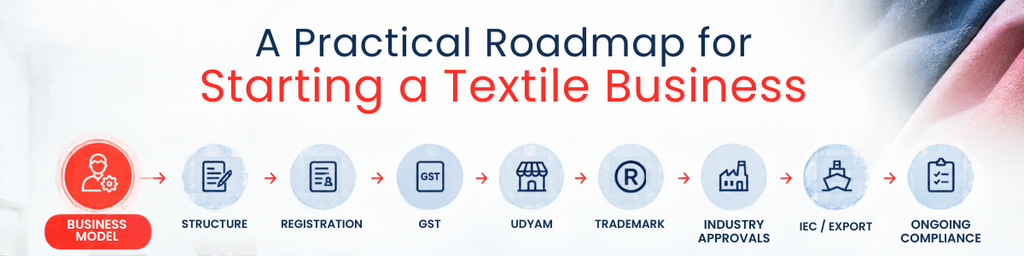
A typical roadmap may look like:
Business Model → Business Structure → Business Registration → GST Assessment → Udyam/MSME → Trademark → Industry-Specific Approvals → IEC/Export Compliance → Ongoing Compliance
The requirements can vary significantly between a garment manufacturer, textile trader, clothing brand, exporter and textile-processing unit.
Tiruppur’s textile ecosystem creates significant opportunities, but entrepreneurs should establish the correct legal and compliance foundation before investing heavily in manufacturing, branding or international sales. Tamil Nadu’s official textile ecosystem specifically recognizes Tiruppur’s importance in knitting, garmenting and textile processing.
If you are planning to start a textile, garment, apparel, clothing brand, manufacturing or export business in Tiruppur, getting the registration roadmap right at the beginning can make future expansion and compliance much easier.
Planning to start a textile business in Tiruppur? FilingPoint can help you evaluate the appropriate business structure, registration requirements, GST, MSME/Udyam, trademark and related business compliance based on your specific business model.
Important Note
Registration and compliance requirements can vary according to the business structure, turnover, products, premises, manufacturing activity, workforce, interstate transactions and export activity. Government rules and fees can change. Entrepreneurs should verify the latest requirements with the relevant government authority before filing.