
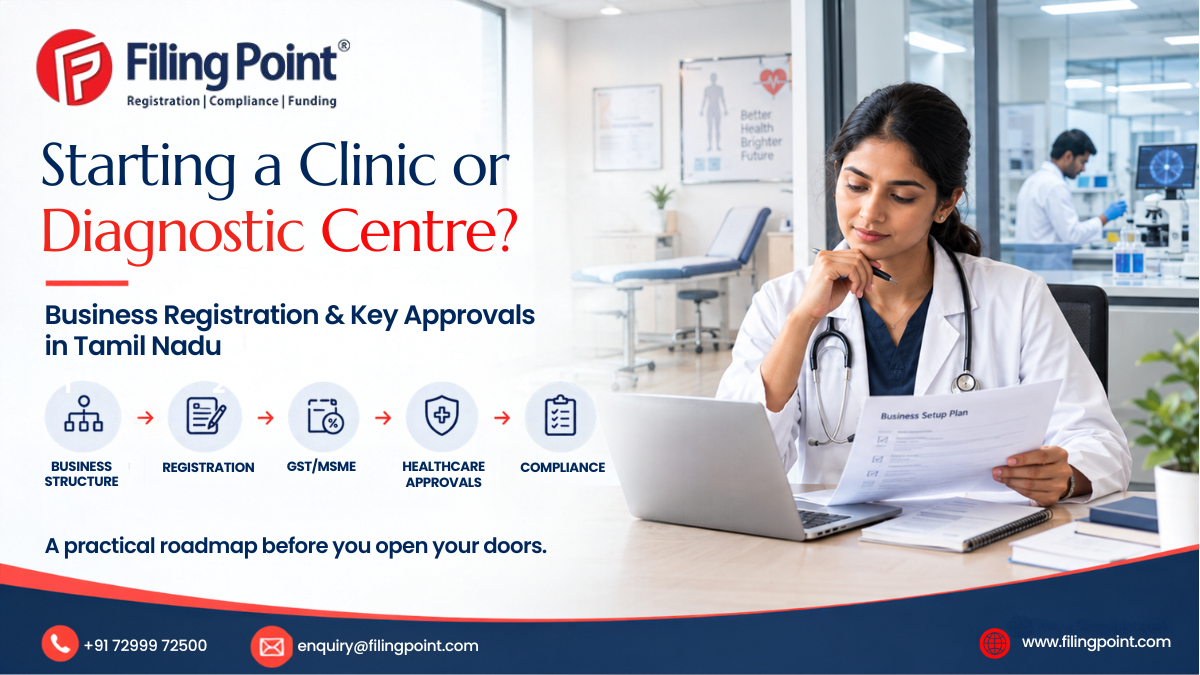
A healthcare business can start small.
It could be a doctor opening a consultation clinic, two professionals establishing a speciality centre, an entrepreneur setting up a diagnostic laboratory, or a healthcare group planning multiple branches.
But the regulatory position can become more complicated as the services expand.
A clinic that provides consultation may have a very different operational profile from a diagnostic centre performing laboratory investigations. A centre using specialised equipment may have additional requirements. A business generating biomedical waste has environmental compliance considerations. A company employing staff and operating from commercial premises may also need to examine employment, premises and local requirements.
This is why “register the company first and sort out the rest later” is not always the best way to approach a healthcare venture.
The better approach is to create a compliance roadmap before the facility opens.
What Does It Mean to Start a Healthcare Business?
There are two different questions involved:
1. What is the legal business entity?
This could be a proprietorship, partnership, LLP, company or another suitable structure depending on the proposed business.
2. What healthcare activity will that entity conduct?
For example:
- Medical consultation
- Specialist consultation
- Polyclinic services
- Diagnostic laboratory services
- Imaging or investigative services
- Day-care treatment
- Nursing or inpatient services
- Allied healthcare services
- Other specialised healthcare activities
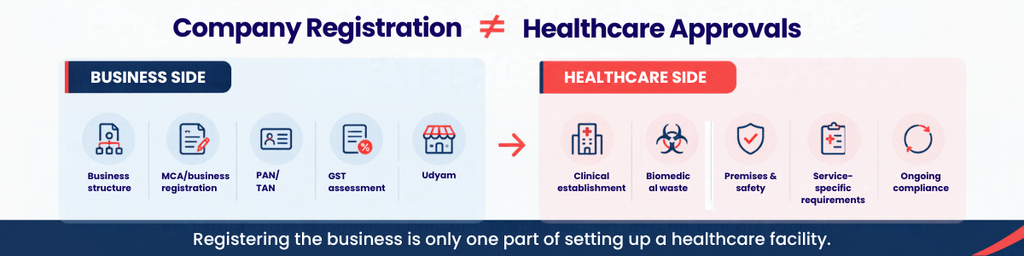
These two layers should not be confused.
Company registration does not automatically mean that the healthcare facility has received every approval required to operate.
The Ministry of Health and Family Welfare’s Clinical Establishments framework itself distinguishes clinical establishments such as clinics, hospitals and diagnostic centres.

Clinic vs Diagnostic Centre: Why the Difference Matters
A clinic generally focuses on consultation, examination, treatment or related patient-care services.
A diagnostic centre may conduct investigations such as laboratory, pathology or other diagnostic services.
Tamil Nadu’s clinical-establishment rules specifically define a clinic and a clinical laboratory, among other categories. The rules also recognise hospitals, polyclinics, dental establishments and other healthcare establishments.
That distinction matters because the applicable requirements can depend on what the establishment actually does.
For example, a business providing only consultations may have a different compliance profile from a diagnostic centre handling biological samples and biomedical waste.
Therefore, before selecting a business structure, prepare a simple description of:
- Services offered
- Type of patients
- Whether treatment is provided
- Whether diagnostic tests are performed
- Whether samples are collected
- Whether medicines are sold
- Whether equipment is used
- Whether patients stay overnight
- Number of professionals
- Number of employees
- Whether the business will have one location or multiple branches
This basic exercise can prevent compliance decisions from being made blindly.
Do You Need to Register a Company?
Not every healthcare professional necessarily needs to create a Private Limited Company.
The appropriate business structure depends on factors such as:
- Number of owners
- Ownership arrangement
- Investment
- Liability considerations
- Whether partners are involved
- Future expansion
- Funding requirements
- Management structure
- Compliance capacity
For example, a solo professional may consider an individual business structure, while two or more professionals may examine an LLP or another partnership structure.
A healthcare venture seeking outside investment or planning multiple branches may consider a company structure.
The important point is:
Do not choose the business structure merely because it sounds more prestigious. Choose it based on how the healthcare business is actually going to operate.
For company incorporation, MCA’s SPICe+ framework is used for incorporation-related processes and linked registrations. MCA documentation also describes PAN, TAN, bank-account and optional GST-related functionality within the incorporation process.

Private Limited Company for a Healthcare Business
A Private Limited Company may be considered where the founders want a separate corporate entity and are planning a more structured or scalable business.
It can be relevant for:
- Multi-doctor healthcare businesses
- Diagnostic companies
- Healthcare startups
- Multi-branch clinics
- Investor-backed ventures
- Businesses intending to bring in shareholders
However, incorporation does not replace healthcare-specific compliance.
A Private Limited Company operating a diagnostic centre still has to consider the requirements applicable to its healthcare activity, premises, waste management and other regulated areas.
This distinction is particularly important because some existing healthcare businesses make the mistake of treating the Certificate of Incorporation as the final operating approval.
It is not.
LLP for Clinics and Healthcare Partnerships
An LLP can be considered when two or more professionals or entrepreneurs want to operate through a structured partnership with limited liability features.
It can be relevant where:
- Two doctors are starting a practice
- Multiple professionals are collaborating
- Founders want defined partnership arrangements
- The business does not require a conventional shareholder structure
The decision should be based on the actual ownership and operating model rather than simply comparing incorporation costs.
Before registration, the founders should clarify:
- Who owns the business?
- Who manages it?
- Who contributes capital?
- How will profits be shared?
- Who will sign contracts?
- What happens if one partner exits?
- Who controls future expansion?
These questions are particularly important in healthcare because professional responsibilities and business responsibilities may overlap.
What Is Clinical Establishment Registration in Tamil Nadu?
This is one of the most important distinctions for anyone starting a clinic or diagnostic business in Tamil Nadu.
Tamil Nadu has its own Clinical Establishments (Regulation) Act and Rules.
The Tamil Nadu framework defines clinical establishments and provides for registration and regulation. The 2018 Rules include definitions covering clinics and clinical laboratories and prescribe requirements concerning registration, records, staff and equipment.
The State’s official Gazette records the 2018 Rules and the notification identifying district-level competent authorities. The rules were subsequently amended in 2024, so applicants should verify the currently applicable forms, requirements and procedures before filing.
This is particularly relevant to:
- Clinics
- Clinical laboratories
- Hospitals
- Polyclinics
- Other covered clinical establishments
The important lesson is that business registration and clinical-establishment registration are separate compliance questions.
What Does Clinical-Establishment Compliance Involve?
The applicable requirements depend on the category and services of the establishment.
The Tamil Nadu rules address matters including:
- Registration
- Qualifications of personnel
- Equipment
- Conditions applicable to different services
- Clinical records
- Staff and equipment records
- Display of registration certificate
- Renewal
- Changes in ownership or system of medicine
The rules also require clinical establishments to maintain records relating to clinical observations, tests, investigations, diagnostic opinions, advice and treatment.
Therefore, healthcare entrepreneurs should think about compliance before opening the facility, not after receiving patient appointments.
Biomedical Waste Compliance
A healthcare establishment may generate waste that falls within biomedical-waste regulations.
The Tamil Nadu Pollution Control Board states that biomedical waste includes waste generated during diagnosis, treatment or immunisation and that State Pollution Control Boards issue authorisation to healthcare facilities under the applicable biomedical-waste framework.
This can be relevant to clinics, laboratories and other healthcare facilities depending on their activities and waste generation.
A healthcare business should therefore examine:
- What type of waste will be generated?
- How will it be segregated?
- How will it be stored?
- Who will collect it?
- Which authorised facility will handle it?
- What documentation is required?
- Is TNPCB authorisation applicable?
The exact compliance requirement should be determined from the facility’s activities rather than assumed.
GST for Healthcare Businesses
GST treatment in healthcare requires careful attention because healthcare services are not automatically treated the same way as every other service or business activity.
CBIC’s GST framework defines “clinical establishment” and “health care services” and provides exemptions for specified healthcare services, while particular supplies can have different GST treatment.
This means a clinic or diagnostic centre should not simply ask:
“Is healthcare exempt from GST?”
The better question is:
“What exactly are we supplying, to whom, and how are we billing it?”
A business may have multiple revenue streams, such as:
- Consultation
- Diagnostic services
- Room or facility services
- Pharmacy-related sales
- Wellness services
- Medical products
- Equipment-related services
- Other commercial services
Each revenue stream should be examined separately.
Do not assume that because one healthcare service is exempt, every transaction of the business automatically receives the same treatment.

Udyam Registration for Healthcare Businesses
A clinic or diagnostic centre that meets the applicable MSME classification requirements may consider Udyam Registration.
The official Udyam portal currently classifies enterprises based on investment and turnover criteria and states that registration is free, online and based on self-declaration. The portal also provides that an enterprise receives a permanent Udyam Registration Number and an online certificate.
The current MSME classification from 1 April 2025 uses:
| Category | Investment limit | Turnover limit |
| Micro | Up to ₹2.5 crore | Up to ₹10 crore |
| Small | Up to ₹25 crore | Up to ₹100 crore |
| Medium | Up to ₹125 crore | Up to ₹500 crore |
Whether a particular healthcare business qualifies depends on its facts and the applicable classification rules.
Udyam is not a replacement for healthcare-specific registration.
It is a separate MSME formalisation mechanism.
What About the Premises?
The premises should be considered before signing a long-term lease or investing heavily in interiors and equipment.
Ask:
- Is the property permitted for the intended use?
- Is the address acceptable for the proposed registration?
- Are there building-related requirements?
- Does the local authority require a licence or permission?
- Are fire-safety requirements applicable?
- Can the required equipment legally be installed?
- Can biomedical waste be handled appropriately?
- Are there restrictions under the building or local planning framework?
The answer can vary depending on the location, type of premises and nature of healthcare activity.
This is why a rented property should not be selected only on the basis of rent and patient footfall.
Regulatory suitability should be part of the site-selection decision.
Fire and Safety Requirements
Fire-safety requirements can depend on the nature, size, layout, occupancy and use of the premises.
A small consultation clinic may not have the same requirements as a hospital with inpatient facilities.
Similarly, a diagnostic facility with specialised equipment may have different safety considerations from a simple consultation centre.
Therefore, rather than assuming that every clinic needs exactly the same certificate, the business owner should identify the applicable requirements for the specific premises and activity.
This is another reason to assess the site before commencing operations.
Other Approvals May Depend on the Services
A healthcare business may require additional registrations, permissions or compliance depending on what it does.
For example, the requirements can change if the business:
- Sells medicines
- Operates a pharmacy
- Uses radiation-generating equipment
- Runs specialised diagnostic equipment
- Provides inpatient care
- Performs procedures
- Operates an ambulance
- Offers blood-related services
- Uses certain medical devices
- Employs a large workforce
- Operates multiple branches
The correct approach is therefore activity-based compliance mapping.
Instead of starting with a generic list of 20 licences, start with:
What exactly will this facility do?
Then map each activity to the authority and approval that applies.
A Practical Registration Roadmap
For a new clinic or diagnostic centre, the process can broadly be organised into the following stages.
Stage 1: Define the healthcare model
Decide:
- Clinic or diagnostic centre
- Services
- Location
- Ownership
- Staffing
- Equipment
- Patient model
- Whether medicines are sold
- Whether the business will expand
Stage 2: Choose the business structure
Evaluate:
- Proprietorship
- Partnership
- LLP
- Private Limited Company
- Other applicable structure
Stage 3: Register the business
Where a company is selected, incorporation is carried out through the MCA framework.
For other structures, the applicable registration and tax process should be followed.
Stage 4: Organise tax registrations
Evaluate:
- PAN
- TAN where applicable
- GST applicability
- TDS-related obligations
- Other tax registrations depending on the business
Stage 5: Address healthcare-specific registration
Check whether the establishment falls within Tamil Nadu’s clinical-establishment framework and complete the applicable registration process.
Stage 6: Address environmental compliance
Assess biomedical-waste generation and TNPCB requirements.
Stage 7: Check premises and safety requirements
Review:
- Local permissions
- Building/use requirements
- Fire safety
- Electrical and equipment requirements
- Waste arrangements
Stage 8: Set up operational records
Prepare systems for:
- Patient records
- Staff records
- Equipment records
- Financial records
- Tax invoices
- Compliance documents
- Renewal dates
Stage 9: Protect the brand
If the clinic or diagnostic centre will operate under a distinctive name or logo, consider trademark protection early.
Stage 10: Plan ongoing compliance
Registration is the beginning of the business’s compliance journey, not the end.
Common Mistakes to Avoid
Mistake 1: Assuming company registration is enough
A Certificate of Incorporation does not automatically satisfy every healthcare-specific requirement.
Mistake 2: Choosing the business structure first and services later
The structure should be selected after understanding the actual business model.
Mistake 3: Signing a lease without checking the premises
A low-rent property can become expensive if it cannot support the intended healthcare activity.
Mistake 4: Assuming all healthcare services have the same GST treatment
Different supplies should be reviewed individually.
Mistake 5: Ignoring biomedical waste
Even a relatively small healthcare facility should assess whether biomedical-waste rules apply.
Mistake 6: Treating Udyam as a healthcare licence
Udyam is an MSME registration mechanism, not a substitute for clinical-establishment or other sector-specific compliance.
Mistake 7: Waiting until launch to organise records
Patient, staff, equipment, financial and statutory records should be designed into the operating system from the beginning.
Mistake 8: Using a brand without checking trademark availability
A business name being available for company incorporation does not by itself settle trademark availability.
Example: A Doctor Starting a Specialist Clinic
Suppose a doctor plans to start a specialist outpatient clinic in Chennai.
The doctor could begin by defining:
- Services offered
- Whether procedures will be performed
- Whether medicines will be sold
- Premises
- Staff
- Equipment
- Ownership structure
The doctor could then evaluate the appropriate business structure, complete the applicable business registration, assess GST treatment, check Tamil Nadu clinical-establishment requirements, examine biomedical-waste obligations and verify premises-related requirements.
If the clinic will operate under a distinctive brand, trademark availability can also be checked before significant investment is made in signage, website development and marketing.
The important point is that the doctor should not treat these as unrelated tasks.
They form one healthcare-business setup plan.
Example: Starting a Diagnostic Centre
Now consider an entrepreneur establishing a diagnostic centre.
The planning exercise should include:
- Type of diagnostic services
- Laboratory activities
- Sample collection
- Equipment
- Staffing
- Premises
- Waste generation
- Business structure
- GST treatment
- Clinical-establishment requirements
- Environmental compliance
- Brand protection
The compliance profile may therefore be broader than that of a simple consultation clinic.
The business should identify the requirements before purchasing expensive equipment or commencing operations.
Clinic or Diagnostic Centre: A Practical Checklist
Before opening, review these categories:
| Area | What to check |
| Business structure | Proprietorship, LLP, company or other suitable structure |
| Business registration | Applicable registration completed |
| PAN/TAN | Applicable tax identifiers |
| GST | Registration and treatment of each revenue stream |
| Clinical establishment | Tamil Nadu registration requirements |
| Premises | Permitted use and documentation |
| Biomedical waste | Applicable authorisation and disposal arrangement |
| Fire/safety | Requirements applicable to the premises |
| Staff | Qualifications and employment records |
| Equipment | Applicable installation/use requirements |
| Patient records | Record-keeping system |
| MSME | Udyam eligibility |
| Brand | Trademark search/protection |
| Ongoing compliance | Tax, ROC and sector-specific renewals |
This is a planning checklist, not a universal licence list. The exact requirements depend on the facility.
What Changes If You Expand?
The compliance picture can change when a clinic becomes a larger healthcare business.
For example:
One doctor → multiple doctors
Single location → multiple branches
Consultation → procedures
Consultation → diagnostics
Diagnostics → specialised equipment
Small practice → company with employees
Each expansion can introduce additional requirements.
Therefore, healthcare entrepreneurs should review compliance whenever they change:
- Services
- Premises
- Ownership
- Equipment
- Branches
- Staffing
- Revenue model
Final Takeaway
Starting a healthcare clinic or diagnostic centre in Tamil Nadu is not simply a company-registration exercise.
The business needs to be viewed through several layers:
Business structure
↓
Business registration
↓
Tax and GST assessment
↓
Clinical-establishment requirements
↓
Premises and safety requirements
↓
Biomedical-waste compliance
↓
Service-specific approvals
↓
Brand and operational compliance
↓
Ongoing statutory compliance
The exact requirements depend on what the healthcare business actually does.
That is why the safest starting point is not to collect a generic list of licences. First define the healthcare model, then map the registrations and approvals that apply to it.
Need help setting up your healthcare business?
Filing Point can help you understand the applicable business-registration and compliance requirements for your proposed healthcare venture.
📞 +91 72999 72500
📧 enquiry@filingpoint.com
This article is for general informational purposes. Healthcare regulations and local requirements can change, and applicability depends on the services, premises and operating model of the establishment. Verify the current requirements with the relevant authority before commencing operations.
