GSTR-1 - 11-Oct-2026
GSTR-3B - 20-Oct-2026

Business Registration

Choosing a legal structure is an important decision when starting a business. A sole proprietor may begin with a small consultancy, a partnership may start with two founders, or a startup may register as a Limited Liability Partnership (LLP) because it suits the initial business model.

But a business does not remain the same forever.

A small enterprise may start hiring employees, take on larger clients, seek outside investment or expand into new locations. The founders may then discover that their existing structure no longer suits their plans. A private limited company may also decide that an LLP better fits its ownership and operating model, subject to the applicable legal and tax conditions.

This leads to a common question: Can you change your business structure after registration, or must you start again?

The answer depends on the legal form you currently have, the form you want to adopt and the route permitted by law. It is not safe to assume that every business can simply “convert” by filing one form with the Ministry of Corporate Affairs (MCA).

This guide explains the main routes available in India, the checks to complete before conversion, and the registrations and records that may need attention afterwards.

What does changing a business structure mean?

Changing a business structure means moving from one legal form of business to another. Examples include:

  • A sole proprietorship moving its business into a private limited company.
  • A partnership firm converting into an LLP.
  • An LLP registering as a company under the applicable legal route.
  • A One Person Company (OPC) becoming a private limited company.
  • A private limited company converting into an LLP, where eligible.
  • A private limited company converting into a public company.

These changes are different from changing a company’s name, registered office, directors, shareholders or business activities. Those actions may require their own approvals and filings, but they do not necessarily change the legal form of the entity.

For example, a private limited company can update its permitted business activities where legally appropriate without becoming an LLP. Likewise, changing a proprietorship’s trade name does not create a separate incorporated entity.

The first step is therefore to identify the change you actually need.

Why might a business want to change its structure?

There is no single reason for restructuring. Common triggers include the following.

Bringing in investors

A startup may want to issue shares, create an employee stock option plan or prepare for an equity investment. A private limited company is often considered for these goals, although the correct structure depends on the investor, business model and applicable rules.

Managing liability

A proprietor and the business are not separate legal persons in the same way as a company. An LLP or company may offer a separate legal identity and limited liability, subject to statutory exceptions and the facts of the case.

Reducing or changing compliance responsibilities

A founder may find that a company’s governance and filing obligations no longer match the scale or operating needs of the business. An LLP may be worth evaluating, but it is not automatically cheaper or simpler in every situation. Conversion itself may involve professional fees, filings, tax analysis and changes to registrations.

Adding co-founders or changing ownership

A sole proprietor may wish to formalise ownership with another founder. A partnership may want to introduce more structured governance, while an established company may consider a different ownership or capital arrangement.

Preparing for expansion

Larger customers, lenders, tenders, licences or business partners may have preferences or eligibility requirements relating to the supplier’s legal form. Confirm the actual requirement rather than restructuring based on assumptions.

Practical point: Changing a structure should solve a defined business problem. Do not convert only because another structure is popular or because someone claims it guarantees lower tax or fewer compliance obligations.

Which business structures can be changed?

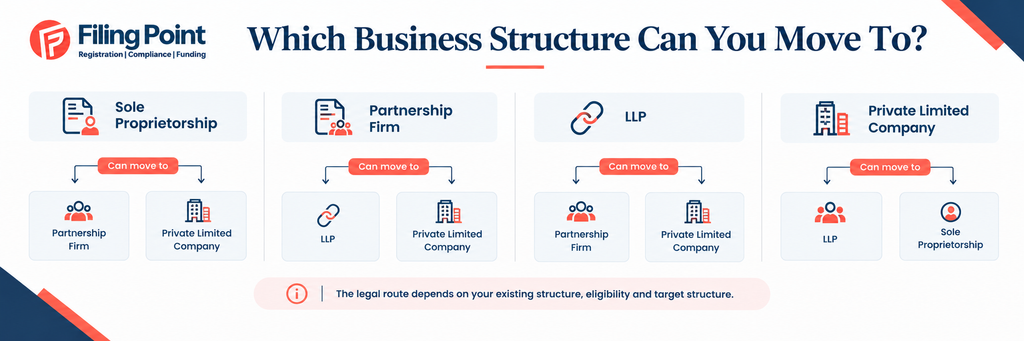
The table below is a starting guide, not a determination that every business is eligible.

Existing structurePossible target structureGeneral route
Sole proprietorshipPrivate limited companyUsually incorporate a new company and transfer the business
Sole proprietorshipLLPUsually form an LLP and transfer the business
Partnership firmLLPStatutory conversion route may be available if conditions are met
Partnership firmCompanyRegistration under the applicable Companies Act route may be available
LLPPrivate limited companyRegistration under the Companies Act route may be available, subject to requirements
OPCPrivate limited companyCompany conversion process under applicable company law
Private limited companyPublic limited companyCompany-class conversion under the Companies Act
Private limited companyLLPStatutory conversion route may be available if the conditions are met
Private limited companyOPCPossible only if current legal requirements and eligibility conditions are satisfied

The legal route, approvals, forms and consequences differ. Confirm the latest MCA requirements before starting the transaction.
Business Structure Conversion

Conversion is not always the same as creating a new business

This is one of the most important distinctions in business restructuring.

When a statutory conversion route exists

Certain types of firms and entities can register or convert into another form under a specific legal provision. For example, the Companies Act, 2013 provides for conversion of companies already registered under the Act into another class of company, subject to the applicable requirements. Section 366 and the Companies (Authorised to Register) Rules, 2014 provide a route for specified entities, including LLPs and partnership firms, to register as companies. The LLP Act also provides conversion routes for specified entities.

The correct route depends on the existing entity and target structure. Relevant provisions include Section 18 and Section 366 of the Companies Act, 2013, and the applicable schedules of the Limited Liability Partnership Act, 2008.  

When a new entity must be formed

A sole proprietorship is not a company registered under the Companies Act. It generally cannot be transformed into a private limited company by simply changing its registration type. Instead, the proprietor incorporates a company and transfers the business or relevant assets, contracts and operations to it under an appropriately structured transaction.

That transfer needs careful planning. It may involve agreements, consent from counterparties, asset-transfer documentation, employee arrangements, tax analysis and fresh or amended registrations.

Why the distinction matters

The two approaches can have different effects on:

  • The identity of the legal entity.
  • Existing debts and obligations.
  • Ownership of assets and intellectual property.
  • Customer and supplier contracts.
  • Bank accounts and borrowing arrangements.
  • Tax treatment and potential tax costs.
  • Licences, permits and registrations.
  • Business continuity and documentary evidence.

Do not assume that every licence, tax registration, contract or bank account automatically continues unchanged. Check each one separately.

How to choose the right conversion route

Before selecting forms or preparing documents, answer these questions.

Check the actual registration documents. A business using a trade name may still be a proprietorship. An LLP has an LLP identification number (LLPIN), while a company has a Corporate Identity Number (CIN). A partnership firm may have a partnership deed and, where applicable, registration with the relevant state authority.

Do not base the decision solely on the business name, GST certificate or Udyam registration.

Step 2: Define the target structure

Decide whether the goal is to become a private limited company, LLP, public company or another permitted form. The reason matters. A funding requirement, liability concern and desire to reduce administrative work may lead to different conclusions.

Step 3: Check statutory eligibility

Review the conditions applying to the specific conversion. Depending on the route, these may concern ownership, consent of partners or shareholders, creditors, security interests, company filings, capital, constitutional documents or other statutory conditions.

For example, an LLP-to-company registration route under Section 366 is not the same as a private-company-to-LLP conversion under the LLP Act. Do not use a generic “conversion checklist” for both.

Step 4: Review pending compliance

Before proceeding, check whether returns, financial statements, annual filings, tax returns, statutory registers or other obligations are outstanding. A conversion plan should include a method for addressing defaults and determining which obligations remain due.

The exact requirements depend on the entity and transaction. Review the MCA record and relevant tax records instead of assuming that conversion automatically resolves past non-compliance.

Step 5: Review tax implications before transferring assets

Identify the business assets, stock, receivables, liabilities, goodwill, intellectual property and capital balances. Ask a tax professional to assess the proposed transfer and the applicable conditions.

Some transactions may qualify for specific tax treatment if statutory conditions are met. That treatment should never be assumed merely because the parties call the transaction a “conversion”. The Income Tax Department’s guidance on Section 47 describes conditions for certain forms of business succession and company-to-LLP conversion. https://www.incometaxindia.gov.in/w/capital-gain

Step 6: Map contracts and registrations

Prepare a list of every registration, licence, contract, bank facility and online account linked to the existing entity. Identify whether it must be transferred, amended, surrendered or obtained afresh.

Step 7: Prepare a written implementation plan

Set out the approvals, filings, transaction documents, responsible people and dependencies. A conversion should not be treated as complete merely because a new certificate has been issued.

GST Registration Chennai

What happens to GST, PAN, bank accounts and other registrations?

This is a major area of risk because business owners sometimes focus on the MCA filing and overlook operational continuity.

PAN and income-tax records

A new legal entity may require its own PAN and tax registrations. Whether a PAN changes or a new one is required depends on the legal route and whether the same legal person continues. A proprietorship-to-company transfer, for example, should not be treated as though the proprietor and company were the same taxpayer.

Review income-tax filings, tax credits, advance tax, TDS/TCS obligations, books of account and any tax attributes before the transition.

GST registration

GST treatment depends on the legal structure, the transaction and applicable GST rules. A transfer of a business as a going concern, a transfer of assets, or a change in the person carrying on the business can have different implications. The old registration should not simply be reused for a different legal person without checking the applicable requirements.

Plan for outstanding returns, input tax credit, stock, invoices, customer advances, tax liabilities and the effective date of the transition. Confirm whether a new registration, amendment, transfer of eligible credit or cancellation process applies in the specific case.

 Bank accounts and loans

Banks may require updated incorporation documents, KYC, board or partner resolutions, fresh mandates and changes to account ownership. Existing loans, guarantees, security interests and working-capital facilities may require lender consent or revised documentation.

Never assume that a bank account or loan automatically moves to the new structure.

UDYAM Registration

Udyam/MSME registration

Review the Udyam registration details after restructuring. The correct action depends on the nature of the change and the portal’s current requirements. Do not assume that the old registration automatically reflects a new legal entity or ownership structure.

Licences, contracts and intellectual property

Review trade licences, professional or sector-specific approvals, lease agreements, vendor contracts, customer contracts, trademarks, domain names, software licences and insurance policies. Some may need amendments, assignments, new applications or counterparty consent.

The list should be prepared before the effective date, not after the business has already moved.

Can you change a company’s business activities without changing its structure?

Yes, changing business activities is different from changing the legal structure.

A private limited company may be able to expand into a new line of business without becoming an LLP or another type of entity. However, the proposed activity must be permitted by the company’s constitutional documents and comply with applicable law. The company may need to alter its memorandum, pass the required resolutions or obtain sector-specific approvals, depending on the circumstances.

For instance, a company incorporated for software services may want to add product sales. The founders should review the objects and applicable regulatory requirements rather than assume that a full legal-structure conversion is needed.

FilingPoint lists a separate Business Nature Change service in its service menu. Use the correct process for the change you actually need. 

Tax implications: what should founders review?

Tax consequences depend on the route, assets transferred, consideration, ownership and statutory conditions. There is no universal “tax-free conversion” rule covering every structure change.

Before proceeding, review:

  • Whether assets are transferred to a new entity or vest under a statutory conversion.
  • Whether the transaction involves a sale, slump sale, contribution or another transfer mechanism.
  • Whether the relevant conditions for any claimed tax relief are satisfied.
  • The treatment of inventory, receivables, fixed assets, goodwill and intellectual property.
  • GST consequences of the business or asset transfer.
  • Existing tax liabilities, tax credits and pending assessments.
  • Whether accumulated losses or other tax attributes can continue to be used.
  • Stamp duty and state-specific costs, where applicable.

The Income Tax Department’s published material on Section 47 identifies conditions relevant to certain successions of proprietary concerns and firms, as well as certain conversions of unlisted companies into LLPs. The conditions are specific and may include requirements relating to assets, liabilities, ownership, consideration, turnover or continuing ownership. 

Do not make a tax decision from a blog checklist alone. Ask a qualified tax professional to assess the exact transaction and applicable law as of the proposed effective date.

Documents to prepare before restructuring

The final document list will depend on the legal route, but the initial review often includes:

  • Certificate of incorporation, partnership deed or existing registration records.
  • Memorandum and Articles of Association, LLP agreement or other constitutional documents.
  • PAN, GST registration and Udyam details.
  • Latest financial statements and relevant tax returns.
  • List of assets, liabilities, receivables and stock.
  • Details of loans, charges, guarantees and security interests.
  • Partner or shareholder details and ownership percentages.
  • Board, shareholder or partner approvals, as applicable.
  • Major customer, supplier, employment and lease agreements.
  • Intellectual-property records and licences.
  • Details of pending litigation, notices, assessments or statutory defaults.
  • Proposed transfer or conversion documents and a transition plan.

These are review categories, not a universal mandatory list. Use the applicable MCA form instructions and professional advice to confirm what must be filed.

Common mistakes to avoid

Assuming all structures can be converted directly

They cannot. A sole proprietorship, partnership firm, LLP and company have different legal characteristics. First confirm whether a statutory route exists.

Treating incorporation as the end of the process

A new certificate does not resolve every contract, tax registration, bank mandate or licence. The transition must be managed across the business.

Ignoring tax until after the transfer

A transaction that appears simple from a registration perspective may have significant tax or stamp-duty consequences. Assess these before signing documents or transferring assets.

Overlooking creditor and lender rights

Loans, charges, guarantees and contractual restrictions can affect the available route. Obtain appropriate advice and consent where required.

Forgetting pending compliance

Outstanding filings and defaults may affect eligibility, timing or risk. Identify them early.

Assuming GST or Udyam details automatically update

Confirm the applicable steps for each registration. Keep the effective date, invoices, records and entity details consistent.

Choosing a structure only to reduce compliance

An LLP may be suitable for one business and unsuitable for another. Consider funding, ownership, liability, tax, contracts and long-term plans together.

Example: a growing consultancy considers incorporation

Suppose two founders operate a consultancy as a partnership. They begin working with larger corporate clients and plan to introduce an investor. They are considering a private limited company.

The right first step is not to submit a conversion form immediately. They should confirm how the partnership is registered, whether the proposed company route is available, what happens to the existing partnership’s assets and contracts, and whether all partners agree to the proposed arrangement.

They should also review the tax treatment of transferring the business, decide how ownership will be reflected in the new company, and identify which customer contracts, bank facilities, registrations and licences require action.

If the partnership cannot or should not use the intended statutory route, a new company and a documented business transfer may be considered. The precise approach must be selected after legal and tax review.

This example illustrates the central principle: the business goal determines the target structure, but the existing entity and applicable law determine the route.

A practical checklist before changing your business structure

Before proceeding, make sure you can answer the following:

  • What is the existing legal structure?
  • What target structure do we need, and why?
  • Is a statutory conversion route available?
  • What eligibility conditions and approvals apply?
  • Are statutory and tax filings up to date?
  • Have we reviewed assets, liabilities, contracts and creditor rights?
  • Have we obtained a tax assessment of the proposed transaction?
  • What will happen to PAN, GST, TDS, Udyam and other registrations?
  • Have we checked bank accounts, loans, licences and intellectual property?
  • Who will manage the transition and verify completion?

Frequently asked questions

1. Can I change my business structure after registration in India?

Often, yes. The available route depends on the existing structure and the target structure. Some changes have a statutory conversion route; others require forming a new entity and transferring the business.

2. Can a sole proprietorship be converted into a private limited company?

A proprietorship generally does not become a company through a direct change of registration type. The usual approach is to incorporate a new company and transfer the business through an appropriately documented arrangement.

3. Can an LLP become a private limited company?

A route may be available under Section 366 of the Companies Act, 2013 and the applicable rules. Eligibility, documents and the current MCA process should be verified before filing.

4. Can a private limited company become an LLP?

A statutory route exists under the LLP Act, subject to applicable eligibility and procedural requirements. Tax treatment must be assessed separately; not every transaction automatically qualifies for tax relief.

5. Can a partnership firm become an LLP?

A partnership firm may be eligible for conversion under the LLP Act if the prescribed conditions are met. The partners should verify the statutory requirements and the current filing process.

6. Will the business keep the same PAN after conversion?

Do not assume that it will. The answer depends on whether the legal person continues or a new entity is formed. Review the tax and registration consequences for the specific route.

7. What happens to GST registration when the structure changes?

The GST action depends on the transaction and the legal identity of the business after the change. Review registration, returns, tax liabilities, eligible credit and invoices before implementation.

8. Does conversion automatically transfer contracts and licences?

Not necessarily. Check each contract, licence and approval. Assignment, amendment, consent or a fresh application may be required.

9. Is changing business structure always tax-free?

No. Any relief depends on the specific legal provision and whether all applicable conditions are met. Obtain a transaction-specific tax assessment.

10. Should I change my business structure just to reduce compliance?

Not without comparing the full implications. Consider liability, ownership, fundraising, tax, contracts, administrative costs and the future direction of the business.

Conclusion

Changing your business structure after registration can be a sensible step when your business goals evolve. But it is not a one-size-fits-all process. A direct statutory conversion, registration as a company, or a new entity with a business transfer may be appropriate in different circumstances.

The safest approach is to identify your current legal structure, confirm the available legal route, assess tax and contractual implications, and prepare a coordinated plan for statutory filings and operational registrations.

Need help with company registration or compliance? FilingPoint can help you understand the applicable process for your business.

  • Phone: +91 72999 72500
  • Email: info@filingpoint.com

Tiruppur is one of Tamil Nadu’s most important textile and knitwear business clusters. For an entrepreneur, however, starting a textile business involves much more than setting up a production unit or finding buyers.

Depending on the nature and scale of the business, you may need to choose an appropriate business structure, complete tax registrations, obtain Udyam registration, protect your brand through trademark registration, and consider additional approvals for manufacturing, processing, employment, environmental compliance or exports.

The right registration strategy depends on what you manufacture or sell, how you operate, your business structure, turnover, location, workforce, whether you export, and the processes carried out at your premises.

This guide explains the major registrations and compliance considerations for entrepreneurs planning to start a textile, garment, apparel, clothing, knitting, processing or textile-related business in Tiruppur.

Quick Answer: A textile business in Tiruppur may require a combination of business/entity registration, GST registration where applicable, Udyam/MSME registration, trademark protection and, for exporters, an Importer Exporter Code (IEC). Manufacturing and textile-processing units may also need additional approvals depending on their activities, premises, machinery, workforce and environmental impact. There is no single registration that covers every textile business.

Why Tiruppur Is an Important Location for Textile Businesses

Tiruppur has a deep textile ecosystem covering knitting, garment manufacturing, processing and apparel-related activities.

The Tamil Nadu government’s textile information identifies Tiruppur as a major knitting and garmenting cluster and highlights its importance to India’s knitwear sector. The state also has a significant network of textile-processing infrastructure, including Common Effluent Treatment Plants in Tiruppur.

The business ecosystem can support different types of entrepreneurs, including:

  • Garment manufacturers
  • Knitwear manufacturers
  • Textile traders
  • Apparel wholesalers
  • Clothing brands
  • Fashion startups
  • Private-label manufacturers
  • Exporters
  • Textile job-work units
  • Knitting units
  • Dyeing and processing units
  • Printing and embroidery businesses
  • Textile accessory suppliers
  • D2C clothing brands
  • Online apparel businesses

The important point is that these businesses do not necessarily have the same registration requirements.

For example, a clothing brand selling finished garments may have a very different compliance profile from a dyeing or processing unit.

What Registrations Does a Textile Business in Tiruppur Need?

There is no universal registration checklist for every textile business.

Your requirements should be mapped according to your business model.

A typical textile entrepreneur may need to consider:

Registration / RequirementWhy It Matters
Business structure/entity registrationEstablishes the legal form of the business
PANRequired for tax and financial identification
GST registrationApplicable based on GST law and business circumstances
Udyam/MSME registrationEstablishes MSME classification where eligible
Trademark registrationProtects the business/brand identity
IECImportant for businesses undertaking import/export activities
Local/business-related approvalsMay apply depending on premises and activity
Factory/manufacturing approvalsMay apply depending on the nature and scale of manufacturing
Pollution/environmental approvalsParticularly relevant to textile processing activities
Labour-related registrations/complianceDepends on workforce and applicable laws
Industry-specific certificationsMay be relevant to particular products, buyers or markets

The exact combination should be determined before the business starts operations, rather than treating every registration as interchangeable.

1. Choose the Right Business Structure

One of the first decisions is determining how the textile business will be legally structured.

Common options include:

Sole Proprietorship

A proprietorship can be suitable for a small business operated by one individual, particularly where the entrepreneur wants a relatively simple structure.

It can work for certain:

  • Small textile traders
  • Boutique businesses
  • Small clothing sellers
  • Independent apparel businesses
  • Home-based businesses

However, the owner and business are not separate legal persons in the same way as a company.

Partnership Firm

A partnership may be considered when two or more individuals want to operate a business together under a partnership arrangement.

It can be relevant for:

  • Family-owned textile businesses
  • Small garment trading businesses
  • Manufacturing businesses with multiple partners
  • Traditional textile enterprises

A properly drafted partnership agreement should clearly establish responsibilities, capital contributions, profit-sharing arrangements and other important terms.

Limited Liability Partnership

An LLP can be considered when entrepreneurs want a separate legal structure combined with limited liability characteristics and a partnership-style management model.

It may be relevant for:

  • Textile trading businesses
  • Apparel sourcing businesses
  • Textile consulting businesses
  • Businesses with multiple founders
  • Certain growing manufacturing or export ventures

Private Limited Company

A Private Limited Company may be appropriate where the founders expect a more structured corporate setup and future growth.

It can be particularly relevant to:

  • Growing garment manufacturers
  • Apparel brands
  • Textile exporters
  • D2C clothing companies
  • Businesses seeking external investment
  • Businesses planning to build a larger corporate operation

FilingPoint already has a dedicated article on Pvt Ltd Company Registration in Tiruppur. Therefore, this article should not duplicate the incorporation process; instead, it places Pvt Ltd registration within the broader textile-business compliance framework.

How Should You Choose?

Consider:

  • Number of owners
  • Capital requirements
  • Expected growth
  • Liability considerations
  • Funding plans
  • Export plans
  • Management structure
  • Compliance capacity
  • Long-term ownership plans

There is no universally “best” structure for every textile entrepreneur.

2. GST Registration for a Textile Business

GST is an important consideration for textile manufacturers, traders, wholesalers and clothing businesses.

GST registration requirements depend on factors such as turnover, nature of supply and circumstances that can trigger registration.

For example, GST law contains threshold exemptions and compulsory-registration provisions, so entrepreneurs should not rely on a simple turnover number without checking the current rules applicable to their particular business.

CBIC’s GST material explains the registration framework and also notes that certain circumstances can affect the availability of threshold exemption.

Why GST Matters to Textile Businesses

A registered textile business may need GST compliance for:

  • Tax invoices
  • Input tax credit
  • B2B transactions
  • Interstate supplies
  • Certain e-commerce transactions
  • Export-related transactions
  • GST returns
  • Business-to-business procurement

A textile manufacturer should also correctly identify the applicable HSN classification for the goods being supplied. The GST portal’s registration guidance requires businesses dealing in goods to provide relevant HSN information.

Example

Suppose a Tiruppur business manufactures cotton T-shirts and sells them to retailers in Tamil Nadu and customers in other states.

The entrepreneur should assess:

  1. Whether GST registration is required.
  2. Correct classification of the products.
  3. Applicable GST rate.
  4. Invoice requirements.
  5. Input tax credit eligibility.
  6. Interstate supply requirements.
  7. Return filing obligations.

The answer should be based on the actual business model, not simply the fact that the business is located in Tiruppur.

3. Udyam Registration for Textile and Garment Businesses

Many textile businesses in Tiruppur may fall within the MSME ecosystem.

Udyam Registration is the government’s official MSME registration system.

The official Udyam portal states that registration is free, online, paperless and based on self-declaration, and that an enterprise receives a permanent Udyam Registration Number and an online certificate.

Current MSME Classification

Under the current classification shown on the official Udyam portal:

MSME CategoryInvestment LimitTurnover Limit
MicroUp to ₹2.5 croreUp to ₹10 crore
SmallUp to ₹25 croreUp to ₹100 crore
MediumUp to ₹125 croreUp to ₹500 crore

These criteria are based on the current Udyam framework and should be checked against the latest government notifications when publishing or updating this article.

Why Textile Businesses Consider Udyam Registration

Udyam registration can be useful for eligible businesses because MSME status can be relevant to:

  • Government schemes
  • Institutional support
  • Certain procurement opportunities
  • Business financing
  • MSME-related programmes
  • Formal recognition as an MSME

However, Udyam registration does not replace company registration or GST registration.

These are different regulatory systems serving different purposes.

Company Registration in Chennai

4. Trademark Registration for a Textile or Clothing Brand

If you are building a clothing or textile brand, protecting the brand name should be considered early.

For example, imagine a Tiruppur manufacturer launches its own clothing brand.

The entrepreneur may invest heavily in:

  • Brand name
  • Logo
  • Packaging
  • Labels
  • Website
  • Social media
  • Retail distribution
  • Advertising

Without a proper trademark strategy, the entrepreneur may face brand-protection issues later.

Trademark registration is therefore different from company registration.

Company registration establishes an entity. Trademark registration protects a brand identifier.

Which Trademark Classes Are Relevant to Textile Businesses?

Trademark classification depends on what you sell or provide.

For textile and apparel businesses, the appropriate Nice Classification class or classes should be determined based on the actual goods/services being protected.

The Indian Trade Marks system uses the Nice Classification framework.

A clothing brand may need to examine classes relevant to its:

  • Garments
  • Footwear
  • Headwear
  • Textile goods
  • Retail services
  • Online retail services
  • Manufacturing-related services
  • Other branded products

The correct class should be selected based on the actual business and the goods/services for which protection is sought.

Current Trademark Filing Fees

As of the current IP India fee schedule, the official e-filing fee for a TM-A application is:

  • ₹4,500 per class/per mark for an individual, startup or small enterprise.
  • ₹9,000 per class/per mark for other applicants.

These are official government filing fees; professional service charges, if any, are separate.

Because trademark fees and rules can change, the latest IP India fee schedule should be checked before publication or filing.

5. IEC for Textile Export Businesses

Tiruppur has a strong export-oriented apparel ecosystem, so many entrepreneurs may eventually consider international markets.

If your textile business plans to undertake import or export activities, Importer Exporter Code (IEC) becomes an important consideration.

DGFT’s Foreign Trade Policy states that an IEC is a 10-character alphanumeric number allotted to an entity and is mandatory for undertaking import/export activities unless specifically exempted.

This can be particularly relevant for:

  • Garment exporters
  • Knitwear exporters
  • Textile manufacturers exporting directly
  • Apparel brands selling internationally
  • Textile sourcing businesses
  • Businesses importing textile machinery or materials

Export Business Planning Should Start Early

An entrepreneur planning exports should consider more than IEC.

The business may also need to understand:

  • GST treatment of exports
  • Export documentation
  • Invoicing
  • Shipping documentation
  • Buyer requirements
  • Product specifications
  • Country-specific requirements
  • Customs procedures
  • Payment mechanisms
  • Foreign exchange considerations
  • Product certifications where required

GST materials describe exports as zero-rated supplies under the GST framework, subject to the applicable conditions and procedures.

6. Textile Manufacturing Can Require Additional Approvals

This is one of the most important distinctions for textile entrepreneurs.

A clothing brand and a dyeing or processing factory should not be treated as having identical compliance requirements.

For example:

Apparel Trading Business

A business that purchases finished garments and resells them may have a relatively different compliance profile.

Garment Manufacturing Unit

A manufacturing facility may need to consider additional requirements relating to:

  • Premises
  • Machinery
  • Workers
  • Factory-related compliance
  • Fire and safety
  • Local approvals
  • Labour compliance

Dyeing or Processing Unit

Textile processing can involve environmental considerations, wastewater and effluent management.

Tamil Nadu’s Handlooms and Textiles Department specifically identifies Tiruppur as a hub for textile processing and knitting and notes the presence of Common Effluent Treatment Plants in the cluster.

Therefore, entrepreneurs planning:

  • Dyeing
  • Bleaching
  • Printing
  • Washing
  • Processing
  • Effluent-generating activities

should identify the applicable environmental and operational approvals before setting up the facility.

This is an area where a generic “company registration checklist” is not sufficient.

7. What Documents Are Commonly Needed?

The exact documents depend on the structure and registration.

A textile entrepreneur may commonly need information relating to:

Promoters / Owners

  • PAN
  • Aadhaar or other identity information
  • Address details
  • Photographs/contact information where applicable

Business

  • Proposed business name
  • Business activity
  • Ownership details
  • Capital/contribution details
  • Partnership or incorporation documents where applicable

Business Premises

  • Address proof
  • Ownership document or rental/lease documentation
  • Utility bill or other acceptable premises evidence, depending on the registration

Tax and Banking

  • PAN
  • Bank account information where applicable
  • GST-related information where applicable

Trademark

Trademark applications require information about the applicant, mark and relevant goods/services, along with the applicable filing details.

Export

An exporter will need the relevant entity and tax information required for IEC and related export procedures.

The important principle is:

Do not collect documents randomly. First determine which registrations apply to your particular textile business.

8. Textile Business Registration: Manufacturer vs Trader vs Brand

A major mistake is assuming every textile business needs the same registration package.

Consider these three examples.

Example 1: Tiruppur Garment Manufacturer

The business manufactures T-shirts and exports them.

Potential areas to evaluate:

  • Business structure
  • GST
  • Udyam
  • Trademark if operating a brand
  • IEC
  • Manufacturing/factory requirements
  • Environmental requirements where applicable
  • Labour compliance

Example 2: Textile Trader

The business purchases garments from manufacturers and sells them to retailers.

The focus may instead be:

  • Business structure
  • GST applicability
  • Udyam eligibility
  • Trademark if operating a brand
  • Trading-related compliance

Example 3: D2C Clothing Brand

The entrepreneur designs products, outsources manufacturing to Tiruppur factories and sells through a website.

The entrepreneur may not operate a textile factory at all.

The focus may include:

  • Business structure
  • GST applicability
  • Udyam eligibility
  • Trademark
  • E-commerce/business compliance
  • Vendor agreements
  • Product and consumer-related requirements
  • Export/IEC if selling internationally

These three businesses operate in the same textile ecosystem but have different compliance requirements.

9. Should a Small Textile Business Register as an MSME?

If the enterprise qualifies under the current MSME criteria, Udyam registration can be considered.

The official portal allows eligible enterprises to register online through a free, paperless process and provides a permanent registration number.

Importantly, Udyam registration is not limited to one type of textile activity.

An enterprise can specify multiple activities, including manufacturing or services, within the Udyam framework.

This can be useful for textile businesses that combine activities.

For example:

Manufacturing + wholesale + branded apparel

may involve multiple business activities that need to be correctly reflected in the business’s registrations and records.

10. When Should You Register Your Trademark?

Ideally, trademark planning should happen before substantial investment in the brand.

Before launching a clothing brand, consider:

Step 1: Choose the brand name

Do not assume that a domain name or social-media username means the brand is legally protected.

Step 2: Search existing trademarks

Check whether similar marks already exist.

Step 3: Identify relevant classes

Determine which goods and/or services your brand needs protection for.

Step 4: File the application

The appropriate trademark application can then be submitted through IP India’s system.

Step 5: Monitor the application

The trademark process can involve examination, responses and potentially opposition proceedings.

The official IP India process and forms should be checked for the current requirements.

11. A Practical Registration Roadmap for a Tiruppur Textile Startup

Instead of treating registrations as unrelated tasks, entrepreneurs can approach the process in stages.

Stage 1: Define the Business

Decide:

  • What products will you sell?
  • Will you manufacture or outsource?
  • Will you sell B2B or B2C?
  • Will you export?
  • Will you operate a brand?
  • How many owners are involved?

Stage 2: Select the Business Structure

Compare:

  • Proprietorship
  • Partnership
  • LLP
  • Private Limited Company

The choice should reflect ownership, growth and operational requirements.

Stage 3: Establish the Business

Complete the relevant incorporation or registration process.

Obtain the necessary PAN and other foundational business information.

Stage 4: Evaluate GST

Determine whether GST registration applies based on:

  • Turnover
  • Nature of supply
  • Interstate transactions
  • Applicable compulsory-registration provisions
  • Business model

Do not rely on outdated threshold information.

Stage 5: Obtain Udyam Registration Where Eligible

If the business qualifies as an MSME, evaluate Udyam registration.

The official portal currently states that Udyam registration is free and does not require payment to private intermediaries for the government registration itself.

Stage 6: Protect the Brand

If you are building a clothing or textile brand:

  • Search the brand
  • Select appropriate classes
  • File the trademark application
  • Monitor the application

Stage 7: Evaluate Industry-Specific Requirements

For manufacturing, processing and other physical operations, check:

  • Factory-related requirements
  • Local approvals
  • Fire/safety requirements
  • Labour compliance
  • Environmental requirements
  • Electricity/power-related requirements
  • Waste/effluent requirements

The exact requirements depend on the activity and premises.

Stage 8: Prepare for Exports

If exporting:

  • Evaluate IEC
  • Review GST export procedures
  • Understand customs documentation
  • Identify destination-market requirements
  • Review buyer-specific certifications
  • Establish appropriate export documentation processes

12. Common Mistakes Textile Entrepreneurs Make

Mistake 1: Thinking Company Registration Is Enough

Registering a company does not automatically complete GST, MSME, trademark, export or industry-specific compliance.

Each serves a different purpose.

Mistake 2: Choosing a Business Structure Without Considering Growth

A structure suitable for a small family trading operation may not necessarily be the best fit for a business planning external investment or rapid expansion.

Mistake 3: Treating Udyam and GST as the Same Registration

They are not.

GST = indirect tax registration/compliance framework.

Udyam = MSME registration/classification framework.

Mistake 4: Delaying Trademark Registration

Building a clothing brand first and thinking about trademark protection later can create unnecessary risk.

Mistake 5: Assuming Every Textile Business Has the Same Approvals

A garment trader, clothing brand, garment factory and dyeing unit can have substantially different compliance requirements.

Mistake 6: Ignoring Export Requirements

If international sales are part of the business plan, export-related requirements should be considered before accepting overseas orders.

Mistake 7: Using Outdated GST or MSME Information

GST thresholds, procedures and government schemes can change.

The same applies to MSME classifications and regulatory requirements.

Always verify current rules before filing.

Textile Business Registration Checklist for Tiruppur

Use this as a starting checklist:

Business Setup

  • Decide business structure
  • Select business name
  • Establish business address
  • Prepare promoter/partner/director information
  • Complete relevant business registration

Tax

  • Obtain PAN
  • Evaluate GST applicability
  • Identify relevant HSN classifications
  • Establish invoicing system
  • Understand GST return requirements

MSME

  • Check MSME eligibility
  • Complete Udyam registration if applicable
  • Keep Udyam information updated

Brand

  • Search proposed brand name
  • Identify relevant trademark classes
  • File trademark application where appropriate
  • Monitor trademark status

Manufacturing

  • Check premises requirements
  • Check factory-related requirements
  • Evaluate labour requirements
  • Evaluate fire/safety requirements
  • Check environmental approvals where applicable

Export

  • Evaluate IEC requirement
  • Understand export GST treatment
  • Prepare export documentation
  • Review destination-market requirements

Frequently Asked Questions

1. What registrations are required to start a textile business in Tiruppur?

There is no single checklist for every business. Depending on the model, you may need business/entity registration, GST registration where applicable, Udyam registration, trademark registration and IEC for import/export activities. Manufacturing and processing businesses may have additional requirements.

2. Is GST registration mandatory for every textile business in Tiruppur?

Not necessarily. GST registration depends on the applicable GST rules, turnover, nature of supply and circumstances that may trigger compulsory registration. The current GST framework should be checked before deciding.

3. Is Udyam registration useful for a textile business?

Eligible textile and garment businesses can consider Udyam registration. The official portal states that Udyam registration is free, paperless and based on self-declaration.

4. Can a textile business have both GST and Udyam registration?

Yes. They serve different purposes. GST relates to the GST tax framework, while Udyam establishes MSME registration/classification.

5. Do I need a trademark for my clothing brand?

Trademark registration is not the same as company registration, but it can be an important part of protecting a clothing or textile brand.

6. What trademark class should a clothing business choose?

The appropriate class depends on the actual goods and services offered by the business. Textile and apparel entrepreneurs should identify the relevant Nice Classification categories before filing.

7. How much does trademark registration cost?

IP India’s current e-filing fee for a TM-A application is ₹4,500 per class/per mark for an individual, startup or small enterprise and ₹9,000 for other applicants. Professional fees, if applicable, are separate.

8. Do textile exporters in Tiruppur need IEC?

Businesses undertaking import/export activities generally need an Importer Exporter Code unless a specific exemption applies. DGFT describes IEC as mandatory for import/export activities, subject to applicable exemptions.

9. Is company registration compulsory for every textile business?

No. The appropriate business structure depends on how the entrepreneur intends to operate. A textile business may operate through different legal structures depending on its circumstances.

10. Does a garment manufacturing business need additional approvals?

Potentially, yes. Manufacturing premises, workforce, machinery, fire/safety, environmental impact and other factors can create additional compliance requirements.

11. Is a clothing brand the same as a garment manufacturing company?

No. A clothing brand may outsource manufacturing to a third-party factory. Its compliance requirements can therefore differ from those of a business operating its own manufacturing facility.

12. Can a Tiruppur textile business sell internationally?

Yes, textile and apparel businesses can target international markets, but export-related requirements, documentation, taxation and destination-market rules need to be evaluated.

13. Can an MSME have multiple business activities under Udyam?

The official Udyam portal states that multiple activities, including manufacturing or services, can be specified or added under one Udyam Registration, subject to the applicable framework.

14. Should I register my business or trademark first?

Business formation and trademark protection are separate processes. Entrepreneurs planning a brand should consider trademark searches and protection early rather than waiting until the brand has significant market exposure.

15. What is the first step for starting a textile business in Tiruppur?

Start by defining your business model: manufacturer, trader, exporter, clothing brand, D2C business, job-work unit or processor. Once that is clear, you can identify the appropriate business structure and registrations.

Final Takeaway

Starting a textile business in Tiruppur is not simply a matter of registering a company and beginning production.

Your compliance requirements should be built around the actual nature of your business.

A typical roadmap may look like:

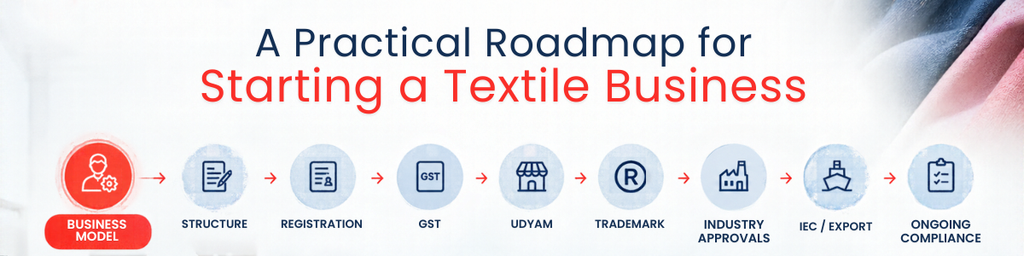
Business Model → Business Structure → Business Registration → GST Assessment → Udyam/MSME → Trademark → Industry-Specific Approvals → IEC/Export Compliance → Ongoing Compliance

The requirements can vary significantly between a garment manufacturer, textile trader, clothing brand, exporter and textile-processing unit.

Tiruppur’s textile ecosystem creates significant opportunities, but entrepreneurs should establish the correct legal and compliance foundation before investing heavily in manufacturing, branding or international sales. Tamil Nadu’s official textile ecosystem specifically recognizes Tiruppur’s importance in knitting, garmenting and textile processing.

If you are planning to start a textile, garment, apparel, clothing brand, manufacturing or export business in Tiruppur, getting the registration roadmap right at the beginning can make future expansion and compliance much easier.

Planning to start a textile business in Tiruppur? FilingPoint can help you evaluate the appropriate business structure, registration requirements, GST, MSME/Udyam, trademark and related business compliance based on your specific business model.

Important Note

Registration and compliance requirements can vary according to the business structure, turnover, products, premises, manufacturing activity, workforce, interstate transactions and export activity. Government rules and fees can change. Entrepreneurs should verify the latest requirements with the relevant government authority before filing.

A healthcare business can start small.

It could be a doctor opening a consultation clinic, two professionals establishing a speciality centre, an entrepreneur setting up a diagnostic laboratory, or a healthcare group planning multiple branches.

But the regulatory position can become more complicated as the services expand.

A clinic that provides consultation may have a very different operational profile from a diagnostic centre performing laboratory investigations. A centre using specialised equipment may have additional requirements. A business generating biomedical waste has environmental compliance considerations. A company employing staff and operating from commercial premises may also need to examine employment, premises and local requirements.

This is why “register the company first and sort out the rest later” is not always the best way to approach a healthcare venture.

The better approach is to create a compliance roadmap before the facility opens.

What Does It Mean to Start a Healthcare Business?

There are two different questions involved:

1. What is the legal business entity?

This could be a proprietorship, partnership, LLP, company or another suitable structure depending on the proposed business.

2. What healthcare activity will that entity conduct?

For example:

  • Medical consultation
  • Specialist consultation
  • Polyclinic services
  • Diagnostic laboratory services
  • Imaging or investigative services
  • Day-care treatment
  • Nursing or inpatient services
  • Allied healthcare services
  • Other specialised healthcare activities

These two layers should not be confused.

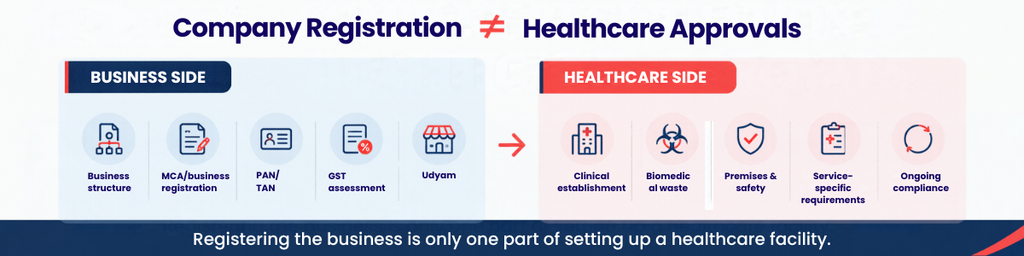
Company registration does not automatically mean that the healthcare facility has received every approval required to operate.

The Ministry of Health and Family Welfare’s Clinical Establishments framework itself distinguishes clinical establishments such as clinics, hospitals and diagnostic centres.

Clinic vs Diagnostic Centre: Why the Difference Matters

A clinic generally focuses on consultation, examination, treatment or related patient-care services.

A diagnostic centre may conduct investigations such as laboratory, pathology or other diagnostic services.

Tamil Nadu’s clinical-establishment rules specifically define a clinic and a clinical laboratory, among other categories. The rules also recognise hospitals, polyclinics, dental establishments and other healthcare establishments.

That distinction matters because the applicable requirements can depend on what the establishment actually does.

For example, a business providing only consultations may have a different compliance profile from a diagnostic centre handling biological samples and biomedical waste.

Therefore, before selecting a business structure, prepare a simple description of:

  • Services offered
  • Type of patients
  • Whether treatment is provided
  • Whether diagnostic tests are performed
  • Whether samples are collected
  • Whether medicines are sold
  • Whether equipment is used
  • Whether patients stay overnight
  • Number of professionals
  • Number of employees
  • Whether the business will have one location or multiple branches

This basic exercise can prevent compliance decisions from being made blindly.

Do You Need to Register a Company?

Not every healthcare professional necessarily needs to create a Private Limited Company.

The appropriate business structure depends on factors such as:

  • Number of owners
  • Ownership arrangement
  • Investment
  • Liability considerations
  • Whether partners are involved
  • Future expansion
  • Funding requirements
  • Management structure
  • Compliance capacity

For example, a solo professional may consider an individual business structure, while two or more professionals may examine an LLP or another partnership structure.

A healthcare venture seeking outside investment or planning multiple branches may consider a company structure.

The important point is:

Do not choose the business structure merely because it sounds more prestigious. Choose it based on how the healthcare business is actually going to operate.

For company incorporation, MCA’s SPICe+ framework is used for incorporation-related processes and linked registrations. MCA documentation also describes PAN, TAN, bank-account and optional GST-related functionality within the incorporation process.

Company Registration in Chennai

Private Limited Company for a Healthcare Business

A Private Limited Company may be considered where the founders want a separate corporate entity and are planning a more structured or scalable business.

It can be relevant for:

  • Multi-doctor healthcare businesses
  • Diagnostic companies
  • Healthcare startups
  • Multi-branch clinics
  • Investor-backed ventures
  • Businesses intending to bring in shareholders

However, incorporation does not replace healthcare-specific compliance.

A Private Limited Company operating a diagnostic centre still has to consider the requirements applicable to its healthcare activity, premises, waste management and other regulated areas.

This distinction is particularly important because some existing healthcare businesses make the mistake of treating the Certificate of Incorporation as the final operating approval.

It is not.

LLP for Clinics and Healthcare Partnerships

An LLP can be considered when two or more professionals or entrepreneurs want to operate through a structured partnership with limited liability features.

It can be relevant where:

  • Two doctors are starting a practice
  • Multiple professionals are collaborating
  • Founders want defined partnership arrangements
  • The business does not require a conventional shareholder structure

The decision should be based on the actual ownership and operating model rather than simply comparing incorporation costs.

Before registration, the founders should clarify:

  • Who owns the business?
  • Who manages it?
  • Who contributes capital?
  • How will profits be shared?
  • Who will sign contracts?
  • What happens if one partner exits?
  • Who controls future expansion?

These questions are particularly important in healthcare because professional responsibilities and business responsibilities may overlap.

What Is Clinical Establishment Registration in Tamil Nadu?

This is one of the most important distinctions for anyone starting a clinic or diagnostic business in Tamil Nadu.

Tamil Nadu has its own Clinical Establishments (Regulation) Act and Rules.

The Tamil Nadu framework defines clinical establishments and provides for registration and regulation. The 2018 Rules include definitions covering clinics and clinical laboratories and prescribe requirements concerning registration, records, staff and equipment.

The State’s official Gazette records the 2018 Rules and the notification identifying district-level competent authorities. The rules were subsequently amended in 2024, so applicants should verify the currently applicable forms, requirements and procedures before filing.

This is particularly relevant to:

  • Clinics
  • Clinical laboratories
  • Hospitals
  • Polyclinics
  • Other covered clinical establishments

The important lesson is that business registration and clinical-establishment registration are separate compliance questions.

What Does Clinical-Establishment Compliance Involve?

The applicable requirements depend on the category and services of the establishment.

The Tamil Nadu rules address matters including:

  • Registration
  • Qualifications of personnel
  • Equipment
  • Conditions applicable to different services
  • Clinical records
  • Staff and equipment records
  • Display of registration certificate
  • Renewal
  • Changes in ownership or system of medicine

The rules also require clinical establishments to maintain records relating to clinical observations, tests, investigations, diagnostic opinions, advice and treatment.

Therefore, healthcare entrepreneurs should think about compliance before opening the facility, not after receiving patient appointments.

Biomedical Waste Compliance

A healthcare establishment may generate waste that falls within biomedical-waste regulations.

The Tamil Nadu Pollution Control Board states that biomedical waste includes waste generated during diagnosis, treatment or immunisation and that State Pollution Control Boards issue authorisation to healthcare facilities under the applicable biomedical-waste framework.

This can be relevant to clinics, laboratories and other healthcare facilities depending on their activities and waste generation.

A healthcare business should therefore examine:

  • What type of waste will be generated?
  • How will it be segregated?
  • How will it be stored?
  • Who will collect it?
  • Which authorised facility will handle it?
  • What documentation is required?
  • Is TNPCB authorisation applicable?

The exact compliance requirement should be determined from the facility’s activities rather than assumed.

GST for Healthcare Businesses

GST treatment in healthcare requires careful attention because healthcare services are not automatically treated the same way as every other service or business activity.

CBIC’s GST framework defines “clinical establishment” and “health care services” and provides exemptions for specified healthcare services, while particular supplies can have different GST treatment.

This means a clinic or diagnostic centre should not simply ask:

“Is healthcare exempt from GST?”

The better question is:

“What exactly are we supplying, to whom, and how are we billing it?”

A business may have multiple revenue streams, such as:

  • Consultation
  • Diagnostic services
  • Room or facility services
  • Pharmacy-related sales
  • Wellness services
  • Medical products
  • Equipment-related services
  • Other commercial services

Each revenue stream should be examined separately.

Do not assume that because one healthcare service is exempt, every transaction of the business automatically receives the same treatment.

Udyam Registration for Healthcare Businesses

A clinic or diagnostic centre that meets the applicable MSME classification requirements may consider Udyam Registration.

The official Udyam portal currently classifies enterprises based on investment and turnover criteria and states that registration is free, online and based on self-declaration. The portal also provides that an enterprise receives a permanent Udyam Registration Number and an online certificate.

The current MSME classification from 1 April 2025 uses:

CategoryInvestment limitTurnover limit
MicroUp to ₹2.5 croreUp to ₹10 crore
SmallUp to ₹25 croreUp to ₹100 crore
MediumUp to ₹125 croreUp to ₹500 crore

Whether a particular healthcare business qualifies depends on its facts and the applicable classification rules.

Udyam is not a replacement for healthcare-specific registration.

It is a separate MSME formalisation mechanism.

What About the Premises?

The premises should be considered before signing a long-term lease or investing heavily in interiors and equipment.

Ask:

  • Is the property permitted for the intended use?
  • Is the address acceptable for the proposed registration?
  • Are there building-related requirements?
  • Does the local authority require a licence or permission?
  • Are fire-safety requirements applicable?
  • Can the required equipment legally be installed?
  • Can biomedical waste be handled appropriately?
  • Are there restrictions under the building or local planning framework?

The answer can vary depending on the location, type of premises and nature of healthcare activity.

This is why a rented property should not be selected only on the basis of rent and patient footfall.

Regulatory suitability should be part of the site-selection decision.

Fire and Safety Requirements

Fire-safety requirements can depend on the nature, size, layout, occupancy and use of the premises.

A small consultation clinic may not have the same requirements as a hospital with inpatient facilities.

Similarly, a diagnostic facility with specialised equipment may have different safety considerations from a simple consultation centre.

Therefore, rather than assuming that every clinic needs exactly the same certificate, the business owner should identify the applicable requirements for the specific premises and activity.

This is another reason to assess the site before commencing operations.

Other Approvals May Depend on the Services

A healthcare business may require additional registrations, permissions or compliance depending on what it does.

For example, the requirements can change if the business:

  • Sells medicines
  • Operates a pharmacy
  • Uses radiation-generating equipment
  • Runs specialised diagnostic equipment
  • Provides inpatient care
  • Performs procedures
  • Operates an ambulance
  • Offers blood-related services
  • Uses certain medical devices
  • Employs a large workforce
  • Operates multiple branches

The correct approach is therefore activity-based compliance mapping.

Instead of starting with a generic list of 20 licences, start with:

What exactly will this facility do?

Then map each activity to the authority and approval that applies.

A Practical Registration Roadmap

For a new clinic or diagnostic centre, the process can broadly be organised into the following stages.

Stage 1: Define the healthcare model

Decide:

  • Clinic or diagnostic centre
  • Services
  • Location
  • Ownership
  • Staffing
  • Equipment
  • Patient model
  • Whether medicines are sold
  • Whether the business will expand

Stage 2: Choose the business structure

Evaluate:

  • Proprietorship
  • Partnership
  • LLP
  • Private Limited Company
  • Other applicable structure

Stage 3: Register the business

Where a company is selected, incorporation is carried out through the MCA framework.

For other structures, the applicable registration and tax process should be followed.

Stage 4: Organise tax registrations

Evaluate:

  • PAN
  • TAN where applicable
  • GST applicability
  • TDS-related obligations
  • Other tax registrations depending on the business

Stage 5: Address healthcare-specific registration

Check whether the establishment falls within Tamil Nadu’s clinical-establishment framework and complete the applicable registration process.

Stage 6: Address environmental compliance

Assess biomedical-waste generation and TNPCB requirements.

Stage 7: Check premises and safety requirements

Review:

  • Local permissions
  • Building/use requirements
  • Fire safety
  • Electrical and equipment requirements
  • Waste arrangements

Stage 8: Set up operational records

Prepare systems for:

  • Patient records
  • Staff records
  • Equipment records
  • Financial records
  • Tax invoices
  • Compliance documents
  • Renewal dates

Stage 9: Protect the brand

If the clinic or diagnostic centre will operate under a distinctive name or logo, consider trademark protection early.

Stage 10: Plan ongoing compliance

Registration is the beginning of the business’s compliance journey, not the end.

Common Mistakes to Avoid

Mistake 1: Assuming company registration is enough

A Certificate of Incorporation does not automatically satisfy every healthcare-specific requirement.

Mistake 2: Choosing the business structure first and services later

The structure should be selected after understanding the actual business model.

Mistake 3: Signing a lease without checking the premises

A low-rent property can become expensive if it cannot support the intended healthcare activity.

Mistake 4: Assuming all healthcare services have the same GST treatment

Different supplies should be reviewed individually.

Mistake 5: Ignoring biomedical waste

Even a relatively small healthcare facility should assess whether biomedical-waste rules apply.

Mistake 6: Treating Udyam as a healthcare licence

Udyam is an MSME registration mechanism, not a substitute for clinical-establishment or other sector-specific compliance.

Mistake 7: Waiting until launch to organise records

Patient, staff, equipment, financial and statutory records should be designed into the operating system from the beginning.

Mistake 8: Using a brand without checking trademark availability

A business name being available for company incorporation does not by itself settle trademark availability.

Example: A Doctor Starting a Specialist Clinic

Suppose a doctor plans to start a specialist outpatient clinic in Chennai.

The doctor could begin by defining:

  • Services offered
  • Whether procedures will be performed
  • Whether medicines will be sold
  • Premises
  • Staff
  • Equipment
  • Ownership structure

The doctor could then evaluate the appropriate business structure, complete the applicable business registration, assess GST treatment, check Tamil Nadu clinical-establishment requirements, examine biomedical-waste obligations and verify premises-related requirements.

If the clinic will operate under a distinctive brand, trademark availability can also be checked before significant investment is made in signage, website development and marketing.

The important point is that the doctor should not treat these as unrelated tasks.

They form one healthcare-business setup plan.

Example: Starting a Diagnostic Centre

Now consider an entrepreneur establishing a diagnostic centre.

The planning exercise should include:

  • Type of diagnostic services
  • Laboratory activities
  • Sample collection
  • Equipment
  • Staffing
  • Premises
  • Waste generation
  • Business structure
  • GST treatment
  • Clinical-establishment requirements
  • Environmental compliance
  • Brand protection

The compliance profile may therefore be broader than that of a simple consultation clinic.

The business should identify the requirements before purchasing expensive equipment or commencing operations.

Clinic or Diagnostic Centre: A Practical Checklist

Before opening, review these categories:

AreaWhat to check
Business structureProprietorship, LLP, company or other suitable structure
Business registrationApplicable registration completed
PAN/TANApplicable tax identifiers
GSTRegistration and treatment of each revenue stream
Clinical establishmentTamil Nadu registration requirements
PremisesPermitted use and documentation
Biomedical wasteApplicable authorisation and disposal arrangement
Fire/safetyRequirements applicable to the premises
StaffQualifications and employment records
EquipmentApplicable installation/use requirements
Patient recordsRecord-keeping system
MSMEUdyam eligibility
BrandTrademark search/protection
Ongoing complianceTax, ROC and sector-specific renewals

This is a planning checklist, not a universal licence list. The exact requirements depend on the facility.

What Changes If You Expand?

The compliance picture can change when a clinic becomes a larger healthcare business.

For example:

One doctor → multiple doctors

Single location → multiple branches

Consultation → procedures

Consultation → diagnostics

Diagnostics → specialised equipment

Small practice → company with employees

Each expansion can introduce additional requirements.

Therefore, healthcare entrepreneurs should review compliance whenever they change:

  • Services
  • Premises
  • Ownership
  • Equipment
  • Branches
  • Staffing
  • Revenue model

Final Takeaway

Starting a healthcare clinic or diagnostic centre in Tamil Nadu is not simply a company-registration exercise.

The business needs to be viewed through several layers:

Business structure
↓
Business registration
↓
Tax and GST assessment
↓
Clinical-establishment requirements
↓
Premises and safety requirements
↓
Biomedical-waste compliance
↓
Service-specific approvals
↓
Brand and operational compliance
↓
Ongoing statutory compliance

The exact requirements depend on what the healthcare business actually does.

That is why the safest starting point is not to collect a generic list of licences. First define the healthcare model, then map the registrations and approvals that apply to it.

Need help setting up your healthcare business?

Filing Point can help you understand the applicable business-registration and compliance requirements for your proposed healthcare venture.

📞 +91 72999 72500
📧 enquiry@filingpoint.com

This article is for general informational purposes. Healthcare regulations and local requirements can change, and applicability depends on the services, premises and operating model of the establishment. Verify the current requirements with the relevant authority before commencing operations.

Introduction

Growing Opportunities in Tamil Nadu’s Food Manufacturing Sector

Tamil Nadu is a great place to start a food manufacturing company. It has strong infrastructure, skilled workers, and high demand for quality food products. Registering your company is the first step toward building a trusted and successful business. With Filing Point, registration becomes quick, simple, and fully compliant. Their expert team handles everything from name approval to company incorporation, ensuring all legal requirements are met. Once registered, your company gains a legal identity, builds customer trust, and becomes eligible for FSSAI and GST licenses. With Filing Point’s professional support, you can focus on growing your food brand while they manage all compliance work efficiently.


🏭 Understanding the Food Manufacturing Industry in Tamil Nadu

Food manufacturing in Tamil Nadu covers:

  • Processed grains
  • Millets
  • Dairy
  • Seafood
  • Packaged snacks

The demand for ready-to-eat and organic foods is growing quickly. This trend offers great opportunities for start-ups and established companies. The One District One Product (ODOP) initiative boosts growth by promoting unique local products. It helps manufacturers showcase regional specialties to larger markets. Food processing is now a profitable sector with high export potential and advanced technology.

Filing Point helps business owners choose the right company model, prepare legal documents, and register their company with ease. By managing all complex registration work, we make it simple for food entrepreneurs to focus on production, quality, and brand growth.

📄 Key Licenses and Registrations Required

Starting a food manufacturing company requires several essential registrations and licenses.

These include:

  • FSSAI registration for food safety
  • Company incorporation for legal identity
  • GST registration for taxation
  • Pollution or trade licenses, based on your operations

Each of these ensures your company meets legal standards and builds trust among customers and distributors. Missing any one of these can delay your company launch or lead to compliance issues later. Filing Point simplifies this process by managing all your registrations under one roof. Our team ensures every license is approved smoothly, so your food company is legally ready to operate without any stress.


📍 Choosing the Right Location for Your Food Company

Location plays a vital role in the success of any food manufacturing unit. Tamil Nadu has a strong network of industrial estates, food parks, and logistic hubs that make it easy to access raw materials and reach markets. Choosing a site near your supply chain, like farming areas or seafood zones, cuts costs and boosts efficiency. Climate, transport, and workforce availability should also influence your choice. Filing Point guides company owners in selecting ideal districts and ensures the company registration aligns with local company norms. This helps create a smooth launch and steady growth for your food manufacturing venture.


🏗 Investment and Infrastructure Planning

Before production starts, entrepreneurs need to plan their investments. They should consider land, machinery, storage, and manpower. Food manufacturing needs good infrastructure, including clean workspaces, cold storage, and quality equipment. Tamil Nadu’s industrial zones and private food parks offer affordable options to set up your unit. Good infrastructure boosts productivity and helps customers trust your brand. Filing Point assists you in structuring your company and organizing documentation for investors, making it easier to secure funding and partnerships. With proper planning, your company can quickly move from setup to production without delays.


✅ Quality Control and FSSAI Compliance

Food safety is the foundation of any successful manufacturing company. Keeping high standards in hygiene, storage, and packaging builds customer trust and supports long-term success. FSSAI compliance is mandatory for all food companies, whether small or large. It covers labeling, production standards, and inspection guidelines. Regular quality checks also help prevent legal issues and product recalls. Filing Point provides expert help in obtaining and maintaining FSSAI licenses, ensuring that your products always meet national food safety standards. With the right compliance approach, your company will stand out in both local and export markets for its reliability and quality.

📣 Marketing and Branding Your Food Products

A great product needs strong branding to reach the right customers. In the competitive food industry, design, packaging, and storytelling make a huge difference. Branding builds trust, while digital marketing helps reach wider audiences quickly. Social media, influencer partnerships, and regional events are powerful ways to promote your food brand. Consistency in logo, message, and packaging adds long-term value. Filing Point helps your company stay legally registered and compliant. This boosts your brand’s credibility. When customers see that your company is professionally managed and verified, they feel more confident buying your products.


🖋 Register Your Food Manufacturing Company

Company registration is the first formal step to start your food company legally. You can register as a Private Limited Company, LLP, or Partnership depending on your company model. A registered company gains better access to banks, distributors, and investors. It also helps in protecting your brand name and building a strong market presence. Filing Point handles the complete registration process — from name approval to ROC filing — with professional precision. Get expert help to register fast. You’ll start your operations without stressing over paperwork or legal issues.


🤝 How Filing point Helps You Register a Food Manufacturing Company

Filing Point makes company registration for food manufacturing simple and stress-free. Our expert team handles every stage. This involves making digital signatures, identifying directors, drafting legal documents, and submitting them to the government. We help you pick the right company structure. Then, we prepare your compliance roadmap and handle all registrations online. Clear updates and expert guidance get your company ready to start manufacturing quickly. Many entrepreneurs in Tamil Nadu trust Filing Point to register their food companies successfully. Start your journey with us and enjoy a seamless registration experience that lets you focus on your brand’s growth.

🌟 Conclusion

 Build a Successful Food Manufacturing Brand in Tamil Nadu

Tamil Nadu has great agricultural resources. Plus, there’s a rising demand for food. This makes it an ideal spot to start a food manufacturing company. With the right registration, planning, and quality focus, your company can achieve great success. Partnering with Filing Point gives you a strong foundation for compliance, credibility, and growth. From company registration to FSSAI approval, we make every step easier for entrepreneurs. Build your food brand confidently in Tamil Nadu and take advantage of a booming market that values quality, trust, and innovation.

Introduction

Starting a company in India has never been more accessible. With digital platforms, simplified government rules, and expert consultancy services, even first-time entrepreneurs can easily register their business. Choosing the right structure, understanding the legal process, and following the correct steps are key to a smooth company incorporation journey. At FilingPoint.com, we simplify every step and offer guidance so your startup begins on a strong foundation. This article covers ten key topics that every founder should know when registering a company in India.


Private Limited vs LLP in India: Which Business Structure is Best for Startups

In India, the two most preferred legal structures for startups are Private Limited Companies and Limited Liability Partnerships (LLP). Both offer limited liability but serve different needs. A Private Limited Company is ideal for businesses planning to scale, raise funds, or maintain a corporate structure. It offers credibility, attracts investors, and comes with stricter compliance requirements.

An LLP is more suitable for small businesses, freelancers, or professional partnerships. It provides the benefit of limited liability without the need to maintain elaborate records or submit heavy compliance paperwork. While a Pvt Ltd offers better brand value and financing opportunities, an LLP is flexible and easier to manage.

Entrepreneurs should choose a structure based on their long-term vision. If you’re planning to build a scalable, investor-ready business, a Private Limited Company is ideal. For simpler, cost-effective operations, an LLP could be the right choice.


How to Register a Company Online in India: Step-by-Step Process for 2025

The online company registration process in India has been designed for speed and convenience. Entrepreneurs no longer need to visit government offices. Everything is processed through the Ministry of Corporate Affairs (MCA) portal.

The process begins with obtaining Digital Signature Certificates (DSC) for all directors. Then, you must apply for Director Identification Numbers (DIN). Next, choose a unique company name and get it approved via the RUN or SPICe+ application. Once the name is confirmed, you file the SPICe+ Part B form that includes incorporation details, PAN, TAN, and EPFO registration. After successful submission, the MCA issues a Certificate of Incorporation (COI), confirming that your company is legally registered.

With expert help, this process can be completed in as little as 3–5 working days. FilingPoint.com offers full support to help clients register online easily and correctly.


Documents Required for Company Registration in India – Full Checklist for 2025

Every company registration in India requires specific documents from directors, shareholders, and the business premises. Here’s what you need to keep ready:

  • Identity Proof: PAN card (mandatory for Indian citizens), passport for foreigners.
  • Address Proof: Aadhaar, voter ID, or utility bill not older than 2 months.
  • Photographs: Recent passport-sized photographs of directors.
  • Business Address Proof: Utility bill, rent agreement, or NOC from the property owner.

Keep scanned copies of these documents in PDF format for quick upload. Additionally, DSC and DIN are compulsory for digital filing.

Missing or unclear documents are the main reason for registration delays. FilingPoint.com ensures your document set is complete, valid, and verified before submission.


Top 5 Common Mistakes to Avoid During Company Registration in India

Registering a company can be smooth if you avoid these common mistakes:

  • Submitting incorrect or mismatched documents.
  • Choosing a company name that conflicts with existing names.
  • Not consulting a professional before selecting the business structure.
  • Filing incomplete forms or missing mandatory declarations.
  • Ignoring post-incorporation compliance like PAN, GST, and bank account setup.

These issues can delay your registration or even lead to rejection. At FilingPoint.com, we help founders prevent these errors from day one.


Many new business owners don’t have a formal office when they start. The good news is, you can still register your company using a residential or co-working space address.

The MCA allows residential addresses to be used as the registered office, provided you submit proper proof and an NOC (No Objection Certificate) from the owner. Virtual office services are also popular, especially in metro cities. These offer legal address usage with courier handling and business support.

It’s important to update your official address later if you shift to a commercial space. FilingPoint.com offers virtual address options for entrepreneurs who need a quick and legal setup.


Fast Company Registration in India: How to Incorporate in 3–5 Days Online

For entrepreneurs in a hurry, fast-track registration is now possible with proper planning and support. FilingPoint.com has streamlined the process to complete company incorporation in just 3–5 business days. Here’s how:

Preparation Checklist:

  • All documents are scanned, verified, and ready before application.
  • DSC and DIN are applied in advance to save time.
  • Company name is selected with alternatives to avoid rejection.

Speed Filing Steps:

  • Use the combined SPICe+ form for name reservation and incorporation.
  • File PAN, TAN, and GST in one go to avoid multiple rounds.
  • Track every step online and fix issues immediately.

Why Choose FilingPoint:

  • Dedicated support team to guide and monitor your application.
  • Zero delays with instant document reviews.
  • Priority handling for startups and urgent registrations.

Company Registration Without Capital in India: What You Need to Know

You don’t need to invest lakhs to register a company. In India, you can register a private limited or OPC even with a declared capital of Rs. 1. There’s no requirement to deposit money in a bank during incorporation.

This facility helps founders who want to legally begin their business without immediate capital. You only need to declare an “authorized capital” in your MCA forms. It doesn’t have to be physically paid unless shares are issued.

FilingPoint.com advises clients on the best capital structure and takes care of compliance without hidden costs.


How to Choose a Unique Company Name in India That Gets MCA Approval Fast

A strong and unique company name improves your brand and avoids MCA rejection. Here’s how to select a winning name:

Name Tips:

  • Avoid names that sound like existing companies or trademarks.
  • Use industry-related terms with a creative twist.
  • Make sure the name is easy to remember, spell, and pronounce.

Check Availability:

Name Approval:

  • Apply via the SPICe+ or RUN form.
  • Get expert help to draft a name that matches MCA guidelines.

FilingPoint.com helps clients select names that pass approval fast while reflecting their brand identity.


Startup India Registration with Company Incorporation – Benefits and Process

When you register a company in India, you can also apply for Startup India recognition. This government scheme supports innovation with tax benefits, funding access, and fewer compliance rules.

To be eligible, your company must be less than 10 years old, have a turnover under Rs. 100 crore, and offer a new product or service. After registering your company with MCA, you apply on the Startup India portal with pitch deck, incorporation proof, and innovation details.

FilingPoint.com provides bundled services to help you register your company and apply for Startup India in one go.


Post-Incorporation Compliance in India: What to Do After Registering Your Company

Registering your company is just the beginning. After incorporation, several legal steps must be followed to stay compliant:

Initial Compliance Tasks:

Mandatory Filings:

  • File Form INC-20A within 180 days (declaration of commencement).
  • Maintain registers and minutes of board meetings.
  • Appoint an auditor within 30 days of incorporation.

Ongoing Compliance:

  • File annual returns (AOC-4, MGT-7).
  • Conduct board meetings and maintain resolutions.
  • File ITR and MCA compliance on time.

FilingPoint.com offers post-incorporation compliance packages to keep your company fully legal year-round.


Conclusion

Company registration in India is more than just filling out forms. It’s about making the right decisions at the right time. From choosing the structure to handling compliance, every step matters. FilingPoint.com is here to guide you through it all—fast, simple, and professional. Use these insights to start strong and grow confidently.

Introduction to Kovai

Coimbatore, affectionately called “Kovai,” is renowned as the Manchester of South India due to its thriving textile industry and dynamic industrial base. But it’s more than just a textile hub—Coimbatore is a powerful blend of industrial progress, startup energy, and educational excellence. Strategically located near Kerala and connected to major cities by rail, road, and air, it acts as a vital catalyst for industrial and trade movements across southern India.

With excellent infrastructure, entrepreneurial culture, and government support, Coimbatore is the ideal destination to launch your dream company. Starting a business in Coimbatore has never been easier, thanks to online company registration services. Whether you’re an aspiring entrepreneur, a growing startup, or an established business looking to formalize operations, Coimbatore offers a thriving ecosystem and simplified online registration options. With the help of professional service providers like FilingPoint.com, the entire process is digital, hassle-free, and affordable.


Why Start a Company in Coimbatore?

Coimbatore, known as the “Manchester of South India,” is a booming hub for textiles, engineering, IT, manufacturing, and startup ventures. The city is supported by various Special Economic Zones (SEZs), industrial parks, and a strong logistics infrastructure, making it easy to conduct domestic and international trade.

Moreover, the city’s skilled workforce, access to world-class educational institutions, low cost of living, and business-friendly government policies make it a perfect launchpad for new businesses. Whether you are into textiles, automation, software services, education, or agriculture-based ventures, Coimbatore provides a supportive and scalable environment.

Coimbatore also has a strong network of financial institutions, angel investors, and incubators to support early-stage entrepreneurs. So, starting a business here isn’t just affordable—it’s smart.


Types of Companies You Can Register Online

Before you register your business, it’s essential to choose the right structure. Each business type has its legal implications, tax benefits, and compliance requirements:

  • Private Limited Company (Pvt Ltd) – Offers limited liability and is suitable for startups seeking funding or scalability.
  • One Person Company (OPC) – Allows a single individual to own and operate with limited liability, ideal for freelancers and consultants.
  • Limited Liability Partnership (LLP) – Provides flexibility of a partnership with the legal benefits of a company, best for service-based businesses.
  • Sole Proprietorship – Easy to start and manage, but the owner has unlimited liability.
  • Public Limited Company – For larger businesses that plan to list on the stock exchange and raise capital from the public.
  • Section 8 Company – For NGOs and non-profit institutions involved in charitable, educational, or religious activities.

Each structure serves a different business purpose. FilingPoint.com provides free consultation to help you pick the right one based on your business vision.


Step-by-Step Process of Online Company Registration

Here is a detailed breakdown of how the online company registration process works:

  1. Choose a Suitable Business Structure – Based on your goals, funding plans, and scalability.
  2. Apply for Digital Signature Certificate (DSC) – A digital identity for signing documents electronically.
  3. Obtain Director Identification Number (DIN) – Every director must have a unique ID issued by the MCA.
  4. Reserve Company Name – Use the RUN (Reserve Unique Name) service on the MCA portal.
  5. Prepare Incorporation Documents – Includes MOA, AOA, and declaration forms.
  6. File SPICe+ Form – The integrated form for incorporation, PAN, TAN, and GST.
  7. Verification and Approval – The Registrar of Companies (ROC) reviews and approves.
  8. Receive Incorporation Certificate – Congratulations! Your company is now legally registered.

With expert assistance, this process can be completed quickly and correctly, avoiding common errors.


Documents Required for Company Registration in Coimbatore

To ensure a smooth registration process, you must have the following documents ready:

For Directors/Shareholders:

  • PAN Card
  • Aadhaar Card/Voter ID/Passport
  • Passport-size Photograph
  • Email ID and Mobile Number

For Registered Office:

  • Rental Agreement or Property Deed
  • Electricity Bill or Gas Bill (not older than 2 months)
  • NOC from Property Owner

Other Supporting Documents:

  • Bank statements
  • Consent to act as Director

All documents must be self-attested and in the correct format. FilingPoint.com helps in preparing and uploading all documents professionally.


Government Fees and Professional Charges Explained

The total cost to register a company in Coimbatore depends on:

  • Authorized Capital: Government fees increase as your capital increases.
  • Stamp Duty: Varies by the state; Tamil Nadu has its own rates.
  • Professional Fee: Service providers like FilingPoint.com charge a nominal fee based on the complexity of the registration.

Sample Pricing (Approx.):

  • Private Limited Company: ₹4,999 to ₹14,999
  • OPC Registration: ₹4,999 to ₹10,000
  • LLP Formation: ₹5,999 to ₹12,999

Additional services such as GST, MSME, and IEC registration can be bundled as a package.


How Long Does It Take to Register a Company Online?

On average, online company registration takes 7 to 10 working days, depending on document readiness and name approval. Here’s a rough breakdown:

  • Digital Signature: 1 Day
  • DIN Application: 1 Day
  • Name Approval: 1 to 2 Days
  • Filing Incorporation: 2 Days
  • MCA Approval: 2 to 3 Days

With FilingPoint.com’s express service, your company can be incorporated in as little as 5 days.


Benefits of Online Registration vs. Offline

  • Time-Saving: No need to travel or stand in queues
  • Paperless Process: All documentation is done digitally
  • Cost-Effective: Lower overheads and no hidden charges
  • Accuracy: Guided by professionals to avoid rejection
  • Convenience: Track your registration status online
  • Integration: Additional registrations like PAN, TAN, GST can be done simultaneously

Best Company Registration Service Provider in Coimbatore

FilingPoint.com. is one of Tamil Nadu’s leading business service providers, offering:

  • Experienced CA/CS/Legal experts
  • Transparent and fixed pricing
  • Step-by-step support
  • Additional services like GST, Trademark, Accounting, and Compliance
  • 24/7 chat and phone support

Clients include textile exporters, software firms, traders, and service providers in and around Coimbatore. With over 5000+ successful registrations, they are the go-to platform for entrepreneurs.


Common Mistakes to Avoid While Registering Your Business

  • Name Conflict: Choosing a name already registered or trademarked
  • Wrong Structure: Picking a structure not suitable for your business model
  • Incomplete Documents: Missing address proof or ID documents
  • Ignoring Compliance: Not applying for GST or missing ROC filings

By choosing an experienced service provider, you can avoid these pitfalls and ensure a seamless process.


FAQs on Online Company Formation in Coimbatore

Q1. Can I register a company in Coimbatore without visiting any office?
Yes, the process is fully online.

Q2. How many directors are needed for a Private Limited Company?
Minimum of 2 directors and a maximum of 15.

Q3. Is a commercial office address necessary?
No, even a residential address can be used for registration.

Q4. What if my company name is rejected?
You’ll be given the option to resubmit with alternate names.

Q5. Can an NRI register a company in Coimbatore?
Yes, with specific documents like passport, foreign address proof, and Indian mobile number.

Q6. Is it mandatory to have GST registration while starting a company?
Not mandatory initially unless your turnover exceeds ₹20 lakhs or you deal in inter-state supply.


Conclusion

Coimbatore is a land of opportunity, and setting up a business here can open the door to great success. From textile giants to tech startups, Coimbatore supports all kinds of ventures. With digital platforms and expert guidance from FilingPoint.com, online company registration in Coimbatore is not only fast and secure but also affordable.

If you’ve been waiting to turn your business dream into reality, now is the perfect time. Let FilingPoint.com handle the legalities while you focus on building your vision.


Start Your Company Today

👉 Visit FilingPoint.com for expert guidance, free consultation, and the best company registration packages in Coimbatore!

Successful Startups in Hosur

Thinking about starting your own company in Hosur? You’re in the right place. This guide is made for founders who want to understand how to register a business online—without confusion or complicated legal terms. Let’s make it easy, step by step.


How Smart Founders Are Building Successful Startups in Hosur

Hosur is quickly becoming a favorite spot for smart entrepreneurs. It’s not just an industrial town anymore — it’s a smart business zone. Founders here enjoy the best of both worlds: low business costs like a small town and big city access through Bengaluru. This unique combo helps them start faster, spend less, and grow steadily.

What makes Hosur even better is the growing local talent, good infrastructure, and peaceful work environment. Smart founders are building strong companies by using local strengths and avoiding the high competition and high rents of metro cities.

🌟 Why Hosur Works So Well for Startups:

  • Close to Bengaluru, but way more affordable
  • Ready access to skilled labor and tech talent
  • Industrial-friendly mindset and support system
  • Less distraction, more focus for founders
  • Easier to set up, hire, and scale operations

Top Industries Booming in Hosur (And What That Means for You)

Hosur is not a quiet factory town anymore. It is growing fast with many new businesses. From factories to tech companies, more businesses are starting here. Smart people see this and are making new companies and helping these businesses grow.

If you want to start or grow a business, Hosur is a good place. There are many customers and help available. Whether you want to sell to other businesses, offer tech help, or join the supply chain, Hosur gives smart business people like you a good chance to do well.

🚗 Automobile & Auto Components

Hosur is home to big players like TVS Motors, and many auto part suppliers are located nearby. This ecosystem creates constant demand for vendors, engineers, logistics, and maintenance services.

Opportunity for you: Start a component supply unit, transport service, or contract staffing firm.

💻 Electronics Making

Hosur has many factories and help from the government. Making electronic parts and fixing gadgets is growing fast here. You can: Start a business to put together electronic parts, sell tools, or fix electronics.

🪑 Furniture Making

Hosur is good for making wooden furniture that people buy here and in other countries. You can: Open a workshop to make furniture, sell wood, or design furniture for people.

🌾 Farming & Food

Hosur is near farms, so it’s good for businesses that help farmers or sell healthy food. You can: Start a food packing business, delivery service for farms, or sell organic food.

🏗️ Building & Houses

More factories mean more workers need houses. People who build houses or decorate homes have good work here. You can: Start a house-building business, help decorate homes, or sell building materials.

🚚 Delivery & Storage

Hosur is close to Bengaluru, so it’s good for delivery and storing goods, especially for online shopping. You can: Start a delivery service, rent small storage spaces, or help deliver packages.

💡 Tech & Startups

Internet is cheap and many smart people live nearby, so many tech businesses are starting here. You can: Start a software business, marketing service, or tech help center.

Online vs Offline Registration – Why Most Founders Now Go Digital

Before, starting a company was hard. You had to go to many offices, sign many papers, wait in long lines, and face delays. It took a lot of time and was confusing.

Now, smart business owners choose to register their company online. It’s much faster and easier. You just upload your documents, pay online, and get your certificate — all with a few clicks.

Online services like FilingPoint.com also help you avoid mistakes and stay on time. They send reminders, help with legal work, and give full support — all without leaving your home. In today’s fast business world, saving time and doing things right is very important.

💡 Why Most Founders Prefer Online Registration:

  • No travel needed – Submit documents from home or office
  • Faster process – Get registered in days, not weeks
  • Expert help available online – Clear guidance from professionals
  • Digital records – Easy to store and access documents anytime
  • Cost-effective – Avoid hidden expenses and middlemen
  • Transparent updates – Get regular progress updates via email or SMS
  • Secure & government-approved – Safe platforms with legal validity

The Hidden Benefits of Registering a Company in Hosur

Many people run to big cities like Bengaluru or Chennai to start their business. But smart business owners are choosing Hosur quietly — and it’s working well for them.

Starting a company in Hosur gives you more than just a certificate. You get a peaceful place, lower costs, and good roads and transport. It’s perfect if you want to grow your business without the stress of big cities.

Hosur also has some hidden benefits like faster approvals, easy entry to factory areas, and support for new startups. Whether you are into making products, giving services, or doing tech work — Hosur gives you less cost, less competition, and more room to grow.

✅ Hidden Benefits You Should Know (Simple Explanation):

  • Low Costs Office rent, staff salary, and daily spending are cheaper in Hosur. You can save money and grow faster.
  • Quick Setup Government work is faster in Hosur. You can get approvals and licenses quickly, especially with online help.
  • Business-Friendly Place Both Tamil Nadu and Karnataka support businesses here. Roads, power, and internet are good.
  • Good for Any Business Whether you make things or give services, Hosur is a good place to start your business.
  • Peaceful Life Hosur is calm and not too crowded. Work and life here are less stressful.
  • Near Bengaluru, Less Cost Bengaluru is close, so you can reach customers and suppliers easily — but spend less by staying in Hosur.
  • Skilled People Available There are many colleges nearby. So, it’s easy to find good people to work with you.

Why More Entrepreneurs Are Choosing Hosur to Start Their Business

Hosur is becoming a smart choice for many people who want to start a business. It’s close to Bengaluru, but much more affordable. You don’t need to spend a lot of money on rent, salaries, or transport. This helps small business owners and startups save money and use it for growing their business.

Hosur is calm and not crowded. It has good roads, trains, and factory areas. The government helps businesses by making registration and approvals easy. Many skilled workers and fresh graduates live nearby, so new companies can find good employees easily.

👉 Simple Reasons Why Founders Prefer Hosur:

  • Low cost – Office rent, electricity, and other expenses are much cheaper than in big cities.
  • Close to Bengaluru – Easy to reach for meetings, talent, and customers.
  • Skilled workers – Many colleges and training centers nearby.
  • Peaceful place to work – Less stress, more focus.
  • Supportive for business – Government support and industrial zones.
  • Less competition – Easier to stand out and get customers.
  • Good for both factories and service businesses – Works well for all types of startups.

Many successful entrepreneurs say starting in Hosur gave them more control and flexibility. You don’t have to compete with large companies from day one. You can take your time, grow steadily, and still access big city opportunities when needed.

Hosur is growing fast. New homes, schools, hospitals, and shops are coming up. Small businesses like delivery, local help, online ads, and shops can get many customers here.

If you’re dreaming of starting your own company, Hosur gives you the right space, support, and savings. It’s not just a location — it’s a launchpad for smart founders.

The Future of Business Is in Hosur – Here’s Why

Hosur is no longer just a small industrial town near Bengaluru. Today, it is fast becoming a favourite spot for smart entrepreneurs and startups. Why? Because it offers everything a business needs — location, affordability, skilled people, and growing infrastructure. It’s the perfect mix of a peaceful town and a growing business hub.

Many founders are now choosing Hosur instead of busy and expensive metro cities. The cost of running a business here is much lower, while the growth opportunities are rising every day. Whether you’re starting a factory, a service company, or a tech business, Hosur gives you space to build and grow with fewer risks.

🚀 Why Hosur is the Future for Smart Businesses

Next to Bengaluru Hosur is right on the Tamil Nadu–Karnataka border, just an hour away from Bengaluru. You can reach big clients, hire top tech talent, and access city resources — without paying high city prices. It’s a smart location for anyone wanting the benefits of a metro without the costs.

Affordable everything One of the biggest reasons founders choose Hosur is the low cost. Office rent, staff salaries, electricity, and other daily expenses are much cheaper here than in big cities. This helps you save money and invest more into growing your business.

Industrial and startup-friendly Hosur is well-known for its industrial areas and strong infrastructure. But now, even service-based and online businesses are growing fast here. The town is supportive for all kinds of startups, from manufacturing to digital.

Fast-developing city Hosur is changing fast. New schools, colleges, houses, and shopping places are coming up. More people are moving in, which means more customers and more chances to grow local businesses.

Easy company setup Starting a company in Hosur is simple. With online services like FilingPoint.com, you don’t need to travel or deal with complicated paperwork. You can register your company from your home or office.

Perfect for long-term growth Unlike big cities, Hosur gives you peace, time, and space to focus. There’s less traffic, less stress, and more support. It’s a great place to build a strong business that lasts for years.

Smart Work-From-Home Startup Ideas for Hosur Entrepreneurs

Not every business needs a big office or factory to succeed. If you’re in Hosur and want to start something from home with low investment, there are many smart ideas you can try. Thanks to good internet, growing demand, and low competition in some areas, now is a great time to launch your home-based startup.

Whether you’re a student, homemaker, freelancer, or full-time dreamer — Hosur is the right place to start small and grow big. Here are some easy-to-start work-from-home ideas for Hosur-based entrepreneurs:

💡 Top Work-From-Home Startup Ideas:

  1. Online Tutoring or Coaching Help students with school lessons, spoken English, or skills like coding and design. Many parents in Hosur want good tutors nearby.
  • Homemade Food & Tiffin Service Cook fresh food and deliver it to offices, factories, or students. Use WhatsApp and apps to get orders.
    Digital Marketing Services Help local shops and factories grow by using social media, SEO, or writing.
    Dropshipping or Online Selling Sell products online without keeping stock. Use websites like Amazon or Meesho to start with little money.
    Handmade Products / Crafts Make and sell candles, soaps, gifts, or art on Instagram or WhatsApp.
    Data Entry & Virtual Assistant Do typing, answer emails, or help customers from your laptop for companies in India or abroad.
    YouTube or Content Creation Make videos about your skills, hobbies, or local news. You can earn money from views and ads.

✅ Why Work-From-Home in Hosur Works Well:

  • Lower living and setup costs
  • Peaceful environment, fewer distractions
  • Good internet and transport
  • Access to Bengaluru market and resources
  • Family and local support system

👉 Want to register your home-based startup legally? FilingPoint.com can help you with online company or GST registration — so you can focus on growing your business, not paperwork.

Starting a business in Hosur is a great idea, but doing it legally is very important. Follow these simple steps to get your business registered and running smoothly.

Doing these steps the right way will keep your business safe and help it grow. If you need help with registration or licenses, services like FilingPoint.com can guide you and make the process fast and easy.

Why Working People Need Company Formation for Their Business

If you have a regular job but want to start your own business, forming a company is a smart idea. It helps you do things the right way and grow your business safely.

Keep Personal and Business Money Separate

When you have a company, your personal money and business money stay separate. This makes it easy to manage money and keeps your savings safe if the business has any problems.

Build Trust with Customers and Banks

A registered company looks professional. People trust companies more than unregistered businesses. This helps you get more customers, suppliers, and even loans from banks.

Protect Your Personal Things

If your business faces losses or legal trouble, only the company is responsible. Your personal things like your house or car will be safe.

Easier to Get Loans and Investors

Banks and investors like to give money to registered companies. This helps you get money to grow your business.

Save Money on Taxes

Companies get some tax benefits, so you can save money and use it to grow your business.

Look Professional and Grow Fast

Having a company makes your business look serious. This helps you compete with other businesses and grow faster.

Plan for the Future

Forming a company helps you plan for the future. When you want to leave your job and work full time on your business, having a company makes it easier.

Manage Work and Business

If you are working and running a business, having a company helps you keep things organized. You can also hire help or get others to work for you.

Starting a company can feel confusing, but FilingPoint makes it easy. They help you register your company online without any stress. You can focus on your job and business, and FilingPoint will handle the paperwork.

In short: Even if you work full time, forming a company keeps your business safe, helps you earn trust, saves taxes, and helps your business grow. And with FilingPoint, registering your company is very simple.

How Hosur Attracts NRI Investors to Register Their Legacy in India

Hosur is quickly becoming a popular destination for Non-Resident Indians (NRIs) who want to invest in India and build a lasting legacy. Here’s why Hosur stands out for NRI investors:

1. Strong Industrial Growth

Hosur is home to many large industries in manufacturing, automobiles, and electronics. This steady industrial growth makes it a safe and profitable place for NRIs to invest their money.

2. Strategic Location and Connectivity

Situated near major cities like Chennai and Bengaluru, Hosur offers excellent road, rail, and air connectivity. This helps investors easily access markets and business opportunities.

3. Affordable Land and Property

Compared to bigger cities, Hosur offers more affordable land and property prices. This lets NRIs invest in real estate and businesses at a reasonable cost.

4. Business-Friendly Environment

The local government supports new businesses with simple rules and quick approvals. This encourages NRIs to start new companies or invest in existing ones without hassle.

5. Skilled Workforce Availability

Hosur has a good pool of skilled workers and engineers. This ensures smooth business operations and growth, giving confidence to investors.

6. Developing Infrastructure

Hosur has good roads, steady electricity, and modern facilities that help businesses succeed.

7. Easy Company Registration

You can register your company online in Hosur. Even NRIs (people living outside India) can start a business here without coming in person. This makes the process fast and easy.

In short: Hosur has strong industries, a great location, low costs, skilled workers, and easy business setup. This makes it a good place for NRIs to invest and build their future.

✅ Frequently Asked Questions (FAQs) – Company Registration in Hosur

1. What is company registration in Hosur?

Company registration in Hosur means officially starting your business by submitting required documents to the government. It gives your business a legal identity and protects you under Indian law.

2. Why should I register my company in Hosur?

Hosur is one of the fastest-growing industrial hubs in Tamil Nadu. Registering your company here gives you access to affordable land, skilled workers, good infrastructure, and strong government support.

3. Can working professionals register a company in Hosur while employed?

Yes! Many people in Hosur start their companies while still working full-time. Services like FilingPoint help handle the registration process online without affecting your job.

4. What types of companies can I register in Hosur? You can register:

  • Private Limited Company
  • One Person Company (OPC)
  • Limited Liability Partnership (LLP)
  • Partnership Firm

Choose based on your business plan and goals.

5. How long does company registration take in Hosur?

Normally, it takes about 7 to 15 working days, depending on how quickly your documents are prepared and submitted.

6. What documents are needed for company registration in Hosur? You’ll need:

  • PAN card
  • Aadhaar or Passport
  • Address proof
  • Digital Signature (DSC) of the directors

All these documents are used for official filings in Hosur and across India.

7. Can NRIs register a company in Hosur?

Yes, NRIs can easily register a company online in Hosur without visiting in person. Experts like FilingPoint assist with all steps remotely.

8. How much does company registration cost in Hosur?

The cost depends on the company type and number of directors. In general, Hosur offers a more affordable setup compared to major metro cities. Online packages from FilingPoint make it even easier and cost-effective.

9. What benefits does Hosur offer to new businesses?

  • Strong industrial base
  • Low real estate costs
  • Access to skilled labor
  • Friendly business policies
  • Nearness to Bengaluru and Chennai All these make Hosur ideal for startups and small businesses.

10. How can FilingPoint help with company registration in Hosur?

FilingPoint offers end-to-end company registration services — from document preparation to final approval. They handle all the paperwork so you can focus on building your business.

🏁 Conclusion: Hosur Is Ready – Are You?

Hosur is booming with industries, talented professionals, and strong government support for new businesses. Whether you’re a working person dreaming of your own venture, an NRI looking to build a legacy, or a first-time founder — Hosur gives you the perfect foundation.

This is the right place, and this is the right time.

With trusted partners like FilingPoint, you can register your company easily and start building something real — from anywhere in India or abroad.

Opportunities are waiting in Hosur. Don’t wait. Hosur is ready — are you?

What’s in a name? For a company in India, almost everything. From legal recognition to brand identity,your company’s name is the cornerstone upon which you’ll build your business empire. But securing that perfect name isn’t as simple as claiming stake—it requires navigating a complex regulatory landscape designed to protect businesses and consumers alike.


Imagine spending months developing your business plan, securing funding, and assembling your team, only to discover that your chosen company name has already been taken or violates regulations. This common setback can delay your launch by weeks or even months. The good news? A strategic approach to name reservation can help you avoid these pitfalls and set your business on the path to success from day one.


In this comprehensive guide, we’ll walk you through everything you need to know about reserving a company name in India—from understanding the legal framework and characteristics of an effective name to step-by-step reservation procedures and post-reservation considerations. Whether you’re a first time entrepreneur or expanding your business portfolio, this roadmap will ensure your company name not only complies with all regulations but also serves as a powerful asset for your brand.

Understanding the Importance of Company Name in India


In India’s rapidly evolving business landscape, a company name serves as much more than just a label. It functions as a critical legal identifier that distinguishes a business entity within the marketplace and regulatory framework. According to the Companies Act of 2013, every business must register a unique name that not only represents its identity but also complies with legal requirements. This name becomes the official designation through which the business interacts with government bodies, financial institutions, and other stakeholders.


The legal significance of a company name extends beyond mere identification. It serves as the primary element on all official documentation, including contracts, tax filings, and regulatory submissions. When properly registered with the Ministry of Corporate Affairs (MCA), the company name provides legal recognition that protects the business from potential misuse or infringement by others.

From a brand perspective, the company name represents the cornerstone of business identity. It embodies the company’s values, mission, and market positioning. A well-chosen name can communicate the essence of the business to potential customers, creating immediate recognition and recall value. This dual function—serving as both a legal identifier and brand cornerstone—makes the selection of a company name one of the most critical decisions entrepreneurs face when establishing a business in India.


The relationship between a company name and trademark protection further highlights this importance. While registering a company name with the MCA provides certain protections, experts like Safir Anand and Abhishek Paliwal emphasize that registering the business name as a trademark with the Indian Trademark Office offers exclusive rights and shields the business from unauthorized use. This additional layer of protection is increasingly essential in India’s competitive market, which is projected to reach a US$ 30 trillion valuation by 2047.

B. Operational Distinction


A properly registered company name creates a clear operational distinction in the business ecosystem. This distinction serves multiple purposes that directly impact day-to-day operations and long-term business strategy.


First, a unique company name allows the business to establish a separate legal identity from its
founders, owners, or shareholders. This separation is particularly important for companies registered under the Companies Act or the Limited Liability Partnership Act of 2008, as it enables the business to:

  • Enter into contracts in its own name
  • Acquire assets and property
  • Take on debt and financial obligations
  • Engage in legal proceedings independently


The operational distinction created by a unique company name also extends to customer interactions and market positioning. In India’s diverse and competitive business environment, a distinctive name helps prevent confusion with competitors offering similar products or services. This clarity is not merely a matter of convenience—it can have significant legal and financial implications.


For instance, if two businesses have similar names, customers might mistakenly patronize one believing it to be the other. This confusion could lead to:

  • Loss of potential revenue
  • Misattribution of product quality or service experiences
  • Dilution of brand reputation
  • Potential legal disputes over customer confusion

The Ministry of Corporate Affairs recognizes these risks and maintains strict guidelines for name approval, rejecting applications that might cause confusion with existing entities. This regulatory oversight underscores the operational importance of a distinct company name.


Additionally, a clear operational distinction facilitated by a unique company name supports various business functions:

  • Marketing and advertising campaigns can clearly promote the specific business
  • Customer service can be properly directed and attributed
  • Strategic partnerships can be formed without ambiguity about which entity is involved
  • Financial transactions and banking relationships can be clearly established

C. Impact on Business Success


The impact of a company name on business success extends far beyond mere identification—it can fundamentally influence the trajectory of a business in India’s dynamic market. This impact manifests across multiple dimensions of business development and growth.

Brand Equity Development


A strategically chosen company name contributes significantly to brand equity development. As the business establishes itself in the market, the name becomes associated with the quality, reliability, and value proposition of its products or services. Over time, this association translates into tangible business value. According to industry experts, companies with strong name recognition often command premium pricing and enjoy higher customer loyalty rates.


The connection between company name and brand equity is particularly relevant in India’s evolving economy. As the country continues its economic expansion, businesses with distinctive and memorable names have opportunities to establish strong market positions. This brand equity becomes a valuable intangible asset that enhances the overall valuation of the business, making it more attractive to investors and potential partners.

Investor and Partner Attraction


The choice of a company name can significantly impact the ability to attract investors and strategic partners. A well-considered name that reflects the business’s purpose, vision, and market position signals professionalism and strategic thinking to potential stakeholders. In India’s increasingly global business environment, a name that resonates both locally and internationally can open doors to diverse
funding and partnership opportunities.


The process of name selection and registration also demonstrates regulatory compliance and attention to legal details—qualities that sophisticated investors value highly. As noted by industry professionals, businesses that have secured proper name registration and trademark protection present lower legal risks and stronger foundations for growth investments.

Market Positioning and Competitive Advantage


A distinctive company name contributes to effective market positioning and can create competitive advantages. In crowded market segments, a memorable and relevant name helps the business stand out and communicate its unique value proposition. This differentiation is particularly important in India’s rapidly expanding sectors like technology, services, and consumer goods.


The competitive advantage derived from a strong company name is amplified when the name aligns with the business’s strategic objectives. For example, a name that suggests innovation may position a technology company advantageously against competitors, while a name that conveys tradition and reliability might better serve a financial services provider.

Digital Presence and Discoverability


In today’s digital business environment, a company name directly impacts online discoverability and digital brand building. A unique name facilitates:

  • Domain name acquisition for web presence
  • Consistent social media handles across platforms
  • Higher visibility in search engine results
  • Reduced confusion with competitors in digital spaces


This digital dimension of a company name’s importance has grown exponentially as more Indian
businesses establish online operations and e-commerce capabilities. The ability to secure consistent digital identifiers that match the registered company name provides significant advantages in building and maintaining market presence.

Long-term Business Continuity


The impact of a company name extends to long-term business continuity and succession planning. A well-established name that has gained recognition and goodwill in the market represents an enduring asset that can persist through changes in ownership, management, or business strategy. This continuity value is particularly significant for family businesses and enterprises planning for generational transitions—a common consideration in India’s business ecosystem.


Additionally, businesses with protected and distinctive names have stronger positions in potential
merger, acquisition, or partnership scenarios. The legal protection afforded by proper name registration reduces risks of disputes and enhances negotiating positions in these strategic transactions.

Risk Mitigation Through Proper Registration


Proper company name registration mitigates several business risks that could otherwise impede
success. These include:

  • Legal challenges from businesses with similar names
  • Confusion in the marketplace leading to lost opportunities
  • Difficulty enforcing contracts or pursuing legal actions
  • Complications in regulatory compliance and filing


By investing time and resources in selecting and registering an appropriate company name, businesses establish a foundation for sustainable growth while avoiding potentially costly legal complications. The structured process provided by the Ministry of Corporate Affairs ensures that registered names meet legal requirements and reduce future risks.


Given the multifaceted impact of a company name on business success, entrepreneurs are encouraged to approach name selection as a strategic decision rather than merely an administrative requirement. The name chosen will influence customer perceptions, market positioning, and legal standing—all critical factors in determining business outcomes in India’s competitive landscape.


With this comprehensive understanding of a company name’s importance, the next logical consideration is the legal framework that governs the selection and registration of these names in India. The regulatory environment establishes specific parameters and processes that entrepreneurs must navigate to secure their desired business identifiers. In the following section on “Legal Framework Governing Company Names,” we will explore the specific laws, regulations, and governmental bodies that oversee company naming practices in India, providing essential knowledge for entrepreneurs seeking to establish their business identity on solid legal ground.

D.Common Reasons for Name Rejection

Your name can’t be too similar to another registered company name, or it will be rejected. Example: You can’t register “Tata Electronics Pvt Ltd” because “Tata” is already a well-known company name.

Some words need special approval from the government. These include terms like “Bank,” “National,” and “Government.” For example, a name such as “National Finance Group” must get approval from the authorities.

Offensive or Misleading Names Names that are rude, offensive, or misrepresent your business are not allowed.

Example: A name like “Miracle Cures Pvt Ltd” might be rejected if it falsely claims health benefits.

Violation of the Emblems and Names Act, 1950

You can’t use names that resemble official government bodies or misuse national symbols. For example, “Indian Parliament Services Pvt Ltd” would be rejected since it sounds like a government body.

E.Conducting Name Availability and Trademark Checks

Check for name availability and trademark conflicts carefully. This will help you avoid rejection and legal problems when reserving a name.

  • Check Company Name Availability: Use official government tools to search the database of registered companies and LLPs. Make sure that the name “FilingPoint” or its close variants are not already in use or too similar to existing entities.
  • Check for Trademarks: Ensure the name isn’t already used by another business, especially in the same or a similar industry. This helps avoid potential legal issues and name objections from existing trademark holders.

Names that look too much like registered companies or trademarks may be rejected. This can happen even if they seem unique at first. A little due diligence at this stage ensures a smoother approval process.


F.Post-Reservation Steps and Name Protection Strategies

After you reserve your company name, like FilingPoint, the next step is to secure and protect it. This includes legal, operational, and digital platforms. With our skilled team at FilingPoint, you can move ahead confidently, knowing your brand is in expert hands. We ensure every detail is aligned, compliant, and ready for growth. This includes documents and our online presence.

A. Timely Completion of Incorporation

Once approved, complete the company registration on time. If you reserved the name through the RUN service, you have 20 days (or 90 days for LLPs) to finish incorporation. Using the SPICe+ form, name reservation and incorporation usually happen together.

If you miss the deadline, you risk losing the reserved name. You’ll need to reapply, and you could end up with a different name if someone else claims it.

B. Consistent Brand Alignment Across Platforms

Once your name FilingPoint is approved:

  • Make sure all incorporation documents, contracts, and registrations show the exact reserved name.
  • Secure relevant domain names and social media handles with consistent branding.
  • Create a strong brand identity with a logo, colour scheme, and design elements that match your name.

This helps establish a professional image and avoids confusion in both physical and digital spaces.

MCA approval does not give you exclusive rights to the name. To fully protect FilingPoint, it’s wise to register it as a trademark. Trademark registration:

  • Secures exclusive rights to the name for specific goods or services.
  • Stops competitors from using similar names or logos.
  • Strengthens your legal position in case of brand infringement.

This extra legal protection makes your name a valuable intellectual asset.

D. Ongoing Brand Vigilance and Reputation Building

After registering and launching, monitor the business landscape for any misuse of your name:

  • Watch for new company registrations and trademark filings that resemble FilingPoint.
  • Act quickly against any similar names that could hurt your brand.
  • Build a strong reputation by consistently delivering quality service. Use the company name at all customer touchpoints.

A well-maintained and respected name boosts credibility and contributes to long-term business value.

Conclusion

Choosing and reserving the right company name isn’t just a legal step. It’s the key to your business journey. A good name boosts credibility, builds brand value, and meets India’s rules. Navigating this process with confidence needs more than good ideas. It needs expertise, foresight, and precision.

At FilingPoint, we have over 15 years of experience. We help entrepreneurs, startups, and established businesses reserve, register, and protect their company names. We help you with everything from name validation to trademark support. This way, your company starts with strong legal backing and builds a lasting brand.

FilingPoint is your trusted partner for company registration services in India. Whether you’re starting your first venture or expanding your business, we offer fast and reliable support. Let our experience work for your success.

“We don’t just reserve names. We build identities.”

    — FilingPoint,