
Opening a restaurant, cafe or cloud kitchen in Tamil Nadu involves more than finding a suitable location, preparing a menu and arranging a kitchen. Before serving your first customer, you need to understand the legal structure of your business, food-safety requirements, local permissions, tax obligations and any registrations connected with your premises and employees.
The requirements are not identical for every food business. A small takeaway counter in Coimbatore, a café with seating in Chennai and a delivery-only kitchen in Madurai may have different operational needs. The number of employees, turnover, type of food handled, building use and local authority jurisdiction can also affect the approvals required.
The practical starting point is to identify your business model and premises, then confirm the applicable registrations before committing to an opening date.
This guide explains the main registrations and checks that restaurant owners, café founders and cloud-kitchen operators should consider in Tamil Nadu.
Choose the right business structure
Your first decision is how the business will be legally organised. You may operate as a sole proprietor, partnership firm, Limited Liability Partnership (LLP) or Private Limited Company, depending on ownership, risk, funding plans and expansion goals.
| Business structure | May suit | Main consideration |
| Sole proprietorship | One owner testing a small food business | Simple ownership structure, but the owner and business are not separate legal persons |
| Partnership firm | Two or more owners operating together | Responsibilities, profit sharing and exit terms should be documented clearly |
| LLP | Partners seeking a separate legal entity with limited liability, subject to law | Requires formal incorporation and ongoing compliance |
| Private Limited Company | Businesses planning structured expansion, outside investment or multiple outlets | More formal governance and statutory filings |
There is no single best structure for every restaurant. A founder opening one neighbourhood café may have different priorities from a group planning several outlets or a food brand seeking investors.
Before choosing, consider who will own the business, who will sign the lease, how profits will be shared, whether personal assets could be exposed to business liabilities, and whether you expect to raise capital or expand into other cities.
For companies and LLPs, incorporation is handled through the Ministry of Corporate Affairs. A sole proprietorship does not have one universal incorporation certificate that replaces all other registrations. Instead, the owner obtains the registrations and permissions relevant to the activities.
Remember that business incorporation does not automatically provide food-safety approval, a local trade licence or permission to use a particular building as a restaurant.
FSSAI registration or licence: a key food-safety requirement
Food-safety registration or licensing is one of the first issues to address. Under the Food Safety and Standards Act, food business operators generally need the appropriate FSSAI registration or licence for their food-business activities.
Restaurants, cafés, takeaway counters and cloud kitchens should identify the correct category and apply through the official Food Safety Compliance System (FoSCoS).
Which FSSAI category applies?
FSSAI’s revised turnover framework, effective from 1 April 2026, sets out these broad categories:
| Annual turnover | Broad category under the revised framework |
| Up to ₹1.5 crore | Registration |
| Above ₹1.5 crore and up to ₹50 crore | State licence |
| Above ₹50 crore | Central licence |
These thresholds are an important starting point, not a substitute for checking the current FoSCoS eligibility criteria. The applicable category may also depend on the kind of food business and its activities. Confirm the current classification before submitting an application.
Does a cloud kitchen need FSSAI registration?
A delivery-only kitchen still prepares, handles, stores or supplies food. Not having customer seating does not, by itself, remove food-safety obligations.
A cloud kitchen should describe its actual activities accurately, including preparation, storage, packing and delivery arrangements. If the operator runs multiple premises, the licensing requirements for each location must be checked under the applicable FSSAI rules.
What should you prepare?
Depending on the category and activity, you may need identity and address documents, proof of possession of the premises, business details and other documents specified by FoSCoS. Manufacturing or processing activities can require additional information.
Use the official portal’s current document checklist rather than relying on a generic list copied from another business. Keep the business name, address, food activities and other application details consistent across supporting documents.
Check local-body trade permissions
A restaurant may need a trade licence or other local-body permission depending on the nature of the activity and the rules applicable in its jurisdiction. The relevant authority may be a municipal corporation, municipality, town panchayat or another competent local body.
Tamil Nadu provides online trade-licence services through local-government portals, but the process and requirements can differ by authority and premises.
For example, the Directorate of Town Panchayats explains the trade-licence process for businesses within town-panchayat jurisdiction. Its guidance refers to an application, address and building-related documents and a declaration of the nature and location of the trade.
Before applying, confirm:
- Which local body governs the premises.
- Whether the proposed food-service activity requires a trade licence.
- Whether the building’s approved use is compatible with the business.
- What ownership or rental documents are accepted.
- Whether an inspection, additional approval or renewal is required.
Do not assume that a licence issued for one activity, address or operator automatically covers a new restaurant, a different tenant or an additional outlet.
Understand Tamil Nadu Catering Establishments registration
Tamil Nadu has a specific legal framework for catering establishments under the Tamil Nadu Catering Establishments Act, 1958, and the associated rules.
The Tamil Nadu Labour Department provides an online registration service under this Act. Its application asks for details such as the establishment’s name, nature of business, organisational structure, address, employer or proprietor, employees and supporting documents.
This is particularly important for operators who may assume that FSSAI registration alone covers every aspect of running a food-service establishment. Food-safety licensing and labour-related registration serve different purposes.
However, do not conclude that every food seller is subject to identical requirements. The legal definition of the establishment, the nature of its activities and the applicable provisions should be checked for the specific business.
If you plan to employ kitchen staff, service staff, cashiers or managers, confirm the applicable registration and employment requirements with the Labour Department or a qualified professional.
Check Shops and Establishments requirements
Tamil Nadu also operates a Shops and Establishments registration service through its Labour Department. The official portal asks for details about the establishment, business nature, address, constitution, employer and workforce.
The registration and employment framework applicable to a particular restaurant depends on the current law and rules, including the establishment’s circumstances. Do not rely solely on an old article or a blanket statement that every business has the same employee threshold.
Keep records of employee details, attendance, working hours, wages, leave and other employment matters as required by the applicable rules. As your workforce grows, revisit the registrations and labour obligations that may apply.
GST registration: when should a restaurant consider it?
GST treatment depends on turnover, the nature of supplies, the business’s operating arrangements and any applicable compulsory-registration provisions.
The general registration threshold for many service suppliers is ₹20 lakh of aggregate annual turnover, subject to the applicable statutory rules and exceptions. This should not be treated as a universal answer for every restaurant or cloud kitchen.
A food business should consider:
- Its aggregate turnover under GST rules.
- Whether it makes taxable, exempt or mixed supplies.
- Whether any compulsory-registration provision applies.
- Whether it sells through online platforms and how those supplies are treated.
- Whether it operates in more than one state.
- How its invoices and accounting records should be maintained.
What about food-delivery platforms?
Selling through a food-delivery platform does not automatically mean that every restaurant has identical GST obligations. The treatment can depend on the supply arrangement, the platform’s role and the applicable provisions.
Before launch, confirm who issues the relevant invoice, how platform sales are recorded, how GST is reported and whether registration is required for the particular arrangement. Do not copy another restaurant’s invoicing method without checking whether its circumstances match yours.

Check the premises before signing a long lease
A common and expensive mistake is to rent a property first and investigate approvals later.
Before paying a large deposit or spending money on interiors, verify whether the premises can lawfully and practically support the proposed operation.
Check:
- The permitted use of the building.
- Whether the landlord’s documents support the proposed commercial activity.
- Whether the rental agreement permits restaurant or kitchen operations.
- Water supply, drainage and waste-disposal arrangements.
- Electrical load, ventilation and exhaust requirements.
- Space for food preparation, storage and cleaning.
- Customer access, parking and delivery-partner movement where relevant.
- Any building, fire or local-body approvals that may be necessary.
A property suitable for a retail shop may not automatically be suitable for a commercial kitchen. A cloud kitchen may have no dining area but still needs appropriate space, hygiene arrangements, ventilation and lawful premises use.
The requirements can vary by building, local body and activity. Ask the relevant authority and a competent building or fire professional to confirm the position before investing heavily.
Fire safety and other premises-specific approvals
Fire-related approvals are not one-size-fits-all. Applicability may depend on the building’s height, occupancy, size, layout, equipment, use and other requirements under the relevant rules.
A small café in an existing commercial building and a large restaurant in a multi-storey property may face different approval questions.
Before opening, determine whether a fire NOC, compliance certificate, building approval or other premises-specific permission is required. Do not assume that the landlord’s existing approval automatically covers your fit-out or use.
The Tamil Nadu e-Sevai service list includes fire-related services for certain building categories. The applicable route should be confirmed with the competent authority for the specific premises.
If the kitchen uses LPG, high-capacity cooking equipment or other potentially hazardous systems, obtain suitable professional advice on safe installation, ventilation and emergency arrangements.
Documents to prepare before applying
The exact document list varies by registration, business structure, location and activity. Preparing a consistent document folder can reduce avoidable delays.
A useful starting checklist includes:
- PAN and identity details of the proprietor, partners or authorised signatories.
- Business constitution documents, where applicable.
- Partnership deed or incorporation records, as relevant.
- Proof of ownership, lease or other accepted premises-possession document.
- Address details and supporting utility or premises records, where required.
- Food-business activity details and proposed menu or food categories, where requested.
- Details of directors, partners or authorised persons, where applicable.
- Workforce details and supporting information for labour-related applications.
- Building and local-body documents relevant to the proposed use.
- Bank and accounting details needed for business operations.
- Any additional documents required by the relevant portal or authority.
This is a preparation list, not a universal official checklist. Use the current document requirements published by the authority handling each application.
Consistency matters: the business name, premises address, applicant details and nature of activity should match across applications wherever the rules require them to do so. Differences between a lease, PAN record, application and supporting documents can lead to queries or rework.
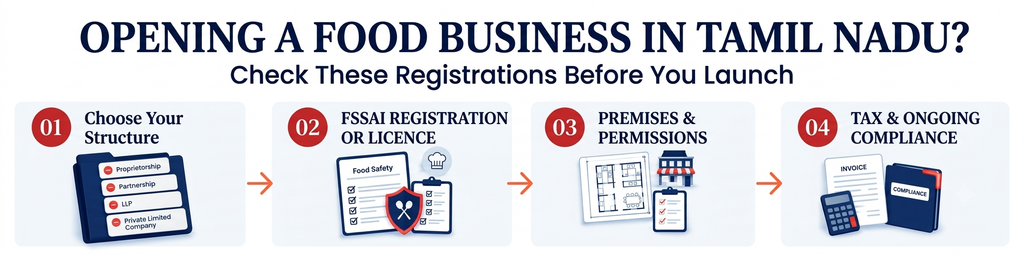
A practical registration sequence
There is no single sequence that works for every business, because some approvals depend on premises, workforce, turnover or the type of activity. The following order is a useful planning framework.
Step 1: Define the business model. Decide whether you will operate a dine-in restaurant, café, takeaway outlet, cloud kitchen or a combination.
Step 2: Choose the legal structure. Decide who will own the business and whether you need a proprietorship, partnership, LLP or company.
Step 3: Screen the premises. Check permitted use, lease terms, utilities, ventilation, local-body requirements and any building-specific approvals.
Step 4: Map the required registrations. Identify the applicable FSSAI category, local trade permissions, labour registrations, GST position and other requirements for the particular operation.
Step 5: Prepare consistent documents. Gather the records required for each application and resolve discrepancies before filing.
Step 6: Submit applications through the relevant official channels. Use the current portal or competent authority, retain acknowledgements and respond to queries with accurate supporting evidence.
Step 7: Complete operational checks. Confirm that the required approvals are in place, staff processes are ready and food-safety practices are documented before opening.
Step 8: Maintain compliance after launch. Track applicable returns, renewals or modifications, employee records, invoices and changes to premises or activities.
Do not advertise a guaranteed opening date based only on an application submission. Processing and inspection requirements can vary, and an application acknowledgement is not the same as an approval.
What changes if you run a cloud kitchen?
A cloud kitchen may save on dining-room space, but it is still a food operation. Its compliance needs should be mapped around actual activities rather than around the absence of tables and chairs.
For example, consider a founder preparing meals for delivery from a rented commercial unit. The founder should confirm the premises’ permitted use, the relevant FSSAI category, local-body permissions, applicable labour requirements, GST treatment and the requirements associated with online ordering and delivery.
If the business adds a second kitchen, the founder should check whether the additional premises needs separate registration or licensing. FoSCoS explains that food-business premises and multi-state operations have specific licensing arrangements; operators should check the current rules for each location.
If the founder starts selling packaged sauces, frozen meals or other products in addition to freshly prepared meals, the additional activities may change the compliance analysis. Product manufacturing, packaging, storage and distribution should not be assumed to be covered by the original activity description without verification.
Common mistakes to avoid
Assuming FSSAI is the only requirement. Food-safety registration is important, but local permissions, premises approvals, tax registration and labour-related obligations may also apply.
Choosing the premises too early. A lease signed before checking permitted use or required building changes can create expensive problems.
Using the wrong FSSAI category. Turnover thresholds have changed. Check the current FoSCoS framework and the actual kind of business before applying.
Copying another restaurant’s GST approach. Turnover, supply arrangements and compulsory-registration rules may differ.
Treating a cloud kitchen as an informal home activity. The legal position depends on the actual premises, activity and applicable rules, not just the business label.
Ignoring employees until after opening. Labour-related requirements and employment records should be considered as part of the launch plan.
Assuming an application means approval. Retain the approval or certificate and verify its scope before relying on it.
Frequently asked questions
What registrations are needed to open a restaurant in Tamil Nadu?
Depending on the business and premises, you may need a suitable business structure, FSSAI registration or licence, local-body trade permission, applicable labour registrations, GST registration where required and building or fire-related approvals where applicable. The exact list should be checked for your operation.
Is FSSAI registration required for a cloud kitchen?
Food businesses generally need the appropriate FSSAI registration or licence. A delivery-only model does not, by itself, remove food-safety obligations. Check the current FoSCoS category for your activities and premises.
What is the FSSAI turnover threshold in 2026?
From 1 April 2026, the revised broad turnover categories are registration up to ₹1.5 crore, State licence above ₹1.5 crore and up to ₹50 crore, and Central licence above ₹50 crore. Confirm the current FoSCoS eligibility criteria for the specific kind of business.
Does a café need a trade licence?
A café may need local-body trade permission depending on its location, activity and the applicable local rules. Confirm the requirement with the relevant municipal corporation, municipality or town panchayat.
Is GST compulsory for every restaurant?
No single answer applies to every restaurant. Turnover, the nature of supplies and statutory exceptions or compulsory-registration provisions matter. Check the current GST rules for the business’s circumstances.
Does a cloud kitchen need a separate registration for each location?
Do not assume one registration covers every kitchen. Check the applicable FoSCoS and local-body requirements for each premises and the rules for businesses operating in more than one state.
Can I start the restaurant while applications are pending?
Do not treat a pending application as approval. Confirm which registrations and permissions must be obtained before starting the relevant activity, and open only when the applicable requirements have been satisfied.
Should I register a restaurant as a Private Limited Company?
Not necessarily. A proprietorship, partnership, LLP or Private Limited Company may be suitable depending on ownership, liability, funding plans and expansion goals. Choose the structure based on the business’s needs rather than assuming one structure is mandatory for all restaurants.
Conclusion
Starting a restaurant, café or cloud kitchen in Tamil Nadu requires a coordinated approach to business setup, food safety, premises permissions, taxation and employment-related compliance. The right checklist depends on what you will serve, where you will operate, how the business is structured and whether you will employ staff or expand to multiple locations.
Start by defining your business model, checking the premises and identifying the applicable requirements. Then prepare consistent documents, apply through the correct official channels and keep evidence of approvals and ongoing compliance.
Planning to launch a restaurant, café or cloud kitchen in Tamil Nadu? FilingPoint can help you understand relevant business registration and compliance services. Contact the team to discuss your business structure and registration needs before you begin the application process.
