

Hosur has developed into an important manufacturing location in Tamil Nadu, particularly for automobile components, engineering products, fabricated metal parts, machinery and related industrial activities. The district’s official export action plan identifies an established auto-component manufacturing base, including ancillary and supplier businesses serving larger manufacturers.
For an entrepreneur planning to establish an engineering or automotive component unit in Hosur, registering a company is only one part of the process. The proposed premises, building use, factory layout, machinery, worker safety arrangements, pollution category and intended manufacturing activity can all influence which approvals are required.
Tamil Nadu’s Business Facilitation reforms in 2026 are relevant to this process. The Tamil Nadu Business Facilitation (Amendment) Act, 2026 came into force on 3 November 2026. The amended law changes the framework for processing certain clearances, strengthens the Single Window mechanism and introduces a statutory route for an Acknowledgement Certificate under the amended Rules.
However, one distinction matters from the beginning: the 21-day framework is not a guarantee that every factory licence, building approval or environmental consent will be granted within 21 days. Its application depends on the relevant enactment, subordinate legislation, prescribed timeline, completeness of the application and statutory exceptions.
This guide explains what the 2026 changes mean for manufacturers planning to set up or expand an industrial unit in Hosur.
What Is the Tamil Nadu Business Facilitation Act?
The Tamil Nadu Business Facilitation Act, 2018 established a framework to coordinate and simplify the process of obtaining business-related clearances from government departments.
The Single Window mechanism is intended to help investors identify and apply for relevant approvals through a centralised online system instead of navigating every department independently.
The 2026 amendment further changes this framework. The Tamil Nadu Business Facilitation (Amendment) Act, 2026 was published in the Tamil Nadu Government Gazette on 15 September 2026 and came into force on 3 November 2026.
The amended framework includes:
- A revised statutory time-limit mechanism for certain clearances.
- A stronger requirement to use the notified Single Window Portal for applications covered by the Act.
- Provisions for the Tamil Nadu Investment Promotion Commission.
- Changes to the treatment of subordinate legislation and scheduled enactments.
- A formal mechanism for monitoring and processing applications.
The accompanying amendments to the Tamil Nadu Business Facilitation Rules, 2017 introduce Rule 11-A, which deals with the Acknowledgement Certificate process.
For a manufacturer, the practical importance is that the application route, supporting documents, statutory timeline and status of each clearance need to be understood together.
Why the 2026 Reforms Matter to Hosur Manufacturers
Hosur is part of Krishnagiri district, where the official District Export Action Plan identifies auto components as a major industrial product category. It describes the presence of automobile and engineering businesses, along with ancillary units and suppliers.
This industrial base makes the reforms relevant to several types of proposed businesses:
- Automotive component manufacturing.
- CNC machining and precision engineering.
- Metal fabrication and industrial equipment.
- Gear, transmission and machinery component production.
- Plastic, rubber and other automotive-related components.
- Ancillary units supplying larger manufacturers and OEM vendors.
A new manufacturing unit may need to coordinate with more than one authority. Depending on its site and operations, this can include planning and building authorities, the Directorate of Industrial Safety and Health (DISH), Tamil Nadu Pollution Control Board (TNPCB), Fire and Rescue Services, local bodies and other relevant departments.
The Single Window Portal provides a consolidated list of clearances and identifies them by stage, department and published turnaround time. The list is periodically updated, so applicants should check the current portal rather than rely on an old checklist.
What Does the 21-Day Clearance Framework Actually Mean?
One of the most significant changes under the amended Section 11 is the revised time-limit framework.
Where a clearance under a scheduled enactment or relevant subordinate legislation has a prescribed processing period exceeding 21 days—or does not prescribe a time limit—the amended provision deems the applicable period to be reduced to 21 days.
But this provision must be read with its exceptions.
When the 21-day period may apply
The provision is relevant where:
- The clearance falls within the scope of the Tamil Nadu Business Facilitation Act.
- The relevant scheduled enactment or subordinate legislation is covered.
- The existing prescribed period exceeds 21 days, or no period has been prescribed.
- No statutory exception preserves a longer period.
- The application is complete with all necessary documents.
The amended Section 11 states that the competent authority must pass orders within the applicable time limit from the date of receipt of a complete application. Where additional information is requested because the original application is incomplete, the applicable timeline is calculated from receipt of that additional information.
When the 21-day period may not apply
The amendment also preserves important exceptions:
- If the relevant scheduled enactment or subordinate legislation already provides a timeline of 21 days or less, that shorter timeline continues.
- If a Central Act prescribes a longer period for a clearance, that longer period prevails.
- A clearance outside the relevant statutory scope cannot automatically be assumed to receive the 21-day timeline.
- An incomplete application can affect when the applicable processing period begins.
Therefore, a manufacturer should not assume that every approval listed on the Single Window Portal has automatically become a 21-day service.
Practical example: The Single Window Portal may display different published turnaround periods for factory plan approval, land-use clearances and TNPCB Consent to Establish. The legal effect of the amendment must be checked against the enactment governing each specific clearance. The portal’s published service timeline and the amended statutory rule should not be treated as interchangeable without checking the relevant legal provision.
Why the Single Window Portal Is Important
The amended Section 7 provides that an application submitted through a web portal other than the Single Window Portal will not be taken up for processing where the Act applies.
For businesses, this makes the correct application route important.
The Tamil Nadu Single Window Portal provides facilities to:
- Register as an investor.
- Identify clearances required for a proposed activity.
- Review department-wise prerequisites and application procedures.
- Submit applications and supporting documents.
- Track application status.
- Access user manuals and published service information.
- Review pre-establishment and pre-operation clearances.
A manufacturer should begin by identifying the proposed activity, location, scale and nature of operations. A machining unit, foundry, metal fabrication unit and surface-treatment facility may not require identical approvals.
Do not select clearances merely because another factory in Hosur obtained them. The applicable requirements depend on the actual activity and premises.
What Is the Combined Application Form?
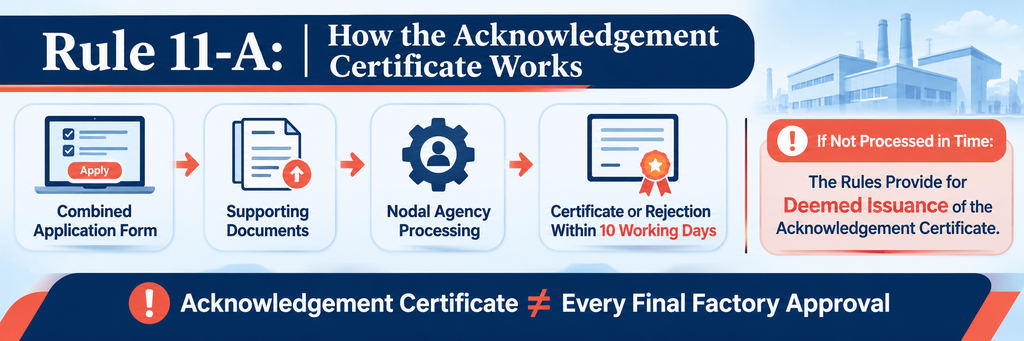
Under Rule 11-A of the amended Tamil Nadu Business Facilitation Rules, a person proposing to start a new activity or expand an existing activity must submit the Combined Application Form through the Single Window Online Portal, together with the prescribed fees and relevant documents.
The Rules identify supporting documents that may include:
- Self-certification under Annexure 12.
- Certificate from an Architect or Structural Engineer under Annexure 13.
- Auditor Certificate under Annexure 14.
These documents are required wherever applicable. The exact supporting documents depend on the application and the nature of the proposed activity.
For planning permission and building permit applications, Rule 11-A also states that consideration will take place only after receipt of the No Objection Certificate from the Directorate of Fire and Rescue Services and other Central Government department NOCs, wherever applicable.
The applicant receives a portal acknowledgement or receipt for tracking. The portal forwards the application to the Nodal Agency for the Acknowledgement Certificate process.
Understanding the Rule 11-A Acknowledgement Certificate
The Acknowledgement Certificate is one of the important procedural features introduced through the 2026 Rules amendment.
After receiving the Combined Application Form and supporting documents, the Nodal Agency must process the application and may issue the Acknowledgement Certificate or reject the application within ten working days.
If the Nodal Agency does not process the application within the prescribed period, Rule 11-A provides for deemed issuance. The portal is required to generate the certificate with the name and seal of the Nodal Agency.
The certificate carries a unique identification number and can be downloaded from the applicant’s portal login. The Rules also provide for its transmission to relevant competent authorities.
Does the Acknowledgement Certificate mean the factory can start production?
No. This is an important distinction.
The Acknowledgement Certificate is part of the Single Window procedure. It should not be treated as a blanket replacement for every statutory approval, licence, consent or operational permission applicable to the factory.
The amended self-certification format itself requires the applicant to undertake compliance with applicable building, factory safety and other legal requirements and to obtain the clearances required from competent authorities before proceeding where the law requires them.
A manufacturer must identify which approvals are still required for the proposed activity and whether each is a pre-establishment or pre-operation requirement.
Reduced Document Resubmission and Self-Attestation
The September 2026 amendments to the Rules introduce two useful procedural changes.
Documents already held by government authorities
Under the new Rule 11 provision, an applicant should not be required to submit information or documents that have already been provided by the applicant or are available with a government authority.
The competent authority is expected to retrieve such information through electronic and interoperable systems, including APIs, wherever feasible.
Resubmission may still be required where particulars have changed or where fresh submission is mandated by law.
Self-attestation wherever applicable
The Rules also provide that documents submitted for clearances or compliance under the Rules should be accepted on the basis of self-attestation wherever applicable.
A competent authority should not require affidavits, notarised documents or attestations by another authority unless such a requirement is expressly mandated under a Central Act, rule, regulation or order.
This is not permission to submit inaccurate or incomplete information. The self-certification format makes the applicant responsible for the correctness of the information supplied.
Manufacturers should retain supporting records and ensure that declarations are consistent with the actual site, building and manufacturing activity.
Factory Site and Building Approvals: What Should Be Checked?
Before signing a long-term lease or beginning construction, a manufacturer should verify whether the premises can legally and practically accommodate the proposed activity.
Important checks include:
- Whether the land use permits the intended industrial activity.
- Whether the building has the necessary planning and building permissions.
- Whether the sanctioned building plan matches the proposed factory layout.
- Whether the building can accommodate machinery, storage and material movement.
- Whether fire access, emergency exits and safety arrangements can be provided.
- Whether power, water, drainage and waste-management arrangements are adequate.
- Whether the premises have any restrictions arising from the industrial estate, local authority or land allotment conditions.
The correct authority can depend on whether the premises are within a planned area, an industrial estate, a local-body jurisdiction or another notified area.
A property advertised as an industrial shed is not automatically suitable for every manufacturing process. Verify the permitted use and approvals for the specific property.
DISH and Factory Plan Approval
The Directorate of Industrial Safety and Health (DISH) is an important authority for factory-related safety and plan approval matters in Tamil Nadu.
The Single Window Portal lists factory plan approval as a pre-establishment clearance handled by DISH.
For a proposed automotive component unit, the factory layout may need to account for:
- Production machinery and workstations.
- Material movement and storage.
- Worker access and circulation.
- Safety distances and emergency arrangements.
- Ventilation and lighting.
- Welfare facilities.
- Hazardous or high-risk operations, where applicable.
The requirements will depend on the applicable factory legislation, rules, worker strength, power usage, manufacturing process and other statutory criteria.
A factory plan should not be prepared as a generic building drawing. It needs to reflect the actual manufacturing process and applicable safety requirements.
TNPCB Consent to Establish and Consent to Operate
Manufacturing units may also need approvals from the Tamil Nadu Pollution Control Board.
Two important consent stages are:
Consent to Establish (CTE): This is generally relevant before establishing or undertaking the activity covered by the consent requirement.
Consent to Operate (CTO): This is generally relevant before operating the unit, subject to the applicable consent conditions and legal requirements.
The exact requirement depends on the industrial activity, pollution category, process, emissions, effluent, waste generation and applicable exemptions or directions.
For example, a basic machining operation may have a different environmental profile from a foundry, electroplating facility, painting unit or chemical-treatment operation.
Do not assume that every automotive component unit has identical TNPCB requirements. Identify the actual process and check the current TNPCB classification and consent procedure.
Pre-Establishment and Pre-Operation Clearances
A useful way to organise a factory project is to separate approvals into two broad stages.
Pre-establishment
These are approvals or permissions that may be required before setting up the facility or carrying out the relevant construction or establishment activity.
Depending on the project, these may include:
- Industrial land allotment or land-use permission.
- Planning permission and building approval.
- Factory plan approval.
- TNPCB Consent to Establish.
- Fire-related NOCs where applicable.
- Other site-specific permissions.
Pre-operation
These are approvals or permissions that may be required before the factory starts the relevant manufacturing activity.
Depending on the project, they may include:
- Factory registration or licence, where applicable.
- TNPCB Consent to Operate.
- Fire and safety-related compliance.
- Electricity and other utility-related permissions.
- Applicable labour and employment registrations.
- Other operational permissions linked to the activity.
This is a planning framework, not a universal sequence. Some approvals may be processed in parallel, while others depend on earlier permissions or inspection results.
Use the current Single Window Portal list and the relevant department’s legal requirements to confirm the actual order.
Company Registration, GST and Udyam Are Separate Requirements
The Business Facilitation reforms do not replace business registrations under other laws.
A manufacturer setting up in Hosur may separately need to consider:
Company or LLP incorporation: The business structure should be selected based on ownership, funding, liability, governance and commercial requirements. Incorporation is handled under the applicable company or LLP law.
GST registration: GST requirements depend on the nature of supplies, turnover, place of supply and applicable statutory provisions. A business should not assume that factory approval automatically provides GST registration.
Udyam registration: Eligible micro, small and medium enterprises can consider Udyam registration under the applicable MSME framework. It is separate from factory licensing and environmental approvals.
These registrations serve different legal purposes. Completing one does not automatically satisfy the others.

A Practical Approval Planning Checklist for a Hosur Manufacturing Unit
Before committing to the project, prepare a clearance matrix.
| Area | What to verify |
| Business structure | Proprietorship, partnership, LLP or company suitability |
| Industrial premises | Permitted land use, ownership or lease rights and building status |
| Building | Planning permission, building permit and approved layout |
| Factory plan | DISH applicability and plan approval requirements |
| Environment | TNPCB category, CTE and CTO applicability |
| Fire safety | Applicable Fire NOC and safety requirements |
| Utilities | Power load, water, drainage and waste arrangements |
| Labour | Applicable factory, employment and welfare compliance |
| Tax | GST applicability and invoicing requirements |
| MSME | Udyam eligibility and registration |
| Single Window | Correct application route, fees, documents and status tracking |
The checklist is a starting point. The final list should be prepared after reviewing the actual manufacturing process, premises and scale of the unit.
What Should You Do If an Approval Is Delayed?
The amended framework and Rules provide mechanisms for time-bound processing and grievance escalation.
If an application is delayed:
- Check whether the application was submitted through the correct Single Window route.
- Confirm that the application is complete and all required fees and documents were submitted.
- Review whether the department has raised a query or requested additional information.
- Record the application number, submission date and status.
- Check the applicable statutory timeline for that specific clearance.
- If the clearance is not eligible for deemed approval and is not disposed of within the applicable timeline, review the automatic grievance registration mechanism under amended Rule 21(6-A).
Do not assume that delay automatically means the approval has been granted. The grievance mechanism and deemed-approval provisions are different legal mechanisms.
Where the applicable law provides deemed approval, the applicant should verify the precise conditions before relying on it. Where it does not, the applicant should use the prescribed escalation process.
What Is the Tamil Nadu Investment Promotion Commission?
The 2026 amendment introduced the Tamil Nadu Investment Promotion Commission under Section 16-A.
The Commission is intended to provide high-level oversight of investment promotion and facilitation activities. Its statutory functions include reviewing the progress of large, strategic and high-impact investments and issuing directions to relevant agencies and departments for timely clearances in the cases covered by the provision.
The Act identifies certain investment categories, including proposed capital investment of ₹200 crore or more and projects expected to generate employment for 5,000 or more persons, along with other specified categories.
This should not be read as an automatic escalation route for every small factory application. A micro or small manufacturing unit should use the applicable Single Window and departmental grievance mechanisms unless it falls within a relevant notified or statutory category.
Common Mistakes Manufacturers Should Avoid
Assuming 21 days applies to every approval: The statutory provision has a defined scope and exceptions. Check the governing enactment and timeline.
Treating an Acknowledgement Certificate as a factory licence: It is not a universal substitute for the approvals required to establish or operate a unit.
Leasing a property before checking land use: An industrial-looking building may still be unsuitable for the proposed process.
Using another factory’s approval list: Requirements vary with manufacturing activity, site, capacity and pollution category.
Submitting inconsistent documents: Differences in company name, site address, ownership, building details or manufacturing activity can lead to queries.
Starting production before required operational approvals: A portal receipt or acknowledgement should not be treated as permission to operate.
Frequently Asked Questions
1. When did the Tamil Nadu Business Facilitation Amendment Act 2026 come into force?
The Tamil Nadu Business Facilitation (Amendment) Act, 2026 came into force on 3 November 2026, as notified by the Tamil Nadu Government.
2. Does the 21-day rule apply to every factory approval in Tamil Nadu?
No. The amended Section 11 applies within its statutory scope and contains exceptions. Existing shorter timelines continue, and a longer period prescribed by a Central Act prevails. The application must also be complete.
3. What is the Rule 11-A Acknowledgement Certificate?
It is a certificate processed by the Nodal Agency after submission of the Combined Application Form and supporting documents through the Single Window Portal. The Rules provide a ten-working-day processing period, with deemed issuance provisions if the application is not processed within that period.
4. Can a manufacturer start production after receiving the Acknowledgement Certificate?
Not automatically. The certificate should not be treated as a replacement for factory licensing, environmental consent or any other statutory permission required before operations begin.
5. Is the Single Window Portal compulsory for applications covered by the amended Act?
The amended Act provides that applications submitted through a web portal other than the Single Window Portal will not be taken up for processing where the Act applies.
6. Do all Hosur manufacturing units need DISH factory plan approval?
The requirement depends on the applicable factory legislation, manufacturing process, premises and other statutory criteria. The applicant should verify the requirement with DISH and the current Single Window clearance list.
7. Does every automotive component unit need TNPCB Consent to Establish and Consent to Operate?
Not necessarily in the same way. Applicability depends on the actual process, pollution category, emissions, effluent, waste generation and relevant exemptions or directions. The manufacturer should verify its category and consent requirements with TNPCB.
8. Can I apply for factory approvals before registering my company?
The correct sequence depends on the proposed ownership structure, applicant eligibility and the specific clearance. Some applications may be made by a promoter or proposed entity where permitted, while others may require established applicant details. Confirm the portal and department requirements before filing.
9. What happens if a department does not process my application within the applicable timeline?
The amended Rules provide for automatic registration of a grievance in specified cases where an application not eligible for deemed approval is not disposed of within the applicable time limit. This does not mean the approval itself is automatically granted.
10. Does Udyam registration replace factory approval?
No. Udyam is an MSME registration. It does not replace factory plan approval, factory licensing, building permissions or environmental consent.
Conclusion
The Tamil Nadu Business Facilitation reforms that came into force on 3 November 2026 introduce important changes to the way certain business clearances are processed. The revised time-limit framework, Single Window application route, Rule 11-A Acknowledgement Certificate and document-submission changes are relevant to entrepreneurs planning new manufacturing activities or expanding existing units.
For Hosur manufacturers, the benefit of these reforms depends on preparing the project correctly. The proposed industrial premises, factory layout, manufacturing process, environmental category and applicable statutory approvals must be identified before the application process begins.
The 21-day framework should be understood as a statutory processing rule for clearances within its scope—not as a blanket approval guarantee. Similarly, an Acknowledgement Certificate does not remove the need to obtain other licences, consents and permissions required by law.
A well-prepared clearance plan can help an automotive component or engineering business avoid preventable delays and make better use of Tamil Nadu’s Single Window system.
Important: Approval requirements and portal service timelines can change. Before filing, verify the latest requirements with the relevant government department and the current Single Window Portal. This article is general information and is not a substitute for project-specific legal or technical advice.
