GSTR-1 - 11-Oct-2026
GSTR-3B - 20-Oct-2026

Trademark Registration

Could AI Misuse or Trademark Squatting Put Your Brand at Risk?

Your business name, logo and reputation may take years to build. But a similar trademark application, an unauthorised attempt to claim your brand name, or an inaccurate legal submission generated using artificial intelligence (AI) can create problems that are difficult and expensive to resolve.

These concerns have gained attention following an announcement published by IP India on 17 October 2026 concerning draft guidelines on the use or misuse of AI and the problem of squatting. The announcement refers to an order of the Delhi High Court dated 13 October 2026. The proposed guidelines focus on the use of AI in proceedings before the Trade Marks Registry and raise important questions about responsible AI use, verification of legal submissions and the protection of legitimate brand interests.

For Indian startups, established businesses, trademark applicants and professionals handling intellectual property matters, this development is worth understanding. It highlights two related but distinct risks: misuse of AI in trademark proceedings and trademark squatting, where someone attempts to register or control a mark in circumstances that may unfairly interfere with another party’s legitimate interests.

An important legal distinction: IP India has published draft guidelines, not a document that should automatically be treated as binding law. Their final status, wording and implementation must be checked against subsequent official notifications or publications.

In this guide, we explain what IP India has announced, what the draft guidelines propose, why trademark squatting matters, and the practical steps businesses can take to protect their brands.

What Has IP India Announced About AI and Trademark Squatting?

IP India, the official Indian intellectual property administration portal, published an announcement on 17 October 2026 concerning draft guidelines on the use or misuse of AI and the problem of squatting.

The announcement identifies compliance with a Delhi High Court order dated 13 October 2026 in W.P.(C)-IPD 16/2026 as its context. The accompanying draft document is titled “Draft Guidelines on Use of Artificial Intelligence in Proceedings Before the Trade Marks Registry, 2026.”

The proposal addresses the role of AI in trademark-related proceedings, including concerns about the accuracy and reliability of material submitted to the Trade Marks Registry.

For businesses, the announcement matters because trademark proceedings can involve detailed legal arguments, statutory references, case-law citations, factual assertions and supporting evidence. AI tools can help prepare or organise material, but their output may contain errors, fabricated references or statements that are not supported by the evidence.

The proposed framework seeks to address these concerns by setting expectations around human responsibility, verification and disclosure in relevant circumstances.

What should businesses understand right now?

  • IP India is the publisher of the announcement. Refer to the source as IP India’s announcement or IP India’s draft guidelines.
  • The guidelines are a proposal at this stage. Do not describe every proposed requirement as an existing legal obligation.
  • The proposal concerns trademark proceedings. It should not be presented as a blanket prohibition on using AI in every business activity.
  • Brand protection remains a practical priority. Businesses do not need to wait for a final version of the guidelines to organise their trademark records and monitor potential misuse of their brands.

Read the official IP India announcement and review the accompanying draft document before relying on specific provisions.

What Are IP India’s 2026 Draft Guidelines?

IP India’s draft guidelines concern the use of AI in proceedings before the Trade Marks Registry. They address the risks that arise when AI-generated or AI-assisted material is used in formal trademark matters without sufficient human oversight.

AI can help professionals summarise documents, prepare first drafts, organise evidence and identify issues for further investigation. However, it can also generate incorrect legal authorities, misstate statutory provisions, introduce unsupported factual claims or produce convincing-looking content that does not withstand verification.

The draft guidelines propose a framework that places responsibility on the human professional or party using the material rather than treating AI output as inherently reliable.

The draft discusses themes including:

  • Human oversight and accountability for submissions.
  • Disclosure or declarations concerning AI use in specified types of documents.
  • Independent verification of case citations, statutory provisions, legal propositions and factual assertions.
  • Treatment of errors and unreliable material generated through AI.
  • Potential consequences for non-compliance under the proposed framework.

The precise scope of any declaration or procedural obligation must be understood from the text of the draft and any final version that may subsequently be notified.

Do the proposed guidelines mean businesses cannot use AI?

No. The proposal should not be interpreted as a general ban on AI.

The practical issue is how AI is used in formal proceedings and whether the material submitted is accurate, relevant and properly supported. AI may assist with drafting, but it should not replace legal judgement, factual verification or responsibility for the final submission.

For example, a business may use an AI tool to organise a chronology of its trademark use. Before that chronology is submitted as part of a formal proceeding, the underlying dates, invoices, advertisements and other records should be checked by a responsible person.

Similarly, a draft opposition reply prepared with AI should not be filed simply because it sounds legally persuasive. The legal references, factual statements and arguments need independent review.

Remember: The draft describes a proposed framework. Check IP India’s latest official publications to establish whether a final version has been issued and when any requirements take effect.

What Is Trademark Squatting in India?

Trademark squatting generally refers to applying to register or claiming rights in a trademark that another person or business has a legitimate interest in using, often to obtain an unfair commercial advantage.

For example, a person may discover that a small Indian company is building recognition around a distinctive brand name. The person then applies to register an identical or confusingly similar mark, hoping to benefit from the company’s reputation, create pressure or gain leverage in a commercial dispute.

The term can cover different fact patterns. Not every application for a similar name is trademark squatting, and the legal outcome depends on the evidence, applicable law and circumstances.

The Trade Marks Act, 1999 provides the legal framework for trademark registration and related disputes in India. Questions involving earlier rights, similarity, the nature of the goods or services, the applicant’s conduct and the evidence of use may be relevant when a dispute arises.

Examples of potential trademark squatting

Example 1: A growing startup

A startup has used a distinctive name for its software service but has not yet filed a trademark application. Another party applies to register a similar name for related services. The startup may need to gather evidence of its earlier use and assess the available legal options.

Example 2: A well-known local brand

A regional food business has built customer recognition over several years. An unrelated applicant attempts to register a similar mark for comparable products. The business may need to examine whether an opposition or another legal response is appropriate.

Example 3: A brand expanding into new markets

A business plans to launch new products or enter another region. It discovers that someone has already applied for a similar mark. The business should assess the filing, the goods or services covered, its existing rights and the commercial risks before deciding how to proceed.

These examples illustrate possible warning signs; they do not establish that every similar application is unlawful.

Is trademark squatting automatically illegal?

The label alone does not determine the legal outcome. A business must assess the relevant facts and legal grounds, which may include the existence of earlier rights, the likelihood of confusion, the applicant’s conduct and the provisions applicable to the particular dispute.

Where a potentially conflicting application appears, prompt investigation and appropriate professional advice can help a brand owner decide whether to oppose the application or consider another remedy.
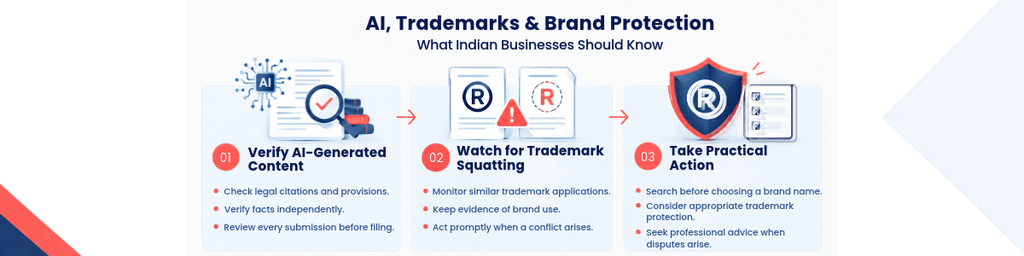
AI, Trademarks Brand Protection

How Are AI Misuse and Trademark Squatting Connected?

AI misuse and trademark squatting are separate issues, but they can intersect in trademark disputes.

AI can make it easier to generate legal-looking submissions, summarise large amounts of information or produce arguments quickly. That can be useful when the tools are used responsibly. It can also make it easier for inaccurate information to enter a proceeding if the output is not checked.

Consider a trademark dispute in which a party submits a document containing fabricated case citations or incorrect descriptions of earlier decisions. The document may look authoritative, but its errors can undermine the reliability of the submission and complicate the proceeding.

In another situation, AI may help a business identify potentially similar marks. That can be a useful starting point, but an automated similarity result is not a definitive legal conclusion. A human reviewer still needs to assess the relevant marks, goods or services, records and legal context.

The proposed IP India framework highlights the importance of accountable use of AI in formal trademark proceedings. It should not be treated as proof that AI use itself is improper or that every dispute involving a similar mark is an instance of squatting.

What this means for business owners

Businesses should distinguish between three activities:

  1. Brand monitoring: Using search tools or AI to identify potentially conflicting marks and online impersonation.
  2. Document preparation: Using AI to help organise or draft material for review.
  3. Formal legal submissions: Filing material that must be accurate, properly supported and compliant with applicable procedural requirements.

The first two activities can assist with preparation. The third requires particular care because errors can affect a formal proceeding.

The draft guidelines focus on reliability, disclosure in specified circumstances and human accountability. Their proposed requirements should be read in context rather than reduced to a blanket statement that every use of AI must be declared or that AI-generated content cannot be used.

A. Human responsibility

The draft emphasises human primacy and accountability. In practical terms, the person or party responsible for a submission should not rely on an AI system as the final authority on its accuracy.

A lawyer, trademark professional or business representative should review the material and ensure that the final submission reflects the relevant facts and law.

AI systems may produce case names, citations or legal propositions that are inaccurate or cannot be verified. A citation should not be included in a formal submission merely because an AI tool generated it.

The person preparing the submission should independently verify that the authority exists, that the citation is accurate and that the decision supports the proposition being made.

C. Verification of factual assertions

AI may confuse dates, parties, transactions or details from different documents. Factual claims should be checked against original records, such as invoices, correspondence, dated advertisements, registration documents or other relevant evidence.

D. Declarations and disclosure

The draft proposes disclosure or declarations concerning AI use in specified types of substantive documents. The scope of these proposed requirements must be checked against the actual text, including the categories of proceedings and documents covered.

Businesses should not assume that the draft imposes an identical disclosure requirement on every email, internal note or administrative task involving AI.

E. Errors and possible consequences

The draft addresses AI-related errors and proposes consequences for non-compliance. These should be described as proposed measures unless and until an applicable final instrument establishes the relevant requirements.

For a live trademark matter, the prudent approach is to follow the applicable law, procedural rules and current official directions, rather than relying on a summary of a draft.

Who Should Pay Attention to IP India’s Draft Guidelines?

Although the announcement concerns proceedings before the Trade Marks Registry, its practical relevance extends to businesses that may need to protect or enforce trademark rights.

Startups and new businesses

A startup may invest in a name, logo, website, packaging and marketing before fully assessing trademark availability. An early trademark search and a considered filing strategy can reduce the risk of later conflict.

Small and medium-sized enterprises

SMEs often expand gradually. A business that begins with local customers may later sell through e-commerce, distributors or franchise arrangements. Trademark planning should keep pace with that growth.

Established brands

Businesses with established customer recognition should maintain a record of their trademark portfolio, monitor potentially conflicting applications and keep evidence of their use.

E-commerce sellers and consumer brands

Online sellers may encounter confusingly similar product names, copied branding, unauthorised listings or impersonation accounts. Trademark rights can be one part of a broader response, depending on the circumstances and platform procedures.

Trademark applicants and professionals

Applicants, trademark agents and legal professionals preparing material for the Registry should monitor the official position on the proposed AI framework and ensure that formal submissions meet the requirements applicable at the time of filing.

Businesses using AI tools

Companies that use AI to prepare legal or compliance documents should establish a review process. AI can support drafting and organisation, but it should not be treated as a substitute for checking facts, legal sources and procedural requirements.

How Can Indian Businesses Protect Their Brands From Trademark Squatting?

Businesses can take several practical steps to strengthen their trademark position. These measures are useful regardless of whether the draft guidelines are ultimately adopted in their current form.

Step 1: Search before committing to a brand name

Before investing heavily in a business name, logo or product identity, search for identical and potentially similar trademarks.

Use the official IP India website and its available trademark search services. Review the relevant classes of goods and services, spelling variations and marks that may create confusion.

A basic online search is not a substitute for a proper trademark clearance assessment. Similarity can involve more than an exact word match.

Step 2: Consider filing an appropriate trademark application

If a brand is commercially important, assess whether a trademark application is appropriate and which classes should be covered.

The correct filing strategy depends on the business’s actual and planned goods or services, the mark being protected and any existing applications or rights. Do not select classes simply because another business has used them.

Registration is not a guarantee against every dispute, but an appropriate filing can help establish and protect the rights available under the applicable law.

Step 3: Keep evidence of actual use

Maintain records that show how and when the mark is used in business.

Depending on the circumstances, useful records may include:

  • Dated invoices and sales records.
  • Product packaging and labels.
  • Website pages and dated screenshots.
  • Marketing materials and advertisements.
  • Marketplace listings and product catalogues.
  • Customer communications and commercial agreements.
  • Records showing the geographic reach of sales or advertising.

Keep original records wherever possible. A document created today to describe historical use may not carry the same evidentiary value as contemporaneous records.

Step 4: Monitor potentially conflicting marks

Periodically review trademark filings and search for potentially similar marks. Monitor relevant online marketplaces, websites and social media accounts for confusingly similar branding or impersonation.

Monitoring can be manual or supported by software. Automated alerts can help identify candidates for review, but they may produce false positives and should not be treated as legal determinations.

Step 5: Act promptly when a conflict appears

If you discover a potentially conflicting trademark application, gather the relevant details and assess the applicable deadlines.

Depending on the circumstances, possible responses may include a trademark opposition an appropriate representation or other legal action. The right option depends on the status of the application, the nature of the rights involved and the available legal grounds.

Do not assume that sending a warning email alone will protect your position. Equally, do not assume that every similar mark should automatically be opposed.

Step 6: Keep ownership and business records consistent

Maintain clear records of the legal entity that owns the mark, assignments, licences and any relevant changes in ownership.

If a brand is owned by a founder personally but used by a company, for example, the arrangement should be reviewed carefully. Ownership and permitted use should be documented appropriately.

Step 7: Build a response plan

Decide who within the business should review potential infringements, who will preserve evidence and who will seek professional advice. A simple documented process can prevent confusion when a suspicious application or impersonation incident is discovered.

Trademark Registration Chennai

What Should You Do If Someone Applies for a Trademark Similar to Yours?

Discovering a potentially conflicting application can be worrying, especially if you have already invested in building your brand. The best response is to investigate the facts before deciding what action to take.

First, identify the application. Record the application number, applicant, filing date, mark representation and relevant goods or services. Check the official record rather than relying only on a search result or social media post.

Second, compare the marks and business activities. Consider their visual, phonetic and conceptual similarities, the relevant goods or services and the likelihood of confusion in context. A superficial resemblance does not by itself determine the outcome.

Third, gather evidence of your rights and use. Collect your registration details, earlier application records, invoices, advertisements, product images and other relevant documents. Preserve the original versions and their dates.

Fourth, check the applicable procedural route and deadline. The appropriate response depends on the application’s status and the legal grounds available. A trademark professional can help assess whether an opposition or another remedy is suitable.

Fifth, keep the response evidence-based. Do not rely on unverified case law or unsupported allegations. If AI assists with organising or drafting the material, verify every important legal citation and factual statement before anything is filed.

Trademark matters can involve strict procedural timelines. If a potentially conflicting application affects an important brand, seek qualified advice promptly.

How Should Businesses Use AI Responsibly in Trademark Matters?

AI can help businesses and professionals work more efficiently, but its output needs to be managed carefully.

A practical review process can include the following controls.

TaskSensible control
Preliminary trademark researchCheck search results against official records and relevant classes
Summarising legal documentsCompare the summary with the original document
Drafting a response or oppositionVerify the facts, legal grounds and procedural requirements
Adding case-law citationsIndependently confirm the case, citation and legal proposition
Preparing an evidence chronologyMatch each date and event to the underlying records
Drafting factual statementsConfirm that each material statement has supporting evidence
Preparing a formal submissionArrange a competent human review before filing

AI should be used as an assistant, not as the final decision-maker. If the proposed IP India guidelines are finalised or brought into effect, businesses and professionals should review the final wording and update their processes accordingly.

A simple AI review checklist

Before using AI-assisted material in a trademark proceeding, ask:

  • Does every cited case or legal provision actually exist?
  • Does each authority support the point for which it is cited?
  • Are all names, dates, application numbers and factual statements correct?
  • Is each important factual assertion supported by reliable evidence?
  • Does the document meet the applicable filing and procedural requirements?
  • Have any disclosure or declaration requirements that are actually in force been satisfied?
  • Has a responsible person reviewed and approved the final version?

This checklist is a practical risk-control measure, not a substitute for the requirements of the applicable law or any final IP India guidelines.

What Is the Difference Between the Announcement, the Draft Guidelines and Binding Requirements?

This distinction is particularly important when reporting a recent regulatory or procedural development.

IP India’s announcement is the official publication informing readers about the draft guidelines and their context.

The draft guidelines are the proposed text explaining the framework being considered. They indicate what the proposal may require if adopted, but should not automatically be described as existing obligations.

A final notification or applicable direction may establish the operative position, depending on its legal form, terms, date and scope. Any later official publication must be reviewed to determine what was finalised and when it applies.

Businesses should therefore avoid statements such as “IP India has made AI declarations mandatory for every trademark filing” unless the applicable final instrument actually supports that statement.

A more accurate formulation is:

“IP India has published draft guidelines proposing safeguards for the use of AI in specified trademark proceedings. Businesses and professionals should monitor the official position and verify the applicable requirements before filing documents.”

This wording is informative without overstating the legal effect of the announcement.

Private Limited Company Registration

What Should Indian Startups Do Now?

A startup does not need to wait for a final version of the guidelines to improve its brand-protection practices.

Start by identifying the names, logos and product marks that matter most to the business. Check whether the relevant trademarks have been searched and whether appropriate applications have been filed.

Next, organise ownership documents and evidence of use. Keep records in a location that the relevant team can access when a dispute arises.

Then establish a basic monitoring process. Review potentially conflicting trademark applications and investigate suspicious online use of the brand. Where a conflict appears, preserve the evidence and check the available legal options and applicable deadlines.

Finally, introduce sensible controls for AI-assisted legal work. Require human review, verify citations and facts, and check any applicable disclosure requirements before submitting formal documents.

These steps can improve readiness for trademark disputes while helping businesses respond responsibly to developments in IP India’s proposed framework.

Frequently Asked Questions

1. What are IP India’s 2026 draft guidelines on AI?

IP India published an announcement on 17 October 2026 concerning draft guidelines on the use or misuse of AI and trademark squatting. The accompanying draft document addresses AI use in proceedings before the Trade Marks Registry, including proposed safeguards around accuracy, disclosure in specified circumstances and human accountability.

2. Are IP India’s 2026 draft guidelines already binding law?

They should not be described as binding merely because they have been published. The announcement concerns draft guidelines. Check IP India’s latest official publications and any relevant final notification or direction to establish the current legal position.

3. Why has IP India addressed AI use in trademark proceedings?

AI tools can help prepare documents, but they may also generate inaccurate case citations, legal propositions or factual assertions. The proposed framework addresses the need for reliable submissions and human responsibility in formal proceedings.

4. What is trademark squatting?

Trademark squatting generally refers to attempts to register or claim a mark in circumstances that may unfairly interfere with another party’s legitimate brand interests. The legal assessment depends on the facts, existing rights and applicable law.

5. Can a business oppose a similar trademark application in India?

A business may be able to oppose an application if it has appropriate legal grounds and follows the applicable procedure. Similarity alone does not guarantee success. The relevant facts, rights, goods or services and procedural deadlines must be assessed.

6. Does using AI to prepare a trademark reply mean the reply will be rejected?

Not automatically. The relevant concerns include accuracy, compliance with applicable requirements and the nature of the material submitted. AI-assisted work should be checked by a responsible person before filing.

7. Should businesses disclose every use of AI?

Do not assume that the draft imposes a universal disclosure requirement for every use of AI. The proposed declarations concern specified types of documents and proceedings. Check the actual draft and any final requirements applicable at the time of filing.

8. How can a startup protect its brand from trademark squatting?

A startup should search for similar marks, consider appropriate trademark filings, preserve evidence of use, monitor potentially conflicting applications and respond promptly to genuine conflicts. Professional advice may be appropriate where the brand is commercially important.

9. What evidence should a business keep to support its trademark rights?

Relevant records may include registration documents, dated invoices, advertisements, packaging, website records, marketplace listings and commercial agreements. The appropriate evidence depends on the issue being addressed.

10. Where can businesses check the official position?

Start with IP India’s official website and the announcement concerning the 2026 draft guidelines. Review the underlying document and any subsequent official publication before relying on a specific requirement.

Conclusion: Protect Your Brand and Keep Track of the Official Position

IP India’s 2026 announcement brings attention to two important business concerns: the responsible use of AI in trademark proceedings and the problem of trademark squatting.

The proposed guidelines highlight the importance of human accountability, accurate legal material and appropriate verification. They should, however, be described as draft guidelines unless and until their final status and implementation are established by the relevant official publication.

For Indian businesses, the practical message is clear: do not wait for a dispute to take brand protection seriously. Search before committing to a name, assess suitable trademark protection, preserve evidence of use and monitor for potentially conflicting applications. If a dispute arises, investigate the facts and consider the available legal options promptly.

FilingPoint can help businesses understand relevant registration and compliance processes. For a trademark dispute or a question about the legal effect of the draft guidelines, seek advice from a qualified trademark professional.


A trademark opposition can delay your registration but it does not automatically mean your application will be rejected.

Here’s what happens after an opposition is filed, including the TM-O process, response deadlines, evidence, hearing and possible outcomes. 

What Is a Trademark Opposition?

A trademark opposition is a legal proceeding through which another party challenges the registration of a trademark.

It normally becomes relevant after a trademark application has been examined and advertised or re-advertised in the Trade Marks Journal.

The party filing the opposition is generally referred to as the opponent, while the business or person who filed the trademark application is the applicant.

The opposition process gives the opponent an opportunity to state why the trademark should not be registered and gives the applicant an opportunity to respond.

Under Rule 42, the notice of opposition must be filed in Form TM-O within four months from publication or republication of the relevant trademark application in the Trade Marks Journal. The Registrar ordinarily serves a copy of the notice on the applicant within three months of receiving it.

Simple example

Suppose ABC Foods Pvt. Ltd. applies to register the brand name FreshBite for food products.

The application is examined and later advertised in the Trade Marks Journal.

Another business, XYZ Foods, believes that registration of FreshBite could affect rights it claims in an earlier trademark.

XYZ Foods may file a trademark opposition within the prescribed period.

ABC Foods would then have an opportunity to respond through the opposition procedure.

The actual outcome would depend on the grounds raised, evidence submitted and applicable trademark law.

Trademark Registration Journey in India

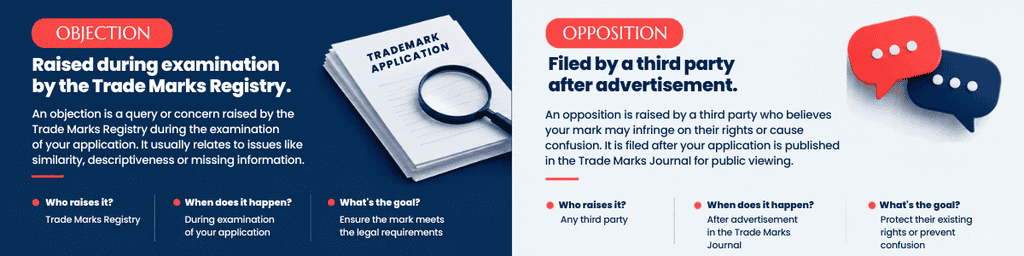
What Is the Difference Between Trademark Objection and Trademark Opposition?

This is one of the most important distinctions for anyone applying for trademark registration in India.

Although the terms trademark objection and trademark opposition are sometimes used interchangeably in casual discussions, they refer to different stages and procedures.

Trademark Examination ObjectionTrademark Opposition
Arises during examination of the applicationArises after advertisement/re-advertisement
Raised by the Trade Marks RegistryFiled by another party
Communicated through an examination reportFiled through a notice of opposition
Applicant responds to Registry’s objectionApplicant responds to opponent’s case
Covered by the examination procedureCovered by the opposition procedure
Rule 33 is relevantRules 42–50 are relevant

Under Rule 33, the Registrar examines a trademark application and may communicate objections to acceptance through an examination report. The applicant is given an opportunity to respond under the prescribed procedure.

A trademark opposition, on the other hand, is filed by a third party after the application has been advertised in the Journal.

Why does this distinction matter?

Because the deadlines, documents and response process are different.

If you receive an examination report, you are dealing with the Registry’s examination process.

If you receive a notice of opposition, you are dealing with another party’s challenge to your trademark application.

Understanding which document you have received is therefore the first step.

When Can Someone Oppose a Trademark Application?

A trademark application can generally be opposed after it has been advertised or re-advertised in the Trade Marks Journal.

Rule 42 provides that a notice of opposition must be filed in Form TM-O within four months from the date of publication of the relevant Trade Marks Journal.

This means filing a trademark application does not immediately result in registration.

There are different stages between filing an application and obtaining registration.

A simplified journey is:

Trademark application → Examination → Advertisement in Journal → Opposition period → Registration, if applicable

If an opposition is filed during the prescribed period, the application enters an opposition proceeding.

Can someone oppose a trademark before it is advertised?

The statutory opposition process under Section 21 and Rule 42 is linked to advertisement or re-advertisement of the application.

Therefore, businesses should distinguish between:

  • Examination by the Registry
  • Advertisement in the Journal
  • Opposition by a third party

These are different stages of the trademark registration process.

Why Would Someone Oppose a Trademark?

There can be different reasons for a trademark opposition.

The exact grounds depend on the facts of the case and the legal provisions relied upon by the opponent.

For example, an opposition may involve arguments relating to:

  • An earlier trademark
  • Similarity between trademarks
  • Similar goods or services
  • Likelihood of confusion
  • Prior rights
  • Lack of distinctiveness
  • Other grounds available under trademark law

An opposition notice is therefore not necessarily based on one single issue.

For example, an opponent may argue that:

“The applicant’s proposed trademark is sufficiently similar to an earlier mark and is being applied for related goods or services.”

Another opposition may involve different legal grounds.

The applicant should therefore read the actual notice of opposition instead of assuming that the dispute is simply about the name being similar.

What Information Does a Trademark Opposition Notice Contain?

Rule 43 specifies information that must be included in a notice of opposition.

This includes information relating to:

  • The trademark application being opposed
  • Application number
  • Goods or services being opposed
  • Name of the trademark applicant
  • Earlier trademark or earlier right relied upon
  • Opponent
  • Grounds on which the opposition is based

The notice must also be properly verified.

This information is important because it tells the applicant what exactly is being challenged.

For example, an opposition may not necessarily concern every class or every product covered by an application.

If an application covers multiple classes, the opposition may relate only to particular classes.

Rule 42 also contains provisions concerning opposition against particular classes and division of applications in certain circumstances.

What Happens After a Trademark Opposition Is Filed?

Once a valid opposition is filed, the matter moves into a formal proceeding.

The broad sequence is:

1. Notice of opposition

The opponent files the opposition in Form TM-O.

2. Service of opposition

The Registrar ordinarily serves a copy of the opposition notice on the applicant.

3. Counterstatement

The applicant files a counterstatement in Form TM-O.

4. Evidence by opponent

The opponent may submit evidence by affidavit or state that it does not wish to submit evidence.

5. Evidence by applicant

The applicant gets an opportunity to submit evidence.

6. Reply evidence

The opponent may submit evidence in reply.

7. Hearing

The Registrar may conduct the hearing stage in accordance with the Rules.

8. Decision

The Registrar communicates the decision to the parties in writing.

Rules 42–50 of the Trade Marks Rules, 2017 provide the principal procedural framework for these stages.

How Long Do You Have to Respond to a Trademark Opposition?

This is one of the most important questions for an applicant.

Under Rule 44, the applicant’s counterstatement must be filed in Form TM-O within two months from receipt of the copy of the notice of opposition from the Registrar.

This should not be confused with the four-month period available for filing the initial opposition.

The two deadlines are different

Opponent:

Four months from publication or republication of the trademark application in the Journal.

Applicant:

Two months from receipt of the copy of the opposition notice.

Keeping these dates separate is important.

What should you do after receiving the notice?

Immediately:

  1. Note the date of receipt.
  2. Check the trademark application number.
  3. Identify the opponent.
  4. Read all grounds raised.
  5. Check the goods or services involved.
  6. Record the counterstatement deadline.
  7. Gather relevant documents.
  8. Prepare the response.

Do not rely only on the date shown on the original trademark application.

The counterstatement deadline under Rule 44 is linked to receipt of the opposition notice.

What Is a Counterstatement in Trademark Opposition?

A counterstatement is the applicant’s formal response to a trademark opposition.

Under Rule 44, it is filed in Form TM-O.

The counterstatement sets out the applicant’s position regarding the facts alleged in the notice of opposition, including which facts, if any, are admitted. It must also be verified in the prescribed manner.

A counterstatement should therefore be more than a simple statement such as:

“We want to register our trademark.”

It needs to address the opposition raised against the application.

The appropriate response depends on:

  • The opponent’s identity
  • The grounds of opposition
  • The trademark involved
  • Goods and services
  • Earlier marks or rights relied upon
  • Applicant’s use of the mark
  • Relevant supporting evidence

Because every opposition can involve different facts, the contents of a counterstatement should be prepared based on the actual notice received.

What Happens After the Counterstatement?

The trademark opposition does not end after the applicant files the counterstatement.

The matter may move into the evidence stage.

Evidence by the opponent

Under Rule 45, the opponent has two months from service of the counterstatement to:

  • Submit evidence by affidavit, or
  • Inform the Registrar and applicant that it does not wish to submit evidence and intends to rely on the facts stated in the notice of opposition.

If the opponent takes no action within the prescribed period, the Rules provide that the opposition is deemed abandoned.

Evidence by the applicant

Under Rule 46, the applicant gets two months after receiving the opponent’s evidence or relevant intimation to submit evidence by affidavit or indicate that it does not wish to submit further evidence.

If the applicant takes no action within the prescribed period, the application is deemed abandoned under the Rule.

Evidence in reply

Rule 47 provides the opponent with one month from receiving the applicant’s affidavit copies to submit evidence by affidavit in reply.

The Rules also contain provisions concerning further evidence in appropriate circumstances.

What Documents Can Be Used as Evidence in a Trademark Opposition?

The evidence required depends on the facts and grounds of the case.

Depending on the circumstances, relevant records may include:

Business-use evidence

  • Invoices
  • Purchase orders
  • Sales records
  • Product packaging
  • Labels
  • Product photographs

Marketing evidence

  • Advertisements
  • Brochures
  • Social media records
  • Website pages
  • Promotional material
  • Marketing campaigns
  • Earlier trademark registrations
  • Trademark applications
  • Assignment documents
  • Licensing records
  • Correspondence
  • Other relevant intellectual property records

Business records

  • Company documents
  • Commercial agreements
  • Distributor records
  • Customer records, where relevant

The correct evidence depends on what the opponent is alleging and what the applicant needs to establish.

There is no universal document list that applies identically to every trademark opposition.

What If You Ignore a Trademark Opposition?

Ignoring a trademark opposition can have serious procedural consequences.

The Trade Marks Rules prescribe specific actions at different stages.

For example:

  • The applicant has a prescribed period to file the counterstatement.
  • The opponent has a prescribed period to submit evidence or notify reliance on the opposition notice.
  • The applicant has a prescribed period for evidence.
  • The opponent may have a further period for reply evidence.

Rule 46 specifically provides that if the applicant takes no action within the prescribed evidence period, the application is deemed abandoned.

This is why businesses should not simply assume that their trademark application will continue automatically after an opposition is filed.

If you have missed a deadline

The correct next step depends on:

  • Which deadline was missed
  • When the deadline expired
  • What stage the proceeding has reached
  • What communication has been issued
  • Whether any procedural option is available

Check the current official record and obtain appropriate professional guidance where necessary.

Company Registration in Chennai

Can a Trademark Be Registered After Opposition?

Yes, an opposition does not automatically mean that registration is impossible.

The opposition is a proceeding through which the opponent challenges the application.

The applicant gets an opportunity to present its case under the prescribed process.

The final result depends on the facts, pleadings, evidence, applicable law and Registrar’s decision.

Rule 53 provides that where no opposition is filed within the prescribed period, or where an opposition is filed and dismissed, the Registrar shall, subject to the applicable provisions of the Act and Rules, enter the trademark on the register.

Therefore, an applicant should not treat the receipt of an opposition notice as equivalent to a final rejection.

Instead, the applicant should focus on responding correctly to the opposition.

What Happens at the Trademark Opposition Hearing?

After the evidence stage closes, Rule 50 provides for a hearing.

The Registrar gives notice of the first hearing date, which is to be at least one month after the first hearing notice. The Rules also contain provisions concerning adjournments.

The parties may present their respective submissions in accordance with the applicable procedure.

The Registrar considers the material before deciding the opposition.

The Rules also state that written arguments, where submitted by a party, are to be considered by the Registrar.

The final decision is communicated to the parties in writing at the address provided for service.

Why should businesses prepare carefully?

By the hearing stage, the matter may already contain:

  • Opposition notice
  • Counterstatement
  • Affidavits
  • Exhibits
  • Reply evidence
  • Written arguments

The hearing should therefore be viewed as part of the overall proceeding rather than as an isolated event.

Can a Trademark Opposition Be Settled or Withdrawn?

A trademark opposition does not necessarily have to continue until a contested decision in every situation.

Depending on the circumstances, parties may resolve their dispute through settlement or other appropriate procedural steps, including withdrawal where applicable.

However, whether settlement is suitable depends on:

  • The rights claimed by the opponent
  • Similarity between the marks
  • Goods or services
  • Evidence of use
  • Commercial relationship
  • Negotiation position
  • Stage of the opposition

Businesses should not assume that every opposition should be settled or every opposition should be contested.

The appropriate course depends on the actual circumstances.

What Is the Current Trademark Opposition Position in India in 2026?

Businesses dealing with trademark opposition matters should also be aware of current developments from IP India.

On 31 August 2026, IP India published a notice titled “Special Disposal Drive for Disposal of Pending Trade Mark Opposition Matters (Settlement/Withdrawal)”.

The title of the notice indicates that the initiative concerns pending opposition matters and settlement/withdrawal.

This should not be confused with a change to the basic opposition deadlines under Rule 42 or Rule 44.

The existing Trade Marks Rules continue to provide the procedural framework for opposition, counterstatement, evidence and hearing.

IP India also published a notice on 21 August 2026 inviting stakeholders to submit comments and suggestions on the Revised Draft Manual of the Trade Marks Office (Practice & Procedure).

For businesses with pending trademark matters, the practical lesson is simple:

Check current IP India communications rather than relying only on old trademark articles or outdated procedural information.

What Should You Do After Receiving a Trademark Opposition?

If your trademark application has been opposed, use this checklist.

1. Confirm the application number

Make sure the opposition relates to your actual trademark application.

2. Identify the opponent

Check the person or business filing the opposition and the rights or trademark they rely upon.

3. Read the grounds carefully

Do not assume that the opposition is simply because the names are similar.

Read every ground stated in the notice.

4. Check the goods and services

Determine whether the opposition concerns:

  • All goods/services
  • Particular goods/services
  • Particular classes

5. Record the deadline

The counterstatement deadline under Rule 44 is linked to receipt of the opposition notice.

6. Review your trademark history

Collect:

  • Application documents
  • User claims
  • Earlier correspondence
  • Trademark search information
  • Business-use records

7. Gather evidence

Depending on the case, collect invoices, advertisements, packaging, website records and other relevant documents.

8. Monitor the proceeding

Do not stop checking the status after filing the counterstatement.

The proceeding can move through evidence and hearing stages.

9. Keep copies of every filing

Maintain an organised record of:

  • Opposition notice
  • Counterstatement
  • Evidence
  • Affidavits
  • Exhibits
  • Hearing notices
  • Written arguments
  • Orders and decisions

What Are Common Mistakes Businesses Make During Trademark Opposition?

Mistake 1: Treating opposition as a rejection

An opposition is a proceeding, not automatically the final rejection of the trademark.

Mistake 2: Missing the counterstatement deadline

Rule 44 provides a specific period for filing the counterstatement.

Mistake 3: Giving a generic response

The counterstatement should address the allegations actually raised.

Mistake 4: Ignoring evidence

Trademark disputes can involve evidence relating to use, prior rights and commercial activity.

Mistake 5: Assuming the trademark is protected because an application was filed

Filing an application and obtaining registration are different stages.

Mistake 6: Using outdated information

Trademark procedures and administrative practices can change.

Always check current IP India information for important procedural matters.

Mistake 7: Waiting until the hearing to understand the case

The opposition should be reviewed from the beginning so that the evidence and response can be prepared appropriately.

Trademark Opposition Timeline in India

Here is a simplified view of the main stages under the Trade Marks Rules:

StageWhat happens?Relevant rule
AdvertisementApplication is published/re-published—
OppositionNotice filed in Form TM-ORule 42
CounterstatementApplicant responds in Form TM-ORule 44
Opponent evidenceEvidence by affidavit or reliance on noticeRule 45
Applicant evidenceEvidence by affidavit or reliance on recordRule 46
Reply evidenceOpponent may submit reply evidenceRule 47
Further evidenceMay be allowed by Registrar in appropriate casesRule 48
HearingHearing after closure of evidenceRule 50
DecisionRegistrar communicates decisionRule 50

The individual procedural periods should be calculated from the relevant event specified in the Rules rather than from the original trademark filing date.

Trademark Opposition vs Trademark Objection: Which One Did You Receive?

If you are confused about the document you received, use this simple test:

If the document is an examination report:

You are likely dealing with a trademark examination objection.

If another party has filed a notice challenging your advertised application:

You are dealing with a trademark opposition.

If you have received Form TM-O relating to opposition:

Check the application number, opponent, grounds and applicable deadline immediately.

This distinction can help prevent businesses from following the wrong response process.

Is Form TM-O Used for Trademark Opposition?

Yes.

Form TM-O is used for a notice of opposition under Rule 42 and for the applicant’s counterstatement under Rule 44. It is also prescribed for various other trademark proceedings under the Rules.

IP India’s current Forms & Official Fees page provides the official forms and applicable fee information.

The current official fee schedule also provides separate fees for trademark opposition and related proceedings. Businesses should check the current official schedule before filing because the applicable fee depends on the type of proceeding and filing circumstances.

Can One Trademark Application Be Opposed for Only One Class?

Yes, the opposition procedure can operate at the class level in relevant circumstances.

Rule 42 specifically addresses opposition where a single trademark application covers different classes.

Where an opposition is filed only for particular classes, the Rules contain provisions concerning the remaining classes and division of the application.

This is particularly relevant for businesses that have filed multi-class trademark applications.

Therefore, when receiving an opposition, check not only the trademark name, but also:

  • Application number
  • Classes
  • Goods/services
  • Scope of the opposition

Does Trademark Opposition Mean Someone Owns the Trademark?

Not necessarily.

An opponent may rely on an earlier trademark or other rights, but the existence of an opposition itself does not establish that the opponent automatically has superior rights.

The opponent has to present its case through the prescribed proceeding.

Similarly, the applicant has an opportunity to present its response and evidence.

The Registrar decides the matter based on the applicable law and material before the Registry.

How Filing Point Can Help

A trademark opposition can involve several procedural stages, and the appropriate response depends on the actual application, opposition notice, grounds and evidence.

Filing Point provides Trademark Registration support for businesses looking to protect their brands in India, including assistance around trademark search, class selection and the registration process.

If your trademark application has received an objection or opposition, the first step is to understand exactly what communication you have received and what deadline applies.

Need help with trademark registration or related filing support?

📞 +91 72999 72500

📧 enquiry@filingpoint.com

Frequently Asked Questions About Trademark Opposition in India

1. Can someone oppose my trademark after I file the application?

Yes. Once the application is advertised or re-advertised in the Trade Marks Journal, a third party can file an opposition within the prescribed period. Rule 42 provides a four-month period from publication or republication.

2. What is the trademark opposition deadline in India?

Under Rule 42, the notice of opposition is generally filed within four months from publication or republication of the application in the Trade Marks Journal.

3. How long do I have to reply to a trademark opposition?

Under Rule 44, the applicant has two months from receipt of the copy of the opposition notice to file the counterstatement in Form TM-O.

4. What is Form TM-O?

TM-O is the prescribed form used for several trademark proceedings, including a notice of opposition and the applicant’s counterstatement in an opposition matter.

5. Is trademark objection the same as trademark opposition?

No. An examination objection is raised by the Trade Marks Registry during examination. A trademark opposition is filed by another party after the application has been advertised.

6. What happens after filing a trademark opposition?

The process can include a counterstatement, evidence by the opponent, evidence by the applicant, reply evidence, hearing and a decision by the Registrar.

7. What happens if the applicant does not file evidence?

Under Rule 46, if the applicant takes no action within the prescribed evidence period, the application is deemed abandoned.

8. What happens if the opponent does not file evidence?

Under Rule 45, if the opponent takes no action within the prescribed period, the opposition is deemed abandoned.

9. Can a trademark be registered after opposition?

An opposition does not automatically prevent registration. Rule 53 provides for registration where an opposition is filed and dismissed, subject to the applicable provisions of the Act and Rules.

10. Can a trademark opposition be settled?

Depending on the circumstances, parties may resolve an opposition through settlement or withdrawal where the applicable procedure permits. The appropriate approach depends on the particular dispute.

11. How long does trademark opposition take?

The Rules prescribe individual periods for different stages, but the total duration of an opposition can vary depending on the proceeding, evidence, hearing schedule and Registry process. It is better not to promise a fixed overall timeline.

12. What should I do after receiving a trademark opposition notice?

Check the application number, opponent, grounds, goods/services and date of receipt. Then identify the applicable counterstatement deadline and prepare the response and supporting material.

Conclusion

A trademark application in India is not automatically registered simply because it has been filed.

After examination and advertisement in the Trade Marks Journal, another party may oppose the application within the prescribed period. Under Rule 42, the notice of opposition is filed in Form TM-O within four months from publication or republication. If an opposition is filed, the applicant generally has two months from receipt of the opposition notice to file a counterstatement under Rule 44.

The proceeding may then move through evidence, reply evidence, hearing and a decision by the Registrar.

For a business owner, the most important practical steps are to:

Read the opposition → understand the grounds → track the deadline → prepare the counterstatement → organise evidence → monitor the proceeding.

A trademark opposition is a formal legal proceeding, so businesses should avoid relying on generic templates or outdated information. Always check the current Trade Marks Registry requirements and the actual notice received in your case.

Introduction to Online TM Registration

Call Our Experts for Trademark Registration +91 7299972500 All those people, companies, organizations that require a trademark for their products/services, manufacturing process, business processes, etc should contact Trademark Consultants in India to identify, protect, register, and maintain their valuable trade marks. Trademark Consultants in India provides you with complete assistance and information required in the registration of your brand, product, and services. This service is provided by specialized trademark advisory firms which contain members having a successful experience of dealing with all sorts of business organizations. These organizations carry out extensive research before providing assistance to their clients.

There are various types of business organizations in India, which need assistance for maintaining their valuable intellectual property. Trademark Registration in India is one of them which ensures that the brands/marks are not stolen/misused by any other party. It also gives legal protection to the rights owners. Trademark Registration in India includes the registration of the trademark name, design, graphics, and the name itself. Trademark registration in India consists of a filling of Trademark Application, filing of the same with respective Indian TM Authorities, and paying the prescribed fee. All these procedures are done under the supervision and advice of legal professionals.

Benefits of Trademark Consulting in India

The services offered by professionals working as Trademark Advisors in India are unique, innovative and cost-effective, the reason being that the consultants have in-depth knowledge about the legal system of India. They also possess relevant work experience in Indian Trademark Registration, TM Registration, and General Patent Law. As they have a depth understanding of all the above they can easily identify the most appropriate legal consultation service which would be beneficial for you and your business. You should be cautious while selecting a trademark consultation service provider because there are many fraudulent companies working in the markets that take advantage of naive clients.

So while choosing Trademark Advisors in India you need to be aware of their authenticity, past records, expertise, and their mode of operation. You need to be aware that the consultants working in this service sector have in-depth knowledge about the domain. They know the importance of online and offline legal support services, they have complete information on the functioning of the trademark registration process, how to secure the domain name, how to complete the registration, and how to proceed further. All this can be discussed after a proper discussion during a consultative meeting. Therefore, you must take the benefit of such interaction because it is beneficial for both the consultants and your company.

Trademark Advisors in India offers an extensive range of services related to the registration of a trademark. The consultation charges are generally affordable and do not require any upfront payments, so if you are looking for this service then you will not have to pay huge amount of money. Moreover, the entire registration process is hassle-free so you can complete it at your own free will. So while selecting the Trademark Consultants in India it is imperative to check whether they provide these various benefits to their customers and ensure that their service is legitimate and trustworthy because only then you can protect your brand name.

How to Select Best Trademark Consultants in India

If you are looking for the Best Trademark Consultants in India then you must be sure that you have selected the service providers with good knowledge and experience Like FilingPoint.Com. It is very important that you must see that the services provided by the firm or the individual consultants hired for the task of trademark registration in India are authentic, accurate, and quick in services. Moreover, the services provided by these individuals should be cost-effective, efficient, and quick. In this article, I am going to discuss the points which you must keep in mind while selecting the services of any online TM Registration Consultants in India.

You must remember one thing that all of the Online TM Registration Consultants in India provide the same services, but there are certain essential points that they need to emphasize in order to provide the best services to their clients. These points are provided on their website and brochures. These consultants should have a clear-cut distinction between the different services offered and the services which they are famous for providing. They must be able to provide you the comprehensive service that you are looking for.

The Online TM Registry should not mislead you to believe that it will register your trademark all on its own. It is the duty of these Online TM Registration Consultants in India to undertake a comprehensive study of all the Trademark Applications filed by the clients in India. This is the most important step in the TM Registration process as it is the only way of ensuring that the TM Registered Trademark is legally free from all kinds of conflict. The online TM registration specialists in India appoint professionals and qualified persons who have sound knowledge and understanding of all the procedures and technicalities involved in trademark Registration.

Cost of Trademark Consultants in India

Trademark Consultants in India, also known as trademark advisors, have a very important role in the field of Protecting Brands in India. As we all know, the cost of trademark registration in India is one of the most expensive in the world. Therefore, it is imperative to conduct thorough research on the cost and type of services offered by the various trademark advisory companies operating in India. There are many different types of services available, depending upon the area of expertise with which they have to deal with.

For instance, if you are planning to secure your brands in India, you will certainly require assistance in dealing with the registration of your trademark. Further, you will also have to look into the cost involved in procuring the services of a trademark attorney. You should also know that, whenever you make use of the services of a good trademark consultation firm, you will have to pay a fixed amount of consultation fees. This may vary from firm to firm. Generally, Trademark Consultants like FilingPoint will charge Rs.2500/- to Rs.10000/- depending on the nature of services you requested. At times, the same cost of consultation fees may be charged, irrespective of whether you get the services done through an online or offline mode. However, if you prefer to deal with an Indian company exclusively, you should know that its cost of registration in India is always considerably less than the cost of the international registration.

Trademark Registration in India

A trademark consultant in India can help a business or organization to prepare a suitable reply to the examiner’s examination report on its trademark registration application. The consultants can also help to prepare and file documents for the examination of the application. Trademark Registration in India is becoming increasingly popular with an increasing number of organizations opting for this option.

Trademark Registration in India needs to be prepared in consultation with an experienced trademark attorney from a reputed law firm. The attorney should be well versed in the norms and regulations related to the service. He should also be familiar with the process involved in the registration. He should be able to tell the applicant about the benefits that will accrue to the business if the application is approved. Trademark Registration in India can be handled by online TM Registration Consultants in Chennai.

The service providers offer consultation services to clients from all over India. They provide assistance and guidance to organizations and individuals, as required. All types of businesses, organizations and individuals can use the TM consultation service offered by these firms.

Contact Our Best TM Attorney Consultants

Call Our TM Experts +91 7299972500 to get consultation relating to Trademark Registration. We charge reasonably and support you at all times from Application to Submission, Examination Report to Hearing, Protection of Your Brands / Logo also.