
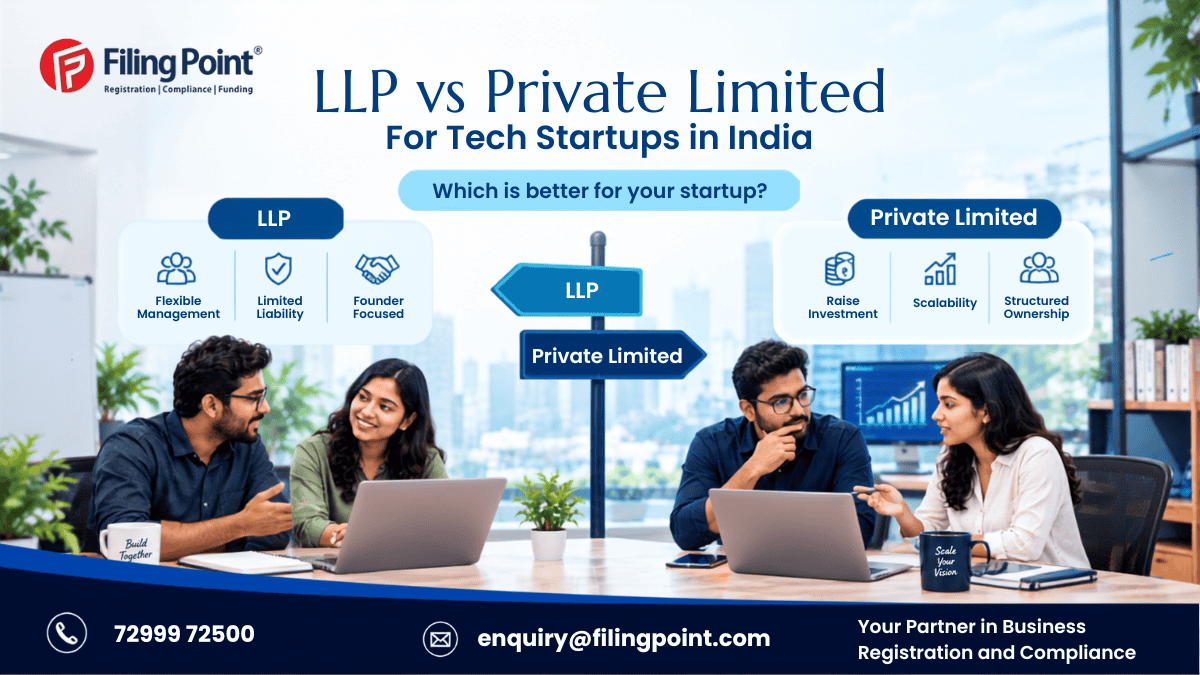
Choosing a legal structure is one of the first important decisions when starting a technology business in India.
For a two-founder SaaS business, software development company, AI startup, IT services company or technology product business, the two structures most commonly considered are a Limited Liability Partnership (LLP) and a Private Limited Company.
Both provide limited liability and can operate as independent legal entities. But they are not interchangeable.
A Private Limited Company is generally better suited to a technology startup that plans to raise equity investment, issue shares to founders or employees, build a formal ownership structure and scale aggressively. An LLP can be attractive when the founders want limited liability with comparatively flexible management and a simpler ownership arrangement.
The right choice depends on your business model and growth plans not simply on which registration is cheaper.
LLP vs Private Limited Company: Quick Answer
A Private Limited Company is usually the stronger choice for a tech startup planning to raise angel or venture capital, issue equity, create an employee stock option structure or build a business for rapid scale. An LLP can be more suitable for a founder-led technology services or consulting business where external equity funding is not a major objective.
Both Private Limited Companies and LLPs can be eligible for Startup India recognition, subject to the applicable eligibility conditions. Startup India currently recognises Private Limited Companies, registered partnership firms and LLPs, among other eligible entities.
What Is an LLP in India?
A Limited Liability Partnership (LLP) is a separate legal business structure governed by the Limited Liability Partnership Act, 2008.
It combines features of a traditional partnership with limited liability protection. The business is operated through partners, including designated partners who are responsible for statutory and regulatory matters.
For example, suppose two software developers in Chennai start a technology consulting business. They do not intend to raise venture capital and expect most of their income to come from client projects.
An LLP may provide the limited-liability structure they need without creating a share-based company structure.
An LLP is particularly worth considering for:
- Technology consulting firms
- Software development agencies
- IT service businesses
- Freelance teams becoming formal businesses
- Professional service businesses
- Bootstrapped businesses
- Businesses owned and operated primarily by their founders
However, an LLP may become less convenient if the business later wants to bring in multiple equity investors.

What Is a Private Limited Company?
A Private Limited Company is a separate legal entity incorporated under the Companies Act, 2013 and registered with the Ministry of Corporate Affairs (MCA).
Ownership is represented through shares held by shareholders, while management is handled by directors.
This structure is commonly used by technology startups because it creates a formal framework for:
- Founder shareholding
- Equity investment
- Share transfers
- Investor participation
- Employee equity arrangements
- Corporate governance
- Future fundraising
For example, consider three founders building an AI SaaS platform.
They expect to spend the first two years developing the product and then approach angel investors or venture capital funds.
For this type of business, Private Limited Company Registration is generally more suitable than LLP registration because the company already has a share-based ownership structure.
LLP vs Private Limited Company: Key Differences
| Factor | LLP | Private Limited Company |
| Governing framework | LLP Act, 2008 | Companies Act, 2013 |
| Separate legal entity | Yes | Yes |
| Liability protection | Limited, subject to law | Limited, subject to law |
| Ownership | Partnership interest/contribution | Shares |
| Management | Partners/designated partners | Directors |
| Equity fundraising | Less suitable for conventional startup equity funding | Generally better suited |
| Angel/VC investment | Can be possible depending on structure and applicable rules, but less conventional | Commonly preferred |
| Employee equity | Less straightforward | Share-based ESOP structures can be used, subject to law |
| Compliance | Generally lighter than a company, but still requires statutory filings | Generally more extensive |
| Governance | More flexible | More formal |
| Founder control | Flexible through LLP agreement | Determined through shareholding, Articles and shareholder arrangements |
| Best suited for | Bootstrapped/service-led businesses | Fundable/scalable startups |
| Startup India eligibility | Can qualify, subject to conditions | Can qualify, subject to conditions |
| Conversion considerations | May be possible depending on circumstances | May be converted/restructured subject to applicable law |
The important point is that “less compliance” does not mean “no compliance.” An LLP still has annual statutory filing requirements with MCA, while a company has a broader corporate compliance framework. MCA provides separate filing processes for companies and LLPs.
Which Is Better for a Tech Startup?
There is no universal answer.
But you can use this simple rule:
Choose a Private Limited Company if you plan to:
- Raise angel investment
- Raise venture capital
- Give equity to investors
- Create an employee stock option plan
- Have several shareholders
- Bring in strategic investors
- Build a technology product for rapid scale
- Potentially sell or transfer part of the business
- Create a formal corporate ownership structure
Consider an LLP if you plan to:
- Bootstrap the business
- Operate mainly as a technology services company
- Earn revenue from consulting or development projects
- Keep ownership among a small group of founders
- Avoid conventional equity fundraising
- Prefer comparatively flexible internal management
- Keep ongoing corporate formalities more manageable
The distinction becomes particularly important when you think beyond the first year.
A Realistic Example: Two Tech Startups, Two Different Choices
Example 1: Chennai SaaS startup
Suppose Arun and Priya develop a cloud-based HR software product in Chennai.
Their plan is:
- Build the MVP.
- Acquire 100 paying customers.
- Raise ₹1 crore from angel investors.
- Hire a product team.
- Raise a larger VC round later.
For this business, a Private Limited Company would normally be the more practical starting structure.
Why?
Because the founders can establish shareholding between themselves and subsequently issue or transfer shares subject to applicable law and documentation.
The company structure is designed around shareholders and shares, which fits the way equity-funded startups are normally structured.
Example 2: Software development business
Now consider three developers who start a software development and consulting firm.
Their plan is:
- Get clients in India and overseas
- Earn revenue from projects
- Hire 10–15 employees
- Distribute profits between the founders
- Remain privately funded
- Have no immediate plan to raise venture capital
Here, an LLP may be worth considering.
The founders may value flexibility and a comparatively lighter corporate compliance framework more than an investor-oriented equity structure.
The important lesson is:
Do not choose a Private Limited Company merely because someone says it is the “best” structure. Choose it when its ownership and fundraising model match your business plan.
Private Limited Company vs LLP for Startup Funding
This is one of the biggest differences.
Private Limited Company
A company has share capital and shareholders.
That makes it easier to design a conventional investment structure involving:
- Founder shares
- Investor shares
- Different shareholding percentages
- Future equity rounds
- Share transfers
- Employee equity arrangements, subject to applicable law
For a startup that expects multiple rounds of investment, this structure is usually easier for investors and professional advisers to work with.
LLP
An LLP does not operate through shares in the same way.
The relationship between partners is primarily governed through the LLP agreement and applicable law.
That can work very well for a closely held business.
But if your five-year plan includes multiple institutional investors and repeated equity funding rounds, you should think about the implications before registering the business.
Changing structures later can involve additional legal, tax, accounting and compliance work.
What About Startup India Recognition?
This is an important point for founders.
You do not need to form a Private Limited Company merely to become a recognised startup.
Startup India states that eligible startups can include Private Limited Companies and LLPs, subject to the applicable recognition conditions.
The current Startup India recognition framework also considers factors such as the age of the entity, turnover and whether the business is working towards innovation, development or improvement of products, processes or services, or has a scalable business model with potential for employment or wealth creation.
The current Startup India portal states that a startup can generally remain within the recognition period for up to 10 years, or 20 years for a DeepTech startup, and the turnover ceiling is currently ₹200 crore for a non-DeepTech startup and ₹300 crore for a DeepTech startup, subject to the applicable conditions.
So the decision should not be:
“LLP or Private Limited—which one gets Startup India?”
Both can potentially qualify.
The better question is:
“Which structure fits the way we intend to own, fund and operate the startup?”
What About Tax?
Tax should be considered, but it should not be the only reason for choosing the structure.
For AY 2026–27, the Income Tax Department states that a partnership firm, including an LLP, is taxable at 30%, with applicable surcharge and 4% health and education cess; AMT provisions can also apply in specified circumstances.
Private Limited Company taxation depends on the applicable tax regime and conditions. Companies may have different corporate tax options and should be assessed based on their circumstances rather than assuming a single tax rate applies to every company.
For a startup, the bigger financial question is often:
What will happen to the money generated by the business?
If profits are regularly distributed to founders, the tax and cash-flow implications may differ from a startup that retains profits and reinvests them into:
- Product development
- Employees
- Marketing
- Technology
- Research
- Expansion
Therefore, founders should compare the structure with their expected profit, salary/remuneration, reinvestment and fundraising plans rather than selecting one purely because of a headline tax rate.
What About GST?
LLP registration or Private Limited Company Registration does not automatically mean that every business must immediately obtain GST registration simply because the entity exists.
GST registration depends on the nature of supplies, turnover, applicable thresholds and specific compulsory-registration provisions.
For example, a technology company providing taxable services may need GST registration when the applicable conditions are met.
A startup should therefore treat these as separate questions:
- What legal entity should we form?
- Do we need GST registration?
- What GST compliance will apply to our business?
Do not assume that incorporation and GST registration are the same process.
The GST system is administered through the GST framework and portal, with registration and compliance requirements depending on the business’s circumstances.

PAN and TAN After Company or LLP Registration
PAN is important for the entity’s tax and financial operations.
TAN is relevant where the entity is required to deduct or collect tax at source under the applicable provisions.
For companies incorporated through the MCA’s SPICe+ process, MCA’s incorporation FAQs explain that PAN and TAN-related services are integrated into the incorporation process. The exact charges and process should always be checked against the current MCA filing system before quoting a registration package.
This is one reason founders should not treat company incorporation as simply “getting a certificate”.
There are several connected registrations and post-incorporation steps.
How Does Private Limited Company Registration Work in India?
The incorporation process is handled through the MCA’s online system.
For a typical Private Limited Company, the broad process involves:
Step 1: Decide the business structure
Determine whether Private Limited Company, LLP, OPC, partnership or proprietorship is appropriate.
Step 2: Decide founders and ownership
For a Private Limited Company, decide:
- Shareholders
- Directors
- Proposed shareholding
- Capital structure
- Business activities
Step 3: Obtain Digital Signature Certificates
Digital signatures are used for electronically signing applicable incorporation documents.
Step 4: Select and reserve the company name
The proposed name must comply with MCA naming requirements and should not conflict with existing names or trademarks.
Step 5: Prepare incorporation documents
Typical incorporation documentation can include identity and address proofs, registered-office-related documents, declarations and constitutional documents as applicable.
Step 6: File through SPICe+
MCA’s SPICe+ framework covers company name reservation and incorporation-related services.
MCA’s official FAQ explains that SPICe+ Part A is used for name reservation, while Part B covers incorporation and linked services such as DIN, PAN and TAN, with GSTIN available as an optional linked service where applicable.
Step 7: MCA review
MCA examines the submitted application. If clarification or resubmission is required, the applicant needs to respond accordingly.
Step 8: Certificate of Incorporation
Once approved, the company receives its Certificate of Incorporation and related identification details.
The actual time can vary depending on document accuracy, name availability, MCA processing and whether resubmission or clarification is required. Therefore, a fixed “X-day guarantee” should not be treated as a government rule.
How Does LLP Registration Work?
LLP registration also takes place through the MCA system.
Broadly, founders need to:
- Decide the proposed LLP name.
- Identify partners and designated partners.
- Arrange required digital signatures and identification requirements.
- Prepare registered-office and partner documents.
- Apply for name reservation where applicable.
- File the LLP incorporation application.
- Receive the LLP incorporation/registration approval.
- Execute and file the LLP agreement within the applicable framework.
- Complete tax and other registrations relevant to the business.
After registration, an LLP also has continuing MCA compliance.
For example, MCA provides Form 8 for the Statement of Account and Solvency and Form 11 for the LLP’s annual return.
How Much Does Company Registration Cost in India?
There is no single government fee that applies to every startup.
The cost can depend on:
- Business structure
- State
- Authorised share capital for a company
- Contribution for an LLP
- Stamp duty
- Number of partners/directors
- Documentation
- Professional assistance
- Additional registrations
- Optional services
For companies incorporated through SPICe+, MCA’s published FAQ states that filing fees depend on authorised share capital and that stamp duty varies by state. It also describes a “zero filing fee” concession for companies incorporated through SPICe+ with authorised capital up to ₹15 lakh, while applicable state stamp duty remains payable.
That means an online advertisement saying:
“Company registration ₹999”
does not necessarily tell you what the founder will actually pay.
Before comparing service providers, ask for a clear breakup of:
| Cost component | What to check |
| MCA filing fee | Based on applicable structure/capital |
| Stamp duty | State-specific |
| DSC | Whether included |
| PAN/TAN | Whether included in quoted package |
| Professional fee | Separate or included |
| GST registration | Included or additional |
| Annual compliance | Separate recurring cost |
| Other registrations | Check based on business requirement |
The initial registration cost is only one part of the decision. Annual compliance cost can matter much more over five years.
LLP vs Private Limited: Compliance Difference
This is often overlooked by new founders.
Private Limited Company
A company generally has more formal corporate compliance requirements.
These can include:
- Maintenance of statutory records
- Board-related requirements
- Financial statements
- Annual return
- Income-tax compliance
- TDS compliance where applicable
- GST compliance where applicable
- Audit requirements where applicable
- Event-based MCA filings when changes occur
MCA’s filing system includes forms such as AOC-4 for financial statements and MGT-7/MGT-7A for applicable annual returns.
LLP
An LLP generally has a comparatively simpler internal governance structure, but it is still required to maintain statutory compliance.
Typical recurring filings include:
- Annual Return
- Statement of Account and Solvency
- Income-tax return
- TDS compliance where applicable
- GST compliance where applicable
- Event-based filings for applicable changes
MCA’s Form 8 instructions specifically relate to the Statement of Account and Solvency, demonstrating that LLPs also have formal annual reporting obligations.
So the real comparison is:
LLP = generally lighter corporate compliance
versus
Private Limited = more formal corporate governance and reporting
—not:
LLP = no compliance.
Other Business Structures You Could Consider
Before choosing LLP registration or Private Limited Company Registration, founders should also understand the alternatives.
| Structure | Suitable for | Funding | Compliance level |
| Private Limited Company | Scalable startups | Strong fit for equity funding | Higher |
| LLP | Bootstrapped/service businesses | Less conventional for VC equity | Moderate |
| OPC | Single-founder business | Limited compared with investor-focused company structure | Moderate |
| Partnership Firm | Small founder groups | Limited suitability for startup equity funding | Relatively lower |
| Sole Proprietorship | Individual/small business | Not designed for institutional equity funding | Lower |
A sole proprietorship is particularly different because the business does not have the same separate-entity structure as a company or LLP.
For a technology startup with ambitions to raise institutional capital, it is usually worth discussing the long-term ownership model before registering.
What About MSME/Udyam Registration?
Your legal entity and your MSME/Udyam status are separate matters.
A Private Limited Company or LLP may potentially qualify for Udyam registration if it satisfies the applicable MSME classification and registration requirements.
Do not confuse:
Company Registration
with:
or:
They serve different purposes.
A startup may have:
- MCA incorporation
- PAN
- GST registration, where applicable
- Udyam registration, where eligible
- DPIIT Startup recognition, where eligible
- Trademark registration
These are not automatically the same registration.
Tamil Nadu Tech Startups: Does Location Change the Choice?
The fundamental choice between LLP and Private Limited Company is governed primarily by India’s central legal framework.
However, Tamil Nadu startups may also need to consider the state’s startup ecosystem and schemes.
Startup India’s Tamil Nadu policy information recognises Private Limited Companies, registered partnership firms and LLPs as possible eligible forms for the relevant state startup policy, subject to the policy’s conditions.
Therefore, a Chennai founder should not choose LLP simply because the business is in Tamil Nadu, or choose Private Limited merely because it is a “startup”.
The better approach is:
Choose the legal structure first based on ownership, funding and business model, then examine the central and Tamil Nadu schemes for which the business may qualify.
Common Mistakes Founders Make
1. Choosing based only on registration price
Saving a few thousand rupees during incorporation may not matter if the structure becomes inconvenient when you raise funding.
2. Assuming every startup needs a Private Limited Company
Not every technology business is a VC-funded startup.
A profitable software consulting company may be perfectly comfortable as an LLP.
3. Assuming LLP cannot be a startup
This is incorrect.
Eligible LLPs can apply for Startup India recognition subject to the applicable criteria.
4. Ignoring future investors
If you expect to approach investors within 12–24 months, discuss the ownership structure before incorporation.
5. Looking only at incorporation cost
The recurring compliance and professional costs can become more important than the initial registration expense.
6. Treating GST as part of incorporation
GST registration is a separate tax registration. Whether it is required depends on the business and applicable GST provisions.
7. Ignoring founder agreements
Registration alone does not solve founder disputes.
Founders should consider documenting:
- Ownership
- Roles
- Decision-making
- Intellectual property
- Exit arrangements
- Founder departure
- Confidentiality
- Investment rights
A technology startup should also pay attention to ownership of source code, product IP, domain names, designs and other intellectual property.
A Practical Decision Checklist
Before choosing LLP registration or Private Limited Company Registration, answer these 10 questions:
Choose Private Limited if most answers are “Yes”
- Do we want angel or VC funding?
- Will outside investors receive equity?
- Do we expect multiple funding rounds?
- Will we create an employee equity programme?
- Do we want a formal shareholding structure?
- Are there several founders?
- Do we expect strategic investors?
- Are we building a scalable technology product?
- Could we eventually sell part or all of the business?
- Are we comfortable with greater corporate compliance?
Consider LLP if most answers are “Yes”
- Are we bootstrapping?
- Is the business primarily service-based?
- Will the founders remain closely involved?
- Do we have no immediate VC funding plans?
- Do we want a flexible partner-based structure?
- Is profit distribution between founders more important than equity fundraising?
- Do we want comparatively lighter corporate formalities?
This is not a substitute for professional legal or tax advice, but it is a useful first filter.
Frequently Asked Questions
1. Which is better for a tech startup: LLP or Private Limited?
A Private Limited Company is generally more suitable when a tech startup expects external equity funding, multiple shareholders, employee equity or rapid scaling. An LLP can be a good fit for bootstrapped technology services and consulting businesses.
2. Is LLP registration cheaper than Private Limited Company Registration?
Not necessarily in every case. Government fees, stamp duty, contribution/share capital and professional fees vary. More importantly, founders should compare ongoing compliance costs rather than only incorporation costs.
3. Can an LLP get Startup India recognition?
Yes. Eligible LLPs can apply for Startup India recognition, subject to the applicable eligibility requirements.
4. Can a Private Limited Company get Startup India recognition?
Yes. A Private Limited Company can apply for DPIIT Startup recognition if it satisfies the applicable conditions.
5. Can an LLP raise investment?
An LLP can bring in additional partners or restructure partner interests subject to the LLP agreement and applicable laws. However, conventional angel and venture-capital equity investment is generally structured more naturally through a company with shares.
6. How long does company registration take in India?
There is no single guaranteed government timeline applicable to every incorporation. Processing depends on name approval, documentation, filing accuracy, MCA processing and whether clarification or resubmission is required.
7. Do I need GST immediately after registering a company?
Not necessarily. GST registration depends on the nature of the business, turnover and other compulsory-registration provisions. Incorporation and GST registration are separate matters.
8. Is an LLP suitable for a SaaS startup?
It can be, particularly for a bootstrapped or founder-funded SaaS business. If the SaaS startup expects substantial equity funding, investor participation or employee equity, a Private Limited structure may be more appropriate.
9. Can I convert an LLP into a Private Limited Company later?
There are legal routes for restructuring/conversion in certain circumstances, but the process, tax implications and eligibility should be evaluated before assuming that conversion will be simple or cost-free.
10. Do LLPs have annual compliance?
Yes. LLPs have continuing statutory filing obligations. MCA provides annual filing mechanisms including Form 11 and Form 8.
11. Do Private Limited Companies have more compliance than LLPs?
Generally, yes. A Private Limited Company has a more formal corporate governance framework and additional filing and record-keeping requirements.
12. Should a two-founder technology startup choose an LLP?
It depends on the business plan. If the founders are building a bootstrapped service business, LLP may work well. If they intend to raise equity investment and build a scalable product company, Private Limited is usually the more practical starting point.
Final Verdict: LLP or Private Limited?
For most funding-oriented technology startups in India, a Private Limited Company is usually the better long-term structure.
For a bootstrapped technology services, consulting or closely held business, an LLP can be a sensible alternative.
The decision should come down to four things:
Funding + ownership + compliance + growth plans.
Do not choose a structure only because the registration price is lower.
If your business is still at the idea stage, spend some time deciding how the founders will own the business and where you expect the company to be in three to five years. Changing the structure later can involve additional professional, legal, tax and compliance work.
If you want to register your company in India, FilingPoint can help you complete the incorporation process and understand the registrations and compliance requirements relevant to your business.