
Choosing a legal structure is an important decision when starting a business. A sole proprietor may begin with a small consultancy, a partnership may start with two founders, or a startup may register as a Limited Liability Partnership (LLP) because it suits the initial business model.
But a business does not remain the same forever.
A small enterprise may start hiring employees, take on larger clients, seek outside investment or expand into new locations. The founders may then discover that their existing structure no longer suits their plans. A private limited company may also decide that an LLP better fits its ownership and operating model, subject to the applicable legal and tax conditions.
This leads to a common question: Can you change your business structure after registration, or must you start again?
The answer depends on the legal form you currently have, the form you want to adopt and the route permitted by law. It is not safe to assume that every business can simply “convert” by filing one form with the Ministry of Corporate Affairs (MCA).
This guide explains the main routes available in India, the checks to complete before conversion, and the registrations and records that may need attention afterwards.
What does changing a business structure mean?
Changing a business structure means moving from one legal form of business to another. Examples include:
- A sole proprietorship moving its business into a private limited company.
- A partnership firm converting into an LLP.
- An LLP registering as a company under the applicable legal route.
- A One Person Company (OPC) becoming a private limited company.
- A private limited company converting into an LLP, where eligible.
- A private limited company converting into a public company.
These changes are different from changing a company’s name, registered office, directors, shareholders or business activities. Those actions may require their own approvals and filings, but they do not necessarily change the legal form of the entity.
For example, a private limited company can update its permitted business activities where legally appropriate without becoming an LLP. Likewise, changing a proprietorship’s trade name does not create a separate incorporated entity.
The first step is therefore to identify the change you actually need.
Why might a business want to change its structure?
There is no single reason for restructuring. Common triggers include the following.
Bringing in investors
A startup may want to issue shares, create an employee stock option plan or prepare for an equity investment. A private limited company is often considered for these goals, although the correct structure depends on the investor, business model and applicable rules.
Managing liability
A proprietor and the business are not separate legal persons in the same way as a company. An LLP or company may offer a separate legal identity and limited liability, subject to statutory exceptions and the facts of the case.
Reducing or changing compliance responsibilities
A founder may find that a company’s governance and filing obligations no longer match the scale or operating needs of the business. An LLP may be worth evaluating, but it is not automatically cheaper or simpler in every situation. Conversion itself may involve professional fees, filings, tax analysis and changes to registrations.
Adding co-founders or changing ownership
A sole proprietor may wish to formalise ownership with another founder. A partnership may want to introduce more structured governance, while an established company may consider a different ownership or capital arrangement.
Preparing for expansion
Larger customers, lenders, tenders, licences or business partners may have preferences or eligibility requirements relating to the supplier’s legal form. Confirm the actual requirement rather than restructuring based on assumptions.
Practical point: Changing a structure should solve a defined business problem. Do not convert only because another structure is popular or because someone claims it guarantees lower tax or fewer compliance obligations.
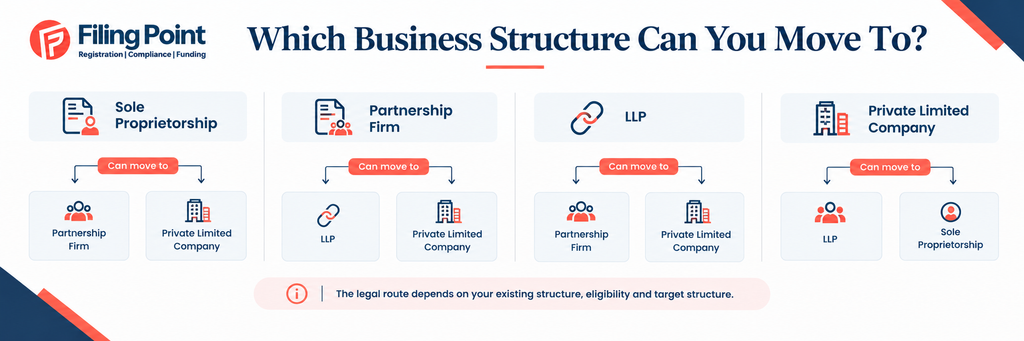
Which business structures can be changed?
The table below is a starting guide, not a determination that every business is eligible.
| Existing structure | Possible target structure | General route |
| Sole proprietorship | Private limited company | Usually incorporate a new company and transfer the business |
| Sole proprietorship | LLP | Usually form an LLP and transfer the business |
| Partnership firm | LLP | Statutory conversion route may be available if conditions are met |
| Partnership firm | Company | Registration under the applicable Companies Act route may be available |
| LLP | Private limited company | Registration under the Companies Act route may be available, subject to requirements |
| OPC | Private limited company | Company conversion process under applicable company law |
| Private limited company | Public limited company | Company-class conversion under the Companies Act |
| Private limited company | LLP | Statutory conversion route may be available if the conditions are met |
| Private limited company | OPC | Possible only if current legal requirements and eligibility conditions are satisfied |
The legal route, approvals, forms and consequences differ. Confirm the latest MCA requirements before starting the transaction.
Conversion is not always the same as creating a new business
This is one of the most important distinctions in business restructuring.
When a statutory conversion route exists
Certain types of firms and entities can register or convert into another form under a specific legal provision. For example, the Companies Act, 2013 provides for conversion of companies already registered under the Act into another class of company, subject to the applicable requirements. Section 366 and the Companies (Authorised to Register) Rules, 2014 provide a route for specified entities, including LLPs and partnership firms, to register as companies. The LLP Act also provides conversion routes for specified entities.
The correct route depends on the existing entity and target structure. Relevant provisions include Section 18 and Section 366 of the Companies Act, 2013, and the applicable schedules of the Limited Liability Partnership Act, 2008.
When a new entity must be formed
A sole proprietorship is not a company registered under the Companies Act. It generally cannot be transformed into a private limited company by simply changing its registration type. Instead, the proprietor incorporates a company and transfers the business or relevant assets, contracts and operations to it under an appropriately structured transaction.
That transfer needs careful planning. It may involve agreements, consent from counterparties, asset-transfer documentation, employee arrangements, tax analysis and fresh or amended registrations.
Why the distinction matters
The two approaches can have different effects on:
- The identity of the legal entity.
- Existing debts and obligations.
- Ownership of assets and intellectual property.
- Customer and supplier contracts.
- Bank accounts and borrowing arrangements.
- Tax treatment and potential tax costs.
- Licences, permits and registrations.
- Business continuity and documentary evidence.
Do not assume that every licence, tax registration, contract or bank account automatically continues unchanged. Check each one separately.
How to choose the right conversion route
Before selecting forms or preparing documents, answer these questions.
Step 1: Identify the current legal structure
Check the actual registration documents. A business using a trade name may still be a proprietorship. An LLP has an LLP identification number (LLPIN), while a company has a Corporate Identity Number (CIN). A partnership firm may have a partnership deed and, where applicable, registration with the relevant state authority.
Do not base the decision solely on the business name, GST certificate or Udyam registration.
Step 2: Define the target structure
Decide whether the goal is to become a private limited company, LLP, public company or another permitted form. The reason matters. A funding requirement, liability concern and desire to reduce administrative work may lead to different conclusions.
Step 3: Check statutory eligibility
Review the conditions applying to the specific conversion. Depending on the route, these may concern ownership, consent of partners or shareholders, creditors, security interests, company filings, capital, constitutional documents or other statutory conditions.
For example, an LLP-to-company registration route under Section 366 is not the same as a private-company-to-LLP conversion under the LLP Act. Do not use a generic “conversion checklist” for both.
Step 4: Review pending compliance
Before proceeding, check whether returns, financial statements, annual filings, tax returns, statutory registers or other obligations are outstanding. A conversion plan should include a method for addressing defaults and determining which obligations remain due.
The exact requirements depend on the entity and transaction. Review the MCA record and relevant tax records instead of assuming that conversion automatically resolves past non-compliance.
Step 5: Review tax implications before transferring assets
Identify the business assets, stock, receivables, liabilities, goodwill, intellectual property and capital balances. Ask a tax professional to assess the proposed transfer and the applicable conditions.
Some transactions may qualify for specific tax treatment if statutory conditions are met. That treatment should never be assumed merely because the parties call the transaction a “conversion”. The Income Tax Department’s guidance on Section 47 describes conditions for certain forms of business succession and company-to-LLP conversion. https://www.incometaxindia.gov.in/w/capital-gain
Step 6: Map contracts and registrations
Prepare a list of every registration, licence, contract, bank facility and online account linked to the existing entity. Identify whether it must be transferred, amended, surrendered or obtained afresh.
Step 7: Prepare a written implementation plan
Set out the approvals, filings, transaction documents, responsible people and dependencies. A conversion should not be treated as complete merely because a new certificate has been issued.

What happens to GST, PAN, bank accounts and other registrations?
This is a major area of risk because business owners sometimes focus on the MCA filing and overlook operational continuity.
PAN and income-tax records
A new legal entity may require its own PAN and tax registrations. Whether a PAN changes or a new one is required depends on the legal route and whether the same legal person continues. A proprietorship-to-company transfer, for example, should not be treated as though the proprietor and company were the same taxpayer.
Review income-tax filings, tax credits, advance tax, TDS/TCS obligations, books of account and any tax attributes before the transition.
GST registration
GST treatment depends on the legal structure, the transaction and applicable GST rules. A transfer of a business as a going concern, a transfer of assets, or a change in the person carrying on the business can have different implications. The old registration should not simply be reused for a different legal person without checking the applicable requirements.
Plan for outstanding returns, input tax credit, stock, invoices, customer advances, tax liabilities and the effective date of the transition. Confirm whether a new registration, amendment, transfer of eligible credit or cancellation process applies in the specific case.
Bank accounts and loans
Banks may require updated incorporation documents, KYC, board or partner resolutions, fresh mandates and changes to account ownership. Existing loans, guarantees, security interests and working-capital facilities may require lender consent or revised documentation.
Never assume that a bank account or loan automatically moves to the new structure.

Udyam/MSME registration
Review the Udyam registration details after restructuring. The correct action depends on the nature of the change and the portal’s current requirements. Do not assume that the old registration automatically reflects a new legal entity or ownership structure.
Licences, contracts and intellectual property
Review trade licences, professional or sector-specific approvals, lease agreements, vendor contracts, customer contracts, trademarks, domain names, software licences and insurance policies. Some may need amendments, assignments, new applications or counterparty consent.
The list should be prepared before the effective date, not after the business has already moved.
Can you change a company’s business activities without changing its structure?
Yes, changing business activities is different from changing the legal structure.
A private limited company may be able to expand into a new line of business without becoming an LLP or another type of entity. However, the proposed activity must be permitted by the company’s constitutional documents and comply with applicable law. The company may need to alter its memorandum, pass the required resolutions or obtain sector-specific approvals, depending on the circumstances.
For instance, a company incorporated for software services may want to add product sales. The founders should review the objects and applicable regulatory requirements rather than assume that a full legal-structure conversion is needed.
FilingPoint lists a separate Business Nature Change service in its service menu. Use the correct process for the change you actually need.
Tax implications: what should founders review?
Tax consequences depend on the route, assets transferred, consideration, ownership and statutory conditions. There is no universal “tax-free conversion” rule covering every structure change.
Before proceeding, review:
- Whether assets are transferred to a new entity or vest under a statutory conversion.
- Whether the transaction involves a sale, slump sale, contribution or another transfer mechanism.
- Whether the relevant conditions for any claimed tax relief are satisfied.
- The treatment of inventory, receivables, fixed assets, goodwill and intellectual property.
- GST consequences of the business or asset transfer.
- Existing tax liabilities, tax credits and pending assessments.
- Whether accumulated losses or other tax attributes can continue to be used.
- Stamp duty and state-specific costs, where applicable.
The Income Tax Department’s published material on Section 47 identifies conditions relevant to certain successions of proprietary concerns and firms, as well as certain conversions of unlisted companies into LLPs. The conditions are specific and may include requirements relating to assets, liabilities, ownership, consideration, turnover or continuing ownership.
Do not make a tax decision from a blog checklist alone. Ask a qualified tax professional to assess the exact transaction and applicable law as of the proposed effective date.
Documents to prepare before restructuring
The final document list will depend on the legal route, but the initial review often includes:
- Certificate of incorporation, partnership deed or existing registration records.
- Memorandum and Articles of Association, LLP agreement or other constitutional documents.
- PAN, GST registration and Udyam details.
- Latest financial statements and relevant tax returns.
- List of assets, liabilities, receivables and stock.
- Details of loans, charges, guarantees and security interests.
- Partner or shareholder details and ownership percentages.
- Board, shareholder or partner approvals, as applicable.
- Major customer, supplier, employment and lease agreements.
- Intellectual-property records and licences.
- Details of pending litigation, notices, assessments or statutory defaults.
- Proposed transfer or conversion documents and a transition plan.
These are review categories, not a universal mandatory list. Use the applicable MCA form instructions and professional advice to confirm what must be filed.
Common mistakes to avoid
Assuming all structures can be converted directly
They cannot. A sole proprietorship, partnership firm, LLP and company have different legal characteristics. First confirm whether a statutory route exists.
Treating incorporation as the end of the process
A new certificate does not resolve every contract, tax registration, bank mandate or licence. The transition must be managed across the business.
Ignoring tax until after the transfer
A transaction that appears simple from a registration perspective may have significant tax or stamp-duty consequences. Assess these before signing documents or transferring assets.
Overlooking creditor and lender rights
Loans, charges, guarantees and contractual restrictions can affect the available route. Obtain appropriate advice and consent where required.
Forgetting pending compliance
Outstanding filings and defaults may affect eligibility, timing or risk. Identify them early.
Assuming GST or Udyam details automatically update
Confirm the applicable steps for each registration. Keep the effective date, invoices, records and entity details consistent.
Choosing a structure only to reduce compliance
An LLP may be suitable for one business and unsuitable for another. Consider funding, ownership, liability, tax, contracts and long-term plans together.
Example: a growing consultancy considers incorporation
Suppose two founders operate a consultancy as a partnership. They begin working with larger corporate clients and plan to introduce an investor. They are considering a private limited company.
The right first step is not to submit a conversion form immediately. They should confirm how the partnership is registered, whether the proposed company route is available, what happens to the existing partnership’s assets and contracts, and whether all partners agree to the proposed arrangement.
They should also review the tax treatment of transferring the business, decide how ownership will be reflected in the new company, and identify which customer contracts, bank facilities, registrations and licences require action.
If the partnership cannot or should not use the intended statutory route, a new company and a documented business transfer may be considered. The precise approach must be selected after legal and tax review.
This example illustrates the central principle: the business goal determines the target structure, but the existing entity and applicable law determine the route.
A practical checklist before changing your business structure
Before proceeding, make sure you can answer the following:
- What is the existing legal structure?
- What target structure do we need, and why?
- Is a statutory conversion route available?
- What eligibility conditions and approvals apply?
- Are statutory and tax filings up to date?
- Have we reviewed assets, liabilities, contracts and creditor rights?
- Have we obtained a tax assessment of the proposed transaction?
- What will happen to PAN, GST, TDS, Udyam and other registrations?
- Have we checked bank accounts, loans, licences and intellectual property?
- Who will manage the transition and verify completion?
Frequently asked questions
1. Can I change my business structure after registration in India?
Often, yes. The available route depends on the existing structure and the target structure. Some changes have a statutory conversion route; others require forming a new entity and transferring the business.
2. Can a sole proprietorship be converted into a private limited company?
A proprietorship generally does not become a company through a direct change of registration type. The usual approach is to incorporate a new company and transfer the business through an appropriately documented arrangement.
3. Can an LLP become a private limited company?
A route may be available under Section 366 of the Companies Act, 2013 and the applicable rules. Eligibility, documents and the current MCA process should be verified before filing.
4. Can a private limited company become an LLP?
A statutory route exists under the LLP Act, subject to applicable eligibility and procedural requirements. Tax treatment must be assessed separately; not every transaction automatically qualifies for tax relief.
5. Can a partnership firm become an LLP?
A partnership firm may be eligible for conversion under the LLP Act if the prescribed conditions are met. The partners should verify the statutory requirements and the current filing process.
6. Will the business keep the same PAN after conversion?
Do not assume that it will. The answer depends on whether the legal person continues or a new entity is formed. Review the tax and registration consequences for the specific route.
7. What happens to GST registration when the structure changes?
The GST action depends on the transaction and the legal identity of the business after the change. Review registration, returns, tax liabilities, eligible credit and invoices before implementation.
8. Does conversion automatically transfer contracts and licences?
Not necessarily. Check each contract, licence and approval. Assignment, amendment, consent or a fresh application may be required.
9. Is changing business structure always tax-free?
No. Any relief depends on the specific legal provision and whether all applicable conditions are met. Obtain a transaction-specific tax assessment.
10. Should I change my business structure just to reduce compliance?
Not without comparing the full implications. Consider liability, ownership, fundraising, tax, contracts, administrative costs and the future direction of the business.
Conclusion
Changing your business structure after registration can be a sensible step when your business goals evolve. But it is not a one-size-fits-all process. A direct statutory conversion, registration as a company, or a new entity with a business transfer may be appropriate in different circumstances.
The safest approach is to identify your current legal structure, confirm the available legal route, assess tax and contractual implications, and prepare a coordinated plan for statutory filings and operational registrations.
Need help with company registration or compliance? FilingPoint can help you understand the applicable process for your business.
- Phone: +91 72999 72500
- Email: info@filingpoint.com