
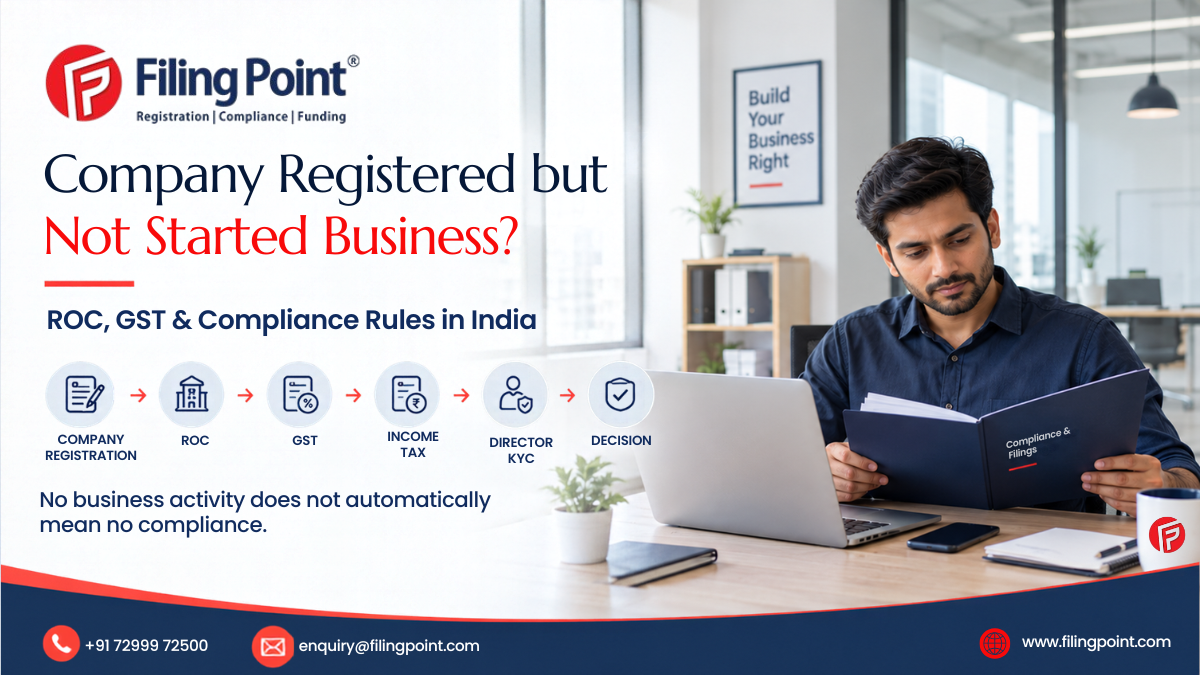
Registered a company but haven’t started the business yet? You may still have compliance obligations even if your company has earned ₹0 revenue.
Many founders incorporate a Private Limited Company before they are ready to start actual business operations. They may still be developing their product, looking for funding, finalising their premises, hiring employees or waiting for the right time to launch.
During this period, it is easy to assume that there is nothing to comply with because the company has no customers and no sales.
That assumption can create problems.
A company can have zero revenue and still have ROC, accounting, income-tax, GST or director-related obligations, depending on its registrations, transactions and circumstances.
For example, a company with no sales but an active GST registration may have a different compliance position from a company that has not obtained GST registration. Similarly, a company with no revenue but with professional fees, bank charges or other expenses still has financial transactions that need to be considered.
So, the better question is not:
“Did my company make any money?”
Instead, founders should ask:
- Is the company still active?
- Has the business actually started?
- Does the company have GST registration?
- Has it incurred any expenses?
- Has it received or issued any invoices?
- Has shareholder capital been introduced?
- Do the directors have applicable KYC obligations?
- Is the registered office still valid?
- Have applicable ROC filings been completed?
- Does the company still need to exist?
This guide explains what founders should review when a newly incorporated company has zero revenue or has not yet started business.
Does Zero Revenue Mean Zero Compliance?
No.
This is one of the most important distinctions for a newly incorporated company.
Consider two companies.
Company A
- Incorporated in April
- No sales
- No employees
- No GST registration
- No bank transactions except incorporation-related expenses
Company B
- Incorporated in April
- No sales
- GST registration obtained
- Company bank account active
- Director expenses paid through the company account
- Professional fees incurred
Both companies have zero revenue, but their compliance position may not be identical.
Company B has an active GST registration and financial transactions that need to be considered. Company A may have a different set of obligations.
Therefore, founders should not use revenue alone to determine whether compliance is required.
The company’s registrations, transactions, legal status and activities all matter.
Does ROC Compliance Continue If the Company Has No Business?
Zero revenue does not automatically eliminate applicable corporate compliance.
A registered company may still have obligations relating to its books of account, financial statements, annual filings, director-related requirements and other applicable MCA filings.
The exact requirements depend on the company’s structure, status and circumstances.
This means:
₹0 sales does not necessarily mean ₹0 ROC compliance.
Depending on the company, continuing compliance may involve:
- Books of account
- Financial statements
- Auditor-related requirements, where applicable
- Annual return
- Applicable MCA forms
- Director-related filings
- Registered-office records
- Other event-based filings
The absence of customers or sales does not automatically remove these obligations.
Why this matters for a newly incorporated company
A founder may incorporate a company in April and plan to launch in October.
During those six months, the company may have no customers or revenue.
However, the company still exists as a legal entity during that period.
It is therefore important to review its applicable corporate obligations rather than waiting until the business launch.
What If the Company Has No Transactions at All?
The phrase “no transactions” can mean different things.
Situation 1: No operational activity
There are no customers, sales, purchases or business expenses.
Situation 2: No revenue but expenses exist
The company may have paid:
- Accounting fees
- Bank charges
- Professional fees
- Software subscriptions
- Office rent
- Other business expenses
Situation 3: Shareholder money was introduced
A founder may have deposited money into the company’s bank account or paid expenses on behalf of the company.
Situation 4: GST registration is active
The company may have no sales but still have applicable GST return obligations.
Situation 5: The company has been abandoned
The founders may have decided that they no longer want to pursue the business.
These situations should not automatically be treated as the same.
Before deciding that a company has “no activity”, review what actually happened after incorporation.
Why Accounting Records Still Matter
“No revenue” does not necessarily mean “nothing to record”.
Even a company that has not started operations may have financial entries such as:
- Bank charges
- Incorporation-related expenses
- Professional fees
- Shareholder funds
- Assets purchased
- Liabilities
- Statutory payments
- Software subscriptions
- Other business expenses
These transactions may need to be appropriately reflected in the company’s books and financial statements.
This is why it is better to maintain accounting records from the date of incorporation instead of waiting until the company starts generating revenue.
Example
Suppose a company has no sales for six months but spends:
- ₹15,000 on professional services
- ₹3,000 on software
- ₹2,000 on bank charges
The company’s revenue is still ₹0.
However, it has had financial activity.
That distinction becomes important when preparing the company’s accounts and reviewing its tax and corporate compliance.
Does a Company With No Income Need to File an Income-Tax Return?
Do not assume that no income means no income-tax compliance.
A company’s income-tax obligations need to be assessed based on the applicable tax framework and its actual circumstances.
A company may have:
- No sales
- No profit
- Expenses only
- Share capital
- Bank interest
- Preliminary expenses
- Other financial entries
Therefore:
No profit does not automatically mean no income-tax compliance.
The applicable return and reporting position should be determined based on the company’s records and the tax framework applicable to the relevant period.
For a newly incorporated company, it is therefore important to distinguish between:
No revenue
No taxable income
No tax compliance
These are not necessarily the same thing.
Important Income-Tax Update for 2026
There is an important tax-framework transition in 2026.
The Income Tax Act, 2025 came into effect from 1 April 2026.
This means companies need to identify the correct tax framework and relevant tax year when reviewing their obligations.
For example, income relating to FY 2025–26 is dealt with under the earlier framework for AY 2026–27, while Tax Year 2026–27 falls under the new Income Tax Act, 2025.
For a company that has not started business, this distinction is still relevant.
The company should review:
- The relevant financial/tax year
- Whether any income was received
- Whether expenses were incurred
- Whether other financial transactions occurred
- The applicable return requirements
The fact that the company has not started commercial operations does not, by itself, answer all of these questions.
What If the Company Has GST Registration but No Sales?
This is another common issue for newly incorporated businesses.
Suppose you registered your company and obtained GST registration because you expected to begin business.
The launch is then delayed.
There are:
- No sales
- No taxable supplies
- No tax collected
- No business activity
Does GST compliance automatically stop?
No.
If the GST registration remains active and the taxpayer is required to file the applicable returns, the absence of transactions may mean that nil returns need to be filed rather than filing nothing.
So:
No sales does not automatically mean no GST return.
The specific GST filing obligations depend on the taxpayer’s registration and applicable filing category.
This is why an inactive business with an active GST registration should periodically review its GST compliance rather than simply stop filing because there are no invoices.

Should You Keep the GST Registration?
There is no single answer for every inactive company.
It depends largely on what you intend to do with the business.
If the business will start soon
You may decide to retain the GST registration and continue the applicable GST compliance.
If the launch has been postponed
Review whether retaining the registration is appropriate based on your expected business plans.
If the business has been permanently discontinued
You can assess whether GST cancellation is appropriate.
The important distinction is:
GST cancellation is not the same as company closure.
Cancelling the GST registration does not automatically dissolve the company.
Company Registration and GST Registration Are Separate
This distinction is particularly important for first-time founders.
A founder may think:
“I cancelled my GST registration, so my company is closed.”
That is not correct.
Company incorporation and GST registration are separate legal and regulatory matters.
| Area | What it relates to |
| Company incorporation | Creation of the corporate entity |
| ROC compliance | Corporate-law filings and obligations |
| Income tax | Direct-tax compliance |
| GST | Indirect-tax registration and returns |
| Udyam | MSME registration |
| Trademark | Brand protection |
| Company closure | Formal exit from the corporate register |
Cancelling one registration does not automatically cancel the others.
If the company itself is no longer required, its corporate status needs to be addressed separately.
What Is a Dormant Company?
A company that is not currently carrying on business may potentially consider dormant company status, provided it satisfies the applicable legal conditions.
The Companies Act provides a framework for dormant companies, including companies formed for a future project or to hold an asset or intellectual property and meeting the applicable conditions.
However:
An inactive company does not automatically become a dormant company.
Dormant status is a formal statutory status.
An eligible company needs to follow the prescribed process and meet the applicable conditions.
This can be useful to consider where founders want to preserve a company for a future project rather than immediately close it.
Dormant Is Not the Same as Abandoned
These terms are sometimes used interchangeably, but they describe different situations.
Dormant
The company has formally obtained dormant status under the applicable legal framework.
Inactive
The company has little or no business activity, but that does not necessarily mean it has formal dormant status.
Non-compliant
The company has failed to complete applicable statutory obligations.
Closed
The company has gone through an appropriate legal closure or strike-off process.
These are different situations.
Simply stopping business activity does not automatically convert a company into a dormant company or close it.
What About Udyam Registration?
Udyam registration is separate from company incorporation.
A company should not assume:
“I registered my company, so I am automatically an MSME.”
Udyam eligibility depends on the applicable MSME classification criteria and the enterprise’s relevant information.
For a newly incorporated company that has not started business, the practical question is whether it meets the applicable conditions for Udyam registration and whether registration is relevant to its business.
Udyam registration also does not replace:
- Company incorporation
- ROC compliance
- GST compliance
- Income-tax compliance
- Company closure procedures
Each registration serves a different purpose.

What Happens to the Registered Office?
Even if the company has no customers, it still has a registered office.
The registered office remains important because statutory communications and company records are connected with the company’s registered details.
If the company moves to another address, the applicable MCA process should be followed.
If the company operates from a rented premises, founders should also ensure that the relevant address documentation remains valid.
An inactive company should not assume that its registered office is irrelevant simply because the business has not started.
Does Director KYC Still Apply?
Another common misconception is:
“There is no business, so the directors don’t need to do anything.”
Director-related MCA compliance can continue even when the company has little or no business activity.
Where applicable, directors holding DIN need to comply with prescribed KYC requirements.
Therefore, an inactive or pre-launch company should review:
- DIN status
- Director KYC
- DSC validity
- Changes in director details
- Other applicable director-related requirements
Company inactivity does not automatically remove director-level compliance.
What About INC-20A?
For applicable companies, the declaration of commencement of business is a separate post-incorporation requirement.
This is important because:
Incorporation and commencement of business are not necessarily the same compliance event.
A founder may receive a Certificate of Incorporation and still have post-incorporation requirements to consider.
If the company is subject to the applicable commencement-of-business provisions, the founders should check the relevant requirement rather than assuming that incorporation itself completes every post-incorporation compliance step.
When Should You Consider Closing the Company?
Sometimes a business idea never gets launched.
A company may be incorporated, but after several months the founders may decide that they no longer want to pursue the business.
In that situation, simply abandoning the company is not a good substitute for assessing its formal status.
The founders can review whether the company should:
- Continue as an active company
- Consider dormant status, if eligible
- Explore formal closure or strike-off, if eligible
Before considering closure, review:
- Pending ROC filings
- Income-tax compliance
- GST status
- Outstanding liabilities
- Bank account
- Assets
- Contracts
- Employee obligations
- Shareholder matters
- Regulatory or legal matters
The appropriate route depends on the company’s actual circumstances.
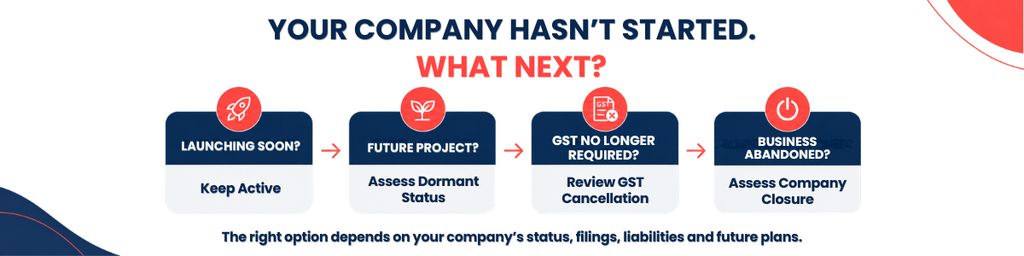
Keep the Company, Make It Dormant or Close It?
A simple framework can help founders organise the decision.
| Current situation | What to assess |
| Business launching soon | Continue the company and maintain applicable compliance |
| Business delayed but still planned | Review whether continuing as active is appropriate |
| Future project with no current operations | Assess eligibility for dormant status |
| Business permanently abandoned | Assess formal closure/strike-off |
| GST no longer required | Separately assess GST cancellation |
| Company still needed for future business or IP | Assess whether retaining the entity is appropriate |
| Compliance has already been missed | Review and regularise applicable obligations first |
There is no universal answer.
The company’s structure, compliance history, registrations, liabilities and future plans all need to be considered.
Example: Startup Incorporated Before Launch
Consider Arun and Priya.
They incorporate ABC Technologies Private Limited in April and plan to launch their SaaS product in October.
Between April and September:
- No customers
- No sales
- No taxable turnover
- ₹20,000 in software expenses
- ₹5,000 in bank charges
- Founders introduce money into the company
- Company bank account remains active
They should not simply conclude:
“We had no business, so there is nothing to file.”
Instead, they should review:
- Accounting records
- Financial statements
- Applicable ROC filings
- Income-tax requirements
- GST obligations, if registered
- Director KYC
- Registered-office compliance
- Commencement-of-business requirements, where applicable
- Whether the company should remain active for the planned launch
The company has zero revenue, but it has still had financial activity.
Example: A Business That Was Permanently Abandoned
Now consider another founder who incorporated XYZ Retail Private Limited but never launched the business.
After one year:
- No sales
- No employees
- No active contracts
- No planned launch
- No future requirement for the company
This is a different situation.
The founder should review whether the company should:
Remain active,
seek dormant status if eligible, or
explore formal closure/strike-off if eligible.
The appropriate route depends on the company’s compliance position and future plans.
The key point is that zero revenue alone does not determine the company’s next legal status.
10 Common Mistakes Founders Make
1. “No sales means no ROC filing.”
Not necessarily.
Applicable corporate compliance can continue even when revenue is zero.
2. “No GST sales means no GST return.”
If GST registration remains active and the applicable return is due, nil filing may still be required.
3. “GST cancellation closes the company.”
It does not.
GST cancellation and company closure are separate processes.
4. “An inactive company automatically becomes dormant.”
Dormant status follows a formal statutory framework.
5. “We can ignore MCA until the business launches.”
This can allow applicable compliance obligations to accumulate.
6. “No bank activity means no accounting is required.”
The company’s records should still be reviewed for all financial entries and obligations.
7. “No income means no income-tax compliance.”
The applicable tax-return position should be assessed for the relevant tax year.
8. “Udyam registration replaces company registration.”
It does not.
9. “Closing the office means closing the company.”
It does not.
10. “We will fix everything when we restart.”
Delaying compliance can make the eventual regularisation process more complicated.
Inactive Company Compliance Checklist
If your company is registered but has not started business, review these areas.
Corporate Compliance
- Certificate of Incorporation
- CIN
- MOA and AOA
- Registered-office details
- Applicable post-incorporation requirements
- INC-20A, where applicable
- Annual ROC compliance
Accounting
- Bank account
- Bank statements
- Expenses
- Shareholder funds
- Assets
- Liabilities
- Financial statements
Tax
- Income-tax return requirements
- GST registration status
- Applicable GST returns
- GST cancellation assessment, if appropriate
- TDS obligations, if applicable
Directors
- DIN status
- Director KYC
- DSC validity
- Director information
MSME
- Udyam eligibility
- Existing Udyam registration
- Required updates, where applicable
Future Status
Finally, decide whether the company should:
Continue → Consider dormant status, if eligible → Consider closure, if appropriate
What Should You Do First?
If your company is registered but has not started business, do not immediately cancel registrations or assume that nothing needs to be filed.
Start with a compliance-status review.
Step 1: Check the company’s MCA status
Confirm that the company is active and identify any pending filings.
Step 2: Review the financial records
Check whether the company has had:
- Income
- Expenses
- Bank transactions
- Capital introduced
- Assets
- Liabilities
Step 3: Check GST
Determine whether the company has an active GSTIN and identify the applicable filing requirements.
Step 4: Review income-tax obligations
Identify the relevant tax year and applicable return framework.
Step 5: Review director compliance
Check DIN, KYC and other applicable director-related requirements.
Step 6: Decide the company’s future
Ask:
“Are we actually going to use this company?”
If yes, maintain the applicable compliance.
If the business is postponed, assess whether continuing as an active company or considering dormant status is appropriate.
If the business has been permanently abandoned, assess whether formal closure is available.
Frequently Asked Questions
Does a company with zero revenue still need ROC filing?
Zero revenue does not automatically remove applicable ROC and corporate compliance obligations. The company’s structure, status and circumstances need to be considered.
Does a company with no sales need to file GST returns?
If the company has an active GST registration and the applicable return is due, nil filing may still be required.
Can I cancel the GST without closing my company?
Yes. GST cancellation and company closure are separate processes.
Does an inactive company automatically become dormant?
No. Dormant status is a formal statutory status subject to applicable eligibility and procedural requirements.
Does Director KYC apply if the company has no business?
Director-related KYC obligations can continue even when the company has little or no business activity.
Should I close a company that has never started business?
Not automatically. First review the company’s compliance position and determine whether it should remain active, qualify for dormant status or be considered for formal closure.
Is Udyam registration the same as company registration?
No. Udyam registration and company incorporation serve different purposes and have separate eligibility and compliance frameworks.
What should I check first if my company has been inactive for a year?
Start with the company’s MCA status, pending ROC filings, accounting records, GST status, income-tax position, director KYC and registered-office details. Then assess the appropriate future status of the company.
Final Takeaway
A company does not stop being a company simply because the founders have not started selling.
That is why:
Zero revenue and zero compliance are not the same thing.
For a newly incorporated or inactive company, the important areas to review are:
ROC → Accounting → Income Tax → GST → Director KYC → Registered Office → Udyam → Future Status
The key question is not simply whether the company has made money.
It is whether the company is:
- Preparing to launch
- Temporarily inactive
- Being preserved for a future project
- Or permanently abandoned
Once that is clear, the founders can determine which compliance obligations need attention and whether the company should continue, seek an appropriate dormant status or explore formal closure.
Need Help With Company Compliance?
Need help understanding your company’s compliance position after incorporation?
Filing Point can help you understand the applicable requirements for your business.
📞 +91 72999 72500
📧 enquiry@filingpoint.com
This article is for general information. Company, GST, income-tax and MCA requirements can vary depending on the company’s structure, transactions, registrations and circumstances. Verify the applicable requirements before filing, cancelling a registration or closing a company.