

Trademark registration in India is generally valid for 10 years and can be renewed every 10 years. The renewal application is filed using Form TM-R with the prescribed fee. Under the Trade Marks Rules, an application for renewal may be made up to one year before the expiry of the existing registration.
If renewal is not completed by the expiry date, the owner may still have a statutory window to apply for renewal with surcharge. If the trademark has already been removed from the Register for non-payment, restoration may be possible within the prescribed period, subject to the applicable requirements.
What Is Trademark Renewal?
Trademark renewal is the process of extending the validity of an existing registered trademark.
When a trademark is registered in India, the registration is granted for a period of 10 years. The registration can then be renewed from time to time for additional periods of 10 years.
For example, if a trademark registration is due to expire in June 2027, the proprietor should not wait until the final days to start the renewal process. The renewal can be planned in advance, allowing time to verify the registration details and complete the required filing.
Trademark renewal is different from applying for a new trademark registration.
If you already have a registered mark that you want to continue protecting, the relevant process is renewal. A fresh application may have different implications and does not simply substitute for maintaining an existing registration.
How Long Is a Trademark Registration Valid in India?
A trademark registration is generally valid for 10 years.
Section 25 of the Trade Marks Act, 1999 provides that registration is for a period of 10 years and may be renewed from time to time. Each renewal extends the registration for another 10-year period.
There is therefore no fixed lifetime limit on the number of times a trademark can be renewed.
A business may continue renewing its registered trademark as long as it remains eligible and the applicable requirements are satisfied.
Example
Suppose a business has a registered trademark with an expiry date in August 2027.
The owner can plan the renewal before August 2027 rather than waiting until the last moment.
If the renewal is completed correctly, the trademark can continue for another 10-year period.
This is why businesses should maintain a simple trademark renewal calendar for all their registered marks.
When Should You Renew a Trademark in India?
Under Rule 57 of the Trade Marks Rules, 2017, an application for renewal of trademark registration can be made not more than one year before the expiration of the last registration.
This gives trademark owners an opportunity to plan renewal well in advance.
A practical approach is to review the trademark several months before its expiry date and check:
- Trademark registration number
- Registered proprietor’s name
- Trademark class or classes
- Expiry date
- Current address and contact details
- Whether the trademark is still being used
- Whether ownership details have changed
- Whether any related applications or proceedings are pending
Early review can help identify issues before the renewal filing is made.
Which Form Is Used for Trademark Renewal?
The prescribed form for renewal of trademark registration is Form TM-R.
IP India lists TM-R for renewal of trademark registration under Section 25. The current official fee schedule also specifies the renewal fee for each class.
The application should be prepared using the details of the registered trademark and filed through the applicable Trade Marks Registry process.
It is important to distinguish renewal from other trademark forms.
For example, if the proprietor’s details have changed because of an assignment or transfer, that may involve a separate procedure. Renewal should not be treated as a way to automatically correct every change in ownership or registration details.
What Is the Trademark Renewal Fee in India?
Trademark renewal fees are prescribed under the Trade Marks Rules and the official IP India fee schedule.
As currently listed by IP India, ordinary renewal of a trademark under Section 25 is charged per class. The current e-filing fee shown for ordinary renewal is ₹9,000 per class, while physical filing is listed at ₹10,000 per class.
Additional amounts apply where renewal is filed with surcharge or where restoration is involved.
Because government fees and filing procedures can change, businesses should check the latest IP India fee schedule before making payment rather than relying on an old fee quotation.
Check IP India Forms & Official Fees
Important: Fee depends on the situation
The amount payable may differ depending on whether the application is:
- Normal renewal
- Renewal after expiry with surcharge
- Restoration and renewal after removal
The applicable fee is also relevant per class, so businesses with multiple registered classes should review each registration carefully.
What Happens If You Miss the Trademark Renewal Date?
Missing the renewal date does not necessarily mean that all options immediately disappear.
Section 25 of the Trade Marks Act provides a statutory mechanism for renewal after expiry with payment of the prescribed fee and surcharge within the specified period. The Registrar may remove the trademark from the Register if the applicable renewal conditions are not fulfilled, subject to the statutory protection available during the prescribed post-expiry period.
This is why a missed renewal should be addressed promptly.
The longer the matter remains unattended, the more complicated the position can become.
A trademark owner who discovers that a registration has expired should first verify:
- The exact expiry date.
- Whether the registration is still on the Register.
- Whether renewal can be filed with surcharge.
- Whether the mark has already been removed.
- Whether restoration provisions may apply.
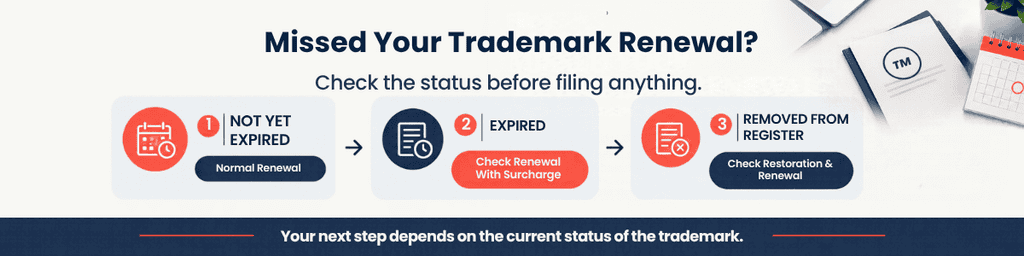
Do not assume that an expired trademark and a removed trademark are exactly the same situation.
What Is Trademark Renewal With Surcharge?
If the ordinary renewal deadline has passed, the law provides a period in which renewal may be sought with the prescribed surcharge.
Section 25(3) provides that where the prescribed fee and surcharge are paid within six months from the expiration of the last registration, the Registrar shall renew the registration in accordance with the statutory provision.
IP India’s current fee schedule separately lists an application for renewal with surcharge and specifies the additional amount payable per class.
Therefore:
Normal renewal → prescribed renewal fee
Late renewal within the applicable period → renewal fee + prescribed surcharge
The exact amount should be checked against the current official fee schedule at the time of filing.
What Happens If the Trademark Has Already Been Removed?
A trademark that has been removed from the Register for failure to pay the renewal fee may still have a route to restoration.
Section 25(4) provides for restoration where the application is made after six months and within one year from the expiration of the last registration, subject to the Registrar being satisfied that restoration is appropriate and the prescribed fee is paid.
This is different from ordinary renewal.
The owner should therefore establish the current status of the trademark before deciding what filing to make.
In simple terms
| Situation | Possible route |
| Renewal period not yet expired | Normal renewal |
| Registration expired but within statutory late-renewal period | Renewal with surcharge |
| Trademark removed from Register | Restoration and renewal may be possible, subject to the law |
| Statutory restoration period has also passed | Further legal assessment may be required |
This table is a simplified guide. The actual position should be checked against the current Register and applicable provisions.
What Is Trademark Restoration?
Trademark restoration is the process of seeking restoration of a trademark that has been removed from the Register because the renewal requirements were not completed.
It is not simply another name for late renewal.
The Trade Marks Act creates a separate mechanism for restoration after removal, while IP India’s fee schedule separately identifies an application for restoration and renewal.
This distinction matters because the appropriate filing depends on the current status of the trademark.
If a business discovers an old registered trademark that was allowed to lapse, it should first check the official trademark record instead of immediately filing a new application.
Does a Trademark Need to Be Used to Renew It?
Trademark renewal and trademark use are related to the broader protection of a mark, but renewal itself should not be understood as a substitute for actual trademark use.
The renewal provisions primarily deal with maintaining the registration by complying with the applicable renewal requirements and paying the prescribed fees.
At the same time, registered trademarks can be subject to other legal issues, including proceedings concerning non-use in appropriate circumstances.
Therefore, businesses should not think of renewal as simply paying a fee and ignoring the trademark thereafter.
If the business has stopped using the mark, changed its brand, sold the business or substantially changed its products or services, it is sensible to review the trademark portfolio before renewal.

Should You Renew a Trademark If Your Business Has Changed?
Not necessarily without first reviewing the trademark portfolio.
Businesses often change over a 10-year period.
For example:
- A company may change its legal name.
- Ownership may change.
- A brand may be assigned to another entity.
- Products or services may expand.
- Some brands may be discontinued.
- The business may start using a new logo.
- The proprietor’s address may change.
A renewal exercise is therefore a useful opportunity to check whether the trademark records still reflect the business.
However, renewal does not automatically update ownership or other registration details. Where a separate change is required, the appropriate Trade Marks Registry procedure should be considered.
Trademark Renewal vs New Trademark Registration
These two processes should not be confused.
| Trademark Renewal | New Trademark Registration |
| Applies to an existing registered trademark | Applies to a new trademark application |
| Extends the existing registration | Starts a new registration process |
| Generally every 10 years | Depends on successful registration |
| Uses TM-R for renewal | Uses the applicable registration application process |
| Maintains the existing registered mark | Seeks registration of a mark |
If your trademark is already registered and approaching expiry, renewal is generally the starting point for maintaining that registration.
If the brand has materially changed, however, the business may need to assess whether additional trademark applications or other filings are appropriate.
What Documents and Details Should You Keep Ready?
Trademark renewal is primarily an official filing process, but businesses should keep their trademark records organised.
Before filing, review:
- Trademark registration certificate/details
- Trademark registration number
- Class or classes
- Registered proprietor name
- Current address
- Expiry date
- Details of any assignment or ownership change
- Details of any pending trademark proceedings
- Authorisation details, where a representative is filing
The exact documentation required can depend on the nature of the application and the circumstances of the trademark.
Do not assume that every renewal application requires the same supporting documents.
How to Check Your Trademark Renewal Status
Before filing a renewal application, check the trademark record through the official Trade Marks Registry system.
The purpose is to establish:
- Whether the mark is registered
- Registration number
- Class
- Proprietor
- Registration date
- Expiry date
- Current status
- Relevant proceedings or correspondence
This is particularly important where a trademark was registered many years ago and the business does not have complete historical records.
A business should work from the current official trademark record, not only from an old certificate or internal spreadsheet.
Common Mistakes in Trademark Renewal
1. Waiting until the last day
Even where the law provides a renewal window, waiting creates unnecessary risk.
2. Looking only at the registration certificate
Old records may not reflect later changes or current status.
3. Confusing renewal with ownership change
Renewal does not automatically transfer a trademark to a new proprietor.
4. Ignoring multiple classes
Renewal fees are prescribed per class, so a business with multiple classes should review each applicable registration.
5. Assuming an expired mark is automatically permanently lost
The law provides specific post-expiry mechanisms, including renewal with surcharge and restoration in prescribed circumstances.
6. Treating renewal as the only trademark compliance issue
A business should also consider changes in ownership, address, use, branding and other relevant trademark matters.
7. Relying on outdated fee information
Government fees and procedures can change. Always check the current IP India fee schedule before filing.
A Practical Trademark Renewal Checklist
Before the renewal date, use this checklist:
Trademark details
- Registration number checked
- Class or classes checked
- Registered proprietor verified
- Expiry date confirmed
Business details
- Proprietor details reviewed
- Address reviewed
- Ownership changes checked
- Brand/logo changes reviewed
Renewal
- Renewal eligibility checked
- Current IP India fee verified
- TM-R prepared
- Correct class details confirmed
- Filing/payment completed
- Filing acknowledgement retained
After filing
- Application status monitored
- Renewal record checked
- Updated expiry information recorded
- Next renewal reminder created
Example: A Small Business With an Expiring Trademark
Suppose an Indian clothing business registered its brand in 2017.
The registration is approaching its 2027 expiry date.
Instead of waiting until the final month, the business checks the trademark record, confirms the proprietor and class details, reviews whether the brand is still being used and prepares the renewal application.
Because the renewal can be made within the permitted advance period, the business has an opportunity to deal with the matter before the registration expires.
Now consider another business that discovers after expiry that it never completed renewal.
The correct response is not automatically to file a new trademark application. The business should first check whether the existing registration is eligible for renewal with surcharge or, if already removed, whether restoration is available under the applicable provisions.

What Should You Do If Your Trademark Renewal Is Already Overdue?
If you have missed your trademark renewal date, take these steps:
Step 1: Check the trademark record
Confirm the current status with the Trade Marks Registry.
Step 2: Confirm the expiry date
Do not rely only on an old reminder or internal record.
Step 3: Identify the applicable route
Determine whether the matter falls under:
- Normal renewal
- Renewal with surcharge
- Restoration and renewal
Step 4: Check the current official fee
Use the latest IP India fee schedule.
Step 5: Review the trademark details
Check the proprietor, class, address and other relevant information.
Step 6: File the appropriate application
Use the applicable form and procedure based on the current status.
Step 7: Monitor the application
Keep the acknowledgement and track the application until the renewal or restoration is reflected appropriately.
Why Trademark Renewal Matters for Businesses
A trademark can become an important business asset over time.
A registered brand may be used on:
- Products
- Packaging
- Websites
- Marketing materials
- Online marketplaces
- Storefronts
- Franchise operations
- Business communications
Allowing an important trademark registration to lapse can create avoidable uncertainty around the brand’s registered protection.
For a business that has invested years in building brand recognition, trademark renewal should therefore be treated as part of its intellectual property management, not just as an administrative deadline.
Is Trademark Renewal Mandatory?
The better way to understand this is that renewal is required if the proprietor wants to continue the registered status of the trademark beyond the current registration period.
A registered trademark has a defined registration period. If the proprietor does not comply with the applicable renewal requirements, the Registrar can remove the mark from the Register subject to the statutory safeguards and post-expiry mechanisms.
Therefore, businesses that want to maintain their registered trademark should actively track and complete renewal.
Frequently Asked Questions
How often does a trademark need to be renewed in India?
A registered trademark is generally valid for 10 years and can be renewed for further 10-year periods.
Which form is used for trademark renewal?
Trademark renewal is filed using Form TM-R with the prescribed fee.
Can I renew my trademark before expiry?
Yes. Under Rule 57, an application for renewal may be made at any time not more than one year before the expiration of the last registration.
What happens if I miss the trademark renewal deadline?
A statutory mechanism exists for renewal with surcharge within the prescribed period after expiry. If the trademark has been removed, restoration may be possible within the prescribed period, subject to the applicable requirements.
What is the current trademark renewal fee?
IP India’s current fee schedule lists ₹9,000 for e-filing of ordinary renewal per class. Additional fees apply for surcharge and restoration. Check the current official schedule before filing.
Can a trademark be renewed after it is removed from the Register?
In certain circumstances, yes. Section 25(4) provides for restoration and renewal after removal for non-payment, subject to the statutory period and applicable requirements.
Does trademark renewal change the owner of the trademark?
No. Renewal itself does not automatically transfer ownership. A change in proprietor may require a separate procedure.
Should I file a new trademark application if my old trademark expired?
Not necessarily. First check the current status of the existing trademark and whether renewal with surcharge or restoration is available.
Final Takeaway
Trademark renewal in India is a recurring requirement for businesses that want to maintain their registered trademark. Registration generally lasts for 10 years, after which it can be renewed for another 10 years and subsequently renewed again.
The safest approach is to track the expiry date, review the trademark details in advance and file TM-R within the permitted period.
If the deadline has already been missed, do not immediately assume that the trademark is permanently lost. Check its current status and determine whether renewal with surcharge or restoration is available under the applicable provisions.
For businesses, trademark renewal is also a good opportunity to review whether the registered proprietor, brand, classes and other details still match the way the business operates.
Need help with trademark registration or renewal?
Filing Point can help businesses understand the applicable trademark filing and compliance requirements.
📞 +91 72999 72500
📧 enquiry@filingpoint.com