
Could AI Misuse or Trademark Squatting Put Your Brand at Risk?
Your business name, logo and reputation may take years to build. But a similar trademark application, an unauthorised attempt to claim your brand name, or an inaccurate legal submission generated using artificial intelligence (AI) can create problems that are difficult and expensive to resolve.
These concerns have gained attention following an announcement published by IP India on 17 October 2026 concerning draft guidelines on the use or misuse of AI and the problem of squatting. The announcement refers to an order of the Delhi High Court dated 13 October 2026. The proposed guidelines focus on the use of AI in proceedings before the Trade Marks Registry and raise important questions about responsible AI use, verification of legal submissions and the protection of legitimate brand interests.
For Indian startups, established businesses, trademark applicants and professionals handling intellectual property matters, this development is worth understanding. It highlights two related but distinct risks: misuse of AI in trademark proceedings and trademark squatting, where someone attempts to register or control a mark in circumstances that may unfairly interfere with another party’s legitimate interests.
An important legal distinction: IP India has published draft guidelines, not a document that should automatically be treated as binding law. Their final status, wording and implementation must be checked against subsequent official notifications or publications.
In this guide, we explain what IP India has announced, what the draft guidelines propose, why trademark squatting matters, and the practical steps businesses can take to protect their brands.
What Has IP India Announced About AI and Trademark Squatting?
IP India, the official Indian intellectual property administration portal, published an announcement on 17 October 2026 concerning draft guidelines on the use or misuse of AI and the problem of squatting.
The announcement identifies compliance with a Delhi High Court order dated 13 October 2026 in W.P.(C)-IPD 16/2026 as its context. The accompanying draft document is titled “Draft Guidelines on Use of Artificial Intelligence in Proceedings Before the Trade Marks Registry, 2026.”
The proposal addresses the role of AI in trademark-related proceedings, including concerns about the accuracy and reliability of material submitted to the Trade Marks Registry.
For businesses, the announcement matters because trademark proceedings can involve detailed legal arguments, statutory references, case-law citations, factual assertions and supporting evidence. AI tools can help prepare or organise material, but their output may contain errors, fabricated references or statements that are not supported by the evidence.
The proposed framework seeks to address these concerns by setting expectations around human responsibility, verification and disclosure in relevant circumstances.
What should businesses understand right now?
- IP India is the publisher of the announcement. Refer to the source as IP India’s announcement or IP India’s draft guidelines.
- The guidelines are a proposal at this stage. Do not describe every proposed requirement as an existing legal obligation.
- The proposal concerns trademark proceedings. It should not be presented as a blanket prohibition on using AI in every business activity.
- Brand protection remains a practical priority. Businesses do not need to wait for a final version of the guidelines to organise their trademark records and monitor potential misuse of their brands.
Read the official IP India announcement and review the accompanying draft document before relying on specific provisions.
What Are IP India’s 2026 Draft Guidelines?
IP India’s draft guidelines concern the use of AI in proceedings before the Trade Marks Registry. They address the risks that arise when AI-generated or AI-assisted material is used in formal trademark matters without sufficient human oversight.
AI can help professionals summarise documents, prepare first drafts, organise evidence and identify issues for further investigation. However, it can also generate incorrect legal authorities, misstate statutory provisions, introduce unsupported factual claims or produce convincing-looking content that does not withstand verification.
The draft guidelines propose a framework that places responsibility on the human professional or party using the material rather than treating AI output as inherently reliable.
The draft discusses themes including:
- Human oversight and accountability for submissions.
- Disclosure or declarations concerning AI use in specified types of documents.
- Independent verification of case citations, statutory provisions, legal propositions and factual assertions.
- Treatment of errors and unreliable material generated through AI.
- Potential consequences for non-compliance under the proposed framework.
The precise scope of any declaration or procedural obligation must be understood from the text of the draft and any final version that may subsequently be notified.
Do the proposed guidelines mean businesses cannot use AI?
No. The proposal should not be interpreted as a general ban on AI.
The practical issue is how AI is used in formal proceedings and whether the material submitted is accurate, relevant and properly supported. AI may assist with drafting, but it should not replace legal judgement, factual verification or responsibility for the final submission.
For example, a business may use an AI tool to organise a chronology of its trademark use. Before that chronology is submitted as part of a formal proceeding, the underlying dates, invoices, advertisements and other records should be checked by a responsible person.
Similarly, a draft opposition reply prepared with AI should not be filed simply because it sounds legally persuasive. The legal references, factual statements and arguments need independent review.
Remember: The draft describes a proposed framework. Check IP India’s latest official publications to establish whether a final version has been issued and when any requirements take effect.
What Is Trademark Squatting in India?
Trademark squatting generally refers to applying to register or claiming rights in a trademark that another person or business has a legitimate interest in using, often to obtain an unfair commercial advantage.
For example, a person may discover that a small Indian company is building recognition around a distinctive brand name. The person then applies to register an identical or confusingly similar mark, hoping to benefit from the company’s reputation, create pressure or gain leverage in a commercial dispute.
The term can cover different fact patterns. Not every application for a similar name is trademark squatting, and the legal outcome depends on the evidence, applicable law and circumstances.
The Trade Marks Act, 1999 provides the legal framework for trademark registration and related disputes in India. Questions involving earlier rights, similarity, the nature of the goods or services, the applicant’s conduct and the evidence of use may be relevant when a dispute arises.
Examples of potential trademark squatting
Example 1: A growing startup
A startup has used a distinctive name for its software service but has not yet filed a trademark application. Another party applies to register a similar name for related services. The startup may need to gather evidence of its earlier use and assess the available legal options.
Example 2: A well-known local brand
A regional food business has built customer recognition over several years. An unrelated applicant attempts to register a similar mark for comparable products. The business may need to examine whether an opposition or another legal response is appropriate.
Example 3: A brand expanding into new markets
A business plans to launch new products or enter another region. It discovers that someone has already applied for a similar mark. The business should assess the filing, the goods or services covered, its existing rights and the commercial risks before deciding how to proceed.
These examples illustrate possible warning signs; they do not establish that every similar application is unlawful.
Is trademark squatting automatically illegal?
The label alone does not determine the legal outcome. A business must assess the relevant facts and legal grounds, which may include the existence of earlier rights, the likelihood of confusion, the applicant’s conduct and the provisions applicable to the particular dispute.
Where a potentially conflicting application appears, prompt investigation and appropriate professional advice can help a brand owner decide whether to oppose the application or consider another remedy.
How Are AI Misuse and Trademark Squatting Connected?
AI misuse and trademark squatting are separate issues, but they can intersect in trademark disputes.
AI can make it easier to generate legal-looking submissions, summarise large amounts of information or produce arguments quickly. That can be useful when the tools are used responsibly. It can also make it easier for inaccurate information to enter a proceeding if the output is not checked.
Consider a trademark dispute in which a party submits a document containing fabricated case citations or incorrect descriptions of earlier decisions. The document may look authoritative, but its errors can undermine the reliability of the submission and complicate the proceeding.
In another situation, AI may help a business identify potentially similar marks. That can be a useful starting point, but an automated similarity result is not a definitive legal conclusion. A human reviewer still needs to assess the relevant marks, goods or services, records and legal context.
The proposed IP India framework highlights the importance of accountable use of AI in formal trademark proceedings. It should not be treated as proof that AI use itself is improper or that every dispute involving a similar mark is an instance of squatting.
What this means for business owners
Businesses should distinguish between three activities:
- Brand monitoring: Using search tools or AI to identify potentially conflicting marks and online impersonation.
- Document preparation: Using AI to help organise or draft material for review.
- Formal legal submissions: Filing material that must be accurate, properly supported and compliant with applicable procedural requirements.
The first two activities can assist with preparation. The third requires particular care because errors can affect a formal proceeding.
What Do IP India’s Draft Guidelines Propose About AI-Generated Legal Material?
The draft guidelines focus on reliability, disclosure in specified circumstances and human accountability. Their proposed requirements should be read in context rather than reduced to a blanket statement that every use of AI must be declared or that AI-generated content cannot be used.
A. Human responsibility
The draft emphasises human primacy and accountability. In practical terms, the person or party responsible for a submission should not rely on an AI system as the final authority on its accuracy.
A lawyer, trademark professional or business representative should review the material and ensure that the final submission reflects the relevant facts and law.
B. Verification of legal citations
AI systems may produce case names, citations or legal propositions that are inaccurate or cannot be verified. A citation should not be included in a formal submission merely because an AI tool generated it.
The person preparing the submission should independently verify that the authority exists, that the citation is accurate and that the decision supports the proposition being made.
C. Verification of factual assertions
AI may confuse dates, parties, transactions or details from different documents. Factual claims should be checked against original records, such as invoices, correspondence, dated advertisements, registration documents or other relevant evidence.
D. Declarations and disclosure
The draft proposes disclosure or declarations concerning AI use in specified types of substantive documents. The scope of these proposed requirements must be checked against the actual text, including the categories of proceedings and documents covered.
Businesses should not assume that the draft imposes an identical disclosure requirement on every email, internal note or administrative task involving AI.
E. Errors and possible consequences
The draft addresses AI-related errors and proposes consequences for non-compliance. These should be described as proposed measures unless and until an applicable final instrument establishes the relevant requirements.
For a live trademark matter, the prudent approach is to follow the applicable law, procedural rules and current official directions, rather than relying on a summary of a draft.
Who Should Pay Attention to IP India’s Draft Guidelines?
Although the announcement concerns proceedings before the Trade Marks Registry, its practical relevance extends to businesses that may need to protect or enforce trademark rights.
Startups and new businesses
A startup may invest in a name, logo, website, packaging and marketing before fully assessing trademark availability. An early trademark search and a considered filing strategy can reduce the risk of later conflict.
Small and medium-sized enterprises
SMEs often expand gradually. A business that begins with local customers may later sell through e-commerce, distributors or franchise arrangements. Trademark planning should keep pace with that growth.
Established brands
Businesses with established customer recognition should maintain a record of their trademark portfolio, monitor potentially conflicting applications and keep evidence of their use.
E-commerce sellers and consumer brands
Online sellers may encounter confusingly similar product names, copied branding, unauthorised listings or impersonation accounts. Trademark rights can be one part of a broader response, depending on the circumstances and platform procedures.
Trademark applicants and professionals
Applicants, trademark agents and legal professionals preparing material for the Registry should monitor the official position on the proposed AI framework and ensure that formal submissions meet the requirements applicable at the time of filing.
Businesses using AI tools
Companies that use AI to prepare legal or compliance documents should establish a review process. AI can support drafting and organisation, but it should not be treated as a substitute for checking facts, legal sources and procedural requirements.
How Can Indian Businesses Protect Their Brands From Trademark Squatting?
Businesses can take several practical steps to strengthen their trademark position. These measures are useful regardless of whether the draft guidelines are ultimately adopted in their current form.
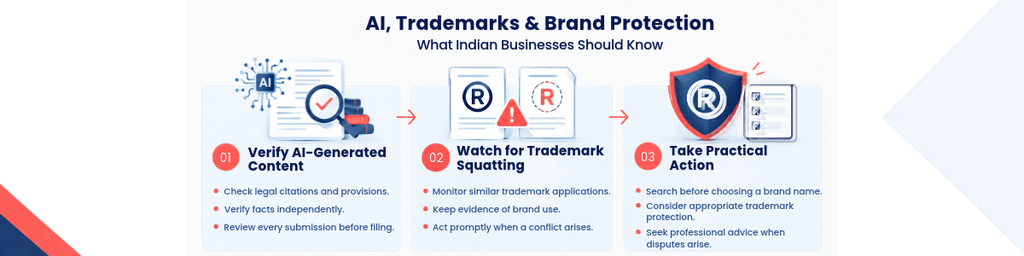
Step 1: Search before committing to a brand name
Before investing heavily in a business name, logo or product identity, search for identical and potentially similar trademarks.
Use the official IP India website and its available trademark search services. Review the relevant classes of goods and services, spelling variations and marks that may create confusion.
A basic online search is not a substitute for a proper trademark clearance assessment. Similarity can involve more than an exact word match.
Step 2: Consider filing an appropriate trademark application
If a brand is commercially important, assess whether a trademark application is appropriate and which classes should be covered.
The correct filing strategy depends on the business’s actual and planned goods or services, the mark being protected and any existing applications or rights. Do not select classes simply because another business has used them.
Registration is not a guarantee against every dispute, but an appropriate filing can help establish and protect the rights available under the applicable law.
Step 3: Keep evidence of actual use
Maintain records that show how and when the mark is used in business.
Depending on the circumstances, useful records may include:
- Dated invoices and sales records.
- Product packaging and labels.
- Website pages and dated screenshots.
- Marketing materials and advertisements.
- Marketplace listings and product catalogues.
- Customer communications and commercial agreements.
- Records showing the geographic reach of sales or advertising.
Keep original records wherever possible. A document created today to describe historical use may not carry the same evidentiary value as contemporaneous records.
Step 4: Monitor potentially conflicting marks
Periodically review trademark filings and search for potentially similar marks. Monitor relevant online marketplaces, websites and social media accounts for confusingly similar branding or impersonation.
Monitoring can be manual or supported by software. Automated alerts can help identify candidates for review, but they may produce false positives and should not be treated as legal determinations.
Step 5: Act promptly when a conflict appears
If you discover a potentially conflicting trademark application, gather the relevant details and assess the applicable deadlines.
Depending on the circumstances, possible responses may include a trademark opposition an appropriate representation or other legal action. The right option depends on the status of the application, the nature of the rights involved and the available legal grounds.
Do not assume that sending a warning email alone will protect your position. Equally, do not assume that every similar mark should automatically be opposed.
Step 6: Keep ownership and business records consistent
Maintain clear records of the legal entity that owns the mark, assignments, licences and any relevant changes in ownership.
If a brand is owned by a founder personally but used by a company, for example, the arrangement should be reviewed carefully. Ownership and permitted use should be documented appropriately.
Step 7: Build a response plan
Decide who within the business should review potential infringements, who will preserve evidence and who will seek professional advice. A simple documented process can prevent confusion when a suspicious application or impersonation incident is discovered.

What Should You Do If Someone Applies for a Trademark Similar to Yours?
Discovering a potentially conflicting application can be worrying, especially if you have already invested in building your brand. The best response is to investigate the facts before deciding what action to take.
First, identify the application. Record the application number, applicant, filing date, mark representation and relevant goods or services. Check the official record rather than relying only on a search result or social media post.
Second, compare the marks and business activities. Consider their visual, phonetic and conceptual similarities, the relevant goods or services and the likelihood of confusion in context. A superficial resemblance does not by itself determine the outcome.
Third, gather evidence of your rights and use. Collect your registration details, earlier application records, invoices, advertisements, product images and other relevant documents. Preserve the original versions and their dates.
Fourth, check the applicable procedural route and deadline. The appropriate response depends on the application’s status and the legal grounds available. A trademark professional can help assess whether an opposition or another remedy is suitable.
Fifth, keep the response evidence-based. Do not rely on unverified case law or unsupported allegations. If AI assists with organising or drafting the material, verify every important legal citation and factual statement before anything is filed.
Trademark matters can involve strict procedural timelines. If a potentially conflicting application affects an important brand, seek qualified advice promptly.
How Should Businesses Use AI Responsibly in Trademark Matters?
AI can help businesses and professionals work more efficiently, but its output needs to be managed carefully.
A practical review process can include the following controls.
| Task | Sensible control |
| Preliminary trademark research | Check search results against official records and relevant classes |
| Summarising legal documents | Compare the summary with the original document |
| Drafting a response or opposition | Verify the facts, legal grounds and procedural requirements |
| Adding case-law citations | Independently confirm the case, citation and legal proposition |
| Preparing an evidence chronology | Match each date and event to the underlying records |
| Drafting factual statements | Confirm that each material statement has supporting evidence |
| Preparing a formal submission | Arrange a competent human review before filing |
AI should be used as an assistant, not as the final decision-maker. If the proposed IP India guidelines are finalised or brought into effect, businesses and professionals should review the final wording and update their processes accordingly.
A simple AI review checklist
Before using AI-assisted material in a trademark proceeding, ask:
- Does every cited case or legal provision actually exist?
- Does each authority support the point for which it is cited?
- Are all names, dates, application numbers and factual statements correct?
- Is each important factual assertion supported by reliable evidence?
- Does the document meet the applicable filing and procedural requirements?
- Have any disclosure or declaration requirements that are actually in force been satisfied?
- Has a responsible person reviewed and approved the final version?
This checklist is a practical risk-control measure, not a substitute for the requirements of the applicable law or any final IP India guidelines.
What Is the Difference Between the Announcement, the Draft Guidelines and Binding Requirements?
This distinction is particularly important when reporting a recent regulatory or procedural development.
IP India’s announcement is the official publication informing readers about the draft guidelines and their context.
The draft guidelines are the proposed text explaining the framework being considered. They indicate what the proposal may require if adopted, but should not automatically be described as existing obligations.
A final notification or applicable direction may establish the operative position, depending on its legal form, terms, date and scope. Any later official publication must be reviewed to determine what was finalised and when it applies.
Businesses should therefore avoid statements such as “IP India has made AI declarations mandatory for every trademark filing” unless the applicable final instrument actually supports that statement.
A more accurate formulation is:
“IP India has published draft guidelines proposing safeguards for the use of AI in specified trademark proceedings. Businesses and professionals should monitor the official position and verify the applicable requirements before filing documents.”
This wording is informative without overstating the legal effect of the announcement.

What Should Indian Startups Do Now?
A startup does not need to wait for a final version of the guidelines to improve its brand-protection practices.
Start by identifying the names, logos and product marks that matter most to the business. Check whether the relevant trademarks have been searched and whether appropriate applications have been filed.
Next, organise ownership documents and evidence of use. Keep records in a location that the relevant team can access when a dispute arises.
Then establish a basic monitoring process. Review potentially conflicting trademark applications and investigate suspicious online use of the brand. Where a conflict appears, preserve the evidence and check the available legal options and applicable deadlines.
Finally, introduce sensible controls for AI-assisted legal work. Require human review, verify citations and facts, and check any applicable disclosure requirements before submitting formal documents.
These steps can improve readiness for trademark disputes while helping businesses respond responsibly to developments in IP India’s proposed framework.
Frequently Asked Questions
1. What are IP India’s 2026 draft guidelines on AI?
IP India published an announcement on 17 October 2026 concerning draft guidelines on the use or misuse of AI and trademark squatting. The accompanying draft document addresses AI use in proceedings before the Trade Marks Registry, including proposed safeguards around accuracy, disclosure in specified circumstances and human accountability.
2. Are IP India’s 2026 draft guidelines already binding law?
They should not be described as binding merely because they have been published. The announcement concerns draft guidelines. Check IP India’s latest official publications and any relevant final notification or direction to establish the current legal position.
3. Why has IP India addressed AI use in trademark proceedings?
AI tools can help prepare documents, but they may also generate inaccurate case citations, legal propositions or factual assertions. The proposed framework addresses the need for reliable submissions and human responsibility in formal proceedings.
4. What is trademark squatting?
Trademark squatting generally refers to attempts to register or claim a mark in circumstances that may unfairly interfere with another party’s legitimate brand interests. The legal assessment depends on the facts, existing rights and applicable law.
5. Can a business oppose a similar trademark application in India?
A business may be able to oppose an application if it has appropriate legal grounds and follows the applicable procedure. Similarity alone does not guarantee success. The relevant facts, rights, goods or services and procedural deadlines must be assessed.
6. Does using AI to prepare a trademark reply mean the reply will be rejected?
Not automatically. The relevant concerns include accuracy, compliance with applicable requirements and the nature of the material submitted. AI-assisted work should be checked by a responsible person before filing.
7. Should businesses disclose every use of AI?
Do not assume that the draft imposes a universal disclosure requirement for every use of AI. The proposed declarations concern specified types of documents and proceedings. Check the actual draft and any final requirements applicable at the time of filing.
8. How can a startup protect its brand from trademark squatting?
A startup should search for similar marks, consider appropriate trademark filings, preserve evidence of use, monitor potentially conflicting applications and respond promptly to genuine conflicts. Professional advice may be appropriate where the brand is commercially important.
9. What evidence should a business keep to support its trademark rights?
Relevant records may include registration documents, dated invoices, advertisements, packaging, website records, marketplace listings and commercial agreements. The appropriate evidence depends on the issue being addressed.
10. Where can businesses check the official position?
Start with IP India’s official website and the announcement concerning the 2026 draft guidelines. Review the underlying document and any subsequent official publication before relying on a specific requirement.
Conclusion: Protect Your Brand and Keep Track of the Official Position
IP India’s 2026 announcement brings attention to two important business concerns: the responsible use of AI in trademark proceedings and the problem of trademark squatting.
The proposed guidelines highlight the importance of human accountability, accurate legal material and appropriate verification. They should, however, be described as draft guidelines unless and until their final status and implementation are established by the relevant official publication.
For Indian businesses, the practical message is clear: do not wait for a dispute to take brand protection seriously. Search before committing to a name, assess suitable trademark protection, preserve evidence of use and monitor for potentially conflicting applications. If a dispute arises, investigate the facts and consider the available legal options promptly.
FilingPoint can help businesses understand relevant registration and compliance processes. For a trademark dispute or a question about the legal effect of the draft guidelines, seek advice from a qualified trademark professional.
