
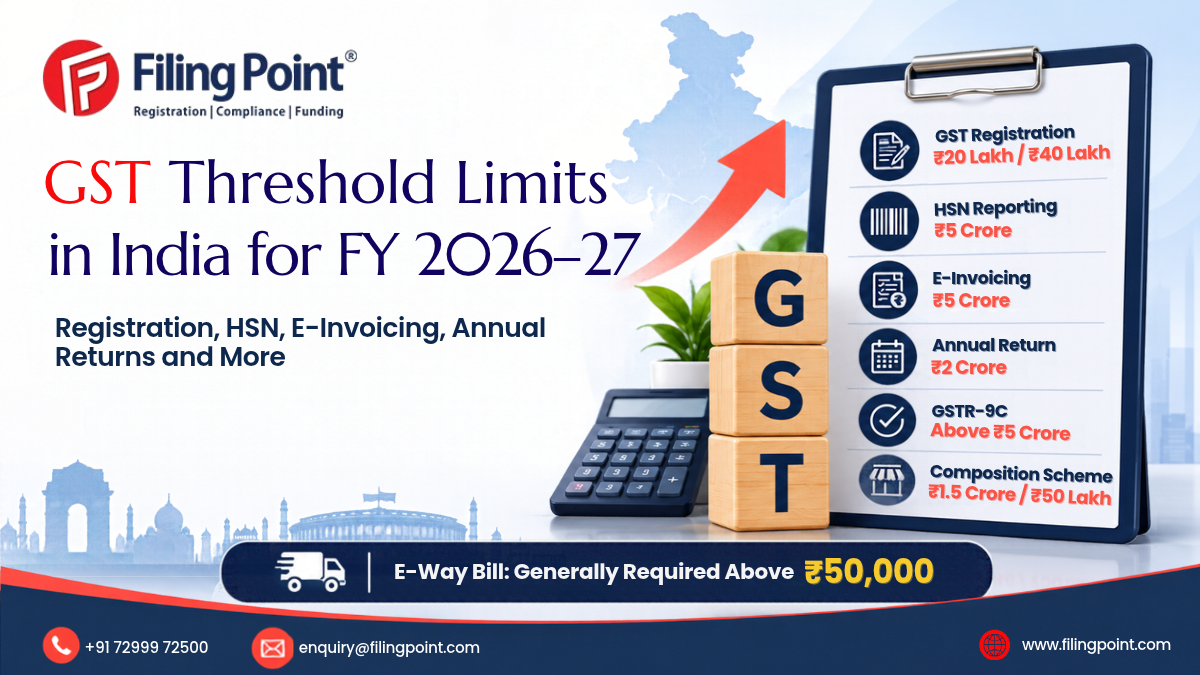
GST compliance in India is not governed by one single turnover limit. Different provisions of the Goods and Services Tax (GST) law use different thresholds for registration, HSN reporting, e-invoicing, annual returns and the composition scheme. E-way bill requirements follow a different rule altogether: they generally depend on the value of a consignment being transported, not the annual turnover of the business.
This distinction matters for small businesses, traders, manufacturers, service providers, startups and growing companies. A business may not yet be required to register under GST but may need to monitor its turnover carefully. Another business may already be registered and have to follow e-invoicing or HSN reporting requirements even though its GST registration threshold is no longer relevant.
For FY 2026–27 (1 April 2026 to 31 March 2027), this guide explains the major GST thresholds, the conditions attached to them and the records businesses should monitor.
Important: GST provisions, notifications and state-level rules can change. This article is a general compliance guide, not a substitute for checking the latest notification or obtaining advice for a particular transaction.
GST Threshold Limits at a Glance
The following table is a quick reference. It should not be read as a statement that every threshold applies to every business.
| GST requirement | Common threshold / trigger | What it relates to |
| Registration – eligible suppliers exclusively dealing in goods | Up to ₹40 lakh in many States/UTs | Aggregate turnover, subject to conditions and State position |
| Registration – services or mixed goods and services | Generally ₹20 lakh | Aggregate turnover, with lower limits in specified States |
| HSN reporting in GSTR-1 | ₹5 crore AATO distinction | 4-digit or 6-digit HSN reporting |
| E-invoicing | Aggregate turnover exceeding ₹5 crore in any preceding financial year from 2017–18 onwards | Specified B2B/export documents, subject to notified exclusions |
| GSTR-9 annual return | Exemption for turnover up to ₹2 crore for FY 2024–25 onwards | Annual return filing |
| GSTR-9C reconciliation statement | Turnover exceeding ₹5 crore | Self-certified reconciliation statement |
| Composition scheme – eligible goods suppliers | Generally ₹1.5 crore | Preceding financial year turnover, subject to conditions |
| Composition option for certain service suppliers | ₹50 lakh | Separate provision under Section 10(2A) |
| E-way bill | Generally consignment value exceeding ₹50,000 | Movement of goods, subject to exceptions and State rules |
The figures above are not interchangeable. A business should identify the provision it needs to comply with before applying a threshold to its turnover.
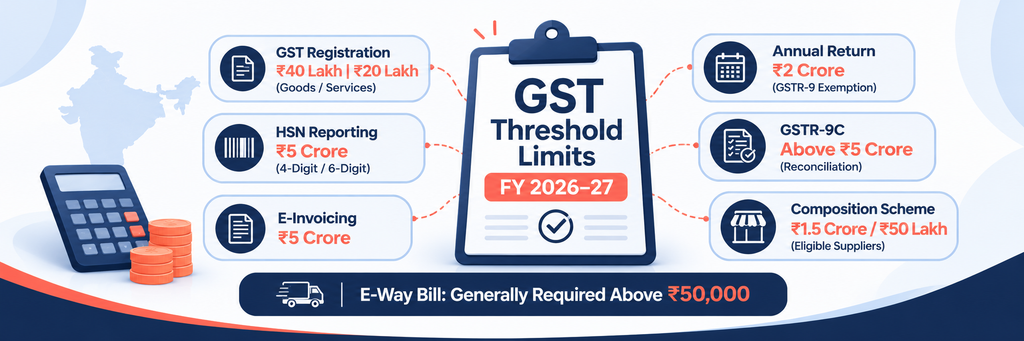
What Is the GST Registration Threshold for FY 2026–27?
The GST registration threshold is the turnover level at which a person making taxable supplies becomes liable to register, subject to the applicable provisions and exceptions.
Under Section 22 of the Central Goods and Services Tax Act, 2017, the general threshold is ₹20 lakh. A higher threshold of ₹40 lakh is available to eligible persons engaged exclusively in the supply of goods in States and Union Territories where the relevant exemption notification applies.
Registration threshold for goods
A person exclusively supplying goods may be eligible for the ₹40 lakh exemption limit in many States and Union Territories. This is not an unconditional ₹40 lakh allowance for every trader.
Notification No. 10/2019–Central Tax, dated 7 March 2019, provides the exemption for eligible persons exclusively supplying goods, subject to exclusions. The exemption is not available to persons who are required to register under Section 24, certain notified manufacturers and suppliers, or persons making intra-State supplies in specified States and Union Territories.
The States and Union Territories excluded from this particular ₹40 lakh exemption include Arunachal Pradesh, Manipur, Meghalaya, Mizoram, Nagaland, Puducherry, Sikkim, Telangana, Tripura and Uttarakhand. A business operating in one of these locations should not automatically apply the ₹40 lakh figure.
Registration threshold for services
For suppliers of services, the general registration threshold is ₹20 lakh. In specified special-category States, the threshold can be ₹10 lakh.
Businesses supplying both goods and services should be particularly careful. The ₹40 lakh exemption is intended for persons exclusively supplying goods, subject to the notification. A business with a mixed supply profile should not assume that it qualifies merely because goods account for most of its revenue.
Does the threshold apply separately to each GSTIN?
No. Aggregate turnover is calculated on an all-India basis for persons having the same PAN. If a business has registrations in multiple States, the turnover of those registrations is considered together for aggregate-turnover calculations.
For example, suppose a company has GST registrations in Tamil Nadu and Karnataka. Its turnover cannot be assessed by looking only at the Tamil Nadu GSTIN if the relevant test requires aggregate turnover under the same PAN.
What Is Aggregate Turnover Under GST?
Aggregate turnover is one of the most important concepts in GST because several thresholds use it.
Section 2(6) of the CGST Act defines aggregate turnover as the aggregate value of:
- Taxable supplies;
- Exempt supplies;
- Exports of goods or services or both; and
- Inter-State supplies made by persons having the same PAN.
The calculation is made on an all-India basis.
Aggregate turnover excludes:
- Central GST;
- State GST;
- Union Territory GST;
- Integrated GST;
- Compensation cess; and
- The value of inward supplies on which tax is payable by the person under reverse charge.
This means that a business cannot simply compare its taxable sales shown in one GST return with the registration threshold and assume that the calculation is complete. Exempt supplies, exports and supplies from other registrations under the same PAN may also affect the calculation.
Example
A business has the following annual figures:
| Particulars | Amount |
| Taxable domestic sales | ₹16 lakh |
| Exempt supplies | ₹3 lakh |
| Export supplies | ₹4 lakh |
| GST collected | ₹2 lakh |
The aggregate turnover for the illustration is ₹23 lakh, not ₹25 lakh, because GST collected is excluded. The exempt and export supplies are included.
This example demonstrates why turnover calculations should be based on the statutory definition rather than only the taxable-sales figure.
Are Businesses Required to Register Before Crossing the Turnover Limit?
Yes, certain categories of persons may be required to register irrespective of the ordinary threshold. Section 24 of the CGST Act contains compulsory-registration categories, subject to exemptions and notifications.
These categories include, among others:
- Persons making specified inter-State taxable supplies;
- Casual taxable persons making taxable supplies;
- Non-resident taxable persons making taxable supplies;
- Persons liable to pay tax under reverse charge, where the relevant provision applies;
- Persons making taxable supplies on behalf of another taxable person as an agent;
- Input Service Distributors;
- Persons required to deduct tax under Section 51;
- Electronic commerce operators required to collect tax at source under Section 52; and
- Certain suppliers making supplies through an electronic commerce operator required to collect tax at source.
However, the phrase “inter-State supply means compulsory GST registration in every case” is too broad. Specific exemptions exist, including for certain inter-State service suppliers below the applicable threshold and specified handicraft suppliers. E-commerce rules have also been modified for eligible small suppliers of goods.
A business should check the exact category, exemption notification and transaction type before deciding that registration is compulsory or unnecessary.
HSN Code Reporting Threshold: ₹5 Crore
HSN stands for Harmonised System of Nomenclature. Businesses use HSN codes to classify goods, while services are classified using Service Accounting Codes (SAC).
The HSN reporting requirement in Table 12 of GSTR-1 depends on the taxpayer’s Aggregate Annual Turnover (AATO) in the preceding financial year.
The GST Portal’s January 2025 advisory explains the reporting structure:
- Taxpayers with AATO up to ₹5 crore are generally required to report 4-digit HSN codes for B2B supplies.
- Taxpayers with AATO above ₹5 crore are required to report 6-digit HSN codes for goods and services.
- Table 12 of GSTR-1/1A separates B2B and B2C supply reporting.
- The portal applies HSN validations and may display warnings where the reported information does not match the relevant supply details.
The ₹5 crore figure is not a GST registration threshold. It is a reporting distinction for HSN information. A business can be required to report HSN details even when its turnover is far below the e-invoicing threshold.
Businesses should maintain accurate product descriptions, HSN/SAC classifications, unit quantities and invoice-level data. Incorrect classification can create reconciliation problems and may affect tax-rate treatment.
GST E-Invoicing Threshold: ₹5 Crore
E-invoicing is a system in which specified invoice details are reported to an Invoice Registration Portal (IRP) and an Invoice Reference Number (IRN) and signed QR code are generated.
Under Notification No. 10/2023–Central Tax, the e-invoicing requirement was extended to eligible taxpayers whose aggregate turnover exceeded ₹5 crore, effective from 1 August 2023.
The turnover test is important:
- It is based on aggregate turnover under the same PAN.
- It considers turnover in any preceding financial year from 2017–18 onwards.
- It is not limited to the current financial year’s turnover.
- The requirement applies to specified documents and transactions, subject to notified exclusions.
For example, if a business crossed the ₹5 crore threshold in an earlier financial year, a later fall in turnover does not automatically remove it from the e-invoicing requirement.
E-invoicing is not simply a requirement to upload every retail bill. The legal framework covers specified documents and classes of registered persons. Certain categories, such as specified financial institutions, insurers, goods transport agencies and other notified persons, have exclusions. Businesses should verify whether an exclusion applies to their exact category.
A business approaching the threshold should review its billing software, ERP integration, customer GSTIN validation, invoice numbering and IRP workflow before the requirement becomes operationally urgent.
GSTR-9 Annual Return Threshold: ₹2 Crore
GSTR-9 is the annual return for eligible regular taxpayers. It consolidates information relating to outward supplies, inward supplies, input tax credit, tax paid and other details for a financial year.
Notification No. 15/2025–Central Tax, dated 17 September 2025, exempts registered persons whose aggregate turnover in a financial year is up to ₹2 crore from filing the annual return for that financial year. The notification applies from FY 2024–25 onwards, unless changed by a later legal measure.
This means that for FY 2026–27, a registered person whose aggregate turnover is up to ₹2 crore falls within the notified exemption, subject to the applicable conditions.
The exemption should not be confused with exemption from all GST returns. Regular periodic return obligations such as GSTR-1 and GSTR-3B may continue to apply depending on the taxpayer’s registration type and filing scheme.
Businesses should also check whether they fall into an excluded category, such as an Input Service Distributor, a TDS/TCS-related registrant, a casual taxable person or a non-resident taxable person.
GSTR-9C Threshold: Above ₹5 Crore
GSTR-9C is a reconciliation statement that compares the figures reported in the annual return with the relevant financial statements and records.
Under Rule 80(3) of the CGST Rules, a registered person whose aggregate turnover during a financial year exceeds ₹5 crore is required to furnish a self-certified reconciliation statement in Form GSTR-9C along with the annual return, subject to the specified exclusions.
This is different from the older GST audit framework. GSTR-9C is now self-certified by the registered person; it should not be described as a compulsory CA or cost-accountant certification in every case.
Businesses approaching ₹5 crore should reconcile:
- Sales as per books and GST returns;
- Credit notes and debit notes;
- Exempt and non-GST supplies;
- Export and zero-rated supplies;
- Input tax credit;
- Tax liability and tax paid; and
- Differences between financial statements and GST returns.
A well-maintained reconciliation throughout the year is more practical than trying to identify every mismatch at the annual filing stage.

GST Composition Scheme Threshold
The composition scheme is an optional simplified tax-payment arrangement for eligible small taxpayers. It is not a general GST exemption and it does not apply automatically when turnover is below a particular limit.
Composition limit for eligible goods suppliers
Under Section 10(1) and the relevant notification, the general turnover limit is ₹1.5 crore in the preceding financial year. For eligible registered persons in specified States, the limit is ₹75 lakh.
The specified States for the lower limit include Arunachal Pradesh, Manipur, Meghalaya, Mizoram, Nagaland, Sikkim, Tripura and Uttarakhand.
Eligibility restrictions apply. For example, certain notified manufacturers are excluded, and a person making prohibited inter-State outward supplies or otherwise falling within a disqualifying category cannot simply opt for the scheme.
Composition option for certain service suppliers
Section 10(2A) provides a separate composition option for certain registered persons who are not eligible under the main composition provisions. The turnover limit under this provision is ₹50 lakh in the preceding financial year, subject to conditions and restrictions.
This is why the statement “the composition scheme limit for services is ₹50 lakh” is incomplete. The business must satisfy the separate eligibility conditions.
What should a business understand before opting in?
A composition taxpayer generally:
- Pays tax at the prescribed composition rate;
- Cannot collect GST from customers as a separate tax under the normal scheme;
- Cannot claim input tax credit on purchases;
- Must issue a bill of supply instead of a regular tax invoice; and
- Must comply with the applicable composition return and payment requirements.
A business should compare the effective tax cost, supplier credit position, customer profile and restrictions before choosing the scheme.
E-Way Bill Threshold: ₹50,000
The e-way bill requirement is different from the other thresholds in this guide. It is generally triggered by the value of a consignment being moved, not by the supplier’s annual turnover.
Under Rule 138 of the CGST Rules, a registered person causing movement of goods of consignment value exceeding ₹50,000 is generally required to furnish the prescribed information and generate an e-way bill before movement begins.
The general rule covers movement:
- In relation to a supply;
- For reasons other than supply; or
- Due to inward supply from an unregistered person.
There are exceptions and special situations. Certain movements may require an e-way bill irrespective of value, while specified goods or movements may be exempt. State-specific rules can also affect intra-State movement.
Interstate and intrastate movement
For interstate movement, the general ₹50,000 rule is the starting point, subject to the prescribed exceptions.
For intrastate movement, States and Union Territories may prescribe different thresholds or conditions under the relevant rules. A business operating in Tamil Nadu should therefore check the current Tamil Nadu e-way bill notification rather than assume that every State uses the same intra-State threshold.
The consignment value should be calculated in accordance with the applicable GST rules. Businesses should also ensure that the invoice, delivery challan, transporter details and vehicle information are accurate.
Voluntary GST Registration Below the Threshold
A business below the compulsory-registration threshold may choose voluntary registration under Section 25(3) of the CGST Act, subject to the law.
Voluntary registration may be considered where:
- Business customers expect GST invoices;
- The business regularly makes taxable business-to-business supplies;
- Input tax credit may be commercially relevant;
- The business expects to expand into activities requiring registration; or
- A customer, vendor or tender arrangement requires a GSTIN.
However, voluntary registration is not automatically beneficial. Once registered, the business must follow applicable return-filing, invoicing, payment and record-keeping requirements even if turnover remains below the ordinary threshold.
A small business serving only final consumers may find that the additional compliance cost outweighs the commercial benefit. It should evaluate the expected output tax, eligible input tax credit, pricing impact and filing cost before applying.
Common GST Threshold Mistakes Businesses Should Avoid
Mistake 1: Treating ₹40 lakh as the limit for every business
The higher limit is not a universal threshold. It is linked to exclusive supply of goods and the conditions in the relevant notification. Service suppliers and mixed suppliers must examine the applicable limit separately.
Mistake 2: Calculating turnover GSTIN by GSTIN
Aggregate turnover is calculated on an all-India PAN basis. Looking at only one State registration can produce an incorrect result.
Mistake 3: Excluding exempt supplies from aggregate turnover
Exempt supplies are included in aggregate turnover, subject to the statutory definition. Businesses should not calculate the threshold only on taxable sales.
Mistake 4: Assuming that e-invoicing starts only when current-year turnover crosses ₹5 crore
The e-invoicing test considers whether the threshold was crossed in any preceding financial year from FY 2017–18 onwards. A past crossing can continue to matter.
Mistake 5: Treating the e-way bill limit as an annual turnover limit
The general ₹50,000 rule relates to consignment value and movement of goods. It is not the same as a business’s annual sales threshold.
Mistake 6: Assuming that registration exemption means no GST compliance
A business that is not required to register may still need to maintain proper books, invoices and transaction records under other applicable laws. Voluntary registration also creates ongoing GST obligations.
A Practical GST Threshold Monitoring Checklist for FY 2026–27
Businesses should review their GST position periodically instead of waiting until the end of the financial year.
| What to monitor | What to check |
| Aggregate turnover | All taxable, exempt, export and inter-State supplies under the same PAN |
| Registration liability | Applicable State threshold, nature of supply and compulsory-registration provisions |
| HSN/SAC reporting | Preceding-year AATO and Table 12 reporting requirements |
| E-invoicing | Whether the ₹5 crore threshold was crossed in any preceding financial year |
| Annual return | Whether the ₹2 crore exemption applies for the financial year |
| GSTR-9C | Whether aggregate turnover exceeds ₹5 crore |
| Composition scheme | Preceding-year turnover and all eligibility restrictions |
| E-way bills | Consignment value, movement type, exemptions and State-specific rules |
A monthly or quarterly review is useful for growing businesses. It helps the owner identify a registration trigger, prepare systems for e-invoicing and avoid last-minute annual reconciliation problems.
Frequently Asked Questions
1. What is the GST registration limit in India for FY 2026–27?
The general threshold is ₹20 lakh for services and mixed supplies in most States and Union Territories. Eligible suppliers exclusively dealing in goods may qualify for a ₹40 lakh exemption in States and Union Territories where the relevant notification applies. Specified States have lower limits, and compulsory-registration provisions may override the ordinary threshold.
2. Is the GST limit ₹20 lakh or ₹40 lakh?
Both figures can apply, depending on the nature of the supply, the State or Union Territory and the conditions of the applicable notification. The ₹40 lakh exemption is not available to every business.
3. Does GST registration depend on profit or turnover?
The registration threshold is based on aggregate turnover as defined under the CGST Act, not business profit. Expenses and net profit do not determine whether the turnover threshold has been crossed.
4. Is exempt turnover included in GST aggregate turnover?
Yes. Exempt supplies are included in aggregate turnover under Section 2(6), along with taxable supplies, exports and inter-State supplies, subject to the statutory exclusions.
5. What is the HSN reporting limit under GST?
The HSN reporting requirement uses a ₹5 crore AATO distinction. Broadly, taxpayers with AATO up to ₹5 crore report 4-digit HSN codes for B2B supplies, while taxpayers above ₹5 crore report 6-digit HSN codes. The GST Portal’s current Table 12 advisory should be checked before filing.
6. What is the GST e-invoicing turnover limit?
E-invoicing generally applies to eligible taxpayers whose aggregate turnover exceeded ₹5 crore in any preceding financial year from FY 2017–18 onwards, subject to notified exclusions.
7. Is GSTR-9 mandatory for businesses below ₹2 crore?
Notification No. 15/2025–Central Tax provides an exemption from annual return filing for registered persons with aggregate turnover up to ₹2 crore for FY 2024–25 onwards, unless the exemption is amended or withdrawn.
8. When is GSTR-9C required?
GSTR-9C is generally required when aggregate turnover during the financial year exceeds ₹5 crore, subject to the exclusions in Rule 80(3).
9. What is the GST composition scheme turnover limit?
The general limit for eligible goods suppliers is ₹1.5 crore, with a ₹75 lakh limit in specified States. A separate ₹50 lakh option exists under Section 10(2A) for certain service suppliers and other eligible persons. Conditions and restrictions apply.
10. Is an e-way bill required for every invoice above ₹50,000?
No. The general rule relates to movement of goods and consignment value, not every invoice in isolation. Exemptions, special cases and State-specific intra-State rules must be considered.
11. Can I voluntarily register under GST below the threshold?
Yes, voluntary registration is permitted under Section 25(3), subject to the law. Once registered, the business must comply with the applicable GST requirements.
12. Does crossing the GST threshold mean I must register immediately?
A person who becomes liable under the relevant provisions must apply within the prescribed time. Section 25 generally provides a 30-day application period from the date liability arises, with separate provisions for casual and non-resident taxable persons. Do not wait until the financial year ends if the threshold has already been crossed.
Conclusion
GST compliance involves several different thresholds, and each one serves a different purpose. A business may need to register based on aggregate turnover, report HSN codes based on preceding-year turnover, generate e-invoices because it crossed the threshold in an earlier year, file annual returns based on the applicable exemption and generate e-way bills based on the value and movement of goods.
For FY 2026–27, businesses should not rely on a single turnover figure to determine every GST obligation. The safer approach is to calculate aggregate turnover correctly, review the nature and location of supplies, monitor preceding-year turnover and check the latest notifications for each compliance requirement.
Need help with GST registration or ongoing compliance? FilingPoint assists businesses with GST registration, return filing and annual GST compliance.
Disclaimer: This article is for general information and educational purposes. GST applicability depends on the taxpayer’s facts, the nature of supplies, location, notifications and amendments in force. Obtain professional advice before acting on a specific transaction or registration decision.
