Freelancing has become a serious business model in India. Software developers, designers, consultants, digital marketers, video editors, writers and other professionals increasingly work with clients across India and overseas.
But as freelance income grows, questions about GST become harder to ignore.
A designer may receive payments from clients in India and the United States. A developer may earn through a foreign freelancing platform. A consultant may receive payments in US dollars but maintain a bank account in India. Another freelancer may earn less than the usual registration threshold and wonder whether GST registration is necessary at all.
These situations are not identical.
The answer depends on several factors: the freelancer’s aggregate turnover, the type of service supplied, the location of the customer, the place of supply, the payment arrangement and whether any special registration provision applies.
This guide explains how to approach GST as a freelancer in India, including registration, foreign clients, export of services, Letter of Undertaking (LUT), invoices, records and ongoing compliance.
Important: This article provides general information, not a personalised tax opinion. GST provisions and administrative procedures can change. Check the current official GST and CBIC guidance before acting, especially where foreign-client contracts, intermediary services or cross-border payment arrangements are involved.
What does GST mean for a freelancer?
Goods and Services Tax is an indirect tax framework that applies to specified supplies of goods and services. A freelancer who supplies services independently may be treated as a supplier for GST purposes, depending on the facts and applicable law.
The word “freelancer” does not create a separate blanket exemption from GST.
For example, consider three professionals:
- A graphic designer serving Indian businesses.
- A software developer supplying services directly to a company in the United States.
- A consultant who works through an agency and receives payment from an Indian business.
Their GST treatment may differ because their customers, contracts, service arrangements and places of supply may differ.
GST is also separate from income tax. A freelancer may need to consider income-tax reporting even when no GST is charged on a particular supply. Likewise, an income-tax presumptive scheme does not, by itself, decide whether GST registration is required.
The correct starting point is to identify what service is being supplied, who receives it, how much aggregate turnover the freelancer has and whether a registration provision applies.
What is the GST registration threshold for freelancers?
Section 22 of the Central Goods and Services Tax Act, 2017 establishes a general registration threshold, subject to the Act, notifications and other applicable conditions. The commonly applicable threshold for service suppliers in many states is ₹20 lakh of aggregate turnover in a financial year, with a lower threshold applying in certain specified states.
However, freelancers should not use one number without checking their circumstances.
The relevant questions include:
- In which state or union territory is the freelancer located?
- What supplies form part of aggregate turnover?
- Does the freelancer provide only services, or also goods?
- Are any compulsory-registration provisions applicable?
- Is the person relying on a specific exemption or notification?
Aggregate turnover is a legal concept. It is not always identical to the cash deposited into a bank account, the profit shown in an income-tax return or the amount left after deducting business expenses.
Under the CGST Act, aggregate turnover is calculated on an all-India basis for supplies of persons having the same PAN, subject to the statutory definition and exclusions. It generally includes taxable supplies, exempt supplies and exports, while specified taxes and certain inward supplies are excluded.
Does income from foreign clients count towards the threshold?
Do not automatically exclude foreign-client income merely because the payment arrives in a foreign currency or the customer is outside India.
Export supplies are part of the GST framework, and the statutory definition of aggregate turnover includes exports. Whether a particular transaction qualifies as an export of services is a separate legal test.
For example, if a freelancer supplies services to Indian clients and overseas clients, the relevant turnover assessment may need to consider both. A professional should not calculate the threshold using only domestic receipts without checking the legal definition.
Does working with clients in another Indian state automatically require registration?
The answer depends on the applicable provisions and the nature of the supply. The general registration threshold and the rules for inter-State supplies must be read together with relevant exemptions and notifications.
Freelancers should not rely solely on a social-media comment saying that every inter-State service requires registration, or that every freelancer below a particular amount is exempt. The applicable notification and facts matter.
For a registration decision, check the current CGST Act and relevant notifications or obtain advice from a qualified GST practitioner.
Is GST registration compulsory for every freelancer?
No. Being a freelancer does not, by itself, mean that registration is immediately compulsory in every case.
A freelancer must assess the general threshold as well as the categories of persons who may be required to register under Section 24 and any relevant notifications or exemptions.
Registration can also be a business decision in some circumstances, but voluntary registration has consequences. Once registered, a person generally has ongoing compliance responsibilities, including applicable returns and record-keeping, even if the business has a low level of activity.
Before choosing voluntary registration, consider:
- Whether registration is legally required.
- Whether clients need a GST registration number or tax invoice.
- Whether input tax credit is relevant to the business.
- The cost and time of maintaining compliance.
- Whether the freelancer’s supplies are domestic, exported or a mixture.
- Whether registration could create obligations that outweigh the immediate benefit.
Do not register simply because another freelancer has done so. Equally, do not delay registration when the law requires it.
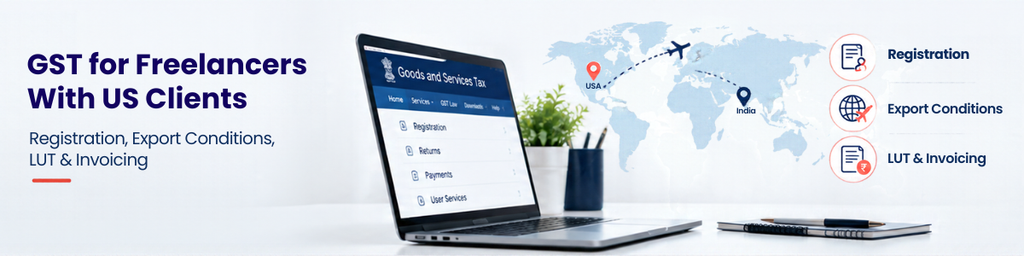
Do freelancers have to charge GST to foreign clients?
This is one of the most misunderstood areas of freelance taxation.
A payment from a foreign client is not automatically an export of services for GST purposes. To qualify, the supply must satisfy the conditions in Section 2(6) of the Integrated Goods and Services Tax Act, 2017.
Broadly, the conditions require that:
- The supplier is located in India.
- The recipient is located outside India.
- The place of supply is outside India.
- Payment is received in convertible foreign exchange or Indian rupees wherever permitted by the Reserve Bank of India.
- The supplier and recipient are not merely establishments of a distinct person in the circumstances covered by the provision.
The exact statutory wording and applicable exceptions should be checked before relying on export treatment.
If all the relevant conditions are satisfied, the service may qualify as an export of services. Exports are treated as zero-rated supplies under the IGST framework, subject to the applicable rules.
Zero-rated does not mean “ignore GST.” Registration, documentation, invoicing and return requirements may still apply.
Example: an Indian software developer serving a US company
Suppose an Indian software developer supplies development services directly to a US company. The developer should review the contract, identify the actual recipient, establish the place of supply, check the payment terms and determine whether the statutory export conditions are satisfied.
If the conditions are met, the transaction may qualify as an export of services. The developer can then consider the applicable zero-rated supply route, including an LUT where eligible and appropriate.
If the developer is actually acting as an intermediary, or the arrangement involves another party receiving the service, the analysis may be different. The customer’s overseas address alone does not settle the question.
What is an LUT, and why might a freelancer need one?
A Letter of Undertaking, commonly called an LUT, is a declaration filed through the GST system that allows an eligible registered person to make qualifying exports without payment of integrated GST, subject to the applicable requirements.
The relevant form is GST RFD-11.
The official GST Portal guidance explains the online process through Services → User Services → Furnish Letter of Undertaking (LUT). The portal generates an acknowledgement reference after successful filing.
An LUT is not a substitute for registration where registration is required. Nor does it turn an ordinary domestic supply into an export.
A freelancer should first determine whether the supply qualifies as an export and whether the person is eligible to use the LUT route. The LUT should be filed for the relevant financial year in accordance with the applicable requirements.
What if the freelancer does not file an LUT?
The consequences depend on the transaction, timing and applicable provisions. Do not assume that filing an LUT later automatically cures every earlier invoice or tax issue.
If export invoices have already been issued, review the dates, return treatment, payment status and applicable rules with a GST professional before attempting corrections.
How should a freelancer invoice a foreign client?
An invoice should accurately describe the services supplied and reflect the transaction’s actual tax treatment.
For an export of services made under an LUT without payment of integrated GST, the applicable invoice endorsement and prescribed details must be followed. The GST invoice rules contain specific export-invoice requirements; the exact wording and fields should be checked against the current rules.
A freelancer’s invoice process should normally include:
- Correct legal name and address of the supplier.
- GSTIN, where applicable.
- Invoice number and date.
- Customer’s legal name and address.
- Clear description of the service.
- Currency and agreed consideration.
- Applicable tax treatment and required export endorsement.
- Contract or project reference where useful.
- Payment terms and due date.
- Relevant banking or payment instructions.
Do not add GST merely because a software template automatically inserts a tax rate. Equally, do not label every foreign-client invoice “zero-rated export” without checking the legal conditions.
A freelancer should retain the invoice alongside the contract, statements of work, evidence of delivery, payment records and supporting remittance documentation.
What if a foreign client pays in Indian rupees?
Payment currency is an important part of the export-of-services analysis, but it is not the only condition.
The statutory definition recognises receipt in convertible foreign exchange or in Indian rupees wherever permitted by the Reserve Bank of India. That means a payment in INR is not automatically disqualifying in every circumstance, but the relevant permitted payment route and supporting evidence need to be established.
For example, payment through an authorised arrangement may have a different evidentiary position from a domestic transfer where the relationship between the payer and overseas customer is unclear.
Freelancers should keep the contract, invoice, payment advice and bank or payment-platform records. If a platform deducts fees before settlement, preserve the gross transaction information and the fee breakdown as well.
Do not rely on a general online answer that says all INR receipts qualify—or that none can qualify. Check the applicable RBI-permitted route and the GST export conditions for the actual transaction.
What records should freelancers keep?
Good records make GST compliance easier and help explain transactions if a question arises.
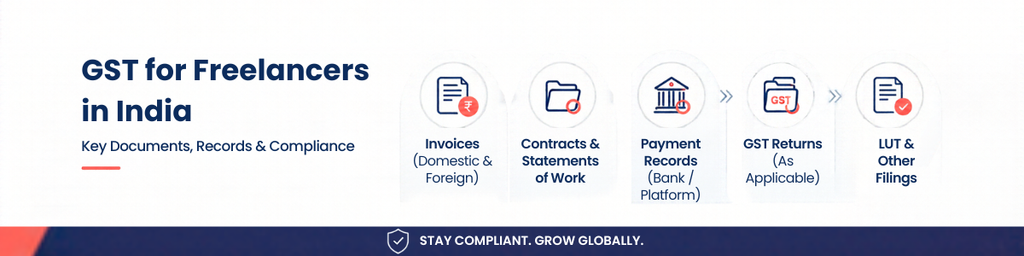
Depending on the business, maintain:
- Client contracts and statements of work.
- Invoices and credit notes.
- Bank statements and payment-platform reports.
- Foreign remittance or payment advice available from the bank or authorised provider.
- LUT filing acknowledgement, where applicable.
- GST registration and return acknowledgements.
- Purchase invoices for business expenses.
- Input-tax-credit records, where applicable.
- Correspondence explaining changes to the scope or recipient of the service.
- A reconciliation between invoices, amounts received and GST returns.
Do not assume that one specific document, such as a FIRC or FIRA, is universally required in exactly the same form for every payment route. What is available and what is legally relevant may depend on the banking or payment arrangement. Ask the authorised bank or payment provider what documentation it can issue and confirm the GST evidence requirements for your transaction.

Do freelancers need to file GST returns if they charge no GST?
Potentially, yes.
A registered freelancer may still have return-filing obligations even when eligible exports are made without payment of IGST under an LUT. Zero-rated supplies are not automatically omitted from GST reporting.
The precise returns and frequency depend on the taxpayer’s registration, filing scheme and applicable requirements. A freelancer should confirm the current return obligations on the GST Portal and ensure that invoices, export values, tax liability and input tax credit reconcile.
A “zero GST invoice” and a “no compliance obligation” are not the same thing.
Missing a required return can create late fees, notices and other consequences, depending on the circumstances. A freelancer should set reminders and retain acknowledgements after filing.
Can a freelancer claim input tax credit or a refund?
The answer depends on eligibility, the nature of the expense, the credit conditions and the refund provisions.
An eligible registered exporter may be able to claim a refund of accumulated eligible input tax credit on qualifying zero-rated supplies made without payment of tax under a bond or LUT, subject to the law and prescribed procedure.
However, not every purchase automatically qualifies for credit. The expense must satisfy the relevant conditions, and blocked credits and other restrictions may apply. Personal purchases should not be treated as business input tax credit merely because the freelancer has a GSTIN.
A freelancer who exports all services and has little or no domestic output tax may have a different credit position from someone who supplies both domestic and overseas customers. Refund eligibility and the amount recoverable should be assessed from the records, not assumed.
What about freelancers working through platforms or agencies?
A platform payment does not, by itself, tell you who the recipient of the service is for GST purposes.
A freelancer may be supplying a service directly to an overseas customer, providing a service to an Indian agency, or working under a platform arrangement with separate contractual roles. The platform may collect money, deduct fees or facilitate delivery without necessarily being the recipient of the underlying service.
Review the contract and terms of service. Identify:
- Who hired the freelancer?
- Who is legally receiving the service?
- Who is responsible for paying the freelancer?
- Is the platform an agent, intermediary or contracting party?
- Where is the recipient located?
- What service is actually supplied?
The answers may affect the place-of-supply and export analysis. Where an intermediary arrangement is possible, seek professional review before applying export treatment.
Common GST mistakes freelancers should avoid
Mistake 1: Assuming overseas income never counts towards turnover.
Aggregate turnover must be calculated under the statutory definition, which includes exports.
Mistake 2: Treating every foreign client as an export.
The statutory export conditions must be satisfied.
Mistake 3: Confusing zero-rated with exempt.
Zero-rated exports remain within the GST framework and may involve reporting and input-tax-credit provisions.
Mistake 4: Using an LUT as a replacement for registration.
An LUT is a route for eligible registered persons; it does not remove a registration requirement.
Mistake 5: Forgetting returns because no GST was charged.
Registered taxpayers may still have filing obligations.
Mistake 6: Treating income-tax rules as GST rules.
A presumptive income-tax provision and GST registration are separate legal questions.
Mistake 7: Relying on payment currency alone.
The recipient, place of supply, contract and permitted payment route all matter.
Mistake 8: Ignoring platform fees and reconciliation.
Keep gross transaction values, deductions and net receipts clear in your records.
A practical GST checklist for freelancers
Before deciding how to invoice, work through this checklist:
- List your services and customer types.
- Calculate aggregate turnover under the GST definition.
- Check the registration threshold applicable to your circumstances.
- Review compulsory-registration provisions and relevant notifications.
- For each foreign-client service, check all export-of-services conditions.
- Review the contract to determine who receives the service.
- Confirm the permitted payment route and retain evidence.
- If registered and eligible, assess whether an LUT is appropriate.
- Use invoices that match the actual transaction and prescribed rules.
- File the applicable returns and reconcile them with invoices and payments.
- Review input tax credit and refund eligibility before claiming.
- Get professional advice for intermediary services, mixed supplies or unclear cross-border arrangements.
Frequently asked questions
1. Is GST registration mandatory for every freelancer in India?
No. Registration depends on aggregate turnover, the nature of supplies, the applicable threshold and any compulsory-registration provision or exemption. Freelancers should assess their actual circumstances rather than assume all freelancers must register immediately.
2. Does foreign-client income count towards the GST threshold?
Exports form part of the statutory aggregate-turnover definition. A freelancer should not automatically exclude overseas receipts when calculating turnover.
3. Do freelancers need to charge 18% GST to US clients?
Not automatically. If the supply qualifies as an export of services, it may be zero-rated subject to the applicable conditions and procedures. The service arrangement and place of supply must be checked first.
4. What is an LUT for a freelancer?
An LUT is a Letter of Undertaking filed through Form GST RFD-11. An eligible registered exporter can use it to make qualifying exports without payment of integrated GST, subject to applicable rules.
5. Can I file an LUT without GST registration?
An LUT does not replace GST registration. The freelancer must first establish the applicable registration position and eligibility to use the LUT route.
6. Do I need GST returns if all my income comes from foreign clients?
If you are registered, you may still need to file the applicable returns and report qualifying exports. The exact filing obligations depend on your registration and the applicable rules.
7. Can a freelancer claim a refund of GST paid on a laptop or software?
Possibly, if the freelancer is registered and the expense and credit satisfy the relevant conditions. Blocked-credit rules and refund eligibility must be considered; not every purchase automatically qualifies.
8. Does receiving money through a payment platform make a transaction an export?
Not by itself. The recipient, contractual arrangement, place of supply, payment route and other export conditions must be assessed.
9. Is GST the same as income tax for freelancers?
No. GST and income tax are separate tax systems. An income-tax treatment does not, by itself, settle GST registration or export eligibility.
10. What should I do if I have already issued foreign invoices without an LUT?
Review the invoice dates, registration status, payment records and applicable rules with a qualified GST professional. Do not assume a later filing automatically resolves every earlier transaction.
How FilingPoint can help
Freelancers often begin with simple client invoices, then gradually take on larger projects, foreign contracts and recurring payments. As the business grows, GST decisions can become more complex.
FilingPoint supports businesses with GST registration and related compliance services. If you are unsure whether registration is required, whether your overseas services qualify as exports, or what filing steps apply after registration, review your facts before choosing a compliance route.
Need help understanding your GST registration and compliance requirements?
Phone: +91 72999 72500
Email: enquiry@filingpoint.com