
For a small business, an unpaid invoice is more than an accounting entry. It can affect salaries, supplier payments, rent, stock purchases and the ability to accept new orders.
You may have delivered the goods, completed the project or provided the service as agreed. Yet, weeks later, the customer keeps asking for more time. Emails go unanswered, payment dates keep changing and your working capital remains stuck.
If this sounds familiar, you may have options beyond sending another payment reminder.
India’s Micro, Small and Medium Enterprises Development Act, 2006 contains specific provisions for delayed payments to eligible micro and small enterprises. Depending on your eligibility and circumstances, you may be able to pursue the outstanding amount through the applicable Micro and Small Enterprises Facilitation Council process.
This guide explains the key payment rules, what to check before filing a claim, how MSME Samadhaan and the MSME ODR framework fit into the process, and how to prepare your records.
What Is an MSME Delayed Payment?
An MSME delayed payment occurs when a buyer fails to pay an eligible micro or small enterprise within the applicable payment period for goods supplied or services rendered.
The issue commonly arises when:
- A customer does not pay an invoice by the agreed date.
- A buyer repeatedly postpones payment after accepting a delivery.
- A business completes a service but receives only part of the agreed fee.
- A supplier’s invoice remains unpaid despite repeated follow-ups.
- A company disputes an invoice after receiving goods or services.
Not every unpaid invoice automatically qualifies for the special protections under the MSMED Act. The supplier’s eligibility, the timing of registration, the contract, the delivery or service records and the circumstances of the dispute need to be assessed.
Who Can Seek Help for Delayed MSME Payments?
The delayed-payment provisions in Sections 15–24 of the MSMED Act primarily concern eligible micro and small enterprise suppliers.
Your first step is to check whether your business qualifies under the relevant rules.
1. Check your enterprise category
Confirm whether your enterprise falls within the applicable micro or small enterprise classification. A medium enterprise should not assume that the same delayed-payment mechanism is available to it.
2. Check your Udyam registration
Keep your Udyam Registration Certificate and enterprise details ready. The official MSME guidance identifies eligible micro and small enterprises with valid Udyam registration as applicants for the delayed-payment process.
Registration alone, however, does not settle every eligibility question.
3. Check when the registration took effect
This is a critical point. The Supreme Court’s decision in Silpi Industries v. Kerala State Road Transport Corporation explains that MSMED Act benefits do not automatically operate retrospectively for supplies completed before registration.
If you obtained Udyam registration only after entering into the relevant arrangement or completing the supply, do not assume that the registration will cover earlier invoices. The dates and facts need careful review.
4. Check the nature of your business
The applicable rules and official guidance must be reviewed for your activity. In particular, do not assume that every trading activity is eligible simply because the business has an MSME registration.
If you are a trader, distributor, reseller or mixed-activity enterprise, confirm eligibility before relying on the special recovery provisions.
What Is the 45-Day Payment Rule?
Section 15 of the MSMED Act addresses the time allowed for a buyer to pay an eligible micro or small enterprise supplier.
Where the buyer and supplier agree on a payment period in writing, that period cannot exceed 45 days from the day of acceptance or deemed acceptance of the goods or services.
Where there is no written agreement on the payment period, the Act’s definition of the appointed day becomes relevant. It generally refers to the day immediately following the expiry of 15 days from acceptance or deemed acceptance.
The practical takeaway is simple: 45 days is not an automatic grace period that every buyer can add to every invoice. The applicable deadline depends on the agreement and the statutory rules.
Example
Suppose an eligible small manufacturer supplies components to a buyer. The goods are delivered, the delivery records are retained and the buyer accepts the consignment.
If the written agreement provides a 30-day payment period, the agreed period must be considered alongside the Act’s requirements. If the agreement specifies a longer period, the statutory maximum becomes relevant.
This is an illustration only. The actual due date depends on the contract, acceptance date and applicable law.
What Happens When Payment Is Delayed?
Section 16 provides for compound interest with monthly rests at three times the bank rate notified by the Reserve Bank of India, subject to the statutory conditions.
Section 17 addresses the buyer’s liability to pay the amount due together with interest under Section 16.
This does not mean every invoice dispute can be resolved by adding a simple interest percentage to the invoice. The relevant dates, amount outstanding, applicable bank rate and statutory calculation need to be established.
Before calculating interest, assemble the following:
- Invoice date and invoice value.
- Date of delivery or service completion.
- Acceptance or deemed-acceptance records.
- Contractual payment period.
- Amounts already paid or adjusted.
- Relevant RBI bank-rate information for the calculation period.
Avoid publishing or using an arbitrary interest percentage. A calculation should be based on the statutory method and the facts of the case.
MSME Samadhaan: What Does It Do?
MSME Samadhaan is the Ministry of MSME’s online facility for eligible micro and small enterprises to submit information about delayed-payment claims.
It helps suppliers initiate the relevant process by filing information about their claim. The application is routed to the appropriate Micro and Small Enterprises Facilitation Council (MSEFC) for consideration under the applicable procedure.
Important: Submitting an online application is not the same as receiving a payment order or recovering the money. The Council’s role and the steps that follow depend on the applicable procedure and the case.
What Is the MSME ODR Portal?
The Ministry of MSME has also developed an Online Dispute Resolution (ODR) framework for delayed-payment matters.
The framework is designed to support a more digital process for handling disputes. The official scheme guidelines describe features such as guided filing, online negotiation, conciliation or mediation, case management and virtual proceedings.
The relevant route and available features should be checked on the current official portal. Do not assume that every case follows exactly the same sequence or that filing guarantees settlement within a fixed time.
MSME Samadhaan vs MSME ODR
These names are related to delayed-payment support, but they should not be used as if they automatically describe the same procedural step.
| Point | MSME Samadhaan | MSME ODR |
| Main purpose | Online facility for delayed-payment applications | Digital dispute-resolution framework |
| Role | Helps suppliers submit claim information | Supports digital dispute-handling stages |
| Decision-making | The relevant MSEFC considers the matter | The applicable process and authority depend on the case stage |
| What it does not guarantee | Immediate recovery of money | Automatic settlement or guaranteed timelines |
Before starting, verify the currently applicable filing route and instructions on the official portals.
Documents to Prepare Before Pursuing a Claim
A well-organised record makes it easier to explain what was agreed, what was supplied and what remains unpaid.
Prepare a folder containing the relevant items.
Business and registration records
- Udyam Registration Certificate.
- Enterprise details and applicable activity information.
- Business identification and contact details.
Contract and order records
- Work order or purchase order.
- Written agreement, quotation or accepted proposal.
- Scope of work and payment terms.
- Relevant email or message confirmations.
Invoice and delivery records
- Tax invoices or other applicable invoices.
- Delivery challans and transport records, where relevant.
- Goods receipt or acceptance records.
- Service completion reports, timesheets or customer approvals.
- Correspondence about defects, rework or disputed items.
Payment and follow-up records
- Bank statements or payment confirmations.
- Account ledger showing the outstanding balance.
- Part-payment and credit-note records.
- Payment reminders and responses.
- Any written acknowledgement of the amount due.
Keep originals and clear copies. Organise the records invoice by invoice, especially where multiple orders or partial payments are involved.

How to Pursue Outstanding MSME Payments
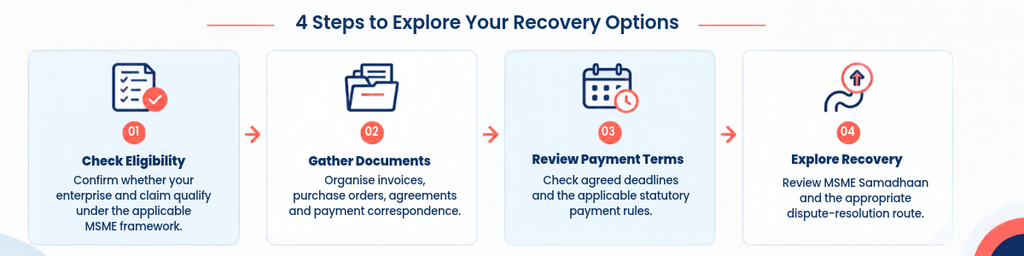
The appropriate route depends on eligibility and the facts of the dispute. The following workflow can help you prepare.
Step 1: Reconcile the outstanding amount
Confirm which invoices remain unpaid. Deduct payments already received and account for valid credit notes, returns, adjustments and disputed amounts.
Do not claim an amount that your own ledger cannot explain.
Step 2: Review the agreement
Identify the payment terms, delivery requirements, acceptance conditions and dispute-resolution clauses. Check whether the buyer has raised a documented objection.
Step 3: Confirm eligibility
Check your enterprise classification, registration details, registration timing and business activity. Seek professional advice if the facts raise a question about whether the statutory provisions apply.
Step 4: Send a clear written payment demand
State the invoice numbers, dates, outstanding amount and requested payment date. Attach a concise statement of account and relevant records.
A written demand may help clarify the dispute, but it does not replace any required legal step or guarantee payment.
Step 5: Check the official filing process
Review the current instructions on the MSME Samadhaan or MSME ODR portal, as applicable. Confirm the documents, information and filing steps required for your case.
Step 6: Submit accurate information
Use consistent invoice amounts, dates, buyer details and supporting documents. Explain any part-payments or disputed items clearly.
Step 7: Track the case and respond to requests
Retain acknowledgements and case references. Monitor communications and respond to requests from the relevant authority or process administrator.
Step 8: Review the outcome and next steps
If a settlement or order is reached, understand its terms. If the buyer does not comply, obtain advice on the appropriate enforcement or further legal process.
Common Reasons a Delayed-Payment Claim Needs Closer Review
A claim may face complications if:
- The supplier’s eligibility is unclear.
- Registration was obtained after the relevant supply.
- The invoice does not match the purchase order.
- The buyer disputes delivery, quality or completion.
- The amount claimed does not account for part-payments.
- Acceptance records are missing.
- The supplier cannot establish the contractual payment terms.
- The claim includes activities or transactions whose eligibility is uncertain.
These issues do not all have the same legal effect. Their significance depends on the evidence and applicable law.
What If the Buyer Disputes the Invoice?
A buyer may say that goods were defective, services were incomplete, a purchase order was not approved or the invoice value is incorrect.
Do not ignore a genuine dispute or assume that the existence of an invoice alone resolves it.
Create a timeline showing the order, delivery, acceptance, complaint and follow-up. Collect inspection reports, customer approvals, photographs where relevant, service records and communications addressing the alleged issue.
Separate the amount that is clearly acknowledged from the portion that remains disputed. If the disagreement concerns contractual interpretation, quality, set-off or jurisdiction, professional advice may be appropriate before filing.
Does GST Registration or GST Filing Recover the Payment?
GST compliance and MSME delayed-payment recovery are different matters.
GST registration, tax invoices and returns may form part of your business records, but GST registration does not by itself guarantee recovery of an unpaid commercial invoice. Similarly, a GST return is not a substitute for following the applicable delayed-payment dispute process.
Make sure your invoices, accounting records and tax records are consistent. If the unpaid invoice creates a separate GST or income-tax question, review that issue under the relevant tax rules rather than assuming the MSME process resolves it.
A Note for Buyers: Why Delayed Payments Matter
Buyers should also take the statutory payment framework seriously.
Eligible micro and small enterprise suppliers may have rights under the MSMED Act. In addition, Section 43B(h) of the Income-tax Act contains a specific deduction-timing provision concerning sums payable to micro and small enterprises covered by Section 15 of the MSMED Act.
The tax treatment depends on the facts and applicable law. Buyers should not assume that an ordinary contractual credit period automatically determines when a deduction is allowed.
Finance teams should maintain supplier classification records, invoice acceptance dates, agreed payment terms and payment evidence, and consult a tax professional about the treatment of outstanding amounts.
Practical Steps to Reduce Future Payment Delays
Recovering an old invoice is important, but preventing future disputes can protect your cash flow.
Before accepting an order
- Verify the customer’s legal name and billing details.
- Put scope, price, milestones and payment terms in writing.
- Confirm who can approve delivery or service completion.
- Review credit exposure before accepting a large order.
When delivering goods or services
- Retain delivery and acceptance evidence.
- Send invoices promptly and to the correct contact.
- Record any changes to scope or price.
- Keep written approval for additional work.
When following up
- Send reminders before and after the due date.
- Maintain an invoice-wise receivables tracker.
- Record the buyer’s promised payment date.
- Escalate unresolved issues through a defined process.
When a customer repeatedly delays
- Review the customer’s outstanding balance before taking further orders.
- Consider staged payments or milestone billing where appropriate.
- Document disputed items promptly.
- Seek professional advice when the amount or legal issues justify it.
Frequently Asked Questions
1. Can an MSME recover delayed payments in India?
Eligible micro and small enterprises may pursue delayed-payment claims under the MSMED Act, 2006, subject to the applicable conditions and procedure.
2. What is the 45-day payment rule for MSMEs?
Section 15 limits a written payment period to no more than 45 days from acceptance or deemed acceptance of goods or services. The applicable due date must be determined from the agreement and statutory rules.
3. What is MSME Samadhaan?
It is an official online facility for eligible micro and small enterprises to submit delayed-payment applications for consideration through the relevant process.
4. Does filing on MSME Samadhaan guarantee payment?
No. Filing starts or supports the relevant process; it does not guarantee settlement, a favourable decision or immediate recovery.
5. Can I register under Udyam now and claim for an old invoice?
Do not assume that a new registration covers earlier supplies. The Supreme Court has held that MSMED Act benefits do not automatically operate retrospectively for supplies completed before registration. Obtain advice on your facts.
6. Can a service provider pursue delayed payment?
Eligible micro and small service enterprises may fall within the framework, subject to registration, activity and other applicable requirements.
7. Can a trader use the delayed-payment process?
Eligibility should be checked carefully. Do not assume every trading activity qualifies simply because the business has an MSME registration.
8. What documents should I keep?
Commonly relevant records include Udyam details, contracts or purchase orders, invoices, delivery or service-completion evidence, acceptance records, ledger statements and payment correspondence.
9. Is MSME ODR the same as MSME Samadhaan?
They are related to delayed-payment support but serve different functions. Check the current official portal instructions to identify the appropriate route and case stage.
10. Can I claim interest on a delayed MSME payment?
Section 16 provides for compound interest with monthly rests at three times the RBI-notified bank rate, subject to the statutory requirements. The calculation should be based on the actual facts and applicable rate.
Final Checklist Before Taking Action
Before pursuing an unpaid invoice, confirm that you have:
- Identified the exact outstanding amount.
- Checked your micro or small enterprise status.
- Reviewed your registration date and business activity.
- Located the contract or purchase order.
- Collected invoices and delivery or completion evidence.
- Recorded acceptance dates and payment terms.
- Documented follow-ups and any buyer dispute.
- Checked the current official filing process.
- Reviewed the need for professional legal or tax advice.
Need Help Understanding Your Business Compliance?
FilingPoint helps Indian businesses navigate registration and compliance requirements. If your business needs support understanding its registration or compliance position, Email: enquiry@filingpoint.com or contact +91 72999 72500.
