
If your company has missed an ROC annual filing deadline, the most useful first step is to identify exactly which filings are pending, for which financial years, and what the company’s current compliance status is. You can then work with a qualified professional to prepare the outstanding documents, calculate the applicable fees and complete the appropriate filings or other required actions.
A missed deadline does not automatically mean that your company has ceased to exist. However, leaving overdue filings unresolved can lead to accumulating additional fees, statutory consequences and complications when applying for finance, bringing in investors, changing company ownership or closing the business.
The correct solution depends on the company’s circumstances. A company that has missed one annual filing may need a different recovery plan from a company with several years of defaults, an ROC notice or a proposed strike-off.
This guide explains how to approach overdue ROC filings in India, what to check before submitting forms, and when professional support may be appropriate.
What Does a Missed ROC Annual Filing Mean?
ROC annual filing refers to statutory filings that a company must make with the Registrar of Companies under the Companies Act, 2013 and applicable rules.
Two key annual filings are:
- Form AOC-4: Used for filing the company’s financial statements and applicable attachments.
- Form MGT-7 or MGT-7A: Used for filing the company’s annual return in the applicable format.
The forms serve different purposes. AOC-4 relates to financial reporting, while MGT-7 or MGT-7A reports prescribed company and ownership information. Completing one does not automatically complete the other.
Other event-based and periodic filings may also be outstanding. Depending on the company’s history, these could include filings relating to auditor appointments, changes in directors, share allotments, charges or other corporate events. Do not assume that clearing AOC-4 and MGT-7 alone resolves every compliance issue.
The legal requirements arise from the Companies Act, 2013, including Sections 92 and 137, alongside the relevant rules and prescribed forms. Check the current official requirements for the company’s type and circumstances before proceeding.
Why Do Companies Miss ROC Annual Filings?
A missed filing does not always happen because a founder deliberately ignored compliance. Common situations include:
- The founder assumed the accountant had filed everything. Accounting, audit and MCA filing are related but distinct tasks. Confirm that the forms were actually submitted and approved or processed as applicable.
- The business was inactive. A company may assume that no revenue means no annual filing obligation. Inactivity alone does not automatically remove statutory responsibilities.
- Financial statements were not finalised. Delayed bookkeeping, missing invoices, unresolved bank reconciliations or an unfinished audit can delay the filing process.
- The company changed its CA, CS or compliance provider. Records, credentials, working papers or responsibility for outstanding years may not have been handed over properly.
- The directors did not know about earlier defaults. A new director or shareholder may discover pending filings only when a bank, investor or adviser reviews the company.
- The filing was prepared but not completed. A draft, uploaded form or payment attempt is not the same as a successfully completed filing. Verify the status and retain the acknowledgement.
The lesson is simple: do not rely only on email assurances or a list of forms that someone says were prepared. Check the company’s actual filing records.
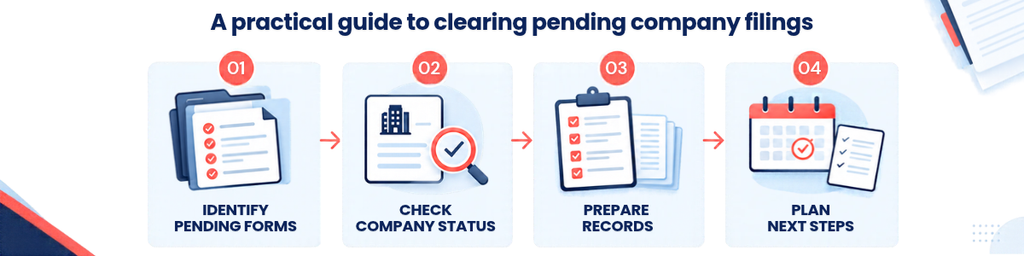
Step 1: Identify Every Pending Filing
Start by establishing the company’s current status and building a year-by-year compliance list.
Review the company’s MCA records and available filing history. Identify the financial years for which the relevant annual forms were due, whether each form was filed, and whether any submission was rejected, resubmitted or otherwise requires attention.
Create a working table such as this:
| Financial year | AOC-4 status | MGT-7/MGT-7A status | Other issue | Next action |
| FY 2022–23 | Pending | Pending | Accounts to verify | Confirm records and prepare documents |
| FY 2023–24 | Filed—verify status | Pending | Annual return incomplete | Review filed record and prepare return |
| FY 2024–25 | Pending | Filed—verify status | Audit status to confirm | Coordinate with auditor and professional |
This is an illustrative template, not a claim about any specific company. Replace the entries with verified information.
Also check whether the company has received notices, whether its status on the MCA register has changed, and whether any director-related or event-based compliance issue needs separate attention.
Important: Do not treat a company master-data page as a complete substitute for checking the individual filing history and documents. The company’s current status and each form’s status are different questions.
Step 2: Check the Company’s Legal and Filing Status
Before submitting overdue forms, confirm that the company remains in a position to make the intended filings and determine whether any formal action has already been initiated.
Check for:
- The company’s current status in MCA records.
- Any notice or communication from the ROC.
- Pending or rejected forms.
- Existing defaults relating to directors or other statutory filings.
- Any strike-off notice, order or other legal proceeding.
- Whether the company is active, dormant, under a status change or otherwise subject to a specific restriction.
If a notice has been received, read it carefully and note the issuing authority, reference number, subject, date and response deadline. A routine overdue filing and a formal regulatory notice should not be treated as the same situation.
If the company’s name has already been struck off, do not assume that ordinary annual filing alone will restore it. The available remedy depends on the legal status, applicable provisions, dates and facts. Obtain advice from a practising company secretary or lawyer familiar with company-law restoration proceedings.
Step 3: Collect the Records Needed for Each Year
A common mistake is to begin filling in forms before the underlying records are ready. For overdue filings, collect documents year by year.
Depending on the company and filing involved, the records may include:
- Trial balance, ledger and bank statements.
- Balance sheet and statement of profit and loss.
- Notes to the financial statements and other applicable statements.
- Auditor’s report and other required reports.
- Board and shareholder meeting records.
- Annual general meeting details, where applicable.
- Register of members, shareholding details and relevant changes.
- Director and registered-office details.
- Details of share allotments, transfers or other corporate events.
- Required declarations, certifications and supporting attachments.
The exact list depends on the company’s type, size, activities, applicable accounting requirements and the form being filed.
For example, if the annual return is pending but the financial statements were already filed, you may not need to repeat the financial-statement preparation exercise. You still need to verify that the previous filing was completed correctly and gather the information needed for the annual return.
Never recreate missing company records from memory when the statutory records, auditor’s working papers, bank statements or previous filings can be obtained. If records are missing or inconsistent, resolve that issue before submitting potentially inaccurate information.
Step 4: Calculate the Applicable Additional Fees and Assess Other Exposure
Late filing can involve more than one financial or legal consequence. Keep the categories separate.
Additional filing fees are amounts payable for delayed submission under the applicable fee framework. The fee may depend on the form, the period of delay and the current rules.
Statutory penalties are separate legal consequences that may arise under the Companies Act or applicable provisions. They are not necessarily settled simply by paying the additional filing fee.
Professional charges are fees charged by a CA, practising CS, lawyer or compliance provider for work such as reviewing records, preparing forms, resolving discrepancies and managing the filing process.
Other costs or consequences may arise if the company has received a notice, needs to correct earlier records, has multiple defaults or is facing strike-off or other proceedings.
Do not rely on a generic online estimate as a final calculation. Check the current MCA filing requirements and fee displayed for each relevant form, and ask a qualified professional to assess any separate statutory exposure. Fee rules and legal provisions can change, and the outcome depends on the facts.
Also verify whether any officially notified fee-relief scheme is currently in force and whether the company and its forms qualify. Do not assume a past scheme is still open, and do not rely on promotional messages that promise a waiver without an official notification.
Step 5: Prepare and Submit the Outstanding Forms
Once the records and compliance position are understood, prepare the forms for the relevant financial years.
A typical recovery workflow is:
- Confirm the financial year and applicable form.
- Reconcile the form data with the company’s books and statutory records.
- Obtain the required audit, approval, signature and certification, where applicable.
- Check attachments, director details, dates and other mandatory fields.
- Validate the form and resolve any errors.
- Complete the prescribed digital-signature and submission steps.
- Pay the applicable filing fee and additional fee shown through the official process.
- Retain the submission acknowledgement, payment evidence and final filing records.
- Verify the resulting filing status and address any resubmission or rejection message.
Do not assume every overdue year can be filed in any order without review. The filing sequence and documents required can depend on the nature of the defaults, the company’s history and the applicable form rules.
If the MCA system rejects a form or requests resubmission, read the reason carefully and correct the underlying issue. Repeatedly uploading the same inaccurate information may waste time and create further problems.
Step 6: Address Notices and Other Legal Issues Separately
If the company has received a formal notice, do not ignore it while preparing the overdue forms.
Read the notice and identify whether it requires a response, documentary evidence, a hearing, payment, correction or another action. Note the deadline and keep a copy of the response and supporting evidence.
If the company is facing proposed strike-off action or its name has already been removed from the register, the issue may require a specific legal route. The Companies Act and the applicable rules govern the available process. In certain strike-off situations, overdue financial statements and annual returns may need to be filed before a voluntary strike-off application can be made; the applicable requirements should be checked against the company’s exact situation.
A professional should review the notice, the current company status and the relevant filing history before advising on the next step.
What If ROC Filings Have Been Pending for Several Years?
A multi-year default requires a broader review than a single late form.
Prepare a complete list of pending filings and confirm the status of each year. Reconstruct or obtain the financial records, coordinate with the auditor, identify changes in directors or shareholding, and check whether other event-based filings are outstanding.
Then assess:
- Which financial statements and annual returns remain pending.
- Whether any previously filed form needs correction.
- Whether directors or officers may face separate consequences.
- Whether a formal notice or strike-off action has been initiated.
- Whether the company intends to continue operating, raise funds, transfer ownership or close.
- Whether legal or professional advice is required before filing.
Do not assume that a company with several years of defaults is automatically struck off. Equally, do not assume it is safe simply because it still appears in a search result. Verify the actual status and any proceedings.
Can a Company Continue Operating With Pending ROC Filings?
The answer depends on the company’s status, the type of default and any applicable legal restrictions or regulatory action. Pending annual filings do not, by themselves, establish that every business activity is prohibited. However, unresolved non-compliance can create significant legal and practical difficulties.
Banks, investors, purchasers, lenders and other counterparties may ask for statutory records and evidence of compliance during due diligence. Outstanding filings can delay that review or lead to requests for clarification and remediation.
Directors should not treat continued business activity as evidence that the compliance position is acceptable. Establish the company’s status and obtain advice on any specific restrictions or consequences that apply.
How Pending ROC Filings Affect Loans, Investment and Business Transactions
A lender or investor may review the company’s MCA filings, financial statements, ownership information, director details and other statutory records.
If required annual forms are missing, the reviewer may need additional explanations or evidence. The transaction could be delayed while the company clears the backlog or reconciles inconsistencies. A purchaser may also ask for representations, warranties or other protections relating to historical compliance.
This does not mean that every company with an overdue filing will automatically be denied funding or a loan. The outcome depends on the lender or investor, the transaction, the company’s financial position and the nature of the outstanding issues.
If you expect a funding round, business sale or loan application, review the company’s compliance history early rather than waiting until due diligence begins.

Common Mistakes to Avoid When Clearing Pending ROC Filings
1. Filing only the most recent year. Older outstanding filings may remain unresolved. Prepare a full year-by-year list.
2. Assuming the accountant has filed everything. Ask for form-wise acknowledgements and independently verify the available records.
3. Ignoring the difference between fees and penalties. Payment of an additional filing fee does not necessarily resolve separate statutory consequences.
4. Submitting forms before reconciling the records. Inconsistent financial statements, shareholder information or dates can cause rejection or create further compliance problems.
5. Ignoring a formal notice. A filing plan may not replace a required response or other action by a deadline.
6. Trusting a supposed waiver without verification. Check the official MCA notification, scheme dates, eligible forms and conditions.
7. Assuming an inactive company has no obligations. Lack of revenue or operations does not automatically remove company-law responsibilities.
8. Failing to retain proof. Keep copies of forms, acknowledgements, payment evidence and communications with professionals.
Frequently Asked Questions
1. Can I file ROC annual returns after the due date?
Late filing may be possible, but the applicable form requirements, additional fees and any separate legal consequences must be checked. If a notice or other proceeding is pending, further action may be required.
2. What should I do first if AOC-4 and MGT-7 are overdue?
Check the company’s filing history, identify every outstanding financial year, confirm the company’s status, collect the required records and calculate the applicable fees before preparing the forms.
3. Does a company need to file ROC returns if it has no business activity?
Inactivity or zero revenue does not automatically remove statutory filing obligations. Confirm the company’s type, status and applicable requirements before deciding what needs to be filed.
4. Will paying the late filing fee clear every default?
Not necessarily. Additional filing fees and statutory penalties are different. Notices, incorrect records, director-related defaults or other proceedings may need separate attention.
5. Can the ROC strike off a company for non-filing?
Strike-off action may be possible under the applicable legal provisions and circumstances. Check the company’s status and any notice received. Do not assume that non-filing has automatically resulted in strike-off.
6. What if the company has not filed for three or more years?
Prepare a year-by-year list of outstanding forms, reconstruct or obtain records, check the company’s legal status and obtain professional advice on the complete backlog. The remedy depends on the facts and any action already taken.
7. Can pending ROC filings affect a loan or investment?
They can create additional due-diligence work or delays because lenders and investors may request statutory records and explanations. The effect depends on the transaction and the company’s overall circumstances.
8. How do I know whether my compliance provider actually filed the forms?
Request the form-wise filing acknowledgements and payment evidence, then verify the available filing records through the official MCA system. Do not rely solely on a message saying that a form was prepared.
When Should You Get Professional Help?
Consider engaging a practising CA, company secretary or lawyer when:
- Several financial years are pending.
- Financial statements or statutory records are incomplete.
- The company has received a notice from the ROC.
- Forms have repeatedly been rejected or resubmission is unclear.
- The company may be facing strike-off action or needs restoration advice.
- Director-related defaults or other statutory issues exist.
- The company is preparing for a loan, investment, sale or restructuring.
- You are unsure whether filing alone will resolve the default.
A professional should first review the company’s actual status and list of defaults, then explain the proposed steps, estimated government fees, professional charges and any separate legal risks. Ask for a written scope of work and proof of filing once the work is completed.
How FilingPoint Can Help
If your company has missed one or more ROC annual filings, FilingPoint can help you understand the compliance work required and organise the next steps.
Before starting, gather your company’s CIN, the relevant financial years, available filing acknowledgements and any notices received. This information helps establish what is pending and whether additional review is needed.
Need help reviewing pending ROC filings? Contact our team to enquire about company compliance support. The appropriate solution will depend on your company’s records, filing history and current legal status.
Final Checklist: Before You Regularise Pending ROC Filings
- List all pending forms and financial years.
- Confirm the company’s current status and check for notices.
- Collect financial statements, audit records and statutory information.
- Reconcile the documents before preparing the forms.
- Verify the applicable fees and assess separate legal exposure.
- Submit the required forms and retain acknowledgements.
- Address any rejection, resubmission or notice separately.
- Create a compliance calendar to prevent future delays.
The most important step is to establish the facts before acting. Once you know what is pending, the company’s current status and the applicable requirements, you can plan a more accurate route to resolving overdue ROC filings.
Note: This article is general information, not legal or company-secretarial advice for a specific company. Verify current MCA forms, fee rules, notifications and statutory provisions before publication and before acting on an individual case.
