
Preparing a company’s annual return involves more than entering director details and shareholding information into an MCA form. Companies must ensure that their statutory records, financial information, meeting details and other disclosures are accurate and consistent with the Companies Act, 2013.
For certain companies, the annual-return process also involves certification by a practising Company Secretary under Section 92(2), commonly associated with Form MGT-8.
The MCA V3 portal introduced an important change to the way this certification is presented. MGT-8 certification was integrated into the MGT-7 e-form rather than being handled as an entirely separate form in the earlier workflow. This change has raised practical questions for companies, directors, accountants and compliance professionals.
Who needs MGT-8 certification? Does every company filing MGT-7 require it? What should companies prepare before approaching a practising Company Secretary? Does the ICSI advisory recommend an additional certification attachment? And what should businesses check before submitting their annual return?
This guide explains the MGT-8 certification framework, the MCA V3 changes and the practical steps companies can take to prepare their annual-return records.
Quick answer: What is MGT-8 certification?
MGT-8 is the certification of a company’s annual return by a Company Secretary in Practice under Section 92(2) of the Companies Act, 2013.
The certification applies to:
- Listed companies; and
- Companies with paid-up share capital of ₹10 crore or more; or
- Companies with turnover of ₹50 crore or more.
The thresholds are alternative tests. A company does not need to meet both financial thresholds.
Under the MCA V3 workflow, MGT-8 certification has been integrated into the MGT-7 e-form. ICSI’s advisory dated 24 December 2025 recommends an additional certification document as an optional attachment, pending further clarification from MCA. Companies should check the latest MCA instructions and professional guidance before filing.
What is Form MGT-8?
MGT-8 is a certificate issued by a Company Secretary in Practice after examining the relevant registers, records, books and papers maintained by a company under the Companies Act, 2013.
The purpose is to certify that the annual return correctly and adequately discloses the facts as at the end of the relevant financial year and that the company has complied with applicable provisions of the Act and Rules.
It is not simply a declaration that the company has completed its annual filing. The professional must examine the relevant information and records before providing the certification.
The certification process may involve checking:
- Company status and statutory particulars.
- Maintenance of registers and records.
- Filing of statutory forms and returns.
- Board and members’ meetings.
- Notices, proceedings and resolutions.
- Shareholding and member-related information.
- Other applicable compliance matters covered by the prescribed certification.
The precise examination depends on the company’s circumstances and the applicable statutory requirements.
Which companies require MGT-8 certification?
Section 92(2) and Rule 11(2) of the Companies (Management and Administration) Rules, 2014 provide the relevant framework.
MGT-8 certification applies to:
- Every listed company.
- A company having paid-up share capital of ₹10 crore or more.
- A company having turnover of ₹50 crore or more.
The financial thresholds operate independently. For example, a company with paid-up share capital of ₹4 crore and turnover of ₹60 crore meets the turnover threshold. A company with paid-up share capital of ₹12 crore and turnover of ₹20 crore meets the paid-up capital threshold.
A company should not assume that it is outside the certification requirement simply because it does not meet both financial limits.
MGT-8 applicability: illustrative examples
| Company situation | MGT-8 certification test |
| Listed company | Applicable |
| Unlisted company with paid-up capital of ₹12 crore | Threshold met |
| Unlisted company with turnover of ₹60 crore | Threshold met |
| Unlisted company with paid-up capital of ₹5 crore and turnover of ₹30 crore | Neither financial threshold met |
| Company with paid-up capital of ₹9 crore and turnover of ₹50 crore | Turnover threshold met |
These examples illustrate the threshold tests. A company should confirm its status and the applicable rules for the financial year concerned.
Is MGT-8 mandatory for every company filing MGT-7?
No. Filing MGT-7 does not automatically mean that a company must obtain MGT-8 certification.
The certification requirement depends on whether the company is listed or meets either of the prescribed financial thresholds.
A company may be required to file MGT-7 but may not meet the MGT-8 certification criteria. Conversely, a company that meets the certification criteria should not treat the integration of MGT-8 into MCA V3 as a reason to ignore the certification requirement.
The company should assess its status, paid-up share capital and turnover before finalising the annual-return filing.
What changed under MCA V3?
The MCA V3 annual filing workflow introduced a change to the presentation of MGT-8 certification.
According to the ICSI advisory dated 24 December 2025, certification in Form MGT-8 has been integrated into the MGT-7 e-form through a static field.
This means companies and professionals must understand the current MGT-7 workflow rather than relying entirely on older filing procedures in which MGT-8 was handled separately.
The change is relevant to:
- Companies preparing their annual returns.
- Directors signing annual-return forms.
- Company Secretaries in employment.
- Company Secretaries in Practice.
- Accountants and compliance teams coordinating annual filing.
The current form and instruction kit should always be checked before submission. Portal workflows and form requirements can change.
What does the ICSI advisory say about the optional attachment?
ICSI issued an advisory on 24 December 2025 concerning MGT-7/MGT-7A certification under MCA V3.
The advisory discusses the integration of MGT-8 certification into MGT-7 and notes that the MGT-7A form does not presently contain a designated field for MGT-8 certification, where applicable.
To maintain due diligence and professional documentation, ICSI advised practising professionals to continue certifying the relevant compliances on the letterhead of a Peer Reviewed Practice Unit, generate a UDIN in accordance with the Institute’s guidelines and attach the certification as an optional attachment to MGT-7 and MGT-7A wherever applicable, pending clarification or rules from MCA.
This recommendation must be described accurately:
- It is professional guidance issued by ICSI.
- It is not the same as an MCA notification amending the Companies Act.
- The advisory itself refers to the position pending further MCA clarification or rules.
- Professionals should check for any later clarification before relying on it for a current filing.
Companies should coordinate with their practising Company Secretary to confirm the appropriate documentation for their particular filing.
What information should a company prepare before MGT-8 certification?
A practising Company Secretary needs access to the relevant statutory records to examine the annual return and applicable compliance matters.
A company can reduce avoidable delays by organising its records in advance.
Company information
Prepare:
- Certificate of Incorporation and current company particulars.
- CIN and registered-office details.
- Memorandum and Articles of Association, including amendments.
- Details of directors and key managerial personnel.
- Share capital and shareholder information.
- Details of holding, subsidiary and associate relationships, where applicable.
Statutory registers and records
Depending on the company’s circumstances, the professional may need to examine:
- Register of members.
- Register of directors and key managerial personnel.
- Register of charges.
- Registers of contracts and arrangements.
- Minutes of Board meetings.
- Minutes of general meetings.
- Resolutions and statutory records.
- Relevant declarations and disclosures.
Financial and filing information
Keep available:
- Audited financial statements.
- Board’s report.
- Auditor’s report.
- Relevant AOC-4 filing information.
- Previous annual returns.
- SRNs and filing acknowledgements.
- Details of delayed or pending statutory filings.
- Details of applicable penalties, compounding or adjudication matters.
This is a preparation checklist, not a claim that every document is mandatory in every case. The practising professional should identify the records relevant to the company’s actual circumstances.
What does the Company Secretary examine?
The certification involves examining the annual-return information and the relevant statutory records.
The professional may need to reconcile the information in the annual return with the company’s registers, minutes, financial records and statutory filings.
For example, director information in the annual return should be consistent with the company’s statutory records and relevant filed changes. Shareholding details should be checked against the register of members and supporting records. Meeting information should be supported by notices, minutes and resolutions.
If the records reveal inconsistencies, the company should resolve or explain them before the certification is finalised.
A company should not ask a professional to certify information that has not been adequately supported by records.
MGT-7 and MGT-8: What is the difference?
MGT-7 is the annual-return filing form for companies other than OPCs and small companies, subject to the applicable rules. MGT-7A is the abridged annual-return form for OPCs and small companies.
MGT-8 is the certification associated with Section 92(2) for companies meeting the prescribed criteria.
| Form | Purpose |
| MGT-7 | Annual return for companies other than OPCs and small companies |
| MGT-7A | Abridged annual return for OPCs and small companies |
| MGT-8 | Certification of annual return by a Company Secretary in Practice where applicable |
The forms serve different purposes. MGT-8 should not be described as a replacement for MGT-7 or MGT-7A.
For small-company eligibility and the revised thresholds effective from 1 December 2025, refer to FilingPoint’s separate guide: New Small Company Rules in India: Does Your Company Qualify for MGT-7A?.
Common issues companies should address before certification
Inconsistent director information
Changes in appointment, resignation or designation should be checked against company records and applicable filings.
Shareholding differences
The register of members, transfer records and annual-return disclosures should be reconciled.
Missing meeting records
The company should organise notices, attendance records, minutes and resolutions for relevant meetings.
Delayed statutory filings
Previous filing delays should be identified and reviewed. Do not assume that a delayed filing has no further consequence merely because it has eventually been submitted.
Incomplete statutory registers
Missing entries or outdated registers may require attention before the professional can complete the examination.
Incorrect financial-year information
The company should ensure that the annual return relates to the correct financial year and that the underlying particulars are accurate.
Unresolved portal or form issues
Record the error message, filing stage and relevant SRN information. Check current MCA instructions and seek professional assistance where necessary.
What happens if a company does not obtain required certification?
If a company falls within the prescribed MGT-8 certification criteria, it should ensure that the annual-return filing is completed in accordance with Section 92 and the applicable rules.
The company should not assume that submitting an annual-return form without the required certification is sufficient.
The consequences of a non-compliant filing depend on the facts, the applicable statutory provisions and the nature of the defect. Companies should obtain professional advice rather than assume that every omission has the same consequence.
Section 92(6) also addresses a practising Company Secretary who certifies an annual return otherwise than in conformity with the section or rules. The current statutory text should be checked before explaining any specific penalty.
How should companies prepare for annual-return certification in 2026?
A structured preparation process can help companies and professionals work more efficiently.
Step 1: Identify the financial year. Confirm the year for which the annual return is being prepared.
Step 2: Confirm the applicable annual-return form. Check whether MGT-7 or MGT-7A applies based on the company’s legal status and relevant rules.
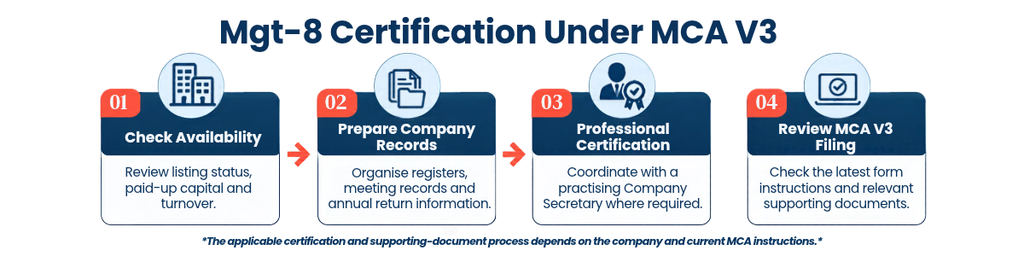
Step 3: Check MGT-8 applicability. Review listing status, paid-up share capital and turnover against the prescribed tests.
Step 4: Reconcile company records. Compare director, shareholder, meeting and other disclosures with statutory records.
Step 5: Review previous filings. Check relevant AOC-4 and annual-return records, SRNs and outstanding matters.
Step 6: Coordinate with the practising Company Secretary. Confirm the scope of examination, records required and the applicable certification workflow.
Step 7: Check current MCA V3 instructions. Use the latest form and filing instructions rather than an old screenshot or checklist.
Step 8: Retain supporting documents. Maintain the records, professional communications and filing acknowledgements relevant to the annual return.
Frequently asked questions
1. What is MGT-8 certification?
MGT-8 is a certification of a company’s annual return by a Company Secretary in Practice under Section 92(2) of the Companies Act, 2013, where the prescribed criteria apply.
2. Is MGT-8 mandatory for all companies?
No. It applies to listed companies and companies meeting the prescribed paid-up share capital or turnover threshold.
3. What is the paid-up capital threshold for MGT-8?
The prescribed threshold is paid-up share capital of ₹10 crore or more.
4. What is the turnover threshold for MGT-8?
The prescribed turnover threshold is ₹50 crore or more.
5. Does a company need to meet both thresholds?
No. The paid-up share capital and turnover tests are alternative criteria. Meeting either one can trigger the requirement, subject to the applicable rules.
6. Has MGT-8 been integrated into MGT-7 under MCA V3?
ICSI’s December 2025 advisory states that MGT-8 certification has been integrated into the MGT-7 e-form as a static field.
7. Is the separate MGT-8 certificate still relevant?
ICSI’s advisory recommends continuing to prepare certification on the letterhead of a Peer Reviewed Practice Unit and attaching it as an optional attachment, pending further MCA clarification or rules. Check the latest position before filing.
8. Who can issue MGT-8 certification?
The certification under Section 92(2) is by a Company Secretary in Practice, where the statutory criteria apply.
9. Does every company filing MGT-7 need MGT-8?
No. MGT-7 filing and MGT-8 certification have different applicability tests.
10. What documents should a company prepare?
Relevant statutory registers, financial statements, Board and general meeting records, director and shareholder details, previous filings and supporting documents should be organised. The professional will confirm the specific records required.
11. Does MGT-8 replace the annual return?
No. MGT-8 is certification; MGT-7 or MGT-7A is the annual-return filing form.
12. Where should companies check the latest filing requirements?
Companies should check the Ministry of Corporate Affairs portal, applicable rules and form instruction kits, and seek guidance from a practising Company Secretary.
Conclusion
MGT-8 certification is an important part of annual-return compliance for listed companies and companies meeting the prescribed paid-up share capital or turnover criteria.
The MCA V3 integration has changed how certification appears in the MGT-7 workflow. ICSI’s December 2025 advisory also provides professional guidance on maintaining a separate certification document as an optional attachment pending further clarification.
Companies should therefore avoid relying on outdated filing procedures. Confirm the applicability criteria, organise statutory records, reconcile annual-return disclosures and coordinate with a practising Company Secretary before submitting the form.
Need help preparing your company’s ROC annual filing? FilingPoint can help you review your annual compliance requirements and coordinate the documentation needed for the filing process.
Contact FilingPoint:
Phone: +91 72999 72500
Email: enquiry@filingpoint.com
Disclaimer: This article is for general informational purposes and is not a substitute for professional legal or company-secretarial advice. Applicability depends on the company’s facts, the relevant financial year and the latest statutory provisions, MCA forms and official clarifications.
