
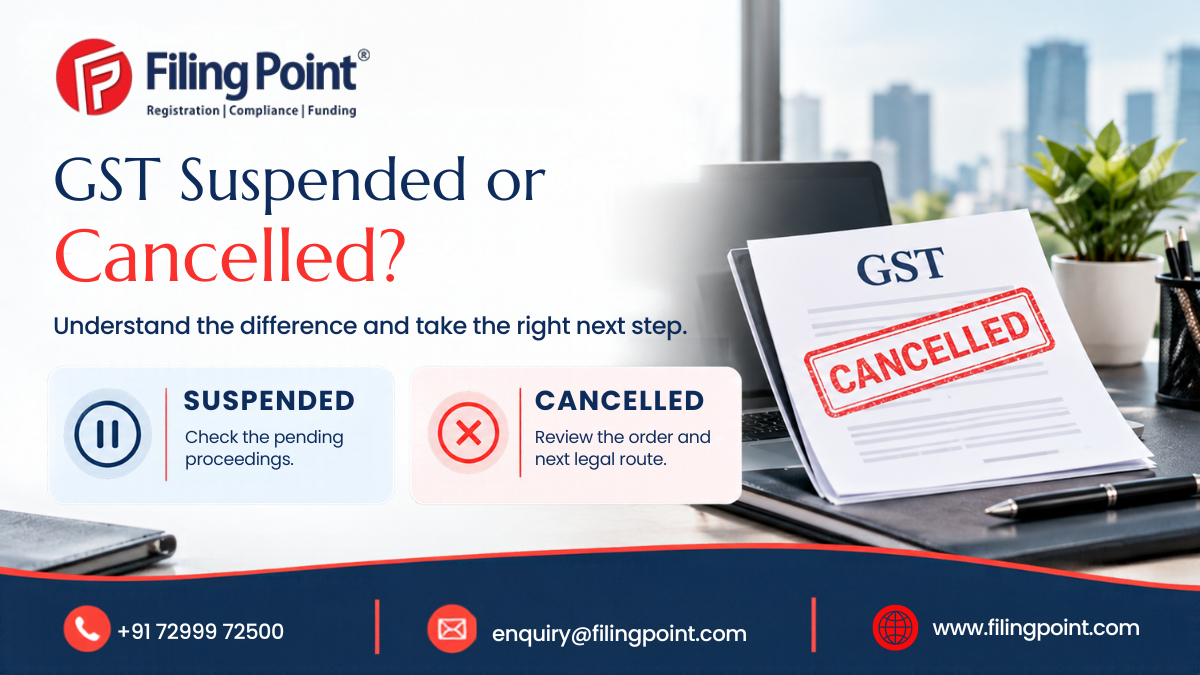
A business may obtain GST registration, start issuing invoices and build its customer base, only to discover that its registration has been suspended or cancelled by the tax department.
This can be worrying, especially when customers expect GST invoices, payments are pending, or the business needs to continue trading.
The first thing to understand is that GST registration cancellation is not the same as rejection of a new GST registration application. Rejection occurs when an application for registration is not approved. Cancellation affects a registration that already exists.
The solution is not always to submit another registration application. Depending on the reason, you may need to respond to a notice, correct a compliance issue, apply for revocation, or consider another legally appropriate route.
This guide explains how to assess a cancelled GST registration in India, what to check before taking action, and how to avoid repeating the same problem.
What does GST registration cancellation mean?
GST registration cancellation means that the existing registration has been cancelled under the applicable GST provisions. Cancellation may occur following an application by the taxpayer or action initiated by the proper officer.
The reasons and procedures differ according to the circumstances. For example, a business may apply for cancellation because it has discontinued operations or is no longer liable to be registered. The department may initiate cancellation proceedings where it believes a legal or compliance condition has been breached.
Section 29 of the Central Goods and Services Tax Act, 2017, addresses cancellation of registration. It also makes clear that cancellation does not automatically remove tax liabilities or other obligations relating to the period before cancellation. The applicable provisions and state GST law should be checked for the particular case.
Important: Do not assume that a cancelled GSTIN has erased past tax liabilities, pending returns or earlier non-compliance.
Why might the GST department cancel a registration?
The exact reason should be stated or explained in the relevant notice or order. Common issues that can lead to cancellation proceedings include:
- Failure to file required GST returns for the applicable period.
- The business not operating from its declared place of business.
- Registration obtained through fraud, wilful misstatement or suppression of facts.
- Certain invoicing or input tax credit violations.
- Other breaches covered by the applicable GST Act and Rules.
These are examples, not a complete list of every possible ground. The legal basis and facts in the department’s order matter.
Why the reason matters
Two businesses may both see “cancelled” in their GST portal status but require different next steps.
A taxpayer whose registration was cancelled because returns were not filed may need to address outstanding returns and liabilities. A taxpayer whose case concerns the declared business premises may need to examine the premises records, actual business operations and the department’s findings.
The correct response should address the actual reason rather than simply submitting a generic explanation.
Suspension vs cancellation: check the exact status
Suspension and cancellation are not interchangeable terms.
A GST registration may be suspended while cancellation proceedings are pending or in circumstances provided by the rules. Cancellation is a formal outcome that changes the registration status.
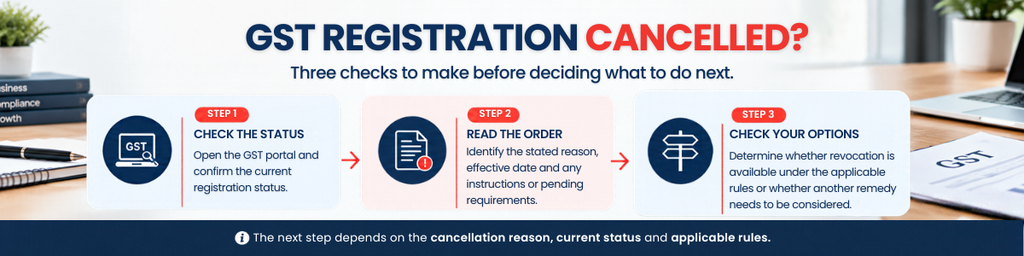
Before taking action, check:
- The status shown on the GST portal.
- Whether a notice has been issued.
- Whether a cancellation order has been passed.
- The date the order was served.
- The effective date of cancellation, if applicable.
- Whether any reply or application is pending.
Do not rely only on an email notification, an old screenshot or what a third party has told you. Review the actual portal record and order.
What should you do immediately after receiving a cancellation order?
Use this sequence to organise the case before filing anything.
Step 1: Download the notice and order
Keep copies of the show-cause notice, your reply, the cancellation order and related correspondence. Record the dates on which the documents were issued and served.
Step 2: Identify the legal reason
Read the reasons carefully. Note the rule or provision cited, the facts alleged and whether the order discusses unanswered notices, missing returns, address verification or another issue.
Step 3: Check your return-filing position
Review the returns due before cancellation, including any periods for which the portal shows outstanding filings. Compare portal information with your accounting records.
Step 4: Review tax and other dues
Check whether tax, interest, late fees or penalties are outstanding. Do not assume that filing a missing return alone resolves every liability.
Step 5: Check whether revocation is available
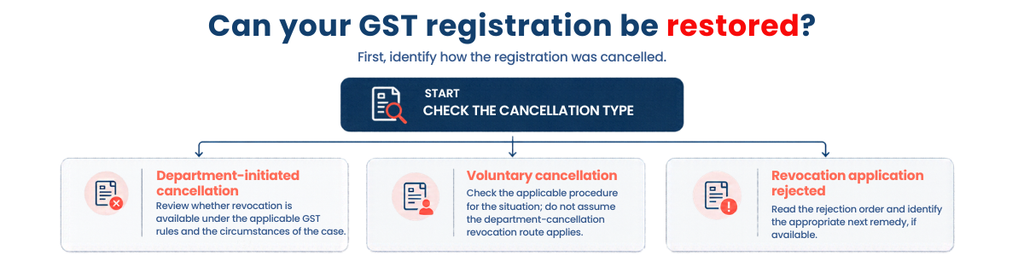
Revocation is generally relevant when the proper officer has cancelled registration on their own motion. It is not the same as requesting cancellation voluntarily.
If your case does not qualify for revocation, the next step may be different. Verify the legal route before submitting a form.
Step 6: Prepare an evidence-based response
Collect documents that directly address the reason for cancellation. For example, a premises-related case may need relevant address and business-operation evidence. A return-default case needs a return and payment review.
Step 7: Track the next deadline
Record the relevant date and any deadline in the notice, order or applicable rule. If the time limit is close or has passed, obtain advice promptly rather than waiting for another reminder.
What is revocation of GST registration cancellation?
Revocation means reversing a cancellation made by the proper officer, subject to the applicable law and procedure.
Section 30 of the CGST Act and Rule 23 of the CGST Rules deal with revocation of cancellation. The process is not available in every situation: the cancellation must be of the kind for which revocation is permitted.
A taxpayer who voluntarily applied to cancel their GST registration should not assume that the same revocation procedure automatically applies. First establish how the cancellation occurred and what order was passed.
Is revocation automatic?
No. An application must meet the applicable conditions and be considered by the proper officer. Filing an application does not itself prove that the registration has been restored.
The taxpayer should monitor the application and any notice or clarification request issued during the process.
What is Form GST REG-21 used for?
Form GST REG-21 is used for an application to revoke cancellation of GST registration where the applicable rules permit it.
Before filing, verify that:
- The cancellation was initiated by the proper officer.
- The case qualifies for revocation.
- Any required returns have been filed.
- Tax and related amounts required under the rules have been paid.
- The explanation and supporting evidence address the cancellation grounds.
- The application is within the applicable time limit, or a permitted extension route is available.
The current rule text and the portal’s live workflow should be checked before submission because procedures and time limits may change.

What if GST registration was cancelled because returns were not filed?
Non-filing requires careful attention because an application for revocation may not be considered until the relevant return defaults and associated dues have been addressed as required by the rules.
Start by preparing a period-wise list of returns that remain pending. Check the return type, tax period, filing status and any tax, interest, penalty or late fee applicable to the case.
Then reconcile the return information with sales, purchase, bank and accounting records. Filing returns without checking the underlying data can create additional inconsistencies.
A practical checklist
- Identify all pending returns and periods.
- Reconcile outward supplies and tax reported.
- Check eligible input tax credit against supporting records and applicable conditions.
- Calculate outstanding liabilities using current information.
- File the returns required for the case.
- Pay the amounts legally due.
- Keep acknowledgements and payment records.
- Review the cancellation order and the current revocation requirements before applying.
Do not assume that clearing one return will automatically restore registration. Follow the required procedure and wait for the relevant order or status update.
What if the deadline for revocation has passed?
Do not assume that the only option is to apply for a new GST registration.
The applicable time limit and any permitted extension must be checked against the current version of Rule 23, relevant notifications and the dates in your case. The current rule text provides for an initial period and a possible extension in qualifying circumstances, subject to the conditions and authority specified in the rule.
This is an area where old online articles can be misleading: earlier versions of the rules used different time limits.
If the deadline appears to have passed:
- Confirm the date on which the cancellation order was served.
- Check the rule and amendments applicable to your case.
- Determine whether a permitted extension or other remedy remains available.
- Prepare evidence explaining the delay, where relevant.
- Obtain professional advice if the registration is essential to ongoing operations.
Never rely on a generic statement such as “you always have 30 days” or “you can apply at any time.” The applicable law and case facts control.
What if the revocation application is rejected?
A rejected revocation application should be reviewed carefully before taking another step.
Read the rejection order and identify whether the issue relates to eligibility, outstanding returns, payment, missing evidence, an unanswered notice or the time limit.
Do not repeatedly submit the same application without addressing the reason for rejection.
Depending on the facts and applicable law, the next step may involve responding to a notice, reviewing whether an appeal or other remedy is available, or correcting a procedural issue where permitted. The right route depends on the order and the statutory framework.
Keep copies of the application, acknowledgement, notices, replies and rejection order. These documents are important for understanding the decision and assessing available options.
Can you continue business after GST registration is cancelled?
A business should not assume it can continue treating itself as a registered taxpayer after cancellation.
The consequences depend on the effective date, the nature of supplies, the applicable provisions and whether a later order restores the registration. A cancelled registration can affect invoicing, tax collection, input tax credit and dealings with customers.
At the same time, cancellation does not necessarily mean that every business activity must cease permanently. The business should obtain advice on what activities may lawfully continue, what tax obligations remain and whether registration is required for future supplies.
Do not issue invoices that represent the business as currently GST-registered if that status is no longer valid. Check the law and the actual registration status before making tax representations to customers.
What happens to earlier tax liabilities and records?
Cancellation does not automatically wipe out obligations relating to earlier periods. Section 29(3) addresses the continuation of liability for tax and other dues and obligations for the period before cancellation.
A business should retain its invoices, books, return records, payment receipts, bank records, purchase documents and correspondence with the department.
If registration is restored, reconcile the period covered by the cancellation and the restoration order. Check which returns or other actions remain necessary and confirm how the portal reflects the status.
A business should not assume that restoration alone fixes every historical issue.
Common mistakes to avoid
Mistake 1: Confusing cancellation with application rejection
They are different procedures. A business that already had a GSTIN should begin with its cancellation order and status.
Mistake 2: Filing without checking the order
The response should address the actual cancellation grounds.
Mistake 3: Ignoring pending returns
Where return defaults are involved, required returns and dues can be central to the revocation process.
Mistake 4: Relying on outdated time limits
Check the current rule and applicable amendments, not an old blog post.
Mistake 5: Assuming revocation is available after every cancellation
The route depends on how cancellation occurred and the applicable provisions.
Mistake 6: Ignoring earlier tax obligations
Cancellation does not erase every liability relating to the pre-cancellation period.
Mistake 7: Treating a submitted application as approval
Track the application and obtain confirmation of the actual outcome.
A practical decision guide
| Your situation | What to review first |
| You received a cancellation notice but no final order | Notice, reply deadline and evidence |
| Your GST registration is suspended | Portal status and pending proceedings |
| The officer has cancelled registration | Order, effective date and revocation eligibility |
| Cancellation relates to missing returns | Pending returns, tax and related dues |
| You applied for cancellation voluntarily | Correct route for your circumstances; do not assume REG-21 applies |
| Your revocation application was rejected | Rejection order and any available remedy |
| The revocation deadline may have passed | Current Rule 23 and possible extension provisions |
| Registration has been restored | Order, portal status, returns and remaining obligations |
This is a starting guide, not a substitute for reviewing the actual order.
How to reduce the risk of future cancellation
A business can reduce avoidable compliance problems by establishing a reliable routine.
- Maintain a calendar for applicable GST return due dates.
- Reconcile books and GST returns regularly.
- Keep the declared principal place of business and supporting records accurate.
- Respond promptly to notices and verification requests.
- Monitor GST portal messages and application status.
- Retain acknowledgements, invoices and payment records.
- Review changes in the business, ownership, premises or registration details.
- Seek help when a notice is unclear or a deadline is approaching.
The objective is not just to restore a GSTIN after cancellation. It is to address the underlying issue so the business can manage its tax obligations more consistently.
Frequently asked questions
1. Can I restore a GST registration cancelled by the department?
Possibly. Revocation may be available when the proper officer cancelled the registration on their own motion and the taxpayer satisfies the applicable conditions. Check the cancellation order and current rules.
2. Which form is used to apply for revocation?
Form GST REG-21 is used for an application for revocation of cancellation where the applicable rules permit it.
3. Can I apply for revocation if I have not filed GST returns?
If cancellation occurred because of return non-filing, the relevant returns and amounts due generally need to be addressed as required by the rules before an application can be filed.
4. Is a cancelled GST registration the same as a rejected GST application?
No. Rejection concerns an application for new registration. Cancellation affects an existing registration.
5. Can I apply for revocation after the deadline?
Possibly, depending on the current rules, any permitted extension and the circumstances. Check the current law and the order’s service date promptly.
6. What if the officer rejects my revocation application?
Review the rejection order and identify the reason. Depending on the facts, an appropriate response or other remedy may be available under the applicable law.
7. Does GST cancellation remove earlier tax liabilities?
No. Cancellation does not automatically remove liabilities or obligations relating to the pre-cancellation period.
8. Should I apply for a new GST registration instead?
Do not assume that a fresh application is the right solution. First determine whether revocation or another route is available and whether a new application would be legally appropriate.
Conclusion
A cancelled GST registration needs a prompt, evidence-based response. Start with the cancellation order, confirm the portal status, identify the reason, review pending returns and liabilities, and determine whether revocation is available.
The correct route depends on the way the registration was cancelled, the applicable deadlines and the taxpayer’s compliance position. Avoid relying on outdated online guidance or submitting forms without understanding the order.
Need help understanding your GST registration status or compliance requirements? Filing Point can help you review the issue and identify the appropriate next steps.
📞 +91 72999 72500
📧 enquiry@filingpoint.com