
Does Every Business Need a Separate Udyam Certificate?
A business owner may operate a manufacturing unit, run a service division, open branches in different states or hold multiple GST registrations. When these activities expand, a practical question arises: should each business activity, branch or GSTIN have a separate Udyam Registration?
The answer is not simply yes or no. It depends on how the enterprise is legally structured, which Permanent Account Number (PAN) it uses and whether the business is adding an activity or creating a genuinely separate legal entity.
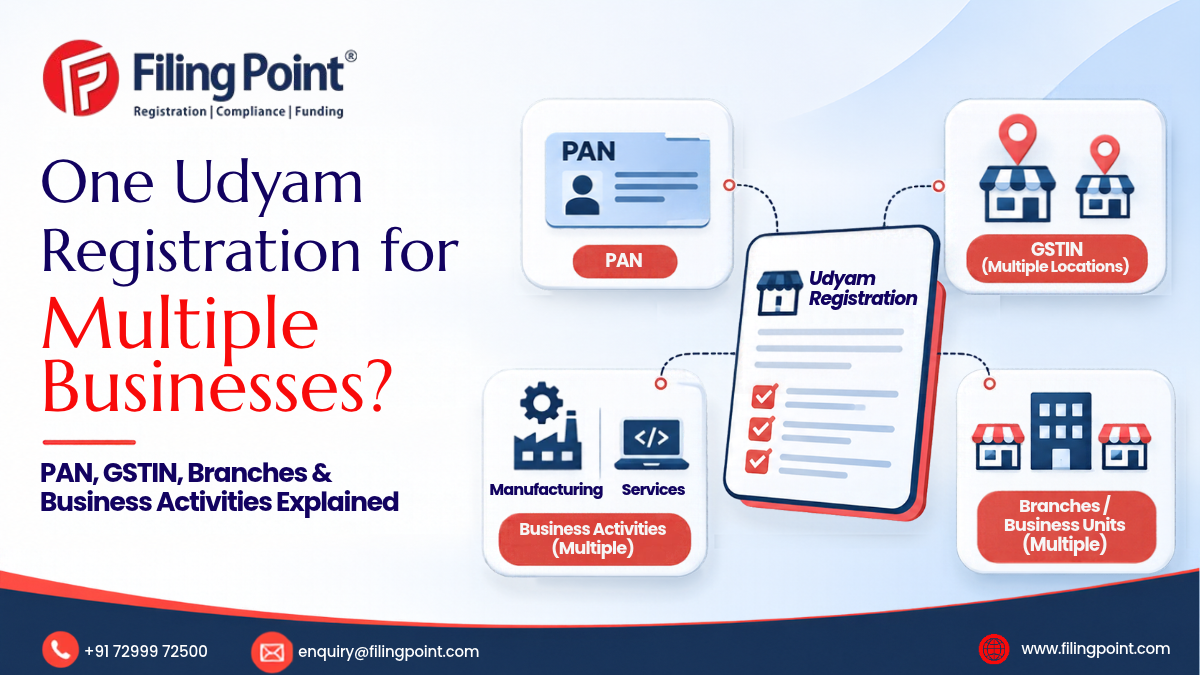
The Ministry of Micro, Small and Medium Enterprises has established a single-registration framework. The official Udyam Registration Portal states that an enterprise cannot file more than one Udyam Registration. However, multiple activities, including manufacturing and services, can be specified or added under one registration.
The rules also connect enterprise classification with PAN. Under the revised MSME framework effective from 1 April 2025, all units with Goods and Services Tax Identification Numbers (GSTINs) listed against the same PAN are collectively treated as one enterprise for classification. Their investment and turnover are considered together.
This means that obtaining another GSTIN, opening another branch or adding a new activity does not automatically create a separate MSME enterprise.
This guide explains how the rules apply to businesses with multiple activities, GSTINs, locations and legal structures.
What Is Udyam Registration?
Udyam Registration is the Government of India’s online registration system for recognising Micro, Small and Medium Enterprises (MSMEs).
An eligible enterprise can register through the official Udyam portal and receive a permanent Udyam Registration Number and an electronic certificate.
The registration is based on self-declaration and government-linked information. The portal states that the process is free and paperless. PAN and GST-linked information is used to obtain relevant investment and turnover details.
Udyam Registration is not the same as:
- Company incorporation under the Companies Act.
- LLP incorporation under the Limited Liability Partnership Act.
- GST registration under GST law.
- A trade licence issued by a local authority.
- A factory licence or sector-specific operating approval.
A business may need more than one of these registrations depending on its legal structure and operations.
For example, a private limited company may have a Certificate of Incorporation, PAN, GSTIN and Udyam Registration. Each serves a different purpose.
Freelancers and independent service providers may also need to understand their eligibility for MSME recognition. If you operate independently, read our guide on Udyam Registration for freelancers in Tamil Nadu.
Can an Enterprise Have More Than One Udyam Registration?
No. The official Udyam Registration framework states that an enterprise shall not file more than one Udyam Registration.
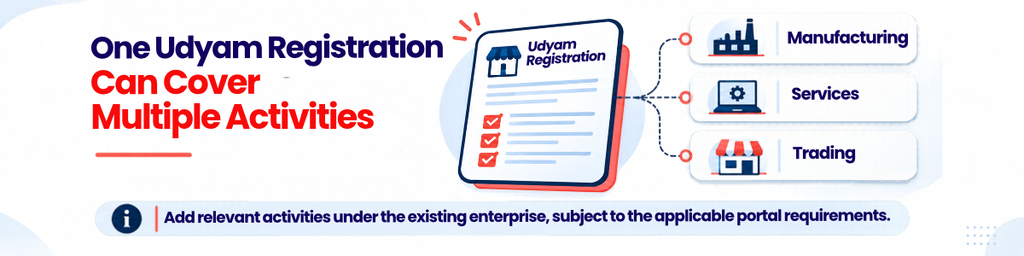
The same rule contains an important clarification: any number of activities, including manufacturing and services, may be specified or added in one registration.
This prevents enterprises from treating every business activity as a separate MSME merely because the activity is different.
Example
Suppose a proprietorship operates:
- A garment manufacturing unit.
- A wholesale clothing business.
- A tailoring and alteration service.
If these activities belong to the same enterprise, the owner should not assume that three separate Udyam certificates are required.
The framework allows multiple activities to be included under one registration, subject to the applicable portal fields and activity-classification requirements.
Why does this rule matter?
The registration identifies an enterprise. It is not intended to create a separate MSME identity for every product, service, branch or revenue stream.
Before applying for another Udyam number, determine whether the proposed activity belongs to an existing enterprise or a genuinely separate legal entity.
Can You Have Multiple Udyam Registrations Using the Same PAN?
The MSME Development and Facilitation Office’s FAQ dated 8 July 2024 directly addresses this question.
It states that only one MSME can register using a single PAN.
This is consistent with the Udyam portal’s one-registration rule. A business should not attempt to obtain separate Udyam registrations for the same PAN simply because it operates under different trade names, has different branches or carries out different activities.
Example: One Proprietor, Two Business Names
Assume a person operates:
- ABC Traders, a wholesale business.
- ABC Services, a repair and maintenance business.
Both are operated as proprietorship activities under the same proprietor’s PAN.
The two trade names do not automatically create two separate legal persons. The owner should not treat them as two independent enterprises for the purpose of obtaining separate Udyam registrations.
The correct approach is to examine the existing Udyam record and the permitted activity-update process.
What if the business has different GSTINs?
Different GSTINs do not necessarily mean different enterprises. GST registrations are state-specific and linked to the PAN of the legal person or entity.
Where multiple GSTINs are listed against the same PAN, the MSME classification framework requires the units to be considered collectively.
Can One Udyam Registration Cover Multiple GSTINs?
Yes, the MSME framework recognises that one enterprise may have multiple GSTIN-linked units.
Under the revised classification notification, all units with GSTINs listed against the same PAN are collectively treated as one enterprise. Their investment and turnover are considered together when determining the MSME category.
Example: A Company Operating in Three States
Suppose XYZ Private Limited operates in:
- Tamil Nadu, with one GSTIN.
- Karnataka, with another GSTIN.
- Maharashtra, with a third GSTIN.
All three GSTINs belong to the same company PAN.
The enterprise should not assume that it needs three separate Udyam registrations merely because it has three state GST registrations.
For MSME classification, the investment and turnover of the units listed against that PAN are aggregated.
Why does the government aggregate turnover?
Without aggregation, a business could potentially split its operations across locations or registrations and present each unit as a smaller enterprise.
The PAN-based aggregation rule helps prevent artificial fragmentation of one enterprise’s turnover and investment for MSME classification.
Important distinction
GST registration and Udyam Registration have different purposes.
| GSTIN | Udyam Registration |
| Identifies a GST registration under GST law | Identifies an MSME enterprise |
| May differ by state or registration requirement | One registration per enterprise |
| Linked to PAN | Uses PAN-linked enterprise information |
| Used for GST compliance | Used for MSME recognition and classification |
A business should not confuse the number of GST registrations with the number of Udyam registrations it can obtain.
Does Every Branch or Factory Need a Separate Udyam Registration?
Not automatically.
A business may operate more than one unit, branch, office, shop or factory. The existence of a separate location does not by itself establish that the location is a separate enterprise for Udyam purposes.
The MSME-DFO FAQ explains that an enterprise may have more than one unit against the same Udyam Registration Number.
Example: A Manufacturer With Two Factories
A company has:
- One manufacturing unit in Chennai.
- Another manufacturing unit in Coimbatore.
- A sales office in Bengaluru.
If these units belong to the same legal enterprise and PAN, the business should not assume that each location requires a separate Udyam registration.
The business should maintain accurate unit, address, activity and GST details in the relevant records.
What should the business check?
Before adding a unit or opening another location, review:
- Whether the new unit belongs to the same legal entity.
- Whether it uses the same PAN.
- Whether a separate GST registration is required.
- Whether the new activity must be added to the Udyam record.
- Whether any separate factory, labour, local-body or environmental approvals are required.
Udyam Registration does not replace location-specific licences or operating approvals.
Can Manufacturing and Service Activities Be Included in One Udyam Registration?
Yes. The official Udyam portal expressly allows multiple activities, including manufacturing and services, to be specified or added in one registration.
This is relevant for businesses that combine production with installation, maintenance, repair, consulting, distribution or other services.
Example: A Machinery Manufacturer
A business manufactures industrial machinery and also provides:
- Installation.
- Repair and maintenance.
- Technical support.
- Equipment servicing.
These activities may be recorded under the same Udyam registration, provided they belong to the same enterprise and are correctly classified.
Why are NIC codes important?
The National Industrial Classification (NIC) system is used to identify economic activities.
Selecting an appropriate NIC code helps describe what the enterprise actually does. A business should not select codes merely to make its certificate appear broader.
The MSME-DFO FAQ dated 8 July 2024 refers to a maximum of ten NIC codes in one registration. Because portal functionality and instructions can change, applicants should verify the current portal’s permitted activity fields before relying on a numerical limit.
The practical point remains: include relevant activities accurately rather than applying for multiple Udyam registrations for different business functions.
Can a Proprietor Have One Udyam Registration and a Private Limited Company Have Another?
This requires a distinction between a person’s identity and an enterprise’s legal identity.
A proprietorship is not a separate legal person from its proprietor. Its PAN is generally the proprietor’s PAN.
A private limited company is a separate legal entity and has its own PAN.
Therefore, where a person operates a proprietorship and also owns or manages a separately incorporated company, the two structures should not automatically be treated as one enterprise merely because the same individual is involved.
The company and proprietorship have different legal identities and PANs.
However, the business owner should verify the current portal requirements, Aadhaar authentication and enterprise details for each registration. The Udyam framework does not allow duplicate registrations for the same enterprise or PAN.
Example
A person operates:
- A proprietorship under their individual PAN.
- A private limited company under the company’s PAN.
These are different legal structures. Each must be assessed on its own facts and eligibility.
Do not use a different trade name or business address as a substitute for a separate legal identity.
What Happens When a Proprietorship Becomes a Private Limited Company?
A conversion or restructuring can affect the Udyam registration because the legal constitution and PAN may change.
The MSME-DFO FAQ dated 8 July 2024 states that when the constitution of an enterprise changes, a fresh request for a Udyam certificate is required. It describes cancellation of the existing certificate followed by a fresh certificate request.
This is an important distinction from a simple address or activity update.
Example
A proprietor operates a small manufacturing business and later incorporates a private limited company to take over the operations.
The proprietor should not assume that the old proprietorship Udyam certificate can simply be edited to show the company name.
The business should review:
- The old enterprise’s legal constitution.
- The new company’s incorporation documents and PAN.
- Existing Udyam registration details.
- The cancellation and fresh-registration procedure.
- GST and other registrations that may also require changes.
Because restructuring can affect contracts, tax registrations, licences and benefits, professional review is advisable before changing the records.
How Are Turnover and Investment Calculated for Multiple GSTINs?
The MSME classification framework uses a composite criterion based on investment and turnover.
From 1 April 2025, the revised limits are:
| MSME category | Investment limit | Turnover limit |
| Micro | Up to ₹2.5 crore | Up to ₹10 crore |
| Small | Up to ₹25 crore | Up to ₹100 crore |
| Medium | Up to ₹125 crore | Up to ₹500 crore |
Both criteria are relevant. An enterprise must satisfy the applicable investment and turnover ceilings for its category.
PAN-based aggregation
Where multiple GSTIN-linked units are listed against the same PAN, the investment and turnover of those units are considered together for classification.
Example
A business has two units under the same PAN:
- Unit A turnover: ₹4 crore.
- Unit B turnover: ₹3 crore.
The combined turnover is ₹7 crore, not ₹4 crore and ₹3 crore as two unrelated enterprises.
The same aggregation principle applies to investment in plant and machinery or equipment as per the applicable framework.
Do not calculate the MSME category using only one branch’s sales when the enterprise has multiple PAN-linked GSTIN units.
Can You Add a New Business Activity to an Existing Udyam Registration?
The Udyam framework allows multiple activities to be included in one registration.
If an existing enterprise starts a new activity, the owner should review whether the activity needs to be added or updated in the Udyam portal.
For example, a business originally engaged in wholesale trading may later begin manufacturing its own products.
Instead of assuming that a second Udyam certificate is required, the enterprise should check the update facility and add the relevant activity information where permitted.
Before updating
Check:
- Whether the new activity is actually being carried out.
- The correct NIC classification.
- Whether the activity changes the enterprise’s investment or turnover profile.
- Whether additional GST or sector-specific licences are needed.
- Whether the current Udyam portal allows the required update.
A new activity may also create separate regulatory obligations. Adding it to Udyam does not automatically grant permission to operate a factory, sell regulated products or provide licensed services.
What If a GSTIN Is Missing From the Udyam Certificate?
Udyam uses PAN and GST-linked information from government databases. However, a business owner may notice that a GSTIN or unit detail is not reflected as expected.
Do not immediately apply for another Udyam number.
First check whether:
- The GSTIN is active.
- The GSTIN is linked to the correct PAN.
- The GST registration belongs to the same legal entity.
- The GST details have been updated in the relevant government systems.
- The Udyam record requires an update or the portal needs time to reflect the linked data.
If the issue continues, use the official Udyam update or grievance facility and retain the relevant acknowledgement or reference details.
Do not share Aadhaar OTPs, PAN details or login credentials with unauthorised agents.
What If the Same PAN or Aadhaar Has Already Been Used?
The MSME-DFO FAQ explains that one PAN cannot be used for multiple Udyam registrations. It also states that a single Aadhaar number may be used in more than one registration in specified circumstances.
This distinction matters because Aadhaar authentication and enterprise PAN are not the same thing.
If the portal says that PAN or Aadhaar details have already been used, first determine whether an existing Udyam certificate has been created.
The 2024 FAQ advises that if someone has used an applicant’s Aadhaar and PAN without authorisation and a certificate has been issued, the enterprise may raise a complaint through the Champions Portal and approach the concerned MSME Development and Facilitation Office.
Do not try to solve an unauthorised-use issue by submitting repeated registrations with altered information.
What Documents and Information Should You Keep Ready?
Udyam registration is paperless and the portal states that documents do not need to be uploaded as part of the ordinary registration process.
However, the business should keep its information accurate and accessible.
Depending on the legal structure, prepare to verify:
- Aadhaar details of the relevant proprietor, managing partner, Karta or authorised signatory.
- PAN of the enterprise.
- GSTIN details, where applicable.
- Business name and constitution.
- Business address and unit information.
- Bank account details requested by the portal.
- Relevant NIC activity details.
- Investment and turnover information available through government records.
For companies and LLPs, the organisation’s PAN and GSTIN details and the authorised signatory’s Aadhaar authentication are relevant under the registration framework.
Do not upload documents to unofficial websites claiming to provide government Udyam registration.
Common Mistakes Businesses Should Avoid
Mistake 1: Applying for a New Udyam Number for Every GSTIN
Multiple GSTINs under the same PAN do not automatically create multiple enterprises for MSME classification.
Mistake 2: Treating Every Branch as a Separate Enterprise
A new branch or factory location does not by itself justify a separate Udyam registration.
Mistake 3: Registering Each Business Activity Separately
The official framework permits multiple activities under one registration.
Mistake 4: Using Different Trade Names to Justify Separate Registrations
A trade name does not automatically create a separate legal entity or PAN.
Mistake 5: Ignoring a Change in Legal Constitution
A change from proprietorship to company or another legal structure may require cancellation and fresh Udyam registration under the MSME-DFO FAQ.
Mistake 6: Selecting Incorrect NIC Codes
Activity codes should describe the actual business operations. Incorrect classification can create confusion when the enterprise seeks MSME-related benefits or updates its details.
Mistake 7: Assuming Udyam Registration Replaces Other Licences
Udyam is not a substitute for GST, factory, pollution-control, trade or other applicable registrations.
How FilingPoint Can Help With Udyam Registration and Updates
Businesses often need help identifying the correct enterprise structure before applying for Udyam Registration.
FilingPoint can assist with reviewing the business structure, identifying relevant activity information and supporting the registration or update process.
Before proceeding, the business should establish:
- Whether it already has a Udyam Registration.
- Which PAN is associated with the enterprise.
- Whether multiple GSTINs belong to the same PAN.
- Whether the business is adding an activity or changing its legal constitution.
- Whether the existing certificate needs an update or cancellation followed by fresh registration.
For assistance, contact FilingPoint at +91 72999 72500 or enquiry@filingpoint.com.
Frequently Asked Questions
1. Can I have two Udyam registrations with the same PAN?
No. The MSME-DFO FAQ states that only one MSME can register using a single PAN. The Udyam portal also says that an enterprise cannot file more than one Udyam Registration.
2. Can one Udyam registration have multiple GSTINs?
An enterprise may have multiple GSTIN-linked units under the same PAN. Those units are collectively treated as one enterprise for MSME classification. Check that the GSTINs are correctly linked to the enterprise.
3. Do I need a separate Udyam registration for every branch?
Not automatically. Multiple units may be covered under one Udyam registration when they belong to the same enterprise. Separate licences may still be required for individual locations.
4. Can I add manufacturing and service activities to one Udyam certificate?
Yes. The official portal allows multiple activities, including manufacturing and services, to be specified or added in one registration.
5. Can a proprietor and a private limited company have separate Udyam registrations?
They have different legal identities and generally different PANs. Each structure should be assessed independently, subject to the one-registration-per-enterprise rule and current portal requirements.
6. What happens if a proprietorship becomes a private limited company?
The MSME-DFO FAQ dated 8 July 2024 says a change in constitution requires cancellation of the existing Udyam certificate and a fresh certificate request.
7. Are turnover and investment combined for multiple GSTINs?
Yes. Where GSTIN-linked units are listed against the same PAN, their investment and turnover are collectively considered for MSME classification.
8. Is Udyam registration free?
Yes. The official Udyam portal states that there is no government filing fee for Udyam registration. A professional may separately charge for advisory or assistance services, but that is not a government registration fee.
9. Can I use one Aadhaar number for multiple Udyam registrations?
The MSME-DFO FAQ dated 8 July 2024 states that one Aadhaar number may be used for up to five fresh registrations in the circumstances described in that FAQ. This does not override the one-registration-per-PAN rule. Verify current portal requirements before applying.
10. What should I do if my GSTIN is not appearing in my Udyam details?
Check the GSTIN’s active status and PAN linkage first. Then review the Udyam update facility or raise a grievance through the official portal if the mismatch continues.
Conclusion: One Enterprise, One Udyam Registration But Multiple Activities and Units May Be Included
A business does not need a separate Udyam certificate for every branch, GSTIN or activity.
The official framework permits multiple manufacturing and service activities under one registration. The revised MSME classification rules also aggregate units with GSTINs listed against the same PAN.
The important question is whether the business is the same enterprise or a genuinely separate legal entity.
Before applying for another Udyam number, review the PAN, legal constitution, GSTIN structure and existing registration. If the legal constitution has changed, check the cancellation and fresh-registration procedure rather than simply editing the old certificate.
Getting this right helps avoid duplicate registrations, incorrect enterprise classification and unnecessary compliance confusion.
