
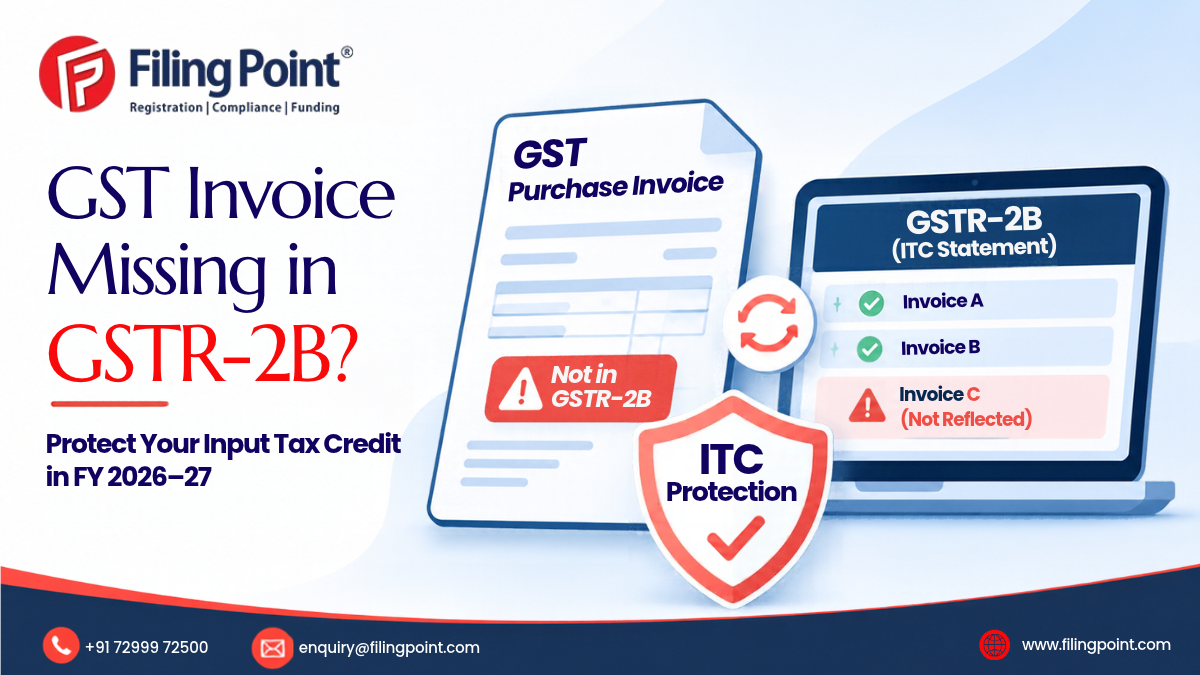
You Paid GST, but the Invoice Is Missing From GSTR-2B. What Happens Next?
Imagine purchasing goods worth ₹5 lakh for your business. Your supplier issues a tax invoice charging ₹90,000 as GST. You receive the goods, record the purchase in your accounts and pay the supplier.
When your accountant reviews GSTR-2B, however, the invoice is missing.
Your purchase register shows ₹90,000 of potential input tax credit (ITC), but the corresponding invoice is not reflected in the relevant GSTR-2B statement.
Can you claim the credit? Should you wait for the supplier? Does the missing invoice mean the GST amount is permanently lost?
These are important questions because paying GST to a supplier and becoming legally entitled to input tax credit are not necessarily the same thing.
Under the GST framework, ITC eligibility depends on several statutory conditions, including possession of the appropriate tax document, receipt of goods or services, supplier reporting and other applicable restrictions.
GSTR-2B is an important part of that process. It helps businesses identify reported purchase documents and assess the credit available for the relevant return period.
For manufacturers, wholesalers, retailers, service providers, exporters and growing SMEs, missing invoices can affect cash flow, compliance decisions and the accuracy of GST returns.
This guide explains the overall legal and business framework for protecting input tax credit in FY 2026–27. It also outlines the controls businesses should establish to identify problems early and reduce avoidable ITC disputes.
Why GSTR-2B Matters to Every GST-Registered Business
Input tax credit is a central feature of India’s Goods and Services Tax system.
A registered business may, subject to the law, use eligible GST paid on business purchases to offset its output GST liability.
Consider a simplified example.
A business collects ₹1,80,000 in output GST on its sales. It also has ₹90,000 of eligible input tax credit from purchases.
If the entire ₹90,000 is legally available and can be utilised against the relevant output liability, the business may need to discharge the remaining ₹90,000 through other available credits or cash, as applicable.
Now imagine that the business cannot establish eligibility for the ₹90,000 credit because the relevant purchase details have not been properly reported.
Its immediate tax funding requirement may increase.
This is why GSTR-2B reconciliation is more than an accounting exercise. It is part of managing tax exposure and business liquidity.
What is GSTR-2B?
GSTR-2B is an auto-drafted input tax credit statement generated from specified supplier and other government-system information.
It includes relevant details furnished through returns such as GSTR-1, GSTR-1A, GSTR-5 and GSTR-6, as applicable, along with certain import-related information.
The statement helps recipients identify credit information for their GST return preparation.
However, GSTR-2B is not itself a tax invoice, a return that the recipient files or a final legal determination that every displayed credit is eligible.
A business must still assess the conditions and restrictions applicable to each credit.
Why a Purchase Invoice Can Be Missing From GSTR-2B
A missing invoice does not always mean that the underlying purchase is fictitious or that the supplier has deliberately failed to comply.
Different commercial and reporting circumstances can produce a mismatch.
For example, a supplier may have issued a valid invoice but not yet furnished the relevant outward-supply details.
Alternatively, the transaction may have been recorded against incorrect recipient information, included in another reporting period or affected by a subsequent amendment.
The important business principle is to identify the actual reason before deciding how to treat the credit.
A company should not assume that every missing invoice has the same explanation.
It should also avoid automatically classifying every mismatch as a permanent tax loss.
Some discrepancies may be capable of correction through the relevant supplier reporting and GST processes. Others may involve substantive eligibility problems or statutory time limits.
Three different questions
When a purchase invoice is absent from GSTR-2B, management should distinguish:
- Commercial validity: Did the business genuinely purchase and receive the goods or services?
- Reporting status: Has the relevant transaction been properly communicated through the GST reporting system?
- Legal eligibility: Are all applicable statutory conditions for claiming ITC satisfied?
These questions are related but should not be treated as interchangeable.
A genuine commercial purchase does not automatically satisfy every GST credit condition.
Likewise, an invoice appearing in a GST statement does not automatically establish that the expenditure qualifies for ITC.
The Legal Foundation: Section 16 of the CGST Act
Section 16 of the Central Goods and Services Tax Act, 2017 establishes the principal framework governing entitlement to input tax credit.
A registered person may be entitled to credit on qualifying goods or services used or intended to be used in the course or furtherance of business, subject to the Act’s conditions and restrictions.
Among the relevant requirements are:
- Possession of a prescribed tax invoice, debit note or other qualifying document.
- Receipt of the goods or services, subject to the statutory provisions.
- Communication of relevant supplier-furnished invoice or debit-note details in the prescribed manner.
- Compliance with applicable restrictions on credit communicated to the recipient.
- Satisfaction of the applicable supplier tax-payment and recipient return-filing conditions.
- Compliance with statutory time limits and other relevant requirements.
The law must be read together with the applicable rules, amendments and notifications.
Why possession of an invoice is not enough
A business may hold a correctly formatted tax invoice and have proof of payment.
Those records are important evidence, but they do not override statutory reporting conditions.
For example, the requirement under Section 16(2)(aa) concerning supplier-furnished details and their communication to the recipient must be considered.
Therefore, a missing invoice should not be treated as an ordinary bookkeeping difference that can simply be ignored.
Why GSTR-2B appearance is not enough either
The reverse assumption is equally dangerous.
An invoice may appear in GSTR-2B even where credit is restricted because of the nature of the expenditure, business use, blocked-credit provisions or another statutory condition.
The GST Portal expressly advises taxpayers to self-assess credit eligibility.
A sound ITC review must therefore examine both reporting status and substantive entitlement.
Section 17: Not Every Business Purchase Qualifies for Full ITC
A business may incur expenditure that is partly connected with taxable business activities and partly connected with exempt or non-business activities.
Section 17 contains provisions governing the apportionment and restriction of input tax credit.
Section 17(5) also identifies categories of blocked credit, subject to the specific exceptions provided in the law.
Consequently, an invoice may be correctly reported and still not generate fully eligible ITC.
This is especially important for businesses with mixed operations.
Example: A business with taxable and exempt supplies
Suppose a company purchases services used partly for taxable operations and partly for exempt activities.
The company should not assume that the entire GST charged on the invoice is available as credit.
It must consider the applicable apportionment provisions and calculations.
Similarly, certain expenditure categories may be subject to specific restrictions regardless of whether the supplier has reported the invoice.
What businesses should learn
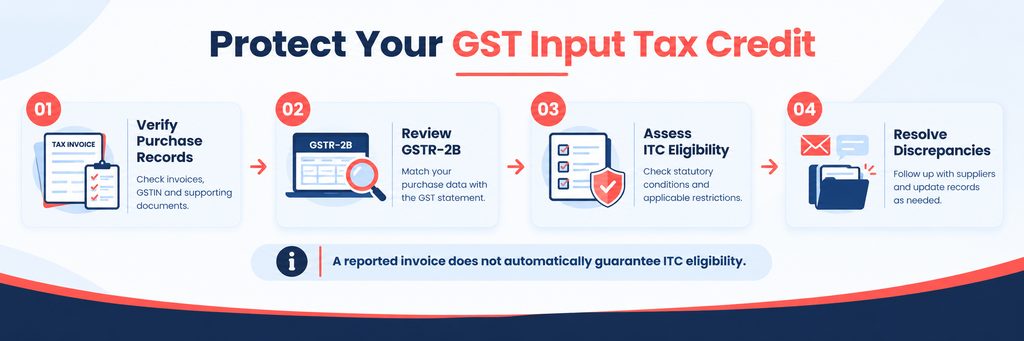
GSTR-2B reconciliation is not simply a process of comparing two totals.
The company must establish which credits are legally available and which require restriction, reversal or further review.
That assessment should be documented consistently.
The Financial Impact of Missing Input Tax Credit
A missing GST invoice can create a larger business problem than the value of the disputed tax alone.
The immediate effect may be additional working capital tied up in tax payments.
But the consequences can extend to budgeting, supplier relationships, financial reporting and compliance management.
Cash-flow pressure
Where credit cannot presently be availed, the business may need to fund a larger portion of its GST liability through cash or other eligible credit.
For a small enterprise operating on limited margins, this can affect its ability to purchase inventory or meet other obligations.
Profitability and pricing
If a credit ultimately becomes unavailable, the GST amount may increase the effective cost of the purchase, subject to the applicable accounting treatment.
That can influence margins and pricing decisions.
Management uncertainty
Unresolved ITC balances create uncertainty over whether an amount is recoverable, temporarily unavailable or likely to become a permanent cost.
Businesses need reliable information to make these assessments.
Compliance exposure
An incorrect ITC claim may lead to scrutiny, demand proceedings, interest or other consequences depending on the facts and applicable law.
Not every mismatch results in a tax demand, but unresolved differences increase the need for evidence and careful review.
Supplier Compliance Is Part of Your GST Risk
A purchaser may maintain accurate books and still experience ITC problems because relevant supplier reporting is incomplete or incorrect.
This creates a practical dependency between a business and its vendors.
A company that purchases from dozens or hundreds of suppliers cannot rely only on its internal accounting records.
It must also consider how supplier reporting affects its GST position.
Why procurement teams should be involved
GST reconciliation is often assigned entirely to the accounts department.
However, procurement teams control important aspects of the supplier relationship.
They select vendors, negotiate commercial terms, approve purchases and maintain communication with suppliers.
If procurement and accounts operate independently, GST mismatches may remain unresolved for several months.
A stronger system brings the two functions together.
Supplier onboarding controls
Before entering a significant recurring supplier relationship, a business should consider verifying:
- The supplier’s GST registration details.
- Whether the invoice will be issued under the correct legal name and GSTIN.
- The contractual responsibility for providing accurate tax documents.
- The process for resolving reporting discrepancies.
- The contact person responsible for GST-related corrections.
These checks do not guarantee supplier compliance.
They do, however, improve the business’s ability to identify and resolve problems.
Building a Reliable ITC Governance System
Businesses should not treat GST reconciliation as an activity performed only when the annual accounts are finalised.
An effective system identifies discrepancies during the ordinary monthly or quarterly compliance cycle, as applicable.
The purpose is to prevent small reporting issues from becoming unresolved historical disputes.
Assign clear responsibility
A company should identify who is responsible for:
- Maintaining purchase records.
- Reviewing GST statement information.
- Identifying potential credit restrictions.
- Communicating with suppliers.
- Approving credit-related return positions.
- Escalating unresolved issues.
For a small business, one person may handle several responsibilities.
For a larger enterprise, different functions may need defined roles.
Maintain a documented review process
A reliable process should not depend entirely on an employee remembering to check a particular supplier.
The business should maintain a recurring review calendar and documented responsibilities.
A standard review should identify material discrepancies, assess their financial significance and record the action required.
Escalate significant risks
Not every discrepancy requires the same level of attention.
A minor clerical issue may be managed through ordinary follow-up.
A large disputed credit, repeated supplier non-compliance or a time-sensitive statutory issue may require management or professional review.
The business should establish reasonable escalation criteria based on its transaction volume and risk exposure.
Why Internal Accounting Records Still Matter
GSTR-2B is an important source of reported GST information, but it does not replace the company’s books.
The purchase register, general ledger, supplier accounts, tax invoices and supporting commercial records remain important.
These records help establish the nature and authenticity of the underlying transaction.
For goods, relevant evidence may include purchase orders, delivery records, goods-receipt notes and stock records.
For services, the evidence may include agreements, work orders, service reports or other records demonstrating performance.
Payment records may also be relevant.
What good documentation achieves
A well-maintained evidence trail helps the company:
- Explain why an invoice was recorded.
- Demonstrate receipt of goods or services.
- Identify differences between commercial and GST reporting.
- Respond to supplier disputes.
- Support its position during a GST review.
Documentation does not cure every legal defect in an ITC claim.
Its value is that it helps establish the facts and supports appropriate corrective or defensive action.
The Role of Invoice Management System in GST Compliance
The Invoice Management System, commonly called IMS, introduced an additional interface through which recipients can manage specified supplier-reported records.
IMS is relevant because the recipient’s actions may affect the preparation of GSTR-2B.
However, businesses should not assume that a document’s appearance in IMS necessarily means that the corresponding credit is already available in GSTR-2B.
The two systems have related but distinct functions.
The GSTN’s guidance also explains that changes in recipient actions after draft GSTR-2B generation can require recomputation before the corresponding GSTR-3B is filed.
The management implication
Businesses should ensure that staff responsible for GST returns understand the relationship between supplier reporting, IMS records and the generated GSTR-2B.
They should not treat the systems as unrelated dashboards.
At the same time, the business should avoid unnecessary portal actions without understanding their consequences.
The detailed choices available in IMS, including the treatment of accepted, rejected and pending records, are addressed separately in the supporting cluster articles.
Protecting ITC Through Better Supplier Contracts
Many businesses focus on price, quantity, delivery and payment terms when negotiating purchase agreements.
GST compliance obligations may receive less attention.
For significant or recurring procurement arrangements, companies can consider including appropriately drafted contractual provisions addressing tax-invoice accuracy and supplier reporting obligations.
Useful contractual considerations
A contract may address:
- The supplier’s responsibility to issue legally compliant tax invoices.
- Correct identification of the recipient GSTIN.
- Timely furnishing of relevant GST information.
- Cooperation in correcting genuine reporting errors.
- Provision of supporting documentation when reasonably required.
- A commercially appropriate mechanism for resolving tax-related disputes.
The terms must be legally appropriate and proportionate.
A contract cannot override the CGST Act or automatically make the recipient eligible for credit.
Nor should a business assume that every contractual indemnity will be enforceable or recoverable in practice.
The purpose of these clauses is to reduce ambiguity and encourage timely cooperation.

Managing ITC Risk Across Multiple Branches and GST Registrations
Businesses operating across several states face additional reconciliation complexity.
A company may have one central procurement team but multiple GST registrations.
Invoices must be issued to the appropriate recipient GSTIN based on the transaction and applicable GST rules.
An error in identifying the recipient can create reporting and eligibility complications.
Example
A company has operations in Tamil Nadu and Karnataka.
Its Chennai team negotiates a service contract, but the services relate to a Karnataka GST registration.
The appropriate invoicing and ITC treatment must be determined from the actual transaction, recipient, place-of-supply and other applicable rules.
The business should not automatically assume that a single GSTIN can claim credit for every purchase made by the wider organisation.
Centralised controls
Multi-state businesses may benefit from a central register of GSTINs, branch-level responsibilities and standard invoice-validation rules.
Such controls help prevent avoidable errors when vendors deal with several branches of the same company.
ITC Risk During Business Expansion
A growing business may change its procurement model, add locations, introduce new products or outsource additional functions.
Each change can affect how purchase invoices are issued, recorded and reviewed.
For example, a manufacturer opening a second factory may begin purchasing machinery, maintenance services and construction-related inputs.
Different expenditures can have different GST treatment.
Similarly, a service company expanding into exempt activities may need to reconsider the extent of available ITC.
A compliance review before expansion
Businesses should review GST implications before major operational changes rather than after invoices have already been issued.
Relevant questions include:
- Which GST registration will receive the supply?
- What is the nature of the goods or services?
- Is the expenditure connected with taxable business activity?
- Are any credit restrictions applicable?
- Are the supplier and recipient details correctly established?
These questions help integrate GST compliance into commercial planning.
Why Year-End ITC Reviews Are Important
Regular reconciliation is essential, but a year-end review provides an additional opportunity to assess unresolved issues.
A business should identify credit amounts that remain unsupported, disputed, restricted or otherwise uncertain.
The review should consider the relevant financial year and statutory provisions, including the applicable deadline for availing ITC.
Under the current general Section 16(4) framework, the time limit is linked to 30 November following the relevant financial year or furnishing the relevant annual return, whichever is earlier, subject to applicable statutory provisions and exceptions.
This is a legal cut-off, not merely an internal accounting target.
What the year-end review should achieve
Management should understand:
- The amount of potential ITC still under review.
- Whether there are unresolved supplier reporting issues.
- Whether any credit has been incorrectly classified.
- Whether the relevant legal time limits create urgency.
- Whether adjustments or disclosures are required.
The detailed legal consequences of an approaching Section 16(4) deadline are addressed in a separate cluster article.
Common Management Mistakes That Increase ITC Risk
Businesses can reduce avoidable disputes by recognising recurring weaknesses.
Treating every purchase invoice as eligible credit
A tax invoice is necessary in many cases, but it is not sufficient by itself.
Assuming every GSTR-2B entry is claimable
Statutory restrictions may apply even when an invoice appears in the statement.
Ignoring supplier reporting behaviour
Supplier compliance can materially affect the recipient’s GST position.
Reviewing discrepancies only once a year
Delayed reviews reduce the opportunity to resolve issues while records and communications are readily available.
Allowing procurement and accounts to operate separately
A lack of coordination can delay supplier corrections and create avoidable disputes.
Failing to preserve supporting records
Weak documentation can make it harder to establish the facts during a later review.
Making GST return decisions without assessing material discrepancies
A business should understand the basis of its ITC position before filing, particularly where significant amounts are involved.
A Practical ITC Protection Framework for SMEs
An SME does not necessarily need expensive software or a large tax department to improve its controls.
It does need a consistent system.
A useful framework has five elements.
1. Accuracy
Ensure that purchase information, GSTIN details and accounting records are recorded correctly.
2. Visibility
Maintain a clear picture of the credits recorded in the books and their corresponding GST reporting status.
3. Accountability
Assign responsibility for reviewing differences and communicating with suppliers.
4. Timeliness
Investigate issues promptly and monitor applicable statutory deadlines.
5. Evidence
Maintain appropriate commercial and tax records supporting the company’s transactions and return positions.
These principles can be adapted to the size and complexity of the business.
A small retailer may maintain a controlled spreadsheet and monthly review.
A larger manufacturer may use an ERP-based process with automated matching and exception reporting.
The underlying objective is the same: identify ITC risks early and make defensible compliance decisions.
When Should a Business Seek Professional GST Advice?
Not every missing invoice requires a legal dispute or an extensive advisory engagement.
However, professional assistance may be useful where:
- A material amount of ITC is involved.
- Multiple financial years are affected.
- Supplier reporting remains unresolved.
- There are questions about blocked or restricted credits.
- The business operates under multiple GST registrations.
- The relevant statutory time limit is approaching.
- A GST notice, audit query or demand has been received.
- The business is uncertain about the correct return treatment.
A qualified GST professional can help assess the relevant provisions, supporting evidence and available compliance options.
The appropriate response depends on the actual facts and current law.
Frequently Asked Questions
1. What does it mean when a GST invoice is missing from GSTR-2B?
It means the invoice is not reflected in the relevant auto-drafted ITC statement. The reason must be investigated. It may involve supplier reporting, incorrect information, timing or another issue.
2. Can I claim ITC simply because I paid GST to the supplier?
No. Payment of GST to a supplier does not by itself satisfy every condition for ITC under the CGST Act.
3. Does every invoice appearing in GSTR-2B qualify for ITC?
No. Credit remains subject to statutory eligibility conditions, restrictions and applicable time limits.
4. Is GSTR-2B the same as a purchase register?
No. GSTR-2B is a GST-system-generated statement. A purchase register is maintained by the business and reflects its accounting records.
5. Can supplier non-compliance affect the purchaser?
Yes. Supplier reporting and other statutory conditions may affect the recipient’s ITC eligibility.
6. Is an invoice visible in IMS automatically included in GSTR-2B?
Not necessarily. The GSTN guidance distinguishes IMS visibility from inclusion in the generated GSTR-2B.
7. Can a business edit GSTR-2B directly?
No. GSTR-2B is an auto-drafted statement. Relevant corrections must follow the applicable GST reporting and portal processes.
8. Why should a company review ITC every month?
Regular reviews help identify discrepancies earlier, preserve evidence and allow more time for appropriate action.
9. Does the Section 16(4) deadline matter for missing invoices?
Yes. The applicable statutory time limit may affect whether ITC can be availed. The facts, financial year and any applicable exceptions must be examined.
10. Can FilingPoint help with GST ITC reconciliation?
FilingPoint can assist with GST compliance support and help businesses review discrepancies and determine when professional tax advice is appropriate.
How FilingPoint Can Help Businesses Manage GST Compliance
GST compliance involves more than filing returns on time.
Businesses also need to maintain accurate purchase records, identify reporting differences and understand when an ITC claim requires additional review.
FilingPoint can assist businesses with GST compliance support, registration-related requirements and coordination of professional review where necessary.
A structured review may help identify discrepancies between purchase records and GST statements, assess the nature of the issue and determine the next appropriate compliance step.
For businesses operating in Chennai, Tamil Nadu and elsewhere in India, maintaining a reliable GST process can reduce avoidable uncertainty as operations expand.
Contact FilingPoint for assistance with GST compliance and input tax credit reconciliation.
Businesses should always verify the latest statutory provisions and official GST Portal instructions before making a return-filing decision.
Conclusion: Protecting ITC Starts Before the GST Return Is Filed
A missing invoice in GSTR-2B is not merely a portal inconvenience.
It may indicate a supplier reporting issue, a data discrepancy or a more significant question about the legal availability of input tax credit.
The correct response begins with understanding the distinction between a genuine purchase, a properly reported transaction and a legally eligible ITC claim.
Businesses should not assume that paying GST to a supplier automatically guarantees credit. They should also avoid treating every mismatch as a permanent loss without examining the facts.
The strongest protection comes from accurate records, supplier coordination, timely reviews and an understanding of the applicable law.
For FY 2026–27, businesses should make ITC governance part of their regular financial controlsnot an exercise undertaken only when a GST notice arrives.
