GSTR-1 - 11-Oct-2026
GSTR-3B - 20-Oct-2026

Trending Articles

Hosur has developed into an important manufacturing location in Tamil Nadu, particularly for automobile components, engineering products, fabricated metal parts, machinery and related industrial activities. The district’s official export action plan identifies an established auto-component manufacturing base, including ancillary and supplier businesses serving larger manufacturers.

For an entrepreneur planning to establish an engineering or automotive component unit in Hosur, registering a company is only one part of the process. The proposed premises, building use, factory layout, machinery, worker safety arrangements, pollution category and intended manufacturing activity can all influence which approvals are required.

Tamil Nadu’s Business Facilitation reforms in 2026 are relevant to this process. The Tamil Nadu Business Facilitation (Amendment) Act, 2026 came into force on 3 November 2026. The amended law changes the framework for processing certain clearances, strengthens the Single Window mechanism and introduces a statutory route for an Acknowledgement Certificate under the amended Rules.

However, one distinction matters from the beginning: the 21-day framework is not a guarantee that every factory licence, building approval or environmental consent will be granted within 21 days. Its application depends on the relevant enactment, subordinate legislation, prescribed timeline, completeness of the application and statutory exceptions.

This guide explains what the 2026 changes mean for manufacturers planning to set up or expand an industrial unit in Hosur.

What Is the Tamil Nadu Business Facilitation Act?

The Tamil Nadu Business Facilitation Act, 2018 established a framework to coordinate and simplify the process of obtaining business-related clearances from government departments.

The Single Window mechanism is intended to help investors identify and apply for relevant approvals through a centralised online system instead of navigating every department independently.

The 2026 amendment further changes this framework. The Tamil Nadu Business Facilitation (Amendment) Act, 2026 was published in the Tamil Nadu Government Gazette on 15 September 2026 and came into force on 3 November 2026.

The amended framework includes:

  • A revised statutory time-limit mechanism for certain clearances.
  • A stronger requirement to use the notified Single Window Portal for applications covered by the Act.
  • Provisions for the Tamil Nadu Investment Promotion Commission.
  • Changes to the treatment of subordinate legislation and scheduled enactments.
  • A formal mechanism for monitoring and processing applications.

The accompanying amendments to the Tamil Nadu Business Facilitation Rules, 2017 introduce Rule 11-A, which deals with the Acknowledgement Certificate process.

For a manufacturer, the practical importance is that the application route, supporting documents, statutory timeline and status of each clearance need to be understood together.

Why the 2026 Reforms Matter to Hosur Manufacturers

Hosur is part of Krishnagiri district, where the official District Export Action Plan identifies auto components as a major industrial product category. It describes the presence of automobile and engineering businesses, along with ancillary units and suppliers.

This industrial base makes the reforms relevant to several types of proposed businesses:

  • Automotive component manufacturing.
  • CNC machining and precision engineering.
  • Metal fabrication and industrial equipment.
  • Gear, transmission and machinery component production.
  • Plastic, rubber and other automotive-related components.
  • Ancillary units supplying larger manufacturers and OEM vendors.

A new manufacturing unit may need to coordinate with more than one authority. Depending on its site and operations, this can include planning and building authorities, the Directorate of Industrial Safety and Health (DISH), Tamil Nadu Pollution Control Board (TNPCB), Fire and Rescue Services, local bodies and other relevant departments.

The Single Window Portal provides a consolidated list of clearances and identifies them by stage, department and published turnaround time. The list is periodically updated, so applicants should check the current portal rather than rely on an old checklist.

What Does the 21-Day Clearance Framework Actually Mean?

One of the most significant changes under the amended Section 11 is the revised time-limit framework.

Where a clearance under a scheduled enactment or relevant subordinate legislation has a prescribed processing period exceeding 21 days—or does not prescribe a time limit—the amended provision deems the applicable period to be reduced to 21 days.

But this provision must be read with its exceptions.

When the 21-day period may apply

The provision is relevant where:

  1. The clearance falls within the scope of the Tamil Nadu Business Facilitation Act.
  2. The relevant scheduled enactment or subordinate legislation is covered.
  3. The existing prescribed period exceeds 21 days, or no period has been prescribed.
  4. No statutory exception preserves a longer period.
  5. The application is complete with all necessary documents.

The amended Section 11 states that the competent authority must pass orders within the applicable time limit from the date of receipt of a complete application. Where additional information is requested because the original application is incomplete, the applicable timeline is calculated from receipt of that additional information.

When the 21-day period may not apply

The amendment also preserves important exceptions:

  • If the relevant scheduled enactment or subordinate legislation already provides a timeline of 21 days or less, that shorter timeline continues.
  • If a Central Act prescribes a longer period for a clearance, that longer period prevails.
  • A clearance outside the relevant statutory scope cannot automatically be assumed to receive the 21-day timeline.
  • An incomplete application can affect when the applicable processing period begins.

Therefore, a manufacturer should not assume that every approval listed on the Single Window Portal has automatically become a 21-day service.

Practical example: The Single Window Portal may display different published turnaround periods for factory plan approval, land-use clearances and TNPCB Consent to Establish. The legal effect of the amendment must be checked against the enactment governing each specific clearance. The portal’s published service timeline and the amended statutory rule should not be treated as interchangeable without checking the relevant legal provision.

Why the Single Window Portal Is Important

The amended Section 7 provides that an application submitted through a web portal other than the Single Window Portal will not be taken up for processing where the Act applies.

For businesses, this makes the correct application route important.

The Tamil Nadu Single Window Portal provides facilities to:

  • Register as an investor.
  • Identify clearances required for a proposed activity.
  • Review department-wise prerequisites and application procedures.
  • Submit applications and supporting documents.
  • Track application status.
  • Access user manuals and published service information.
  • Review pre-establishment and pre-operation clearances.

A manufacturer should begin by identifying the proposed activity, location, scale and nature of operations. A machining unit, foundry, metal fabrication unit and surface-treatment facility may not require identical approvals.

Do not select clearances merely because another factory in Hosur obtained them. The applicable requirements depend on the actual activity and premises.

What Is the Combined Application Form?

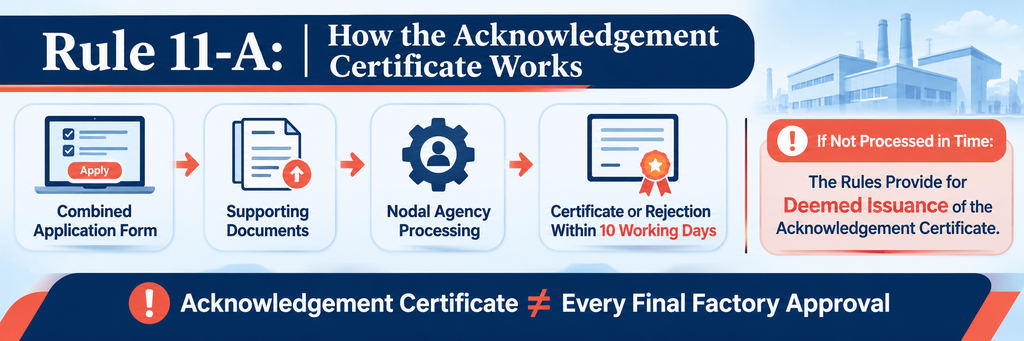
Under Rule 11-A of the amended Tamil Nadu Business Facilitation Rules, a person proposing to start a new activity or expand an existing activity must submit the Combined Application Form through the Single Window Online Portal, together with the prescribed fees and relevant documents.

The Rules identify supporting documents that may include:

  • Self-certification under Annexure 12.
  • Certificate from an Architect or Structural Engineer under Annexure 13.
  • Auditor Certificate under Annexure 14.

These documents are required wherever applicable. The exact supporting documents depend on the application and the nature of the proposed activity.

For planning permission and building permit applications, Rule 11-A also states that consideration will take place only after receipt of the No Objection Certificate from the Directorate of Fire and Rescue Services and other Central Government department NOCs, wherever applicable.

The applicant receives a portal acknowledgement or receipt for tracking. The portal forwards the application to the Nodal Agency for the Acknowledgement Certificate process.

Understanding the Rule 11-A Acknowledgement Certificate

The Acknowledgement Certificate is one of the important procedural features introduced through the 2026 Rules amendment.

After receiving the Combined Application Form and supporting documents, the Nodal Agency must process the application and may issue the Acknowledgement Certificate or reject the application within ten working days.

If the Nodal Agency does not process the application within the prescribed period, Rule 11-A provides for deemed issuance. The portal is required to generate the certificate with the name and seal of the Nodal Agency.

The certificate carries a unique identification number and can be downloaded from the applicant’s portal login. The Rules also provide for its transmission to relevant competent authorities.

Does the Acknowledgement Certificate mean the factory can start production?

No. This is an important distinction.

The Acknowledgement Certificate is part of the Single Window procedure. It should not be treated as a blanket replacement for every statutory approval, licence, consent or operational permission applicable to the factory.

The amended self-certification format itself requires the applicant to undertake compliance with applicable building, factory safety and other legal requirements and to obtain the clearances required from competent authorities before proceeding where the law requires them.

A manufacturer must identify which approvals are still required for the proposed activity and whether each is a pre-establishment or pre-operation requirement.
Reduced Document Resubmission and Self-Attestation

The September 2026 amendments to the Rules introduce two useful procedural changes.

Documents already held by government authorities

Under the new Rule 11 provision, an applicant should not be required to submit information or documents that have already been provided by the applicant or are available with a government authority.

The competent authority is expected to retrieve such information through electronic and interoperable systems, including APIs, wherever feasible.

Resubmission may still be required where particulars have changed or where fresh submission is mandated by law.

Self-attestation wherever applicable

The Rules also provide that documents submitted for clearances or compliance under the Rules should be accepted on the basis of self-attestation wherever applicable.

A competent authority should not require affidavits, notarised documents or attestations by another authority unless such a requirement is expressly mandated under a Central Act, rule, regulation or order.

This is not permission to submit inaccurate or incomplete information. The self-certification format makes the applicant responsible for the correctness of the information supplied.

Manufacturers should retain supporting records and ensure that declarations are consistent with the actual site, building and manufacturing activity.

Factory Site and Building Approvals: What Should Be Checked?

Before signing a long-term lease or beginning construction, a manufacturer should verify whether the premises can legally and practically accommodate the proposed activity.

Important checks include:

  • Whether the land use permits the intended industrial activity.
  • Whether the building has the necessary planning and building permissions.
  • Whether the sanctioned building plan matches the proposed factory layout.
  • Whether the building can accommodate machinery, storage and material movement.
  • Whether fire access, emergency exits and safety arrangements can be provided.
  • Whether power, water, drainage and waste-management arrangements are adequate.
  • Whether the premises have any restrictions arising from the industrial estate, local authority or land allotment conditions.

The correct authority can depend on whether the premises are within a planned area, an industrial estate, a local-body jurisdiction or another notified area.

A property advertised as an industrial shed is not automatically suitable for every manufacturing process. Verify the permitted use and approvals for the specific property.

DISH and Factory Plan Approval

The Directorate of Industrial Safety and Health (DISH) is an important authority for factory-related safety and plan approval matters in Tamil Nadu.

The Single Window Portal lists factory plan approval as a pre-establishment clearance handled by DISH.

For a proposed automotive component unit, the factory layout may need to account for:

  • Production machinery and workstations.
  • Material movement and storage.
  • Worker access and circulation.
  • Safety distances and emergency arrangements.
  • Ventilation and lighting.
  • Welfare facilities.
  • Hazardous or high-risk operations, where applicable.

The requirements will depend on the applicable factory legislation, rules, worker strength, power usage, manufacturing process and other statutory criteria.

A factory plan should not be prepared as a generic building drawing. It needs to reflect the actual manufacturing process and applicable safety requirements.

Manufacturing units may also need approvals from the Tamil Nadu Pollution Control Board.

Two important consent stages are:

Consent to Establish (CTE): This is generally relevant before establishing or undertaking the activity covered by the consent requirement.

Consent to Operate (CTO): This is generally relevant before operating the unit, subject to the applicable consent conditions and legal requirements.

The exact requirement depends on the industrial activity, pollution category, process, emissions, effluent, waste generation and applicable exemptions or directions.

For example, a basic machining operation may have a different environmental profile from a foundry, electroplating facility, painting unit or chemical-treatment operation.

Do not assume that every automotive component unit has identical TNPCB requirements. Identify the actual process and check the current TNPCB classification and consent procedure.

Pre-Establishment and Pre-Operation Clearances

A useful way to organise a factory project is to separate approvals into two broad stages.

Pre-establishment

These are approvals or permissions that may be required before setting up the facility or carrying out the relevant construction or establishment activity.

Depending on the project, these may include:

  • Industrial land allotment or land-use permission.
  • Planning permission and building approval.
  • Factory plan approval.
  • TNPCB Consent to Establish.
  • Fire-related NOCs where applicable.
  • Other site-specific permissions.

Pre-operation

These are approvals or permissions that may be required before the factory starts the relevant manufacturing activity.

Depending on the project, they may include:

  • Factory registration or licence, where applicable.
  • TNPCB Consent to Operate.
  • Fire and safety-related compliance.
  • Electricity and other utility-related permissions.
  • Applicable labour and employment registrations.
  • Other operational permissions linked to the activity.

This is a planning framework, not a universal sequence. Some approvals may be processed in parallel, while others depend on earlier permissions or inspection results.

Use the current Single Window Portal list and the relevant department’s legal requirements to confirm the actual order.

Company Registration, GST and Udyam Are Separate Requirements

The Business Facilitation reforms do not replace business registrations under other laws.

A manufacturer setting up in Hosur may separately need to consider:

Company or LLP incorporation: The business structure should be selected based on ownership, funding, liability, governance and commercial requirements. Incorporation is handled under the applicable company or LLP law.

GST registration: GST requirements depend on the nature of supplies, turnover, place of supply and applicable statutory provisions. A business should not assume that factory approval automatically provides GST registration.

Udyam registration: Eligible micro, small and medium enterprises can consider Udyam registration under the applicable MSME framework. It is separate from factory licensing and environmental approvals.

These registrations serve different legal purposes. Completing one does not automatically satisfy the others.

Company Registration in Chennai

A Practical Approval Planning Checklist for a Hosur Manufacturing Unit

Before committing to the project, prepare a clearance matrix.

AreaWhat to verify
Business structureProprietorship, partnership, LLP or company suitability
Industrial premisesPermitted land use, ownership or lease rights and building status
BuildingPlanning permission, building permit and approved layout
Factory planDISH applicability and plan approval requirements
EnvironmentTNPCB category, CTE and CTO applicability
Fire safetyApplicable Fire NOC and safety requirements
UtilitiesPower load, water, drainage and waste arrangements
LabourApplicable factory, employment and welfare compliance
TaxGST applicability and invoicing requirements
MSMEUdyam eligibility and registration
Single WindowCorrect application route, fees, documents and status tracking

The checklist is a starting point. The final list should be prepared after reviewing the actual manufacturing process, premises and scale of the unit.

What Should You Do If an Approval Is Delayed?

The amended framework and Rules provide mechanisms for time-bound processing and grievance escalation.

If an application is delayed:

  1. Check whether the application was submitted through the correct Single Window route.
  2. Confirm that the application is complete and all required fees and documents were submitted.
  3. Review whether the department has raised a query or requested additional information.
  4. Record the application number, submission date and status.
  5. Check the applicable statutory timeline for that specific clearance.
  6. If the clearance is not eligible for deemed approval and is not disposed of within the applicable timeline, review the automatic grievance registration mechanism under amended Rule 21(6-A).

Do not assume that delay automatically means the approval has been granted. The grievance mechanism and deemed-approval provisions are different legal mechanisms.

Where the applicable law provides deemed approval, the applicant should verify the precise conditions before relying on it. Where it does not, the applicant should use the prescribed escalation process.

What Is the Tamil Nadu Investment Promotion Commission?

The 2026 amendment introduced the Tamil Nadu Investment Promotion Commission under Section 16-A.

The Commission is intended to provide high-level oversight of investment promotion and facilitation activities. Its statutory functions include reviewing the progress of large, strategic and high-impact investments and issuing directions to relevant agencies and departments for timely clearances in the cases covered by the provision.

The Act identifies certain investment categories, including proposed capital investment of ₹200 crore or more and projects expected to generate employment for 5,000 or more persons, along with other specified categories.

This should not be read as an automatic escalation route for every small factory application. A micro or small manufacturing unit should use the applicable Single Window and departmental grievance mechanisms unless it falls within a relevant notified or statutory category.

Common Mistakes Manufacturers Should Avoid

Assuming 21 days applies to every approval: The statutory provision has a defined scope and exceptions. Check the governing enactment and timeline.

Treating an Acknowledgement Certificate as a factory licence: It is not a universal substitute for the approvals required to establish or operate a unit.

Leasing a property before checking land use: An industrial-looking building may still be unsuitable for the proposed process.

Using another factory’s approval list: Requirements vary with manufacturing activity, site, capacity and pollution category.

Submitting inconsistent documents: Differences in company name, site address, ownership, building details or manufacturing activity can lead to queries.

Starting production before required operational approvals: A portal receipt or acknowledgement should not be treated as permission to operate.

Frequently Asked Questions

1. When did the Tamil Nadu Business Facilitation Amendment Act 2026 come into force?

The Tamil Nadu Business Facilitation (Amendment) Act, 2026 came into force on 3 November 2026, as notified by the Tamil Nadu Government.

2. Does the 21-day rule apply to every factory approval in Tamil Nadu?

No. The amended Section 11 applies within its statutory scope and contains exceptions. Existing shorter timelines continue, and a longer period prescribed by a Central Act prevails. The application must also be complete.

3. What is the Rule 11-A Acknowledgement Certificate?

It is a certificate processed by the Nodal Agency after submission of the Combined Application Form and supporting documents through the Single Window Portal. The Rules provide a ten-working-day processing period, with deemed issuance provisions if the application is not processed within that period.

4. Can a manufacturer start production after receiving the Acknowledgement Certificate?

Not automatically. The certificate should not be treated as a replacement for factory licensing, environmental consent or any other statutory permission required before operations begin.

5. Is the Single Window Portal compulsory for applications covered by the amended Act?

The amended Act provides that applications submitted through a web portal other than the Single Window Portal will not be taken up for processing where the Act applies.

6. Do all Hosur manufacturing units need DISH factory plan approval?

The requirement depends on the applicable factory legislation, manufacturing process, premises and other statutory criteria. The applicant should verify the requirement with DISH and the current Single Window clearance list.

Not necessarily in the same way. Applicability depends on the actual process, pollution category, emissions, effluent, waste generation and relevant exemptions or directions. The manufacturer should verify its category and consent requirements with TNPCB.

8. Can I apply for factory approvals before registering my company?

The correct sequence depends on the proposed ownership structure, applicant eligibility and the specific clearance. Some applications may be made by a promoter or proposed entity where permitted, while others may require established applicant details. Confirm the portal and department requirements before filing.

9. What happens if a department does not process my application within the applicable timeline?

The amended Rules provide for automatic registration of a grievance in specified cases where an application not eligible for deemed approval is not disposed of within the applicable time limit. This does not mean the approval itself is automatically granted.

10. Does Udyam registration replace factory approval?

No. Udyam is an MSME registration. It does not replace factory plan approval, factory licensing, building permissions or environmental consent. 

Conclusion

The Tamil Nadu Business Facilitation reforms that came into force on 3 November 2026 introduce important changes to the way certain business clearances are processed. The revised time-limit framework, Single Window application route, Rule 11-A Acknowledgement Certificate and document-submission changes are relevant to entrepreneurs planning new manufacturing activities or expanding existing units.

For Hosur manufacturers, the benefit of these reforms depends on preparing the project correctly. The proposed industrial premises, factory layout, manufacturing process, environmental category and applicable statutory approvals must be identified before the application process begins.

The 21-day framework should be understood as a statutory processing rule for clearances within its scope—not as a blanket approval guarantee. Similarly, an Acknowledgement Certificate does not remove the need to obtain other licences, consents and permissions required by law.

A well-prepared clearance plan can help an automotive component or engineering business avoid preventable delays and make better use of Tamil Nadu’s Single Window system.

Important: Approval requirements and portal service timelines can change. Before filing, verify the latest requirements with the relevant government department and the current Single Window Portal. This article is general information and is not a substitute for project-specific legal or technical advice.
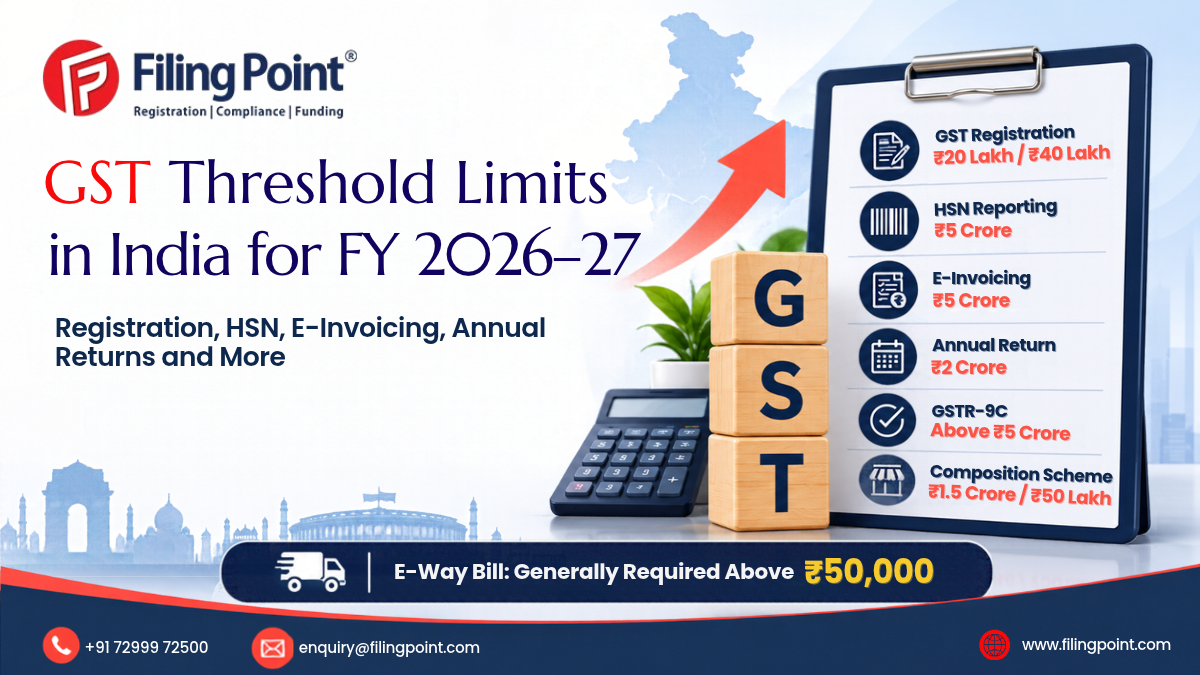
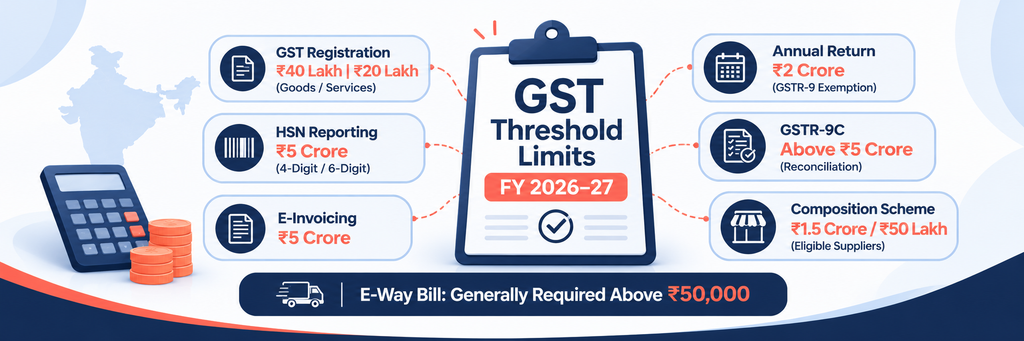
GST compliance in India is not governed by one single turnover limit. Different provisions of the Goods and Services Tax (GST) law use different thresholds for registration, HSN reporting, e-invoicing, annual returns and the composition scheme. E-way bill requirements follow a different rule altogether: they generally depend on the value of a consignment being transported, not the annual turnover of the business.

This distinction matters for small businesses, traders, manufacturers, service providers, startups and growing companies. A business may not yet be required to register under GST but may need to monitor its turnover carefully. Another business may already be registered and have to follow e-invoicing or HSN reporting requirements even though its GST registration threshold is no longer relevant.

For FY 2026–27 (1 April 2026 to 31 March 2027), this guide explains the major GST thresholds, the conditions attached to them and the records businesses should monitor.

Important: GST provisions, notifications and state-level rules can change. This article is a general compliance guide, not a substitute for checking the latest notification or obtaining advice for a particular transaction.

GST Threshold Limits at a Glance

The following table is a quick reference. It should not be read as a statement that every threshold applies to every business.

GST requirementCommon threshold / triggerWhat it relates to
Registration – eligible suppliers exclusively dealing in goodsUp to ₹40 lakh in many States/UTsAggregate turnover, subject to conditions and State position
Registration – services or mixed goods and servicesGenerally ₹20 lakhAggregate turnover, with lower limits in specified States
HSN reporting in GSTR-1₹5 crore AATO distinction4-digit or 6-digit HSN reporting
E-invoicingAggregate turnover exceeding ₹5 crore in any preceding financial year from 2017–18 onwardsSpecified B2B/export documents, subject to notified exclusions
GSTR-9 annual returnExemption for turnover up to ₹2 crore for FY 2024–25 onwardsAnnual return filing
GSTR-9C reconciliation statementTurnover exceeding ₹5 croreSelf-certified reconciliation statement
Composition scheme – eligible goods suppliersGenerally ₹1.5 crorePreceding financial year turnover, subject to conditions
Composition option for certain service suppliers₹50 lakhSeparate provision under Section 10(2A)
E-way billGenerally consignment value exceeding ₹50,000Movement of goods, subject to exceptions and State rules

The figures above are not interchangeable. A business should identify the provision it needs to comply with before applying a threshold to its turnover.

What Is the GST Registration Threshold for FY 2026–27?

The GST registration threshold is the turnover level at which a person making taxable supplies becomes liable to register, subject to the applicable provisions and exceptions.

Under Section 22 of the Central Goods and Services Tax Act, 2017, the general threshold is ₹20 lakh. A higher threshold of ₹40 lakh is available to eligible persons engaged exclusively in the supply of goods in States and Union Territories where the relevant exemption notification applies.

Registration threshold for goods

A person exclusively supplying goods may be eligible for the ₹40 lakh exemption limit in many States and Union Territories. This is not an unconditional ₹40 lakh allowance for every trader.

Notification No. 10/2019–Central Tax, dated 7 March 2019, provides the exemption for eligible persons exclusively supplying goods, subject to exclusions. The exemption is not available to persons who are required to register under Section 24, certain notified manufacturers and suppliers, or persons making intra-State supplies in specified States and Union Territories.

The States and Union Territories excluded from this particular ₹40 lakh exemption include Arunachal Pradesh, Manipur, Meghalaya, Mizoram, Nagaland, Puducherry, Sikkim, Telangana, Tripura and Uttarakhand. A business operating in one of these locations should not automatically apply the ₹40 lakh figure.

Registration threshold for services

For suppliers of services, the general registration threshold is ₹20 lakh. In specified special-category States, the threshold can be ₹10 lakh.

Businesses supplying both goods and services should be particularly careful. The ₹40 lakh exemption is intended for persons exclusively supplying goods, subject to the notification. A business with a mixed supply profile should not assume that it qualifies merely because goods account for most of its revenue.

Does the threshold apply separately to each GSTIN?

No. Aggregate turnover is calculated on an all-India basis for persons having the same PAN. If a business has registrations in multiple States, the turnover of those registrations is considered together for aggregate-turnover calculations.

For example, suppose a company has GST registrations in Tamil Nadu and Karnataka. Its turnover cannot be assessed by looking only at the Tamil Nadu GSTIN if the relevant test requires aggregate turnover under the same PAN.

What Is Aggregate Turnover Under GST?

Aggregate turnover is one of the most important concepts in GST because several thresholds use it.

Section 2(6) of the CGST Act defines aggregate turnover as the aggregate value of:

  • Taxable supplies;
  • Exempt supplies;
  • Exports of goods or services or both; and
  • Inter-State supplies made by persons having the same PAN.

The calculation is made on an all-India basis.

Aggregate turnover excludes:

  • Central GST;
  • State GST;
  • Union Territory GST;
  • Integrated GST;
  • Compensation cess; and
  • The value of inward supplies on which tax is payable by the person under reverse charge.

This means that a business cannot simply compare its taxable sales shown in one GST return with the registration threshold and assume that the calculation is complete. Exempt supplies, exports and supplies from other registrations under the same PAN may also affect the calculation.

Example

A business has the following annual figures:

ParticularsAmount
Taxable domestic sales₹16 lakh
Exempt supplies₹3 lakh
Export supplies₹4 lakh
GST collected₹2 lakh

The aggregate turnover for the illustration is ₹23 lakh, not ₹25 lakh, because GST collected is excluded. The exempt and export supplies are included.

This example demonstrates why turnover calculations should be based on the statutory definition rather than only the taxable-sales figure.

Are Businesses Required to Register Before Crossing the Turnover Limit?

Yes, certain categories of persons may be required to register irrespective of the ordinary threshold. Section 24 of the CGST Act contains compulsory-registration categories, subject to exemptions and notifications.

These categories include, among others:

  • Persons making specified inter-State taxable supplies;
  • Casual taxable persons making taxable supplies;
  • Non-resident taxable persons making taxable supplies;
  • Persons liable to pay tax under reverse charge, where the relevant provision applies;
  • Persons making taxable supplies on behalf of another taxable person as an agent;
  • Input Service Distributors;
  • Persons required to deduct tax under Section 51;
  • Electronic commerce operators required to collect tax at source under Section 52; and
  • Certain suppliers making supplies through an electronic commerce operator required to collect tax at source.

However, the phrase “inter-State supply means compulsory GST registration in every case” is too broad. Specific exemptions exist, including for certain inter-State service suppliers below the applicable threshold and specified handicraft suppliers. E-commerce rules have also been modified for eligible small suppliers of goods.

A business should check the exact category, exemption notification and transaction type before deciding that registration is compulsory or unnecessary.

HSN Code Reporting Threshold: ₹5 Crore

HSN stands for Harmonised System of Nomenclature. Businesses use HSN codes to classify goods, while services are classified using Service Accounting Codes (SAC).

The HSN reporting requirement in Table 12 of GSTR-1 depends on the taxpayer’s Aggregate Annual Turnover (AATO) in the preceding financial year.

The GST Portal’s January 2025 advisory explains the reporting structure:

  • Taxpayers with AATO up to ₹5 crore are generally required to report 4-digit HSN codes for B2B supplies.
  • Taxpayers with AATO above ₹5 crore are required to report 6-digit HSN codes for goods and services.
  • Table 12 of GSTR-1/1A separates B2B and B2C supply reporting.
  • The portal applies HSN validations and may display warnings where the reported information does not match the relevant supply details.

The ₹5 crore figure is not a GST registration threshold. It is a reporting distinction for HSN information. A business can be required to report HSN details even when its turnover is far below the e-invoicing threshold.

Businesses should maintain accurate product descriptions, HSN/SAC classifications, unit quantities and invoice-level data. Incorrect classification can create reconciliation problems and may affect tax-rate treatment.

GST E-Invoicing Threshold: ₹5 Crore

E-invoicing is a system in which specified invoice details are reported to an Invoice Registration Portal (IRP) and an Invoice Reference Number (IRN) and signed QR code are generated.

Under Notification No. 10/2023–Central Tax, the e-invoicing requirement was extended to eligible taxpayers whose aggregate turnover exceeded ₹5 crore, effective from 1 August 2023.

The turnover test is important:

  • It is based on aggregate turnover under the same PAN.
  • It considers turnover in any preceding financial year from 2017–18 onwards.
  • It is not limited to the current financial year’s turnover.
  • The requirement applies to specified documents and transactions, subject to notified exclusions.

For example, if a business crossed the ₹5 crore threshold in an earlier financial year, a later fall in turnover does not automatically remove it from the e-invoicing requirement.

E-invoicing is not simply a requirement to upload every retail bill. The legal framework covers specified documents and classes of registered persons. Certain categories, such as specified financial institutions, insurers, goods transport agencies and other notified persons, have exclusions. Businesses should verify whether an exclusion applies to their exact category.

A business approaching the threshold should review its billing software, ERP integration, customer GSTIN validation, invoice numbering and IRP workflow before the requirement becomes operationally urgent.

GSTR-9 Annual Return Threshold: ₹2 Crore

GSTR-9 is the annual return for eligible regular taxpayers. It consolidates information relating to outward supplies, inward supplies, input tax credit, tax paid and other details for a financial year.

Notification No. 15/2025–Central Tax, dated 17 September 2025, exempts registered persons whose aggregate turnover in a financial year is up to ₹2 crore from filing the annual return for that financial year. The notification applies from FY 2024–25 onwards, unless changed by a later legal measure.

This means that for FY 2026–27, a registered person whose aggregate turnover is up to ₹2 crore falls within the notified exemption, subject to the applicable conditions.

The exemption should not be confused with exemption from all GST returns. Regular periodic return obligations such as GSTR-1 and GSTR-3B may continue to apply depending on the taxpayer’s registration type and filing scheme.

Businesses should also check whether they fall into an excluded category, such as an Input Service Distributor, a TDS/TCS-related registrant, a casual taxable person or a non-resident taxable person.

GSTR-9C Threshold: Above ₹5 Crore

GSTR-9C is a reconciliation statement that compares the figures reported in the annual return with the relevant financial statements and records.

Under Rule 80(3) of the CGST Rules, a registered person whose aggregate turnover during a financial year exceeds ₹5 crore is required to furnish a self-certified reconciliation statement in Form GSTR-9C along with the annual return, subject to the specified exclusions.

This is different from the older GST audit framework. GSTR-9C is now self-certified by the registered person; it should not be described as a compulsory CA or cost-accountant certification in every case.

Businesses approaching ₹5 crore should reconcile:

  • Sales as per books and GST returns;
  • Credit notes and debit notes;
  • Exempt and non-GST supplies;
  • Export and zero-rated supplies;
  • Input tax credit;
  • Tax liability and tax paid; and
  • Differences between financial statements and GST returns.

A well-maintained reconciliation throughout the year is more practical than trying to identify every mismatch at the annual filing stage.

GST Registration Chennai

GST Composition Scheme Threshold

The composition scheme is an optional simplified tax-payment arrangement for eligible small taxpayers. It is not a general GST exemption and it does not apply automatically when turnover is below a particular limit.

Composition limit for eligible goods suppliers

Under Section 10(1) and the relevant notification, the general turnover limit is ₹1.5 crore in the preceding financial year. For eligible registered persons in specified States, the limit is ₹75 lakh.

The specified States for the lower limit include Arunachal Pradesh, Manipur, Meghalaya, Mizoram, Nagaland, Sikkim, Tripura and Uttarakhand.

Eligibility restrictions apply. For example, certain notified manufacturers are excluded, and a person making prohibited inter-State outward supplies or otherwise falling within a disqualifying category cannot simply opt for the scheme.

Composition option for certain service suppliers

Section 10(2A) provides a separate composition option for certain registered persons who are not eligible under the main composition provisions. The turnover limit under this provision is ₹50 lakh in the preceding financial year, subject to conditions and restrictions.

This is why the statement “the composition scheme limit for services is ₹50 lakh” is incomplete. The business must satisfy the separate eligibility conditions.

What should a business understand before opting in?

A composition taxpayer generally:

  • Pays tax at the prescribed composition rate;
  • Cannot collect GST from customers as a separate tax under the normal scheme;
  • Cannot claim input tax credit on purchases;
  • Must issue a bill of supply instead of a regular tax invoice; and
  • Must comply with the applicable composition return and payment requirements.

A business should compare the effective tax cost, supplier credit position, customer profile and restrictions before choosing the scheme.

E-Way Bill Threshold: ₹50,000

The e-way bill requirement is different from the other thresholds in this guide. It is generally triggered by the value of a consignment being moved, not by the supplier’s annual turnover.

Under Rule 138 of the CGST Rules, a registered person causing movement of goods of consignment value exceeding ₹50,000 is generally required to furnish the prescribed information and generate an e-way bill before movement begins.

The general rule covers movement:

  • In relation to a supply;
  • For reasons other than supply; or
  • Due to inward supply from an unregistered person.

There are exceptions and special situations. Certain movements may require an e-way bill irrespective of value, while specified goods or movements may be exempt. State-specific rules can also affect intra-State movement.

Interstate and intrastate movement

For interstate movement, the general ₹50,000 rule is the starting point, subject to the prescribed exceptions.

For intrastate movement, States and Union Territories may prescribe different thresholds or conditions under the relevant rules. A business operating in Tamil Nadu should therefore check the current Tamil Nadu e-way bill notification rather than assume that every State uses the same intra-State threshold.

The consignment value should be calculated in accordance with the applicable GST rules. Businesses should also ensure that the invoice, delivery challan, transporter details and vehicle information are accurate.

Voluntary GST Registration Below the Threshold

A business below the compulsory-registration threshold may choose voluntary registration under Section 25(3) of the CGST Act, subject to the law.

Voluntary registration may be considered where:

  • Business customers expect GST invoices;
  • The business regularly makes taxable business-to-business supplies;
  • Input tax credit may be commercially relevant;
  • The business expects to expand into activities requiring registration; or
  • A customer, vendor or tender arrangement requires a GSTIN.

However, voluntary registration is not automatically beneficial. Once registered, the business must follow applicable return-filing, invoicing, payment and record-keeping requirements even if turnover remains below the ordinary threshold.

A small business serving only final consumers may find that the additional compliance cost outweighs the commercial benefit. It should evaluate the expected output tax, eligible input tax credit, pricing impact and filing cost before applying.

Common GST Threshold Mistakes Businesses Should Avoid

Mistake 1: Treating ₹40 lakh as the limit for every business

The higher limit is not a universal threshold. It is linked to exclusive supply of goods and the conditions in the relevant notification. Service suppliers and mixed suppliers must examine the applicable limit separately.

Mistake 2: Calculating turnover GSTIN by GSTIN

Aggregate turnover is calculated on an all-India PAN basis. Looking at only one State registration can produce an incorrect result.

Mistake 3: Excluding exempt supplies from aggregate turnover

Exempt supplies are included in aggregate turnover, subject to the statutory definition. Businesses should not calculate the threshold only on taxable sales.

Mistake 4: Assuming that e-invoicing starts only when current-year turnover crosses ₹5 crore

The e-invoicing test considers whether the threshold was crossed in any preceding financial year from FY 2017–18 onwards. A past crossing can continue to matter.

Mistake 5: Treating the e-way bill limit as an annual turnover limit

The general ₹50,000 rule relates to consignment value and movement of goods. It is not the same as a business’s annual sales threshold.

Mistake 6: Assuming that registration exemption means no GST compliance

A business that is not required to register may still need to maintain proper books, invoices and transaction records under other applicable laws. Voluntary registration also creates ongoing GST obligations.

A Practical GST Threshold Monitoring Checklist for FY 2026–27

Businesses should review their GST position periodically instead of waiting until the end of the financial year.

What to monitorWhat to check
Aggregate turnoverAll taxable, exempt, export and inter-State supplies under the same PAN
Registration liabilityApplicable State threshold, nature of supply and compulsory-registration provisions
HSN/SAC reportingPreceding-year AATO and Table 12 reporting requirements
E-invoicingWhether the ₹5 crore threshold was crossed in any preceding financial year
Annual returnWhether the ₹2 crore exemption applies for the financial year
GSTR-9CWhether aggregate turnover exceeds ₹5 crore
Composition schemePreceding-year turnover and all eligibility restrictions
E-way billsConsignment value, movement type, exemptions and State-specific rules

A monthly or quarterly review is useful for growing businesses. It helps the owner identify a registration trigger, prepare systems for e-invoicing and avoid last-minute annual reconciliation problems.

Frequently Asked Questions

1. What is the GST registration limit in India for FY 2026–27?

The general threshold is ₹20 lakh for services and mixed supplies in most States and Union Territories. Eligible suppliers exclusively dealing in goods may qualify for a ₹40 lakh exemption in States and Union Territories where the relevant notification applies. Specified States have lower limits, and compulsory-registration provisions may override the ordinary threshold.

2. Is the GST limit ₹20 lakh or ₹40 lakh?

Both figures can apply, depending on the nature of the supply, the State or Union Territory and the conditions of the applicable notification. The ₹40 lakh exemption is not available to every business.

3. Does GST registration depend on profit or turnover?

The registration threshold is based on aggregate turnover as defined under the CGST Act, not business profit. Expenses and net profit do not determine whether the turnover threshold has been crossed.

4. Is exempt turnover included in GST aggregate turnover?

Yes. Exempt supplies are included in aggregate turnover under Section 2(6), along with taxable supplies, exports and inter-State supplies, subject to the statutory exclusions.

5. What is the HSN reporting limit under GST?

The HSN reporting requirement uses a ₹5 crore AATO distinction. Broadly, taxpayers with AATO up to ₹5 crore report 4-digit HSN codes for B2B supplies, while taxpayers above ₹5 crore report 6-digit HSN codes. The GST Portal’s current Table 12 advisory should be checked before filing.

6. What is the GST e-invoicing turnover limit?

E-invoicing generally applies to eligible taxpayers whose aggregate turnover exceeded ₹5 crore in any preceding financial year from FY 2017–18 onwards, subject to notified exclusions.

7. Is GSTR-9 mandatory for businesses below ₹2 crore?

Notification No. 15/2025–Central Tax provides an exemption from annual return filing for registered persons with aggregate turnover up to ₹2 crore for FY 2024–25 onwards, unless the exemption is amended or withdrawn.

8. When is GSTR-9C required?

GSTR-9C is generally required when aggregate turnover during the financial year exceeds ₹5 crore, subject to the exclusions in Rule 80(3).

9. What is the GST composition scheme turnover limit?

The general limit for eligible goods suppliers is ₹1.5 crore, with a ₹75 lakh limit in specified States. A separate ₹50 lakh option exists under Section 10(2A) for certain service suppliers and other eligible persons. Conditions and restrictions apply.

10. Is an e-way bill required for every invoice above ₹50,000?

No. The general rule relates to movement of goods and consignment value, not every invoice in isolation. Exemptions, special cases and State-specific intra-State rules must be considered.

11. Can I voluntarily register under GST below the threshold?

Yes, voluntary registration is permitted under Section 25(3), subject to the law. Once registered, the business must comply with the applicable GST requirements.

12. Does crossing the GST threshold mean I must register immediately?

A person who becomes liable under the relevant provisions must apply within the prescribed time. Section 25 generally provides a 30-day application period from the date liability arises, with separate provisions for casual and non-resident taxable persons. Do not wait until the financial year ends if the threshold has already been crossed.

Conclusion

GST compliance involves several different thresholds, and each one serves a different purpose. A business may need to register based on aggregate turnover, report HSN codes based on preceding-year turnover, generate e-invoices because it crossed the threshold in an earlier year, file annual returns based on the applicable exemption and generate e-way bills based on the value and movement of goods.

For FY 2026–27, businesses should not rely on a single turnover figure to determine every GST obligation. The safer approach is to calculate aggregate turnover correctly, review the nature and location of supplies, monitor preceding-year turnover and check the latest notifications for each compliance requirement.

Need help with GST registration or ongoing compliance? FilingPoint assists businesses with GST registration, return filing and annual GST compliance. 

Disclaimer: This article is for general information and educational purposes. GST applicability depends on the taxpayer’s facts, the nature of supplies, location, notifications and amendments in force. Obtain professional advice before acting on a specific transaction or registration decision.

Imagine you registered your business name as a trademark for clothing. A few months later, your business expands into footwear, bags and accessories. You already have a trademark application pending, so the obvious question is: can you simply add the new products to the same application?

Or perhaps you filed a trademark under the wrong class. You now realise that some of the goods listed in your application belong to another class. Can you correct the classification without starting again?

These situations are common among startups, manufacturers, ecommerce businesses and growing consumer brands. However, Indian trademark law does not allow every type of change after an application has been filed.

The answer depends on an important distinction:

Are you trying to correct the classification of goods or services already included in your original application, or are you trying to introduce new goods or services that were never included?

These are legally different situations under the Trade Marks Act, 1999 and the Trade Marks Rules, 2017.

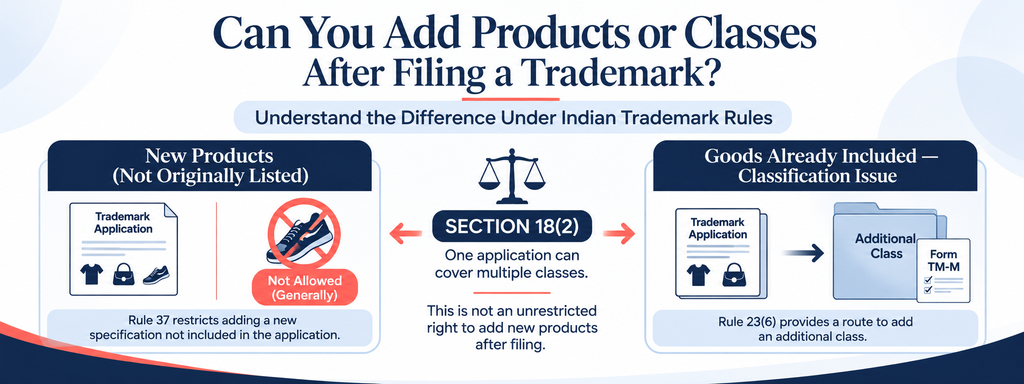
Section 18(2) of the Act allows a single trademark application to cover different classes. Rule 23(6) provides a mechanism for adding classes when the Registrar determines that goods or services already applied for fall into additional classes. However, Rule 37 restricts amendments that introduce a new specification of goods or services not included in the application as filed.

This guide explains what businesses can change, what they generally cannot change, how to approach a classification mistake and when a fresh trademark application may be necessary.

Can you add new products to an existing trademark application?

Generally, no. You cannot use an ordinary amendment to introduce a new specification of goods or services that was not included in the original application.

Rule 37 of the Trade Marks Rules, 2017 allows an applicant to request certain corrections or amendments before the trademark is registered. However, it contains an important restriction.

An amendment cannot:

  • Substantially alter the trademark applied for.
  • Substitute a new specification of goods or services that was not included in the application as filed.

This means that a business cannot normally expand the original specification simply because it has launched new products after submitting its trademark application.

Example: A clothing brand expanding into footwear

Suppose a company files a trademark application covering shirts, trousers and jackets under Class 25.

Six months later, it decides to manufacture footwear under the same brand.

The original application should be examined to determine exactly which goods were included in its specification. If footwear was not included, the applicant cannot simply add it through a Rule 37 amendment.

The business may need a fresh trademark application covering the relevant footwear goods.

What if the application is still pending?

The fact that an application is pending does not automatically give the applicant permission to expand its specification.

Rule 37 applies before registration, including after the application has been accepted. The restriction on introducing a new specification remains relevant throughout that period.

A pending application should not be treated as an opportunity to keep adding new product categories as the business evolves.

Practical takeaway: Before requesting an amendment, compare the proposed goods or services with the exact specification filed in the original TM-A application.

What does Section 18(2) of the Trade Marks Act allow?

Section 18(2) of the Trade Marks Act, 1999 allows a single trademark application to cover different classes of goods and services.

This is commonly called a multi-class trademark application.

For example, a consumer brand might seek protection for:

  • Clothing under Class 25.
  • Bags under Class 18.
  • Retail services under Class 35.

The applicant may file one application covering the relevant classes, subject to the applicable requirements and payment of the prescribed fee for each class.

However, Section 18(2) concerns the ability to file across multiple classes. It should not be interpreted as an unrestricted right to add new goods or classes at any later stage.

The distinction is important:

  • At the initial filing stage: The applicant can identify the relevant classes and include the appropriate goods or services in the application.
  • After filing: Changes are subject to the amendment provisions, including Rule 37.
  • Where the Registrar identifies additional classes for goods already applied for: Rule 23(6) provides a specific procedure.

Section 18(2) is therefore useful when planning protection across multiple product and service categories, but it does not remove the need to prepare an accurate specification before filing.

What is the difference between adding a product and adding a class?

These two expressions are often used interchangeably, but they do not mean the same thing.

A product is a commercial item that a business manufactures, sells or intends to sell. A class is a classification category used to organise goods and services for trademark registration.

The Nice Classification, used in India, contains 45 classes:

  • Classes 1–34 cover goods.
  • Classes 35–45 cover services.

A single business can operate across several classes. However, the correct classification depends on the actual goods or services and the relevant classification rules.

Example

Consider a business using one brand name for:

  • Leather bags.
  • Clothing.
  • Online retail services.

These activities may involve different classes.

If the original application already described all the relevant goods and services but the Registry determines that some fall into an additional class, Rule 23(6) may become relevant.

However, if the applicant originally listed only clothing and later decides to introduce leather bags, the situation is different. The bags were not part of the original specification.

The applicant cannot assume that the additional class can be added simply because the same brand name is being used.

The important question is not just whether the class is missing. It is whether the goods or services were already included in the original application.

What does Rule 23(6) of the Trade Marks Rules, 2017 say?

Rule 23(6) addresses a specific situation.

It applies when an applicant files a single trademark application and the Registrar determines that the goods or services applied for fall into one or more classes in addition to those originally applied for.

The applicant then has two options under the rule:

  1. Restrict the specification to the class or classes already applied for.
  2. Amend the application to add the additional class or classes through Form TM-M and pay the appropriate fee.

There is also a proviso dealing with a situation where all the goods or services fall into a class other than the one specified. In that situation, the Registrar may permit correction of the class through a request in Form TM-M.

Example: Goods already included but classified differently

Suppose an applicant files a trademark application for several products and lists them in one class.

During examination, the Registrar determines that some of the goods already included in the specification belong to another class as well.

The applicant may need to restrict the specification to the original class or request the addition of the relevant class under Rule 23(6), subject to the Registrar’s determination and the prescribed fee.

This is different from adding an entirely new product that was not mentioned in the original application.

Does Rule 23(6) mean anyone can add another class?

No.

The rule is not a general expansion facility. Its purpose is to deal with classification of goods or services already applied for when the Registrar determines that additional classes are involved.

The distinction between the original specification and a new specification is essential.

What does Rule 37 allow you to amend?

Rule 37 is titled Correction and amendment of application.

It allows an applicant to request correction of an error or amendment of an application using Form TM-M, accompanied by the prescribed fee.

The request may be made before or after acceptance, but before registration.

However, the proviso to Rule 37 restricts amendments that:

  • Substantially alter the trademark applied for.
  • Substitute a new specification of goods or services not included in the application as filed.

What does this mean in practice?

An applicant may seek to correct certain errors or make permitted amendments, subject to the Registrar’s consideration.

However, the applicant cannot use the amendment process to replace the original commercial scope with a substantially different list of products or services.

For example:

Proposed changeGeneral position
Correcting an error in application detailsMay be requested, subject to approval
Narrowing the goods specificationGenerally possible, subject to the rules
Removing goods no longer requiredMay be requested
Adding a new product never included in the original specificationRestricted by Rule 37
Replacing the original specification with unrelated goodsNot permitted through an ordinary amendment
Adding a class for goods already applied for under Rule 23(6)Possible in the specific circumstances covered by that rule

This is why the original TM-A application matters so much. The wording of the specification determines what was actually claimed at the time of filing.

What if you selected the wrong trademark class?

A classification mistake does not always have the same solution.

First, determine what kind of mistake occurred.

Situation A: Goods were included but the Registrar identifies another class

If the original specification already included the relevant goods or services, and the Registrar determines that they fall into additional classes, Rule 23(6) may provide a route to address the classification.

The applicant may need to submit Form TM-M and pay the appropriate fee, or restrict the specification.

Situation B: You selected a class that does not cover the goods you actually intended to protect

If the goods were never included in the original specification, Rule 23(6) should not be treated as a way to introduce them.

The applicant may need to file a fresh application covering the missing goods.

Situation C: You included goods that are too broad or inaccurate

The applicant may need to consider whether the specification can be corrected or narrowed without introducing a new specification.

The exact wording and scope of the original application must be reviewed before deciding what amendment to request.

Situation D: All goods were placed in the wrong class

The proviso to Rule 23(6) allows the Registrar to permit correction of the class where all the goods or services fall into a class other than the one specified.

This is a specific classification correction, not permission to add new goods.

Do not file an amendment simply because another class seems more appropriate. First establish whether the goods were already included in the original application.

How can you request an amendment through Form TM-M?

Form TM-M is used for various requests and amendments under the Trade Marks Rules, 2017.

For a request involving Rule 23(6) or Rule 37, the applicant should first identify the exact legal basis for the change.

A practical review should include:

Step 1: Obtain the original application.

Download or retrieve the original TM-A application and confirm the exact specification of goods and services filed.

Step 2: Identify the proposed change.

Prepare a comparison between the original specification and the wording you now want.

Step 3: Determine whether the change introduces new goods.

If the proposed wording introduces goods or services not included in the original filing, Rule 37 may prevent the amendment.

Step 4: Check whether Rule 23(6) applies.

If the goods or services were already included and the Registrar has determined that they fall into additional classes, assess the Rule 23(6) procedure.

Step 5: Identify the correct request and fee.

Use the current official forms and fee schedule. Do not assume that every Form TM-M request carries the same fee.

Step 6: Submit the request with supporting information.

Explain the requested correction or amendment accurately and provide the relevant application details.

Step 7: Monitor the Registry’s response.

A request is not automatically approved merely because it has been submitted. The Registrar’s decision and any further requirements must be followed.

Should you file a fresh trademark application for new products?

When a business introduces products that were not covered by its original specification, a fresh application is often the appropriate route to consider.

For example, a business may have registered its brand for cosmetics and later decide to launch clothing, furniture or electronic accessories.

The existing registration does not automatically extend to every new product category.

A fresh application allows the business to identify the relevant goods, select the appropriate class or classes and establish a filing date for the new scope of protection.

Before filing, the applicant should:

  • Identify the exact new products.
  • Determine the relevant Nice Classification classes.
  • Search for identical or similar earlier trademarks.
  • Prepare an accurate goods specification.
  • Confirm the applicant and ownership details.
  • Decide whether one multi-class application or separate applications are more suitable.

A new application does involve additional filing costs and examination. It also receives its own filing date.

This matters because an earlier third-party application may affect the availability of the mark for the newly covered goods.

What happens to the filing date when you submit a fresh application?

A fresh trademark application has its own filing date.

It does not automatically inherit the filing date of an earlier application merely because the same applicant and brand name are involved.

Consider this example:

  • January: A business files its trademark for clothing.
  • August: The business launches footwear.
  • September: It files a new application covering footwear.

The new footwear application generally carries the September filing date, subject to the applicable filing rules and any valid priority claim.

The January application continues to relate to the goods and services specified in that original application. It does not automatically extend its earlier date to the newly filed footwear application.

This is one reason businesses should plan trademark protection before announcing or launching new product lines.

A later filing may face an earlier conflicting application that was not present when the original trademark was filed.

One multi-class application or separate applications?

Section 18(2) allows one application to cover different classes. However, businesses should consider whether a single multi-class application or separate applications better suits their commercial and legal needs.

Multi-class application

A multi-class application may be convenient when the same mark is intended to cover several related product and service categories.

Potential advantages include:

  • One application covering several classes.
  • Centralised application tracking.
  • A consolidated filing structure.

However, the fee is payable for each class. The application also requires careful specification and monitoring across its classes.

Separate applications

Separate applications may be preferable where different product lines have different launch plans, risk profiles or commercial priorities.

They can provide greater flexibility in managing the prosecution of each application.

For example, a brand may want immediate protection for its core product while planning to introduce a second category later.

The decision should not be based only on the number of forms. Consider filing dates, opposition risks, product launch schedules, costs and how the brand will be used.

Neither approach guarantees registration. Each application remains subject to examination and any applicable opposition proceedings.

What if one class in a multi-class application faces opposition?

A multi-class application can face opposition in relation to one or more classes.

Rule 42 of the Trade Marks Rules, 2017 addresses this situation.

Where opposition is filed only against particular classes in a single multi-class application, the remaining classes do not simply proceed to registration automatically.

Rule 42(3) provides that the applicant must request division of the application in Form TM-M, together with the divisional fee, for the remaining classes to proceed separately.

Rule 108 explains the procedure for divisional applications. The divided applications retain the filing date of the initial application.

This is a separate issue from adding new products or classes.

Division separates existing classes or portions of an application. It does not create a right to add goods that were never part of the original specification.

Does an existing trademark registration cover products launched later?

Not automatically.

A registered trademark gives the proprietor rights in relation to the goods or services for which the mark is registered, subject to the Act and any conditions or limitations.

A business should not assume that registration for one product category automatically protects every future category under the same brand.

For example, registration for clothing does not automatically mean that the brand is registered for cosmetics, furniture or software.

The commercial relationship between goods and services may be relevant when assessing similarity, but class numbers alone do not determine whether a conflict exists or what the registration covers.

If a business plans to launch a new product category, it should review:

  • Whether the existing specification already includes that product.
  • Whether the new product falls within another class.
  • Whether a fresh application is necessary.
  • Whether similar marks already exist for the new goods.
  • Whether the same brand will be used consistently.

How should businesses plan trademark protection before expansion?

The best way to avoid amendment problems is to plan the trademark specification before filing.

Businesses should not simply choose the class that appears closest to their current product and assume it will cover future expansion.

A more practical approach is to prepare a product and service roadmap.

Step 1: List current products

Identify the goods and services currently offered under the brand.

Step 2: Identify realistic future products

Consider the product categories the business genuinely intends to launch.

Avoid claiming every possible product in a class without a commercial basis. Rule 23(5) allows the Registrar to question applications covering all goods in a class or a large variety of goods if the specification is not justified by actual or intended use.

Step 3: Identify the relevant classes

Use the official classification resources and review the exact descriptions of goods and services.

FilingPoint’s Trademark Class Search can help businesses explore the classification categories.

Search the relevant classes and consider potentially related goods and services. A search should not be restricted mechanically to one class number where commercial similarity may extend further.

Step 5: Choose the filing strategy

Decide whether a single multi-class application or separate applications are more appropriate.

Step 6: Review the specification before filing

Make sure the goods and services are described accurately and reflect the business’s actual or genuine intended use.

A carefully prepared application is usually easier to manage than trying to correct an incomplete specification after filing.

Trademark Registration

Common mistakes businesses should avoid

Assuming a pending application can be expanded freely. A pending application is still subject to Rule 37.

Confusing a product with a class. A class is a classification category, not a general label that automatically covers every product sold by the business.

Treating Rule 23(6) as a general addition facility. It addresses additional classes identified by the Registrar for goods or services already applied for.

Ignoring the original specification. The exact goods and services in the filed TM-A application are central to deciding whether an amendment is permissible.

Assuming the same brand means the same protection. A trademark registration is linked to the goods or services for which it is registered.

Waiting until after a product launch. A fresh application filed later receives its own filing date, which may affect priority against conflicting applications.

Claiming every product in a class without justification. Rule 23(5) allows the Registrar to question an overly broad specification.

Using Form TM-M without identifying the correct legal basis. The form is a filing mechanism, not a guarantee that the requested amendment is permitted.

Frequently asked questions

Can I add new products to an existing trademark application in India?

Generally, no. Rule 37 restricts amendments that introduce a new specification of goods or services not included in the application as filed. A fresh application may be needed.

Can I add another trademark class after filing Form TM-A?

In the specific circumstances covered by Rule 23(6), an additional class may be added when the Registrar determines that goods or services already applied for fall into additional classes. This is not a general right to add new products.

What is Rule 37 of the Trade Marks Rules, 2017?

Rule 37 allows certain corrections and amendments before registration through Form TM-M, but does not permit amendments that substantially alter the mark or substitute a new specification of goods or services not included in the original application.

What is Rule 23(6)?

Rule 23(6) addresses situations where the Registrar determines that goods or services already applied for fall into additional classes. The applicant may restrict the specification or request additional classes through Form TM-M and payment of the appropriate fee.

Can I correct a wrong trademark class after filing?

It depends on the facts. If goods already included in the application fall into additional classes, Rule 23(6) may apply. If the goods were not included in the original specification, a fresh application may be necessary.

Can I narrow the goods specification after filing?

A narrowing amendment may be possible, subject to the applicable rules and the Registrar’s consideration. The applicant should ensure that the amendment does not introduce a new specification or substantially alter the mark.

Can I add a new class after trademark registration?

Do not assume that the existing registration can be expanded to cover new goods or services. A fresh application may be required for the new scope. The exact position should be reviewed against the registered specification and applicable law.

Does a multi-class trademark application cover all my future products?

No. It covers the goods and services specified in the application and accepted for registration. It does not automatically cover every future product the business may launch.

Does a fresh trademark application get the same filing date as my earlier application?

Generally, no. A fresh application receives its own filing date, subject to applicable priority provisions. The earlier application date does not automatically extend to newly added goods.

Can one class be opposed while the other classes proceed?

Rule 42(3) provides a division procedure where opposition is filed only for particular classes in a multi-class application. The applicant must request division through Form TM-M and pay the divisional fee for the remaining classes to proceed separately.

Conclusion

A business can expand its product range without necessarily being able to expand the scope of an already-filed trademark application.

Indian trademark law makes a clear distinction between correcting the classification of goods or services already included in an application and introducing new goods or services that were never part of the original specification.

Section 18(2) permits multi-class applications. Rule 23(6) provides a specific route for additional classes when the Registrar determines that goods or services already applied for fall into those classes. Rule 37, however, restricts amendments that introduce a new specification not included in the original application.

For businesses planning to launch new products, the practical step is to review the original specification, identify the relevant classes and determine whether a fresh application is required.

Already filed a trademark application or planning to expand your product range? FilingPoint can help you review your trademark filing requirements, identify relevant classes and understand the next steps for protecting your brand.

Legal information note: This article provides general information about Indian trademark law. The appropriate action depends on the exact wording and status of the application, the goods or services involved and the Registrar’s directions. Review the current official legal text and obtain professional advice before submitting an amendment or fresh application.

You have prepared your company’s financial statements, checked the annual return details and started filing the required forms on the Ministry of Corporate Affairs (MCA) portal. But the process stops unexpectedly.

AOC-4 displays a validation error. MGT-7 does not accept the Excel attachment. The portal shows incorrect pre-filled information. Your Digital Signature Certificate (DSC) is not recognised. In some cases, the form appears to have been submitted, but the Service Request Number (SRN) is not immediately available.

These problems can be frustrating, particularly when a company is trying to complete its annual ROC filing.

MCA V3 has introduced changes to the filing workflow, including form-specific processes and Excel-based attachments for certain filings. The Institute of Company Secretaries of India (ICSI), in its representation dated 20 December 2025, documented several difficulties reported by professionals, including AOC-4 validation failures, MGT-7 and MGT-7A data issues, Excel upload failures, missing SRNs and portal timeouts.

However, not every error has the same cause. Some problems arise from incorrect information or incomplete attachments. Others may be related to the browser, DSC setup, user permissions or portal-side processing.

This guide explains how to identify common MCA V3 filing problems, what to check before trying again, how to protect your filing records and when professional assistance may be appropriate.

Important: Do not change statutory information simply to make a form pass validation. The information submitted to the MCA must remain consistent with the company’s approved financial statements, statutory registers and underlying records.

What Is MCA V3 and Why Are Companies Facing Filing Problems?

MCA V3 is the Ministry of Corporate Affairs’ online platform for company and LLP-related services and statutory filings.

The annual filing workflow includes preparing the applicable e-form, entering company information, attaching the required documents, completing validations, applying the required digital signature and submitting the form.

The V3 filing environment introduced changes to the way certain forms are prepared and submitted. Depending on the form, companies may need to work with:

  • Online form fields and pre-filled company information.
  • Form-specific attachment requirements.
  • Downloadable or generated Excel templates.
  • Digital Signature Certificate association and verification.
  • Pre-scrutiny and validation checks.
  • SRN generation and payment confirmation.
  • Subsequent processing or resubmission, where applicable.

These steps create several opportunities for errors.

For example, a company may have accurate financial statements but encounter a technical attachment problem. Another company may be able to upload the form but discover that its pre-filled share-capital details do not match its records.

It is important to identify whether the problem is:

  1. A data or documentation issue.
  2. A form eligibility or selection issue.
  3. A DSC or user-account issue.
  4. A file-format or attachment issue.
  5. A portal or server-side issue.
  6. A post-submission processing or payment issue.

The correct response depends on the category.

Which Annual Filing Forms Are Commonly Affected?

The main forms relevant to this guide are AOC-4 and MGT-7/MGT-7A. They serve different purposes and should not be treated as interchangeable.

FormPurposeMain information involved
AOC-4Filing financial statementsFinancial statements and applicable supporting documents
AOC-4 CFSFiling consolidated financial statementsConsolidated financial statements and applicable attachments
AOC-4 XBRLFiling financial statements in XBRL formatStructured financial data and related documents
MGT-7Filing annual returnCompany, director, member and shareholding information
MGT-7AAbridged annual return for eligible OPCs and small companiesApplicable company and annual-return information

A company should confirm the correct form before preparing its filing.

For example, an eligible small company may be required to use MGT-7A rather than MGT-7, subject to the applicable statutory definition, exclusions and current filing instructions. The company should not choose a form merely because the portal displays it first.

Likewise, using MGT-7A does not remove the company’s separate financial-statement filing obligations.

Common MCA V3 Filing Errors Reported by Professionals

ICSI’s 20 December 2025 representation to the Ministry of Corporate Affairs listed difficulties experienced by professionals using MCA V3.

The reported issues included:

AOC-4 problems

  • Difficulty generating PDF versions of forms after submission.
  • Frequent validation errors during form processing.
  • SRNs not appearing or being retrievable after submission.
  • Incorrect company forms being downloaded.
  • Problems with certain earlier V2 SRNs.
  • Difficulty entering reasons for changes in previous-year figures.

AOC-4 XBRL problems

  • File validation failures.
  • Redirection to another form without allowing the user to proceed.
  • Inability to upload certain forms.
  • Validation messages advising users to contact the administrator.

MGT-7 and MGT-7A problems

  • Incorrect Excel files being uploaded.
  • Conflicting prompts to use MGT-7 or MGT-7A.
  • Incorrect pre-filled authorised share-capital information.
  • Excel templates failing to upload.
  • Generated Excel files that could not be opened.
  • Incomplete or inaccessible business-activity dropdown options.
  • Difficulty entering certain premium amounts.

General portal problems

ICSI also reported slowdowns, timeouts, website access problems and SRNs reportedly being cancelled while forms were awaiting DSC affixation.

These reports are important because they show that not every failed filing is necessarily caused by a company’s incorrect data. However, they are stakeholder-reported issues, not a guarantee that the same defect affects every user or filing.

How to Fix AOC-4 Pre-Scrutiny and Validation Errors

AOC-4 is used to file a company’s financial statements and applicable supporting documents with the Registrar of Companies.

A pre-scrutiny or validation failure means the form has not passed the relevant checks. The message may relate to missing information, inconsistent data, an attachment problem or a technical issue.

Step 1: Read the complete error message

Do not rely only on the headline message.

Record:

  • The exact error text.
  • The form name and version.
  • The stage at which it appears.
  • The date and time.
  • The section or field involved.
  • Whether the error appears before or after DSC affixation.

A screenshot is useful, but retain the original form and attachments as well.

Step 2: Review mandatory fields

Check whether all mandatory fields have been completed.

Review the company identification details, financial year, AGM information and other form-specific fields.

Do not enter an estimated or invented value to bypass a mandatory field.

Step 3: Compare the figures with approved financial statements

Check whether the information entered in the form agrees with the approved financial statements and applicable documents.

Pay particular attention to:

  • Balance sheet figures.
  • Profit and loss information.
  • Previous-year figures.
  • Share capital information.
  • Related-party disclosures, where applicable.
  • Consolidated information, where relevant.

A difference may have a legitimate explanation, but it should be supported by the company’s records and disclosed where required.

Step 4: Check attachments

Confirm that the correct documents have been attached and that the files open properly.

Check whether the applicable form instructions prescribe a particular file type, size, naming convention or template.

Do not assume that an attachment is accepted simply because the upload appears to have completed.

Step 5: Validate again

After correcting a verified issue, save the form and repeat the applicable validation process.

If the same error continues despite correct information and attachments, preserve the evidence and raise the issue through the appropriate MCA support channel.

When professional review is useful: If the validation error involves financial figures, previous-year balances, audit documents or a difference between the form and approved accounts, ask a qualified professional to review the filing before changing the underlying data.

Why AOC-4 May Show Financial Year or AGM Date Mismatches

AOC-4 contains information connected with the company’s financial statements and annual general meeting.

A mismatch may occur when the information entered in the form does not agree with the company’s approved records or other filing information.

Possible causes include:

  • Incorrect AGM date entered in the form.
  • Incorrect financial-year selection.
  • A previous filing containing a different date.
  • A genuine change in the company’s meeting or reporting circumstances.
  • Incorrect or outdated information carried forward.
  • A portal-side pre-fill or validation issue.

What should the company check?

Start with the approved AGM minutes and notice, the financial statements and the company’s filing history.

Compare the AGM date and relevant financial-year information across the records.

If the company has held its AGM on a different date from the one appearing in an earlier document, determine why the difference exists before proceeding.

Do not simply change the date in one form to match another form if the underlying records do not support that change.

If the difference is genuine, obtain professional advice on the correct disclosure and filing treatment.

How to Resolve DSC Errors During MCA V3 Filing

A Digital Signature Certificate is used to authenticate filings by the authorised signatory.

A DSC-related problem can stop a filing even when the form and attachments are otherwise ready.

Common issues include:

  • DSC not associated with the correct MCA user.
  • DSC not detected by the signing utility.
  • Expired or revoked DSC.
  • Incorrect signatory details.
  • Browser or local-system configuration problems.
  • Token driver or certificate detection issues.
  • Signatory not having the required role or authority.

DSC troubleshooting checklist

  1. Check whether the DSC is valid and has not expired or been revoked.
  2. Confirm that the certificate belongs to the authorised signatory.
  3. Check whether the DSC is associated with the correct MCA user account.
  4. Confirm that the token and required drivers are working.
  5. Check the current MCA signing utility requirements.
  6. Close and reopen the browser or signing application if the certificate is not detected.
  7. Avoid repeated signing attempts if the portal is displaying an unclear or changing status.

If the DSC is valid but the portal continues to reject it, preserve the error message and raise a support request.

Do not use another person’s DSC merely to get the form submitted. The signatory must have the appropriate authority and responsibility.

Why AOC-4 Attachments May Not Upload

An attachment may fail because of an incorrect file, unsupported format, file-size restriction, corrupted document or portal-side issue.

The exact requirements depend on the form and its current instruction kit.

Check the following before uploading

File format: Confirm that the form accepts the format being uploaded.

File size: Check the maximum permitted size in the applicable instruction kit or portal field.

File integrity: Open the document and confirm that it is not corrupted or password-protected where that is not permitted.

Document completeness: Confirm that the attachment contains all required pages and signatures.

Correct version: Make sure the document corresponds to the relevant financial year and approved records.

Attachment mapping: Confirm that the correct document has been placed in the correct attachment field.

For example, uploading an auditor’s report in a field intended for another document may cause a validation problem even if the file itself is valid.

If the file meets the published requirements but still fails repeatedly, capture the error and escalate it rather than repeatedly modifying the document.

How to Fix Director, Member and Shareholding Mismatches in MGT-7

MGT-7 is an annual return. It contains information about the company, its directors, members, shareholding and other prescribed particulars.

A mismatch may arise when the information entered in the annual return does not agree with the company’s statutory records or MCA records.

Information to reconcile

  • Director details.
  • Member details.
  • Shareholding at the relevant dates.
  • Changes in shareholding during the year.
  • Authorised and paid-up share capital.
  • Registered office information.
  • Meeting details.
  • Other prescribed annual-return particulars.

Documents to review

Depending on the issue, the company may need to review:

  • Register of Members.
  • Register of Directors and Key Managerial Personnel.
  • Share certificates and allotment records.
  • Share transfer records.
  • Relevant board and shareholder resolutions.
  • Previous annual returns.
  • Filed forms relating to changes in directors or share capital.

A portal mismatch should not be resolved by changing the statutory register or annual return without checking which record is correct.

If the company’s statutory records are incomplete or inconsistent, the matter may require more than a simple portal correction.

MGT-7 and MGT-7A Excel Attachment Problems

Some MCA V3 filing workflows involve downloadable or generated Excel templates.

ICSI’s December 2025 representation specifically reported problems with Excel uploads and generated files in MGT-7 and MGT-7A.

Potential causes include:

  • Wrong template used.
  • Template downloaded for a different form.
  • File modified in a way that affects its structure.
  • Incomplete mandatory information.
  • Unsupported file version or format.
  • File corruption.
  • Portal-side processing failure.

A safer approach

  1. Download the applicable template through the current MCA filing workflow.
  2. Confirm the form name and relevant financial year.
  3. Preserve an untouched copy of the original template.
  4. Enter information in the designated fields.
  5. Avoid changing protected cells, formulas or template structure.
  6. Save the file in the format prescribed by the portal.
  7. Reopen it to confirm that the data is retained.
  8. Upload it through the relevant form workflow.

If the generated Excel file cannot be opened, do not recreate the template from scratch unless the current MCA instructions expressly permit that method.

Keep the original download and a screenshot of the error. If the issue persists, raise a support ticket.

What to Do When MCA V3 Shows an Error After Submission

A form that appears to have been submitted is not necessarily a successfully processed filing.

The company should identify the actual status before attempting another submission.

What to check

  • Was an SRN generated?
  • Was payment completed, if applicable?
  • Is the form visible in the filing history?
  • Is the status pending, approved, rejected, resubmission required or another status?
  • Is a challan or acknowledgement available?
  • Has the portal generated the submitted PDF?

The exact status labels and processing sequence may vary according to the form and filing workflow.

Avoid duplicate submissions

If the first submission appears to have gone through, do not immediately create a second filing.

First check the SRN, payment and filing history. Duplicate attempts may create confusion and can complicate reconciliation.

If the SRN is missing or the status is unclear, save the available evidence and contact MCA support.

How to Check MCA SRN, Payment and Filing Status

The SRN is an important reference for tracking an MCA filing.

After submission, retain the available acknowledgement and payment details.

A company should maintain a filing record containing:

RecordWhy it matters
Company name and CINIdentifies the company
Form nameIdentifies the filing
Financial yearLinks the filing to the relevant period
SRNHelps track the transaction
Submission dateRecords when the form was submitted
Payment referenceHelps reconcile payment
Challan or receiptSupports payment verification
Current filing statusShows the latest available position
Submitted form copyPreserves the filed information

If payment is successful but the SRN or filing status is not updated, do not assume that the filing is complete.

Check the transaction and portal records. If necessary, raise a support request with the payment reference, timestamp and available acknowledgement.

How to Handle AOC-4 or MGT-7 Resubmission

A resubmission request means the filing requires further action. It should not be treated as an automatic rejection or as permission to change any information without review.

Start by reading the resubmission remarks carefully.

Identify:

  • The field or document questioned.
  • The information the Registrar requires.
  • Whether the issue relates to a factual mismatch, missing attachment or clarification.
  • The applicable response period.
  • Whether the requested correction is supported by company records.

Prepare a response that addresses each point.

If the requested change affects financial statements, shareholding, director information or another statutory record, review the underlying documents before modifying the form.

Keep a copy of the original submission, the resubmission remarks, corrected documents and final response.

Where the remarks are unclear or appear inconsistent with the records, seek professional advice rather than guessing.

MCA V3 Portal Errors: When to Retry and When to Escalate

Not every portal issue needs a professional intervention. Some are temporary or related to the user’s system.

SituationSensible first action
Portal page does not loadRetry later and record the time
Session expiresSign in again and check whether the form was saved
DSC not detectedCheck certificate, token, association and signing utility
Excel upload failsVerify the correct template and file integrity
Financial figures mismatchReconcile with approved financial statements
Director or shareholder details mismatchReview statutory registers and filed records
SRN not visibleCheck filing history and payment records before retrying
Resubmission remarks receivedReview each remark and prepare a documented response

When to raise an MCA helpdesk ticket

Raise a support request when:

  • The portal repeatedly displays a technical error despite correct information.
  • A submitted form or SRN cannot be retrieved.
  • A payment has been completed but the filing status remains unclear.
  • The portal displays contradictory form-selection instructions.
  • The correct template cannot be generated or uploaded.
  • A valid DSC is not recognised despite the required checks.

Include the CIN, form name, SRN if available, date and time, exact error text and relevant screenshots.

Do not share DSC private keys, passwords or OTPs in a support request.

October 2026 MCA Annual Filing Update: What Companies Should Know

MCA General Circular No. 05/2026 dated 24 October 2026 provides a specific relaxation for certain annual filings relating to FY 2025–26.

The circular allows the following forms to be filed without additional fees up to the stated dates:

FormsFinancial yearDate allowed without additional fees
AOC-4, AOC-4 (CFS), AOC-4 (XBRL), AOC-4 NBFC (Ind AS), AOC-4 CFS NBFC (Ind AS)FY 2025–2631 December 2026
MGT-7 and MGT-7AFY 2025–2631 January 2027

This relief is specific to the forms and financial year named in the circular.

The circular does not extend the statutory deadline for holding the AGM. It also should not be assumed to cover other forms or earlier financial years.

Companies should therefore:

  1. Confirm whether the circular applies to the relevant form and financial year.
  2. Check whether the AGM was held within the applicable statutory timeline.
  3. Complete financial-statement preparation and approval.
  4. Resolve technical errors early.
  5. File within the applicable relaxed period.
  6. Retain the circular and filing evidence with the compliance records.

Do not wait until the last day to resolve a portal issue. A technical problem that might be manageable earlier can become more difficult when many users are filing close to a deadline.

How to Prevent MCA V3 Filing Errors

A structured review before submission can reduce avoidable problems.

Before preparing the form

  • Confirm the company’s legal category.
  • Confirm the correct form and financial year.
  • Check the applicable current MCA instruction kit.
  • Collect approved financial statements and statutory records.
  • Review previous filing history.
  • Identify any changes in directors, members or share capital.

Before uploading

  • Verify every figure and date.
  • Reconcile financial and corporate information.
  • Check that the correct attachments are ready.
  • Confirm that the applicable Excel template is complete.
  • Verify the authorised signatory and DSC.
  • Keep copies of the original files.

Before final submission

  • Review the complete form.
  • Run the required validations.
  • Confirm that the DSC is applied correctly.
  • Check the final submission screen.
  • Record the SRN and payment details.
  • Download and retain the acknowledgement and filed documents when available.

The objective is not simply to get a form accepted. It is to submit accurate statutory information supported by the company’s records.

When Should a Company Get Professional Help?

A company may be able to resolve a temporary login or browser issue internally. However, more complicated problems need a different approach.

Professional review is worth considering when:

  • AOC-4 figures do not reconcile with approved financial statements.
  • The company is unsure whether MGT-7 or MGT-7A applies.
  • Shareholding or director information differs across records.
  • The Excel template repeatedly fails despite following the current instructions.
  • A previous filing contains incorrect information.
  • The form has been marked for resubmission.
  • Payment has been completed but filing status remains unclear.
  • The company has several pending annual filings.
  • The filing issue may affect other statutory compliance obligations.

A professional should first understand the company’s records and filing history. The correct solution may involve correcting data, preparing an explanation, resolving an attachment issue or escalating a technical defect.

It is not responsible to promise that every portal error can be fixed immediately or that every submission will be approved.

How FilingPoint Can Help With AOC-4 and MGT-7 Filing

MCA V3 filing problems can consume time and create uncertainty for company directors and finance teams.

FilingPoint helps businesses manage their ROC annual filing requirements through a structured process.

Depending on the company’s circumstances and the service agreed, support can include:

  • Reviewing the company’s annual filing requirements.
  • Checking the applicable AOC-4 and MGT-7/MGT-7A forms.
  • Reviewing financial and company information for consistency.
  • Checking supporting documents and applicable attachments.
  • Reviewing director, member and shareholding information.
  • Assisting with the applicable filing workflow.
  • Helping review resubmission remarks and supporting documents.
  • Maintaining filing acknowledgements and records.

The scope of assistance depends on the issue. A portal-side technical defect may require escalation to MCA, while a statutory-data mismatch may need a review of the company’s underlying records.

Frequently Asked Questions

1. Why is MCA V3 showing a validation error in AOC-4?

The error may relate to missing mandatory information, inconsistent financial figures, an attachment issue, an incorrect form entry or a portal-side problem. Review the exact message and compare the form with the approved financial statements before making changes.

2. What is an AOC-4 pre-scrutiny error?

A pre-scrutiny error indicates that the form has not passed the relevant validation checks. The specific message should be reviewed to identify whether the problem concerns data, attachments or the filing system.

3. Why is MGT-7 not accepting the Excel attachment?

Possible causes include using the wrong template, an incomplete file, file corruption, changes to the template structure or a portal-side upload problem. Download the current applicable template and follow its instructions.

4. Why does MCA V3 show MGT-7A instead of MGT-7?

The applicable annual-return form depends on the company’s legal classification and the relevant statutory requirements. Confirm whether the company qualifies for MGT-7A before selecting a form. Do not rely only on a portal prompt if it appears inconsistent.

5. What should I do if my DSC is not recognised by MCA V3?

Check the DSC’s validity, the authorised signatory details, user association, token drivers and current signing utility requirements. If the issue continues, preserve the error and raise a support request.

6. What if payment is successful but the SRN is not generated?

Check the transaction reference, payment acknowledgement and filing history. Do not immediately submit a duplicate form. If the status remains unclear, contact MCA support with the available evidence.

7. Can I edit AOC-4 after submission?

The available action depends on the form’s processing status and the applicable MCA procedure. Do not assume that a submitted form can be freely edited. Check the status and seek professional advice where correction or resubmission is required.

8. What should I do if MGT-7 is marked for resubmission?

Read the remarks, identify the exact issue, compare the information with statutory records and prepare a response supported by documents. Avoid making unsupported changes just to clear the remark.

9. Does the October 2026 circular extend the AGM deadline?

No. General Circular No. 05/2026 provides specified additional-fee relief for certain FY 2025–26 AOC-4 and MGT-7/MGT-7A filings. It does not extend the statutory time for holding an AGM.

10. Can FilingPoint help resolve MCA V3 annual filing errors?

FilingPoint can help review the applicable forms, company records, attachments and filing issues, and support the agreed ROC annual filing work. Portal-side issues that require MCA intervention may still need to be escalated through the official support channel.

Conclusion

MCA V3 filing errors can arise from different causes. A validation message may point to incomplete information, an incorrect attachment, a mismatch in company records, a DSC problem or a technical issue with the portal.

The safest approach is to identify the exact problem before attempting a correction. Companies should preserve their filing evidence, verify information against approved records and follow the current MCA instructions for the relevant form.

For FY 2025–26, MCA General Circular No. 05/2026 provides additional-fee relief for specified AOC-4 forms up to 31 December 2026 and MGT-7/MGT-7A up to 31 January 2027. The AGM timeline itself has not been extended.

If your company is facing repeated AOC-4 or MGT-7 errors, or if the form contains information that does not match your statutory records, a structured compliance review can help identify the correct next step.

FilingPoint can help your company review and manage its ROC annual filing requirements. Contact +91 72999 72500 or enquiry@filingpoint.com.

Explore by Category

Auditor Resignation

Filing Point - India's Best Business Consultant Who Provides All Kinds of Registrations and Filing Services Online Call FilingPoint.Com Experts Now. Seeking professional assistance for Filing of auditor resignation in India? Trust FilingPoint.Com, India’s Largest Registration and Filing Services Provider, to handle the process seamlessly and ensure timely completion. Call us at +91 72999 72500 or visit https://filingpoint.com to avail of our services and experience a hassle-free auditor resignation process. Introduction to Auditor Resignation Auditor resignation is a significant event in the lifecycle of a private limited company, one person company (OPC), or limited liability partnership (LLP) in India. It occurs when the appointed auditor decides to step down from their position due to various reasons such as conflicts of interest, non-compliance issues, or personal circumstances. Managing the Auditor Resignation Filing Services process effectively is crucial to maintain compliance with regulatory requirements and ensure transparency and accountability in financial reporting. Advantages of Auditor Resignation Filing Services in India for Private Limited Companies, OPCs, and LLPs 1. Compliance Assurance: We ensure compliance with all relevant provisions of the Companies Act, 2013, and other applicable laws and regulations governing auditor resignations in India, minimizing the risk of non-compliance. 2. Timely Completion: Our expert team prioritizes timely completion of the auditor resignation process, ensuring minimal disruption to the company’s operations and financial reporting. 3. Efficient Communication: We handle all communication and correspondence with regulatory authorities, including the Ministry of Corporate Affairs (MCA) and Registrar of Companies (ROC), to notify them of the auditor’s resignation promptly. 4. Smooth Transition: We facilitate a smooth transition between the outgoing auditor and the newly appointed auditor, ensuring continuity in the audit process and adherence to statutory timelines. 5. Documentation Support: We assist businesses in preparing and filing the necessary documentation and forms required for notifying the authorities of the auditor’s resignation, ensuring accuracy and completeness. 6. Independent Assessment: Our team conducts an independent assessment of the reasons for the auditor’s resignation, providing valuable insights and recommendations to address any underlying issues or concerns. 7. Stakeholder Confidence: Effective management of the auditor resignation process enhances stakeholder confidence in the company’s governance practices and financial reporting, maintaining trust and credibility. 8. Risk Mitigation: By managing the auditor resignation process professionally, we help mitigate the risk of reputational damage or regulatory sanctions associated with improper handling of auditor resignations. 9. Expert Guidance: Our experienced professionals provide expert guidance and support throughout the auditor resignation process, addressing any queries or concerns and ensuring compliance with regulatory requirements and best practices. Contact Us for Efficient Auditor Resignation Services in India FilingPoint.Com is your trusted partner for seamless and efficient auditor resignation services tailored to the needs of private limited companies, OPCs, and LLPs in India. With our expertise and commitment to excellence, we ensure compliance with regulatory requirements and facilitate a smooth transition during auditor resignations. Call us at +91 72999 72500 or visit https://filingpoint.com to avail of our services and manage auditor resignations with confidence today.
Call Us Now +91 72999 72500

Business Registration

Company Name Reservation

Company Registration

FilingPoint.Com, India’s Largest Registration and Filing Services Provider, ensures timely completion of your company registration process. Let us handle your registration needs efficiently! Call us at +91 72999 72500 or Visit https://filingpoint.com. Introduction for Company Registration Services: Company Registration in India is a pivotal step for entrepreneurs and business owners looking to establish a legal entity for their ventures. Whether it’s a private limited company, One Person Company (OPC), or Limited Liability Partnership (LLP), registering a company offers numerous advantages, providing a solid foundation for growth, compliance, and credibility in the market. Advantages for Company Registration Services for Private Limited Companies, OPCs, LLPs: 1. Legal Recognition: Company Registration grants legal recognition to the business entity, establishing its separate legal identity distinct from its owners or shareholders, ensuring protection of personal assets and liabilities. 2. Limited Liability Protection: Private limited companies and LLPs offer limited liability protection to their owners, shielding personal assets from business debts and legal obligations, providing financial security and risk mitigation. 3. Access to Funding: Registered companies have better access to funding opportunities from banks, financial institutions, venture capitalists, and angel investors, enabling them to raise capital for business expansion and growth. 4. Credibility and Trust: A registered company instills confidence and trust among customers, suppliers, investors, and stakeholders, enhancing the credibility and reputation of the business in the market. 5. Brand Protection: Registering the company name and logo as trademarks safeguards intellectual property rights, preventing unauthorized use or infringement by competitors, protecting the brand identity and goodwill. 6. Perpetual Succession: Companies enjoy perpetual succession, meaning the existence of the business is not affected by changes in ownership, management, or death of shareholders, ensuring continuity and stability. 7. Tax Benefits: Registered companies are eligible for various tax benefits, incentives, and exemptions provided by the government, reducing the tax burden and optimizing tax planning strategies. 8. Growth Opportunities: Company Registration opens doors to business expansion opportunities such as entering new markets, launching new products or services, and forming strategic partnerships or joint ventures. 9. Compliance and Governance: Registered companies are required to comply with statutory regulations, including filing annual returns, maintaining proper accounting records, conducting board meetings, and adhering to corporate governance standards, ensuring transparency and accountability. Experience the seamless process of Company Registration with FilingPoint.Com, your trusted partner for registration and filing services in India. Let us assist you in establishing your business entity while you focus on realizing your entrepreneurial vision. Call us at +91 72999 72500 or Visit https://filingpoint.com for expert assistance today!
Call Us Now +91 72999 72500

GST Address Change

Filing Point - India's Best Business Consultant Who Provides All Kinds of Registrations and Filing Services Online FilingPoint.Com, India’s Largest Registration and Filing Services Provider, ensures timely completion of your GST Address Change process. Let us handle your compliance needs efficiently! Call us at +91 72999 72500 or Visit https://filingpoint.com. Introduction for Address Change Services in GST: GST (Goods and Services Tax) Address Change in India is a critical requirement for private limited companies, One Person Companies (OPCs), and Limited Liability Partnerships (LLPs) looking to update their business address with the GST authorities. This process involves submitting the necessary documentation and making the required changes to ensure accurate tax compliance, offering numerous advantages to businesses and facilitating seamless operations. Advantages for Address Change Services in GST for Private Limited Companies, OPCs, LLPs: 1. Compliance with Regulatory Requirements: Updating the GST address ensures compliance with GST regulations, avoiding potential penalties or legal consequences associated with outdated or incorrect business information. 2. Accurate Tax Reporting: A correct GST address ensures accurate tax reporting and invoicing, reducing the risk of errors and discrepancies in GST filings and facilitating smooth interactions with customers and vendors. 3. Seamless Business Operations: A current GST address eliminates disruptions in business operations, ensuring that important communications, notices, and correspondences from the GST authorities reach the company promptly without delays or complications. 4. Improved Credibility: Maintaining up-to-date business information, including the GST address, enhances the company’s credibility and trustworthiness among customers, suppliers, and other stakeholders, fostering stronger business relationships. 5. Avoidance of Communication Errors: Updating the GST address prevents communication errors and misunderstandings, ensuring that the company receives important notifications, alerts, and updates from the GST authorities without any issues. 6. Efficient Logistics and Deliveries: A correct GST address facilitates efficient logistics and deliveries, ensuring that goods and services are shipped to the correct location without delays or misplacements, thereby enhancing customer satisfaction. 7. Enhanced Visibility: A current GST address enhances the company’s visibility in the GST ecosystem, making it easier for customers, suppliers, and regulatory authorities to locate and engage with the business, thereby boosting its market presence. 8. Seamless Expansion: Updating the GST address streamlines the process of expanding or relocating business operations to new locations, ensuring that the company’s tax registrations and compliance obligations are updated accordingly. 9. Proactive Compliance Management: Regularly updating the GST address demonstrates proactive compliance management and a commitment to maintaining accurate business records, reducing the risk of non-compliance and associated penalties. Experience the seamless process of GST Address Change with FilingPoint.Com, your trusted partner for registration and filing services in India. Let us ensure your compliance with GST regulations while you focus on growing your business. Call us at +91 72999 72500 or Visit https://filingpoint.com for expert assistance today!
Call Us Now +91 72999 72500

GST Name Change

Filing Point - India's Best Business Consultant Who Provides All Kinds of Registrations and Filing Services Online FilingPoint.Com, India’s Largest Registration and Filing Services Provider, ensures timely completion of your GST Name Change process. Let us handle your compliance needs efficiently! Call us at +91 72999 72500 or Visit https://filingpoint.com. Introduction for Name Change in GST: GST Name Change in India is a significant procedure for private limited companies, One Person Companies (OPCs), and Limited Liability Partnerships (LLPs) looking to update their GST registration details due to a change in the business name. This process involves submitting the necessary documentation to the GST authorities, offering numerous advantages to businesses and ensuring seamless compliance with tax regulations. Advantages for Name Change in GST for Private Limited Companies, OPCs, LLPs: 1. Compliance with Legal Requirements: Changing the GST registration name ensures compliance with GST regulations, avoiding potential penalties or legal consequences associated with outdated or incorrect registration information. 2. Reflects Updated Business Identity: Updating the GST registration name reflects the updated business identity, ensuring that the company’s tax records accurately represent its current legal entity and branding. 3. Enhanced Brand Recognition: A changed GST registration name enhances brand recognition and visibility in the market, aligning the company’s tax registration with its brand identity and facilitating stronger market presence. 4. Streamlined Business Operations: A current GST registration name streamlines business operations, ensuring that invoices, documents, and communications accurately reflect the company’s legal name, thereby reducing confusion and errors. 5. Improved Customer Trust: A changed GST registration name instills trust and confidence in customers, suppliers, and other stakeholders, as it demonstrates the company’s commitment to transparency and professionalism. 6. Clear Communication Channels: Updating the GST registration name clarifies communication channels with the GST authorities and other government agencies, ensuring that notifications, alerts, and updates are received promptly and accurately. 7. Facilitates Contractual Agreements: A changed GST registration name facilitates the execution of contractual agreements and legal documents, ensuring that the company’s tax registration aligns with its contractual obligations and commitments. 8. Enables Seamless Transition: Changing the GST registration name enables a seamless transition for the company, allowing it to adapt its tax registration to reflect changes in its business structure or branding without disruptions. 9. Demonstrates Adaptability: Updating GST registration with a name change demonstrates the company’s adaptability and responsiveness to market dynamics, showcasing its ability to evolve and grow in line with changing business requirements. Experience the seamless process of GST Name Change with FilingPoint.Com, your trusted partner for registration and filing services in India. Let us ensure your compliance with GST regulations while you focus on driving your business forward. Call us at +91 72999 72500 or Visit https://filingpoint.com for expert assistance today!
Call Us Now +91 72999 72500

IE Code Address Change

Filing Point - India's Best Business Consultant Who Provides All Kinds of Registrations and Filing Services Online FilingPoint.Com, India’s Largest Registration and Filing Services Provider, ensures timely completion of your IE Code Address Change process. Let us handle your compliance needs efficiently! Call us at +91 72999 72500 or Visit https://filingpoint.com. Introduction for IE Code Address Change: IE Code Address Change in India is a crucial procedure for private limited companies, One Person Companies (OPCs), and Limited Liability Partnerships (LLPs) engaged in import-export activities. This process involves updating the registered address of the Importer-Exporter (IE) Code with the Directorate General of Foreign Trade (DGFT), offering numerous advantages to businesses and ensuring seamless continuity of their international trade operations. Advantages for IE Code Address Change for Private Limited Companies, OPCs, LLPs: 1. Compliance with Regulatory Requirements: Updating the IE Code address ensures compliance with DGFT regulations, avoiding penalties or legal consequences associated with outdated or incorrect address information. 2. Uninterrupted Trade Operations: IE Code Address Change ensures uninterrupted trade operations, allowing businesses to continue importing and exporting goods and services without disruptions or delays. 3. Legal Compliance with Banks: Banks and financial institutions require accurate IE Code address information for processing international transactions and providing trade finance facilities, making IE Code Address Change essential for maintaining banking relationships. 4. Facilitates Smooth Customs Clearance: Updating the IE Code address expedites customs clearance processes, reducing the time and effort required for importing and exporting goods, thereby enhancing operational efficiency and reducing costs. 5. Enhanced Credibility: A current and accurate IE Code address enhances the credibility and trustworthiness of the business in the eyes of international suppliers, buyers, and regulatory authorities, fostering stronger relationships and partnerships. 6. Ensures Proper Documentation: Updating the IE Code address ensures that all trade-related documents, including invoices, shipping documents, and contracts, reflect the correct address information, minimizing errors and discrepancies in documentation. 7. Compliance with Export Control Laws: IE Code Address Change ensures compliance with export control laws, regulations, and government policies, mitigating the risk of legal liabilities and penalties associated with non-compliance. 8. Facilitates Government Benefits: Businesses with updated IE Code address details may be eligible for various government incentives, benefits, and schemes aimed at promoting exports and boosting foreign trade. 9. Enables Growth Opportunities: A current IE Code address facilitates business growth and expansion into new international markets, enabling businesses to capitalize on emerging opportunities and diversify their revenue streams. Experience the seamless process of IE Code Address Change with FilingPoint.Com, your trusted partner for registration and filing services in India. Let us ensure your compliance with DGFT regulations while you focus on expanding your international trade operations. Call us at +91 72999 72500 or Visit https://filingpoint.com for expert assistance today!
Call Us Now +91 72999 72500

IE Code Director Addition

Filing Point - India's Best Business Consultant Who Provides All Kinds of Registrations and Filing Services Online FilingPoint.Com, India’s Largest Registration and Filing Services Provider, ensures timely completion of your IE Code Director Addition process. Let us handle your compliance needs efficiently! Call us at +91 72999 72500 or Visit https://filingpoint.com. Introduction for Director Addition in IE Code: IE Code Director Addition in India is a significant procedure for private limited companies, One Person Companies (OPCs), and Limited Liability Partnerships (LLPs) involved in import-export activities. This process involves adding directors to the Importer-Exporter (IE) Code with the Directorate General of Foreign Trade (DGFT), offering numerous advantages to businesses and ensuring seamless continuity of their international trade operations. Advantages for Director Addition in IE Code for Private Limited Companies, OPCs, LLPs: 1. Enhanced Governance Structure: Adding directors to the IE Code ensures an enhanced governance structure, reflecting the accurate representation of the company’s management team in its import-export operations. 2. Compliance with Regulatory Requirements: IE Code Director Addition ensures compliance with DGFT regulations, as all directors involved in import-export activities must be listed in the IE Code to legally represent the company. 3. Expanded Decision-Making Authority: Including additional directors in the IE Code broadens the decision-making authority within the company, enabling a more collaborative approach to import-export strategies and operations. 4. Improved Operational Efficiency: With more directors listed in the IE Code, tasks related to import-export activities can be delegated more effectively, leading to improved operational efficiency and streamlined processes. 5. Redundancy Planning: Adding directors to the IE Code provides redundancy planning, ensuring continuity of import-export operations even in the absence or unavailability of key personnel. 6. Enhanced Credibility: A comprehensive list of directors in the IE Code enhances the credibility of the company in the eyes of international partners, suppliers, and regulatory authorities, fostering trust and confidence. 7. Facilitates Business Expansion: IE Code Director Addition facilitates business expansion initiatives by providing the necessary legal framework to support growth into new international markets and territories. 8. Strengthened Legal Representation: With multiple directors listed in the IE Code, the company benefits from strengthened legal representation in import-export transactions and dealings with international entities. 9. Enables Strategic Partnerships: Having a robust IE Code with all relevant directors listed enables the company to enter into strategic partnerships and collaborations with international counterparts, leveraging collective expertise and resources for mutual benefit. Experience the seamless process of IE Code Director Addition with FilingPoint.Com, your trusted partner for registration and filing services in India. Let us ensure your compliance with DGFT regulations while you focus on expanding your international trade operations. Call us at +91 72999 72500 or Visit https://filingpoint.com for expert assistance today!
Call Us Now +91 72999 72500

IE Code Director Removal

Filing Point - India's Best Business Consultant Who Provides All Kinds of Registrations and Filing Services Online FilingPoint.Com, India’s Largest Registration and Filing Services Provider, guarantees timely completion of your IE Code Director Removal process. Let us handle your compliance needs efficiently! Call us at +91 72999 72500 or Visit https://filingpoint.com. Introduction for Director Removal in IE Code: IE Code Director Removal in India is a crucial procedure for private limited companies, One Person Companies (OPCs), and Limited Liability Partnerships (LLPs) involved in import-export activities. This process involves removing directors from the Importer-Exporter (IE) Code with the Directorate General of Foreign Trade (DGFT), offering numerous advantages to businesses and ensuring seamless continuity of their international trade operations. Advantages for Director Removal in IE Code for Private Limited Companies, OPCs, LLPs: 1. Compliance with Regulatory Requirements: Removing directors from the IE Code ensures compliance with DGFT regulations, as only active directors involved in import-export activities should be listed in the IE Code. 2. Streamlined Governance Structure: IE Code Director Removal streamlines the governance structure of the company, ensuring that only relevant and authorized personnel are associated with import-export operations. 3. Legal Clarity: Removing inactive or unauthorized directors from the IE Code provides legal clarity and transparency, mitigating the risk of misunderstandings or disputes regarding the representation of the company in import-export transactions. 4. Operational Efficiency: With unnecessary directors removed from the IE Code, import-export operations can be managed more efficiently, leading to improved productivity and streamlined processes. 5. Reduces Administrative Burden: IE Code Director Removal reduces the administrative burden on the company by eliminating the need to involve inactive or unauthorized directors in import-export-related tasks and decision-making processes. 6. Enhanced Security: Removing unauthorized directors from the IE Code enhances the security and integrity of import-export operations, reducing the risk of unauthorized access or misuse of IE Code-related information. 7. Facilitates Succession Planning: IE Code Director Removal enables effective succession planning by ensuring that only designated and authorized individuals are listed in the IE Code to represent the company in import-export activities. 8. Maintains Compliance with Banking Requirements: Banks and financial institutions require accurate IE Code information for processing international transactions and providing trade finance facilities. IE Code Director Removal ensures compliance with banking requirements by updating the IE Code with only active and authorized directors. 9. Supports Strategic Decision-Making: With unnecessary directors removed from the IE Code, the company’s leadership can focus on strategic decision-making and planning for the future of import-export operations without distractions or complications. Experience the seamless process of IE Code Director Removal with FilingPoint.Com, your trusted partner for registration and filing services in India. Let us ensure your compliance with DGFT regulations while you focus on optimizing your international trade operations. Call us at +91 72999 72500 or Visit https://filingpoint.com for expert assistance today!
Call Us Now +91 72999 72500

IE Code Registration

Filing Point - India's Best Business Consultant Who Provides All Kinds of Registrations and Filing Services Online FilingPoint.Com, India’s Largest Registration and Filing Services Provider, ensures timely IE Code Registration for your private limited company, OPC, or LLP. Let us simplify your registration process efficiently! Call us at +91 72999 72500 or Visit https://filingpoint.com. Introduction for IE Code Registration Services: IE Code Registration in India is a crucial requirement for businesses engaged in the import and export of goods and services. Issued by the Directorate General of Foreign Trade (DGFT), Importer Exporter Code (IE Code) is a unique 10-digit identification number that facilitates international trade transactions. Obtaining an IE Code offers several advantages to private limited companies, One Person Companies (OPCs), and Limited Liability Partnerships (LLPs), enabling them to engage in global trade activities seamlessly. Advantages for IE Code Registration Services for Private Limited Companies, OPCs, LLPs: 1. Facilitates International Trade: IE Code Registration facilitates international trade by providing businesses with a unique identification number recognized by customs authorities for importing and exporting goods and services. 2. Requirement for Customs Clearance: IE Code is mandatory for customs clearance of goods at Indian ports and airports, ensuring smooth and hassle-free clearance of imported and exported shipments. 3. Enables Access to Export Incentives: Registered exporters with IE Code are eligible to avail various export incentives and benefits offered by the government, such as duty drawback, export subsidies, and export finance schemes. 4. Establishes Credibility: Having an IE Code enhances the credibility and reliability of businesses in the eyes of overseas suppliers, buyers, banks, and financial institutions, facilitating trust and confidence in trade transactions. 5. Expands Market Reach: IE Code enables businesses to explore new markets and expand their customer base globally by engaging in cross-border trade activities without any restrictions. 6. Compliance with Legal Requirements: IE Code Registration ensures compliance with the Foreign Trade Policy (FTP) of India and other relevant regulations governing import and export activities, avoiding penalties or legal consequences for non-compliance. 7. Enables Direct Exporting: IE Code empowers businesses to engage in direct exporting, allowing them to negotiate better terms with overseas buyers, establish direct business relationships, and maximize profits. 8. Access to Government Schemes: Registered exporters with IE Code can participate in various government schemes and initiatives aimed at promoting exports, such as trade fairs, exhibitions, and international buyer-seller meets. 9. Simplifies Banking Transactions: IE Code facilitates smooth banking transactions for international trade, including receiving payments in foreign currency, opening and maintaining foreign currency accounts, and availing export finance facilities. Experience the seamless process of IE Code Registration with FilingPoint.Com, your trusted partner for registration and filing services in India. Let us assist you in obtaining your IE Code efficiently while you focus on expanding your global trade opportunities. Call us at +91 72999 72500 or Visit https://filingpoint.com for expert assistance today!
Call Us Now +91 72999 72500

IE Code Renewal

Filing Point - India's Best Business Consultant Who Provides All Kinds of Registrations and Filing Services Online FilingPoint.Com, India’s Largest Registration and Filing Services Provider, ensures timely completion of your IE Code Renewal process. Let us handle your compliance needs efficiently! Call us at +91 72999 72500 or Visit https://filingpoint.com. Introduction for IE Code Renewal: IE Code Renewal in India is an essential requirement for private limited companies, One Person Companies (OPCs), and Limited Liability Partnerships (LLPs) engaged in import-export activities. This process involves renewing the Importer-Exporter (IE) Code issued by the Directorate General of Foreign Trade (DGFT), offering numerous advantages to businesses and ensuring seamless continuation of their international trade operations. Advantages for IE Code Renewal for Private Limited Companies, OPCs, LLPs: 1. Compliance with Regulatory Requirements: Renewing the IE Code ensures compliance with the regulatory requirements of the DGFT, avoiding penalties or legal consequences associated with expired or invalid IE Codes. 2. Uninterrupted Trade Operations: IE Code Renewal ensures uninterrupted trade operations, allowing businesses to continue importing and exporting goods and services without disruptions or delays. 3. Access to International Markets: A valid IE Code enables businesses to access international markets, facilitating cross-border trade and expanding business opportunities beyond domestic boundaries. 4. Credibility and Trust: Renewing the IE Code enhances the credibility and trustworthiness of the business in the eyes of international suppliers, buyers, and regulatory authorities, fostering stronger relationships and partnerships. 5. Compliance with Banking Requirements: Banks and financial institutions often require a valid IE Code for processing international transactions and providing trade finance facilities, making IE Code Renewal essential for maintaining banking relationships. 6. Seamless Customs Clearance: A valid IE Code expedites customs clearance processes, reducing the time and effort required for importing and exporting goods, thereby enhancing operational efficiency and reducing costs. 7. Legal Protection: Renewing the IE Code provides legal protection to businesses engaged in international trade, ensuring compliance with export control laws, regulations, and government policies. 8. Facilitates Government Benefits: Businesses with a valid IE Code may be eligible for various government incentives, benefits, and schemes aimed at promoting exports and boosting foreign trade. 9. Enables Growth and Expansion: A renewed IE Code facilitates business growth and expansion into new international markets, enabling businesses to capitalize on emerging opportunities and diversify their revenue streams. Experience the seamless process of IE Code Renewal with FilingPoint.Com, your trusted partner for registration and filing services in India. Let us ensure your compliance with DGFT regulations while you focus on expanding your international trade operations. Call us at +91 72999 72500 or Visit https://filingpoint.com for expert assistance today!
Call Us Now +91 72999 72500

LLP Registration

Filing Point - India's Best Business Consultant Who Provides All Kinds of Registrations and Filing Services Online FilingPoint.Com, India’s Largest Registration and Filing Services Provider, ensures timely LLP Registration for your private limited company, OPC, or LLP. Let us simplify your registration process efficiently! Call us at +91 72999 72500 or Visit https://filingpoint.com. Introduction for LLP Registration Services: LLP Registration in India is a popular choice for entrepreneurs and businesses looking for a flexible and less burdensome form of business structure. A Limited Liability Partnership (LLP) combines the benefits of a partnership with limited liability protection, making it an attractive option for various industries. Registering an LLP offers several advantages to private limited companies, One Person Companies (OPCs), and other entities, providing a legal framework for collaboration and growth. Advantages for LLP Registration Services for Private Limited Companies, OPCs, LLPs: 1. Limited Liability Protection: LLP Registration provides limited liability protection to its partners, ensuring that their personal assets are safeguarded from business liabilities and debts, offering financial security. 2. Separate Legal Entity: An LLP is considered a separate legal entity distinct from its partners, allowing it to enter into contracts, own assets, sue or be sued in its own name, enhancing credibility and legal recognition. 3. Flexibility in Management: LLPs offer flexibility in management and operations, allowing partners to define their roles, responsibilities, profit-sharing arrangements, and decision-making processes as per the LLP Agreement. 4. Minimal Compliance Requirements: LLPs have fewer compliance requirements compared to private limited companies, such as no requirement for mandatory audits for smaller LLPs, reducing administrative burden and costs. 5. Tax Benefits: LLPs are taxed as partnerships, with profits taxed at the partner level, offering tax benefits such as pass-through taxation, avoiding double taxation on profits distributed to partners. 6. Easy Transferability of Ownership: LLPs allow for easy transferability of ownership interests, enabling partners to transfer their ownership stake to other individuals or entities as per the terms of the LLP Agreement. 7. No Minimum Capital Requirement: LLPs do not have any minimum capital requirement, allowing partners to contribute capital as per their agreement, making it accessible to startups and small businesses. 8. Continuity of Existence: LLPs enjoy perpetual succession, meaning the LLP continues to exist irrespective of changes in partners or management, providing continuity and stability to the business. 9. Enhanced Credibility: Registering as an LLP enhances the credibility and trustworthiness of the business in the eyes of customers, suppliers, lenders, and stakeholders, facilitating smoother business transactions. Experience the seamless process of LLP Registration with FilingPoint.Com, your trusted partner for registration and filing services in India. Let us assist you in establishing your LLP efficiently while you focus on building and growing your business. Call us at +91 72999 72500 or Visit https://filingpoint.com for expert assistance today!
Call Us Now +91 72999 72500

MSME Registration

Filing Point - India's Best Business Consultant Who Provides All Kinds of Registrations and Filing Services Online FilingPoint.Com, India’s Largest Registration and Filing Services Provider, ensures timely MSME Registration for your private limited company, OPC, or LLP. Let us simplify your registration process efficiently! Call us at +91 72999 72500 or Visit https://filingpoint.com. Introduction for MSME Registration Services: MSME Registration in India holds significant importance for businesses aiming to avail of various benefits and incentives provided by the government for Micro, Small, and Medium Enterprises (MSMEs). This registration acknowledges the contribution of small businesses to the country’s economy and provides them with exclusive benefits and support. Whether you operate as a private limited company, One Person Company (OPC), or Limited Liability Partnership (LLP), obtaining MSME Registration offers numerous advantages, fostering growth and development. Advantages for MSME Registration Services for Private Limited Companies, OPCs, LLPs: 1. Access to Subsidized Loans: MSME-registered entities are eligible for collateral-free loans and subsidies under various government schemes, facilitating access to finance for business expansion and development. 2. Priority Lending by Banks: Banks often prioritize lending to MSMEs, offering lower interest rates and favorable terms on loans, fostering financial stability and growth for registered businesses. 3. Credit Guarantee Fund Scheme: MSME Registration enables businesses to avail of the Credit Guarantee Fund Scheme, providing collateral-free credit facilities and reducing the risk for lenders. 4. Preference in Government Tenders: MSME-registered companies receive preference in government procurement contracts and tenders, promoting their participation in public sector projects and initiatives. 5. Concessions on Electricity Bills: Registered MSMEs enjoy concessions and rebates on electricity bills, reducing operational costs and improving competitiveness in the market. 6. Subsidies for Technology Upgradation: MSMEs can benefit from subsidies and incentives for adopting modern technology, enhancing productivity, efficiency, and competitiveness in the industry. 7. Protection Against Delayed Payments: MSME Registration enables businesses to seek redressal for delayed payments from buyers or clients under the Micro, Small, and Medium Enterprises Development (MSMED) Act, ensuring timely receivables. 8. Skill Development and Training Programs: MSME-registered entities have access to skill development and training programs organized by the government to enhance the capabilities and competencies of the workforce. 9. Marketing Assistance and Support: The government provides marketing assistance and support to MSMEs through various schemes, helping them promote their products and services domestically and internationally. Experience the seamless process of MSME Registration with FilingPoint.Com, your trusted partner for registration and filing services in India. Let us assist you in obtaining your MSME Registration efficiently while you focus on growing your business. Call us at +91 72999 72500 or Visit https://filingpoint.com for expert assistance today!
Call Us Now +91 72999 72500

Name Change

Filing Point - India's Best Business Consultant Who Provides All Kinds of Registrations and Filing Services Online FilingPoint.Com, India’s Largest Registration and Filing Services Provider, ensures timely and accurate completion of your company’s name change process. Trust us to handle your documentation needs efficiently. Call us today at +91 72999 72500 or visit https://filingpoint.com. Introduction for ROC Company Name Change Filing Services: Name change in India is a significant decision for private limited companies, one person companies (OPCs), and limited liability partnerships (LLPs). It involves altering the company’s name to better reflect its evolving business objectives, market positioning, or ownership structure. This process requires compliance with legal formalities and regulatory approvals. Let’s explore the advantages of opting for a name change for businesses in India. Advantages of Name Change in India for Private Limited Companies, OPCs, and LLPs: 1. Brand Reinvention: Changing the company’s name allows for a fresh start and enables brand reinvention, helping to attract new customers, investors, and business partners. 2. Market Differentiation: A new name can differentiate the company from competitors, helping it stand out in the market and gain a competitive edge. 3. Reflecting Company Evolution: As companies evolve and expand their offerings or change their strategic direction, a name change can better reflect these changes and align with the company’s current identity. 4. Correcting Misconceptions: In cases where the existing name causes confusion or misconceptions about the company’s products, services, or values, a name change can help clarify the company’s identity and positioning. 5. Ownership Transition: In the event of ownership changes or mergers, a name change can signal the transition to new management or ownership, providing clarity to stakeholders and customers. 6. Legal Compliance: A name change ensures compliance with legal requirements and regulations governing company names, avoiding any legal challenges or complications in the future. 7. Enhancing Brand Image: A well-chosen new name can enhance the company’s brand image and reputation, positioning it as innovative, forward-thinking, and responsive to market trends. 8. Rebranding Opportunities: A name change provides an opportunity for comprehensive rebranding, including updates to the company’s logo, website, marketing materials, and messaging, to create a cohesive brand identity. 9. Attracting Investment: A new name can generate renewed interest from investors and stakeholders, signaling the company’s commitment to growth and adaptation to market dynamics. In conclusion, opting for a name change in India offers numerous advantages for private limited companies, OPCs, and LLPs, including brand reinvention, market differentiation, and legal compliance. Trust FilingPoint.Com to deliver expert name change services tailored to your company’s specific needs. Contact us today at +91 72999 72500 or visit https://filingpoint.com for reliable and efficient assistance.
Call Us Now +91 72999 72500

Name Ideas

OPC Registration

Filing Point - India's Best Business Consultant Who Provides All Kinds of Registrations and Filing Services Online FilingPoint.Com, India’s Largest Registration and Filing Services Provider, ensures timely OPC Registration for your private limited company, OPC, or LLP. Let us simplify your registration process efficiently! Call us at +91 72999 72500 or Visit https://filingpoint.com. Introduction for OPC Registration Services: OPC Registration in India offers a unique opportunity for entrepreneurs and small businesses to establish a separate legal entity with limited liability while retaining the benefits of sole proprietorship. One Person Company (OPC) is an ideal choice for single entrepreneurs looking to start their venture with limited liability protection. Whether you operate as a private limited company, OPC, or Limited Liability Partnership (LLP), registering as an OPC comes with several advantages, providing a conducive environment for business growth and success. Advantages for OPC Registration Services for Private Limited Companies, OPCs, LLPs: 1. Limited Liability Protection: OPC Registration provides limited liability protection to its sole owner, safeguarding personal assets from business debts and liabilities, ensuring financial security. 2. Separate Legal Entity: An OPC is considered a separate legal entity distinct from its owner, enabling it to enter into contracts, own assets, sue or be sued in its own name, enhancing credibility and legal recognition. 3. Minimal Compliance Requirements: OPCs have fewer compliance requirements compared to private limited companies, such as no requirement for mandatory annual general meetings (AGMs) or rotation of auditors, reducing administrative burden and costs. 4. Single Ownership: OPC allows a single individual to own and manage the entire business, providing full control and autonomy over decision-making and operations, eliminating the need for external shareholders. 5. Easy Transferability of Ownership: OPC allows for easy transferability of ownership through transfer of shares, enabling the owner to sell or transfer the business to another individual or entity as per the provisions of the Companies Act, 2013. 6. Continuity of Existence: OPC enjoys perpetual succession, meaning the OPC continues to exist irrespective of changes in ownership or management, providing continuity and stability to the business. 7. Tax Benefits: OPCs enjoy tax benefits similar to private limited companies, including lower corporate tax rates and eligibility for deductions and exemptions under the Income Tax Act, 1961. 8. Enhanced Credibility: Registering as an OPC enhances the credibility and trustworthiness of the business in the eyes of customers, suppliers, lenders, and stakeholders, fostering confidence and facilitating smoother business transactions. 9. Ease of Conversion: OPCs have the flexibility to convert into private limited companies or LLPs as the business grows and expands, providing scalability and adaptability to changing business needs. Experience the seamless process of OPC Registration with FilingPoint.Com, your trusted partner for registration and filing services in India. Let us assist you in establishing your OPC efficiently while you focus on building and growing your business. Call us at +91 72999 72500 or Visit https://filingpoint.com for expert assistance today!
Call Us Now +91 72999 72500

Registration Services

Filing Point - India's Best Business Consultant Who Provides All Kinds of Registrations and Filing Services Online FilingPoint.Com, India’s Largest Registration and Filing Services Provider, your trusted partner for seamless business registration solutions. Count on us to handle all your registration needs promptly and efficiently. Call us at +91 72999 72500 or visit https://filingpoint.com for expert assistance today. Introduction for Registration Services: Registration services play a pivotal role in establishing the legal identity and framework of private limited companies, One Person Companies (OPCs), and Limited Liability Partnerships (LLPs) in India. From company incorporation to obtaining necessary licenses and permits, efficient registration services are crucial for ensuring compliance and initiating business operations. FilingPoint.Com offers comprehensive registration services tailored to meet the specific needs of businesses, empowering them to thrive in the competitive Indian market. Advantages of Registration Services for Private Limited Companies, OPCs, and LLPs: 1. Legal Compliance: Ensure adherence to regulatory requirements and legal compliance by obtaining all necessary registrations, licenses, and permits for your business, avoiding potential penalties or legal complications. 2. Established Legal Identity: Secure the legal identity of your business through proper registration, enhancing credibility and trustworthiness among clients, investors, and stakeholders. 3. Access to Government Schemes: Facilitate access to government schemes, subsidies, and incentives available exclusively for registered businesses, boosting growth and profitability. 4. Enhanced Marketability: Gain a competitive edge in the market by showcasing your registered status, demonstrating reliability and commitment to professionalism. 5. Facilitated Banking and Financing: Open business bank accounts, avail loans, and attract investments more easily with proper registration, facilitating financial transactions and business expansion. 6. Limited Liability Protection: Shield personal assets from business liabilities by opting for registration as a private limited company or LLP, offering limited liability protection to shareholders and partners. 7. Operational Continuity: Ensure uninterrupted business operations by securing necessary registrations and licenses, mitigating the risk of operational disruptions or closures due to non-compliance. 8. Tax Benefits: Avail tax benefits and incentives available to registered businesses, optimizing tax planning strategies and maximizing profitability. 9. Expert Guidance: Benefit from the expertise of professionals at FilingPoint.Com who possess in-depth knowledge of registration procedures and regulatory requirements, ensuring smooth and hassle-free registration process. Partner with FilingPoint.Com today to leverage the advantages of expert registration services tailored to your business needs. Call us at +91 72999 72500 or visit https://filingpoint.com for reliable assistance and support. Let us be your partner in achieving business success and growth.
Call Us Now +91 72999 72500

Trademark Registration

Filing Point - India's Best Business Consultant Who Provides All Kinds of Registrations and Filing Services Online FilingPoint.Com, India’s Largest Registration and Filing Services Provider, ensures timely Trademark Registration for your private limited company, OPC, or LLP. Let us simplify your registration process efficiently! Call us at +91 72999 72500 or Visit https://filingpoint.com. Introduction for Trademark Registration Services: Trademark Registration in India plays a pivotal role in protecting the brand identity and intellectual property of businesses, including private limited companies, One Person Companies (OPCs), and Limited Liability Partnerships (LLPs). It provides legal recognition and exclusive rights to use a trademark for goods or services, distinguishing them from competitors in the market. Registering a trademark is essential for building brand reputation, preventing infringement, and enhancing market visibility. Advantages for Trademark Registration Services for Private Limited Companies, OPCs, LLPs: 1. Legal Protection: Trademark Registration provides legal protection against unauthorized use or infringement of the trademark, enabling businesses to take legal action against infringers and counterfeiters. 2. Exclusive Rights: Registered trademark owners enjoy exclusive rights to use the trademark for their goods or services, preventing others from using similar marks that may cause confusion among consumers. 3. Brand Recognition: Trademark Registration enhances brand recognition and reputation, making it easier for customers to identify and choose products or services offered by the business. 4. Market Expansion: A registered trademark facilitates market expansion by providing a unique identity and distinguishing the business from competitors, attracting new customers and expanding market reach. 5. Asset Value: A registered trademark is an intangible asset that adds value to the business, enhancing its marketability, attracting investors, and increasing the overall valuation of the company. 6. Licensing Opportunities: Trademark Registration opens up opportunities for licensing and franchising arrangements, allowing businesses to generate additional revenue by granting others the right to use the trademark. 7. Global Protection: Trademark Registration in India provides protection within the country and can also serve as a basis for seeking trademark protection in other countries, facilitating international expansion. 8. Prevention of Domain Name Misuse: Registered trademarks help prevent domain name misuse and cyber-squatting, ensuring that the business’s online presence remains secure and consistent with its brand identity. 9. Competitive Advantage: A registered trademark provides a competitive advantage in the market by creating barriers to entry for competitors, establishing brand loyalty among customers, and strengthening market position. Experience the seamless process of Trademark Registration with FilingPoint.Com, your trusted partner for registration and filing services in India. Let us assist you in protecting your brand identity and intellectual property efficiently while you focus on growing your business. Call us at +91 72999 72500 or Visit https://filingpoint.com for expert assistance today!
Call Us Now +91 72999 72500

START WITH CONFIDENCE

Company Registration

Get your Private Limited company registered with expert guidance, from the first name check to incorporation.